
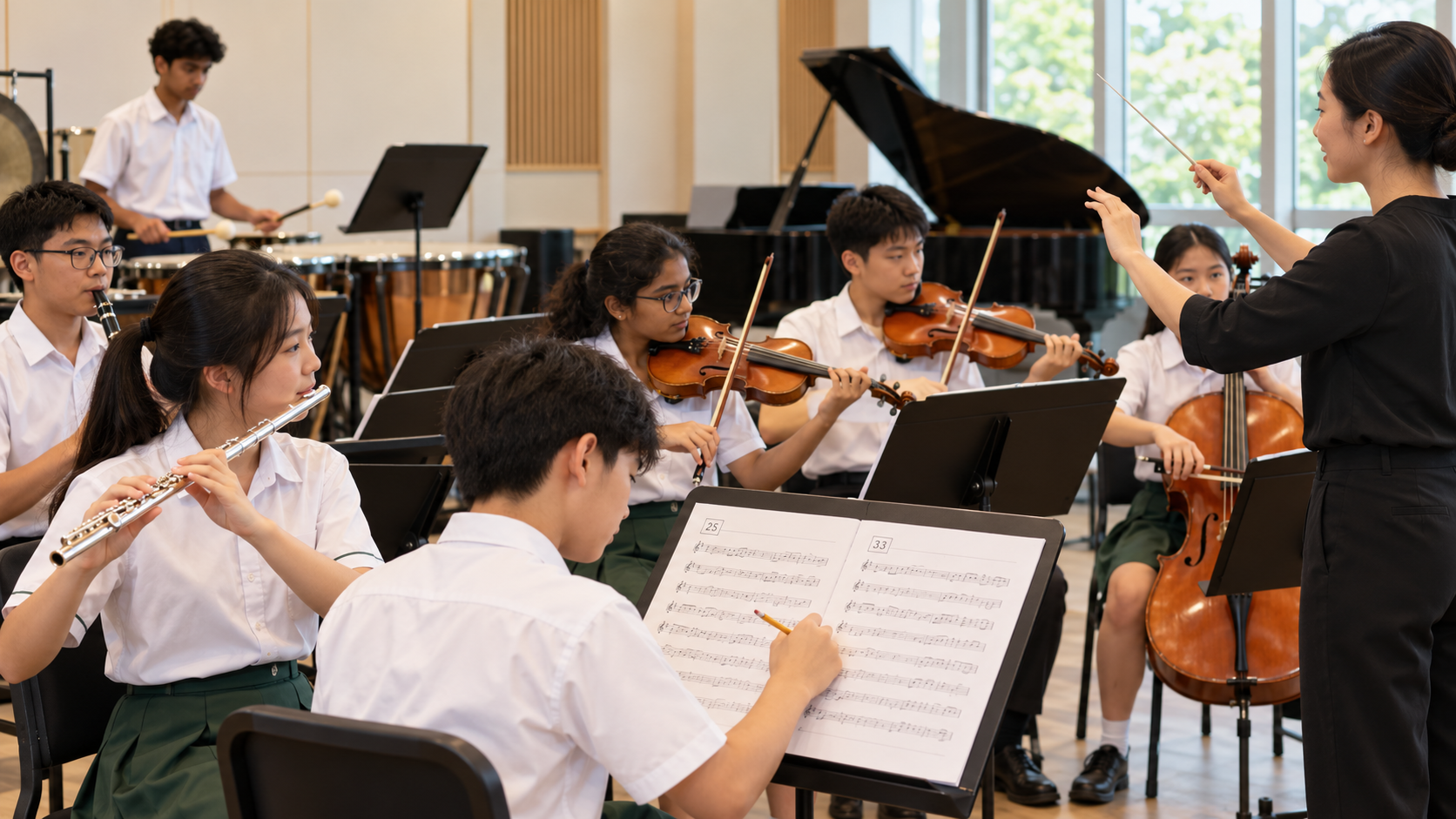
If your child enjoys composing melodies, recording voices, creating beats, arranging music on a tablet or making soundtracks, begin with the actual PSLE Score and the eligible PG1, PG2 or PG3 Posting Group. Then compare the music education offered to entering Secondary 1 pupils rather than assuming every school with a band or choir provides music production. Commonwealth Secondary’s current programme uses BandLab soundscape projects in Secondary 1 and Mixcraft soundtrack work in Secondary 2; Yishun Secondary develops instrumental foundations before an industry-linked Secondary 2 music arrangement and recording programme; Naval Base Secondary’s Music Recording and Production Programme is specifically for students beginning in Secondary 3.
Check the current school Music and Aesthetics pages, studio access, songwriting, digital audio workstations (DAWs), beginner coaching, after-school activities and the pupil’s academic and travel needs. Tampines Secondary, West Spring Secondary and St. Patrick’s School describe different first-year and later-year digital music experiences. A school with electronic music projects does not necessarily offer the formal Music Elective Programme (MEP), or guarantee a selected talent place or professional recording career. For normal S1 Posting, rank six genuinely suitable eligible schools in preference order with realistic historical COP alternatives.
- Read the S1 Option Form, overall PSLE Score and selected Posting Group first.
- Distinguish normal lower-secondary Music, selected enrichment, music-production CCA and formal MEP.
- Commonwealth’s current Secondary 1 Music programme uses BandLab; its soundtrack work develops later.
- Yishun’s industry-linked arrangement programme is published at Secondary 2; Naval Base’s MRPP begins at Secondary 3.
- Ask what pupils learn about listening, rhythm, arrangement, recording, editing and mixing.
- Check school-provided devices, licences, equipment, copyright and realistic costs.
- Compare school culture, other academic subjects, after-school rehearsals and commute.
- Rank six genuinely suitable schools with realistic previous-year COP alternatives.
Definition lock: production is not the same as performing in a band
Music production can involve recording, arranging, editing, mixing and preparing a piece of music for listening or performance. A pupil may create original digital sounds, record a live instrument or build a soundtrack. Joining a band or choir develops performance and ensemble skills, but it does not automatically mean the pupil learns to use recording software or produce a finished audio project.
Parents should ask which part of the process the child wants to explore. Someone who loves making beats may prefer digital sequencing, while a vocalist may enjoy microphone work and another pupil may want songwriting. School programmes vary in teaching and access; the most attractive name does not determine actual learning.
Parent action: Identify whether the child prefers performance, composition, recording or production.
PG1, PG2 and PG3 are not musical rankings
Posting Groups facilitate Secondary 1 admission under Full Subject-Based Banding. They do not measure rhythm, creativity, listening or the ability to compose a melody. Individual G1, G2 and G3 subject levels describe academic demand, which may vary across the pupil’s timetable. A PG1 learner can be musically expressive, while a high-scoring pupil may be new to formal music education.
Begin with the S1 Option Form and eligible schools before evaluating digital studios or ensembles. A home recording or audition video does not bypass ordinary school-entry rules. DSA-Sec, where available for a specific musical talent area, has separate selection and commitments. A suitable school must also teach the child’s other subjects appropriately.
Parent action: Keep academic admission and music interests as distinct decisions.
Commonwealth teaches digital soundscapes in Secondary 1
Commonwealth Secondary’s September 2026 Craft and Technology page describes lower-secondary music through Listening, Creating and Performing. In Secondary 1, students learn ukulele and use BandLab to make immersive soundscapes. In Secondary 2, the school introduces keyboard and original soundtrack composition for film using Mixcraft.
This is a useful example of digital creation in the regular curriculum, not only in a selected CCA. Parents should confirm the incoming cohort’s actual lessons, devices and timetable. A soundscape activity may teach how sounds create an atmosphere even before a pupil is ready to write a complex song.
Parent action: Ask Commonwealth what the first-year BandLab task teaches and how students receive feedback.
Yishun develops performance before its recording extension
Yishun Secondary’s August 2026 Aesthetics page describes lower-secondary instrumental foundations through guitar, keyboard and cajon. It also describes music technology, digital arrangement and professional recording experience. Its special Secondary 2 music-arrangement programme was developed with music professionals under the National Arts Council Artist-in-School Scheme.
Parents should not promise an entering Secondary 1 child immediate access to every industry masterclass. Ask which activities belong to ordinary Music and which are later enrichment or selected projects. A gradual foundation in rhythm and instruments can help pupils make more thoughtful digital arrangements.
Parent action: Confirm Yishun’s current first-year Music learning and later recording project access.
Naval Base MRPP begins in Secondary 3
Naval Base Secondary’s August 2026 Music Recording and Production Programme is an additional one-year experience open to Secondary 3 pupils, beginning in Term 3 and ending in Secondary 4. It teaches digital audio workstation operation, MIDI sequencing, drum tracks, harmony, songwriting, audio recording and mixing through two modules.
This is attractive for an older student who wants electronic music, but it is not an automatic first-year entitlement. Families should ask what regular Secondary 1 Music builds before the later option. A child can develop foundational listening and instrumental skills without immediately entering an advanced production programme.
Parent action: Label Naval Base MRPP as a later-year opportunity and check current entry rules.
Tampines introduces fundamentals before digital production
Tampines Secondary’s current Craft and Technology description introduces fundamental Music skills in Secondary 1, including keyboard, ukulele, percussion and a composition project. Secondary 2 expands into sound production basics, digital audio workstations, arranging and an iPad Band Project.
This shows why the year level matters. An incoming pupil might benefit from understanding rhythm and ensemble work before using digital production software in a more involved way. Ask which projects are part of regular learning and which equipment is supplied. A programme need not start with advanced software to be musically valuable.
Parent action: Compare first-year fundamentals with later digital recording experiences.
West Spring uses digital instruments and rhythms in Secondary 2
West Spring Secondary’s current Music Unit page describes Secondary 1 keyboard and music-theory foundations. Its Secondary 2 programme includes ethnic percussion and iPad Cajon/digital music integration, developing basic audio production and performance skills. The sequence links instrumental and cultural learning with technology.
Parents should ask whether the child enjoys rhythm and practical ensemble tasks as well as creating tracks on a screen. A hands-on programme may make digital production more meaningful when the pupil understands the musical material they are arranging. Avoid treating a one-off workshop as a guaranteed permanent recording studio.
Parent action: Ask how the school’s Music curriculum builds from basic playing toward audio creation.
St. Patrick’s LLP includes music technology in the curriculum
St. Patrick’s School describes a Learning for Life Programme in Music and Music Technology. Its lower-secondary curriculum includes ukulele, keyboard and the creation of musical arrangements or action and emotional music cues using technology tools. The programme aims to provide broad opportunities within formal Music education.
Ask what incoming students receive and whether they need personal devices or a previous instrument background. A music cue exercise can teach how rhythm, tempo and tone affect a scene even if the pupil never produces a complete commercial track. This provides another way for a technology-minded child to develop musical understanding.
Parent action: Ask what first-year creating-and-performing activity every pupil can experience.
Serangoon Garden offers digital creation as part of Music
Serangoon Garden Secondary’s September 2026 Music page describes a two-year General Music Programme involving performance, creation and appreciation. It includes songwriting and digital music tools. The school also describes an older upper-secondary Normal (Technical) Music pathway using digital audio workstations, reflecting legacy examination terminology on the webpage.
Parents must not copy the older NT course description as a guaranteed SEC subject for a child entering Secondary 1 in 2027. Ask the school how current Full SBB arrangements and later subject options apply. The broad lower-secondary music experience can still be valuable without a future examined Music course.
Parent action: Verify the current entry-year music activities and later formal-subject eligibility separately.
Admiralty includes digital composition after initial learning
Admiralty Secondary’s Music page describes Secondary 1 activities involving musical elements, basic composition and keyboard, followed by Secondary 2 digital audio software and arranging using tools such as Soundtrap. This illustrates how a school can introduce musical thinking before pupils develop digital-production skills.
Ask which lessons are taught to everyone and which extension activities are optional. Some pupils may love creating loops, while others prefer playing live instruments. A balanced programme can help children explore both. The key is understanding musical decisions rather than collecting names of software applications.
Parent action: Ask what the pupil can create at the end of the ordinary two-year music sequence.
A DAW is a tool, not a musical qualification
A digital audio workstation can record and organise sound, sequence notes and allow editing or mixing. Different schools use platforms such as BandLab, Mixcraft or other suitable tools. Knowing how to open a project is not the same as understanding rhythm, harmony or what makes a composition communicate well.
Ask how teachers develop musical ideas alongside software fluency. A student might create a short original soundscape using just a few carefully chosen sounds and learn more than one who stacks many effects without a plan. The purpose should be meaningful music making.
Parent action: Ask which musical choice the software helped the pupil make.
MIDI and recorded audio are not identical
MIDI typically represents performance instructions such as which notes are triggered and when, whereas audio recordings contain captured sound signals. A pupil creating music digitally may work with both, but they require different editing choices. The distinction can be introduced in an age-appropriate way without technical jargon dominating the lesson.
Ask whether the school’s production programme helps students explain why a keyboard sequence behaves differently from a recorded vocal phrase. Learning the basics supports more thoughtful arrangements later. Parents should not assume the child needs professional equipment to grasp the concept.
Parent action: Ask the pupil what in a project is recorded sound and what is a sequence of notes.
Rhythm and timing need understanding before complexity
A beat can organise the movement and timing of a musical piece. Digital software makes it easy to place sounds into a grid, but pupils still need to hear whether the rhythm supports the intended music. A complicated drum track is not automatically more expressive than a simple consistent one.
Ask how teachers use listening, practical playing and revision. A student can learn to compare a programmed rhythm with a live performance and explain the differences. These are valuable skills even when the child does not intend to become a producer.
Parent action: Ask what changed when the rhythm or timing was adjusted.
Harmony and arrangement involve thoughtful choices
Arranging means deciding how musical parts fit together, such as melody, harmony, bass and rhythm. A pupil who has learned a few keyboard chords may begin experimenting with how the same tune sounds under different accompaniment. The digital tool offers flexibility, but understanding the musical effect remains important.
Ask whether the school teaches foundational harmony in relation to simple practical tasks. A beginner should not be judged by how many complex effects are used. A clear, balanced arrangement that communicates an idea can be an excellent first project.
Parent action: Ask which instrument or layer carries the main musical idea and why.
Recording a voice or instrument requires consent and care
Student recording projects may include classmates singing or performing. The child should follow school instructions about consent, use of the recordings and whether work may be shared publicly. An audio file can reveal a person’s voice and private context even when no photograph is attached.
Ask how the school teaches respectful microphone use, recording practices and appropriate storage. A school performance recording is not automatically free for unrestricted publication. Parents can model good practice by seeking permission before posting other pupils’ voices from school events.
Parent action: Ask what permission is needed before recording and sharing another person’s performance.
Mixing is about clarity, not simply volume
Mixing can involve balancing parts, adjusting tone and making the main musical ideas audible. A beginner may turn every track louder and discover that the result becomes less clear. The learning goal is listening critically and understanding how sound choices affect an audience.
Ask whether teachers encourage students to compare versions and explain why a change improves the music. A school should not focus only on producing a polished online file. A pupil who can recognise a problem and revise the mix is developing both musical and analytical skill.
Parent action: Ask which musical element became clearer after a mixing decision.
Songwriting combines language and musical structure
Writing a song may involve choosing a theme, creating lyrics, shaping a melody and arranging supporting sounds. Pupils can connect English or Mother Tongue literacy with rhythm and expressive choices. A child who enjoys writing stories may find this especially engaging.
Ask what the school teaches about original ideas, feedback and appropriate language. Pupils should not be pressured into performing personally sensitive lyrics in public. A short age-appropriate song can provide meaningful creative learning without the expectation of releasing music commercially.
Parent action: Ask what feeling or message a song is intended to communicate.
A film soundtrack is a different design problem
A soundtrack supports a visual scene, story or emotional moment. Pupils may learn to create music that changes the viewer’s understanding of an image. Commonwealth’s Secondary 2 film-soundtrack work illustrates this interdisciplinary possibility.
Ask whether students analyse the scene’s purpose before selecting sounds. A dramatic effect that overwhelms dialogue may not serve the story. The student can learn to collaborate with visual storytellers and adjust the music based on feedback. This connects Music, English and media literacy.
Parent action: Ask how the same scene feels with two different musical choices.
Music technology belongs with listening and cultural appreciation
Singapore schools’ lower-secondary music curriculum develops listening, creating and performing. A child who is fascinated by production software can benefit from listening to music from different cultures and recognising how rhythm, instruments and form convey meaning. A digital audio project is stronger when grounded in those musical ideas.
Ask how teachers connect technology with musical understanding. A pupil might make an electronic track, then learn why another tradition structures its sound differently. A balanced programme encourages respect and discovery without requiring every child to pursue a commercial popular-music style.
Parent action: Ask what musical idea the pupil learned beyond a software command.
A computer does not replace learning to hear
Some pupils focus on waveforms, visual editing or arranging blocks on a screen. These tools can help, but musical judgement also involves hearing pitch, rhythm, balance and expressive choices. A student who notices that a phrase sounds unclear is learning something the display cannot decide for them.
Ask whether lessons include attentive listening, practical playing and comparing versions. A well-designed first-year activity can use a simple rhythm and keyboard melody rather than advanced software. Parents should value the pupil’s ability to explain what they heard and how they improved it.
Parent action: Ask the child to describe one sound change using listening rather than only a screenshot.
Sound waves can connect Music and Science
Music technology may invite questions about vibration, pitch, volume and how sound changes when processed. MOE-linked open educational resources include a virtual synthesiser intended for Secondary 1–4 Music and Technology exploration. Such tools can introduce waveforms and timbre in a controlled, educational context.
Ask how schools handle basic sound concepts without confusing a visual waveform with a complete account of music. Scientific curiosity can complement artistic expression, but the pupil still needs regular Science lessons to develop accurate physical understanding. A short experiment with sound may be more meaningful than a complex track no one can explain.
Parent action: Ask what physical property changes when a musical sound becomes higher or lower.
Copyright applies to covers, samples and backing tracks
Students may want to import a commercially released song, sample a famous recording or publish a remix. Music being easy to find online does not automatically make it available for public use. A school project needs to follow copyright, licensing and competition rules when it incorporates material created by others.
Ask how teachers teach original recording, appropriate attribution and authorised use. A pupil can study a song for listening and analysis without assuming permission to distribute a new recording. Parents should not upload classroom covers or samples publicly without checking applicable rules and permissions.
Parent action: Ask who created the music and whether the planned recording or publication is authorised.
AI-generated music should not be misrepresented
New tools can generate melodies, vocals or arrangements from a short instruction. These may be interesting for learning, but a pupil who simply exports generated audio should not claim to have composed every note or performed a voice they did not record. The school may have particular originality expectations for assessed work.
Ask how teachers handle disclosure, verification and the rights of other creators. A student can learn from comparing generated suggestions with their own arrangement, but should still understand the result. Accurate descriptions of assistance are part of genuine music education.
Parent action: Ask which musical decisions the student personally made and which were supplied by a tool.
Professional recording workshops are not guaranteed to every pupil
Yishun’s artist-linked programme and Naval Base’s MRPP show that schools can offer specialised music-production experiences. However, the programme year, selection, partner availability and timetable may differ. A photograph of a studio visit does not prove that every new Secondary 1 student will record with an industry producer.
Ask which activities are regular curriculum and which are selected or later-year enrichment. A pupil may benefit greatly from first-year instrumental foundations before accessing a studio. Strong instruction matters even when a prominent artist or external partner is unavailable.
Parent action: Verify the year level and participation rules behind each advertised music workshop.
The formal Music Elective Programme is a separate route
The Music Elective Programme has its own formal academic structure, eligibility and selected school arrangements. It is different from lower-secondary General Music, an audio-production workshop or membership in a band. A school may teach digital recording without offering MEP to every interested student.
Ask which school programmes are actually available to the child’s academic route and what curriculum commitments they involve. A student who enjoys making electronic beats may prefer broad Music lessons and a suitable CCA rather than a demanding examined elective. The decision should follow the child’s interests and readiness.
Parent action: Separate ordinary Music, school production opportunities and formal MEP eligibility.
DSA music talent and ordinary posting are not interchangeable
Some secondary schools offer DSA-Sec in selected performing or creative talent areas. Those applications occur before PSLE results and can involve auditions or other requirements. A pupil successfully allocated through DSA generally follows that commitment instead of entering a new six-school list to change schools after results.
Parents should not infer that a school with digital audio tools automatically offers DSA in music production. An unsuccessful audition does not prevent a young person from learning composition in another suitable school. Verify the actual admissions route before ranking ordinary school choices.
Parent action: Check final DSA status and the school’s specific talent areas rather than assuming a music-technology exception.
A music CCA may not teach recording software
A choir, guitar ensemble or concert band can provide excellent opportunities for musicianship and teamwork, but membership does not guarantee production training. An AVA Club may teach sound-system operation and event support, which differs from composing original audio with a digital workstation.
Ask what the child wants to learn: performing, recording, arranging, audio engineering or writing songs. A school might offer some skills during normal Music lessons and others through selected events or clubs. Accurate categorisation prevents the family from choosing based on a misleading programme label.
Parent action: Ask whether the actual activity is music creation, ensemble performance or live sound support.
Sound engineering for school events is a different experience
Some pupils may enjoy operating microphones, mixers and speakers for assemblies or concerts. Zhenghua Secondary’s AVA Club describes sound systems, stage lighting and media editing, including a learning journey about music production. Such work develops technical responsibility but is not identical to a class on songwriting.
Ask whether new pupils receive safe training and how they assist more experienced members. A child can learn about signal levels and teamwork through event support without writing a musical composition. Parents should distinguish the technical interest from artistic expression while recognising that both may be valuable.
Parent action: Check what the student would actually operate, create and explain.
Original songwriting does not require professional equipment
A pupil who writes a short melody and a few lines of lyrics may already be practising composition. Good school teaching can help them organise those ideas into a coherent piece using simple instruments or software. A large studio setup is not required to understand rhythm, harmony and expressive choices.
Ask whether the school gives beginners opportunities to create small complete works and receive respectful feedback. Parents should not insist that every original idea sounds commercially polished. A child’s ability to explain an artistic decision is a stronger educational sign than a list of expensive devices.
Parent action: Ask the pupil to complete one short original musical idea before expanding it.
School music costs should be confirmed, not imagined
Some programmes use school-provided keyboards, tablets or software, while others have particular equipment or instrument requirements. Parents should not assume that a professional DAW named in a school article means every pupil must purchase the same product or a private microphone.
Ask about compulsory materials, school facilities and any relevant financial support. Digital music can sometimes be explored using suitable school-approved tools and shared resources. The family’s budget also needs to cover books, meals, transport and other Secondary 1 necessities.
Parent action: Get the school’s actual equipment and licensing list before spending.
A long commute can reduce time for recording projects
Music activities may include after-school rehearsals, selected studio workshops or performances that finish later than ordinary classes. A school that looks close enough on a map may still create a tiring journey home after an event. Current programme schedules may change for the 2027 cohort.
Ask about typical session times, venues and travel arrangements. The child needs space for homework, friendships and rest alongside music. A nearer school with clear foundational teaching may suit the family better than a distant programme selected solely for a past recording event.
Parent action: Compare ordinary and late-activity travel before ranking schools.
Previous cut-off points and programme entry are distinct
A historical school COP records the last pupil admitted through a Posting Group in an earlier exercise. It can shift with demand and vacancies. A child’s song recording does not create general priority through normal S1 Posting, and admission to a school does not guarantee a place in every selected production workshop.
MOE advises using six school preferences with two or three genuinely suitable options whose previous COPs are less stringent than the child’s score. These alternatives should still provide strong teaching and meaningful Music experiences. The family should be clear about both academic entry and programme access.
Parent action: Record school admission risk and music-production selection separately.
The first term should build musical foundations
After posting, the pupil may begin with rhythm, listening, keyboard or group performance before making a digital soundtrack. That is a sensible progression rather than a delay. Parents should follow the actual receiving-school curriculum and avoid demanding an advanced studio project immediately after orientation.
Encourage the child to listen carefully, try small original ideas and keep a manageable school routine. A selected production programme may become relevant later, while ordinary Music already provides valuable learning. A positive beginning includes academic adjustment and social belonging.
Parent action: Choose one listening skill and one small creating goal for the first term.
The best music-production school helps pupils listen and create thoughtfully
Music technology can help children express ideas, collaborate and understand how sounds are arranged, recorded and shared. Some pupils may later study music professionally; others will retain a lifelong creative hobby. A school cannot guarantee success in the music industry from one classroom workshop.
Choose eligible schools based on current first-year teaching, genuine access to later opportunities, academic support, travel and the child’s motivation. The right environment builds musicianship and digital competence without making expensive equipment or public awards the measure of personal worth.
Parent action: Select a school where the child can listen, create and learn responsibly.
Frequently asked questions about music production and school choice
Is music production the same as joining a band?
No. A band primarily develops ensemble performance; production involves recording, arranging and editing sound.
Does Commonwealth use BandLab in Secondary 1?
Its 2026 Music curriculum describes BandLab soundscapes in Secondary 1 and Mixcraft soundtrack work in Secondary 2.
When does Naval Base MRPP begin?
The published programme is open to Secondary 3 students and extends into Secondary 4.
Does Yishun offer recording work in Secondary 1?
Its first-year focus includes instrumental foundations, while its special industry-linked arrangement experience is listed at Secondary 2.
Does every school with a music CCA teach DAWs?
No. Ask about ordinary Music, selected production and actual club scope separately.
Can PG1 students learn digital music?
Yes. Posting Group is not a measure of creative musical potential.
Do parents need to buy music software?
Not automatically. Check school-supplied equipment and licences.
Can students upload copyrighted song covers freely?
Not automatically. Permission, licensing and school rules must be considered.
Is music production the same as MEP?
No. MEP is a separate formal programme.
Does a studio workshop guarantee a music career?
No. It is educational exposure and may be selected.
Are previous COPs guaranteed?
No. Historical school score ranges can change.
How should schools be ranked?
By genuine preference among eligible schools with realistic alternatives.
Official music programmes and parent guides
Commonwealth Secondary Music and Soundscapes
Yishun Secondary Aesthetics and Music Technology
Naval Base Music Recording and Production Programme
Tampines Secondary Music by year
St Patrick’s Music Technology LLP
Serangoon Garden Secondary General Music
Zhenghua Secondary AVA sound and lighting
MOE-linked open music synthesiser educational resource
eduKateSG Arts and Music school guide
eduKateSG complete PSLE parent guide hub
Reviewed 5 November 2026. Music programmes, partner workshops, age eligibility and later examined subjects can change. Some current school pages retain historical N-Level terminology; verify actual Full SBB and SEC options for the child’s cohort. Previous school cut-off points cannot guarantee admission.