
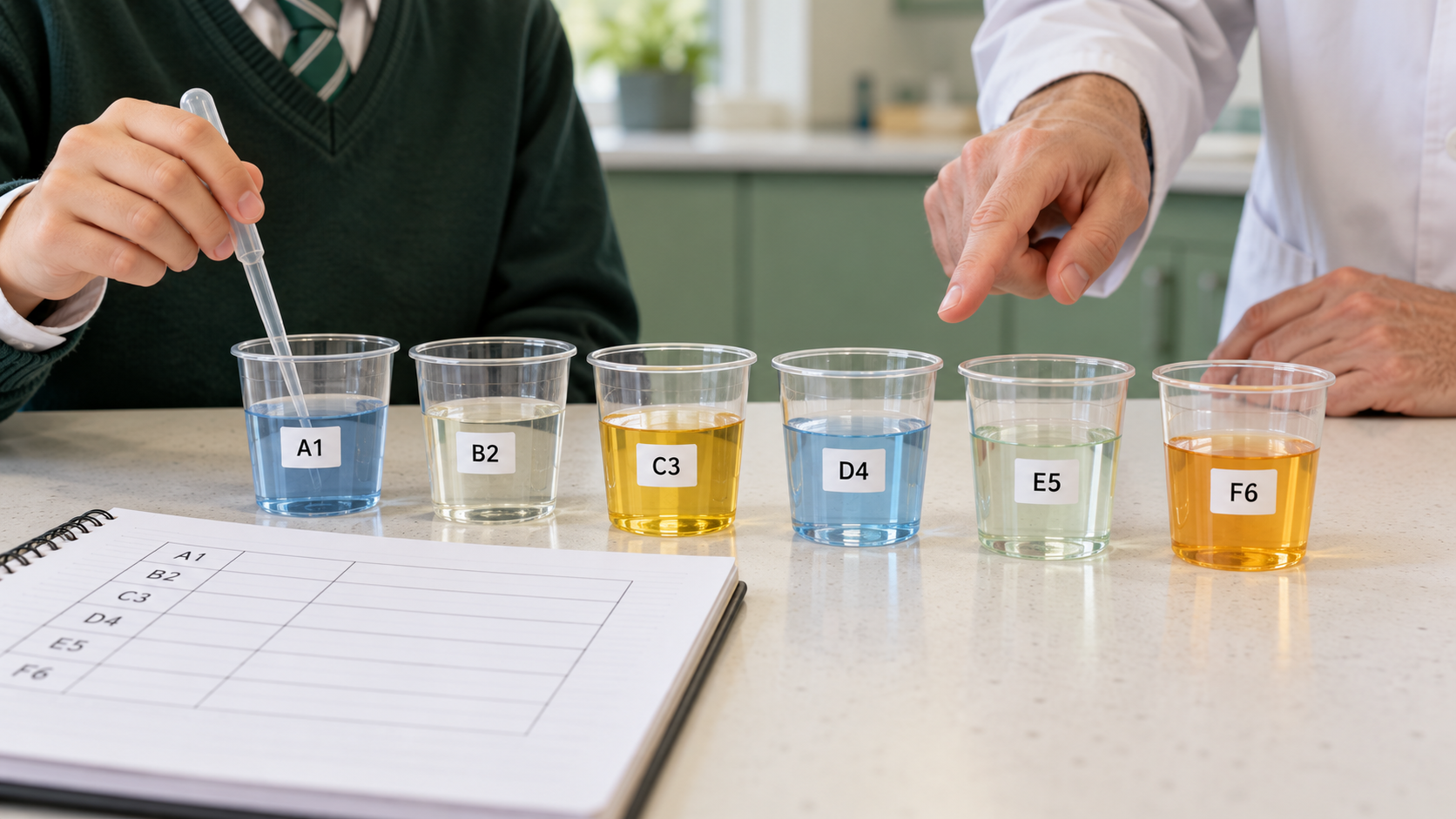
If your child loves experiments, asking why things happen, investigating unusual questions or entering science fairs, first use the PSLE results to check which schools accept the child’s eligible PG1, PG2 or PG3 Posting Group. Then compare actual Science Research Programmes, ordinary Science lessons, lab inquiry and selected research or Olympiad opportunities. Anderson Secondary describes scientific inquiry beginning in Secondary 1 and a research-project progression; Bukit Batok Secondary lists a Secondary 2 research programme and selected research talent activities; Nan Chiau High’s Science Talent Programme uses Secondary 2 results and evidence of interest for selection. These are different experiences, not automatic first-year research positions.
Use current MOE SchoolFinder information to compare each school’s academic support, laboratory teaching, project work, safety rules, mentors and travel. CHIJ St. Nicholas Girls’ School describes a selected upper-secondary Science Talent Development Programme, while ACS (Independent) publishes a Science Research Challenge CCA with separate DSA requirements. A school partnership with A*STAR, Science Centre Singapore or a university is not a guaranteed personal attachment. Rank six genuinely suitable eligible schools in true preference order, with realistic previous-year cut-off-point alternatives and the child’s full education in mind.
- Read the S1 Option Form, overall PSLE Score and individual Science AL separately.
- Distinguish ordinary Science, class research projects, selected science talent programmes and Science Olympiads.
- Check Anderson’s scientific inquiry, Bukit Batok’s Secondary 2 research and Nan Chiau’s later talent criteria.
- Ask what incoming Secondary 1 pupils actually plan, observe, test and explain.
- Treat mentorship, external workshops and research attachments as selected or conditional unless confirmed.
- Check lab safety, student privacy, authentic project work and qualified supervision.
- Compare Mathematics, English, scientific vocabulary, school culture, workload and commute.
- Rank six eligible schools honestly, using historical COPs as uncertainty rather than promises.
Definition lock: scientific research is not simply doing a demonstration
A classroom demonstration can show an interesting reaction or physical effect, but research begins with a question that can be investigated responsibly. Students may need to identify variables, plan a fair comparison, record evidence and explain what the results support. A pupil who follows instructions to make a model is not necessarily conducting an independent study, although it may be a useful first step.
Ask how teachers move from guided tasks toward inquiry. A modest experiment that a child can explain is more educationally valuable than sophisticated laboratory equipment that pupils only watch. Good research education also teaches that unexpected results can be informative and that a claim should not extend beyond the evidence collected.
Parent action: Ask for an actual first-year research question and how students investigate it.
Posting Group eligibility and scientific curiosity are different
PG1, PG2 and PG3 facilitate Secondary 1 admission under Full Subject-Based Banding. They do not measure the child’s willingness to investigate, notice patterns or cooperate in a project. Subject demand levels G1, G2 and G3 are distinct from the entry Posting Group, and an individual Science AL may reveal a strength not fully represented by the overall PSLE Score.
Begin with the official S1 Option Form and eligible schools. A child who won a primary-school science prize cannot assume the award overrides ordinary admission rules. If the pupil has an option-band route, choose an appropriate academic starting level before ranking schools. Strong curiosity deserves support at different subject levels, while all pupils need safe and understandable teaching.
Parent action: Record overall score, Science AL, Posting Group and research interests in separate columns.
Anderson Secondary has a research progression
Anderson Secondary’s Science Research Programme page, last updated in June 2026, describes scientific inquiry in Secondary 1 lessons, projects across levels and a historically established Secondary 2 schoolwide Science Research Project. It also describes Science Specialists, mentoring and external opportunities for selected students.
Some parts of the page retain legacy terms about academic streams and past programme history, so parents should ask how the current Full SBB cohort participates. A school can have meaningful research foundations for many pupils and advanced projects for smaller groups. The correct question is what a newly admitted student will learn before any selected research attachment.
Parent action: Ask Anderson how its current Secondary 1 inquiry leads to later research and selection.
Bukit Batok Secondary describes inquiry and specific year levels
Bukit Batok Secondary’s August 2026 Science department page describes problem-based learning, the 5E instructional model, modelling and differentiated teaching. Its programmes include a Secondary 2 science research experience, Scientists-in-School with A*STAR, Science Centre research talent development and a Secondary 1 smart-city and sustainability learning journey.
These entries refer to different cohorts and participation arrangements. Ask which are ordinary lessons and which are selected workshops or competition opportunities. A child interested in experiments should understand how observation and evidence are taught before considering a specialised challenge. A school with varied science activity can be a good fit when core teaching supports the pupil.
Parent action: Check Bukit Batok’s first-year Science curriculum separately from research-talent extension.
Nan Chiau High’s Science Talent Programme is selected later
Nan Chiau High’s July 2026 programme page describes Science research, A*STAR research exposure and Olympiad training. Its published entry criteria include strong performance in English, Mathematics and Science in the Secondary 2 end-of-year examinations and demonstrated interest in research or enrichment.
This is not a universal Secondary 1 programme available to every incoming pupil. The selection follows later performance and participation, so the child has time to develop skills. Parents should ask what normal first-year Science teaching is like and how pupils can explore research before the selection stage. A school can challenge a curious student without guaranteeing an early place in its most advanced programme.
Parent action: Note Nan Chiau’s actual selection stage and foundational year-one opportunities.
CHIJ St. Nicholas targets upper-secondary research development
CHIJ St. Nicholas Girls’ School’s Science Talent Development Programme is explicitly for upper-secondary students who demonstrate strong interest and academic readiness. It describes small-group mentoring with researchers, A*STAR exposure and selected Biology, Chemistry and Physics Olympiad preparation. Some activities take place after lessons or at external institutions.
Parents should not present these experiences as automatically available in Secondary 1 or assume every pupil obtains a university mentor. Ask how first- and second-year teaching prepares students for consideration. A school choice should remain valuable through ordinary curriculum, culture and support even if the pupil never joins a selected research team.
Parent action: Separate first-year Science learning from upper-secondary mentorship eligibility.
ACS (Independent) research CCA and DSA are different routes
ACS (Independent)’s Science Research Challenge page, updated in August 2026, describes a CCA for students who enjoy scientific research and competitions. Its separate DSA eligibility has specific high-achievement requirements, which cannot be inferred merely from enjoying Science at home.
Parents should check the school’s actual admission route, the child’s eligibility and whether general CCA membership has separate capacity rules. A successful DSA allocation generally carries a commitment; an unsuccessful application does not prevent the student from learning research in other schools. A CCA with competition awards is not a national guarantee of future research placement.
Parent action: Verify school admission, CCA membership and DSA research criteria separately.
A good research question can start from everyday observation
A child might ask why a material cools differently, what affects the growth of a plant or how a simple object responds to changes. Teachers can help turn a broad curiosity into a question suitable for an age-appropriate supervised investigation. The learner should recognise what can actually be measured and what lies beyond the task.
Ask whether pupils are encouraged to explain why their question matters before choosing an experiment. A fascinating question is not always safely testable at school, and that is part of learning scientific judgement. Students can use existing reliable information when direct experimentation is inappropriate.
Parent action: Ask the child to turn one curiosity into a clear, measurable and safe question.
A hypothesis is a testable prediction, not a promise of success
Students sometimes believe they have failed when an experiment produces a result different from the predicted one. In inquiry, the hypothesis guides a test and may be supported or not supported by evidence. A careful unexpected result can improve understanding when it is honestly recorded.
Ask schools how teachers discuss predictions, observation and revision. A student who changes results to match expectations has lost the most important part of scientific learning. Parents should praise accurate records and thoughtful explanations rather than insisting that every project must succeed.
Parent action: Ask what was predicted and what the actual evidence showed.
Variables and fair comparisons are foundational skills
An investigation can become misleading when many conditions change at once. Pupils should learn to identify the factor being examined, the outcome measured and other conditions that need suitable control. The complexity should match the age and subject level, but the central reasoning can be introduced early.
Ask whether the school teaches students to explain why a comparison is fair. A pupil who sees two plants grow differently should not immediately assume one cause without considering light, water and other influences. The habit of questioning test conditions supports later Science and Mathematics.
Parent action: Ask what changed, what was measured and what was kept comparable.
Repeated measurements are not decorative numbers
A single observation may be affected by error, timing or unusual conditions. Repeated suitable measurements can help students understand reliability and variation. They also need to learn to record units and avoid rounding numbers simply to create a dramatic difference.
Ask how teachers handle inconsistent data and whether the pupil is encouraged to investigate rather than erase it. The goal is a reasoned conclusion supported by the actual observations. A school Science fair report should not look more precise than the equipment or methods permit.
Parent action: Ask how many observations were made and why they are trustworthy.
Research safety rules should be explicit
School investigations can involve heat, electrical equipment, chemicals or biological materials. A child must follow the teacher’s authorised procedures and safety instructions. The existence of a prestigious research programme does not permit independent experiments involving unknown substances, organisms or risky equipment at home.
Ask how the school teaches hazard awareness, protective equipment and safe disposal at the appropriate age. Projects that cannot be performed safely can often be replaced by supervised demonstrations, simulations or analysis of published data. Careful limits are part of scientific competence.
Parent action: Confirm the authorised experiment and adult supervision before practical work.
A research poster must explain the reasoning
Science fairs often involve posters describing a question, method, observations and conclusions. A visually appealing poster is helpful, but its scientific value depends on whether the information is accurate and understandable. Pupils should not substitute a graphic design template for evidence.
Ask what teachers look for when students present and respond to questions. A student who can acknowledge limitations demonstrates deeper understanding than one who memorises an exaggerated sales pitch. Good school research includes communication without turning every finding into a claim of discovery.
Parent action: Ask the pupil to explain the research in plain language without looking at the poster.
Scientific writing depends on English as well as Science
A child may understand a practical activity but struggle to describe it using precise terms and sentences. Research reports require pupils to separate method, results and interpretation, which places real demands on reading and writing. Strong English teaching is therefore relevant to school Science research opportunities.
Ask whether the school provides examples and feedback for explaining investigations. A learner with excellent Science curiosity but weaker language can benefit from scaffolded writing rather than exclusion from every project. The goal is communicating evidence accurately across the curriculum.
Parent action: Compare scientific curiosity and language-learning support as complementary needs.
Mathematics makes data analysis more reliable
Science research may require measurements, ratios, graphs, averages and reasonable numerical comparisons. A pupil can be passionate about experiments while needing support with these ideas. Formal Mathematics lessons help students understand quantities rather than merely enter numbers into software.
Ask whether scientific projects explicitly connect observations to mathematics at the child’s appropriate G-level. A useful graph should answer a clear question and not conceal the sample size or measurement limitations. Parents should encourage accurate understanding rather than assume a computer-generated chart proves the conclusion.
Parent action: Ask what a project’s numbers mean and whether the comparison is justified.
Research mentorship is a distinct selected opportunity
A school may partner with A*STAR, Science Centre Singapore, universities or outside scientists. These relationships can offer enrichment, but the scope differs: a lecture, a short workshop and an extended supervised research project are not interchangeable. Selected programmes may have academic and conduct requirements.
Ask who can participate, whether there are fees or transport commitments and what the pupil is expected to produce. A prestigious mentor’s name is not proof that every new student receives one-to-one guidance. Strong foundational teaching can be valuable even without external attachment.
Parent action: Identify whether the opportunity is a schoolwide event, selected workshop or actual sustained mentorship.
Science Olympiads and science research teach different skills
An Olympiad often challenges a student to solve demanding questions under a competition format, while research usually involves defining a question and generating or interpreting evidence over time. A pupil might enjoy one and not the other. A school that offers both should be able to explain the distinct expectations.
Ask whether training is available to beginners and how selection works. The child’s interest should guide which kind of challenge they pursue rather than adult assumptions about prestige. A Science Olympiad medal does not automatically make a student skilled in laboratory design or research reporting.
Parent action: Ask whether the child prefers experimental inquiry, challenging problems or both.
A research competition is not an automatic place for a newcomer
Schools may report awards from the Singapore Youth Science Fair, Singapore Science and Engineering Fair or international challenges. These can show meaningful work by selected teams, but they do not entitle every new Secondary 1 pupil to a place. The age, criteria and project expectations may vary between competitions and editions.
Ask what introductory opportunities are open to ordinary pupils before focusing on competition selection. A child may need time to develop a reliable question and learn fair testing. A school should remain worthwhile even if one research team is full or the child does not enter a fair.
Parent action: Separate general Science learning, selected project teams and competition awards.
An impressive lab does not guarantee research participation
Photographs of microscopes, specialist instruments or advanced laboratories can attract curious families. But the equipment may be reserved for older students, supervised sessions or selected groups. Its value depends on whether the pupil understands its purpose and has suitable access.
Ask what entering Secondary 1 students actually handle and how teaching staff train them. A simple investigation with good instruction can be more educational than observing an expensive instrument without explanation. Equipment is a means to answer a question, not the entire learning objective.
Parent action: Ask for one real first-year practical lesson and its assessment.
Research on people requires special care
Some pupils become interested in surveys, exercise patterns, learning habits or human behaviour. Collecting information about classmates is not automatically acceptable simply because a school project is called research. Consent, privacy, suitability and teacher oversight matter, especially when sensitive or identifiable data may be involved.
Ask whether projects use anonymous, simulated or properly authorised information and how students learn to avoid misleading conclusions. Children should not be asked to publish classmates’ personal circumstances or medical details. Ethical judgement belongs alongside scientific method.
Parent action: Verify approved data collection, privacy and supervision before any human-focused inquiry.
A school project should distinguish evidence from publicity
A project might propose that a new material is stronger, a method saves energy or a design improves everyday life. The stronger claim needs evidence that actually tests it. A student should be encouraged to describe what was observed and the conditions, rather than claim a world-changing invention from a single successful demonstration.
Ask how teachers review exaggerated statements and help pupils present limitations. Accurate scientific communication can be less dramatic but much more useful. Parents should praise honesty when a result is uncertain. The goal is to learn to investigate and explain, not to market every result.
Parent action: Ask what the project can truly conclude and what remains untested.
Research topics should be genuinely interesting to the pupil
An adult might prefer a fashionable biomedical or AI topic because it sounds impressive, while the child would rather study plants, light, water or materials. A student who chooses a manageable question that interests them may be more willing to observe carefully, read the background and correct mistakes.
Ask the pupil which phenomenon they keep wondering about and discuss whether the school can support a safe investigation. An age-appropriate question is not inferior just because it uses ordinary equipment. Authentic curiosity can provide a better foundation for later work than a complex topic prepared mainly by adults.
Parent action: Ask the child to suggest the question before choosing the equipment or competition.
Scientific modelling is another way to investigate
Not every interesting scientific question can be explored directly in a Secondary 1 laboratory. Teachers may use diagrams, physical models, simulations or existing datasets to explain systems. These are valuable when pupils understand the assumptions involved and recognise what the model leaves out.
Ask whether the school helps students test a model against known evidence and acknowledge its limits. A digital simulation of a disease or extreme weather system does not provide permission or competence to conduct unsafe real-world experiments. Responsible modelling can introduce complex ideas safely.
Parent action: Ask what real system the model represents and what has been simplified.
Science and engineering research should not be conflated
An experimental Science project often investigates why or how something happens, while an engineering challenge may aim to design a solution meeting specified constraints. Some projects combine both: a pupil investigates a physical principle and uses the evidence to improve a prototype. The learning purpose affects how the work should be judged.
Ask whether the programme emphasises explanation, invention, design testing or a combination. A working robot may still require evidence for claims about its effectiveness. A scientific explanation may be valuable even without an invented product. Matching the child’s interests to the programme matters.
Parent action: Identify whether the main goal is understanding a phenomenon or building a useful solution.
Selected mentorship may require a sustained commitment
Research mentoring sometimes involves recurring meetings, readings, project records and travel to external institutions. CHIJ St. Nicholas’s upper-secondary programme describes small research teams guided by school or external mentors and sometimes visiting university sites. Such arrangements demand more than attending one exciting science talk.
Ask what participation actually requires and whether the child will be academically ready when eligible. At twelve, the family should not promise a professional mentor before a separate selection process. Building reliable study habits and understanding Science is a sensible preparation.
Parent action: Check the expected time, travel and project responsibilities of selected mentorship.
Science fairs do not define the child’s potential
Some pupils enjoy competing, while others prefer slow experimentation and careful observation. A child may present a strong project without receiving a prize because competitions use particular criteria and limited awards. Selection outcomes do not measure every kind of scientific understanding.
Ask whether schools allow pupils to ask questions and learn outside the award system. A supportive Science department encourages curiosity, accurate work and collaboration. Parents can value progress in designing a fair test and explaining evidence even when the pupil never enters an Olympiad or research fair.
Parent action: Celebrate a stronger method or explanation rather than only recognition.
The science classroom should welcome different starting points
Some students arrive with extensive paid enrichment, while others have only experienced their normal primary syllabus. A school should help newcomers learn foundational investigative skills, including safety, measurement and explaining concepts. Prior enrichment does not automatically establish superior long-term ability.
Ask how teachers differentiate lessons and how pupils who need help can obtain it. A strong Science AL or a previous certificate is useful information but not a substitute for the ordinary curriculum. Conversely, a less competitive PSLE result should not close every opportunity for meaningful inquiry.
Parent action: Check ordinary classroom support as carefully as elite research options.
Research opportunities can begin in later school years
Nan Chiau’s selection based on Secondary 2 performance and CHIJ St. Nicholas’s upper-secondary talent programme show that some advanced opportunities do not begin immediately. A pupil entering Secondary 1 should not be promised an A*STAR project simply because its name appears on the school’s website.
Ask what experiences build the foundations and whether pupils can demonstrate growing interest through safe class projects. Later selection can give a child time to mature and improve. Families should compare what the school teaches now, not only what exceptional students may receive years later.
Parent action: Label every research opportunity by year level and selection requirements.
A long commute can make research extension harder
Selected projects may involve after-school training, preparation for Science fairs or meetings at external venues. A school that is convenient at ordinary dismissal may be difficult to reach home from after a late project session. Parents should check actual schedules, not assume every opportunity occurs within lesson time.
Test the weekday journey and consider meals, homework, rest and other CCAs. A nearer school with clear Science teaching may support a pupil better than a distant institution chosen solely for a possible future mentor. A sustainable routine allows curiosity to survive.
Parent action: Compare ordinary school days and selected research days before ranking schools.
School cut-off points are still historical
Previous-year cut-off points record the last pupil admitted through a relevant Posting Group in a completed exercise. Demand and vacancies can change for the next cohort. Winning a primary-school Science competition does not automatically provide admission through normal S1 Posting or access to a selected school research programme.
Use the correct PG1, PG2 or PG3 historical range and include two or three genuinely suitable schools whose past cut-offs were less stringent than the child’s score, as MOE advises. The alternative schools should still offer good teaching and acceptable travel. Keep admissions risk and research selection separate.
Parent action: Check school entry, research access and actual child fit independently.
The six choices must reflect genuine preference
Normal S1 Posting uses ranked school choices along with PSLE merit and eligibility. If students with identical scores compete for the last places, citizenship, preference order and then computerised balloting form the standard tie-breaker sequence. A school research award does not add a general extra tie-breaker.
Let the child explain which school they would prefer overall, then compare core teaching, programme access and commute. Every lower-ranked option should still be a viable daily school. A plan based on one elite research opportunity and five unresearched schools is less useful than a balanced list of places where the child can learn well.
Parent action: Verify the school list and submission acknowledgement in the official S1 Portal.
The best research school protects curiosity and honesty
A meaningful Science education teaches students to ask a focused question, follow safe methods, collect evidence and explain conclusions without exaggerating them. Some may later join Science fairs or research teams; others will use those skills in ordinary learning and everyday decisions. Both outcomes matter.
Choose eligible schools based on actual first-year experiences, supportive teachers, suitable academic demand, travel and the pupil’s interests. Do not promise a particular university, scholarship or scientist career from one programme. The strongest result is a child willing to investigate, learn from errors and act responsibly.
Parent action: Choose the environment where scientific curiosity can grow into careful understanding.
Frequently asked questions about science research after PSLE
Is every science research programme open to Secondary 1 students?
No. Basic inquiry may start early while selected research and mentoring can begin in Secondary 2 or upper secondary.
Does Anderson have science research teaching?
Its 2026 school page describes inquiry in Secondary 1 and a historical Secondary 2 research programme; confirm current Full SBB arrangements.
Is Nan Chiau Science Talent an automatic first-year course?
No. The published selection uses Secondary 2 results and demonstrated research interest.
Do all Bukit Batok pupils get A*STAR mentorship?
No universal attachment should be assumed. The school lists several programmes with differing access.
Can PG1 and PG2 pupils be interested in scientific inquiry?
Yes. Posting Group is not a complete measure of ability or curiosity.
Does winning a primary science competition guarantee secondary admission?
No. Normal S1 Posting follows formal admission criteria and the school choice process.
Is a school lab demonstration the same as research?
Not necessarily. Research involves a question, method, observations and justified conclusions.
Are Science Olympiads and science fairs identical?
No. Olympiads often assess problem-solving while fairs focus on projects and investigation.
Can students collect classmates’ health information for a project?
They must follow authorised school procedures, consent and privacy protections; do not assume permission.
Are external science mentors guaranteed?
No. Such opportunities typically have separate selection and availability.
Do historical COPs guarantee places?
No. They can change with demand and vacancies.
How should schools be ranked?
By genuine preference among eligible schools with suitable realistic historical alternatives.
Official Science Research and school-choice references
Anderson Secondary Science Research Programme
Bukit Batok Secondary Science and Research
Nan Chiau High Science Talent Programme
CHIJ St Nicholas Science Talent Development
ACS Independent Science Research Challenge CCA
Christ Church Secondary STEM and Research Projects
MOE PSLE 2026 Results and S1 process (Greenridge)
eduKateSG Science, Robotics and STEM school guide
eduKateSG Maths Olympiads and Modelling guide
eduKateSG PSLE results parent hub
Reviewed 5 November 2026. School research programmes, Science Olympiad selection, external mentors and activity venues vary by cohort. Some current school pages preserve legacy stream terminology, which should not replace official Full SBB eligibility. The 2026 PSLE results date was tentatively 24–25 November; confirm the actual S1 Portal window and requirements.