
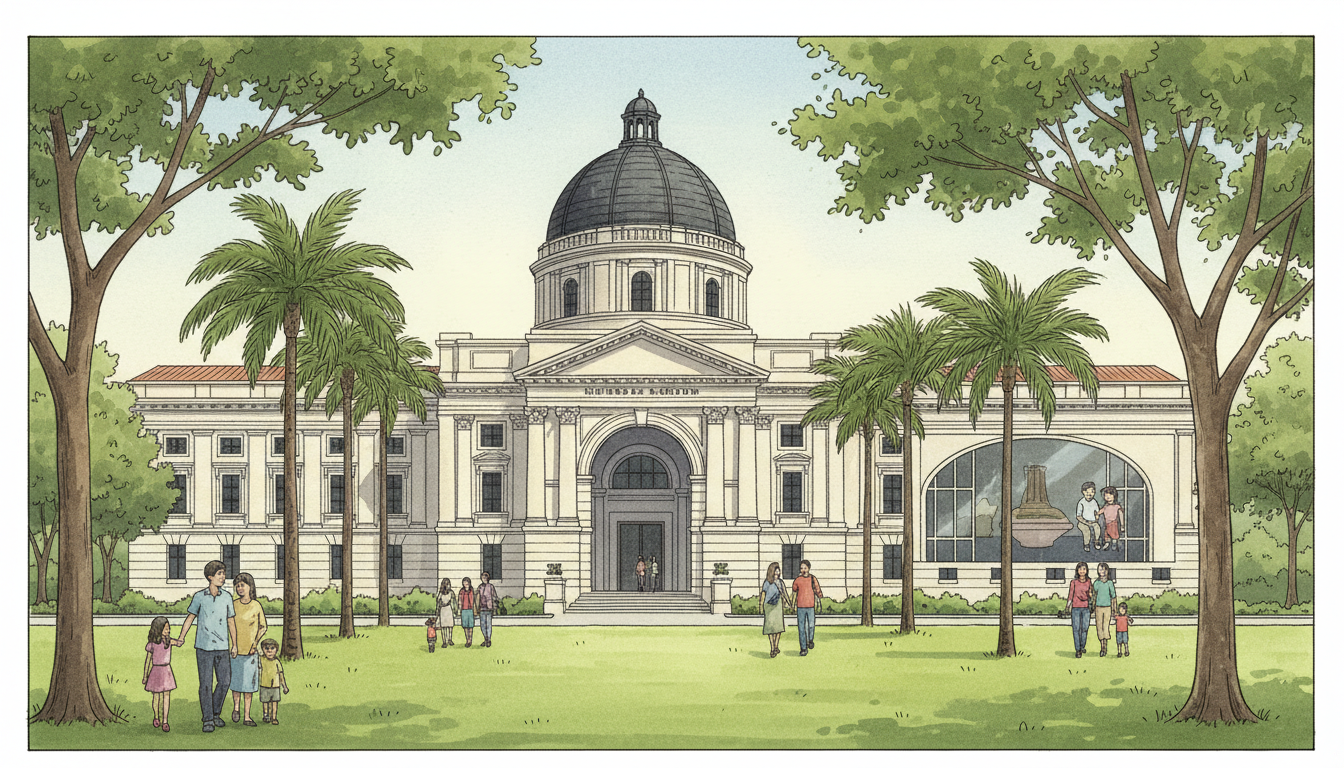
What to do in Singapore when you want a museum experience that introduces the country’s long history through sound, light, interactive storytelling and a little imagination? Explore Singapore Odyssea: A Journey Through Time at the National Museum of Singapore. The immersive exhibition uses a changing maritime landscape, animated scenes and wildlife-inspired digital companions to invite visitors to think about how Singapore developed over roughly seven centuries.
This is not literally a journey into the past, and the digital images are not substitutes for historical evidence. That distinction makes the experience interesting. A visitor can enjoy the spectacle and still ask which parts reflect documented events, which are artistic interpretations and which belong to legend. The sea, trade, people and environment are connected themes that continue to shape Singapore’s present.
The official National Museum page lists Singapore Odyssea as a permanent Level 2 experience at the Shaw Foundation Glass Rotunda, at 93 Stamford Road, Singapore 178897. Since 15 September 2025, visitors have not needed a separate timeslot and may enter with the appropriate general admission ticket, subject to capacity and operating conditions. The museum normally opens 10 a.m.–7 p.m. daily, with last entry to Singapore Odyssea at 6.30 p.m. Verify the museum’s changing gallery-renovation notices and current admission before leaving, especially because the separate *Once Upon a Tide* special exhibition ended on 9 October 2026.
Quick answer: follow one question through the experience
- Choose a question such as how the sea helped shape Singapore, or how people imagined the island at different times.
- Visit Singapore Odyssea at the National Museum’s Shaw Foundation Glass Rotunda.
- Read the entry instructions and use the RFID wristband or digital companion as directed.
- Observe the difference between real historic events, reconstructed scenes and legendary storytelling.
- Notice how the exhibition changes its use of sound, light and images as the journey progresses.
- Keep the visit comfortable for anyone sensitive to immersive effects.
- Finish with one verified historical fact, one artistic interpretation and one environmental question for further study.
Why the National Museum tells this story
The National Museum of Singapore is associated with collecting, interpreting and presenting the country’s history. It is Singapore’s oldest museum, with institutional roots in the nineteenth century. Singapore Odyssea was introduced as part of the museum’s SG60 programming and presents an immersive introduction to the relationship among sea, settlement, cultural change and environmental responsibility. But an experience built around projections has a different function from a traditional artefact gallery. It can inspire curiosity and a sense of place; careful historical study still requires records, objects and appropriate sources. Recognising the distinction helps visitors enjoy the exhibition without confusing visual spectacle with a complete scholarly account.
Where the Glass Rotunda fits
The museum exhibition page places Singapore Odyssea in the Shaw Foundation Glass Rotunda, on Level 2. This is a distinctive part of the museum complex, not a separate independent building across the city. The circular architecture and immersive audiovisual design help shape the visitor’s experience. Check the actual visitor map and follow the designated entry rather than assuming every corridor leads directly into the showcase. A public exhibition can have specific flow controls, and some adjoining galleries may be affected by ongoing museum upgrades. The building itself is part of the storytelling environment.
Why the word odyssey is appropriate
An odyssey is a long journey, often involving discovery and changing circumstances. In the exhibition title, it refers metaphorically to Singapore’s historical development and the visitor’s imaginative movement through different eras. The phrase does not promise a factual time machine or a complete chronological account of every event. A student can use the title to predict themes such as travel, change and encounters. Then compare that prediction with what the experience actually presents. Learning to read a title critically is a useful English skill: the metaphor invites an interpretation, but evidence determines which historical statements can be made.
Singapore’s history is longer than independence
Singapore became an independent republic in 1965, but its earlier history includes precolonial trade, regional connections, colonial development and the experiences of diverse communities. A museum that spans roughly seven centuries helps challenge the common misconception that the island’s story began in the twentieth century. However, the earliest periods involve different kinds of surviving evidence and sometimes more uncertainty than recent documented events. A visitor should not assume every visual scene represents a historically verified individual or precise building. The useful lesson is that modern Singapore grew from earlier networks and transformations, not from one isolated founding date.
What does seven hundred years mean?
A long historical period can be difficult to imagine. Seven hundred years contains many generations of people whose daily lives, technologies and institutions changed. An exhibition must select representative scenes rather than reproduce every year. A student can create a simple timeline dividing the centuries into broad periods and identify where the available evidence is stronger or weaker. Avoid treating a period label as proof that all residents experienced one identical way of life. History becomes more meaningful when we see continuity, change and diversity across generations rather than a single straight path toward the present.
The sea is more than background scenery
Singapore’s location near important maritime routes influenced trade, migration and the movement of ideas. The sea appears throughout Singapore Odyssea as a setting for understanding those relationships. A coastline can connect places through vessels even when it physically separates them. It can also expose communities to changing weather and environmental conditions. Ask why ports depend on geography, information and people working together. Do not treat the existence of water as proof that every object or person in Singapore arrived by one particular route. The exhibition introduces the maritime theme, while detailed trading histories require additional evidence.
Early seafaring required technology
Before modern engines and satellite navigation, sailors relied on different combinations of vessels, environmental knowledge, winds, stars and accumulated experience. Their methods varied across regions and historical periods. A visual sequence showing ships can inspire questions about hull design, cargo capacity and route choices. Do not assume a stylised animated ship reproduces the exact construction of every vessel used in Southeast Asian waters. The scientifically useful question is what problems a ship must solve to carry people and goods safely. A student can later investigate documented vessels using museum collections and maritime history sources.
Trading ports connect people
A port links goods, labour, money, information and institutions. A ship arriving with cargo may depend on merchants, dock workers, warehouses, transport and marketplaces. Singapore’s trading history involved these overlapping networks across different eras. An immersive picture can show movement, but the real system is larger than one waterfront scene. Ask what a port needs to function and how changes in ship size or trade patterns might affect a city. Avoid claiming every trade arrangement looked the same across seven centuries. The lesson is that maritime activity shapes more than shipping; it influences settlement, work and cultural exchange.
Migration is part of the story
People moved to and through Singapore for different reasons, including commerce, work, family and circumstances shaped by political change. A historical exhibition can make those movements visible through images and narrative. But one animated crowd cannot represent the full experiences of Chinese, Malay, Indian, Eurasian or other communities. Ask whose viewpoint is included and what additional sources could explain individual experiences. Migration history becomes stronger when it recognises varied motivations and consequences rather than portraying all journeys as equally voluntary or easy. The sea connected people, but those connections were not identical for everyone.
What an animated reconstruction can show
An animated historical scene can help visitors visualise a marketplace, port or settlement that no longer survives in its former appearance. Designers use research and artistic choices to create a coherent image. However, some details may be interpretive rather than archaeologically documented. Ask what the scene illustrates and which features would need verification from maps, photographs, texts or material finds. A reconstruction is useful because it makes abstract history approachable, not because every colour or face is guaranteed accurate. A careful visitor enjoys the visual storytelling while keeping evidence and imagination distinct.
Historical scenes are not original footage
Many events from Singapore’s earlier centuries occurred before moving-image recording existed. Digital scenes depicting those periods must therefore be reconstructions, not actual films of the events. Even for more recent eras, a projected sequence may combine archive material and new visual effects. Read interpretive labels when available and do not republish an animation frame as a documentary photograph without clarification. The distinction is particularly important in an age when realistic computer-generated images can be mistaken for evidence. A museum visit can teach digital literacy by inviting visitors to ask how an image was produced.
Myths belong in history, but differently
Singapore Odyssea includes encounters with legendary creatures and stories associated with local myths. Such narratives can be culturally significant even when they are not literal descriptions of verifiable events. The correct response is not to discard legends or present them as facts. Ask where the story originated, how it changed and what it may reveal about the communities telling it. A myth can help people express identity, values and explanations of the world. Historical research then asks which elements are supported by independent evidence. A good visitor recognises both kinds of meaning without confusing their purposes.
A legend is not a historical record
A historical record is evidence created or preserved in circumstances that can be analysed for information about the past. A legend is a story transmitted and transformed within cultural traditions. Some legends may refer to real places or events, but their narrative details are not automatically verified. When a mythical creature appears in the exhibition, explain to children that the scene belongs to storytelling. Then ask which geographical or cultural ideas it evokes. This teaches respectful curiosity alongside factual discipline. The same skill applies to traditional folktales, epic literature and modern fantasy: meaningful narratives can be appreciated without being presented as literal history.
Why mythical creatures help imagination
A digital creature may make a historical exhibition more engaging, especially for younger visitors. It can create a memorable bridge between unfamiliar time periods and familiar forms of storytelling. But the design is still a contemporary artistic interpretation. A child can describe how the creature looks and what feeling it creates, then distinguish that response from a factual claim about the historical period. An older student can investigate how legends move between communities and media. The useful learning is the relationship between imagination and cultural memory, not a quiz about whether a fictional animal existed.
The RFID wristband is a visitor interface
The official Singapore Odyssea page describes a personal RFID wristband used to activate a digital companion. RFID stands for radio-frequency identification, a technology that can identify a tagged object using radio communication under suitable conditions. At the exhibition, the wristband links the visitor with selected interactive storytelling features. Follow museum instructions and return any loaned equipment as directed. The device is an educational interface, not a souvenir to take home or evidence that the fictional companion is physically alive. Its value lies in how it supports personalised engagement with the experience.
How a digital companion changes the visit
An interactive companion can make a visitor feel that a larger narrative is responding to their choices or presence. This may encourage exploration, particularly for children who enjoy characters and games. But the interaction is created through software, sensors and programmed content. It should not be confused with an independent living organism. A useful design question is whether the companion helps visitors understand the story or distracts from the historical material. Different people may respond differently, so one successful interaction does not prove a universal educational outcome. Use the character as a guide into questions about the past and environment.
Wildlife-inspired companions
The National Museum’s exhibition description says its companions are inspired by Singapore’s native fauna. Examples described in the museum’s materials include animals such as pangolins, crabs and hornbills. That gives the digital characters a connection with local biodiversity alongside the maritime narrative. But do not assume every fictional ability assigned to a companion reflects real animal biology. A pangolin in a digital adventure may behave in ways created for storytelling. A child can enjoy the character and later learn about the real species through a reliable nature source. Imagination becomes an invitation to investigate, not a substitute for biological evidence.
Pangolins are real, magical companions are not
A pangolin is a real mammal with protective scales and distinctive ecological characteristics. The digital version of one in an exhibition may gain additional visual effects or personality for narrative purposes. The visitor should distinguish the real animal’s natural history from its fictional role. This is a useful entry point into conservation, because Singapore’s native wildlife faces habitat and other pressures. Do not assume seeing an animated pangolin means a live animal can be found easily nearby. A good discussion asks what the real species needs to survive and how people can avoid disturbing it in its natural environment.
Crabs connect the story with the coast
A crab-inspired companion fits a maritime exhibition because coastal and wetland environments support many species of crabs. Their bodies and behaviours differ by habitat; not all crabs live on sandy beaches or are identical in appearance. A digital crab may draw attention to the relationship between the island’s history and marine nature. Ask what a real coastal crab needs from its environment, then consult appropriate NParks sources. Do not treat an animated character as a reliable guide to species identification. The wider lesson is that coastlines are places where human and ecological histories overlap.
Hornbills and the forest connection
Hornbills are birds associated with wooded habitats, and their distinctive bills can make them memorable subjects for wildlife education. A magical hornbill companion may introduce the idea that Singapore’s history includes forests and ecological change as well as ports. But the fictional character is not a biological demonstration. Use museum interpretation for the narrative and reliable NParks species information for the real bird. A child can explain what makes the animal recognisable while acknowledging that its digital behaviour is invented. This supports a broader understanding of biodiversity without confusing entertainment and scientific evidence.
Nine companions are not nine species surveys
Museum materials describe nine possible wildlife-inspired companions. That is a design choice for the interactive narrative, not an ecological survey of Singapore’s fauna. There are far more native species in the country’s different habitats, and the choice of nine characters does not indicate which organisms are most abundant or scientifically important. A visitor can ask why designers selected particular animals and what they wanted those characters to communicate. Without a curator’s account, do not claim to know every intention behind a specific companion. The educational value comes from the relationship between the character and the theme of environmental awareness.
Interactivity changes attention
When people can activate a digital response, they may notice the surrounding environment differently. The exhibition’s companion system can encourage movement, observation and a sense of participation. But interaction can also compete with the historical message if visitors focus only on triggering effects. Choose a simple approach: enjoy the response, then ask what idea it relates to. Does it communicate trade, environmental change or a story from a particular era? The answer may not be obvious, and that is acceptable. A good design evaluation examines whether technology helps the audience learn rather than assuming that more screens automatically mean better education.
The relationship between art and history
Singapore Odyssea uses creative visuals to communicate historical themes. Art can make an unfamiliar period emotionally accessible, while historical scholarship asks what the sources establish. Neither role should erase the other. A beautiful reconstruction may inspire someone to read more about early ports; a historical document may deepen understanding of a visual scene. A visitor can write one sentence about the artistic effect and another about the verified fact. This method respects both creative storytelling and evidence-based research. It helps children learn that an experience can be imaginative and educational without every visual detail representing a literal historical record.
The sea changes through time
Coastlines can be altered by natural processes and human decisions, including land reclamation, port development and changes in coastal infrastructure. The exhibition’s evolving seascape theme creates an opportunity to ask how Singapore’s relationship with water changed. A student might compare an early trading scene with a modern built waterfront and identify the different purposes served by ships, reservoirs or coastal structures. Do not assign exact reclamation boundaries or dates from an artistic animation alone. Use maps and official sources for specific claims. The important concept is that a coastline can shape society while society also changes the coastline.
What is a seascape?
A seascape is a view or artistic representation of the sea and the surrounding coastal environment. It can include islands, boats, shorelines, weather and human activity. In an immersive exhibition, a seascape may be animated to guide visitors through different time periods. A child can identify what changes when ships appear or the shoreline becomes more built-up. A Secondary student can ask how the same visual elements communicate different historical relationships. Do not confuse an artist’s representation with a measured coastal survey. The word is useful because it helps describe the setting without making unsupported geographical claims.
Environmental conservation as an undercurrent
The museum’s official announcement explains that environmental awareness and the future of the sea are important themes. Visitors are invited to consider how Singapore’s natural environment shaped its history and how the country must respond to future challenges. That does not mean the exhibition provides a complete technical plan for climate adaptation. It introduces questions about the relationship between people and nature. A responsible learner asks what ecological conditions have changed and which scientific sources would be needed to evaluate specific proposed solutions. The storytelling can inspire inquiry without replacing technical evidence.
Rising sea levels are a real challenge
Sea-level rise can affect low-lying coastal areas, infrastructure and ecosystems, with impacts depending on location and conditions. An immersive exhibition may communicate the issue through dramatic imagery, but a single projection does not quantify future risk for a particular neighbourhood. Scientific assessments use measurements, models and scenarios. A Secondary student can ask what information planners need for coastal adaptation: elevation, tides, storm conditions, population and infrastructure all matter. Avoid treating one imagined future scene as a guaranteed forecast. The valuable lesson is the importance of evidence and long-term planning when responding to environmental change.
Environmental messages should remain accurate
A museum may encourage visitors to protect nature. That is useful, but environmental explanations can become misleading if they imply one personal action solves every large-scale problem. Biodiversity conservation, waste management and coastal protection involve individual behaviour alongside public institutions, engineering and scientific research. Ask what action is being recommended, why it matters and how success could be measured. A child can understand the value of not littering; an older student can investigate the wider systems required to manage marine waste. The exhibition’s role is to begin the conversation, not to promise simple solutions to every environmental challenge.
Singapore’s identity and the sea
The country has a long history of maritime connections, but national identity cannot be reduced to shipping alone. People have also shaped Singapore through homes, languages, schools, work, art and political choices. The exhibition’s sea-centred narrative provides one useful lens rather than an exhaustive explanation. A thoughtful visitor asks whose stories are emphasised and which may require other museum galleries or research. The sea connects many historical periods, but different communities experienced those connections in varied ways. Recognising the narrative’s scope makes the experience more valuable and encourages further investigation into Singapore’s multicultural history.
A port city depends on hidden labour
Ships and waterfront imagery can be visually impressive, but maritime life also involved workers who loaded cargo, repaired vessels, handled documents, managed supplies and created services for travellers. The visual spectacle may not show every role. Ask who made a trading city function beyond captains and merchants. A student could investigate dock labour, market networks or transport connections through specialised historical sources. Do not invent precise working conditions from an animated crowd. This helps balance the grandeur of maritime scenes with the everyday effort of people whose work supported the wider port economy.
The difference between myth and memory
A legend may change through retelling, while a person’s memory describes an experience from their own perspective. Both can hold cultural meaning, but historians analyse them differently. A mythological creature in Odyssea is not the same as an oral-history recording of a family who lived in Singapore during a documented period. Ask what type of source the exhibition is using at a particular moment. The ability to distinguish creative narrative, personal memory and formal record is a valuable Humanities skill. It allows visitors to appreciate each without treating all forms of storytelling as equivalent evidence of specific events.
The history gallery renovation is a separate issue
The museum’s upgrading notice listed the Singapore History Gallery for a major revamp with a planned October 2026 reopening. That planned date should not be treated as proof the gallery is available on every day afterward. Check the museum’s live exhibition directory before adding it to your itinerary. Singapore Odyssea is a separate permanent multimedia experience, and its status should be checked independently. A public museum may have some spaces open while others are under renovation. This distinction prevents old itinerary articles from making incorrect promises about the whole building.
Once Upon a Tide has ended
The National Museum’s *Once Upon a Tide: Singapore’s Journey from Settlement to Global City* special exhibition ran from 24 May 2025 to 9 October 2026, according to the official exhibition calendar. It is no longer a dependable option for a November 2026 visitor. Do not confuse its separate RFID interactions or temporary installations with the ongoing permanent Singapore Odyssea experience. An old museum guide may describe both together because they overlapped earlier. Check the date attached to any programme and choose only currently listed activities. Learning from past exhibition material is possible online, but physical admission depends on actual current availability.
A permanent exhibition can still change
The designation permanent means the museum intends a longer-term experience rather than a short seasonal show. It does not guarantee that every screen, interactive feature or room is available without occasional maintenance or operational change. A visitor should check current notices and follow staff guidance if part of the installation is offline. Do not demand access to restricted equipment or attempt to repair an interactive station. The educational goal can continue through other displays or published sources when a particular feature is unavailable. Reliable visiting advice separates the intended long-term exhibition from its day-to-day operating status.
Entry no longer requires an extra timeslot
The official Singapore Odyssea page says that from 15 September 2025, separate timeslot booking was removed. Visitors can enter with the relevant General Admission ticket, subject to the museum’s current entry rules. This does not mean the museum has unlimited capacity or that all optional interactive components operate without waiting. Check the visitor counter and follow the actual admission instructions. A ticket is still necessary under the applicable visitor-category rules. The distinction helps avoid outdated directions telling visitors to reserve a time that the museum no longer requires.
National Museum admission categories
The museum’s admissions page currently lists free general admission for eligible Singapore citizens and permanent residents. It also identifies general adult admission for tourists and foreign residents at S$20, concession admission at S$15, and free entry for children aged six and below, subject to the stated conditions. Selected local school groups and qualified students or educators may have separate eligibility. Prices and promotions can change, so verify the live ticket before purchase. Do not infer that a promotion for a temporary exhibition applies indefinitely to all programmes.
Last entry is earlier than the closing time
The museum is normally open 10 a.m.–7 p.m., but its admissions information lists last ticket sales at 6 p.m. and last entry to Singapore Odyssea at 6.30 p.m.. A visitor who arrives at 6.45 p.m. should not assume that being before the building’s closing time guarantees access to the experience. Plan enough time for the interactive journey and any desired rest. Avoid combining a late arrival with several unrelated galleries. A calm visit allows the audience to observe the scenes carefully rather than racing through them to beat closing time.
Quiet Mornings offer a different arrangement
The National Museum admissions page describes Quiet Mornings with earlier entry at 9 a.m. on the first Saturday and first and third Thursday of each month, subject to current museum conditions. Such arrangements can be useful for visitors who prefer a different sensory or crowd environment, but the exact access and applicable exhibition features should be checked. An earlier building opening does not automatically guarantee that every digital interaction operates identically or that all programmes begin at 9 a.m. Confirm the actual details when planning for a visitor with specific needs.
The location on Stamford Road
The National Museum of Singapore is at 93 Stamford Road, Singapore 178897. Its getting-here page lists approaches from Bras Basah, Bencoolen, Dhoby Ghaut and City Hall MRT stations, with varying walking distances. Choose the route that suits your mobility and weather needs rather than assuming every station is equally convenient. The museum is not the same building as National Gallery Singapore, even though both are associated with central Singapore’s cultural precinct. Accurate navigation helps visitors arrive calmly and spend their time on learning rather than searching for the entrance.
Why a central museum still needs route planning
A landmark in the city centre may look close to an MRT station, but the practical journey includes crossings, slopes, rain exposure and the correct entrance. Families with strollers or visitors using mobility aids may prefer a different station or path from someone walking alone. Check the actual route to the National Museum and the connection to the Shaw Foundation Glass Rotunda inside. Do not assume that the shortest line on a digital map is always step-free or comfortable. Good museum planning considers the complete journey from home to the exhibit and back, including rest and suitable transport after the visit.
The National Museum building has its own history
The National Museum is Singapore’s oldest museum and a recognised cultural and architectural landmark. Its history reaches back to nineteenth-century collecting institutions, while the present visitor environment includes later extensions and new exhibition technology. The historic exterior can prompt questions about how public cultural buildings change their uses and displays across generations. However, the fact that the building is old does not make all the interactive technology inside historically original. A student can compare the heritage architecture with the contemporary digital experience. This is a useful example of adaptive reuse and institutional evolution, not a claim that museum practice remained unchanged.
The dome shapes the digital experience
The Shaw Foundation Glass Rotunda creates a particular spatial setting for projections and immersive storytelling. A circular environment may influence the sense of enclosure, movement and attention compared with a conventional flat screen. The exact technical arrangement is part of the exhibition design, and a visitor should not infer undocumented equipment specifications. Instead, ask how the architecture changes the way images and sound are experienced. Does the surrounding projection encourage visitors to feel inside a scene? What happens when visuals move around the viewer? This connects Art, Design and Technology while maintaining a clear distinction between observation and unverified engineering claims.
Sound is part of the storytelling
An immersive exhibition uses sound to support atmosphere, transitions and emotional response. A soundscape may include music, environmental effects or narration depending on the sequence. Audio can direct attention even when the visual scene appears unchanged. A learner can note how the mood shifts when the sound becomes quieter, louder or more complex. Avoid claiming a particular musical motif has one universal cultural meaning without support. For people sensitive to intense audio, check current accessibility information and allow breaks where appropriate. The useful lesson is how media designers combine different senses to communicate a narrative.
Light can make a scene feel historical
Lighting and projection can create the impression of a particular era, location or atmosphere. But a warm-coloured scene is not proof that the historic environment literally looked that way. Designers select colour and visual rhythm to help tell a story. A visitor can describe what the lighting communicates and then ask what historical evidence supports the associated event. This is a lesson in visual literacy: images influence understanding, and their persuasive power should not be confused with factual certainty. A creative presentation can be excellent while still involving interpretation and simplification.
The role of animated dioramas
A diorama is a constructed or represented scene used to illustrate a situation. Digital animation can add motion and narrative transitions that static models cannot show easily. Singapore Odyssea’s museum description includes animated dioramas of significant historical moments. Such scenes help viewers imagine change across time, but an animated crowd or ship does not automatically reproduce exact historical details. Read any associated explanation and distinguish documented events from the specific creative reconstruction. A student can choose one scene and ask what information the designers might have needed to build it responsibly. This question links history research with creative production.
A timeline is a model
Even a sophisticated multimedia journey compresses centuries into a manageable experience. It selects representative moments and connects them in a narrative. That structure is useful, but it may give the impression that history progressed neatly from one planned stage to the next. Real history includes contingency, uncertainty and different experiences among communities. A learner should ask which events occurred in the same period and whether different groups might remember them differently. The exhibition can provide orientation, while a detailed history gallery or archival source may help answer more specific questions. Models become valuable when we understand what they include and omit.
The risk of hindsight
When we know Singapore’s present circumstances, earlier events may appear to lead inevitably toward the modern city. Historical participants, however, did not know future outcomes. They made decisions within the information and constraints available at the time. A museum narrative may connect periods for clarity, but visitors should not assume every event happened because the final result was predetermined. Ask what alternatives or uncertainties existed. This strengthens History reasoning because it takes the past seriously as a period people actually lived through rather than a prelude to a future already known to them.
Whose story appears in a national narrative?
A country contains many individuals, communities and institutions. An immersive exhibition must choose particular themes, and no single installation can represent everyone’s experience equally. A student can ask which kinds of work, migration or daily life are visible and which might need additional research. The question should be explored fairly and with evidence, not used to assume omissions are automatically deliberate or malicious. A national museum can provide a useful shared introduction while encouraging deeper study of specific histories. Understanding the exhibition as a curated narrative makes its contributions clearer and its limits easier to recognise.
The difference between the National Museum and ACM
The National Museum focuses strongly on Singapore’s story and presents Singapore Odyssea as a multimedia journey through time. The Asian Civilisations Museum explores connections among cultures across Asia through objects, trade, belief and design. Both can illuminate maritime history, but their main questions and collections differ. For an object-centred visit, see What to do in Singapore | Discover Connections at Asian Civilisations Museum. A family can visit them on different days to compare a digital narrative with historical artefacts. One experience does not replace the other, and neither is a complete account of every Asian society.
The difference from a library history investigation
A library or archive may allow visitors to examine newspapers, books, maps and other sources in more detail. Singapore Odyssea creates an accessible visual introduction and may prompt the questions that lead to later research. If a student wants to know the precise date of a port development, the original context of a photograph or the history of a family, a dedicated reference source may be more appropriate. See What to do in Singapore | Investigate a Question at the National Library for a different method. The museum and library serve complementary educational roles: curiosity and systematic evidence-gathering.
A first family visit
Begin by explaining that the exhibition uses sound, light and interactive characters to tell a story inspired by Singapore’s history. Choose one question about the sea or environmental change. Follow the wristband instructions and allow the child to enjoy the scenes without racing through every effect. Afterward, ask them to distinguish a real animal from a fictional magical action. A child can name one fact learned and one invented story element. Keep the visit short enough for comfort, especially if the sensory environment feels intense. The goal is positive engagement with history, not memorisation of hundreds of years in one sitting.
A child’s first history timeline
Before visiting, draw a simple line with long ago, colonial period, modern Singapore and today. Explain that these are broad teaching categories, not complete dates for every change. During the exhibition, let the child place one remembered scene near a relevant part of the line. Check the actual date with museum information if precision matters. Do not scold a child for confusing two eras after a highly visual experience. A timeline is a learning tool that can be revised. It helps children see that the country changed over many generations rather than appearing suddenly in its present form.
Primary-school Science through the sea
A child may recognise crabs, hornbills or other native animals represented by the digital companions. Choose one and ask what its real habitat might be. Use an appropriate NParks description for the actual biology. Then compare its needs with the fictional abilities shown in the museum. This is a gentle exercise in distinguishing evidence from imagination. Do not tell children that the animated environment represents a complete natural ecosystem. A playful digital character can inspire curiosity about biodiversity, but the accurate scientific explanation requires knowledge of real organisms and the places where they live.
Secondary History: evaluate a reconstruction
Ask: How can an immersive exhibition communicate history responsibly? Choose one depicted event or period. Record what the exhibition states, then identify which visual elements are interpretive. Consult a reliable secondary or primary source for the historical context. Write a paragraph explaining how the reconstruction improves understanding and where it might simplify uncertainty. Do not claim that every projected figure is a real documented person. This is an excellent Humanities exercise because it develops the ability to evaluate media that blend information and storytelling, a skill increasingly important when realistic synthetic imagery is widely available.
Secondary Geography: maritime connections
Ask how Singapore’s location influenced trade, migration and urban development. Use the museum’s changing seascape as a starting prompt, then verify geographic claims through maps and historical sources. Consider how ships need ports, people and information networks, and how coastal development changes land use. Avoid treating one animation as a measured map of past shorelines. A strong answer explains the relationships rather than listing famous dates. The museum’s maritime emphasis can connect Geography with Economics and History, provided the learner distinguishes general mechanisms from particular documented events.
Secondary Social Studies: identity and change
Ask: How do people build a shared understanding of a place whose population and institutions change over time? Use the exhibition’s themes of settlement, cultural exchange and environmental responsibility. Consider which forms of evidence help societies remember and explain past events. Do not assume every Singaporean shares the same personal memory or interpretation. A balanced response acknowledges common institutions alongside the varied experiences of families and communities. The museum can support civic reflection, but the best discussion remains open to documented differences rather than reducing national identity to one uniform story.
Secondary English: metaphor and storytelling
The title *Odyssea* uses the idea of a long journey to organise an exhibition. Students can examine how a narrative is built through sequence, transition, character and mood. The sea becomes a recurring motif connecting different historical periods. Ask which scene works as an introduction, which creates a change and how the ending frames the future. Distinguish analysis of storytelling choices from claims about what historically happened. A creative exhibition can improve comprehension and composition skills when students describe how visual and audio devices influence the viewer, supported by specific observations rather than vague praise.
A Design and Technology investigation
The RFID wristband and digital companion system offer a way to discuss user interaction with technology. Identify the visitor’s action, the system’s response and the information conveyed. Does the interaction help clarify a historical idea? What might happen if the wristband fails or the user finds the interface confusing? Avoid guessing the museum’s exact software architecture or data handling practices from appearance alone. The useful investigation concerns the broader design principle: an interface should guide a person toward a clear purpose while considering accessibility, reliability and practical constraints. A creative digital experience still requires careful user-centred design.
A sound-and-light observation worksheet
Create four fields: scene, what I saw, what I heard and how it affected my understanding. Record one visual transition and one sound change without photographing or filming where prohibited. Then compare your interpretation with the exhibition’s explanatory material. A student might notice that changing light makes a period feel more dramatic, while acknowledging that the effect is an artistic choice. The worksheet develops precise language for multimodal media. It can also help children who prefer drawing rather than long writing. The main goal is reflection rather than producing a perfect critical review.
Accessibility and sensory needs
Immersive shows may combine moving imagery, low lighting, sound effects and interactive stations. People experience these differently. Before visiting, check the National Museum’s accessibility information and current exhibition advisories, particularly for children or adults who may be sensitive to flashing visuals or loud sound. An individual may prefer a shorter visit or a different museum activity. Do not force a visitor to complete an overwhelming sequence. Access means being able to participate comfortably, not simply being physically permitted into the building. Staff can clarify available support for specific needs.
Why a multi-sensory experience can help learning
Different visitors respond to different formats. Some may remember images, others sounds or written explanation. Combining methods can create an engaging experience, but it does not guarantee that every visitor learns the same facts or finds the same environment comfortable. The key educational question is what the audiovisual design makes easier to understand. Ask someone in your group what they remember and why. Their response may differ from yours without being wrong. A museum should create opportunities for inquiry rather than demand identical emotional reactions. Immersion is a method, not an automatic measure of educational quality.
A quiet visit may be more useful for some people
If an immersive environment creates discomfort, choose the museum’s applicable quiet-period arrangements or adjust the visit. Read the current entry and accessibility guidance rather than assuming a normal early-morning slot is guaranteed to be silent. A person may also enjoy the museum’s architecture or another suitable gallery without completing every audiovisual feature. The goal of cultural education is meaningful understanding, not enduring intense sound or images as proof of enthusiasm. Families should feel able to shorten the outing when needed, especially with very young children or visitors who become tired.
Admission is not the same as a programme ticket
General museum admission covers the applicable permanent-gallery access under the current rules. Temporary exhibitions, workshops and guided programmes may have different prices or registration conditions. Singapore Odyssea no longer requires its own timeslot as of the operator’s published change, but it still operates within the museum’s admission and capacity system. Do not assume a ticketed activity elsewhere in the building is automatically included. Read the exact ticket category before checkout. A realistic family budget includes transport, food and optional purchases, while remembering that some eligible visitors may enter the permanent experience without paying a general admission charge.
A free family activity may still require care
Eligible Singapore citizens and permanent residents enjoy free general admission under the current National Museum rules, and young children may have separate free-entry eligibility. That does not mean the museum is a childcare facility or a playground where all objects can be handled. Parents remain responsible for supervision, especially around interactive equipment and historic displays. Follow instructions about wristbands, queues and restricted areas. The value of free cultural access is that families can explore meaningful stories, not that every form of behaviour becomes permitted. A short respectful visit can be both affordable and educational.
Getting to Stamford Road
The museum’s official directions list approaches from Bencoolen, Bras Basah, Dhoby Ghaut and City Hall MRT stations. The indicative walking distances vary, and the best route depends on your starting point and needs. A person using a wheelchair or stroller may prefer a different approach from the shortest one on a generic map. Check crossings, entrances and current building works. A good itinerary begins with an accurate address and a comfortable arrival rather than reaching the exhibition already stressed from a hurried journey.
The building and the exhibition are different historical objects
The museum’s historic architecture is part of Singapore’s cultural heritage, while the digital Odyssea experience is a contemporary production. Both can be meaningful, but their dates and functions differ. A visitor could compare the building’s older architectural language with the use of projections and RFID technology inside. This illustrates how cultural institutions adapt over time. Do not assume a modern projection system was part of the original historic interior or that every room in the building is open. A carefully framed comparison can introduce the idea of adaptive reuse without making unsupported claims about particular construction phases.
A separate history-gallery visit may be appropriate
If the renewed Singapore History Gallery has reopened by your chosen date, it may provide a different method of learning through artefacts and interpreted displays. But its planned October 2026 schedule alone is not definitive proof of current accessibility. Check the live exhibition list and visitor notices. An artefact-based gallery can provide evidence that complements Odyssea’s visual story. It is not necessary to combine both in one visit, particularly with young children. Choosing a single clear educational objective is better than rushing through multiple rooms without processing the ideas they present.
A visit focused on the historical sea
Choose one maritime question before entering: how did waterways connect Singapore with people elsewhere? During the experience, notice vessels, shorelines and the changing role of the coast. Afterward, use the National Museum’s interpretation or another reliable historical resource to verify one claim. Do not assume every ship shown represents a documented specific voyage. This is an illustrative learning sequence, not a required official route inside the exhibition. It helps a student transform vivid imagery into research questions. One carefully verified connection between sea and settlement is a meaningful result.
A visit focused on the environment
Choose an environmental question: how did the natural setting shape early communities, and what responsibilities do people face today? Watch for imagery connecting forests, coastal habitats and changes to the city. Distinguish a real conservation issue from a fictional creature or imagined scene. After the visit, read an appropriate NParks or scientific source. Avoid drawing precise environmental predictions from an artistic animation. A strong response explains the relationship between human activity and natural systems, then identifies what evidence would be needed to evaluate a particular proposed action. The museum becomes a beginning for responsible environmental thinking.
An intergenerational history outing
A grandparent may recognise earlier features of Singapore, while a child may connect more strongly with a digital wildlife companion. Invite each to describe what matters to them. A personal memory can enrich understanding but should not be presented as a universal account of an entire historical period. The older visitor may need a suitable seat or a shorter experience, while the child may need guidance distinguishing story from fact. Do not require identical reactions. A shared conversation about what changed across generations can be the most valuable part of the day.
Avoid turning history into an inevitable success story
A long national narrative can make developments appear as a simple sequence of achievements. But earlier people faced uncertainty, disagreement and practical difficulties, and communities experienced change in different ways. Ask what evidence shows about decisions and consequences rather than assuming the outcome was predetermined. This does not mean dismissing achievements; it means explaining them with appropriate context. An immersive exhibition can offer an encouraging public story while a researcher later investigates more complex circumstances. Both can contribute to learning when their purposes and evidentiary limits remain clear.
What the exhibition cannot show completely
No single immersive presentation can cover every neighbourhood, migration experience, policy dispute, family story or economic change across centuries. The exhibition uses selected images and moments to make a broad theme understandable within the visitor’s available time. This is a design constraint rather than automatically a defect. A responsible visitor asks which questions the narrative raises for future research. The National Library, other museum collections and reputable historical publications can extend the inquiry. The most valuable outcome is often a new question that would never have occurred to someone who had not experienced the visual introduction.
Photography and intellectual property
Follow the National Museum’s current policies about photography, recording and the use of interactive equipment. A digital installation contains creative work that may be protected by copyright or subject to specific restrictions. Do not assume permission to enter grants unlimited commercial reproduction rights to audiovisual scenes. A short written reflection or permitted personal photo can record the learning without copying the entire experience. When sharing a caption, identify imagery as a modern reconstruction where appropriate rather than presenting it as original footage of a historical period. Accurate representation protects both creative work and historical understanding.
A family plan of roughly one hour
Choose a suitable arrival and allow time to locate the Glass Rotunda, read instructions and participate in the experience without rushing. The official permanent exhibition does not require a separate timeslot, but actual queues and comfort can affect duration. After finishing, take a short break and discuss one historical scene and one environmental detail. If a child is tired, end the visit rather than adding every other museum gallery. The hour is an illustrative family allocation, not an operator-guaranteed length. The educational outcome is understanding one relationship, not consuming the maximum possible number of installations.
A longer museum day
Older students or history enthusiasts may want to combine Singapore Odyssea with another currently open National Museum exhibition, the building’s heritage interpretation or suitable online resources. Check the actual gallery status before planning, because the museum’s ongoing revamp has affected different areas at different times. Allow time for food and rest. A longer visit can use Odyssea’s narrative as orientation before examining objects or documentary sources. But two exhibits should not be combined merely to fill the schedule; each should answer a meaningful question. The strongest plan lets one experience deepen the other rather than producing sensory overload.
Children should not be required to memorise everything
Seven centuries of history can overwhelm a young learner if adults demand a list of every date and event. Choose one theme, such as the role of the sea or the meaning of a native animal character. Ask the child what they remember and what they would like to know more about. Use a short factual explanation to correct misconceptions gently. The purpose is developing curiosity and a sense of chronology, not testing memory immediately after an immersive presentation. A child who can distinguish a legend from a verified event has learned something important even if they cannot recite a full national timeline.
A five-word vocabulary pack
Learn odyssey, seascape, migration, reconstruction and conservation. An odyssey is a long journey. A seascape represents a sea and its surroundings. Migration involves movement of people or other organisms. A reconstruction is a modern attempt to represent something based on evidence and interpretation. Conservation concerns protecting valued living systems or heritage resources, depending on context. Use the words to explain one part of the exhibition. Avoid confusing migration of people with biological migration in a sentence that does not distinguish them. Precise vocabulary helps visitors describe how history and environmental themes interact.
Media literacy: three questions for every scene
Ask: What is presented? How was it made? What evidence supports the historical claim? An image of a legendary creature may answer the first two questions but should not be treated as proof of a real organism. An animated reconstruction of a trading port may be historically informed while containing details chosen by artists. A surviving artefact would offer different kinds of evidence. This method helps students become thoughtful viewers of documentaries, virtual museums and AI-generated images. The goal is not distrust of every picture; it is understanding what kind of claim each visual can reasonably support.
A post-visit evidence notebook
Divide a page into scene, historical period, verified fact, artistic choice and further question. If you cannot confirm the period from the exhibition or a reliable source, leave it uncertain rather than guessing. A student might write that a changing maritime scene suggests the importance of sea trade, then use official historical sources to investigate one documented trading relationship. An artistic impression should be labelled as such. This simple framework turns an immersive sensory experience into a useful research starting point and prevents visual emotion from being mistaken for historical proof.
The most important 2026 corrections
Do not plan to see *Once Upon a Tide* after its 9 October 2026 closing date. Do not assume the Singapore History Gallery is open solely because an earlier notice projected an October reopening. Do not tell visitors they must book a special Odyssea timeslot when the operator removed that requirement in September 2025. Do not confuse free general admission for eligible Singapore residents with free access to every separately ticketed programme. These are different facts with different dates. A useful travel guide keeps them separate and links readers to the actual National Museum visitor information for verification.
What not to do at Singapore Odyssea
Do not treat myths as documented events, a projection as archival footage or an animated wildlife companion as a real animal. Do not remove a loaned RFID wristband or interfere with interactive equipment. Do not rush through the whole installation while expecting a child to remember every fact. Do not ignore sensory discomfort or museum photography rules. Do not arrive after the last-entry period assuming the building’s general closing time guarantees access. A responsible visit preserves the creative experience while giving history, technology and personal comfort the appropriate kinds of attention.
Why a vivid experience can be academically useful
An immersive exhibition can give learners a broad mental map before they begin detailed research. A child may remember that Singapore’s sea connections long predate independence, while a teenager may become interested in the way historical scenes are reconstructed. These are useful beginnings if followed by accurate source checking. The multimedia format should neither be dismissed as mere entertainment nor treated as a complete textbook. Its strength lies in making questions memorable and encouraging further inquiry. Good education connects the vivid moment to disciplined explanation instead of demanding that excitement serve as evidence.
The better question after leaving
Ask not only “Did I enjoy it?” but “What do I now understand, what did the creators interpret, and what should I verify?” A response might identify the sea as an important historical connector, recognise that the mythical scenes belong to cultural storytelling and raise a question about future coastal resilience. That answer combines History, English, Science and civic reflection without confusing their methods. The exhibition’s success can be measured personally through clearer thinking, not just the number of interactive effects triggered. The most meaningful learning often begins after the visitor has left the Glass Rotunda.
Frequently asked questions
What is Singapore Odyssea?
A permanent multi-sensory digital history experience at the National Museum of Singapore, using light, animation, storytelling and RFID companions.
Where is it located?
At the Shaw Foundation Glass Rotunda, Level 2, National Museum of Singapore, 93 Stamford Road.
Is Singapore Odyssea still open in November 2026?
The official museum lists it as a permanent exhibition. Check daily operational notices for any temporary interruption.
What are the National Museum opening hours?
Normally 10 a.m. to 7 p.m. daily; last entry to Singapore Odyssea is listed at 6.30 p.m.
Do I need to reserve a separate timeslot?
No, according to the museum’s change effective 15 September 2025. Normal admission rules still apply.
Is the exhibition free for Singapore citizens and PRs?
Yes, under the current general-admission eligibility rules; check the museum’s live visitor page.
What does admission cost for overseas visitors?
The currently published general adult rate is S$20, with S$15 concession categories subject to proof and updated terms.
What is the RFID companion?
A digital wildlife-inspired character activated through a visitor wristband to support the exhibition’s interactive storytelling.
Are the legendary creatures historically real?
They belong to myth and creative storytelling. The exhibition also includes historically inspired scenes, which should be interpreted through evidence.
Is Once Upon a Tide still running?
No. Its advertised special-exhibition period ended on 9 October 2026.
Has the main Singapore History Gallery reopened?
Earlier notices planned October 2026 reopening; verify the current live status rather than relying only on that projection.
Is the experience suitable for children?
Many children may enjoy it, but families should consider the audiovisual intensity, age and individual sensory needs.
Can I use photos from the experience commercially?
Do not assume permission. Follow the museum’s photography rules and check copyright or reproduction rights.
Official sources and connected eduKate reading
Use the Singapore Odyssea official experience page, National Museum admissions and opening hours, getting here, current exhibitions and gallery-upgrading notices to verify the actual conditions for your date.
Continue with Touring Singapore | Things to Do and Places A–Z, What to do in Singapore | Discover Connections at Asian Civilisations Museum, What to do in Singapore | Follow the Singapore River’s Trading History and What to do in Singapore | Investigate a Question at the National Library.
What to bring home
Singapore Odyssea is an invitation to imagine the past, not a literal journey through it. The strongest visit joins enjoyment of the creative technology with careful respect for historical evidence and environmental responsibility. Follow the sea through time, distinguish legend from documented history and leave with one question worth investigating further. If the experience makes Singapore’s long relationship with the world and its natural environment easier to understand, it has accomplished something lasting.