
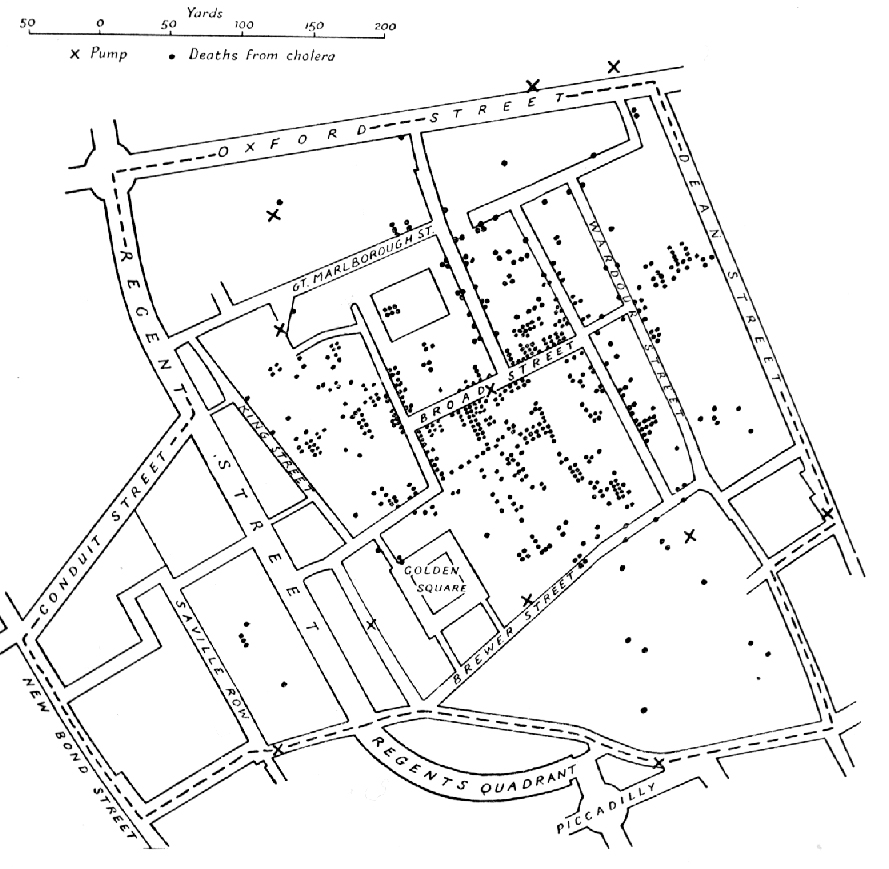
Did you know? One of the best-known maps in medical history shows something that can be easy to miss in a great city: drinking water that appears normal can still carry a dangerous disease. In 1854, a severe cholera outbreak devastated families around Broad Street in London’s Soho district. Physician John Snow investigated the pattern and connected many cases to a public water pump.
The popular version says Snow drew a map, removed the pump handle, and instantly stopped the outbreak. The true history is more interesting. Snow had argued for waterborne transmission years earlier, he used interviews and comparisons alongside mapping, the authorities removed the handle, and the outbreak had already begun to decline by that point. Later research made the role of water much clearer.
The question for a civilisation is not merely whether it owns water pipes. It is whether drinking water, sanitation, disease surveillance and public decisions protect everyone who relies on those pipes. Good infrastructure and sound reasoning make each other stronger.
London cholera in 1854: answers in one minute
| Question | Short, careful answer |
|---|---|
| Where was the major outbreak? | Around Broad Street, in the Soho district of London. |
| When? | A severe outbreak escalated around the end of August and beginning of September 1854. |
| What is cholera? | An intestinal infection caused by the bacterium Vibrio cholerae, usually spread through contaminated food or water. |
| Who investigated the Broad Street pump? | Physician John Snow, alongside important local investigative work by others including Reverend Henry Whitehead. |
| Was the pump handle removed? | Yes. Local authorities disabled the pump after Snow presented his findings. |
| Did removing the handle instantly end the outbreak? | That popular story is misleading; the number of new cases was already falling, though disabling a contaminated source was a prudent measure. |
| What did the map show? | Cholera deaths clustered around the pump, supporting analysis of a shared exposure. |
| What is the modern lesson? | Combine safe water, sanitation, reliable evidence and accountable response rather than relying on one heroic intervention. |
Soho before the outbreak: a city growing faster than its safeguards
Nineteenth-century London was growing rapidly. Dense neighbourhoods housed residents, workshops, shops and businesses. Many people obtained water from public pumps or private suppliers while waste disposal and drainage remained inadequate in some areas.
The Royal College of Surgeons’ historical account explains that Soho had serious sanitation problems, including cesspits and poor drainage. Crowded urban life meant a contaminated supply could expose many residents in a relatively small area.
There was no simple distinction between a modern thriving city and a dangerous old settlement. London had commerce, universities, medicine and sophisticated institutions. Yet one essential system—separating human waste from drinking water—remained unreliable for many households.
Did you know? The accepted explanation involved ‘bad air’
Many doctors and officials of the period linked cholera to miasma, the idea that foul air and smells carried disease. This belief was understandable in a city where dirty streets, overflowing waste and illness were often found together. But observing that things occur together does not show which physical mechanism causes illness.
Snow argued that cholera was often spread through material swallowed in water rather than through the air people breathed. He published a waterborne theory before 1854, in 1849, and later expanded his analysis. His reasoning was therefore not a sudden insight produced entirely by one map.
The distinction matters in science education. A person may notice the right pattern but explain it incorrectly. Good investigation asks what evidence would distinguish competing explanations and what prediction each explanation would make.
What is cholera, in modern scientific terms?
The World Health Organization identifies cholera as an acute diarrhoeal infection caused by consuming food or water contaminated with Vibrio cholerae. Severe illness can cause rapid dehydration and requires prompt medical care. Safe water, sanitation and hygiene are fundamental means of prevention.
This knowledge was not available to John Snow in its modern microbiological form. He did not isolate Vibrio cholerae as a laboratory discovery during the Soho outbreak. His contribution was to establish a strong epidemiological case for how exposure occurred, using patterns in human populations.
That difference illustrates the value of evidence before every mechanism is known. Public protection does not always have to wait for the last scientific detail, provided a reasonable intervention can reduce a serious suspected risk while investigation continues.
The sudden outbreak around Broad Street
At the end of August 1854, cholera became particularly severe around Broad Street. The London Museum’s historical narrative describes hundreds of deaths during the first days. The speed and concentration of illness made the outbreak especially alarming.
Residents relied on a public pump for water used in daily life. Snow suspected that the pump’s water was implicated, and he compared affected households with where people obtained their drinking water. His investigation involved talking to people and looking for shared exposures, rather than relying solely on broad theories about the city’s smell.
For families, the immediate experience was personal: a household member became gravely ill, neighbours were frightened and people struggled to know which everyday actions might be safe. Public-health infrastructure is valuable partly because it removes the need for every household to solve such a mystery alone.
Why water from a public pump can appear harmless
A pump may produce clear water with a familiar taste while still drawing from a contaminated source. Harmful microorganisms are generally not detectable through ordinary visual inspection. In an urban setting, a damaged separation between wastewater and a well or supply could introduce pathogens without making the water obviously dirty.
Snow’s investigation was notable because it sought evidence beyond appearance. He looked at who had drunk water from the suspected supply. This can be more informative than asking whether a street smelled foul or whether residents thought the water tasted good.
The general lesson is straightforward: the quality of drinking water must be verified using appropriate systems, not inferred from its appearance, reputation or the fact that a pump has been used for years.
The famous map: how to read it properly
Snow produced maps of cholera deaths in the affected district. His well-known map showed streets, pumps and bars representing deaths at particular addresses. The arrangement highlighted a concentration around the Broad Street pump.
A historical image can persuade readers quickly, but interpreting it requires care. A cluster is a clue to investigate, not mathematical proof that the nearest visible object caused every death. Investigators must ask whether people used other water sources, travelled across neighbourhoods or had different exposure patterns.
The UCLA John Snow archive explains differences between the versions of Snow’s maps and their publication history. That is why it is misleading to imagine one perfect diagram appearing on his desk before any other investigative work had been done.
Interviews matter as much as drawing dots
Snow did not have a modern automatic database of every person’s drinking habits. Information came from homes, local knowledge, records and inquiries. The Reverend Henry Whitehead also contributed important local investigative work that helped clarify the circumstances of the outbreak.
Human stories revealed details that a street map alone would miss. Two people living far apart could share the same water source. Someone located near the pump might obtain water elsewhere. An apparently empty area on a map could reflect a different population or a different water-using habit.
A useful model for public-health work is therefore map, interview, compare, revise. Each source of evidence corrects weaknesses in the others. The strongest conclusion emerges not from the prettiest map but from the explanation that withstands the most reasonable tests.
The story of the pump handle: what really happened?
Snow presented his suspicions to the local authorities, and the Broad Street pump handle was removed, preventing people from drawing water there. The act became a memorable image of science translated into practical protection.
However, a historical analysis in Social Science & Medicine stresses that the numbers of deaths were already declining before the handle was removed. The familiar claim that turning off the pump immediately ended the epidemic gives a false sense of certainty about the intervention’s measured effect.
This does not mean removal was pointless. When a shared supply is credibly suspected of spreading serious illness, reducing further exposure is sensible. It does mean history should avoid crediting a single dramatic gesture with everything that followed.
Why was the outbreak already slowing?
Outbreak curves can change for many reasons. Residents may have left the area, altered water use, fallen ill already or changed behaviour; the susceptible population and source of exposure may also vary. Establishing the exact contribution of each factor requires evidence beyond a date on a timeline.
The historian’s task is to distinguish an action was taken from that action alone produced the observed decline. If disease incidence begins falling before a measure, we need additional analysis before attributing the entire reduction to the measure.
Modern public health faces the same issue. Officials should act to protect people when evidence warrants action, then evaluate the result without claiming more certainty than the data support.
John Snow also studied different water companies
The Broad Street story is famous, but Snow’s work extended to larger drinking-water systems. He compared cholera outcomes among people served by different water companies in parts of south London, where the quality and sources of water varied.
The Royal College of Surgeons records his attention to the Southwark and Vauxhall and Lambeth water suppliers. These comparisons linked water obtained from more sewage-polluted sources to higher cholera incidence.
That is a strong example of comparative reasoning. If groups share many features of a city but have different water exposures, investigators can test whether their health outcomes also differ. It is not a perfectly controlled experiment, but it offers evidence that extends beyond one neighbourhood.
The role of sewage and separation
A modern city depends on reliable separation of treated drinking water from human waste. Collection, transport, treatment, monitoring and maintenance work together. A fault in one part can contaminate another if protective barriers are inadequate.
The Broad Street case belongs to an era when London’s rapid growth had exceeded parts of its sanitation capacity. Improving water and sewerage systems required engineering, public investment and administrative decisions sustained across years.
This is why focusing only on Snow’s personal heroism misses a large part of the civilisational story. Disease prevention also needed dependable infrastructure and collective responsibility for water quality.
What did Snow know—and what was discovered later?
Snow developed a strong argument about transmission through contaminated water. He did not possess all the microbiological knowledge that later scientists would develop. Subsequent work helped establish the bacterial cause and mechanisms of cholera.
Good history avoids two extremes. It should not claim Snow personally invented all modern public health. It should not dismiss his contribution because he could not yet identify the bacterium in today’s terms. His work showed how rigorous population evidence can make a dangerous pathway visible.
For students, this is how science often progresses: a testable hypothesis, careful observations, comparison, criticism and later refinement. Progress rarely arrives as a single solitary moment in which every question is resolved.
Why the outbreak matters beyond Victorian London
Cities everywhere depend on drinking water, sewage treatment and sanitation. These systems are vulnerable to maintenance failures, power disruptions, floods, shortages and unequal access. The precise technology differs, but the protective purpose is shared.
A future water-quality problem should be investigated using laboratory tests, distribution records, service maps, clinical data and household-level evidence as appropriate. No one source can substitute for all others.
The lesson is not that we should repeat the 1854 methods literally. It is that investigators should identify likely exposures, protect people, compare competing explanations and verify what changed after intervention.
From information to trust
During an outbreak, people want to know what is safe. Vague assurances can be damaging when the water system is actually compromised; unsupported panic can also cause harm. Effective public communication has to explain what is known, what remains uncertain, who is responsible for action and where updated instructions will be available.
Trust increases when authorities correct mistakes openly. A public-health team that revises a map after new evidence arrives is behaving better than one that hides the revision. Accuracy is a process rather than a claim of infallibility.
A civilisation becomes safer when residents can report unusual events, public institutions listen and independent evidence can change a decision.
A cause-and-effect chain: contamination to recovery
| Stage | Historical issue | Future protection question |
|---|---|---|
| Urban growth | Population outpaced sanitation capacity | Are water and waste systems keeping pace? |
| Exposure | Residents used an unsafe shared pump | Can contamination pathways be detected early? |
| Illness | Cholera cases clustered in time and place | Can clinical and location data be compared responsibly? |
| Investigation | Snow and others tested water-source hypotheses | Are rival explanations actively evaluated? |
| Intervention | Local authorities disabled the suspected source | Does action reduce exposure while investigation continues? |
| Repair | Longer-term sanitation improvements were needed | Has the system been made reliably safe, not merely temporarily closed? |
Four conditional futures for a water-dependent civilisation
These scenarios are hypothetical and not forecasts about any named modern city’s drinking water.
Scenario 1: a fault is found before illness spreads widely
Routine testing identifies a problem in part of a distribution system. Operators isolate the affected section, follow official response protocols, communicate with residents and investigate the physical cause. Independent retesting helps determine when service can safely resume.
The key feature is a functioning chain from detection to action and verification. Water quality is not assumed safe merely because no one has complained.
Scenario 2: residents report illness but the systems do not communicate
Clinics notice a cluster of gastrointestinal illness, while a water operator has separate records of an unusual maintenance incident. Neither system initially shares information. The possible connection remains hidden because evidence is divided across institutional boundaries.
The improvement is lawful, privacy-respecting coordination between relevant public-health and infrastructure teams. Linking records responsibly can reveal a hypothesis worth investigating without assuming every illness has one common source.
Scenario 3: the average is safe but one neighbourhood is neglected
Citywide reports show good water quality, yet a peripheral settlement has intermittent service, ageing pipes and limited testing. Residents rely on inconsistent alternatives. A national average conceals a local vulnerability.
A fair response requires sampling, local service data and practical remedies targeted to those who lack reliable supply. Safe water is not simply the performance of a treatment plant; it is the quality of what reaches the user.
Scenario 4: science becomes a habit of institutional learning
Authorities track complaints, routine measurements, near misses and maintenance records. They test hypotheses openly, explain decisions and document which actions worked. Students learn how evidence and infrastructure support one another.
This pathway does not imply that outbreaks can never occur. It means a community has strengthened its ability to notice hazards, prevent unnecessary exposure and correct failures before they cascade.
A five-minute exercise: what can a map prove?
Look at John Snow’s public-domain map. Identify the clustering of deaths around Broad Street. Then ask what additional information would help distinguish water transmission from a different cause.

Write three questions about household water use, two questions about timing, and one question about a location that does not follow the main pattern. Explain why an exception might strengthen an investigation if it reveals how exposure actually worked.
Finally, state clearly why the map cannot by itself prove that removing the pump handle instantly stopped every new case. You have now practised one of the most valuable habits in historical and scientific reasoning: separating correlation, intervention and demonstrated effect.
Why the simple hero story is attractive—and incomplete
People like stories with one villain, one discovery and one decisive act. The Broad Street pump narrative seems to provide all three: bad water, a brilliant doctor and a removed handle. It makes epidemiology memorable.
But The Lancet’s historical critique warns against turning a complicated evidence process into a myth. Snow’s work involved prior theory, local evidence, mapping, other investigators and later publications. The timeline of disease decline is also more complicated than the textbook legend.
Rejecting the oversimplified story is not an insult to Snow. It respects what he actually contributed. Students who learn the fuller history gain a more realistic picture of how important science reaches public decisions.
Compare cholera with other threats to city life
In London’s Great Smog of 1952, air pollution created a public-health emergency and later research refined the death toll. Cholera in 1854 involved contaminated water rather than coal smoke. Both histories show that everyday urban systems can carry risks unseen by the people depending on them.
The North China Famine of 1876–1879 raises another issue: a physical shortage becomes more damaging when institutions struggle to protect access to essentials.
Together they strengthen the theme of Do Civilisations Collapse or Transform?. A city’s safety often depends on quiet infrastructure and trustworthy information more than on the grand buildings by which it is remembered.
Frequently asked questions
When did London’s Broad Street cholera outbreak occur?
The intense local outbreak escalated at the end of August and beginning of September 1854, within a wider history of nineteenth-century cholera epidemics.
Did John Snow invent the germ theory of disease?
No. He developed strong epidemiological evidence for waterborne transmission, but he did not discover all the microbiological mechanisms later established by other researchers.
What did his famous map show?
It plotted cholera deaths near Broad Street and nearby water pumps, illustrating the clustering of cases and supporting investigation of a shared water source.
Did Snow remove the pump handle himself?
The local authorities disabled the pump following Snow’s presentation. Simplified retellings that describe him personally performing a dramatic solitary action are misleading.
Did the outbreak end only because the handle was removed?
The incidence was already declining before the intervention. Disabling the contaminated source was reasonable, but it cannot be credited with the entire subsequent decline without qualification.
Why wasn’t contaminated water obvious?
Water can look and taste normal while carrying pathogens. Visible cleanliness does not prove microbiological safety.
Is cholera still a real public-health issue?
Yes. The World Health Organization describes cholera as an ongoing global threat closely associated with inadequate safe water, sanitation and hygiene.
What should a modern city learn?
Protect the water supply, maintain sanitation, investigate illness patterns, act on credible evidence and explain clearly how decisions are verified.
Continue exploring Civilisation futures
- When the Air Becomes Dangerous: London’s Great Smog
- When the Sea Breaks Through: Netherlands 1953
- When Drought Meets Weak Relief: North China Famine
- Do Civilisations Collapse or Transform?
- Civilisation: The Beginner’s Guide
Sources and further reading
- London Museum — John Snow, Cholera and the Broad Street Pump. Local history and map.
- Royal College of Surgeons — Mapping Disease: John Snow and Cholera. Snow’s earlier work and wider investigations.
- UCLA — John Snow’s Broad Street Pump Mapping History. Different versions and historical context of the map.
- The Lancet — Map-making and Myth-making in Broad Street (2000). Historical analysis warning against oversimplified claims.
- Social Science & Medicine — Our Sense of Snow (2000). Critical evaluation of map and handle-removal narratives.
- World Health Organization — Cholera Fact Sheet. Current scientific understanding of transmission and prevention.
- Wellcome Collection — A Map Taken from a Report by Dr John Snow. Public-domain historic source.
- Wikimedia Commons — Snow Cholera Map. Nineteenth-century public-domain cartography.
Reviewed 25 October 2026. The featured visual is a historical cholera map created in the nineteenth century, public domain, not a modern outbreak map. The claim that pump-handle removal alone ended the epidemic is deliberately rejected in favour of the documented, more complex history. Future scenarios are hypothetical.