
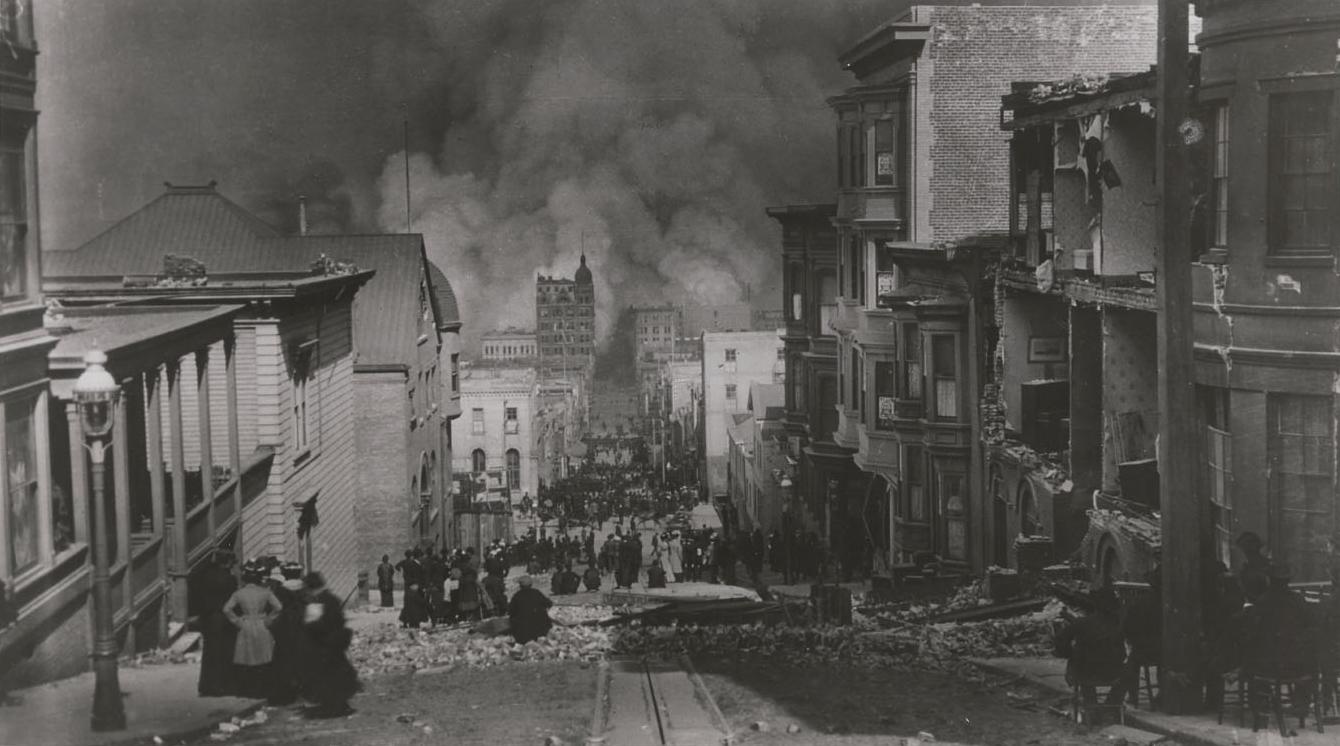
Did you know? The great San Francisco disaster of 1906 did not end when the ground stopped shaking. An earthquake broke buildings, roads and water pipes. Fires then spread through the city while firefighters struggled with damaged water supplies. For days, people faced a second catastrophe created in part by the damage of the first.
At 5:12 a.m. on 18 April 1906, the San Andreas Fault produced a major earthquake in northern California. The US Geological Survey describes a magnitude of about 7.8, more than 3,000 deaths and around 225,000 people left homeless in the combined earthquake-and-fire disaster. Historical estimates vary by source and method, but the scale is beyond doubt.
The city did not disappear. Survivors found shelter, relief networks delivered supplies, and rebuilding changed the urban landscape. Yet recovery was not equally easy for all residents. To understand what this means for the future of civilisation, we need to examine how essential systems fail together—and how communities rebuild when physical infrastructure, housing and public trust have all been damaged.
San Francisco 1906: the essential answers
| Question | Quick answer |
|---|---|
| When did the earthquake strike? | 18 April 1906, about 5:12 a.m. local time. |
| How powerful was it? | Approximately magnitude 7.8 according to a USGS account; differing historical methods produce slightly different estimates. |
| What made the disaster last several days? | Fires spread after the shaking, while damaged water infrastructure and other constraints hindered firefighting. |
| How many died? | More than 3,000 in the earthquake and ensuing fires, according to the USGS’s modern historical account. |
| How many were homeless? | The USGS cites 225,000; other historical sources offer somewhat different counts. |
| What happened to the city? | Extensive destruction followed by emergency shelter, relief and years of rebuilding. |
| What is the central lesson? | One hazard can disable the system needed to fight a second hazard. |
A great city built on connected systems
San Francisco was a busy port and commercial centre at the beginning of the twentieth century. Residents depended on banks, transport, water networks, gas supplies, warehouses, housing, hospitals and fire services. These were signs of a thriving modern city, but they were also interconnected.
A pipe might run beneath a street carrying water to homes and firefighters. A damaged building might block a road. A fire service might own effective engines yet lack the water pressure to use them. When many links are affected simultaneously, the normal meaning of preparedness changes.
Civilisation is often admired in terms of what it has constructed. The 1906 disaster shows the importance of asking how the structures behave together under stress.
Did you know? The earth moved for less than a minute, but the fires lasted for days
The main earthquake rupture shook the San Francisco Bay Area with great intensity. Buildings were damaged or collapsed, and infrastructure broke. Fire outbreaks began in the damaged city. According to the US National Archives, the fires burned for approximately three days, devastating nearly 500 city blocks.
The extended burning is why a simple description of San Francisco as only an earthquake disaster is incomplete. Seismic shaking set conditions for failures that continued after the physical earthquake had ended. The USGS also reports that the extensive conflagration produced much of the total damage to the city’s buildings.
This is an example of cascading risk: the initial event changes the likelihood and consequences of subsequent events. The chain matters as much as the original trigger.
Why broken water mains changed the meaning of fire
Water delivery is often taken for granted in a city. Pipes, reservoirs and other parts of the network have to remain usable for hydrants and firefighting. In 1906, damaged infrastructure made supplying water to certain areas extremely difficult just as multiple fires demanded it.
The USGS’s historical account explains that the pipeline bringing water into the city was severed and that fires spread after gas infrastructure was damaged. The inability to draw upon a reliable firefighting supply was a central problem.
The technical lesson is not merely “build stronger pipes.” It is to assess whether a city has ways of continuing a critical service when its ordinary supply chain is interrupted. Redundancy, isolation of damage and alternative sources require design and maintenance long before an emergency.
A fire service cannot operate on courage alone
Firefighters worked in extremely difficult conditions, but determination could not replace missing water, safe access or reliable communication. A heroic response matters, but an institution should not depend on heroism to compensate for predictable weaknesses.
Imagine a fire engine reaching a street where the hydrant has no pressure. The crew may be skilled and well equipped, yet the resource required to use its equipment is unavailable. Now imagine the same street blocked by rubble or burning buildings.
This is why a civilisation’s resilience cannot be measured only by the strength of its most visible emergency department. Firefighting depends on water, transport, communications and safe places to stage operations.
What do the casualty and damage numbers mean?
The USGS estimates more than 3,000 deaths, roughly 225,000 people homeless and more than 28,000 buildings destroyed by the combined effects of shaking and fire. These figures are widely used today, but surviving historical records do not provide a perfectly uniform census.
Some older reports used lower death totals. Public records and research subsequently reassessed the toll. A responsible article should therefore identify the source and not pretend that every estimate from different years means the same thing.
The USGS casualty and damage overview presents historical figures and the reasons counts differ. This is a useful exercise in source criticism: a large number should come with its date, method and geographic scope.
The lives behind the statistics
Some families lost relatives, homes or businesses. Others escaped injury but had nowhere secure to sleep. Workers needed new employment, students needed schooling, and local communities tried to reconnect with people whose addresses had been destroyed.
The city also contained unequal social groups before the earthquake. Rebuilding did not automatically remove discrimination. Residents of Chinatown, for instance, faced the destruction of their neighbourhood and proposals by officials to relocate them elsewhere.
The National Park Service’s history of Chinese displacement describes how the disaster intersected with existing prejudice and political interests. This is a reminder that a recovery plan can rebuild impressive streets while harming particular communities if their rights are not protected.
Relief arrived before rebuilding was complete
Emergency needs included food, clean water, shelter, medical care and communication with relatives. The National Park Service describes extensive relief operations involving the US Army, civic authorities, charitable organisations and the Red Cross.
Supplies came from beyond the disaster area. Distribution centres and temporary camps helped sustain people who had lost homes or access to ordinary services. Organising that support was itself a major logistical task.
The NPS account of relief efforts notes that more than 30,000 people depended on Army assistance for food and shelter, and that relief arrangements evolved during the emergency. Those figures refer to particular operations and times, not the total number of homeless people.
Temporary camps became a form of civilisation
When a family’s home is destroyed, a tent is far more than a piece of fabric. It is part of a temporary neighbourhood that needs sanitation, food, safety and everyday organisation. The US Army established or managed many organised camps after the disaster.
The National Park Service’s refugee-camp history explains the development of camp routines and later small wooden cottages. Families developed temporary patterns of everyday life while deciding how to return, relocate or begin again.
Civilisation continues in these ordinary activities: preparing meals, caring for children, sharing information, keeping order and restoring small services. Catastrophic loss can erase buildings without erasing people’s capacity to organise, though this continuity should not minimise suffering.
Medical care was another system under pressure
Earthquake injuries, burns and crowded camps created urgent medical needs. Workers faced the danger of disease spreading in temporary shelters without adequate sanitation. The NPS account of medical care and sanitation shows how officials organised medical assistance and inspected camp conditions.
This matters because surviving the initial event is only the beginning. People who endure an earthquake or fire may later face preventable illnesses, loss of access to medicines or unsafe living conditions. Recovery programmes must cover both immediate injury and the health of displaced populations.
Modern readers can ask how a future city would maintain medical power, communication, clean water and patient transport if the earthquake damaged multiple services at once.
Did rebuilding erase the losses?
No. The commercial centre and housing stock were rebuilt over time, and many people found new ways to live and work. But some personal, cultural and financial losses could not be reversed.
Reconstruction involved decisions about streets, buildings, property, financing and the balance between speed and safety. Different residents had different resources, legal protections and abilities to influence where rebuilding took place.
A city skyline may regain familiar shapes while the population’s experience changes permanently. This is why photographs of restored buildings must be accompanied by evidence about housing access, livelihoods and the treatment of those who suffered most.
The science of earthquakes advanced through evidence
The 1906 event became highly important to the development of earthquake science, particularly understanding fault rupture and the relation between accumulated strain and seismic movement. Scientific inquiry drew on ground displacement, damaged infrastructure and observations across the affected region.
That knowledge did not instantly make earthquakes predictable to the day or hour. Even today, earthquakes cannot be forecast with the precision many headlines imply. The scientifically useful approach is to understand hazards, construction performance and preparedness without pretending to know the exact time of the next event.
The USGS historical material allows readers to connect physical evidence with the development of seismic understanding.
A cause-and-effect model of the disaster
| Layer | What happened in 1906 | Future systems question |
|---|---|---|
| Earthquake | Strong fault rupture shook the region | Are structures designed and maintained for seismic risk? |
| Lifelines | Water and other infrastructure were damaged | Can essential networks keep operating after shaking? |
| Secondary hazard | Fires spread for days | Are emergency services prepared for multiple simultaneous fires? |
| Emergency response | Supplies and communications required rapid organisation | Can separate institutions coordinate quickly? |
| Housing | Hundreds of thousands lost homes | Is there a realistic plan for safe temporary accommodation? |
| Reconstruction | New buildings and services emerged over time | Does rebuilding reduce risk and respect the rights of residents? |
Four conditional futures after an urban earthquake
These are illustrative scenarios, not local earthquake forecasts or personal emergency instructions.
Scenario 1: shaking damages buildings but the lifeline system recovers
Critical networks have been evaluated for seismic failure. Alternative water and communication arrangements work, and emergency services can reach damaged districts. Losses still occur, but critical systems recover without a long cascade of secondary failures.
The goal is not to make a city invulnerable. It is to prevent an initial event from disabling every tool needed to respond to the next one.
Scenario 2: a small secondary fire grows into a systems crisis
A city has trained firefighters and good vehicles, but vulnerable water infrastructure fails over a wide area. Fires that might have been contained under ordinary conditions spread while crews search for alternative supply and access routes.
The important measurement is effective firefighting capability after the earthquake, not only the number of engines in service before it. Planning needs to test compound failure conditions rather than isolated equipment performance.
Scenario 3: recovery prioritises property values over displaced residents
Visible commercial areas are rebuilt rapidly, but lower-income families remain in temporary accommodation without stable schooling or employment. Some communities lose the neighbourhood institutions that sustained them.
This is a failure of social recovery even if construction statistics look strong. A more equitable plan measures safe housing, access to services, family continuity and the ability of affected residents to participate in decisions.
Scenario 4: reconstruction becomes a chance to reduce future harm
Authorities assess why structures and networks failed, involve professional scrutiny and revise practice. Rebuilding addresses vulnerable lifelines and provides more realistic disaster support, while historical lessons remain in education and public planning.
The process is never finished once a new building opens. Maintenance and periodic review are necessary so that improvements remain useful decades later.
A preparedness dashboard without false reassurance
Useful public indicators include the condition of critical water and power networks, backup arrangements, emergency access, communications, the availability of safe housing and the unresolved risks in essential public buildings.
But averages are misleading if they hide local pockets of weakness. A citywide percentage of inspected structures does not reveal whether the uninspected group includes hospitals or emergency routes. Risk needs to be understood by function and location.
Equally, an exercise is only valuable if it changes operations. A drill may expose that people cannot reach a certain district or that two organisations assumed the other was responsible. A good system records the problem, assigns responsibility and verifies the fix.
Did you know? Public memory can shape future preparation
San Francisco continues to commemorate the 1906 earthquake and fire. That history remains useful because residents have to make decisions about hazards whose consequences may not be visible in routine daily life.
Public archives, museums and photographs help show how the same city functioned before, during and after disaster. Yet memory becomes most valuable when it leads to current inspection, competent design and community planning rather than mere nostalgia.
The Library of Congress’s collection of Arnold Genthe photographs captures damage, people, rescue activities and temporary camps. A photograph provides evidence, but readers still need records explaining dates, conditions and the experience of communities outside the frame.
A classroom exercise: draw the second disaster
Draw a simple city with a water supply, hospital, fire station, roads, warehouses and schools. Imagine an earthquake affects several districts. Mark which services are needed to rescue people and control fires.
Now remove the main water supply and block two roads. What could no longer be done? Which other services depend on those two networks? How could backup arrangements change the result?
Finally, imagine that one neighbourhood has greater wealth and another houses many families with limited savings. Would the same reconstruction plan work equally for both? This exercise turns resilience into questions about systems and fairness, rather than a promise that disaster can always be prevented.
Comparing San Francisco with other civilisational shocks
Lisbon’s earthquake of 1755 provides a different historical combination of earthquake, tsunami, fire and institutional reconstruction. Both cities teach the importance of multiple hazards, but their periods, geography and political circumstances differ.
London’s Great Fire of 1666 is useful for thinking about density, combustible buildings, governance and rebuilding. San Francisco adds the role of earthquake damage to the systems needed for firefighting.
The 1953 Netherlands flood provides another example of an essential protection system being overwhelmed, with subsequent national investment. Each event belongs to a different hazard family but illustrates why public responsibility extends beyond individual structures.
Frequently asked questions
When was the 1906 earthquake?
On 18 April 1906, at approximately 5:12 a.m. San Francisco local time.
How large was it?
Modern USGS material commonly gives about magnitude 7.8. Some estimates differ slightly because of historic measurement methods.
Did the earthquake alone destroy the city?
No. Earthquake damage was severe, and fires spread for several days afterward, destroying additional districts.
Why couldn’t firefighters simply stop the fires?
Damaged water supply and other infrastructure, multiple fire outbreaks and access problems seriously constrained the response.
How many people died?
Modern USGS summaries estimate more than 3,000 deaths in the combined earthquake and fire disaster.
How many people became homeless?
The USGS cites approximately 225,000; some other historical sources use different counts. Each estimate should be identified with its source.
Did the city recover?
Yes, but rebuilding took time and did not reverse every loss. Different communities faced unequal challenges.
What is the strongest lesson for civilisation?
When one hazard damages emergency lifelines, secondary events can cause much greater harm. Effective resilience protects connected systems and the people who depend on them.
Sources and further reading
- US Geological Survey — The Great 1906 San Francisco Earthquake, event science and historic materials.
- USGS — Casualties and Damage, death, damage and homelessness estimates.
- USGS — Facing the Great Disaster, shaking and damaged infrastructure.
- US National Archives — San Francisco Earthquake, 1906, relief and historical images.
- National Park Service — Relief Efforts, supplies, camps and interagency response.
- National Park Service — Refugee Camps, temporary living arrangements.
- Library of Congress — Chinatown Before and After, historical comparisons and unequal experiences.
- Wikimedia Commons — San Francisco Earthquake photograph, Arnold Genthe, 18 April 1906, US public domain.

Reviewed 25 October 2026. The featured image is Arnold Genthe’s authentic 1906 view down Sacramento Street, not a digital reconstruction. Historical numerical estimates are sourced and may differ; modern scenarios are conditional and not location-specific emergency instructions.