
Where can you buy fresh bread, buns and pastries on Orchard Road in Singapore? Start with five verified destinations that serve different purposes. Wu Pao Chun at Paragon, #B1-11/12, is known for its artisan loaves, including its signature lychee-rose and red-wine-longan bread. Paris Baguette at ION Orchard, #B1-15B/15C, sells breads, sandwiches and pastries. BreadTalk at 313@somerset, #B2-33, is a convenient option for Singapore-style bakery favourites. The 313@somerset directory also lists Swee Heng 1989 Signature at #B3-23, and Marché at #01-40 describes house-baked bread within its wider restaurant concept. All five have official mall listings.
There is a lovely pleasure in carrying warm bread home, but the practical questions still matter. Are you buying a loaf for breakfast tomorrow, a bun to eat now, a gift to bring to friends or pastries for an office meeting? Should it stay soft, be toasted later or be eaten while the crust is crisp? Bread is not interchangeable simply because every shop smells inviting.
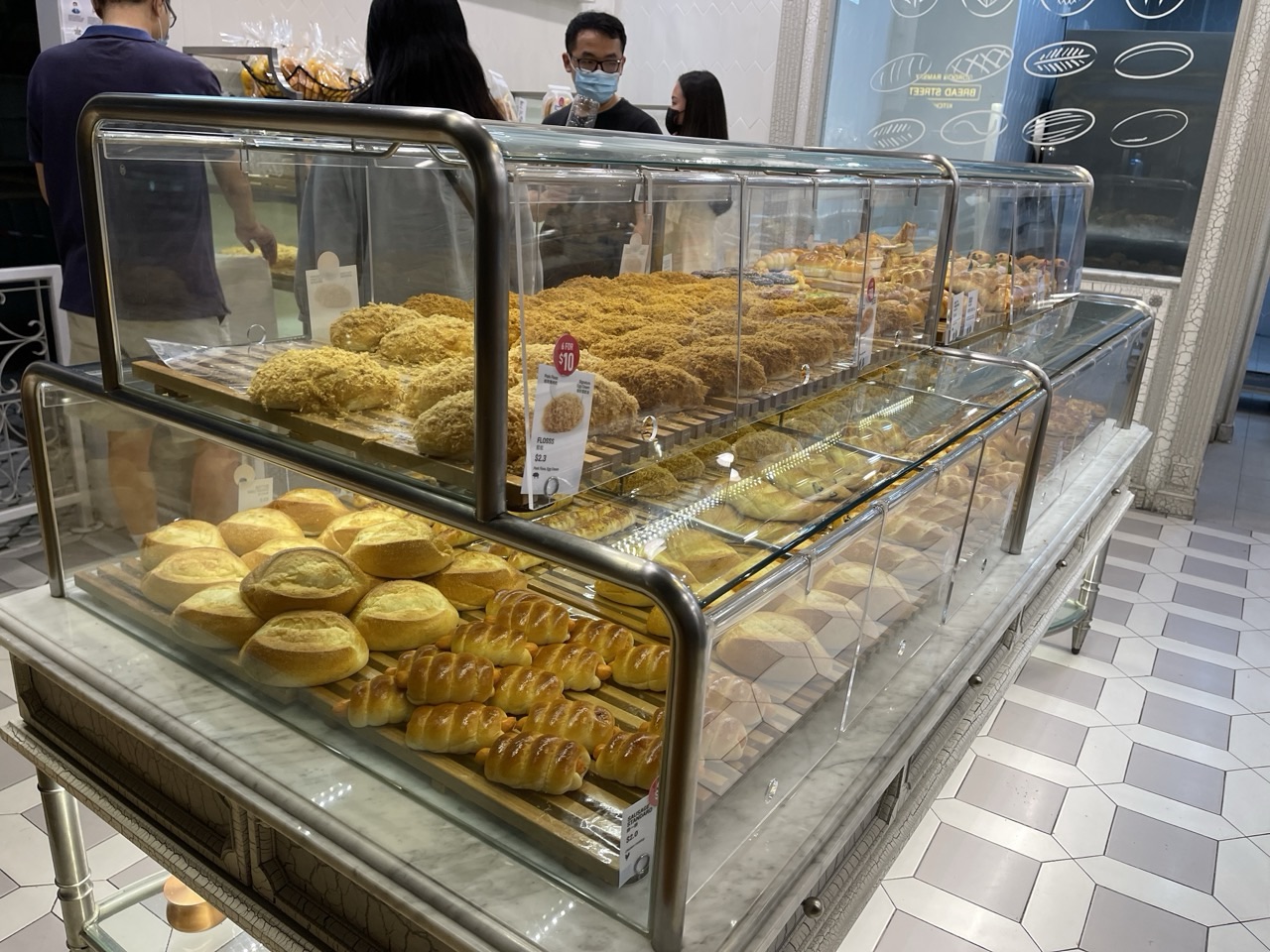
This October 2026 guide draws on original eduKateSG bakery-display and Orchard Road photographs. The pictures show real breads, cakes and customers, but unless the photograph explicitly identifies a retailer, it should not be taken as evidence of that shop’s current inventory. Specific flavours, promotions, allergen information and stock remain matters to confirm with the bakery.
Quick directory: bread and pastry shops on Orchard Road
- Wu Pao Chun Bakery: Paragon, 290 Orchard Road, #B1-11/12. The official mall page describes artisan bread, signature loaves and pineapple cakes.
- Paris Baguette: ION Orchard, 2 Orchard Turn, #B1-15B/15C. A bakery and café with breads, sandwiches, pastries and cakes.
- BreadTalk: 313@somerset, 313 Orchard Road, #B2-33. A Singapore bakery for convenient takeaway breads and buns.
- Swee Heng 1989 Signature: 313@somerset, #B3-23. The mall lists breads, cakes and confectionery inspired by Singapore and Taiwanese flavours.
- Marché: 313@somerset, #01-40. The official store description includes breads prepared as part of its bakery-and-restaurant offering.
- Orchard MRT is most convenient for ION; Somerset MRT serves 313@somerset; Paragon sits along the central Orchard shopping belt.
- Check whole-loaf availability, filling, ingredients, whether the product is sold by weight or piece, and the maker’s storage instructions.

Wu Pao Chun at Paragon: a bakery for specialty loaves
Paragon’s official Wu Pao Chun Bakery page places the bakery at #B1-11/12. Its description points to the Taiwanese founder’s baking awards and signature loaves, including Lychee Rose Royale and Red Wine Longan. That makes it a useful choice for someone seeking a more distinctive loaf rather than a quick everyday bun.
A specialty bread purchase rewards a little curiosity. Ask whether the loaf is best enjoyed on the day of purchase, whether it can be sliced, and how the baker recommends storing it. A large loaf may be perfect for sharing but inconvenient for a household of one unless portions can be managed.
The bakery’s described range includes breads influenced by distinctive flavours. If any ingredient is important to you, consult the actual product information. A flavour name such as red wine longan is not enough to determine whether an item fits someone’s dietary restrictions.
It can be a lovely gift for a person who enjoys bread, but check presentation and practical transport. A good loaf needs no extravagant story: something delicious, fresh and thoughtfully chosen is often enough.
Paris Baguette at ION Orchard: bakery convenience near Orchard MRT
ION Orchard’s current Paris Baguette listing gives #B1-15B/15C. The mall describes breads, pastries, sandwiches, cakes and drinks, which makes the outlet useful both for takeaway bakery items and an uncomplicated food stop.
If you want breakfast to carry away, choose according to what you will eat and when. A savoury filled pastry may need different handling from an unfilled croissant. A plain loaf might be intended for use over several meals.
Paris Baguette’s ION location is convenient when arriving by Orchard MRT. You can make the bakery a first stop for immediate food or a last stop for fresh bread to take home. The second option is often preferable when you plan to browse the area for several hours.
Ask the shop what was baked that day, which items are best for your intended serving time and whether a specific product contains allergens. A general chain description cannot establish those details for every recipe.
BreadTalk at 313@somerset: a straightforward takeaway stop
The official BreadTalk listing at 313@somerset identifies #B2-33. This offers a practical answer for commuters and shoppers searching for buns and fresh bread near Somerset MRT.
BreadTalk is a Singapore bakery brand, but the exact items displayed can change during the day. A particular bun mentioned in a review or seen on social media is not guaranteed to be on the shelf when you arrive.
If buying for a family, consider a mixed selection. Some people favour savoury fillings, others enjoy sweet buns, and some prefer bread to toast at home. A small variety can be more useful than buying a large quantity of one fashionable item.
Choose a suitable bag or box so that delicate pastries are not crushed under shopping. When you plan to carry bread for several hours, storage and filling ingredients become relevant.
Swee Heng 1989 Signature at 313@somerset
313@somerset’s official Swee Heng 1989 Signature directory entry locates it at #B3-23 and describes bread, cakes and confectionery that draw on Singapore and Taiwanese flavours.
The mall’s description refers to the company’s halal bakery heritage, but dietary or certification decisions should always be based on the current status of the particular premises and product, not a broad interpretation of a brand story.
A local-flavour pastry can be a thoughtful alternative to a standard plain croissant, especially for visitors wanting a taste of Singapore bakery culture. That does not mean every product is uniquely Singaporean. Ask which particular items reflect local ingredients or traditions.
This shop and BreadTalk are both in 313@somerset but on different basement levels. Remember the unit numbers to avoid searching the wrong floor.
Marché at 313@somerset: bread within a wider dining concept
The official Marché 313@somerset listing describes a restaurant with a bakery producing breads. The store is on Level 1, #01-40, according to the mall’s current page.
Marché is not the same kind of retail visit as a small grab-and-go bread kiosk. Its bakery operates as part of a larger food setting, so check how takeaway purchases work if you only want bread.
A house-baked loaf might suit a meal at home, while a quick bun from another bakery could be better for a short commute. Neither is universally superior; the right format follows the eating plan.
If browsing with children, keep the outing simple. One bakery purchase and a meal can be an enjoyable stop without requiring everyone to visit every retailer in the complex.
Which bakery should you visit first?
Start with the task. If you want an artisanal specialty loaf, Wu Pao Chun at Paragon is a clear candidate. If you are at Orchard MRT and want a quick pastry, Paris Baguette is conveniently placed in ION.
If you enter via Somerset MRT, 313@somerset gives you BreadTalk, Swee Heng and Marché without travelling farther up Orchard Road. That makes it a good cluster for comparing formats and prices at the place where you already are.
The choice between artisan bread and an everyday bun is not a measure of sophistication. It is a question of taste, freshness, budget and how you plan to serve it.
A shop with a long queue may be busy because of timing, promotions or popularity. The queue alone does not prove that its bread is right for you.
Artisan bread versus everyday bakery buns
The term artisan is often associated with attention to methods, fermentation or smaller-scale production, but it is not a universal protected guarantee of quality. Ask about the bread rather than relying only on the label.
An everyday bun may be soft, sweet or filled and designed for convenient eating. A crusty loaf may be intended for slicing and serving with meals. Both can be carefully made and enjoyable.
The practical difference is often texture and shelf life. Some crusty breads lose their fresh crust quickly in humid conditions, while certain enriched breads stay softer but may contain fillings requiring particular handling.
Buy according to the experience you want, not an assumption that one category is automatically healthier or better.
Sourdough: what makes it different?
Sourdough uses fermentation involving microorganisms such as yeasts and lactic acid bacteria in a starter. The exact process and flavour depend on the baker’s methods.
Not every loaf labelled sourdough will have a pronounced sour taste. Nor does the term establish that a bread is gluten-free or suitable for people with coeliac disease. Ordinary wheat sourdough still contains gluten unless specifically formulated and verified otherwise.
A properly fermented loaf can offer an appealing texture and aroma. Whether it suits you is a matter of product, taste and dietary needs.
Ask for the current ingredient information and storage advice if choosing a specialty loaf.
Baguettes, sourdough loaves and sandwich bread
A baguette is commonly associated with a long, narrow shape and a crusty exterior. Sandwich loaves often emphasise easier slicing and a softer bite. Specialty loaves may use different flours, inclusions or fermentation methods.
These differences influence how bread should be transported and served. A crusty baguette can be delightful with a meal but less convenient for a school lunchbox than a soft sandwich slice.
When buying for multiple days, think about how the bread responds to storage and toasting.
A good baker can explain which products are most suitable for your planned use, without promising that every loaf remains identical for several days.
Croissants: pastry texture and timing
Croissants use layered dough to create a flaky texture. They can be wonderful freshly baked, but the layers may soften or lose their crispness with time and humidity.
If you are buying for immediate enjoyment, the temperature and freshness you prefer matter. If you are taking croissants home, ask whether gentle reheating is recommended and follow the maker’s directions.
A filled croissant may require different storage from a plain one. Cream, custard or other perishable fillings deserve particular care.
Not every bakery at Orchard offers the same croissant or even a croissant every day. Confirm the actual product rather than assuming a French-sounding name guarantees it.
Danish pastries and sweet pastries
Danish-style pastries may include fruit, custard, cheese or other toppings and fillings. Their textures and ingredients can differ considerably even within one bakery.
A glazed fruit pastry may look attractive in a display case but be delicate when transported. A pastry box can sometimes protect it better than an ordinary paper bag.
Check ingredient and allergen information, especially if buying for someone else. A pastry can include eggs, dairy, wheat, nuts and other components.
If you are unfamiliar with the flavours, consider a small assortment rather than buying many pieces of a filling no one has tried.
Savoury buns: useful for a short meal
A savoury bun can be practical when a full sit-down meal is unnecessary. Yet the filling determines whether it needs refrigeration or prompt consumption.
Products containing meat, eggs or dairy should be handled according to the bakery’s guidance. Do not leave them for many hours at room temperature simply because they were sold alongside ordinary bread.
For a commuter, packaging matters too. Some filled buns can leak or become messy when carried in a crowded train.
A good quick snack is one you can eat safely and conveniently at the intended time.
Sweet buns and local bakery flavours
Singapore’s bakeries often combine familiar sweet-bread formats with regional flavour ideas. Coconut, pandan, red bean, custard and other fillings may appear, depending on the retailer.
These are descriptions of possible categories, not promises that the named stores carry each one at all times.
Choose based on the person’s preference and check the actual ingredients. A visually plain bun can contain filling; a brightly coloured one does not establish its composition.
Local bakery culture is enjoyable precisely because it includes familiar everyday food, not only elaborate premium desserts.
Whole loaves versus sliced portions
A whole loaf can be appealing for a shared meal, while sliced bread makes packed lunches and breakfast preparation easier. The best choice depends on when it will be used.
Ask whether the bakery can slice a loaf and whether slicing changes its recommended storage. A cut loaf can expose more surface area to air.
For a household that eats little bread, freezing suitable portions according to the maker’s guidance may reduce waste. But follow product instructions, especially for unusual fillings or toppings.
There is no prize for buying the largest loaf when most of it will remain uneaten.
How to tell whether bread will be soft or crusty
Appearance provides clues but not certainty. A dark crust, glossy finish or decorative scoring can look impressive without explaining the interior texture.
Ask whether the loaf is chewy, soft, dense or crisp and whether it is intended for immediate eating or toasting. Different breads can feel completely different.
The best choice for breakfast with butter might differ from a loaf intended for soup or sandwiches.
A simple conversation with the bakery staff often saves more disappointment than reading generic online rankings.
Bread for breakfast the next morning
When buying bread for tomorrow, consider the baker’s storage recommendation and the type of bread. Some products are enjoyable after toasting, while others are at their best shortly after purchase.
Do not assume that every fresh pastry can be held overnight without a change in texture. Cream-filled products may have specific refrigeration needs.
If the bakery is near the end of your route, buy the bread as you head home so it spends less time being carried outdoors.
For an early Orchard morning, see eduKateSG’s Orchard Road morning walking guide, which covers wider breakfast ideas.
Bread for school lunches
When purchasing bread for children, consider ease of eating, allergens, food safety and the school’s own food rules. A simple unfilled roll may travel differently from a custard bun.
Children’s tastes differ. Let the intended eater have some input, but read ingredient labels and assess portion size.
If the lunch will sit in a bag until midday, ask about appropriate storage and consider whether a filling makes the item unsuitable for that journey.
Bread can be a convenient part of lunch, but one bakery item does not by itself determine whether a child’s meal is nutritionally balanced.
Bread for an office meeting
For a workplace gathering, pastries can provide convenient individual portions. But it is worth asking how many people are expected and whether anyone has dietary restrictions.
A selection of savoury and sweet items may work better than a large number of identical pieces. Provide simple identification so guests can choose sensibly.
If the meeting starts much later than collection, plan storage, particularly for products with perishable fillings.
Some bakeries may accommodate advance bulk orders, but ask directly rather than assuming every branch guarantees them.
Bread as a housewarming gift
An artisanal loaf or pastry assortment can be a thoughtful gift when the household enjoys bread. Presentation can be simple: a good loaf in suitable protective packaging and a friendly note.
Do not choose a complicated flavour purely because it sounds luxurious. A familiar loaf may be more useful if the recipient has young children or prefers plain bread.
Consider the handover time and the recipient’s storage capacity. A fresh loaf is less useful when the recipient will be away for several days.
Good gifts fit people’s routines instead of creating pressure to eat something immediately.
Bread allergies and ingredient questions
Bread commonly contains wheat or other gluten-containing grains, and many pastries contain milk, eggs, nuts or other allergens. Fillings increase the number of ingredients to check.
If a person has a serious allergy, the shop should provide trustworthy information about the actual product and relevant cross-contact risk. Do not infer safety from the item’s colour, name or apparent simplicity.
Gluten-free is not established by the absence of visible wheat pieces. A product must be specifically formulated and appropriately verified for the intended dietary need.
When information is uncertain, choose another suitable food rather than guess.
Halal status and dietary restrictions
A Singapore bakery’s heritage or marketing description is not a universal certification for every product and outlet. Verify current halal certification using the appropriate official source when required.
Vegetarian, vegan and egg-free claims also require specific ingredient information. Some breads contain dairy, eggs, honey or other additions that are not obvious from appearance.
Alcohol-containing flavours or ingredients can be important to some recipients. Read the exact product details and ask for clarification.
Being considerate about food needs is more meaningful than buying the most fashionable bakery item.
Storing bread in Singapore’s humidity
Warmth and humidity influence how bread changes over time. Some loaves become softer on the surface, while others lose their crispness or develop mould under unsuitable conditions.
Follow the maker’s instructions. A crusty loaf may need different handling from an enriched bun or cream-filled pastry.
Do not assume the refrigerator is the best place for every plain bread. Refrigeration can change texture, while freezing suitable bread may sometimes be preferable for longer storage. Specific fillings still take priority.
Buy in quantities you expect to eat and inspect bread before consumption.
When can bread be frozen?
Some plain loaves and buns can be frozen when properly wrapped, but not every decorated or filled bakery item is suitable. Ask the bakery for its advice on the actual product.
For suitable bread, dividing into manageable portions before freezing can make later use more convenient. Packaging helps protect the food against drying and odours.
Follow safe thawing and reheating guidance. Do not assume a frozen product will reproduce the exact texture of a fresh pastry.
Freezing is a practical tool for avoiding waste, not a reason to purchase far beyond your normal needs.
How to reheat pastries thoughtfully
Reheating may restore some crispness to certain pastries, but temperature and method matter. Delicate creams and toppings may not tolerate heating.
Follow the bakery’s own directions rather than heating a product based solely on its appearance.
Avoid leaving heated food in unsuitable conditions for long periods. If the item was originally sold chilled, observe the storage rules.
A small improvement in texture is not worth risking product damage or food safety.
Reading price labels
Compare the actual price per piece or loaf, as appropriate, and check whether promotions require a minimum quantity. A bundle can be good value if all the items will be eaten.
Price is influenced by size, ingredients, labour and brand, but it cannot guarantee flavour preference.
An expensive specialty loaf might be wonderful for a gift, while a modest everyday bun can be exactly right for breakfast.
Do not use the price labels in old photographs as current prices; they document the moment of photography.
Which bread is best for a family?
There is no universal winner. Some families prefer a soft loaf for sandwiches, while others enjoy crusty bread at dinner or a selection of sweet buns on weekends.
Ask who will eat the bread, whether anyone has dietary restrictions and how many meals it should cover.
Consider storage and preparation. A loaf that requires careful slicing and immediate eating may be less practical for a rushed weekday morning.
Bread shopping should serve the household, not force the household to adapt to the shopping purchase.
Photographing Orchard Road bakery displays
eduKateSG’s October 2026 images show people viewing bakery cases, breads and pastries on shelves and cakes in display cabinets. These images fit an article about bread shopping because they show the experience readers are likely to recognise.
They do not establish freshness, ingredient lists, current price or the store’s exact identity unless a sign or verified caption supports that detail.
In a dependable local guide, the photograph illustrates what readers can see, while written shop information comes from trustworthy current sources.

A bread-shopping walk from Orchard MRT to Somerset
Begin at Orchard MRT and ION Orchard. Paris Baguette is officially listed on Basement 1. If a quick pastry is the only task, there may be no need to go any farther.
For a more distinctive loaf, continue towards Paragon for Wu Pao Chun. This part of Orchard includes several large malls and outdoor crossings, so consider the weather.
If your itinerary continues toward Somerset, 313@somerset has BreadTalk, Swee Heng 1989 Signature and Marché, providing several bakery styles near the MRT.
A route does not need to include every bakery. Choose one or two relevant stops and buy delicate items near the end rather than carrying them for hours.
What if your first bakery is sold out?
A popular product can sell out, especially at certain times. Ask when the bakery expects more stock or whether a different item with similar characteristics is suitable.
Do not assume the same product is available at another branch of a chain. Call the specific outlet if you are travelling for one item.
If you are buying for an important event, consider ordering ahead where the bakery permits it. A confirmed arrangement is better than relying on a photograph posted online.
A flexible choice of flavours often makes an ordinary shopping day more pleasant.
What about birthday cakes?
Bread, pastries and celebration cakes overlap in bakery displays, but they answer different buying questions. A whole birthday cake may require advance ordering, refrigerated transport and careful serving.
This guide concentrates on loaves, buns, pastries and everyday bakery takeaways. For detailed cake comparisons and celebration planning, use Where to Buy Birthday Cakes on Orchard Road.
Separating these topics gives readers a clearer answer than mixing every dessert, bakery and café into one enormous directory.
Frequently asked questions
Where is Wu Pao Chun on Orchard Road?
Paragon’s official directory lists Wu Pao Chun at 290 Orchard Road, #B1-11/12.
Is there Paris Baguette at ION Orchard?
Yes. ION’s current directory lists Paris Baguette at #B1-15B/15C.
Can I buy BreadTalk bread at 313@somerset?
Yes. The official mall directory places BreadTalk at #B2-33.
Is Swee Heng 1989 Signature at 313@somerset?
Yes. The mall lists the bakery at #B3-23. Check current items and certification details with the store when relevant.
Where is Marché at 313@somerset?
The mall’s directory lists Marché on Level 1, #01-40, and describes a bakery component to its dining operation.
What is the best bread to buy for breakfast?
Choose according to when and how it will be eaten. A soft loaf may be practical for sandwiches, while a pastry may be more enjoyable fresh. There is no universal best.
Are artisan breads gluten-free?
No. The word artisan does not establish gluten-free status. Check the specific ingredients and appropriate product verification.
Can I buy bread the night before?
Often yes, depending on the bread. Follow the maker’s storage advice, particularly for items with perishable fillings.
Does a bread bundle always save money?
Only if the quantity, price and products suit your actual needs. Buying extra food that goes to waste is not a meaningful saving.
Can I bring bread on the MRT?
Ordinary packaged bakery purchases can usually be carried with consideration for other passengers and the transport rules. Protect the food from crushing and follow its storage needs.
Is Orchard MRT closest to all Orchard Road bakeries?
No. Orchard MRT is convenient for ION; Somerset MRT is convenient for 313@somerset. Paragon is between the main shopping clusters.
What if I need an allergen-free product?
Ask the retailer for reliable ingredients and cross-contact information for the exact item. Do not guess from the name or photograph.
Bread and pastry shopping checklist
- Decide the meal, event or person the bread is for.
- Choose a convenient verified retailer.
- Check the whole-loaf or individual-piece format.
- Ask when the product is intended to be eaten.
- Review ingredient and allergen information.
- Confirm any required dietary or certification status.
- Check the filling and whether refrigeration is needed.
- Ask about storage or reheating instructions.
- Compare portion size with the price.
- Plan packaging and transport.
- Avoid buying too much for the household.
- Check if an unusual item needs advance ordering.
- Confirm the specific branch’s stock when important.
- Use Orchard or Somerset MRT according to the actual destination.
- Enjoy the bread without turning a simple purchase into a stressful itinerary.
More Orchard Road guides
For celebration desserts, read Where to Buy Birthday Cakes on Orchard Road. For an early outing, see Best Breakfast on Orchard Road and the Orchard Road Morning Walk.
For practical navigation, use Orchard Road Walking Guide.
Official retailer sources
- Paragon: Wu Pao Chun Bakery
- ION Orchard: Paris Baguette
- 313@somerset: BreadTalk
- 313@somerset: Swee Heng 1989 Signature
- 313@somerset: Marché
- 313@somerset current shop directory
- Singapore Food Agency
Updated October 2026. Verified mall pages establish the described locations and categories, not guaranteed stock or prices. The independent October photographs show bakery retail scenes without falsely attributing them to named outlets.