
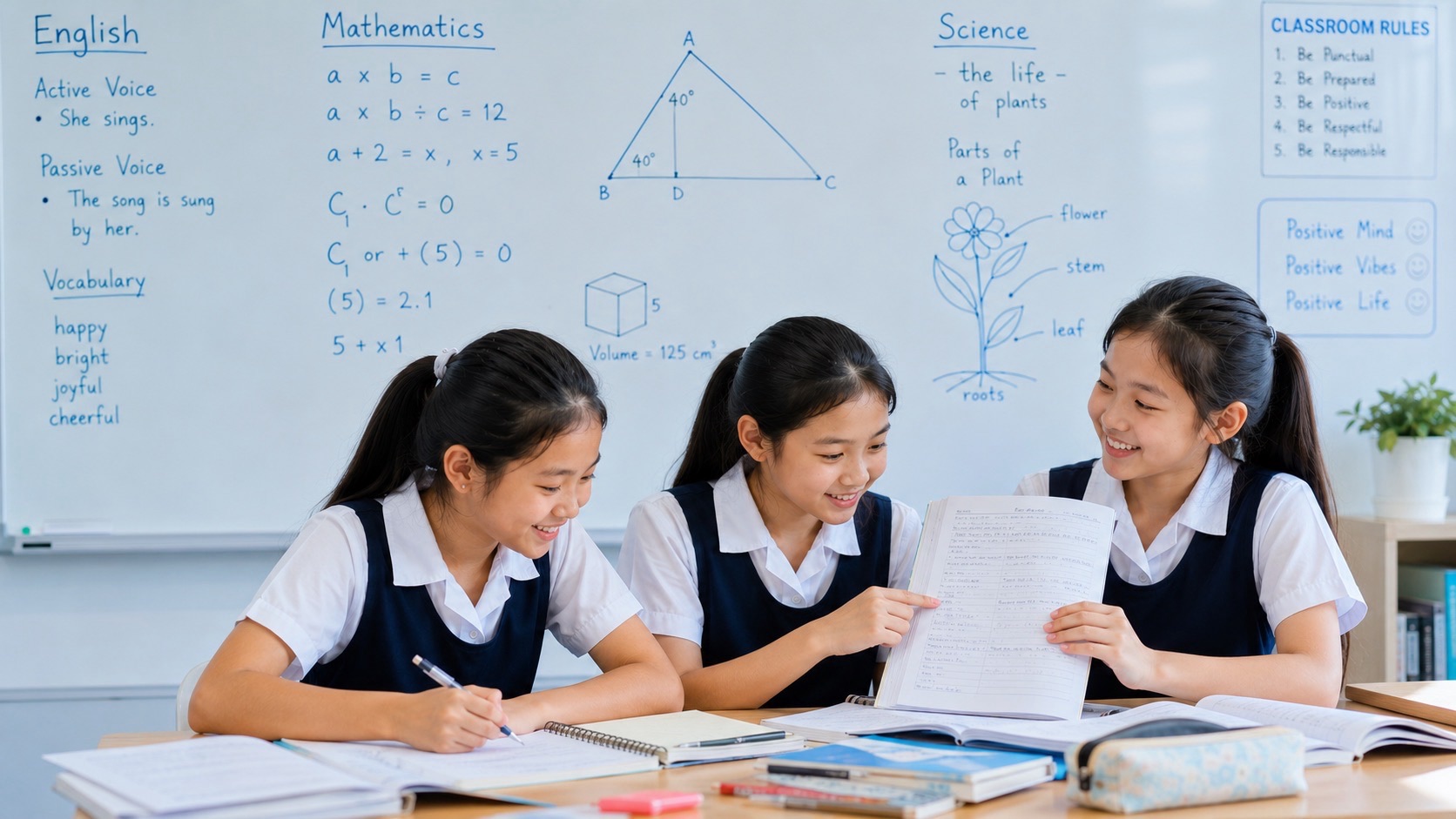
Should we shortlist Ahmad Ibrahim Primary School?
Did you know? Ahmad Ibrahim Primary School gives you two concrete starting points for a school-choice conversation: Sustainability Education – Nurturing Students to be Stewards of Our Environment and The 3Rs – Leader U Development programme- From Values to Action: Developing Community-based Student Leaders. Read the practical profile first, then use the school chapters below to explore what those opportunities could mean for your child.
Why this school specifically? Ahmad Ibrahim Primary School combines STEM – Sustainability through Sustainability Education – Nurturing Students to be Stewards of Our Environment with Community Service & Student Leadership through The 3Rs – Leader U Development programme- From Values to Action: Developing Community-based Student Leaders. If your child likes asking how things work, the STEM direction is worth investigating. Ask what pupils build, investigate or improve, and how they explain the reasoning behind a first attempt. For the service and leadership direction, ask what contribution looks like for ordinary pupils as well as those with formal appointments.
| Your decision | School-specific information |
|---|---|
| Campus in Yishun | 10 Yishun Street 11, S768643 |
| School setting | Co-Ed School; Government School; Single session |
| Applied learning | Sustainability Education – Nurturing Students to be Stewards of Our Environment — STEM – Sustainability |
| Learning for life | The 3Rs – Leader U Development programme- From Values to Action: Developing Community-based Student Leaders — Community Service & Student Leadership |
| Official source | MOE school profile · checked 6 October 2026 |
| School enquiries | Official school website |
Can our child realistically enter Primary 1?
Start with the registration year and eligible phase, your child’s citizenship and the home address recognised by MOE. Register for one school in a phase. Check the school’s dated vacancy and balloting history; a previous outcome is useful context, rather than a prediction of a future place.
For entry in 2028, use the framework applying from the 2027 Registration Exercise. It changes Phase 2C provision and introduces a Two-Track Scheme at 12 named schools. Check whether this school is included before relying on older distance advice. International students follow a separate application process. For an older child, ask about the appropriate transfer or admissions route.
Keep the admission-distance rules separate from the journey you test with your child. A short walking route is useful for daily life, but does not establish your official distance category or guarantee a vacancy. Check any address and residence conditions that apply to your application.
What does the dated P1 demand history show?
2025 P1 Registration Exercise — historical reference. These are the published figures for Ahmad Ibrahim Primary School. Read the phase you are eligible for. The total applicant count and the number actually entering a ballot are different measures.
| Phase in 2025 | Vacancies | Applicants | Balloting |
|---|---|---|---|
| 2A | 132 | 6 | Not required |
| 2B | 62 | 1 | Not required |
| 2C | 185 | 31 | Not required |
The phases shown did not require balloting in that exercise. That is useful historical context for a family’s entry discussion, but demand and intake can change. Verify the rules and places for your child’s actual registration year.
This school is not on the initial 12-school Two-Track list in MOE’s 10 September 2026 announcement and Annex A. Check the applicable Phase 2C reserved places and current admission-distance rules for your intended exercise; MOE may review the scheme’s school list.
Will the language provision and school setting fit?
Mother Tongue subjects listed for this school: Chinese Language; Malay Language; Tamil Language. Higher Mother Tongue listed: Higher Chinese Language; Higher Malay Language; Higher Tamil Language. Foundation Mother Tongue listed: Foundation Chinese Language; Foundation Malay Language; Foundation Tamil Language. Confirm where the relevant language is taught and the arrangements for your child’s level. Higher and Foundation subjects have their own placement conditions; the listing does not place a child in a course.
The published setting is Co-Ed School. Ask how that setting feels in an ordinary class, how new pupils are helped to settle, and how families raise a concern. Where the school has a religious or distinctive cultural ethos, discuss assemblies, values activities and everyday participation with the school so the family understands the experience.
Which activities could our child actually enjoy?
Examples from the primary CCA list: Art and Crafts (Girls and Boys); Badminton (Girls and Boys); Chinese Dance (Girls and Boys); Choir (Girls and Boys); Malay Dance (Girls and Boys); Photography (Girls and Boys); Rope Skipping (Girls and Boys); Scouts (Girls and Boys). The full MOE profile lists the other activities. Let your child choose two to ask about: one familiar interest and one they would like to try. Confirm the starting level, beginner access, places, selection and actual weekly commitment before building your care timetable around a CCA.
What support and after-school plan would we need?
Support listed in the primary profile: Barrier-free accessibility; Special Educational Needs Officers; P1 TRANSIT (Social and Behavioural Needs). Discuss the child’s specific needs with the school, including transition, classroom arrangements and communication with the family. A listed support service needs an individual conversation about suitability and access.
For student care, confirm the operator, vacancies, hours, fees, holiday arrangements and collection rules directly. School admission does not reserve a student-care place. Test the journey to 10 Yishun Street 11, S768643 at the time your household would travel, then include the return, rainy weather and any activity day. Use the current school notice for arrival, dismissal and gate access; a single-session label does not tell you the full timetable.
When might another primary school suit us better?
Compare Ahmad Ibrahim Primary School with another feasible school using the same family priorities. Its named programmes are attractive when they connect with an interest your child can explore. Another option deserves equal attention if it provides a much easier journey, confirms essential language or support arrangements, or offers workable care when this school cannot. A programme advantage needs to be weighed against the ordinary week.
Leave with a clear decision: “We are shortlisting Ahmad Ibrahim Primary School because our child could explore Sustainability Education – Nurturing Students to be Stewards of Our Environment and The 3Rs – Leader U Development programme- From Values to Action: Developing Community-based Student Leaders. Our entry route is ___. Our language and support arrangements are ___. Our daily journey and care plan are ___. The answer that could change our choice is ___.” Fill those gaps with checked information, then continue into the detailed school profile below.
Read the full school guide · Ask the school your remaining question
Explore the full school profile
Why go Ahmad Ibrahim Primary School? For families looking at primary schools in Yishun and the north of Singapore, Ahmad Ibrahim Primary School offers a warm, values-led education built around character, resilience, leadership, environmental responsibility, interdisciplinary learning and the belief that every child can grow into a lifelong learner. Its 2026 identity is unusually coherent: “Leaders of Character, Learners for Life”, supported by the motto “Grow with resilience” and the CaR3InG values of Compassion, Responsibility, Resilience, Respect, Integrity and Gratitude.
Located at 10 Yishun Street 11, Ahmad Ibrahim Primary School has served generations of families since 1995 and carries the name of Mr Ahmad Ibrahim, one of Singapore’s early political leaders. Parents searching for Ahmad Ibrahim Primary School review, AIPS programmes, primary school in Yishun, AIPS ALP, AIPS LLP, AIPS CCA or Why choose Ahmad Ibrahim Primary School will find that the school’s strongest story is not a single headline programme. It is the way leadership, sustainability, kindness, service, project work and resilience are designed to reinforce one another.
In 2026, Ahmad Ibrahim Primary School’s distinctive experiences include its 3Rs Leader U character-development Learning for Life Programme, sustainability-focused Applied Learning Programme, Totally Outrageous Day interdisciplinary project work, Programme for Active Learning for younger pupils, service-learning and kindness initiatives, National Education journeys and a broad curriculum that aims to prepare children not only for PSLE but for life beyond primary school. The school also reports overseas learning by Primary 5 groups in 2025; families should confirm current availability and participation arrangements. This article looks at why those experiences may make AIPS a strong fit for some children and families.
Visit Ahmad Ibrahim Primary School’s official website
Explore Awesome Schools in Yishun
Explore the History of Education in Singapore Atlas
The First Reason: The School Has a Very Clear Moral Vocabulary
Children spend an enormous amount of time in school, and they absorb far more than subject content. They notice how adults speak, how conflicts are resolved, what gets praised, what is tolerated and what happens when someone makes a mistake. That is why a school’s values are not decorative. They become useful only when pupils hear them often enough to apply them in ordinary situations.
At Ahmad Ibrahim Primary School, the CaR3InG values—Compassion, Responsibility, Resilience, Respect, Integrity and Gratitude—give the community a shared language. Each value can be translated into behaviour a primary-school child can understand. Compassion means noticing others. Responsibility means doing what you said you would do. Resilience means continuing when the first attempt fails. Respect means treating people and spaces with care. Integrity means choosing what is right even when nobody is checking. Gratitude means recognising what others contribute.
The strength of a compact values framework is repetition. A child can meet the same idea in class discussion, CCE, group work, leadership opportunities, service learning, sport and daily routines. Over six years, the vocabulary can move from something adults say to something the child uses internally.
For families who want a primary education in which character is deliberately named and practised, AIPS has a strong foundation.
“Grow With Resilience” Is More Useful Than “Be Perfect”
Ahmad Ibrahim Primary School’s motto, “Grow with resilience”, is a particularly healthy message for primary-age children because it contains movement. Growth assumes that the child is unfinished. Resilience assumes that development will include difficulty.
That is realistic. A Primary 1 child may cry after a disagreement. A Primary 2 child may forget homework. A Primary 3 pupil may struggle when Science begins. A Primary 4 pupil may become frustrated by a harder Mathematics topic. A Primary 5 child may feel pressure as workload increases. A Primary 6 pupil may worry about PSLE and secondary-school choices.
None of these moments automatically signals failure. They are opportunities to learn recovery. The adult task is not to remove every obstacle but to keep difficulty within a range the child can learn from.
A school that explicitly values resilience can help families frame those moments differently. Instead of asking, “How do we make sure my child never feels uncomfortable?” the question becomes, “How do we help my child handle discomfort constructively?” That shift can protect children from both unnecessary pressure and unnecessary rescue.
Resilience should never become an excuse to ignore genuine distress. It works best alongside compassion, which is why the school’s values framework is useful. Children need challenge and care at the same time.
Leadership for Every Child: The 3Rs Leader U Learning for Life Programme
Ahmad Ibrahim Primary School’s Learning for Life Programme is built around character-based leadership. The school’s stated belief is that every pupil can be an agent of change for family and society, and that children are not too young to serve the school and wider community.
This is an important interpretation of leadership. If leadership is reserved only for prefects, captains and confident speakers, many children spend six years believing that leadership belongs to someone else. If leadership means taking responsibility, serving, influencing positively and acting on values, every child has an entry point.
The 3Rs Leader U programme uses Values-in-Action experiences to help pupils practise social responsibility. This makes leadership concrete. A child may plan, help, organise, encourage, communicate or contribute to a community need. The project is useful not because a certificate says “leadership”, but because the pupil experiences the consequence of taking action.
For quieter children, this can widen the definition of leadership. They can lead through reliability, listening, preparation or care. For outspoken children, the programme can deepen leadership by adding service and empathy. For children who are reluctant to take initiative, repeated opportunities can make responsibility feel normal rather than intimidating.
Read about AIPS’s Learning for Life Programme
Sustainability Education: Learning to Become a Steward, Not Just a Spectator
AIPS’s Applied Learning Programme focuses on sustainability education and the idea of nurturing pupils to become stewards of the environment. The word “steward” matters. It suggests responsibility for something that extends beyond personal convenience.
Primary children are surrounded by environmental topics—climate change, waste, biodiversity, food, water, plastic, energy—but these can feel too large or frightening if presented only as global crises. A good primary-school approach makes the issues observable and actionable.
AIPS uses inquiry-based and investigative case-based learning, with experiences such as the Primary 3 Eco Camp and Every Child a Seed programme. Growing a plant may appear simple, but it teaches patience, attention and cause-and-effect. The plant does not respond to good intentions. It responds to light, water, soil, care and time. That is a gentle but powerful lesson in responsibility.
An eco-camp can similarly transform sustainability from a chapter in a textbook into something pupils see and discuss. Biodiversity becomes an environment full of living relationships. Resource conservation becomes a set of choices. Environmental care becomes behaviour.
For children who love nature, Science or hands-on learning, this creates obvious engagement. For children less naturally interested, the programme can still build systems thinking: actions have consequences, problems have interacting causes, and improvement requires observation.
Explore AIPS’s sustainability Applied Learning Programme
Interdisciplinary Project Work: Why “Totally Outrageous Day” Is More Serious Than the Name Sounds
Ahmad Ibrahim Primary School’s interdisciplinary project work includes the memorably named Totally Outrageous Day Project Work. The playful name suits primary school, but the educational idea is substantial: pupils tackle real-world problems using knowledge from different subjects and practise creativity, teamwork and communication.
This kind of project matters because life does not arrive in timetable periods. A real problem does not announce, “This is a Mathematics question now.” It may require reading, measuring, researching, discussing, designing and presenting all at once.
Interdisciplinary work helps children build bridges between subjects. English becomes the language for explaining an idea. Mathematics supports data and comparison. Science helps pupils understand mechanisms. Art and design make thinking visible. ICT can support research and presentation. CCE shapes how the group works together.
The group-work dimension is also educationally rich. Children must learn to divide tasks, listen, disagree, wait, compromise and recover when another member does not do exactly what they expected. These social skills are not side effects; they are part of becoming an effective learner.
For families who want school to develop more than worksheet competence, interdisciplinary project work is one reason to consider AIPS.
Programme for Active Learning: Primary 1 and 2 Should Still Feel Like Childhood
AIPS’s Programme for Active Learning gives Primary 1 and 2 pupils experiences in visual art, drama, dance, outdoor education, sports and games. The purpose is broad exposure, enjoyment, curiosity, confident expression and the development of social-emotional skills.
This is important because the move into Primary 1 can tempt adults to become overly academic too quickly. Young children still learn through movement, play, imitation, storytelling, rhythm and hands-on activity. PAL protects space for these modes of learning within curriculum time.
A child who struggles to sit still may discover focus through dance. A shy pupil may begin speaking more confidently through drama. A child who finds written work difficult may experience competence in art or sport. A child who prefers solitary play can practise cooperation in a structured setting.
These experiences also help teachers see pupils more fully. The child who appears quiet during English may be highly expressive in movement. The child who rushes written work may show patience in art. Holistic education becomes real when school has enough different contexts for these qualities to appear.
See AIPS’s Programme for Active Learning
Kindness Is Treated as Something Children Can Practise
AIPS’s CCE experiences include Kindness Day, Friends of Singa, classroom responsibility initiatives, service learning and opportunities for pupils to shape aspects of school life through programmes such as Aspirations@AIPS.
Kindness programmes can become superficial if they are only about slogans. Their deeper value appears when children must make choices. Do I include someone? Do I leave the classroom cleaner than I found it? Do I listen to an elderly resident? Do I use my idea to improve a shared space?
The school’s Primary 6 service-learning report describes visits to All Saints Home from 29 October to 10 November 2025. Pupils prepared performances, games and crafts for residents. This past example of intergenerational learning shows how children can spend time with people whose life experiences are very different from their own. The educational outcome is not only “community service hours”; it is the expansion of the child’s social world.
For parents who want children to grow up capable without becoming self-absorbed, these programmes support an important balance: achievement and contribution can coexist.
Explore AIPS Character and Citizenship Education experiences
A Yishun School With a Strong Sense of Place
Ahmad Ibrahim Primary School is located in Yishun, a mature northern town with a long education history and a wide range of primary and secondary schools. For families living nearby, location can be one of the school’s quiet strengths.
A primary-school commute repeats almost every weekday. A practical journey can protect sleep, reduce morning conflict, make CCA days easier and allow children to gain travel independence earlier. Parents also benefit when attending school events, collecting an unwell child or coordinating siblings.
The useful question is not merely how many kilometres separate home and school. Families should test the actual journey at school time. Notice bus frequency, walking routes, sheltered connections, traffic crossings and how tired the child is likely to feel.
A school that fits educationally and geographically can give a family a great deal of everyday freedom. That practical ease is often underrated during school selection.
Explore the wider Yishun school landscape
The School’s History Gives Its Values More Context
AIPS was established in 1995 and named after Mr Ahmad Ibrahim, who served Singapore in the early years of nationhood as a Member of Parliament and minister. The school describes his courage, determination and pride in nation-building as part of the inspiration behind its identity.
This historical connection gives the school’s leadership language a local Singapore context. Leadership is not presented only as personal success. It is connected to service, community and contribution.
For primary pupils, history becomes meaningful when it is attached to people and places they encounter. A school name can become an entry point into Singapore’s story. National Education journeys and commemorative activities can then deepen that relationship.
Families interested in education that is rooted locally while preparing children for a changing future may appreciate this balance.
English: Building the Language Children Need to Think, Connect and Explain
English in primary school is the language of much of the curriculum, but its importance goes beyond examination papers. Children use English to ask questions, understand instructions, negotiate friendships, explain reasoning, read widely and express identity.
AIPS’s broader emphasis on leadership and project work gives communication a real purpose. A pupil who presents a sustainability idea, works in a group or serves the community needs to organise thoughts clearly. Language becomes a tool for action.
Parents can support this without recreating school at home. Read together. Discuss a news story. Ask the child to explain a game. Let the child order food or speak to an adult politely. Encourage complete thoughts rather than correcting every sentence mid-conversation.
The goal is confident, accurate communication that remains alive and useful. Children who experience language as something they can use are generally more willing to read, write and speak with increasing complexity.
Mathematics: Resilience Is Especially Valuable When Answers Can Be Wrong
Mathematics can reveal a child’s learning mindset very quickly. A wrong answer is visible. A method may fail. A word problem may look unfamiliar. Some pupils enjoy this clarity; others experience it as threat.
AIPS’s resilience culture can support healthy mathematical learning if pupils are encouraged to inspect mistakes rather than fear them. When a child learns that an error can be located, explained and corrected, Mathematics becomes less personal. “I got this step wrong” is very different from “I am bad at Maths.”
Strong primary Mathematics should develop number sense, fluency, visualisation, problem-solving, reasoning and the ability to communicate working. Families can help by asking children to compare methods or estimate whether an answer is sensible instead of focusing only on speed.
That approach aligns naturally with a school that repeatedly asks pupils to grow through challenge.
Science: Sustainability Gives Inquiry a Real-World Destination
Primary Science becomes more memorable when pupils can see why a concept matters. Plant systems, materials, energy, water, ecosystems and human impact all connect naturally to AIPS’s sustainability programme.
Inquiry-based learning encourages pupils to observe carefully, ask testable questions, control variables and interpret evidence. These habits are valuable even if a child never becomes a scientist because they train the mind to distinguish assumption from observation.
A sustainability context also introduces ethical thinking. Science can tell us what happens; values help us decide what we should do about it. That intersection between knowledge and responsibility is one of the more interesting features of the school’s programme design.
Mother Tongue and Multicultural Singapore
AIPS serves a diverse Singapore community, and Mother Tongue learning sits naturally beside the school’s values of respect and compassion. Language gives children access to family histories, cultural practices, stories and different ways of expressing ideas.
National Education learning journeys and multicultural activities can help pupils see Singapore not as an abstract concept but as a society built by people with different backgrounds and contributions.
For children who speak Mother Tongue at home, school can extend vocabulary and literacy. For children who use English more often, school may provide the consistency needed to keep the language active.
Parents can support this by valuing communication before perfection. A child who is willing to speak, listen and enjoy the language has a foundation on which accuracy can grow.
Leadership Camps and the Power of Shared Difficulty
AIPS’s leadership development includes yearly leadership camps. Camps are valuable because they change the environment. Away from the exact routines of a normal class period, children must solve tasks, collaborate, follow instructions and sometimes manage fatigue or frustration.
Shared difficulty can build relationships. Pupils see classmates differently when they work through a challenge together. The child who is not academically prominent may prove excellent at navigation, encouragement, organisation or practical problem-solving.
These moments widen peer perception and self-perception. Children discover that competence has many forms.
The best camp outcome is not a dramatic transformation overnight. It is a small increase in confidence: “I did something I thought would be hard.” Those memories can later support resilience in academic settings.
Overseas Learning: Perspective, Independence and Cultural Curiosity
AIPS’s published overseas reports describe 20 selected Primary 5 pupils visiting Shanghai in April 2025 and 21 Primary 5 pupils visiting Kuching in May 2025. These are past group experiences; ask the school about opportunities and participation for your child’s year. The educational value of such journeys comes from more than travelling. Participants encounter unfamiliar settings, observe different routines, manage themselves away from home and represent their school.
Preparation is part of the learning. Children think about safety, culture, communication, packing and group responsibility. During the trip, they practise flexibility. Afterwards, reflection helps convert experience into understanding.
Families who value global awareness may appreciate these opportunities, while also remembering that a child can build cultural curiosity locally through museums, neighbourhoods, books, food, languages and conversations.
The strongest global learner is not simply well-travelled. It is a child who notices difference without rushing to judge it.
School Facilities Matter, But How They Are Used Matters More
Parents naturally notice facilities during school visits. Learning spaces, sports areas, gardens, technology and specialised rooms can support rich experiences. AIPS highlights facilities that include learning spaces, eco gardens, sports halls and student-care support.
The better question, however, is how spaces are used. An eco garden becomes educational when pupils observe, measure, care and ask questions. A hall becomes meaningful when children perform, compete and gather as a community. A classroom becomes powerful when pupils feel safe enough to contribute.
Families should therefore look beyond whether a facility appears new. Ask what children actually do there, how often they use it and how it connects to the curriculum.
Parent Communication: Respectful Partnership Is Part of the School Culture
AIPS publishes clear communication guidance for families, including official channels, school-hour expectations and response timelines. That may seem administrative, but it reflects an important principle: healthy school-home partnership needs boundaries and mutual respect.
Teachers work most effectively when they can teach during teaching time and communicate through reliable channels. Parents work most effectively when they know how to raise concerns and what response window to expect.
The school’s guidance that communication should remain respectful also models something children need to learn. Adults can disagree, seek clarification or raise serious concerns without demeaning one another.
For families, this clarity can reduce uncertainty and help establish a professional partnership around the child.
Read AIPS’s official parent communication guidance
What Kind of Child Might Find AIPS a Good Fit?
- A child who benefits from explicit values: CaR3InG gives children memorable language for choices and behaviour.
- A child who needs to build resilience: the school’s motto and leadership culture repeatedly frame challenge as part of growth.
- A child who loves nature or environmental topics: sustainability learning offers authentic contexts for inquiry and responsibility.
- A child who enjoys projects: interdisciplinary project work creates room for collaboration, design and presentation.
- A child who learns through movement and expression: PAL exposes younger pupils to art, drama, dance, outdoor education and sports.
- A child who is ready to serve: VIA, service learning and kindness programmes connect leadership to contribution.
- A quieter child: leadership is not limited to formal titles, allowing responsibility to be practised in many forms.
- A highly energetic child: camps, CCA, PAL and applied experiences create constructive outlets beyond desk-based learning.
These are not labels. A child who seems shy at six may be outspoken at ten. A child who initially dislikes outdoor activity may discover an interest later. Primary school should leave enough room for surprise.
A Six-Year AIPS Journey: How the Pieces Can Build on One Another
Primary 1: Safety, routines and the beginning of identity
The first year should help children understand how school works and who they are within it. PAL, class routines, early CCE and relationships create the emotional foundation. Success means more than worksheets: the child learns to ask for help, manage belongings, join a group and recover from small setbacks.
Primary 2: Confidence through participation
Pupils can take more responsibility and participate with less adult prompting. Art, movement, language, class roles and everyday routines help children discover different forms of competence.
Primary 3: Science, sustainability and wider inquiry
Primary 3 is an important stage for AIPS’s environmental strand, with experiences such as eco learning and plant-growing. Children are old enough to track change over time and connect personal action with environmental outcomes.
Primary 4: Collaboration, responsibility and growing interests
As academic demands increase, pupils can take more complex roles in project work and CCA. They begin to understand that being a good team member requires preparation and follow-through, not only friendliness.
Primary 5: Leadership and perspective
Upper-primary pupils can manage larger responsibilities, participate in camps or wider experiences and begin thinking about secondary-school possibilities. Interests become more visible and self-knowledge becomes more useful.
Primary 6: Service, transition and a wider horizon
The final year brings PSLE, service learning, Education and Career Guidance and transition. Ideally pupils leave with more than subject knowledge. They should understand how they respond to difficulty, how they contribute to a group and what kinds of environments help them thrive.
PSLE Preparation Works Best When It Is Built on Earlier Habits
By Primary 6, examination preparation becomes more visible. Yet the strongest preparation begins years earlier with reading, number sense, careful work, self-correction, organisation and the ability to persist when something is not immediately easy.
AIPS’s resilience message is relevant because PSLE inevitably includes pressure. Children need routines that help them interpret practice papers, corrections and scores as information rather than verdicts on their identity.
Parents can support this by separating effort, strategy and result. A disappointing mark may require more practice, a different method, better sleep, greater attention or a conceptual repair. The useful conversation is specific.
The aim is not to pretend PSLE is unimportant. It is to keep one examination in proportion within a child’s larger development.
Twenty Parent Questions That Reveal More Than a Ranking
The practical activities and questions in this decision guide are suggestions for family conversations, rather than school assignments or accounts of observed lessons. Use them to notice your child’s present needs and interests. Confirm current programme access, participation requirements and support with the school for the intended cohort.
How does my child react to challenge?
If difficulty quickly becomes tears, anger or avoidance, a resilience-rich environment may be particularly relevant. Ask how teachers scaffold challenge, how corrections are handled and how children are taught to try again without feeling ashamed.
When a task goes wrong, pause and identify the specific difficulty before deciding what to try next. A shorter step, another explanation or a little rest may help more than repeating encouragement. Let your child describe what changed on the next attempt. Ask how teachers support this process in class. Resilience develops through manageable challenge and useful support, with room to acknowledge frustration honestly.
Does my child care about fairness and other people?
Children who notice social situations deeply may connect with service learning and kindness programmes. They can learn to move from empathy into useful action rather than carrying concern without knowing what to do.
Let your child describe a time someone made it easier for them to join an activity. Ask what that person noticed and what they did. Then consider a small way your child could include someone else without deciding for them. Care becomes more understandable through these ordinary actions. At a school visit, ask how teachers guide inclusion, friendship difficulties and help-seeking for children who are still learning.
Would hands-on sustainability learning excite my child?
Some pupils light up when they can grow, build, observe or investigate. AIPS’s environmental ALP can give those children a meaningful context while also introducing less naturally interested pupils to real-world responsibility.
Observe one ordinary use of a resource, such as paper or water, and discuss a small change that could reduce waste. Check whether the change is practical and what evidence would show a difference. Keep responsibility proportionate to the child’s age. This family illustration helps connect concern with observation and action. Ask the school how environmental learning is introduced across levels and which additional opportunities involve selected participation.
Does my child enjoy group projects?
Interdisciplinary project work rewards communication and collaboration. Children who love groups may need to learn listening; children who prefer working alone may gradually build confidence in shared tasks.
Give two people a small shared task and agree on roles before beginning. Afterwards, ask whether both understood the plan, had a chance to contribute and completed what they promised. A child who prefers leading can practise listening; a quieter child can practise stating a useful idea. These observations help families ask the school about collaboration as a teachable skill rather than a fixed personality trait.
How important is a neighbourhood commute?
If the family lives near Yishun Street 11, everyday convenience can be a major advantage. Test the actual morning journey and imagine repeating it through rainy days, CCA days and upper-primary schedules.
Test the actual morning route with the reporting time in mind, including the walk from transport to the gate. Consider wet weather, a delayed connection and the journey home after an activity. Record the time the child would need to wake, rather than only the travel distance. A route that the family can sustain protects the energy needed to make good use of school opportunities.
Does my child need more opportunities to lead?
Leadership at AIPS is framed broadly, which can help children practise responsibility before they ever hold a formal title.
Give your child responsibility for one small part of a shared activity, including checking what others need. Afterwards, discuss whether the plan helped everyone participate and what they would change. Leadership becomes more understandable when it includes listening and follow-through. Ask the school how pupils practise these actions and which formal roles require additional selection or training. A useful beginning need not depend on receiving a badge.
How does my child respond to praise?
Some children become dependent on approval. A values-and-resilience culture can support a shift from “Am I good?” to “What did I learn and what can I improve?”
When recognising effort, name the action that helped: asking for clarification, checking a detail or returning to a difficult step. Ask your child what they learned from it. Specific recognition gives them something to repeat independently. It also leaves room to discuss an unsuccessful approach calmly. Families can encourage motivation by connecting praise with useful decisions, rather than expecting the child to maintain a permanent label such as brilliant.
How does my child respond to another child succeeding?
Healthy leadership includes being able to celebrate peers, learn from them and continue working without turning comparison into resentment.
Invite your child to describe something a peer did well and one idea they could learn from it. Appreciation does not require dismissing their own effort or copying another child’s route. Discuss the different kinds of contribution a group needs. This helps families turn comparison into curiosity. Ask how the school encourages pupils to recognise one another’s progress while pursuing their own manageable goals and receiving appropriate support.
Does my child like performing or moving?
PAL, CCA, camps and school activities give children outlets where physical and expressive strengths can become visible.
Invite your child to try a manageable movement activity and notice what becomes easier through practice. Discuss following instructions, taking turns and recognising when help is needed. Enjoyment and willingness to return can matter alongside present skill. Ask about beginner participation, current activity commitments and appropriate support. A child can develop physical confidence gradually without needing an early competitive identity or a crowded weekly schedule.
What relationship does my child have with nature?
A child who already loves plants or animals may deepen that interest. A child who rarely notices nature may begin learning to observe and care.
Start with a safe observation, such as comparing the shadows of two objects. Ask your child what they noticed, what might explain the difference and how they could check the idea. Keep an observation separate from a guess. The family is exploring a habit of scientific thinking, rather than reproducing a school lesson. Ask how the school helps children develop that habit through age-appropriate inquiry.
How independent is my child now?
Primary school should not require a six-year-old to behave like a twelve-year-old. Look instead for gradual transfer of responsibility across the years.
Choose one age-appropriate responsibility and make the steps clear: prepare an item, complete a small task or check a simple plan. Agree on when an adult will remind and when the child will try independently. Review what helped without turning a forgotten step into a label. These observations make school-readiness discussions more concrete and help the family transfer responsibility gradually as the child becomes more capable.
What kind of correction helps my child?
Some need direct feedback; others need time to process. Parents can ask teachers how the school balances standards with encouragement.
Choose one useful piece of feedback and help your child turn it into an action. If an explanation was unclear, they might add an example; if a task was disorganised, they might change the sequence. Compare the attempts and discuss what improved. Correction becomes easier to use when it is specific. Ask how the school gives pupils opportunities to apply feedback rather than only receive it.
How does my child make friends?
Children who connect slowly may benefit from structured group experiences. Social confidence can develop through repeated shared tasks, not only free play.
Ask your child how they might join a shared activity and practise a simple opening if that would help. Discuss what to do when the first invitation does not work and which adult can support an ongoing difficulty. Friendship grows through opportunities, time and guidance. Families can ask about class routines and structured participation without expecting every child to make friends at the same speed or in the same way.
Does my family value service?
If service and community contribution matter at home, the school’s VIA and leadership philosophy may feel especially aligned.
Choose a small helpful action with your child, beginning by asking the intended recipient what would be useful. Agree on what the child can do and review whether the help worked. A contribution need not be elaborate to be meaningful. This gives the family a practical way to discuss service, and a concrete example to bring when asking the school how pupils learn to contribute thoughtfully.
How much academic pressure is healthy for my child?
Different children respond differently. A school fit should support strong learning without making the child’s identity depend entirely on marks.
Agree on language that keeps assessment connected to learning. Ask what a result shows, what it leaves uncertain and which next step would help. Plan preparation alongside rest, interests and relationships. The child needs clear expectations and support without feeling that one examination describes their whole worth. Families can ask the school how guidance and feedback develop across the Primary years, then reinforce a manageable routine at home.
Does my child enjoy asking why?
Inquiry, Science and project work give curious pupils room to investigate rather than only receive answers.
Choose an ordinary object and let your child ask three questions about it. Decide together which question could be explored through observation, which needs reading and which might need help from someone knowledgeable. Avoid supplying all the answers immediately. Notice whether the child enjoys returning to a question. This small exercise gives the family a clearer starting point for discussing inquiry opportunities with the school.
Can my child explain ideas clearly?
Leadership, project work and presentation opportunities make communication a practical skill rather than an isolated oral-exam exercise.
Invite your child to explain a favourite activity to someone who has not tried it. Ask the listener what was clear and what needed another example. Let the child adjust one part of the explanation. Confidence can grow through this understandable feedback. When investigating an oracy programme, ask how beginners receive support and how listening, organising ideas and responding to others are taught alongside speaking.
How does my child handle responsibility for belongings and deadlines?
Executive habits become increasingly important in upper primary. Parents can support by letting children own manageable responsibilities.
Break a small task into a beginning, a middle and a finish that your child can explain. Let them decide which materials are needed and where a reminder would help. Review the plan after trying it. Structure can support creativity by making an idea easier to carry through. Ask the school how pupils are guided towards independence, and adapt the family routine to the child’s current readiness.
What does my child want to try that they have never tried?
Primary school is a discovery period. PAL, CCA and projects can expose pupils to strengths nobody in the family predicted.
Ask your child to name something they would like to try and explain the part that attracts them. Find a modest first step that fits the family routine, then review the experience together. A new interest need not become a long-term commitment immediately. When considering school opportunities, ask what beginners can access and how pupils decide whether to continue, deepen participation or explore a different direction.
Can I support the school’s values at home?
The strongest fit comes when children hear similar messages about compassion, responsibility, resilience, respect, integrity and gratitude in both school and family life.
Agree on a practical way to share important information with the school, using its current published channels. Keep messages specific about the situation, the child and the question needing an answer. Include what has already been tried. A respectful partnership works through useful information and realistic follow-through. Review an agreed next step together so that the child hears a coherent explanation of how the adults will help.
Frequently Asked Questions About Ahmad Ibrahim Primary School
What is AIPS best known for in its current programme identity?
Its strongest themes are character leadership, resilience, sustainability education, interdisciplinary project work, active learning and community contribution. The programmes are designed to reinforce one another rather than operate as isolated enrichment activities.
What are the CaR3InG values?
Compassion, Responsibility, Resilience, Respect, Integrity and Gratitude. The acronym gives pupils a memorable way to recall the school’s core values.
What is the 3Rs Leader U programme?
It is the school’s character-based Learning for Life Programme, intended to develop every pupil as a socially responsible leader through authentic experiences including Values-in-Action.
What is the AIPS Applied Learning Programme about?
It focuses on sustainability education and environmental stewardship using inquiry-based and investigative learning. Experiences include environmental projects and programmes such as Eco Camp and Every Child a Seed.
Is AIPS only suitable for naturally resilient children?
No. “Grow with resilience” assumes resilience develops. Children who need to learn how to persist may benefit precisely because the school names and practises that habit.
Does AIPS have learning beyond academics?
Yes. PAL, project work, leadership camps, CCA, service learning, National Education and CCE contribute to the school’s holistic programme. Its overseas reports describe Primary 5 group visits in 2025; check current opportunities and participation arrangements with the school.
How should parents compare AIPS with other Yishun primary schools?
Compare educational emphasis, school culture, commute, CCA, programme fit, family logistics and how your child responds to the environment. Avoid reducing the decision to reputation alone.
Is the school’s sustainability focus useful for children who are not “science kids”?
Yes. Sustainability projects also develop responsibility, teamwork, communication, observation and systems thinking. The topic is a context for broader competencies.
Why might a family choose AIPS?
Because they want a Yishun primary school with a clear values language, strong emphasis on resilience and leadership, meaningful environmental learning, active lower-primary experiences and opportunities for children to contribute to community.
Final Thought: Why Go Ahmad Ibrahim Primary School?
Go to Ahmad Ibrahim Primary School if you want a school that treats character as something children practise, not simply something printed on a wall.
Go if “Grow with resilience” sounds like a useful philosophy for childhood: not endless pressure, not protection from every difficulty, but steady support as children learn to recover, adapt and take responsibility.
Go if the sustainability ALP, every-child leadership, project work, PAL and service-learning experiences feel aligned with the kind of education your family values.
Go if Yishun is home and the practical rhythm works. The ordinary school morning matters. A child who can arrive rested, participate fully and gradually become independent gains a quiet advantage every day.
And go with a generous definition of success. A six-year primary education should certainly build strong English, Mathematics, Science and Mother Tongue foundations. It should also help a child become more compassionate, more responsible, more resilient, more respectful, more principled and more grateful.
That is what the CaR3InG idea is really pointing toward: a capable learner who remains recognisably human while growing.
Ahmad Ibrahim Primary School official website
Schools in Singapore | Primary, Secondary, JC & Universities (2026)
Continue your Primary school comparison
After exploring Ahmad Ibrahim Primary School, return to the Primary Why Go guide index to compare your realistic options. Keep the same questions beside each guide: programme access, language, support, travel and afternoon care.
- Previous in the alphabetical guide list: Admiralty Primary School.
- Next in the alphabetical guide list: Ai Tong School.
These neighbouring entries are browsing links, not recommendations, rankings or evidence of affiliation. Choose your shortlist around your child and your family’s actual routine.
If the next question is preparation, read School Readiness: Ready for What?. For a learning concern, use the English, Mathematics and Science learning hubs. For planning dates and transitions, continue through the Singapore School Pathways Calendar, then check the relevant official guidance for your intake.