
A child drops a coin into a glass of water and watches it fall. Then a plastic bottle cap stays at the surface. ‘The coin is heavier,’ comes the immediate explanation. It sounds sensible, until a much heavier boat floats and a tiny pebble sinks. That is a lovely moment for Science: a perfectly ordinary observation has revealed a theory that needs improving.
Why have Secondary 1 Physics tuition in Punggol for density, floating and sinking? Targeted Secondary 1 Science tuition can help a learner understand mass, volume, density, displacement, buoyancy and the difference between an object that is heavy and one that is dense. Students can practise measuring correctly, predicting what floats in a given fluid, interpreting results and explaining exceptions without falling back on ‘heavy sinks, light floats’. These ideas are studied within Singapore’s integrated Lower Secondary Science, with different learning outcomes at G1, G2 and G3; the student’s current school programme must lead the lesson.
The purpose of Physics-focused support at this age is a better explanation, not an early Pure Physics examination. A child who can tell the difference between a measured property, a prediction and an observation is carrying something valuable into later Science. This article continues our Secondary 1 Punggol Physics foundation article and sits beside the thermal-energy guide, while staying focused on how students learn the physical properties of matter.
The answer parents need first: tuition is useful when the explanation keeps breaking
One wrong prediction about a floating object does not make a child ‘weak at Science’. Prediction is part of inquiry; sometimes an unexpected result is the beginning of understanding. But if a learner repeatedly confuses mass with density, reads a cylinder incorrectly or can only answer when a textbook diagram is copied exactly, targeted help may be useful. The tutor should identify the first wrong reasoning step and repair that, rather than assign another forty near-identical questions.
Try a home conversation without laboratory equipment. Ask why a huge cargo ship might float despite being made partly of steel. If the child says ‘because it is big’, ask whether being large by itself always makes something float. If the answer is ‘because the ship has air spaces and displaces water’, the model is becoming more precise. Do not demand full upper-secondary fluid-mechanics equations from a beginning learner. Ask for an explanation that fits the student’s current curriculum.
The best outcome is a learner who needs fewer hints when the object changes. A bottle cap, a piece of wood, a clay ball and a clay boat make different stories from the same ideas. If the child can explain those examples in their own words, the learning has travelled beyond one worksheet.
What the MOE syllabus actually says
Singapore’s MOE G1 Lower Secondary Science syllabus includes density under Matter. It asks learners to investigate how density depends on mass and volume and predict floating or sinking by comparison with the surrounding medium. Importantly, the G1 learning outcome specifically notes that the density formula is not required. This is why automatically handing a G1 child a page of formal algebra is not a substitute for checking the actual learning objective.
The G2/G3 Lower Secondary Science syllabus includes physical properties of materials and investigative measurement skills. Density, mass, volume and sinking or floating can be explored more quantitatively as appropriate to the assigned outcomes. The level of formal calculation and equipment techniques should follow the student’s syllabus and school instructions, not an online article’s chosen example.
Lower-secondary Science spans two years. A school may teach density in a different term from another school. The expression ‘Secondary 1 Physics tuition’ is therefore shorthand for Physics-related explanations within integrated Science, not proof of a separate national Secondary 1 Physics examination. Ask the child’s teacher or look at the school topic sequence before deciding what to revise.
Mass, volume and density: three questions that sound similar but are not
Mass: how much matter?
Mass is measured in kilograms or grams in ordinary school contexts, using a suitable balance. It is a property of the object and is not the same as the force of weight. A student who says ‘the mass is five newtons’ has mixed a force unit with a mass unit. A good tutor treats that as a quantity-identification gap rather than merely correcting the unit in red.
Two objects with the same mass can be very different sizes. A compact metal object and a much larger foam object might each have mass 100 g. The measured mass alone does not describe how concentrated the material is within the object’s volume. That is why we need the next quantity.
Volume: how much space does the object occupy?
Volume is measured in cubic units, such as cubic centimetres or cubic metres, and in suitable liquid contexts millilitres. For basic measurement, 1 mL equals 1 cm³. A box has a volume determined by its dimensions; an irregular solid may have its volume measured by fluid displacement if the method is suitable and the object is fully submerged without inappropriate absorption or trapped-air complications.
Students often remember the formula length × width × height but forget that all dimensions must use compatible units. A box measuring 2 cm by 3 cm by 4 cm has volume 24 cm³. Multiplying centimetres produces cubic centimetres, not centimetres. Teaching the units alongside the geometry can repair a subtle source of wrong answers.
Density: mass relative to volume
Density expresses how much mass is present per unit volume for a material or specified object. In quantitative tasks, density = mass ÷ volume. A sample of mass 60 g occupying 20 cm³ has density 3.0 g/cm³. The key insight is not the division. It is that a 60 g sample and a 120 g sample of the same uniform material can have the same density if the second sample occupies twice the volume.
For a G1 learner whose syllabus does not require the formula, use visual comparisons instead: a block containing more material in the same space is denser in the relevant simple model, while objects of equal mass occupying different volumes have different average densities. More advanced calculations can be introduced only when appropriate. The concept should not be replaced with formula anxiety.
Why ‘heavy sinks’ fails—and the better prediction
An object placed in a fluid experiences forces including its weight and an upward buoyant force, often called upthrust. Floating or sinking depends on the balance of those forces and the object’s density relative to the surrounding fluid in a suitable simple model. An object whose effective average density is less than that of the surrounding fluid can float with part of its volume submerged. An object more dense than the fluid generally sinks if unsupported by other effects.
The phrase effective average density matters for hollow objects. A steel ship includes a large enclosed volume containing air, so the average density of the whole floating structure, including its contents and enclosed spaces, can be low enough to float. A small solid steel ball without those spaces can sink. The material and the whole object’s geometry are not the same question.
This does not mean density is an infallible one-line explanation for every object in every situation. Surface tension can support very small objects, trapped air may influence apparent behaviour, the fluid can move and an object may be held by another force. For a school question, identify the assumptions first. Good teaching welcomes these limits without turning the chapter into a university fluid-dynamics seminar.
Worked example 1: two objects with equal mass
Imagine two original solid objects. Object A has mass 80 g and volume 20 cm³. Object B also has mass 80 g, but its volume is 100 cm³. Which is denser? Object A: 80 ÷ 20 = 4.0 g/cm³. Object B: 80 ÷ 100 = 0.80 g/cm³. Equal mass has not produced equal density.
Suppose both objects are suitable for placement in freshwater with an approximate density of 1.0 g/cm³ at everyday classroom temperatures. In the idealised comparison, A is denser than water and would sink; B has lower average density and would float, assuming no other complicating support or surface effects. We chose the numbers to make the conceptual distinction clear, not to describe a real school experiment.
The tutor should ask the student to state the prediction before dividing. A learner who predicts that both behave identically because their masses are equal has revealed the misconception. After working through the relative volumes, give a new pair with different masses and ask again. Learning is demonstrated when the reason changes, not merely when an answer becomes correct.
Worked example 2: a small dense object and a large lighter one
A fictional metal sphere has a mass of 240 g and volume of 30 cm³, giving density 8.0 g/cm³. A much larger lightweight block has mass 300 g and volume of 500 cm³, giving density 0.60 g/cm³. Which one is heavier? The block, at 300 g. Which is denser? The sphere, at 8.0 g/cm³. In an idealised water comparison, which tends to sink? The sphere, despite being lighter in total mass.
A student who answers ‘the heavier one sinks’ has used the wrong property. That misconception often survives because classroom examples happen to pair small light objects with floating and heavy compact objects with sinking. Carefully chosen counterexamples are more effective than scolding the learner.
Now ask for a verbal explanation without numbers: ‘A heavier block can float when its volume is so large that its average density is lower than the surrounding water.’ This sentence is an excellent bridge from calculation back to scientific language. The tutor should check that the child understands what ‘average’ refers to in a potentially hollow or composite object.
Worked example 3: measuring an irregular object’s volume
A small object is placed into a measuring cylinder using a suitable safe classroom method. The initial water reading is 35 mL and the final reading, with the object completely submerged, is 47 mL. The displaced volume is 12 mL, equal to 12 cm³. If the object’s separately measured mass is 48 g, its average density in the simplified case is 48 ÷ 12 = 4.0 g/cm³.
The central measurement step is subtraction. Students sometimes copy the final cylinder level, 47 mL, as the object’s volume. They have confused a total reading with a change. A tutor can draw both readings, ask the learner to identify what the extra liquid level represents and practise with a non-zero starting value. The child should not need the tutor to say ‘subtract’ each time.
The method has limitations. The object should be fully submerged, the cylinder should be appropriate for its size, and the liquid should not be absorbed or cause unsuitable reactions. Trapped bubbles, parallax and reading the wrong part of the meniscus can affect accuracy. These are excellent opportunities to teach practical reasoning, not reasons to demand unsafe experiments at home.
Worked example 4: how unit conversion reveals a hidden mistake
Density may be reported in g/cm³ or kg/m³. Because 1 g = 0.001 kg and 1 cm³ = 0.000001 m³, 1 g/cm³ = 1000 kg/m³. Water’s density is often approximated as 1 g/cm³ or 1000 kg/m³ for introductory problems, with temperature-dependent variation ignored when appropriate.
If a student computes 2.5 g/cm³ and reports 2.5 kg/m³, the numerical operation may have been correct but the unit conversion failed. Rather than asking them to memorise ‘multiply by one thousand’ without understanding, work from the units and the definitions. A cubic centimetre is a very small volume compared with a cubic metre; the conversion of volume is especially easy to mishandle.
This calculation is not required at every lower-secondary level, and G1 learners should not be made to practise it as a universal compulsory requirement. When a G2/G3 teacher assigns quantitative density, however, understanding the scale of the units can prevent persistent upper-secondary Physics errors.
Worked example 5: the clay ball and the clay boat
Take an imaginary quantity of modelling clay that normally sinks when rolled into a compact solid ball in water. The same clay can be reshaped into a hollow boat form that encloses air and displaces a much greater volume of water before becoming fully submerged. Its total mass has not magically disappeared, but the form and displaced volume have changed. The surrounding fluid can provide enough upthrust for the new arrangement to float.
This is not proof that ‘changing shape changes the intrinsic density of clay’ in the ordinary material-property sense. It changes the overall geometry and effective average density of the clay–air structure, and it changes the water displaced at a given immersion. A clear lesson separates material density, overall object density and buoyant force.
Ask the learner to compare a solid ball of clay, a sealed hollow clay form and a shape that takes in water. Why might one float and another sink? The model leads to interesting questions about enclosed air, water ingress and structural stability. The child is learning a system, not merely guessing that ‘boats are shaped like boats’.
Worked example 6: a block that floats partly submerged
In an idealised fluid model, a uniform block with density 0.75 g/cm³ placed in freshwater of density about 1.0 g/cm³ can float with approximately 75% of its volume submerged at equilibrium, assuming no significant surface forces and that it is freely floating. The floating condition means upward buoyant force equals the object’s weight.
For a lower-secondary learner, the qualitative idea is enough: a less-dense object need not float completely out of the water; some of it is submerged so that sufficient fluid is displaced. For a more advanced learner, the volume fraction follows from the force balance and equal displaced-fluid weight. Explain which model and assumptions justify the ratio.
A common misconception is that a floating object has no weight, since it does not sink. But a floating object still experiences gravity. The upward buoyant force balances its weight in the steady floating case. This prepares the student for later balanced-force diagrams without insisting on upper-secondary calculations too early.
Worked example 7: equal density does not mean ‘nothing happens’
Suppose a suitably submerged object has the same average density as the surrounding fluid. In an idealised condition without other forces or motion, it can be neutrally buoyant. The upward buoyant force can balance weight while the object remains fully immersed. It is not necessary for all floating behaviour to take place at the surface.
This is a helpful third case alongside ‘denser sinks’ and ‘less dense floats’. Real bodies and fluids can have complicated distributions of density and shape, but a good lower-secondary model includes the idea of equilibrium. Ask the child which force balance is proposed, and what might happen if the fluid density changes.
A learner who treats a density comparison as a competition in which something must win has not yet grasped equality. Neutral buoyancy is a quiet invitation to think carefully about what ‘balanced’ means.
Worked example 8: a measurement table that needs an honest conclusion
Imagine three hypothetical objects tested in one fluid. Object A sinks, B floats at the surface and C remains supported fully submerged. A child says, ‘A is heavy, B is light and C is halfway between.’ That language may conceal the true physical question. Ask what density relationships and buoyant-force balances could explain each observation under controlled conditions.
A strong answer should also acknowledge that observing floating behaviour alone may not determine the object’s exact density or internal composition. The experiment needs suitable measurements if numerical density is required. This is the difference between using an observation as evidence and treating it as if it revealed every hidden property.
It is an excellent early lesson in the limits of data. An experiment may support an explanation without measuring every variable. The job is to describe what was observed, identify a defensible model and state what extra measurement would make the conclusion more precise.
The floating-or-sinking decision tree
- Identify the whole object. Is it a solid piece or a hollow structure that encloses air?
- Name the surrounding fluid. Water, oil and air do not have identical densities.
- Check what is given. Does the question supply mass, volume, density or only an observation?
- Use the proper level. Make a qualitative comparison if that is what the school requires; use mass/volume where the syllabus expects it.
- Think about forces. Weight acts downward and upthrust acts upward in the standard simple model.
- Predict, then test. Compare the expected floating behaviour with reliable observations.
- Explain any surprise. Consider hollow shape, trapped air, surface tension or a limitation in the model.
- Transfer to another object. The prediction should not depend on the original worksheet picture.
This is a useful scaffold for a struggling learner, not an instruction that every test answer must contain eight steps. Once the child can recognise which information controls the result, a concise explanation may be sufficient.
Why density is really a lesson in scientific measurement
Density combines two measured quantities. Any error in mass or volume can affect the calculated result. A tutor should therefore inspect the measuring instrument and the method before blaming a low mark on ‘carelessness’. Was the balance zeroed appropriately? Was the object fully immersed? Did the learner read the initial and final cylinder values? Did they convert units consistently?
Volume displacement is an especially revealing diagnostic task because the child must understand the relationship between two readings. They can easily memorise the definition and still report the final volume as the object’s volume. Asking for the difference and its meaning repairs the connection between observation and calculation.
The same skill will reappear in experiment planning, pressure, fluid mechanics and practical exams in later years. A short well-taught density activity can therefore be more valuable than spending the entire lesson on ten identical division exercises.
Practical enquiry: make a fair comparison
Suppose a fictional class wants to compare how different materials of identical external size behave in water. What should remain the same? The fluid, container conditions, object dimensions and observation method are useful candidates. What is changed? The material. What is measured or recorded? The mass, floating behaviour or another stated outcome.
If one object is hollow and another is solid, a claim about material type alone becomes difficult. The overall geometry has changed too. A child who notices this has begun thinking like an experimental scientist. Not every variable can be controlled perfectly, but the student should recognise which changes might offer alternative explanations.
For a separate experiment about volume displacement, children need not place electrical devices, glass fragments or unknown materials into water. School-approved objects, safe instruments and diagrams are sufficient. A tutor can teach planning using a supplied dataset before anyone handles apparatus.
What parents should avoid teaching as a shortcut
- ‘Heavier means sink.’ Heavy objects can float when the relevant overall density and buoyant forces allow it.
- ‘Bigger means float.’ Size alone does not determine density or buoyant balance.
- ‘All metals sink.’ Whole-object structure matters, and different materials have different densities.
- ‘Every object with holes floats.’ Water may enter, changing the enclosed air and the overall system.
- ‘The final water reading equals object volume.’ Displacement requires the difference between readings.
- ‘Density is just mass.’ Density is mass per unit volume.
- ‘An object on the surface has no weight.’ In steady floating equilibrium, weight is balanced by upthrust.
- ‘Every child needs the formula now.’ The G1 lower-secondary syllabus explicitly does not require the density formula.
Shortcuts can make the first worksheet feel easier while creating later contradictions. A calm tutor uses counterexamples to replace them with a durable model. Children are often pleased to discover that being wrong about a floating object does not mean Science is mysterious—it means their first rule was too broad.
A three-student tutorial: how to expose three different misconceptions
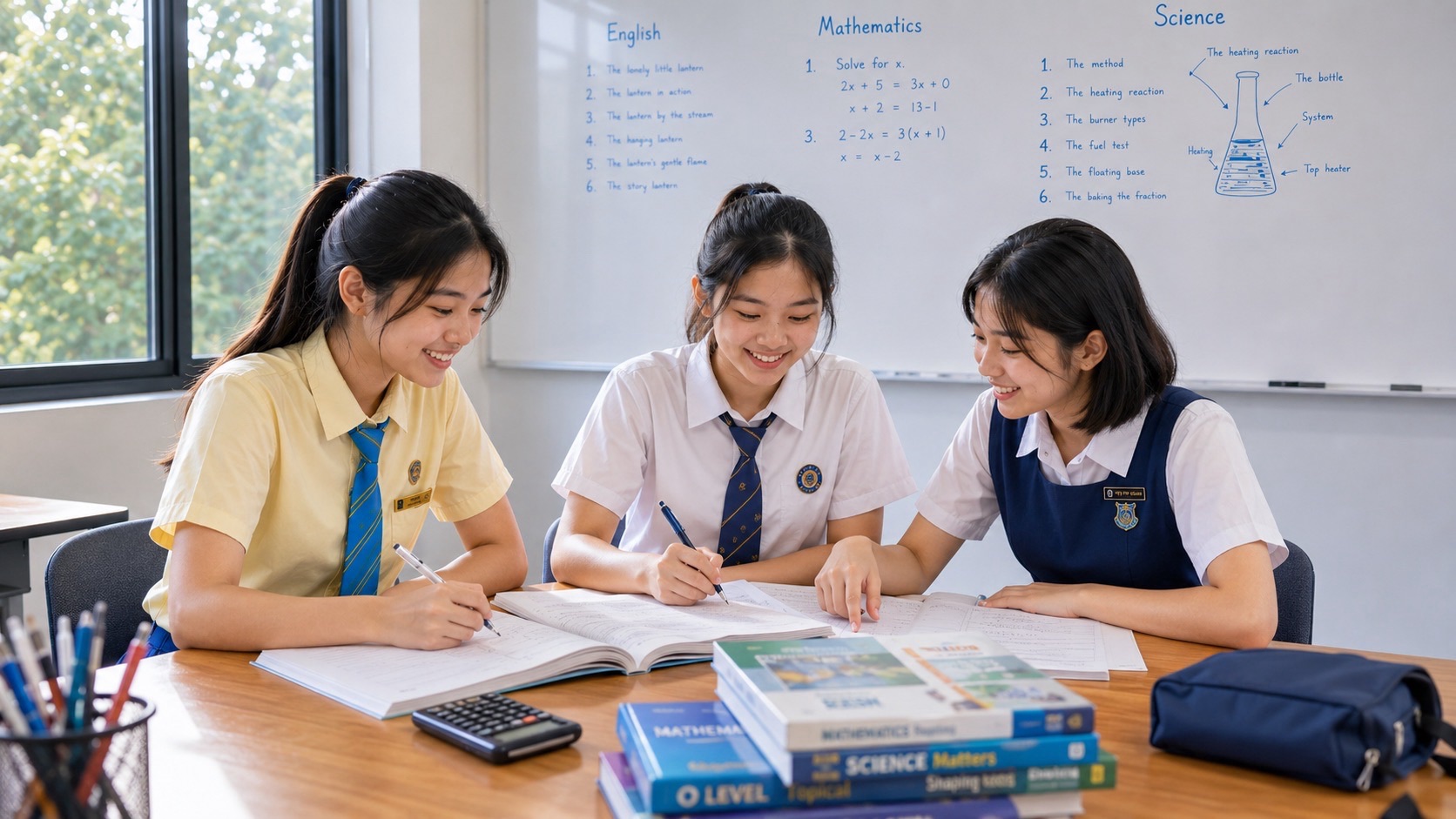
In a genuine 3-pax small-group session, one student may be good at numbers but believe that the heavier sample must sink. Another may reason correctly about density but misread the measuring cylinder. A third may explain the clay boat accurately but struggle to write a clear comparison. All three need different feedback even if their test scores are similar.
The teaching principle follows the immutable eduKateSG Clementi Secondary 1 Mathematics small-group reference: diagnose the exact wrong step, guide a correction and test independently. That published page concerns Mathematics in Clementi; it does not prove a particular Punggol Physics class schedule, tutor, fee or availability.
The local eduKate Punggol Science tuition programme can be consulted for current arrangements. The promise worth looking for is careful observation and transferable learning, not a mystical effect of the number three. Each learner should be asked to make a fresh prediction and explain it without relying on a classmate.
A practical six-stage lesson sequence
Stage 1: test the starting theory
Show two safe illustrations: a tiny pebble sinking and a much larger hollow boat floating. Ask the learner to predict a new example and explain why. Record whether the child’s rule is about mass, size, material or density. Do not reveal the answer too early. The first explanation is a valuable diagnostic.
Stage 2: distinguish the quantities
Use a compact comparison of equal-mass objects with unequal volumes. Measure or supply suitable values. Ask the learner to describe mass and volume separately. Introduce density through a picture or formula as appropriate to the actual G-level syllabus.
Stage 3: repair instrument reading
Present a balance reading and two measuring-cylinder levels. Make the student decide which values describe the object and what difference is required. A child who corrects the calculation but cannot explain it should try another non-zero starting level.
Stage 4: connect with buoyancy
Explain qualitatively that weight and an upward buoyant force act on an immersed object. Compare sinking, steady floating and neutral buoyancy under simple stated assumptions. Students do not need to memorise advanced fluid equations to recognise why the forces matter.
Stage 5: challenge the model
Use a hollow and solid object made with the same nominal material. Ask how enclosed air or fluid entry changes the effective whole-object density. If the child responds with the old rule about mass alone, rebuild that particular connection before continuing.
Stage 6: independent transfer
Remove hints. Provide a fresh object, a different surrounding fluid or a new data table suited to the child’s course. Ask for a prediction, reason and one limitation. Compare it with the initial attempt to decide whether more targeted teaching is justified.
These stages are illustrative, not a fixed six-week package or a promised learning speed. The actual sequence should consider teacher feedback, school unit order, individual readiness, CCA and available time for consolidation.
Home learning that stays curious instead of becoming a second classroom
A parent can ask which household objects might float and why, using safe paper sketches or familiar examples rather than launching a large sink-or-float experiment. Invite the child to predict how a small toy boat changes if it takes in water. The interesting part is the explanation. Avoid putting batteries, electronics, sharp objects or unknown materials into water.
Another gentle question compares a water-filled and air-filled sealed plastic bottle of the same external size. Their overall masses differ while the external volumes are similar. How might that affect effective average density and floating behaviour? It is a conceptual exercise, not a need to construct a complicated apparatus.
These conversations are most valuable when the child can say, ‘I think it will float because…’ and then revise that sentence when new information arrives. Science becomes a way to learn from being surprised rather than an exercise in guessing what the adult wants.
The Punggol connection: use the waterway to ask, not to pretend we measured
Punggol’s waterfront and public spaces offer familiar pictures of floating objects and watercraft. They can prompt questions about buoyancy, load and balance. That does not mean the waterway has a special Physics syllabus or that this article has measured the density of its water, recorded local vessel data or inspected marine engineering systems.
A carefully phrased question might be, ‘If a boat takes on water, what happens to its effective average density and ability to remain buoyant?’ The model can be discussed safely indoors. Students should never be invited to test floating objects at the edge of a public waterway or lean over railings for a tuition activity.
How to know whether tuition is working
- Before: the student says ‘heavy things sink’. After: they compare whole-object density and fluid density under stated assumptions.
- Before: mass and volume are used interchangeably. After: each has a different meaning and unit.
- Before: a cylinder’s final reading is taken as the object’s volume. After: the student subtracts the starting level and explains displacement.
- Before: a steel ship is treated as an exception without explanation. After: the student considers enclosed air, displaced fluid and effective average density.
- Before: correct answers occur only on copied examples. After: predictions remain sound when the fluid or shape changes.
- Before: a test result is accepted uncritically. After: the child identifies a measurement limitation or a possible alternative influence.
Keep an early and later sample of independent work. A school score may reflect many skills at once and cannot by itself prove which concept improved. A worthwhile tutor can show the exact misconception that was repaired and the new situation that demonstrated it.
How density connects to the rest of the four-year Physics progression
The earlier Secondary 1 measurement foundation builds observation and unit discipline. Density adds mass, volume, comparison and buoyancy. The next Secondary 2 forces and friction guide brings interactions, motion and more careful force explanations.
Later, Secondary 3 pressure, moments and stability applies density within fluid pressure and turning-effect questions, while Secondary 4 radioactivity and half-life introduces a very different kind of measurement and probabilistic reasoning. The connected learning habit is to identify the physical quantity before calculating.
Frequently asked questions for Punggol parents
Is density definitely taught in Secondary 1?
Density is an established lower-secondary Science concept, but schools can plan their units across Secondary 1 and Secondary 2. Check the student’s present course and teacher materials rather than assuming every school studies it in the same term.
Does every G1 student need to calculate density?
No. The MOE G1 Lower Secondary Science syllabus says the density formula is not required for its relevant learning outcome. The emphasis includes how mass and volume relate to density and how a density comparison can explain floating or sinking.
Does a heavier object always sink?
No. The overall density relative to the fluid, the structure of the object and buoyant-force balance matter. A large hollow boat may float while a small solid pebble sinks.
Is density the same as weight?
No. Density is mass per unit volume, whereas weight is a force due to gravity. A correct answer must name the physical quantity and use its appropriate unit.
Can a teacher use a clay boat to explain density?
Yes, if the explanation distinguishes the intrinsic density of the clay from the effective average density and displaced volume of the whole hollow structure. Merely saying ‘boat shape floats’ misses the mechanism.
Should we buy tuition immediately after one incorrect test?
Not automatically. Review teacher feedback and test whether the child can correct and transfer the concept. Tuition is most plausible when a persistent gap remains despite reasonable independent practice and school support.
What is a good way to judge the tutor?
Ask for an example of the student’s original misconception, the teaching step that corrected it and a fresh problem the learner solved without hints. That is more informative than the number of pages completed.
Official sources and connected eduKate reading
- MOE: updated G1 Lower Secondary Science syllabus, Matter and density
- MOE: updated G2/G3 Lower Secondary Science syllabus
- eduKateSingapore: Lower Secondary Science topic map
- eduKate Punggol: Science tuition information
- Immutable reference: Secondary 1 Mathematics Tutor Clementi small groups
The right reason to have Secondary 1 Physics-focused tuition
Density is a lovely chapter because it turns an everyday question—’Will it float?’—into a model that respects measurements, structure, forces and evidence. A student who can explain why a boat floats without saying ‘because it is big’, who reads volume displacement accurately and who can revise a prediction when the conditions change has gained more than one chapter’s marks.
For families needing help with a repeated misconception, a calm, diagnostic tutorial can be worthwhile. Where school feedback and independent practice are working, there is no obligation to add another class. Start with eduKate Punggol’s programme and consultation details to confirm local arrangements.