
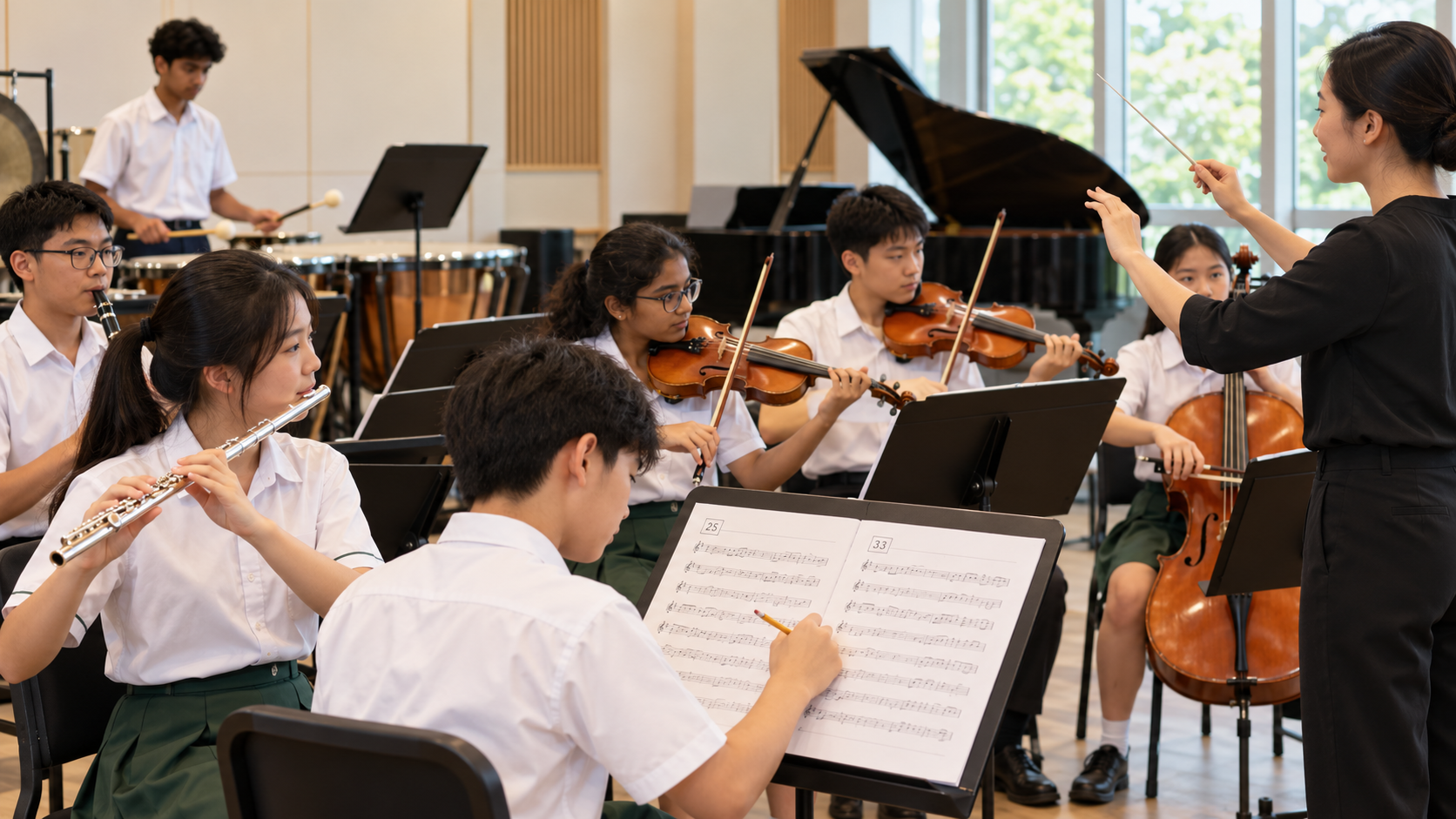
Did you know? A distorted guitar sound is not enough to identify Rock, and a loud chorus is not necessarily faster than the verse. In Singapore’s G1 Music curriculum, students learn to identify the actual relationships among riffs, rhythm, instrument roles, vocal techniques and song form. The important examination skill is explaining what the music does—not guessing its genre from volume.
Rock is a prescribed genre in Area of Study 1: Popular Music from 2000 onwards of the 2027 Singapore–Cambridge SEC G1 Music syllabus K128. The official concepts include eighth-note/eight-beat drums and bass, guitar and keyboard riffs, falsetto, vocal harmony and unison, lead guitar solo, slides, bends and the use of distortion to build intensity.
This guide explains how to hear those features, distinguish Rock from Pop, R&B and Electronic Dance Remix, understand the national Listening paper, and apply genre knowledge to authentic G1 arranging coursework. All listening and composition exercises described here are original learning scenarios rather than official examination questions or copies of commercial recordings.
The immediate answer for parents
Rock study develops careful listening, music vocabulary, understanding of musical structure and the ability to connect sound production with expression. A pupil should recognise a riff, describe how drums and bass support it and hear what changes during a guitar solo.
The real achievement is a transferable explanation: the repeated guitar figure provides a recognisable motif, while the rhythm section maintains the pulse. Merely naming a band is not the same level of understanding.
The correct 2027 K-code
SEAB lists G1 Music K128 as a local subject. Rock is one of four subgenres under AoS1, not a separately graded Rock exam or a stand-alone practical electric-guitar qualification.
A student’s school must handle subject entry and supervised coursework. Learning guitar privately can help musicianship, but it does not automatically mean the student has entered the K128 national examination.
How Rock fits the subject assessment
Paper 1 Listening is one hour, 40 raw marks, 40% of the qualification. Paper 2 Creating and Performing is 60%, with a one- to two-minute arrangement and a separate 30-second original film/TV cue.
The listening paper draws from all four Areas of Study. There is no guaranteed, separately allocated Rock percentage; a pupil needs broader musical understanding beyond the guitar-centred examples here.
The four AoS1 Popular genres
The 2027 list is Pop, Rock, R&B and Electronic Dance Remix from 2000 onwards. Genres share tools, instruments and sometimes musical characteristics.
A Rock excerpt may contain a vocal hook or electronic keyboard, just as Pop can include guitar distortion. The candidate should identify several features and interpret their functions, not insist the categories never overlap.
The three Rock indicative examples
SEAB’s indicative list includes You’re All I Have (Snow Patrol, 2006), Ordinary Love (U2, 2013) and Night Lights (The Great Spy Experiment, 2014).
These works illustrate the syllabus’s sound and techniques, including a Singaporean artist. They are reference repertoire, not a guarantee that a particular commercial track will be played in the examination.
What distinguishes Rock in the syllabus
K128 explicitly identifies eighth-note/eight-beat drum and bass rhythms, guitar or keyboard riffs, falsetto and layered or unison vocals, lead guitar solo, slides and bends, and distortion.
These are musical tools to recognise, not a checklist that must all appear in one 30-second excerpt. A useful answer names what the source actually contains and connects the feature to style.
| G1 Rock concept | 2027 K128 focus | What to listen for |
|---|---|---|
| Rhythm section | Eighth-note/eight-beat Rock drums and bass | Recurring accents, kick and bass relationships |
| Recognisable idea | Guitar/keyboard riffs | Which motif returns or develops? |
| Guitar lead | Solo, slides, pitch bends | How does pitch movement or foreground role change? |
| Voice | Falsetto, vocal harmonies and unison | Register and pitch-layer differences |
| Production | Distortion to build musical intensity | Timbral roughness, not merely loudness |
An original short Rock listening scenario
Imagine an original four-bar recording with a repeated electric-guitar figure, bass notes reinforcing a steady kick, and a vocal line that enters while the riff continues.
A precise answer says the riff creates continuity and the bass/drums establish the groove. It does not invent a famous band name or assume the tempo changes when the singer becomes louder.
Eighth-note Rock drum and bass patterns
The syllabus names eighth-note or eight-beat patterns for Rock. They help students describe subdivision and consistent rhythmic accompaniments in appropriate examples.
Do not confuse ‘eight-beat’ style language with a compulsory 8/4 time signature. The general AoS1 material includes 4/4; note division, measure length and rhythmic style are different concepts.
Pulse precedes rhythmic detail
Before analysing a guitar riff or drum fill, identify the recurring beat. A stable pulse makes it easier to hear when an instrumental part adds smaller notes or changes accent.
The student should be able to maintain a pulse while listening to another part. This reveals whether a perceived speed increase is actual tempo change or simply increased activity.
The kick and bass partnership
Kick drum and electric bass may reinforce recurring rhythmic points or work in contrasting patterns that create forward motion.
Ask where bass notes coincide with kick beats and where they do not. The relationship is more informative than simply stating that the recording contains a bass guitar.
Snare, backbeat and groove
A backbeat is a rhythm-accent relationship often marked by a snare or comparable source. It can provide continuity beneath a changing melody or riff.
The candidate should identify where the accent occurs relative to the pulse. Not every snare sound is proof of a Rock song, and every Rock example need not share the same backbeat.
A drum fill prepares a transition
A fill can occupy the space before a chorus, solo or return of the main riff. It may create anticipation by temporarily varying the established pattern.
An answer should describe whether the fill changes rhythmic detail, texture or dynamics. It is not necessarily a new underlying tempo or time signature.
The Rock drum kit is an ensemble of timbres
Different drum-kit components supply bass accents, snare articulation, cymbal colour and rhythmic subdivision. They can work in complementary layers.
Ask what each part does at the particular moment. Writing ‘drums’ may identify the family but not answer a question about the actual groove or transition.
What a riff is
A riff is a distinctive recurring musical figure, often short enough to be recognised when it returns. K128 specifically highlights guitar and keyboard riffs in Rock.
A pupil can trace a riff’s rhythm, melodic shape or repeated timbre. The strength of the analysis is in showing recurrence and function, not simply naming ‘riff’ whenever a guitar plays.
Riff versus hook
A riff is a particular recurring figure, while a hook is a memorable feature that can take different forms. A riff may also be a hook, but the terms do not always identify the same thing.
In an original classroom example, ask whether the guitar figure organises accompaniment and whether the vocal phrase is the main memorable hook. Both can coexist.
Riff versus chord progression
A riff may involve a melodic or rhythmic pattern, while a chord progression concerns a sequence of harmonies. The two can interact without being identical.
A candidate who describes only the chord names when asked about the riff’s rhythmic identity may miss the specific musical demand. Focus on what the excerpt and question establish.
Keyboard riffs are Rock too
The official genre concepts include keyboard riffs, not only electric guitar. A repeated keyboard pattern can become a strong identity within a Rock arrangement.
Avoid using the instrument name as the entire genre definition. What matters is the figure’s role and the relationship to voice, bass and percussion.
Electric guitar and acoustic guitar
Both are named in K128 Rock instrumentation. An acoustic guitar may supply strummed support while an electric guitar carries a lead or repeated figure; actual arrangements vary.
A learner should not assume acoustic means quiet or electric means distorted. Describe the attack, sustain, register and function of the specific part.
Strumming, picking and plucking
Strumming moves across several strings to create chordal texture, while picking or plucking can articulate individual notes or patterns. Each produces different rhythmic character.
Students should listen for what is played, not only how a guitarist looks in a performance video. Sound-based evidence helps in the national listening paper.
Bass guitar is not merely another guitar
Electric bass often operates at a lower register and provides a rhythmic-harmonic foundation. Its plucked notes can complement or contrast with guitar riffs.
Ask what the bass does during the riff and when the chords change. A good answer distinguishes supportive roles from melodic foreground.
Lead guitar solo
K128 names a lead-guitar solo as a Rock feature. It may carry its own melodic development, interact with harmony or provide contrast with the sung sections.
A solo is not simply a louder guitar. The pupil should hear a foregrounded line and describe how the other instruments support or respond to it.
Why solos require musical organisation
A compelling solo can develop a small motif, vary rhythm, use register or respond to the underlying groove. The skill is not measured solely by the number of notes.
A student may compare two original solo sketches and explain which one relates more clearly to the backing. This trains interpretation without copying protected recordings.
Slides on guitar
A slide can connect pitches or create a gliding gesture in the lead line. SEAB explicitly names this technique in the Rock area.
The listener should identify where a pitch moves continuously instead of jumping directly. A software portamento or a keyboard gesture may also glide, so context matters.
Pitch bends on guitar
A bend changes the pitch of a fretted note through a playing technique. It can shape expression and create a distinctive attack and movement.
Ask where the bend begins, what happens to the pitch and why the phrase uses it. Calling every high guitar note a bend would be inaccurate.
Slides and bends are different
Both can connect or alter pitches, but their physical techniques and resulting nuances differ. A thoughtful pupil learns to compare the actual audible shape.
A school-approved demonstration can isolate a bend and a slide without reproducing a commercial solo. Describe what is heard before making a confident technique identification.
Distortion changes timbre
Distortion changes the signal’s character by adding harmonic complexity or roughness. The syllabus names its use to build musical intensity in Rock.
A louder clean guitar is not necessarily distorted. Students should identify the timbral quality and explain why it matters to the particular passage.
Distortion is not proof of aggression
A distorted guitar can be used for many expressive purposes, and an undistorted guitar can be played intensely. Neither a genre nor a private emotion can be determined from the effect alone.
Avoid reducing Rock to emotional stereotypes. Describe the sound and articulate an appropriately qualified interpretation.
Distortion compared with reverb
Distortion affects tonal character, whereas reverb adds reflections or perceived acoustic space. Both may appear in the same guitar recording but serve different purposes.
Ask whether the sound is rougher or whether a tail remains after its attack. Mixing the terms leads to avoidable exam errors when production effects are specifically questioned.
Delay and repeated guitar gestures
Delay can create timed repeats of a played sound, potentially supporting a rhythmic pattern. An actual riff may itself be repeated through performance instead.
The listener may not know the exact recording process. A careful answer distinguishes a heard repeated gesture from a definite claim about hidden studio tools.
Falsetto in Rock singing
K128 lists falsetto as one Rock vocal technique. It can change the singer’s register or tone quality in an expressive passage.
A pupil should identify the audible quality and context rather than call every high note falsetto. Pitch height, vocal mechanism and musical function are related but distinct.
Vocal unison
Multiple voices may perform the same melodic line together in unison, creating reinforcement and a richer timbral blend without separate harmony pitches.
A candidate should listen for whether the singers share one line. Several voices in a recording do not automatically mean three-part vocal harmony.
Vocal harmony
Backing singers or overdubbed parts may contribute different simultaneous pitches, supporting or contrasting with the lead melody. These harmonic layers can enlarge a chorus.
Explain what joins the main line and how the texture changes. The distinction between unison and harmony is an important transferable Pop/Rock listening skill.
Song form: the verse
A verse may carry developing textual or musical content while retaining a familiar groove or harmonic foundation. The role depends on the full song’s structure.
In a short extract, the pupil should describe what is actually heard rather than assert confidently that the section is a verse without surrounding context.
Song form: the pre-chorus
A pre-chorus may prepare a chorus by altering dynamics, rhythm, harmony, register or texture. It helps build musical expectation.
Ask which feature changes, not simply whether the passage becomes louder. A section name requires evidence of its structural role.
Song form: the chorus
The chorus may bring back a central hook, fuller voice layering or a stronger rhythmic setting. The return can create recognition across the song.
A chorus can feel more energetic even when the pulse stays stable. Describe the change in instrumentation or texture before claiming an increase of tempo.
Bridge and interlude
A bridge can introduce contrast before another section returns; an interlude can link vocal sections with an instrumental passage.
An instrumental guitar solo is not automatically a bridge. The student should identify its relation to the larger musical structure and what returns afterward.
Intro and ending
An introduction can establish a riff, groove or timbre; an ending may return to a motif, conclude decisively or fade out.
Students should recognise when an ending is a recorded fade rather than a performed slowdown. These are different musical events.
Melodic contour in a riff
A riff may repeat pitches, move by step or leap to another register. Its identity can remain recognisable even when the timbre or accompaniment changes.
Ask what stays the same across two appearances of the figure. This teaches both melodic listening and structural reasoning.
Unison and intervals
The G1 syllabus includes unison, major and minor thirds, perfect fifth and octave. These help describe relationships among notes and voices in relevant examples.
A student should use them correctly rather than guess by feel. Short original classroom notes can provide reliable interval practice without reproducing copyrighted melodies.
Harmony and power in arrangement
Rock may use chordal support that helps create tension, continuity or contrast. The specific harmonic relationship matters more than a broad claim that Rock is ‘powerful’.
A student can hear when guitar and keyboard supply similar harmonic material or when bass supports a new chord. The answer should name the function when the question requires it.
Open and closed voicings
Chord tones can be grouped compactly or spread across a wider register. This affects texture and spacing even when the fundamental harmony remains related.
Use short original keyboard examples to compare. A wider voicing does not always create greater loudness, and the effect should be described precisely.
Changing harmonic rhythm
Harmonic rhythm describes how frequently the harmony changes. This can remain constant while the drums become more active or guitar notes move faster.
Ask whether the chord sequence has actually changed or whether only its strumming pattern varies. This prevents the term ‘rhythm’ from becoming ambiguous.
Dynamics are separate from tempo
A crescendo increases loudness; accelerando increases speed. A Rock build-up can use either, both or neither, depending on the arrangement.
Listen to the pulse while noting dynamic growth. A candidate should not assume louder music is automatically faster.
Texture and layering
Rock arrangements can move from a single guitar figure to melody with accompaniment, vocal harmony and fuller drum sound. These are relationships among parts.
Count independent musical functions, not simply the number of microphone tracks or visible band members. Several instruments doubling one riff do not create several unrelated melodies.
Comparing Rock with Pop
K128 Pop names eight-beat drums and bass, vocal harmony/unison and similar instruments. Rock further specifies riffs, lead guitar solo, slides, bends, falsetto and intensity-building distortion.
The distinction should be made from combined audible evidence, not instrument ownership or the performer’s identity. An electric guitar can appear in both genres.
Comparing Rock with R&B
R&B places additional prescribed emphasis on sixteenth-note groove, syncopation and melisma. Rock’s riff-oriented material may produce a different musical focus.
A performer can incorporate cross-genre influences. Good analysis identifies which features are prominent in the particular excerpt and how they relate.
Comparing Rock with Electronic Dance Remix
Electronic Dance Remix’s four-on-the-floor kick, off-beat hi-hat, build-up and drop, and synth layers can create structural characteristics different from the Rock syllabus’s riff and guitar techniques.
Listen for the entire arrangement, not merely for loudness or electronic equipment. A remix can contain guitars and a Rock track can use synthesised sounds.
Riffs and genre identity are not stereotypes
Rock music spans varied artists, communities and production choices. One selected example does not define the preferences or abilities of all listeners.
Music analysis should be based on rhythm, technique, form and sound. Avoid broad cultural claims about a style’s audience that the recording itself cannot establish.
K128 Task 1 permits a Rock arrangement
The G1 Music coursework allows an appropriate source from AoS1, AoS2 or AoS4. A Rock source may be arranged in a DAW into one to two minutes, with required musical layers and one unique student-performed part.
The source, backing-track and authentication rules are strict. An adult-made Rock backing file, auto-accompaniment or corrected live take cannot be passed off as the student’s examination work.
The live part must genuinely be performed
The candidate records one distinct part after arranging the other materials. Within the specified thirty-minute period, they record three takes and choose the best, with video authentication.
A Rock guitar riff may provide a suitable practice context, but actual assessed selection follows school approval. The performance must not duplicate an existing arrangement part or be corrected artificially.
A Rock practice task outside assessment
Create an original four-bar riff with a simple pulse and add a bass line that reinforces selected accents. Try a version with more open texture and one with a brief vocal unison.
Ask what changes, which layer supplies identity and whether the new arrangement is clearer. This is general skill development; it is not a pre-prepared K128 coursework submission.
A distortion listening exercise
Using appropriately licensed, original sound, compare a clean guitar phrase with a version that has a mild distortion effect at matched perceived loudness.
Ask what changes in timbre rather than decide only which version is louder. This makes the effect’s musical role easier to understand.
A four-week Rock learning cycle
Week one: pulse, bass and eight-beat drum pattern. Week two: guitar/keyboard riff, picking, strumming, solo, slide and bend. Week three: vocal unison/harmony, falsetto, distortion and song form. Week four: unfamiliar listening comparisons and a focused error review.
The sequence is illustrative, not the national teaching schedule. Students still need the three other Popular Music genres and the other three Areas of Study.
Diagnose the first misconception
A student may confuse a guitar riff with a chord progression, distortion with loudness, falsetto with any high note, or a drum fill with tempo change.
Label the precise error and test it using a different short excerpt. Recognising the answer in the exact original song is weaker evidence than understanding the same feature in unfamiliar music.
Parents can support without playing guitar
Try Which figure repeats? What does the bass do? Did the tempo really change? What makes that guitar sound different?
A teenager who can explain these questions is moving toward independent analysis. Parents should consult school-approved examples when instrument terminology is uncertain.
Frequently asked questions: is Rock a separate SEC subject?
No. Rock is one genre of AoS1 in G1 Music K128. The same subject also assesses other genres and music contexts through Listening and Creating/Performing.
The registered subject code is K128, not a distinct national guitar examination.
Frequently asked questions: must every Rock song use distortion?
No. The syllabus lists distortion as a relevant effect that can build intensity, but real Rock examples may use clean or mixed guitar sounds.
A specific excerpt should be identified through multiple audible features, not through a single mandatory sonic signature.
The lasting reason to study Rock
Rock analysis can help teenagers understand how repeated musical ideas, instrument technique, vocal layering and rhythmic organisation communicate musical identity.
Refer to the official SEAB 2027 G1 Music K128 syllabus, especially AoS1. Compare Popular Music overview, Pop, R&B and Electronic Dance Remix. The unchanged Clementi tutorial benchmark illustrates feedback-led teaching in another subject and does not establish Rock tuition availability.