
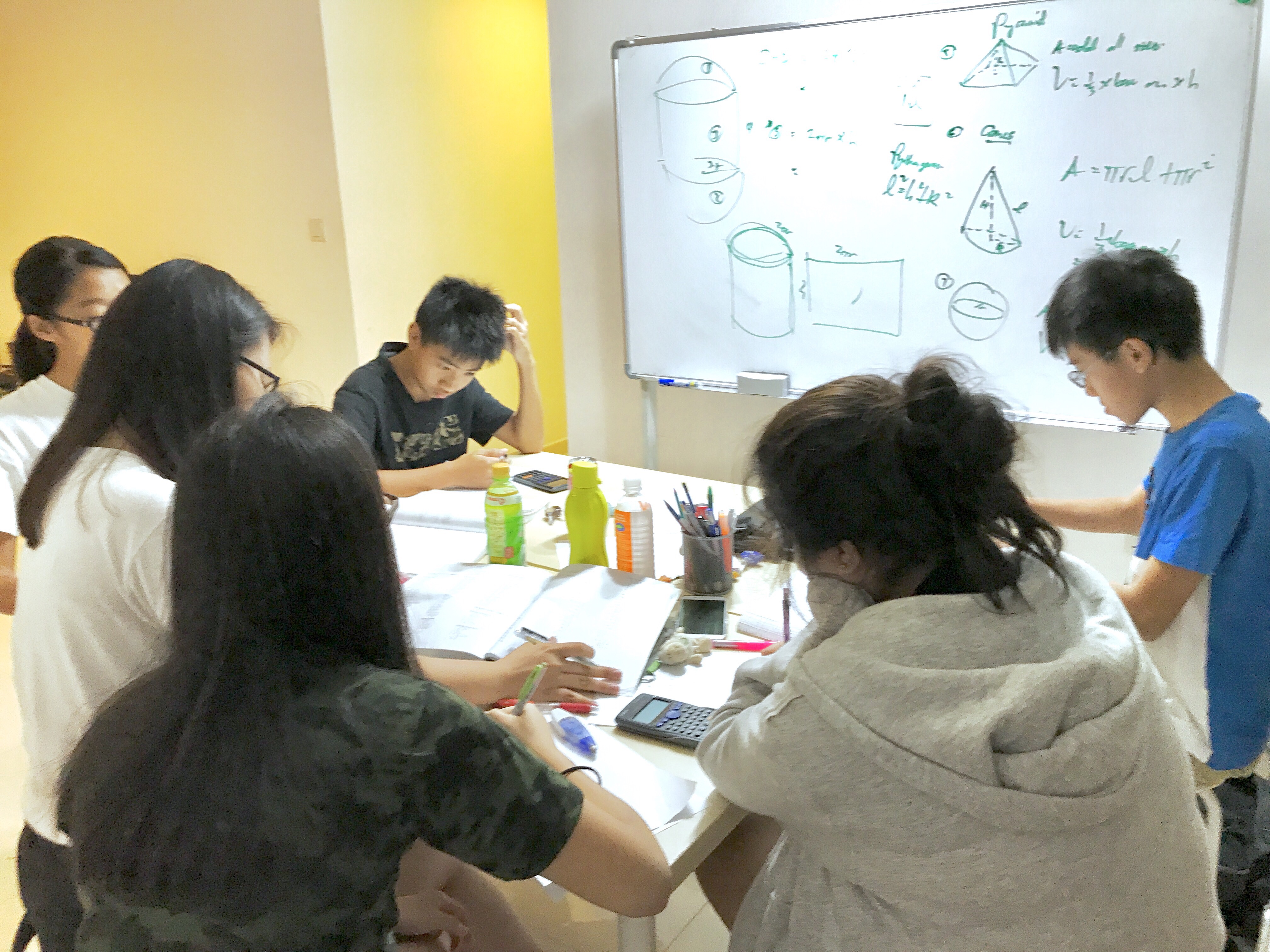
Did you know that G2 Mathematics helps your child decide when an answer is reasonable, not just calculate it? A percentage on a price tag, the scale of a map and a graph showing a trend all contain mathematical relationships. Students who learn Mathematics well become more capable of recognising those relationships, explaining their methods and checking the results. That is valuable in school, in further education and when interpreting everyday information.
Under Singapore’s Full Subject-Based Banding, G2 describes a subject level rather than a permanent identity or complete measure of a teenager’s potential. It would be a mistake to see G2 Mathematics as unimportant simply because G3 has a different syllabus. The learner still needs accurate mathematical language, confidence with quantitative decisions, and a dependable way to approach unfamiliar problems.
This guide explains why G2 Mathematics under the 2027 Singapore-Cambridge Secondary Education Certificate (SEC), syllabus K210, matters. It covers numbers, algebra, geometry, statistics, real-world applications, examination papers, common misconceptions and practical ways parents can support an increasingly independent student without making every evening another timed paper.
The quick answer for parents
G2 Mathematics teaches teenagers to reason with numbers, represent relationships, measure shapes, interpret data and explain quantitative decisions. The official syllabus is organised around three connected strands: Number and Algebra; Geometry and Measurement; and Statistics and Probability. It also tests method selection, problem solving and mathematical communication.
The 2027 SEC subject code is K210. Paper 1 and Paper 2 each last two hours, carry 70 marks and contribute 50 per cent. An approved calculator may be used in both. The subject is not just a test of mental arithmetic. It is also about understanding which method fits a question and why a result makes sense.
The syllabus develops thinking, not only techniques
The SEAB 2027 G2 Mathematics K210 syllabus states aims relating to mathematical understanding, reasoning, communication, application, metacognition and confidence.
Its assessment-objective weightings are approximately 60 per cent for standard techniques, 30 per cent for solving problems in varied contexts and 10 per cent for mathematical reasoning and communication. Routine skill is important, but it cannot replace choosing a suitable method in an unfamiliar situation.
Parents should ask whether a child can explain what a calculation represents. A correct number from a copied example is useful, but a correct result from a changed problem tells us much more about understanding.
Understanding G2 within Full Subject-Based Banding
The G2 level is part of a system in which students can study different subjects at different levels, according to applicable school arrangements and eligibility. The subject level is not a definitive description of their intellect or future possibilities.
For 2027, G2 Mathematics is K210, distinct from G3 Mathematics K310 and G2 Additional Mathematics K232. Their specifications and assessment demands are not interchangeable.
Parents should use the child’s real syllabus when planning revision. Compare performance against the concepts they need to learn, not against assumptions about what their classmates should be taking.
Mathematics begins with understanding quantities
A number has meaning only in relation to the quantity it describes. Twelve kilometres, twelve dollars and twelve degrees all use the same numeral but tell different stories.
Students must learn to read units, signs, magnitude and context. If a question asks for the difference between two temperatures, the meaning of a negative sign matters; it is not a decoration added to a calculation.
Parents can encourage the habit of naming the quantity before performing an operation. “What does this number stand for?” is often more useful than “Which formula should you use?”
Positive and negative numbers build directional thinking
Negative numbers represent quantities below a reference point or movement in an opposite direction in suitable contexts. A student can learn the arithmetic rule while still struggling to connect it with meaning.
For example, a temperature changing from −3°C to 4°C has increased by 7°C, since 4 minus negative 3 equals 7. Simply subtracting the smaller-looking numeral without considering the signs may produce an incorrect answer.
A number line can clarify the movement. Ask where the value starts and where it ends. Visual reasoning helps connect symbol manipulation with an actual difference.
Fractions are relationships, not only small numbers
Fractions describe parts of a whole, ratios, quotients and other relationships. Their meaning depends on the defined whole. One half of a large quantity can exceed three quarters of a smaller one.
Students may compare the numerators of fractions without considering denominators. For example, 3/5 = 0.6 while 2/3 is about 0.667, so 2/3 is larger despite its smaller numerator.
Ask the learner to estimate or draw a simple representation before calculating. It develops a sense of scale that can catch mistakes.
Ratios make comparisons meaningful
A ratio expresses how quantities relate. A student might know how to simplify 6:9 to 2:3 yet misunderstand what the terms represent in a real problem.
Imagine a fictional drink prepared with a fruit concentrate and water in a ratio of 1:4. The mixture has five parts altogether, not four. If there are 500 millilitres, each part corresponds to 100 millilitres under that simple model.
Parents can ask the child to identify the parts and total. Ratio reasoning becomes dependable when the labels remain attached to the quantities.
Percentages need a clear base
A percentage is measured relative to a reference quantity. Confusing the original and final base causes errors in discounts, growth and comparisons.
Suppose an item originally costs $80 and is discounted by 25 per cent. The reduction is $20 and the new price is $60. A student who adds 25 per cent of $60 to get the original price obtains the wrong result because the percentage is based on $80.
Ask what “100 per cent” refers to in the question. This small check can prevent a large class of mistakes.
Reverse percentage problems reveal deeper understanding
If a price after a 20 per cent discount is $64, the $64 represents 80 per cent of the original price. Therefore the original price is $64 ÷ 0.8 = $80.
A pupil who merely multiplies $64 by 1.2 gets $76.80 and may not notice the mistake. The arithmetic is accurate, but the model is wrong.
Parents can ask the learner to verify the answer by applying the original discount. Finding 20 per cent of $80 and subtracting it gives $64, confirming the relationship.
Percentage changes do not always cancel
If a value increases by 10 per cent and then decreases by 10 per cent, it does not generally return to the beginning. The second change uses a different base.
Starting from $100, a ten per cent increase gives $110. A ten per cent decrease of $110 is $11, leaving $99. The net change is a one per cent decrease.
This is a useful example of quantitative literacy: identical percentages can produce different absolute changes when their reference amounts differ.
Rate and speed require attention to units
Rate compares quantities, often in relation to time. Speed connects distance and time. Students must know which units are being used before combining numbers.
For instance, 54 km/h is equivalent to 15 m/s, because 54 kilometres is 54,000 metres and an hour is 3,600 seconds. The familiar conversion rule can be understood through the underlying units.
Ask the learner to check whether an answer measured in kilometres per minute is suitable when the question requested metres per second. Unit reasoning is part of the solution.
Average speed is not usually a simple average
Suppose a fictional cyclist travels 30 km at 30 km/h and another 30 km at 60 km/h. The first segment takes one hour and the second half an hour. Overall, 60 km is travelled in 1.5 hours, giving an average of 40 km/h.
The simple numerical average of 30 and 60 is 45, which is incorrect for this journey. The student must consider the total distance and total time.
Parents can ask what the denominator represents before a calculation. This helps identify when a familiar averaging shortcut is inappropriate.
Algebra replaces guessing with a relationship
Algebra uses symbols to represent quantities and relationships. A student should know what the variable stands for rather than manipulate x as if it were meaningless decoration.
Imagine that two identical books and a $5 notebook cost $31. If a book costs x dollars, the equation is 2x + 5 = 31, giving x = 13. The result can be checked: two books cost $26 and the notebook adds $5.
The skill is translation from a situation into a valid equation. Once the relationship is correctly represented, the procedure becomes more understandable.
Balancing an equation has a reason
Some children describe equation solving as moving a number across an equal sign and changing its sign. That shortcut can hide the reason the step works.
For 3x − 4 = 17, adding 4 to both sides gives 3x = 21. Dividing both sides by 3 gives x = 7. The equality is preserved through the same operations on both sides.
Parents can ask what operation occurred. This builds a transferable understanding for equations involving fractions or brackets.
Expressions and brackets are not arbitrary rules
An expression such as 4(x + 2) means four copies of the whole bracket. Expanding gives 4x + 8, not 4x + 2.
A pupil may memorise “multiply through” without understanding why the multiplication applies to both terms. A drawing of four equal groups can make the structure visible.
Ask whether two expressions give the same result when x is replaced with a simple number. Numerical checks support understanding, though they do not replace proof of a general identity.
Graphs turn relationships into pictures
Graphs help students see patterns in data or between quantities. But a graph is meaningful only when the axes, units, scale and context are understood.
A straight line rising from left to right may indicate a positive relationship under its specified axes. It does not automatically mean a real situation is improving or that one variable causes the other.
Parents can ask, “What does one point mean?” If the learner cannot answer, further graph manipulation may be premature.
Gradient has meaning in context
The gradient of a straight line relates the change in one variable to the change in another. A student may calculate it correctly but fail to explain the units.
If a distance-time graph rises by 20 metres over four seconds, the gradient is 5 metres per second for that section. This can represent speed under the appropriate model.
The answer is not merely the number five. It describes a rate with a defined meaning and unit.
Interpreting a flat graph depends on the axes
A horizontal section of a distance-time graph represents unchanged recorded distance over that interval. A horizontal section of a speed-time graph at a nonzero speed represents constant speed.
The same visual shape has different interpretations because the axes represent different quantities.
This teaches an important habit: read the labels before assigning meaning to an image. A graph should be interpreted, not guessed from appearance.
Geometry develops evidence-based deduction
Geometry asks students to reason from properties of shapes and lines. A diagram may suggest a relationship, but its visual appearance is not always enough to prove it.
If two lines are parallel, certain related angles can be equal or supplementary under the relevant geometric rules. The student should identify which relationship is justified rather than assume the sketch is accurately drawn to scale.
Parents can ask, “Which rule allows you to conclude that?” An accurate reason is more useful than a lucky numerical answer.
Angles, polygons and mathematical explanation
Angles in triangles and polygons are connected through geometric properties. Students should understand when the rules apply and how a missing angle follows.
For example, the interior angles of a triangle sum to 180 degrees in plane Euclidean geometry. If two interior angles are 45 and 70 degrees, the third is 65 degrees.
The calculation is simple. The deeper achievement is identifying the right figure and rule without relying on visual guesswork.
Similar shapes preserve proportion
Similarity connects corresponding lengths through a common scale factor. The corresponding areas, however, change by the square of that factor.
If one similar square has side length 2 cm and another has side length 6 cm, the length factor is three and the area factor is nine.
Parents can ask why area changes faster than length. Thinking in square units provides an explanation more reliable than memorising an unexplained rule.
Pythagoras’ theorem has conditions
For a right-angled triangle, the squares of the shorter side lengths add to the square of the hypotenuse. The theorem does not apply unchanged to every triangle.
If the shorter sides measure 3 cm and 4 cm, the hypotenuse is 5 cm, because 3² + 4² = 5². The learner must first identify the right angle and the correct side.
A wrong side assignment can produce a neat but invalid calculation. Parents can ask which side is the hypotenuse and why.
Trigonometry connects angles and lengths
Basic trigonometric ratios help students solve right-angled triangle questions involving lengths and angles. The ratio chosen depends on the known and required sides relative to the angle.
A learner might recite SOHCAHTOA yet still confuse the opposite and adjacent sides when the triangle is rotated. The formula has been remembered, but the geometry has not.
Ask the child to name the sides before selecting a ratio. The underlying relationship matters more than the orientation of the drawing.
Mensuration makes measurement practical
Perimeter, area, surface area and volume describe different properties of a shape. They cannot be used interchangeably.
A rectangular floor 5 metres long and 3 metres wide has area 15 square metres, while its perimeter is 16 metres. Both calculations use the same dimensions, but answer different questions.
Parents can ask which quantity the task actually needs. Flooring and skirting are different real-world contexts because they depend on area and boundary length respectively.
Statistics helps interpret everyday information
Statistics summarises and compares datasets through measures such as mean, median, mode and range. Each describes something different, and the most useful measure depends on the situation.
Consider the values 2, 3, 3, 4, 18. The mean is 6, while the median is 3. The unusually high value influences the mean. Neither number is inherently incorrect.
A stronger student can explain what each measure reveals and where it might mislead. This is valuable when reading surveys and numerical claims outside school.
Charts can exaggerate impressions
A bar chart whose vertical scale begins high can make modest changes look dramatic. An irregular scale or missing label can conceal information needed for fair interpretation.
The pupil should inspect the axes and source rather than assume the image is a neutral representation of facts.
Parents can compare two correctly labelled charts of the same fictional data using different scales and discuss how the visual impression changes. The exercise supports careful media and data literacy.
Probability makes uncertainty manageable
Probability expresses the likelihood of an event under a model. A probability of one quarter does not promise that the event occurs once in every exact set of four attempts.
For two flips of an ideal fair coin, the outcomes HH, HT, TH and TT are equally likely, giving the event “two heads” a probability of 1/4. Four separate double-flip trials may produce varying results.
Students learn to distinguish predicted probabilities from guaranteed short-run frequencies. This is a useful antidote to false certainty about chance.
Real-world Maths combines several topics
The syllabus explicitly includes real-world contexts involving travel plans, transport, household finance, recipes, maps, data and other situations. Such questions can require more than one mathematical technique.
A journey problem might combine a timetable, rate calculation and percentage discount. The student must decide which information matters, apply the right method and interpret the result.
This is why mixed practice is valuable. A topic worksheet tells the learner which method to use; real-world problems often do not.
The 2027 Paper 1 requirements
Paper 1 lasts two hours, contains approximately 23 short-answer questions, carries 70 marks and contributes 50 per cent of the K210 grade. Candidates answer all questions.
The paper assesses a broad range of mathematical skills. Essential working matters even when a calculator is used.
Parents should prepare learners for accurate methods, clear notation and meaningful checks rather than assuming the task is only to produce a number.
The 2027 Paper 2 requirements
Paper 2 also lasts two hours, carries 70 marks and contributes 50 per cent.
Section A contains approximately 9–10 questions, all compulsory. Its final question focuses on a real-world scenario. Section B contains two questions, and candidates answer one, choosing between questions drawn from specified Geometry and Measurement or Statistics and Probability content.
The choice is not a licence to skip the underlined syllabus topics entirely. Students should know the actual content and make an informed decision during the examination.
Are calculators allowed in both G2 Mathematics papers?
Yes. The 2027 K210 specification permits an approved calculator in both Paper 1 and Paper 2. There is no compulsory non-calculator paper in this specification.
But a calculator cannot decide what the symbols mean or whether a method is valid. A pupil who enters incorrect quantities may receive a precise-looking but incorrect result.
Estimation and unit checks remain important even when the tool performs arithmetic.
Working must show the mathematical route
The official syllabus notes that omitting essential working can result in lost marks. A correct calculator answer does not automatically explain how the student reached it.
Good working shows the relevant relationship, substitutions and necessary deductions without adding pages of unrelated calculations.
Parents can ask the child to describe one major step and why it follows. This builds mathematical communication as well as examination readiness.
Accuracy rules have a purpose
The 2027 syllabus normally asks for non-exact answers to three significant figures, or one decimal place for angles in degrees, unless a question specifies otherwise. Candidates should also use appropriate units.
A learner who rounds an intermediate answer too early may introduce avoidable error into the final result.
Teach the child to retain sufficient precision during working and apply the requested rounding at the correct stage. Accuracy is not only calculator operation; it is part of responsible reporting.
A fictional pupil who can follow but not start
Imagine Secondary 2 student Ethan. He understands worked solutions in class and can complete examples when the chapter heading says “Simultaneous Equations”. During a mixed test he struggles to identify the method.
His teacher asks him to translate each word problem into known and unknown quantities before choosing an equation. Ethan begins to recognise situations that require two conditions to find two unknowns.
This illustrative case shows why recognition and independent method selection are different skills. More examples that announce the method would not fully repair the gap.
Another fictional pupil who makes reasonable-looking errors
Consider Secondary 4 learner Sarah. She often obtains answers that look plausible but are wrong because she mixes kilometres and metres or rounds too early.
Her tutor introduces a small routine: label quantities, estimate the scale, calculate, then check the unit and context. Sarah becomes more likely to catch her own mistakes.
The progress is not simply increased speed. It is a stronger ability to verify the result without relying on an adult.
Learning from an error log
An error log can record specific causes: a misunderstood question, wrong sign, unsupported geometric assumption, poor unit conversion or incomplete working.
A note that says “careless again” rarely helps. A note that says “used the final price as the percentage base instead of the original” identifies a concept that can be practised.
Parents can revisit the same underlying skill with changed numbers and contexts. If the child can correct it independently later, the learning has transferred.
How to practise without overwhelming your child
A useful session can begin with five minutes of retrieval from an earlier topic, ten minutes of current work and five minutes reviewing one error.
Another day can use a mixed question requiring the student to choose a method. Sometimes more time is needed for an unfamiliar problem, and sometimes a student needs rest rather than another worksheet.
The number of completed questions is not the only measure of quality. Look for correct reasoning and increasing independence.
Maths anxiety needs supportive, precise feedback
A child who repeatedly experiences failure may start saying they are hopeless at Mathematics. That belief can make unfamiliar problems feel threatening before the student begins.
Avoid global labels about mathematical talent. Identify controllable actions, such as correctly interpreting a ratio, checking a unit or explaining why a geometric angle rule applies.
Confidence grows through achievable success and a method for addressing mistakes. It does not require pretending that the subject is always easy.
Mathematics and future education
G2 Mathematics can support further learning in subjects requiring numeracy, measurement and data interpretation. The actual admission requirements for ITE, polytechnic, junior-college or other courses depend on current official criteria and the student’s complete qualifications.
A subject level alone should not be used to predict every future option. Parents should consult the school and relevant post-secondary guidance when planning transitions.
The durable value of quantitative literacy remains important whichever pathway the learner follows.
When extra help may be useful
Targeted instruction can help when recurring foundational gaps block progress, when the student cannot translate word problems or when exam results reveal weak method selection.
A good plan begins by diagnosing the specific difficulty. Concept explanation, guided work, mixed application and later independent practice should form a coherent sequence.
Extra tuition is not automatically necessary for everyone. Its value appears when the learner becomes better able to start, solve and check unfamiliar questions.
Signs that G2 Maths learning is becoming secure
Look for a teenager who identifies the quantity a number represents, constructs an equation from text, explains why a geometric rule applies and checks whether a numerical answer is plausible.
Notice whether the student can interpret a graph or percentage change when the context is new rather than simply repeat one memorised format.
Those behaviours help explain the assessment score and show whether the capability is likely to last.
Frequently asked questions from Singapore parents
Does G2 Mathematics define my child’s intelligence?
No. It is a subject level under Full SBB, not a permanent measure of overall ability or worth.
What is the 2027 G2 Mathematics code?
K210, distinct from G3 Mathematics K310.
How many papers are there?
Two written papers, each lasting two hours.
How are the papers weighted?
Each contributes 50 per cent and carries 70 raw marks.
Does Paper 2 have optional questions?
Section B contains two questions, of which candidates answer one, while Section A is compulsory.
Is there a real-world question?
Yes. The final question of Paper 2 Section A focuses on applying Mathematics to a real-world scenario.
Is a calculator allowed in Paper 1?
Yes. An approved calculator can be used in both 2027 K210 papers.
Why do students struggle with percentages?
They may misidentify the reference amount, especially with reverse percentages or successive changes. Teach the base before the calculation.
Can my child be strong at arithmetic but weak at algebra?
Yes. Algebra requires representing relationships with symbols. Diagnose the translation skill separately from calculation fluency.
Does speed guarantee a strong Maths result?
No. Accuracy, problem formulation, communication and checking all matter.
Should I focus only on past-year papers?
No. Use papers to diagnose readiness, then repair specific concepts and check whether the improvement transfers.
What is a sign of genuine progress?
The child can choose a suitable method for a new problem and explain or verify their own solution.
The lasting reason to study G2 Mathematics
G2 Mathematics develops a teenager’s ability to interpret quantity, reason with structure and recognise when a calculation does not fit the question. It teaches them to connect diagrams, symbols, units and real decisions.
Parents can support this by valuing clear thinking as well as accuracy. When a child can interpret an unfamiliar graph, solve a changed problem and explain why the result is reasonable, Mathematics is affecting how they think—not only the mark on a paper.
For official requirements consult the SEAB 2027 G2 Mathematics K210 syllabus and 2027 SEC G2 subject catalogue. For more context, read Understand SEC G2 Mathematics, Why Study Primary Mathematics and Why Study G3 Mathematics. These resources address different levels without presenting their examinations as interchangeable.