
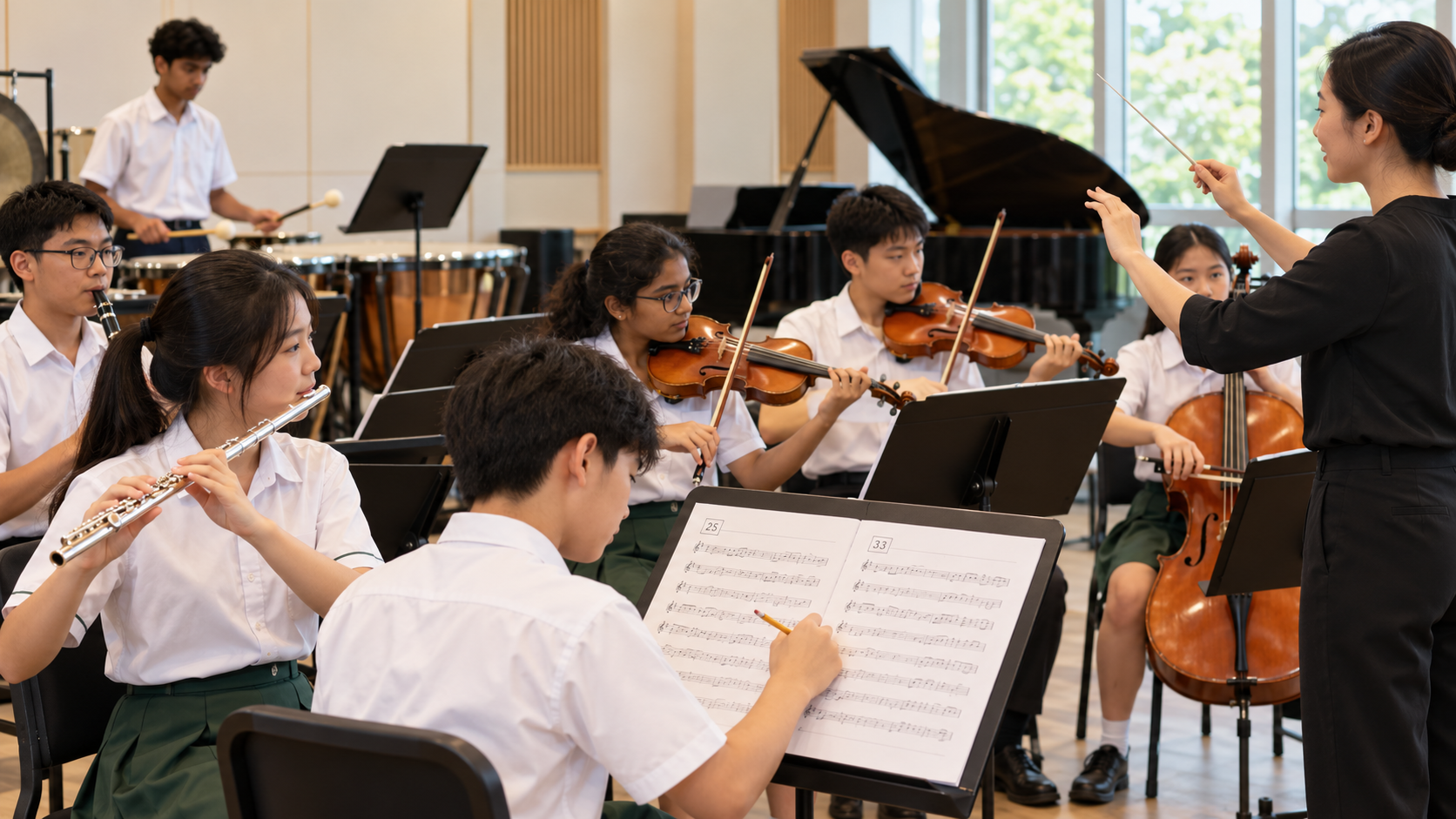
Did you know? A teenager can play an impressive solo perfectly yet still need to prove a different skill in G3 Higher Music Performing: communicating inside an ensemble. The 2027 SEC elective requires two contrasting performance items, including at least one ensemble piece, and follows the recital with a short viva voce in which the student explains musical and rehearsal choices.
Higher Performing K351 Paper 32 turns musical skill into something that can be heard, observed and discussed. A student must make responsible repertoire choices, perform with control and sensitivity, listen and respond to other musicians, then explain why their interpretation works. The goal is not a contest in speed or technical difficulty.
This guide uses the 2027 Singapore–Cambridge Secondary Education Certificate G3 Higher Music K351 syllabus. It explains the eight- to twelve-minute recital, 40-mark performance, three- to five-minute ten-mark viva voce, ensemble requirement, permitted second-item choices, marking criteria, authentication and the separate Higher Music award.
The quick answer for parents
Paper 32 Higher Performing is one of three elective options for Higher Music. It requires two contrasting performance items, at least one ensemble piece, and a short viva voce immediately after the recital.
The lasting skill is a combination of musicianship and self-understanding: the student can interpret music with purpose, collaborate effectively and explain how rehearsal decisions changed the performance.
Where Paper 32 belongs in the qualification
All K351 candidates complete compulsory Music Studies (40%), Creating (30%) and Performing (30%). They then choose one independent 50-mark elective: Research Essay K351/12, Higher Creating K351/22 or Higher Performing K351/32.
The Higher Performing result is considered separately for the Higher Music award. It is not another 40% added to the core Music grade.
The exact paper and examination format
SEAB titles the elective K351/32 Higher Performing. It is assessed in person by two examiners during a live performance, followed by an oral examination of the candidate’s understanding.
An uploaded video from private practice is not by itself the formal national recital. Families must follow the approved school’s actual examination arrangements.
The 50-mark assessment breakdown
Recital: 40 marks, requiring 8–12 minutes of performance. Viva voce: 10 marks, lasting approximately 3–5 minutes immediately afterward. Both components form the 50-mark independent elective.
Practice needs to include both making music and articulating musical decisions. A polished recital cannot fully substitute for the examiner’s discussion of the work.
| G3 Higher Music Paper 32 | 2027 assessment |
|---|---|
| Recital | Two contrasting items, at least one ensemble, 8–12 minutes |
| Performing marks | 20 technique + 20 musicality for each item; total out of 80 halved to 40 |
| Viva voce | 3–5 minutes directly after recital; 10 marks |
| Two-item repertoire | Must differ from core Paper 3 programme |
| Assessor | Two examiners at a live performance |
| Elective total | 50 independently assessed marks |
Two contrasting pieces are mandatory
Candidates must present two contrasting performance items or improvisations. Contrast can concern style, character, technique, musical organisation or performance context, appropriate to the actual repertoire.
Choosing two pieces solely because they are favourites does not necessarily demonstrate the contrast required. The approved teacher should help assess whether the proposed pair meets the syllabus.
One item must be an ensemble performance
The published Paper 32 rules require at least one ensemble piece. The candidate must demonstrate an independently assessable role while responding to other musicians.
Ensemble skill is not simply playing alongside others. The student should listen for balance, timing, cues and the relationship of their part to the collective musical texture.
The second item has several legitimate forms
Beyond the required ensemble performance, the second item may be a solo, another ensemble piece, an accompaniment, or a solo/ensemble improvisation within an appropriate tradition, subject to the specified rules.
This choice allows the learner to demonstrate another area of musicianship. Parents should avoid assuming every candidate must present one piano solo and one string quartet.
Solo performance is not necessarily the best second choice
A technically confident soloist may use a contrasting solo item to show interpretative range. Another candidate may be better served by accompaniment or a second ensemble performance.
The best option follows genuine capability and the two-item contrast. Repertoire should fit the student’s stage of development, not the parent’s preferred appearance of difficulty.
Improvisation may count as a piece
The official syllabus states that ‘pieces’ also refer to improvisations. It permits solo or ensemble improvisation within a chosen improvisatory tradition under the second-item options.
Improvisation must still demonstrate musical coherence and responsive understanding. It is not an unplanned excuse to avoid rehearsal or the required ensemble evidence.
Accompaniment is an authentic performing role
Accompaniment can demand sensitive balance, timing and awareness of the principal voice or instrument. It should be chosen where the candidate can demonstrate a musically substantial part.
Ask what the accompanist contributes to the phrasing, harmony, texture or expressive direction. An invisible supporting role can be as demanding as a foreground melody.
The recital lasts eight to twelve minutes in total
K351 Paper 32 specifies a combined performance duration between eight and twelve minutes for the two contrasting items. The candidate must plan repertoire that fits the actual timing.
A slow piece should not be accelerated unnaturally merely to meet the time window, nor a passage padded with unrelated repetitions. Choose repertoire appropriately before finalising the programme.
The core Paper 3 recital is shorter
Compulsory Performing Paper 3 requires a five- to ten-minute recital plus Reflection Notes. Higher Performing Paper 32 instead has a longer eight- to twelve-minute recital plus viva voce.
The similar subject names conceal different assessment requirements. Use the correct paper number during tuition, rehearsal and school form submission.
Higher repertoire must differ from core repertoire
SEAB explicitly requires the pieces used for Paper 32 to be different from those presented for compulsory Paper 3.
Do not present the same performance under a new title or slightly altered accompaniment. This requirement is an important part of keeping the Higher elective distinct from core assessment.
Candidates must organise appropriate accompaniment
The published rules state that candidates provide their own accompanist and ensemble where appropriate. The school must also manage the formal examination and supervision arrangements.
Students should plan practical availability and rehearsals early. A chosen ensemble item can become risky when partners, instruments, or rehearsal space are not realistically available.
Not every ensemble member is an examination candidate
SEAB allows other participants who are not examination candidates to perform in the ensemble. However, the assessed student’s own part must be clear enough for valid judgement.
A talented group cannot stand in for the candidate’s musical role. The pupil should be able to play independently and explain how they interact with the ensemble.
Avoid extensive doubling of the candidate’s part
The syllabus says the candidate’s ensemble part must not be extensively doubled by another part, to ensure ensemble skills can be judged.
If other players consistently play the exact same line at the same time, the examiner may not be able to evaluate the individual candidate clearly. Ask the teacher how to maintain a valid musical arrangement.
What contrast can sound like
A programme might juxtapose two different musical characters, structures or performance settings. The contrast should be perceivable through relevant musical features, not only the titles printed on the programme.
A student should explain what changes between the two items and why the difference demonstrates a broader understanding of music.
The instrument is a medium, not the objective
The examination accepts music from different styles and traditions, on suitable instruments or voice under the guidelines. The goal is technical and interpretative competence appropriate to the chosen medium.
A powerful drum performance, expressive vocal piece or sensitive accompaniment is not automatically less valid than a difficult keyboard work. The rules and actual musical evidence determine suitability.
Technique should serve the musical idea
Accurate notes, rhythm, articulation, intonation and appropriate tempo are important, but they serve communication. Playing fast without control can damage phrase shape and ensemble balance.
Ask the learner to identify which technical choice supports a particular musical moment. This connects repetitive practice to a purpose listeners can hear.
Rubric Part 1: technical control
For each recital item, the examiner awards up to 20 marks for technical control appropriate to the style or genre, or quality of improvisation where applicable.
The relevant standard depends on the repertoire. A candidate should choose music that allows secure, expressive performance rather than chase difficulty levels that exceed current competence.
Rubric Part 1: musicality and sensitivity
Each item also carries up to 20 marks for musicality and sensitivity. This concerns expression, interpretation and the ability to bring musical decisions to life.
Musicality is not merely moving dramatically while playing. It is audible in choices about phrasing, timing, texture, dynamics and the coherent treatment of musical material.
Why the performance marks are averaged
The two recital items are each marked out of forty: twenty for technique/improvisation and twenty for musicality. Their total reaches eighty, which is divided by two, rounding up an odd result, to give forty recital marks.
That forty-mark recital result is then combined with the ten-mark viva voce. Knowing this helps families understand why both contrasting items need genuine preparation.
The viva voce is not a theory worksheet
Immediately after performing, the student answers examiner questions about repertoire, musical analysis, technique, rehearsal and interpretative choices. The exchange lasts approximately three to five minutes.
The goal is to explain the performed music in relation to real decisions, not recite a memorised biography of the composer.
Three areas shape the viva questions
The syllabus directs examiners to ask about knowledge of chosen repertoire/improvisations, analysis of specific musical features and performance techniques, and rehearsal and preparation.
Students should be able to discuss the repertoire, point to an audible feature and describe a genuine rehearsal challenge. These three kinds of explanation complement one another.
Viva Question Type 1: repertoire knowledge
An examiner may ask about the chosen music, stylistic setting, composer where appropriate, musical character, or performance tradition. The student should know the actual item they performed.
A generic statement such as ‘this is from an old period’ is less helpful than an accurate explanation connected to a particular feature or context.
Viva Question Type 2: analysis and technique
A question might explore how a change of texture affects balance or why the candidate shaped a phrase in a particular way. The answer should connect a musical feature to a technical or expressive decision.
Teach the pupil to explain what listeners can hear and what the performer was trying to achieve. Avoid vague answers about ‘making it nice’.
Viva Question Type 3: rehearsal processes
The examiner may ask what was difficult, what practice strategy was chosen and whether the result changed. A specific rehearsal example demonstrates reflective learning.
Instead of ‘I practised every day’, the candidate might explain that entries were inconsistent and that structured cue rehearsals improved group coordination.
The examiner may ask follow-ups
The syllabus allows examiners to explore a point with a follow-up question or replace a question in the same category when necessary, while maintaining the appropriate standard.
A pupil should not panic when the question changes. Listening and adapting are part of demonstrating understanding, not a failure of preparation.
The viva is marked holistically
The ten-mark viva score reflects the candidate’s answers collectively, not a fixed number of marks per question. A more developed explanation can clarify competence even if another response is shorter.
Practise honest, clear answers using the actual repertoire rather than invent polished statements for questions that may never be asked.
The recital should be stage-appropriate
SEAB advises candidates to select music suited to their current technical and musical development. A piece that is beyond the student’s reliable control can make interpretation harder rather than impress examiners.
The repertoire should provide sufficient challenge to demonstrate skill while allowing secure rhythm, tone and expression.
Repertoire breadth needs planning
Two contrasting pieces may require different playing techniques, rehearsal strategies or ensemble settings. The learner should decide early which skills need attention and how the two items fit the time window.
Ask whether preparation resources are realistic. A complicated ensemble work is a poor choice if the required partners are never available for rehearsal.
A rehearsal plan begins with the actual problem
Rather than rehearse an entire item repeatedly, identify the first passage where timing, intonation, coordination or interpretation breaks down. Isolate it and practise deliberately.
After correction, return to the surrounding musical context. A passage that works in isolation may still fail when the preceding cue changes.
Slow practice is a method, not the finished performance
Working below performance tempo can help the student hear relationships and build reliable movement. The eventual performance still requires the intended style, pacing and expression.
Increase tempo only when accuracy and musical meaning remain stable. The aim is controlled performance, not simply reaching the number printed on a metronome.
Counting in an ensemble requires listening
A player may know their rhythm yet enter incorrectly because they did not hear the other part’s cue. Ensemble practice should include the relationship between parts rather than individual notes alone.
Ask which sound signals the entrance and how the candidate confirms the group’s pulse. This builds responsive musicianship.
Balance is a collective decision
A supporting instrument may need to change dynamics or articulation so that another part remains audible. The right balance depends on the score, ensemble, venue and intention.
Students should explain why they made a balance adjustment. Playing as loudly as possible can undermine both musicality and teamwork.
Communication through eye contact and cues
Some ensemble contexts benefit from visual and auditory cues, agreed entrances or careful phrasing. These are ways musicians coordinate shared timing and expression.
A competent performer should know when to lead, when to follow and when a cue is needed. Visible confidence is less useful than coordination listeners can actually hear.
Rehearsal with non-examined players
If some ensemble members are not candidates, they still need appropriate preparation and reliable understanding of the programme. The candidate remains responsible for an assessable part.
Confirm arrangements through the school. Parents should not assume that any available group of musicians automatically satisfies the Higher Music ensemble criteria.
A performance journal should be specific
Record the passage, identified issue, practice method, result and next step. A log of hours alone does not reveal why a performance has improved.
These notes can help the candidate prepare genuine viva responses. They should describe actual rehearsal rather than a tidy process invented afterwards.
Use recordings responsibly for feedback
Where school and performers permit, a rehearsal recording can help students notice timing, balance and expression. The recording is a diagnostic aid, not a replacement for the official live examination.
Obtain permission and respect privacy and copyright. Avoid distributing recordings of classmates or teachers without appropriate consent.
A hypothetical rehearsal example
Imagine a school ensemble in which one student consistently enters half a beat late after a quiet passage. The first question is whether the problem comes from counting, a missing cue or uncertain listening.
The students might rehearse the transition with a clear agreed signal, then restore the musical context. This is an original learning example, not an official 2027 task.
A hypothetical interpretative contrast
Imagine two original, suitably licensed musical pieces, one with restrained phrasing and another with sharply articulated rhythmic exchanges. The student can explain what makes the approaches contrasting and how they would perform each.
Do not assume that all slow music must be sad or all fast music joyful. Expression should follow the actual musical evidence.
Why stage presence is not a costume contest
Professional conduct and audience awareness can help a performance run smoothly, but music is assessed through technical and interpretative performance under the published criteria.
A visually impressive outfit, dramatic gestures or expensive instrument cannot compensate for unclear phrasing or insecure musical control.
The hidden Mathematics in performance
Musical timing involves proportion, pulse, subdivisions and patterns. Students can use a counted rehearsal method to establish relationships before performing them naturally.
The aim is not to turn every phrase into arithmetic. Measurement can help repair timing, while musical judgement determines expression.
The hidden English in the viva
An examiner’s question may ask why a technique was chosen, how rehearsals changed or what a stylistic feature communicates. Each asks for a different type of answer.
Teach the candidate to restate the question mentally and respond with a relevant example. Technical terminology should clarify the explanation instead of hiding uncertainty.
What parents can ask after practice
Try Which passage improved today? How did you know? What would you tell the examiner about it? These questions help students connect preparation with musical reasoning.
Parents need not be performers themselves. Listening patiently and supporting an appropriate rehearsal schedule can be more useful than constant judgement.
The five-hour consultation limit
The official syllabus allows candidates up to a maximum of five consultation hours with the coursework supervisor for the elective.
Use that time for repertoire suitability, musical questions and preparation within the authorised conditions. General music learning and school-specific supervision must still follow the applicable rules.
Official repertoire forms matter
The syllabus requires a completed form identifying pieces selected for core Paper 3 and Higher Paper 32. Schools receive the exact submission date from SEAB in advance of the examination.
A parent can remind the learner to check this administrative step with the school. Do not assume that successfully booking rehearsal rooms also completes the official entry process.
Choose stage-appropriate instruments and styles
The K351 guidance includes details about instrument and repertoire suitability. A candidate should work with the authorised teacher when selecting a programme involving voice, acoustic or electronic instruments and specific styles.
A musical tradition should be understood on its own terms. It is not automatically inferior because its notation or performance conventions differ from those of a Western classical recital.
How to choose between the three electives
Paper 12 may suit a student who enjoys listening research and extended written analysis. Paper 22 may suit a student drawn to composing and sound design. Paper 32 may suit a student who enjoys performing, collaborating and explaining interpretative choices.
Different strengths can justify different choices. No elective is universally easier, and the official school must be able to support the relevant assessment.
How the Higher Music award is determined
SEAB awards the core SEC Music grade from compulsory Papers 1–3. The independently assessed elective is then considered alongside that core result for Higher Music Distinction or Merit.
Distinction requires A1/A2 in both the core combination and elective. Merit requires C6 or better in both. A good recital cannot guarantee an award if the other published condition is unmet.
Common mistake: the ensemble part cannot be heard
A candidate’s part extensively doubled by other players may be difficult to assess individually. The official guidance warns against that arrangement.
Discuss the part’s independence and balance with the school teacher, ensuring both legitimate musical texture and assessable ensemble skill.
Common mistake: two performances from core Paper 3
Higher Performing pieces must differ from those performed in compulsory Paper 3. Repeating the same item under another arrangement is not automatically a valid new selection.
Keep a repertoire checklist for the core and elective programmes so the candidate and teacher can confirm compliance early.
Common mistake: a memorised viva speech
A polished answer about the piece’s composer does not necessarily address a question about the candidate’s rehearsal process. A generic answer may reveal little real understanding.
Prepare categories of real evidence instead: what the music does, what technique was used and what changed during rehearsal.
A four-week performance preparation cycle
Week one: identify technical gaps and confirm repertoire suitability. Week two: target ensemble coordination and individual passages. Week three: rehearse full-item continuity and musical interpretation. Week four: practise an appropriate recital sequence and short viva questions.
This is an illustrative general practice cycle, not the official examination calendar. The real programme requires longer-term preparation and school-supervised rehearsal.
Frequently asked question: how many pieces?
Two contrasting pieces or improvisations, with at least one ensemble item and a combined recital duration of eight to twelve minutes.
The second item may be solo, ensemble, accompaniment or appropriate improvisation under the published options.
Frequently asked question: is the viva immediately afterward?
Yes. The 3–5-minute viva voce takes place directly after the recital, with questions about repertoire, musical analysis and rehearsal.
Students should be able to describe genuine choices without relying on a script or written notes not permitted by the examiner.
Frequently asked question: how are the fifty marks calculated?
The two performances are each marked out of forty, with twenty for technical control/improvisation and twenty for musicality. Those eighty marks are halved to forty, then ten viva marks are added.
This makes both performance items and the oral explanation substantive parts of the independent elective.
Frequently asked question: is this the regular Music recital?
No. Regular Paper 3 requires a five- to ten-minute recital plus Reflection Notes. Higher Paper 32 requires a different eight- to twelve-minute two-item programme plus a viva voce.
Both are compulsory for a candidate who chooses Paper 32, because the Higher elective is additional to the core Music papers.
The lasting reason to study Higher Performing
The Higher Performing elective gives young musicians an opportunity to be accountable for their own sound and for the shared work of an ensemble. Explaining a rehearsal decision can turn an instinctive skill into something understood and improved.
Use the official 2027 Higher Music K351 Paper 32 syllabus and rubric. Compare Higher Music Research Essay, Higher Creating and Higher Music compared with Music. The unchanged Clementi small-group Mathematics tutorial reference illustrates feedback-led learning in another subject, not the availability of Higher Performing supervision.