
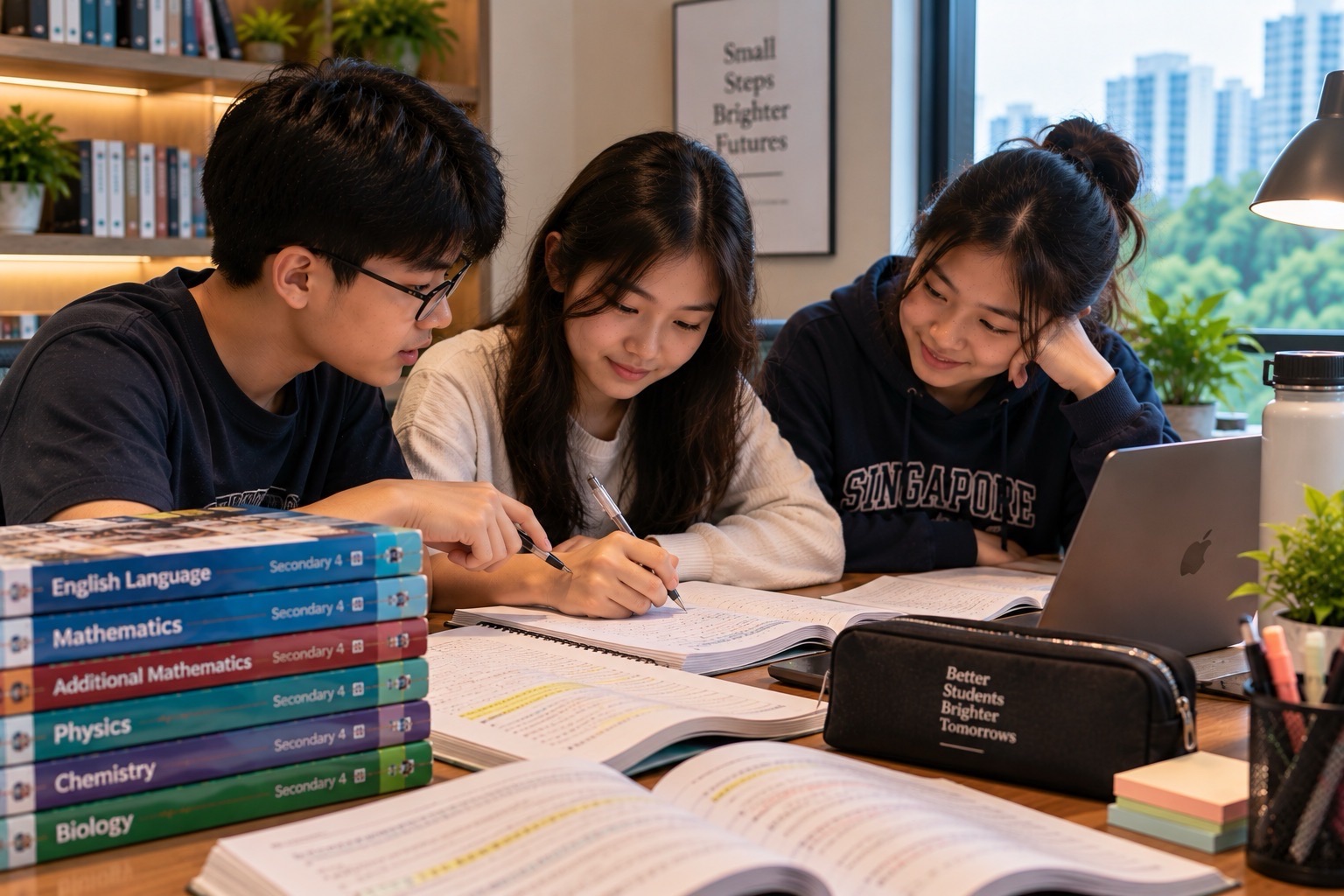
Did you know? A student in Singapore can study another language at G3 and face one of several quite different SEC examinations. German and Japanese assess writing, reading, listening and oral across four papers. Burmese and Thai each have one three-hour written paper. Chinese and Malay Special Programmes combine practical writing, reading, oral and listening in another arrangement. The phrase ‘third language’ is not enough to identify the paper.
Learning an additional language can give teenagers more ways to ask questions, understand communities, appreciate writing and communicate across contexts. But the 2027 Singapore–Cambridge Secondary Education Certificate (SEC) includes separately coded foreign-language subjects and Special Programmes, each with its own purposes, teaching arrangements and examination requirements. Students should not be pushed into a route on the assumption that all languages have the same difficulty, structure or recognition.
This parent guide explains the official G3 Chinese (Special Programme) K364, Malay (Special Programme) K365, Arabic as a Third Language K366, Bahasa Indonesia as a Third Language K367, Burmese K369, French K370, German K371, Japanese K372, Spanish K373 and Thai K374. It highlights key examination differences, how to choose accurate resources, and the transferable learning habits that matter beyond any paper.
The quick answer for parents
Studying a third or additional language develops reading, writing, listening and spoken understanding to the extent specified by the particular course. It can also help a learner recognise how another language organises thought and how language is used within differing cultural contexts.
The most important administrative step is to verify the exact K-code and school eligibility. The most important educational step is to find out what the teenager can understand and express independently.
A useful distinction: programme versus exam subject
A school or MOE programme is a teaching arrangement, while an SEC K-code identifies a specific examinable subject. A course described informally as a ‘third language’ does not guarantee entry into every language examination listed by SEAB.
Some G3 subjects are explicitly named ‘as a Third Language’, such as Arabic and Bahasa Indonesia. Others appear under general language names or as Chinese/Malay Special Programmes. Parents should preserve those differences.
The ten 2027 G3 language codes
SEAB’s school-candidate directory lists K364 Chinese Special Programme, K365 Malay Special Programme, K366 Arabic as a Third Language, K367 Bahasa Indonesia as a Third Language, K369 Burmese, K370 French, K371 German, K372 Japanese, K373 Spanish and K374 Thai.
This is a crosswalk of separately listed codes, not a promise that each is available in every Singapore school or that all can fulfil any student’s Mother Tongue obligations.
Not every language is the student’s Mother Tongue
A student may learn Chinese or Malay through a Special Programme while studying another designated Mother Tongue Language. Other languages can be taken for different educational purposes depending on school approval and registration rules.
It would be misleading to assume that any additional-language certificate automatically replaces the student’s Mother Tongue qualification or yields identical admissions treatment.
Full Subject-Based Banding should not become stereotyping
G3 identifies a subject level, not an intellectual identity or a statement about heritage. A learner’s prior exposure, interest, reading ability and speaking confidence can vary widely.
Parents should not assume that a child with a particular surname must know a language, or that one language is inherently the ideal choice for a student of a particular background.
The most surprising difference: examination structure
The 2027 G3 language subjects are not all assessed across four skills in the same way. K364 and K365 use their own Writing, Language Use/Reading and Oral/Listening structure; K371 and K372 have four papers; K369 and K374 are assessed through one written paper.
Using a generic foreign-language workbook without checking the code can result in practising the wrong paper, response length or permitted materials.
| 2027 G3 language route | SEC code | Core assessment distinction |
|---|---|---|
| Chinese (Special Programme) | K364 | Writing 20%; Reading 30%; Oral 30%; Listening 20% |
| Malay (Special Programme) | K365 | Writing 20%; Reading 30%; Oral 30%; Listening 20% |
| Arabic as 3rd Language | K366 | Writing 20%; Reading 30%; Listening 20%; Oral 30% |
| Bahasa Indonesia as 3rd Language | K367 | Four equally weighted 25% skills |
| French, German, Japanese, Spanish | K370, K371, K372, K373 | Four papers; 33% Writing, 33% Reading, 17% Listening, 17% Oral |
| Burmese, Thai | K369, K374 | One 3-hour written paper, 100% |
What families should ask the school
Ask whether the language is offered, who is eligible, how lessons are scheduled, which 2027 code is entered and whether there are separate programme attendance requirements.
Also clarify how the result is recognised for any intended next educational route. The subject directory alone does not settle those student-specific questions.
Chinese Special Programme K364
CSP is designed as an additional-language route. Its 2027 SEC scheme allocates Writing 20%, Language Use and Reading 30%, Oral 30% and Listening 20%.
Paper 1 takes 105 minutes and asks for a practical response of at least 60 Chinese characters and narrative composition of at least 180 characters. The oral conversation is based on a picture stimulus.
Why CSP is not ordinary Chinese K320
Ordinary G3 Chinese Language has its own G3 Mother Tongue syllabus, with longer written responses and a different 30/35/25/10 assessment balance.
A learner should practise CSP questions if entered for K364, rather than assume that any G3 Chinese paper accurately matches the additional-language route.
Malay Special Programme K365
MSP also allocates 20% Writing, 30% Language Use/Reading, 30% Oral and 20% Listening. It uses short practical texts, a picture-stimulated oral conversation and its own word-count requirements.
Paper 1 includes a functional response of at least 50 words and an essay of at least 170 words. The ordinary G3 Malay K321 paper has different lengths and weighting.
Why MSP has its own purpose
Malay Special Programme supports additional-language communication in everyday contexts. Its educational value cannot be assessed solely by comparing the number of words in its composition with ordinary Mother Tongue Malay.
Ask whether the teenager can use a new expression to ask for information, explain an instruction or respond to someone appropriately. These outcomes show genuine competence.
Arabic as a Third Language K366
The official 2027 Arabic syllabus assumes approximately four years of study and targets standard Arabic used across a wide range of contexts. It uses four compulsory papers with Writing 20%, Reading/Language Use 30%, Listening 20%, Oral 30%.
K366 is not the same exam as CSP or MSP. It includes different reading, written correspondence, listening and conversation tasks, and students should use the appropriate standard-language materials.
Arabic Writing has two separate tasks
K366 includes short functional correspondence of approximately 50–70 words and an extended composition of at least 170 words. The writing paper lasts one hour 45 minutes.
The official rules allow an unannotated monolingual dictionary in the Writing paper; that permission does not automatically extend to personal translation apps or other exams. Students need to control meaning themselves.
Arabic script and pronunciation require connected learning
Arabic’s right-to-left script, letter forms and grammatical patterns create particular literacy demands. Recognising isolated characters does not automatically make unfamiliar sentences readable.
Use teacher-approved words in context, connect reliable audio with print and ask the learner to explain a complete message. This creates transferable understanding rather than visual copying.
Bahasa Indonesia as a Third Language K367
K367 is listed with its first examination in 2027. It assesses Listening, Reading, Speaking and Writing at 25% each, unlike the Arabic and Special Programme schemes.
The syllabus targets CEFR A2 with elements of B1 and assumes a multi-year learning programme. These descriptors support practical familiar-situation communication rather than a claim of professional fluency.
K367 Writing includes more than an essay
The Bahasa Indonesia Paper 4 tasks include form filling, directed writing of around 80–90 words and extended writing of around 130–140 words. The paper lasts one hour 15 minutes.
A successful candidate should understand the audience, purpose and information supplied. More sophisticated expressions are valuable only when they make the required meaning clearer.
K367 Speaking includes role play
The official Speaking paper includes a role play involving an everyday transaction and two topic conversations. The learner must understand and respond to the actual questions.
A memorised talk about a favourite hobby cannot serve every request for directions, booking information or explanation of a changed plan. Practise useful exchanges with an information gap.
Bahasa Indonesia is related to, but not identical with, Malay
Familiar-looking words and structures may help some Singapore students begin learning Indonesian, yet meaning, usage and common forms can differ.
Treat familiarity as a starting hypothesis. A child should read the Indonesian sentence in context and verify a word’s meaning rather than translate automatically from Malay.
French K370
The 2027 French syllabus has four compulsory papers with approximate weightings of Writing 33%, Reading 33%, Listening 17% and Oral 17%. The Writing paper includes two 140–150-word tasks.
The course can develop practical reading of notices, writing with accurate grammar and conversation about everyday experiences. Dictionaries are prohibited during the examination under the official syllabus.
German K371
The German examination likewise allocates Writing 33%, Reading 33%, Listening 17% and Oral 17%. Paper 1 lasts 90 minutes and has two writing questions of 140–150 words each: a six-picture story and directed writing.
A student should practise interpreting the full sentence and choosing appropriate verb forms, including time relationships. An answer can look fluent while changing who performed an action.
How German articles and verbs connect
German grammar uses article forms, agreement and changes to verb position that can affect the meaning of a sentence. Some errors become visible only when a learner changes the subject or tense.
Practise one reliable sentence, alter its speaker or time and explain which parts must change. Copying the original model without understanding its structure offers limited transfer.
Japanese K372
The 2027 Japanese exam also uses 33% Writing, 33% Reading, 17% Listening and 17% Oral, but its Writing paper measures characters rather than German- or French-style word totals.
Paper 1 has a 260–300-character six-picture story and a second essay of 350–400 characters. A family should never substitute a European-language word limit for these Japanese character requirements.
Japanese writing uses multiple scripts
Japanese uses hiragana, katakana and kanji in different roles and contexts. Students should build appropriate recognition, accurate word usage and the ability to understand the full message.
The official Japanese Reading paper even tests conversion between kanji and hiragana in context. A learner who recognises a kanji in a familiar flashcard may still need practice in a complete sentence.
Spanish K373
The 2027 Spanish syllabus assigns Writing 33%, Reading 33%, Listening 17% and Oral 17%. It specifies two writing responses of 140–150 words each, including a six-picture story.
A good learner should understand relevant time frames, sentence agreement and the exact task. A letter about a school event is not made stronger by inserting unrelated travel vocabulary.
Why European-language papers cannot simply be swapped
French, German and Spanish may share some broad examination features, but grammar, vocabulary and spoken forms differ. Japanese uses a different writing system and character-count rules.
The common percentages are a planning aid, not a single generic exam. Select actual syllabus-coded materials for the child’s language.
Burmese K369 has one written examination
Unlike the four-paper languages, G3 Burmese K369 requires Paper 1 only: three hours, 100%. It covers Composition, Translation and Reading Comprehension within a 100-mark written paper.
The official 2027 syllabus states November availability and prohibits dictionaries during the assessment. Families should not invent a separate Burmese national Oral or Listening paper.
The Burmese composition task
In K369’s written paper, Section A carries fifty marks and asks for two compositions of approximately 150 words each, selected from five available topics.
The tasks can involve an opinion, a letter, narrative, description or dialogue. Each needs an appropriate form and clearly connected ideas rather than memorised phrases alone.
Thai K374 uses the same broad one-paper structure
G3 Thai K374 also specifies a three-hour written Paper 1 worth 100%, comprising Composition, Translation and Reading Comprehension. It is available in November and does not permit dictionaries.
The shared structure should not be taken as proof that Thai and Burmese language conventions are interchangeable. Accurate script, vocabulary and composition still require distinct teaching.
The Thai writing task includes two compositions
K374 requires two compositions of approximately 150 Thai words each from a choice of five topics in the fifty-mark composition section.
These responses may take different communicative forms. Students should choose a suitable topic and plan for clarity rather than write one general-purpose piece regardless of the prompt.
Why Translation is different from composition
In a translation task, the learner must preserve the intended relationships, conditions and meaning of the source while using natural forms of the target language.
A composition allows independent selection of ideas; a translation does not permit adding an invented conclusion. These are different intellectual jobs and should be taught separately.
Why a strong translation can be simple
An accurate simple sentence is preferable to an elaborate one that reverses a condition or changes a person’s role. The goal is faithful communication, not decorative complexity.
Ask what the original sentence establishes and whether the translated sentence asserts the same thing. If not, the wording should be revised even if every individual word looks familiar.
Recognising the examination schedule
SEAB’s general SEC calendar describes September written English and core Mother Tongue examinations, while individual language syllabus documents specify October, November or October/November availability.
Always follow the entered language’s syllabus and the actual candidate timetable. A general statement about ‘Mother Tongue’ should not override an explicit language-paper availability rule.
Why students should not choose by a paper’s apparent length
A three-hour paper is not inherently more valuable than four shorter papers, and a higher number of assessed components does not necessarily represent stronger language ability.
Examination schemes reflect different syllabus choices and assessment priorities. Subject selection should consider genuine interest, school eligibility, workload and future needs.
How to start learning a new script
Students benefit from connecting letters or characters with reliable sound, meaning and whole-word use. Script learning should progress from recognition toward actual reading rather than endless copying.
For Japanese, Arabic, Burmese or Thai, school-approved forms and accurate models are particularly important. An invented transliteration may teach the wrong relationship.
A notice can train comprehension across languages
Imagine a fictional community event taking place on Saturday with registration closing Thursday. Different scripts may describe the facts, but every learner must identify which date determines attendance and which requires action.
The exercise reveals whether the student understands a full message instead of matching familiar names or numerals. It does not need private student data to feel realistic.
Build speaking around information gaps
One student knows a fictional venue and opening time, while another must ask for it. The learning task is to obtain the relevant information and verify it.
Where oral is nationally assessed, align practice with that language’s actual role play, presentation or conversation format. Where it is not separately examined, speaking can still enrich general language competence.
Listening must follow changes, not keywords
A recording might mention an original destination and then a changed final destination. A candidate who selects the first recognisable place has not understood the revised plan.
Ask what changed, what caused the change and what the listener should now do. This tests sentence relationships more reliably than an isolated vocabulary quiz.
Writing needs an intended audience
An email, letter, forum post, report, narrative and translation have different purposes. The same words may be inappropriate when the reader or communicative job changes.
Before drafting, identify the audience, question and necessary information. Relevance should be checked before stylistic improvements.
A vocabulary notebook should support transfer
Write one expression with its meaning in context and a verified example, then make a second original sentence. Return after several days without seeing the first model.
The real test is whether the learner can retrieve it when discussing a new situation. Recognising an item only beside its translation is a weaker achievement.
Why grammar cannot be learned as decoration
Sentence order, agreement, affixes, word forms and other language-specific structures determine who did what, when and under what conditions. A fancy sentence can still convey the wrong fact.
Teach one meaningful contrast at a time. Ask the learner to describe why the correction was necessary and apply it in an unfamiliar example.
Use authentic cultural context respectfully
Languages connect people with varied stories, social practices, writing and contemporary experiences. The language of a large community cannot be reduced to one dish, holiday or family custom.
Explain where a particular cultural example comes from and what it does or does not represent. Respectful curiosity is part of meaningful language learning.
The danger of overgeneralising from a related language
A learner may notice similarities between languages and assume a word means the same thing everywhere. False friends, differing usage and divergent registers can make that assumption misleading.
Use the whole sentence to test a guess and verify the word from appropriate teaching material. The student should learn to distinguish useful transfer from overconfidence.
School resources come before expensive purchases
Many learners can begin with their school’s approved textbooks, reading passages, recorded dialogues and teacher feedback. Families should ask which software, script conventions and exam materials are actually used.
A costly language package that prepares the wrong K-code is not a good investment. Practice should be accurate, manageable and linked to a real learning need.
A practical weekly learning rhythm
Try one short new reading, a useful response in writing, a listening or spoken task where appropriate, and a brief error-review session. Recycle vocabulary while changing contexts.
The routine should reflect the actual paper and the learner’s needs. Students sitting a one-paper written examination need a different national exam practice balance from those with four assessed skills.
A four-week improvement cycle
Week one: diagnose script, vocabulary and basic understanding. Week two: target the language’s functional or composition tasks. Week three: practise unseen comprehension and either translation or listening according to its actual syllabus. Week four: attempt a suitable timed selection and review which weaknesses remain.
The cycle is illustrative. School instructions, available time and the child’s wellbeing determine the right order and practice volume.
What parents can ask after a lesson
Try What was the message asking? Which words made you decide? How would you reply if the context changed? These questions develop evidence and flexible communication regardless of the language.
A parent need not know every word or script feature. They can encourage the pupil to seek reliable feedback and apply one verified correction in a new example.
How a tutor can genuinely help
A capable teacher distinguishes reading difficulty from weak vocabulary, grammar, task relevance, translation fidelity, listening recognition or spoken hesitation. They also know the exact 2027 examination structure.
A good lesson produces improvement on unfamiliar work completed independently. Copying a polished model answer is not the same as being able to adapt language for a new person or purpose.
Subject eligibility and admission rules need exact verification
Additional-language study can be valuable for personal development, travel, research and future communication. But each programme or qualification may have its own eligibility and institutional recognition conditions.
Parents should not assume automatic bonus points, Mother Tongue substitution or course admission. Confirm the actual rule with the school or intended institution.
Frequently asked questions: are all these languages four-paper exams?
No. G3 German and Japanese have four papers; Burmese and Thai each have one three-hour written paper. CSP, MSP, Arabic and Bahasa Indonesia also have their own distinct schemes.
The official K-code—not an informal label such as ‘third language’—determines the assessment.
Frequently asked questions: which programmes have picture oral?
Chinese Special Programme K364 and Malay Special Programme K365 use picture-based oral conversations, while other language syllabuses may use video presentation, role play or general conversation.
Do not practise only the wrong stimulus format. The current SEAB syllabus and school’s instructions provide the needed details.
Frequently asked questions: is a dictionary allowed in every language?
No. For example, German K371, Burmese K369 and Thai K374 prohibit dictionaries in their published assessments. Other subjects have different rules, including specific permitted references in some writing papers.
Consult the language-specific official syllabus, not a generic statement about translation aids.
Frequently asked questions: does Japanese use ordinary word counts?
K372’s Writing paper specifies Japanese character counts—260–300 for the picture-story exercise and 350–400 for the second essay—rather than the 140–150-word German requirement.
These quantities cannot be compared as though they were identical units.
The lasting reason to learn a third or additional language
Another language expands what young people can read, hear, ask and understand. The lasting achievement is not a memorised phrase or an examination label, but being able to communicate with another person meaningfully and responsibly.
Use the official 2027 SEAB G3 subject directory and check the particular syllabus, including Chinese Special Programme K364, Malay Special Programme K365, Arabic K366, Bahasa Indonesia K367, German K371, Japanese K372, Burmese K369 and Thai K374. Related eduKateSG guides include G3 Arabic, G3 Bahasa Indonesia and Chinese Special Programme comparison. The unchanged Clementi tutorial reference is a separate example of diagnostic teaching, not a claim of additional-language class availability.