
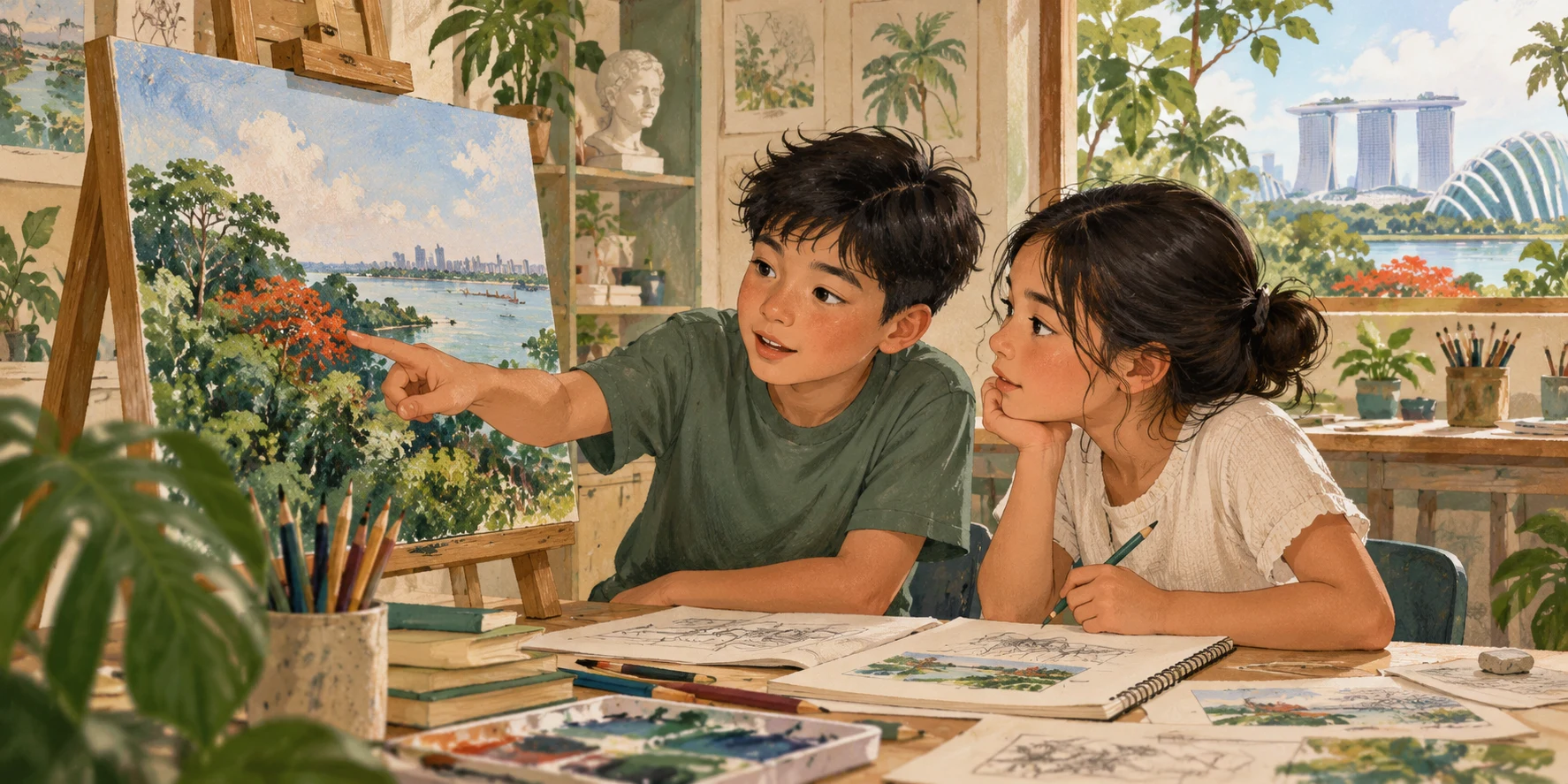
Primary Art matters because a child learns to observe the world closely, communicate through images and explore ideas that cannot always be captured in a sentence or number. Drawing, painting, making, discussing and looking carefully at artworks can all develop the child’s ability to notice differences, make choices, evaluate an approach and explain what they intended. The subject deserves a place in school not because every child must become a professional artist, but because visual thinking is part of a broad education.
For Singapore parents, Primary Art is sometimes described as a pleasant break from examinable subjects. Enjoyment matters, yet the 2024 MOE syllabus gives the subject a richer educational purpose: imagination, adaptability, visual discernment, expression and awareness of society and culture. An art lesson is not simply time to colour something neatly. Children can learn why an image produces a particular impression, how a material changes what can be made and how different people interpret an artwork.
This guide explains why Primary Art is worth studying from Primary 1 to Primary 6, what Singapore’s revised Art syllabus develops, why drawing is a language of observation, how visual culture affects children, what parents can do without expensive materials and why the subject’s value should not be reduced to either a PSLE grade or a promised future career.
A one-minute answer for busy parents
Why study Primary Art? Because it teaches children to see, express and appreciate. They learn to observe details rather than glance superficially, turn ideas into visual forms, try different materials, explain decisions and engage respectfully with the artworks and perspectives of other people. The result can be a more curious and reflective learner who recognises that meaning can be communicated through images as well as words.
The MOE 2024 Primary Art Syllabus organises learning around Context, Artistic Processes, Visual Qualities and Media. Its broad focus includes children’s immediate experiences, Singapore across time and the wider world. Primary Art is not a PSLE paper, but that does not make it educationally optional or insignificant. It develops capabilities relevant to daily visual communication and to a balanced school experience.
What Singapore’s 2024 Primary Art syllabus sets out to achieve
The official MOE 2024 Primary Art Syllabus presents Art as integral to holistic development. Its stated value includes expanding imagination and creativity, building adaptability, developing the capacity to discern and process visual information, and fostering a sense of identity, culture and place in society.
The framework connects observing, creating and appreciating. Children should not merely imitate an example and submit the finished piece. They should engage with an idea, examine visual choices, make something intentionally and reflect on its meaning or effectiveness.
The syllabus describes four interconnected content components: Context, Artistic Processes, Visual Qualities and Media. Parents can use these as a way to understand what a teacher is developing, rather than judge every lesson by whether the final picture looks polished.
Seeing is a skill, not merely opening your eyes
Children encounter visual information continuously, from road signs and food packaging to nature, photographs and digital screens. Yet looking at something does not guarantee careful observation. Art teaches pupils to notice shapes, line, colour, texture, proportion, space and relationships.
Consider two leaves. A child might initially say they look the same because both are green. A careful drawing exercise could reveal differences in edge, vein arrangement, curvature and size. The value is the act of attending accurately to what is present, not producing a museum-quality botanical illustration.
Parents can ask, “What detail did you notice on your second look?” Such questions support observation without creating anxiety about artistic talent. Careful seeing is useful in art, scientific inquiry and everyday interpretation, although improvement in one subject should not be promised to transfer automatically into every other.
Drawing helps children think
Drawing is often judged as a performance: either the child can draw a realistic face or cannot. In education, drawing also serves as a way of investigating objects, recording visual information, planning an idea and communicating a relationship.
A child may sketch three possible designs for a school garden. None needs to be photorealistic to be useful. The drawings can reveal where paths, plants and seating might go, and the child can compare whether each arrangement serves its purpose.
MOE’s 2024 refresh places importance on drawing as a visual language. Parents can reinforce this by inviting children to explain what a drawing shows and why they chose its arrangement. The conversation should focus on meaning and revision, not a simplistic judgement of talent.
Visual qualities: line, shape, colour and texture carry meaning
The same subject can feel very different when represented with different visual choices. Sharp angular lines may create one impression, while curved lines and soft contrasts create another. A bright colour combination may draw attention to a focal point; restrained colour may shift the emphasis.
These are possibilities, not universal emotional laws. Interpretation depends on context, culture and the overall composition. Students should learn to identify what a visual choice does in a particular work and explain their reaction rather than memorise that one colour always means one emotion.
At home, compare two book covers for similar stories. Ask which part catches attention first and how the placement, size or contrast contributes. This turns everyday imagery into an accessible lesson in visual literacy.
Composition: deciding what matters most in an image
Composition involves arranging parts of an artwork so that they work together. Size, position, balance, emphasis, space and contrast influence what a viewer notices and how the image is read. A child learns to choose rather than simply fill an entire page.
Suppose a drawing is intended to show a small puppy lost in a busy park. If every figure is equal in size and importance, the viewer may not recognise the central idea. The child can change placement, contrast or perspective to give the puppy more visual emphasis.
This encourages purposeful decision-making. The pupil is not just producing an attractive picture; they are asking whether the choices communicate the intended message.
Artistic processes: ideas improve through exploration
A finished artwork hides the many decisions that preceded it. A child may test materials, make sketches, revise a composition, discover a limitation and choose a new approach. The process is educational because it requires reflection and adaptation.
Adults sometimes focus only on the finished product, especially when comparing pieces displayed on a school wall. But the learner who changes a plan after discovering an unsuitable material may have developed more useful creative judgement than the child who copied an example neatly without understanding it.
Parents can ask what was difficult and how the child handled it. Questions about experimentation and revision help pupils see that creativity involves work, not merely waiting for inspiration.
Creativity is not the same as random activity
Creative work can involve experimentation and uncertainty, but that does not mean every choice is equally effective for a particular purpose. If a pupil wants a poster that communicates a safety message, they must consider legibility, audience and the relationship between text and image.
The subject can teach children to develop several possibilities and then select among them using criteria. An idea may be imaginative but fail to communicate clearly. Another may be simple yet powerful because it makes the intended meaning easy to recognise.
Parents should value openness without abandoning standards of thoughtful making. Creativity is strongest when children can explain why they explored a possibility and what they learnt from the result.
Materials and media change what an artist can do
Pencils, paint, paper, fabric, clay, collage, photography and digital tools have different properties and affordances. Choosing a medium is part of the artistic problem. Some materials allow fine control; others invite texture, layering, movement or three-dimensional form.
A pupil who works with collage may discover that cutting and rearranging pieces can reveal a composition before anything is glued. A clay task involves thinking about volume and stability in ways a flat drawing does not. The learner encounters constraints and possibilities through practical making.
Families do not need a cupboard of expensive supplies. Recycled paper, suitable drawing materials and school-provided resources can create meaningful artistic experiences. Follow age-appropriate safety guidance and avoid hazardous solvents, blades or hot tools without proper supervision.
Context: artworks belong to people and places
MOE’s 2024 syllabus includes context because artworks can reflect their time, society, culture and the experiences of their makers. Looking at an artwork involves more than naming a technique. It may invite questions about who created it, what circumstances shaped it and how different audiences interpret it.
Students encounter works by Singapore and international artists alongside examples made by other learners. This can help children recognise that making art is not reserved for professionals, while also teaching them to appreciate the historical and cultural knowledge behind particular works.
Parents can ask, “What do you think this artwork is about, and what makes you think so?” Encourage responses grounded in visible details and any reliable background information rather than claims about the artist’s intentions that cannot be established.
The three focus areas make art personally and socially relevant
The refreshed syllabus includes broad focus areas concerning Self and Immediate Environment, Singapore in Past, Present and Future, and The World and the Region We Live In. These create opportunities for children to connect artistic work to their surroundings and to wider perspectives.
A child might make an artwork inspired by a family memory or a familiar neighbourhood. Another lesson could draw attention to a Singapore public space or a work by a local artist. Wider contexts can introduce landscapes, people and ideas beyond the child’s daily routine.
The benefit is connection, not a requirement that every art project convey a grand public message. Children can enjoy making while gradually recognising that visual images can also carry memories, viewpoints and shared histories.
Experience and emotions: expressing without forced disclosure
One of the syllabus’s themes concerns experiences and emotions. Art can give children a way to explore mood, memory or personal meaning through visual choices. But a child’s painting is not a diagnostic test of their psychological state.
Adults should not assume that dark colours prove unhappiness or that a crowded picture reveals anxiety. Colour and composition have many possible explanations, including aesthetic preference, the task’s requirements and experimentation.
Parents can invite a child to discuss a piece while respecting their choice not to explain every personal feeling. A question such as “What did you want the viewer to notice?” supports artistic reflection without pressuring the learner to disclose private experiences.
The natural world: observation becomes visual inquiry
Plants, animals, water, stones and weather offer rich opportunities for visual study. A pupil might draw the shape of a leaf, compare several textures or create a pattern inspired by a natural form. Careful seeing can lead to curiosity and artistic invention.
Art and Science may meet around observation, but they have distinct purposes. A scientific diagram prioritises selected factual relationships; an artwork may communicate an interpretation or expressive idea. Children benefit from learning when accuracy is essential and when abstraction is intentional.
Parents can use safe, ordinary objects for a short sketching activity. Encourage noticing rather than demanding realism. A drawing that captures an important structural feature can be valuable even if it is visually simple.
People and places: learning to see a community
Buildings, markets, corridors, parks and public spaces can become art subjects. Students may notice architectural forms, patterns of movement, colours and small details that are usually ignored during a routine journey.
A child drawing a neighbourhood playground can choose whether to emphasise the equipment, shade, people or sense of scale. Each choice communicates a different aspect of the place. Discussing these choices helps develop awareness of how images represent environments.
Parents can invite the learner to compare sketches made from different viewpoints. The objective is not to produce a perfect map but to understand how position, framing and selection shape visual meaning.
Time and space: representing change and perspective
Another syllabus theme explores time and space. Artists may represent movement, memory, imagined futures or viewpoints that depart from literal observation. Children can explore how repetition, overlap, scale and sequence suggest change.
For instance, an artwork about a journey might show several moments on one page. A drawing of the same street in the past and an imagined future could compare what has changed and what remains. These are purposeful design decisions, not mistakes in photographic realism.
The subject encourages a learner to distinguish representation from reality. An image may convey an idea about time or place rather than claim to record a single exact moment.
Primary Art builds visual literacy in a digital world
Children routinely encounter images on websites, social media and advertisements. Visuals can inform or persuade, but they may also be cropped, edited or presented without context. Art education helps pupils notice composition and ask why an image creates a particular impression.
A photograph of a busy shopping area might make the location appear crowded, yet one picture cannot establish the average number of visitors throughout the day. A striking poster may use colour and scale to create urgency even when the supporting evidence is limited.
A parent can ask, “What does the image actually show, and what might the caption want us to believe?” This teaches responsible viewing without making children suspicious of every artwork or photograph.
Appreciation means more than saying “I like it”
An informed viewer can describe visual qualities, consider the artist’s approach and explain a personal interpretation. Liking or disliking a work is legitimate, but an educational discussion asks for a reason and a detail from the work.
If a child says a painting feels peaceful, invite them to identify which parts contribute to that response. Are there broad spaces, repeated lines or a particular use of colour? Another viewer may have a different interpretation, and that difference can be discussed respectfully.
This develops language for looking. It also demonstrates that disagreement need not become dismissal. A careful interpretation is open to conversation and evidence.
Respecting different interpretations without pretending all claims are facts
Art can support multiple interpretations. However, not every statement about an artwork has the same evidential status. A viewer’s impression differs from a factual claim about the artist’s life or a historical event represented.
A child can say, “This painting reminds me of a rainy afternoon,” without pretending the artist definitely intended that response. If the child claims that the work commemorates a specific event, they should check reliable background information.
Parents can model this distinction. Encourage personal responses while keeping factual statements accurate. The result is both openness and intellectual responsibility.
Drawing from observation versus drawing from imagination
Observational drawing attends to an object or scene in front of the learner. Imaginative drawing develops ideas that may not exist in the same form in reality. Both can be valuable, but they ask for different decisions.
When observing a cup, the child may work on proportion, perspective and shading. When inventing a creature, they may combine shapes, textures and features for a narrative or expressive purpose. A creative creature is not “wrong” because it is not biologically possible unless the task requires scientific accuracy.
Parents should ask what the assignment was intended to develop before judging the outcome. A realistic drawing and an imaginative design should not be measured by a single criterion.
How Primary Art affects perseverance
Artistic work can reveal unexpected problems. Paint may mix into a different shade, folded paper may fail to stand or a composition may feel unbalanced after several steps. A child can learn to pause, assess the result and adjust rather than abandon the task.
Perseverance is valuable when the challenge is achievable and supported. Forcing a child to repeat an unwanted drawing for hours until it pleases an adult is not a reliable way to cultivate resilience.
Parents can ask what alternative the child considered. A revised plan or thoughtful explanation of a failed attempt may be a stronger sign of learning than a flawless copied product.
Collaboration and shared artworks
Art sometimes involves working with others on a mural, installation or group project. Children must communicate ideas, listen to different preferences and make decisions about how individual contributions form a coherent whole.
A group project can be challenging when one child dominates or another feels their ideas are ignored. Teachers can help establish shared goals and roles. Parents can discuss how their child contributed and whether the team resolved differences constructively.
The value of collaboration is not guaranteed by simply placing children at the same table. It emerges when the making process invites negotiation and respectful consideration of other people.
Art and cultural identity: connection without stereotypes
Singapore’s visual culture includes work shaped by many communities and histories. Art education can allow children to encounter different traditions, contemporary practices and personal interpretations without presenting a single fixed image as representative of an entire culture.
A child may look at a mural, textile, photograph or sculpture and ask who created it and what it communicates. Such questions encourage curiosity and respect. They also reveal why historical background matters when interpreting cultural symbols.
Parents should avoid reducing art to decorative national stereotypes. A richer discussion considers the specific artwork and its creator rather than assuming a whole community thinks or feels the same way.
Singapore museums and meaningful viewing
Museums and public exhibitions can extend learning when children are encouraged to look closely and ask questions. Some Singapore primary schools incorporate museum-based experiences, and the refreshed syllabus brings more local and contemporary artworks into learning.
A productive museum visit does not require viewing every gallery or memorising every wall label. Choose one or two age-appropriate works, allow time to observe and ask what the child notices. Read the reliable background text before making factual claims about the artist or subject.
Parents can use resources from the National Gallery Singapore or other suitable public institutions to support viewing and discussion. The educational goal is attention and interpretation, not a family competition over how many galleries were visited.
Digital art: technology should support a visual idea
Digital photography, image editing and other contemporary media can be included in primary art experiences according to school planning and the syllabus. These tools offer different ways to compose, layer, revise and communicate visual ideas.
A child might crop a photograph to change its emphasis or rearrange digital shapes to test two layouts. The important learning is why the change was made and how it affects meaning. A sophisticated app does not automatically make the artwork more thoughtful.
Parents should follow the school’s age and platform requirements, privacy guidance and assessment rules. Digital tools should not replace the child’s opportunity to choose, create and reflect. Using a generated image without understanding or authorship may conceal the very learning the task was designed to develop.
Why copying a model artwork is not the whole lesson
A guided demonstration can introduce technique. Copying a pattern may help children learn how a tool works. Problems arise when every artwork must look identical and the child has no opportunity to make a decision or explain an intended effect.
A strong learning sequence may begin with observation and demonstration, then offer a bounded choice of colour, composition, subject or material. The pupil explores the consequence of that choice and reflects on the outcome.
Parents can ask which part of the artwork the child decided independently. The answer reveals whether the exercise built artistic agency or was primarily a technique drill. Both can have places in learning, but they should not be confused.
Art is not only for children who draw realistically
Some pupils are comfortable with observation and fine motor control; others prefer bold forms, construction, collage, photography or imaginative design. A child who struggles with realistic faces may still communicate compelling visual ideas in another medium.
It is unfair to use a single drawing as a definitive measure of creativity. Artistic competence has multiple dimensions: seeing, planning, experimenting, controlling materials, understanding context and explaining a response.
Parents can explore a range of appropriate formats without promising that every child must be outstanding in all of them. The purpose is to build meaningful participation and confidence, not assign a talent label at age eight.
Primary 1 and 2: exploring through seeing and making
Early Primary Art can introduce simple visual qualities, opportunities to play with materials and the language of personal expression. Children learn that an image can represent a memory, object, mood or imagined scene. They also learn to talk about what they notice in other works.
Parents can support this with simple, safe materials and brief conversations. Ask the child to describe one choice or point out an interesting detail. Avoid correcting every unconventional colour or proportion unless the task specifically concerns observation.
The strongest early experience is one in which the child remains willing to try, sees meaning in their own work and respects that other children may create something different from the same starting point.
Primary 3 and 4: developing technique and interpretation
In the middle Primary years, students can make more deliberate comparisons among artworks and materials. They may practise observational drawing, explore patterns, investigate context and explain their developing choices with greater precision.
A learner might study an artwork by a Singapore artist and then create a piece inspired by one technique or idea, without simply reproducing the original. The distinction between inspiration and copying can be introduced in an age-appropriate way.
Parents can ask what the artist’s work helped the child notice and which choices became their own. This encourages learning from others alongside respect for authorship.
Primary 5 and 6: more independent visual decisions
Upper Primary pupils can increasingly plan, compare alternatives and reflect on whether an artwork communicates its intention. They may encounter more complex subject matter, different media and opportunities to connect art with experiences outside the classroom.
The challenge should be appropriate to the child’s readiness. One student may benefit from refining observational technique; another may need help planning a multi-step project or discussing an artwork’s context. A shared grade or display does not tell the complete story.
Parents can keep a few examples of work over time and ask how the learner’s choices changed. Evidence of experimentation, intention and reflection may be more informative than whether each later piece looks uniformly more realistic.
Primary Art is not tested in the PSLE
Primary Art is part of education but not one of the PSLE examination papers. Parents should not interpret that fact to mean the subject is unimportant. A school curriculum can develop worthwhile capabilities that are not measured by the same national examination.
Nor should adults promise that taking Art will automatically increase PSLE Mathematics, Science or English marks. Visual reasoning and creativity can contribute to a broad education, but direct score-transfer claims require evidence and cannot be assumed.
The strongest justification for Art is its own educational purpose: visual observation, making, interpretation, imagination, cultural awareness and communication.
How art connects with other subjects without replacing them
Art can complement learning in Science through careful observation and representation, in History through visual sources, in English through visual storytelling and in Mathematics through spatial composition and pattern. Yet each subject has its own methods and standards.
A botanical artwork and a scientific diagram may both depict a plant, but they do not necessarily have the same purpose. A historical poster may be powerful visual communication while also requiring verification as evidence about its period. Recognising these distinctions is itself educational.
Parents can ask what the artwork contributes and which additional knowledge another subject would require. This is a more accurate way to celebrate interdisciplinary learning than claiming all creative exercises teach everything at once.
A fictional pupil: the child who believes they cannot draw
Imagine a Primary 3 learner, Nathan, who says he is bad at Art because a classmate draws people more realistically. He avoids experimenting, worries about his lines and repeatedly erases the page before finishing.
His teacher asks him to make a collage communicating movement and energy. Nathan experiments with shapes and overlapping pieces and discovers that he can make a clear visual idea without producing a realistic figure. His confidence grows because he sees a controllable process.
This fictional example shows why a parent’s response should not be “You will never be good at drawing” or the opposite unsupported promise of exceptional talent. A broader view of artistic work gives the child more opportunities for meaningful success.
Another fictional pupil: polished artwork but little independence
Consider a Primary 5 pupil, Siti, whose artwork looks impressively neat because an adult at home frequently finishes difficult parts. Her school displays a beautiful piece, but when asked about the choice of materials or composition, she cannot explain them.
The teacher shifts attention to sketches, experimentation and independent decisions. Siti’s next artwork is less polished, but she can describe why she arranged the main elements and what she would change. The learning is more authentic because the work now belongs to her.
Parents should support logistics and safe materials without taking over assessed creative tasks. Independence is part of what Art education develops.
A ten-minute home art conversation
Choose a suitable image or a work the child created. Spend two minutes looking quietly. Ask what the learner noticed on a second look. Spend three minutes discussing one visual choice, such as colour, line or emphasis. Spend another three minutes asking what the artist might be communicating and what evidence supports that interpretation.
Use the final two minutes to suggest one possible change and ask what effect it could have. Do not insist on executing the change. The objective is a thoughtful conversation about seeing and visual decisions.
This routine requires no expensive equipment and need not be done daily. Sometimes the child will simply want to make art. Respecting enjoyment is part of a healthy art-learning environment.
An inexpensive making activity: three versions of one idea
Give the child a safe everyday object, such as a cup or a leaf. Invite three brief representations: one from observation, one using exaggerated shapes and one using a different material or texture. Then ask which version communicates which intention.
The activity demonstrates that there is no universal “best drawing” independent of purpose. An accurate sketch may help document details, while an expressive version may better convey a mood. The child learns that choices can be evaluated according to the task.
Use age-appropriate supplies and supervise tools as needed. The educational benefit comes from the comparison and explanation, not from buying specialised materials.
Constructive feedback: what to say instead of “That is nice”
Praise can encourage a child, but generic comments offer little information about artistic decisions. “I noticed you made the red shape much larger, so I looked at it first” identifies a visible feature and its effect.
Ask questions that invite the child to explain: “What were you trying to show?” “Which material worked as you expected?” “What might you try differently?” Avoid imposing your preferred style or assuming that an unusual choice is a mistake.
Specific feedback helps the learner reflect on work without making approval conditional on producing an adult-approved picture. Parents can be interested viewers rather than permanent examiners.
What if my child refuses to draw?
Find out why. The child might dislike a particular medium, fear comparison, struggle with fine motor control or simply prefer another artistic form. Those are different issues requiring different responses.
Offer manageable alternatives such as collage, arranging found shapes on paper, photography where appropriate or drawing with a less demanding tool. A teacher can help identify whether the difficulty relates to confidence, technique or something that warrants additional educational support.
Do not force prolonged repetition of a hated exercise in the name of creativity. A useful next step gives the pupil a plausible path to participation and some control over the process.
Art, wellbeing and the limits of interpretation
Creative expression can be enjoyable and personally meaningful, but parents should not treat art class as therapy or claim that a child’s picture reveals a medical condition. The meaning of an artwork depends on the child, context and intended expression; adults should avoid invasive interpretations.
If a child uses art to discuss a difficult experience, listen respectfully and seek appropriate help when needed. Do not require disclosure in order to praise the work. A school art activity should remain a safe opportunity to create and learn.
The educational benefit is a wider set of expressive possibilities, accompanied by the ability to discuss and evaluate them. That is valuable without making ungrounded promises about emotional outcomes.
The Secondary School bridge: Art can become more specialised
Primary Art provides a broad foundation in observing, creating and appreciating. Secondary schools may offer further Art experiences, and some students may consider formal upper-secondary routes such as G3 Art K347 or Higher Art K348 in the 2027 SEC.
These are not automatic continuations for every child. Eligibility, school offerings, portfolio or coursework requirements and examination structures must be checked against the actual programme. A child who enjoys Primary Art is not obliged to specialise; they can continue valuing visual culture in many other ways.
Parents should avoid choosing the later pathway solely because a young child once produced an attractive picture. Consider sustained interest, commitment to making and reflection, workload and the course’s real expectations.
When enrichment or additional art instruction is useful
Some pupils seek instruction in observational drawing, digital media, design or other forms. This can be enjoyable and beneficial when it matches the learner’s interests. However, extra classes are not automatically required for a child to benefit from Primary Art.
The most useful support encourages experimentation, individual voice and age-appropriate technical growth. Beware of programmes that value identical display-ready products more than the child’s decisions. A neatly copied picture is not sufficient evidence of creative understanding.
Parents can evaluate progress through sketches, reflections, the ability to interpret other artworks and confidence in making purposeful choices. These are more meaningful than an endless sequence of polished certificates.
How to recognise genuine learning in Art
Your child is learning when they observe with more care, try several possible approaches, describe how a visual quality affects an image and explain why one design better serves its purpose. They may also begin to appreciate unfamiliar art without dismissing it immediately.
Progress need not appear as steadily more photorealistic drawings. It may show in stronger composition, thoughtful material choices, willingness to revise or more precise language when discussing a work.
Ask whether the learner can transfer an idea to a different subject or medium. A child who understands emphasis in a drawing might use it meaningfully in a poster. That flexibility is a sign of growing visual literacy.
Frequently asked questions from Singapore parents
Why study Primary Art if it is not a PSLE subject?
It develops visual observation, creativity, communication and cultural appreciation that have educational value beyond national examination grading.
Is Primary Art only colouring and drawing?
No. The revised syllabus covers context, artistic processes, visual qualities and media, with opportunities to make, interpret, investigate and discuss art.
Is there a new Primary Art syllabus for 2024?
Yes. MOE’s refreshed 2024 Primary Art Syllabus describes the curricular aims and learning content for primary pupils. Use the school’s current programme for actual lesson implementation.
Does Art guarantee better Mathematics or Science marks?
No. Arts learning may complement other skills, but there is no universal guarantee of score improvement in unrelated subjects.
Must my child draw realistically to succeed in Art?
No. Observational skill is one dimension, but art education also includes imagination, visual communication, materials, context and interpretation.
How can I help if I am not good at Art myself?
Look carefully at the child’s work, ask what they intended and discuss visible choices. Technical expertise is not required to show informed interest.
Are expensive supplies necessary?
Usually not for meaningful home exploration. Suitable basic and recycled materials can support safe observation and making, alongside resources supplied by school.
Is digital art part of Primary Art?
The refreshed syllabus recognises contemporary media and artistic practices. The exact digital activities and platforms depend on the school’s curriculum and requirements.
Should parents finish an artwork so it looks better?
No. Doing the child’s work can remove the opportunity to make decisions and learn from mistakes. Support should preserve ownership and independence.
What should I ask during a museum visit?
Ask what the child notices, how visual details support an impression and what reliable information the gallery provides about the artwork.
Can Art help a child express feelings?
It can provide expressive opportunities, but artworks should not be treated as psychological diagnoses or required personal disclosures.
Does enjoying Primary Art mean my child should take G3 Art later?
Not automatically. The later route depends on sustained interest, readiness, subject availability and formal requirements. Primary Art has value even without specialisation.
The lasting reason to study Primary Art
Art teaches children to look again, make an intentional choice and recognise that other people may see and express the world differently. A drawing can record observation; a collage can explore an idea; a photograph can direct attention; and a conversation about an artwork can connect personal response with visual evidence. These are real forms of learning.
Parents can protect that value by showing curiosity about the process, allowing safe experimentation and avoiding comparisons that turn every picture into a competition. If your child begins to notice more, explain visual decisions and approach unfamiliar art thoughtfully, Primary Art is helping them grow.
For official guidance, use the MOE 2024 Primary Art Syllabus and the MOE primary subjects and syllabuses page. For related eduKateSG reading, see Primary Art: Step-by-Step MOE Study Guides, How Primary Art, Music and Practical Skills Lead to SEC Subjects and Why Study G3 Music. These provide separate perspectives on visual education, longer-term pathways and another expressive school subject.