
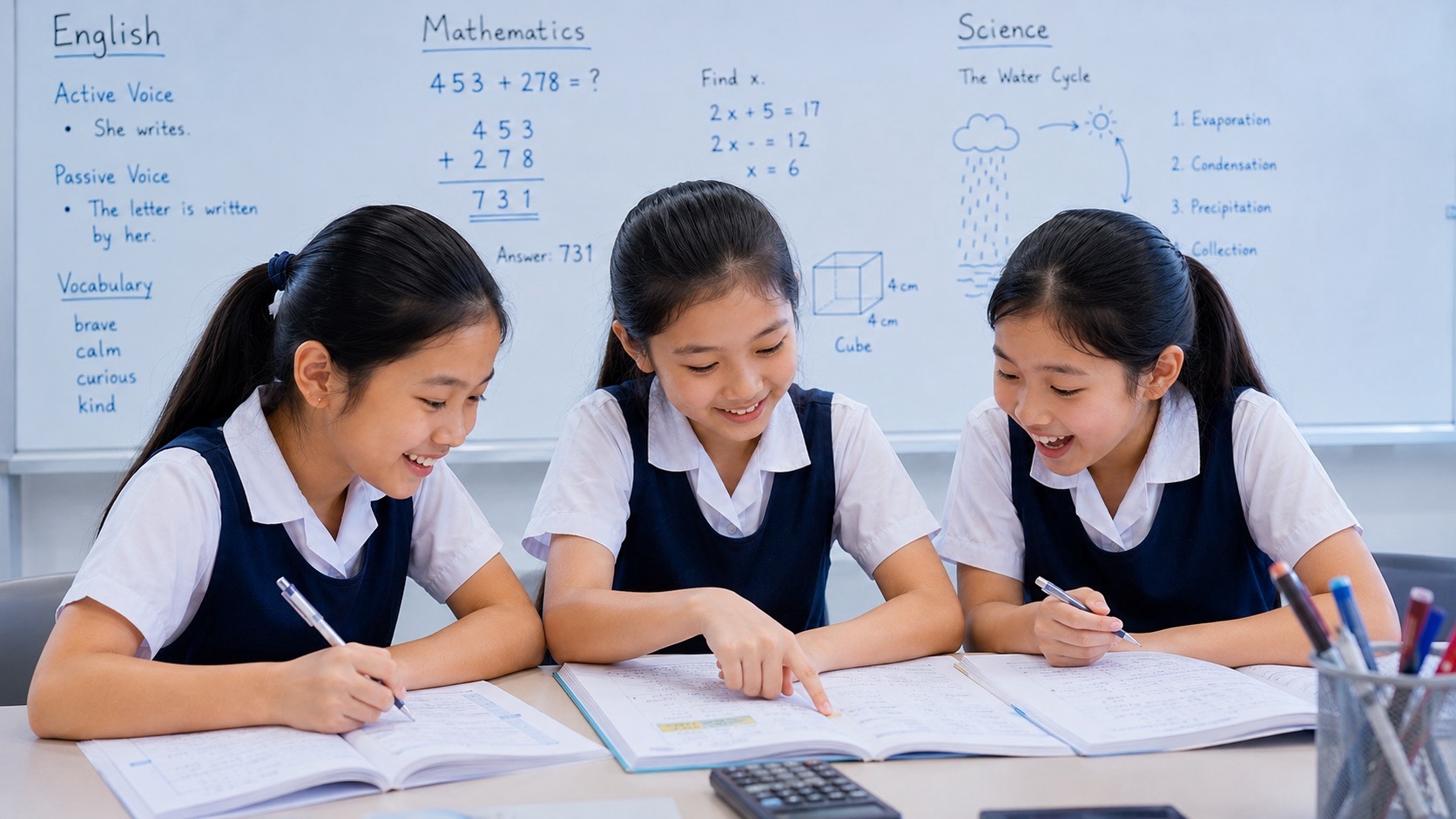
Primary 1 Vocabulary Transfer: Using the Same Word in a New Situation
A child learns curious in a classroom story. Can the word survive outside that story? Can the child use it for a museum, a river, a robot or a question about the Moon? Transfer is where vocabulary proves it is no longer tied to one worksheet.
This page develops transfer around the protected Primary 1 Intermediate Vocabulary: 100 World-Building Words. The hero owns the full set. This article owns one skill: carrying a known word into a new context without losing its meaning.
One-Sentence Answer
Vocabulary transfer happens when a child can use a learned word accurately in a different setting, sentence, subject or story from the one in which it was first taught.
Wait, What? A New Sentence Is Not Always Transfer
If a child memorises “I feel grateful for help” and changes only the person’s name, the structure is still almost the same. Stronger transfer changes the setting or relationship: grateful to a neighbour, grateful for a teacher’s explanation, grateful after a classmate shares transport information.
The Four Transfer Moves
- Change the person.
- Change the place.
- Change the purpose.
- Change the subject world.
Transfer a Feeling
Nervous can appear before speaking in class, waiting at a clinic, boarding transport, or approaching a steep climb. The core meaning remains uncertainty or unease about what may happen.
Transfer an Action
Pull can describe a chair, a drawer, a rope or a suitcase. The direction relationship remains stable while the object changes.
Transfer a Place Concept
Island can appear in geography, story writing, travel discussion, map reading and science-related observation. The core concept—land surrounded by water—must survive.
Transfer Across Modes
Read the word in a story. Say it in conversation. Write it in a sentence. Draw a scene. Explain it. Transfer across modes builds flexible access.
The Change-One-Thing Method
Start: “I felt grateful because my classmate shared an umbrella.” Change place: at the bus stop. Change helper: neighbour. Change object: directions. Change genre: a story set on an island. Keep the meaning of grateful stable.
A Five-Level Transfer Diagnostic
| Level | Performance |
|---|---|
| 0 | uses word only in memorised example |
| 1 | changes one detail |
| 2 | changes setting |
| 3 | changes language mode |
| 4 | uses word across subject worlds |
| 5 | uses word spontaneously and accurately |
Common Failure Modes
- Meaning drifts: return to core concept.
- Only sentence substitution: change context more deeply.
- Word forced into every setting: accept when it does not fit.
- Transfer without evidence: explain why word belongs.
Twenty-Five Transfer Prompts
- Use curious at school.
- Use curious in nature.
- Use nervous before transport.
- Use nervous before speaking.
- Use grateful with family.
- Use grateful with classmate.
- Use pull with chair.
- Use pull with rope.
- Use island in a map sentence.
- Use island in a story.
- Use robot in school.
- Use robot in an imagined island.
- Read a word.
- Say it without text.
- Write it.
- Explain it.
- Draw it.
- Change person.
- Change place.
- Change purpose.
- Change subject.
- Check meaning.
- Reject one bad transfer.
- Explain why it fails.
- Create one new transfer independently.
Transfer Passage
Use curious, transport, island, grateful, pull in a school story, then rewrite the same vocabulary into an outdoor exploration story. The meanings should remain recognisable even though the world changes.
Evidence and Claim Calibration
Transfer is an important sign of flexible learning, but it does not happen automatically simply because a word has been taught many times. Children benefit from varied examples, retrieval and explicit comparison across contexts.
Where to Go Next
- Protected World-Building Hero
- Vocabulary Recall
- Retrieval Practice
- Primary 1 Vocabulary Review
Final Thought
A word becomes part of the child’s language when it can leave the lesson where it was born.
Phase 4 Extension: Transfer Is the Test of Whether Meaning Survives Change
The deepest question about a vocabulary word is not “Can the child remember it?” but “What remains stable when everything around it changes?” If grateful was learned in a story about an umbrella, the umbrella should not become part of the definition. If island was learned through a tropical postcard, palm trees should not become part of the concept. Transfer strips away accidental features and reveals whether the core meaning is actually understood.
Core Meaning vs Accidental Detail
| Word | Core that must survive | Details that may change |
|---|---|---|
| grateful | appreciation for help/benefit | helper, place, object |
| island | land surrounded by water | size, climate, buildings, population |
| pull | force/movement towards direction of pull | object, strength, setting |
| nervous | unease about uncertain event | event, person, place |
| library | place/system associated with access to books/information | building size, school/public setting |
| robot | machine carrying out controlled/programmed tasks | shape, size, job |
Near Transfer, Farther Transfer and Mode Transfer
Transfer has degrees. Near transfer changes one small feature: pull a chair becomes pull a drawer. Farther transfer changes the world: pull a rope during an outdoor activity. Mode transfer changes how the child uses the word: recognise it in reading, explain it aloud, then use it in writing. A robust vocabulary should eventually survive all three.
The Variation Ladder
- Keep sentence, change person.
- Keep meaning, change object.
- Change setting.
- Change story problem.
- Change subject area.
- Change language mode.
- Use word spontaneously without an adult prompt.
Do not jump straight from a memorised example to a wildly different context. Transfer can be built progressively.
Worked Transfer Lab 1: Grateful
Base: “Mei felt grateful because her classmate shared an umbrella.”
- Home: grateful because a sibling helps find a lost item.
- School: grateful because a teacher explains a confusing instruction.
- Community: grateful because a neighbour returns a parcel.
- Travel: grateful because someone gives directions.
- Story: grateful because a character receives help crossing a river.
Ask what stays the same. The answer should point to appreciation after help or benefit, not to umbrellas, schools or kindness alone.
Worked Transfer Lab 2: Island
Show a tiny tropical island, then Singapore, then a rocky island, then a map symbol. Ask whether all can still be islands. If the learner rejects Singapore because it has roads and buildings, the original example has become a stereotype. Repair by returning to the defining relation: land surrounded by water.
Worked Transfer Lab 3: Nervous
Use four events: waiting to read aloud, boarding a ferry for the first time, meeting a new class, and waiting for a medical check. Nervous can fit all four without making any of them dangerous. Then add a genuinely dangerous scene and compare nervous with scared. Transfer deepens emotional boundaries.
Transfer Can Fail by Overextension
Children sometimes learn that a word can move and then move it too far. “I am grateful to the chair because it let me sit” is grammatically possible but pragmatically odd in most ordinary contexts. “The island is a beach” collapses part and whole. “The robot is the internet” confuses categories. Transfer must be flexible and constrained by meaning.
The Fit Test
For every attempted transfer, ask:
- What is the core meaning?
- Which part of the new situation matches that core?
- Which old details are no longer relevant?
- Does the word sound natural here?
- Could another word fit better?
The child learns that transfer is not permission to force vocabulary into every sentence.
Transfer Across Reading, Speaking and Writing
Teach curious in a shared story. Later ask the child to use it in conversation about a museum. Later still, write about a scientist, a robot or a nature walk. The word should continue to point towards wanting to know or discover, even though the genre and setting change.
Transfer Across Subjects
Words can cross subject boundaries when their meanings genuinely apply. Compare appears in English and Mathematics. Observe can support everyday inquiry and Science. Explain appears everywhere. Transport can belong to geography, community life and story settings. Cross-subject transfer is strongest when teachers name the shared job.
Parent Practice: Change the World, Keep the Word
Choose one known word and move it through three ordinary situations. “Where else could you feel proud?” “What else can we pull?” “Where else might transport matter?” Keep the conversation short. The child is learning portability, not completing a worksheet.
Tutor Practice: The Transfer Grid
| Word | School | Nature | Community | Imagination |
|---|---|---|---|---|
| curious | book/question | pond/insect | museum/place | unknown robot |
| pull | chair | rope | door | lever on machine |
| transport | school bus | reach island | train network | vehicle in invented city |
| grateful | teacher help | guide help | neighbour help | character rescue |
After completing examples orally, remove the grid and ask the child to invent a fifth context.
Thirty Deeper Transfer Challenges
- Transfer grateful from school to home.
- Transfer grateful from home to community.
- Transfer nervous from performance to travel.
- Transfer curious from book to nature.
- Transfer pull to three objects.
- Transfer climb from playground to geography.
- Transfer library from school to public setting.
- Transfer island from picture to map.
- Transfer transport from bus to ferry.
- Transfer robot to a realistic workplace job.
- Use a word in speech after learning it in reading.
- Use it in writing.
- Draw its meaning.
- Explain it.
- Change the person.
- Change the place.
- Change the time.
- Change the purpose.
- Change the genre.
- Keep the core meaning.
- Identify one accidental detail from the original example.
- Remove it.
- Reject one overextended use.
- Explain why it fails.
- Choose a better word.
- Transfer across a subject.
- Explain the shared job.
- Use the word without being prompted.
- Find the word in a new book.
- Explain how the new example proves transfer.
Full Transfer Challenge: One Vocabulary Set, Three Worlds
Use curious, island, transport, nervous, grateful, pull in three different worlds. World 1: a school project. World 2: an outdoor journey. World 3: an imagined future learning centre. The stories should not copy one another. Afterward ask the child which meanings stayed constant and which relationships changed.
Transfer Readiness Test
- Retrieve word unseen.
- Explain core meaning.
- Use familiar example.
- Use unfamiliar example.
- Reject near-miss.
- Use in another language mode.
- Use after a delay.
- Use spontaneously in a fresh task.
Transfer is strongest when the final step happens naturally, not because the adult has announced the target word.
Expanded Route Through the Suite
- Vocabulary Recall — get the word back without seeing it.
- Retrieval Practice — build several routes into the word.
- Vocabulary Review — maintain transfer over time.
- Intermediate to Advanced Vocabulary — decide when successful transfer means it is time to widen.
Extended Final Thought
A vocabulary word is not truly portable until the scenery can change and the meaning remains intact. Transfer is the moment the child discovers that grateful does not belong to one umbrella story, island does not belong to one postcard, and curious does not belong to one classroom. The word has become part of a language system large enough to travel.