
Start here for our Primary Mathematics hub.
Primary 2 Mathematics is the year lower-primary ideas begin to organise themselves into a more usable system.
Children are still young, but the Mathematics is asking more from them: larger numbers, more formal operations, early multiplication and division, fractions, money, time, measurement, shapes and data.
The Primary 2 goal is to move from “I can do this example” towards “I understand the relationship and can use it again”.
Place Value Becomes the Number System
Three-digit numbers are not just longer strings of digits. Children need to understand how hundreds, tens and ones work together.
- What does the 4 mean in 436?
- How is 406 different from 460?
- What happens when ten ones are regrouped as one ten?
- Can the child compare numbers by place value rather than visual size?
If place value remains fragile, later addition, subtraction, multiplication and division become harder than necessary.

Addition and Subtraction Need Structure, Not Only Algorithms
Formal written algorithms are useful, but children should still understand the quantity changes underneath them.
Regrouping becomes much more reliable when the student knows why ten ones can be exchanged for one ten, or why one hundred can be decomposed into ten tens.
A useful check is to ask the child to explain the same calculation with base-ten blocks, a drawing or expanded notation before relying entirely on the written procedure.
Multiplication Is Equal Groups
Multiplication tables matter, but memorising them should come after the relationship is understood.
Children can represent multiplication as:
- equal groups;
- repeated addition;
- arrays;
- skip counting;
- a number sentence.
3 groups of 4 → 4 + 4 + 4 → 3 × 4
When these representations connect, multiplication facts become easier to retrieve and easier to use in word problems.
Division Is Sharing and Grouping
Division becomes meaningful when children see both common interpretations:
- sharing: 12 objects shared equally among 3 people;
- grouping: how many groups of 3 can be made from 12?
These two stories can lead to the same number sentence while requiring different thinking about what the answer represents.
Fractions Begin as Relationships
Primary 2 fractions should remain concrete and visual enough for the child to understand that a fraction describes equal parts of a whole.
- Is the whole clear?
- Are the parts equal?
- What does the denominator describe?
- What does the numerator describe?
- Can two simple fractions be compared visually?
Strong fraction understanding now reduces confusion when fractions become more demanding in upper primary.
Money, Time and Measurement Should Stay Practical
These topics are powerful because children can test them against the real world.
- Use coins and simple purchases to reason about money.
- Read clocks in daily routines.
- Measure real objects before relying only on worksheet diagrams.
- Estimate length or mass before measuring.
- Discuss which unit is sensible for the object.
Word Problems Are Translation Problems
Primary 2 is where many children first discover that being good at arithmetic is not enough to solve a story problem.
The student must translate language into a relationship.
- Who or what is being compared?
- What changed?
- What is known?
- What is being asked?
- Is this a total, difference, equal-groups or sharing relationship?
Keyword hunting can be tempting, but words such as “more” or “left” do not always mechanically determine the operation. Understanding the story is safer.
Picture Graphs Teach Evidence Reading
Children should learn to inspect the scale and read what the graph actually says before calculating.
- What does one picture represent?
- Which category is greatest or least?
- How much greater?
- What conclusion is supported?
- What cannot be known from this graph?
The Hidden Primary 2 Errors
| Observed difficulty | Possible weak link | Repair |
|---|---|---|
| Counts every calculation from one | Number facts and relationships are fragile | Use number bonds, grouping and short retrieval |
| Writes 403 when thinking 430 | Place value representation | Use expanded form and place-value models |
| Knows tables but cannot solve multiplication stories | Meaning is disconnected from recall | Use groups, arrays and story translation |
| Always chooses wrong operation | Language-to-relationship translation | Retell and draw before calculating |
| Correction disappears next week | Retrieval is missing | Retest after spacing |
Practice Should Be Short Enough to Stay Thoughtful
Large worksheet volume is not automatically helpful for a seven- or eight-year-old child.
A useful short practice loop is:
- Retrieve: two old number facts.
- Represent: show one idea with objects or a drawing.
- Practise: complete a small number of accurate questions.
- Explain: say why the operation fits.
- Check: review one earlier error.
The point is to preserve attention and thinking rather than exhaust the child.
Confidence Should Follow Competence
Children gain durable confidence when they can do something they previously could not do.
A tutor can help by creating achievable learning steps, giving specific feedback and letting the child experience independent success.
The goal is not to tell the child “you are a Math person”. It is to show the child that understanding can be built through patient work.
What a Good Primary 2 Tutor Observes
- how the child reads the problem;
- whether place value is understood;
- whether multiplication and division have meaning;
- how the child reacts to an unfamiliar question;
- whether the child can explain the method;
- whether corrections survive later;
- whether prompts are becoming less necessary.
Small Groups of Up to Three
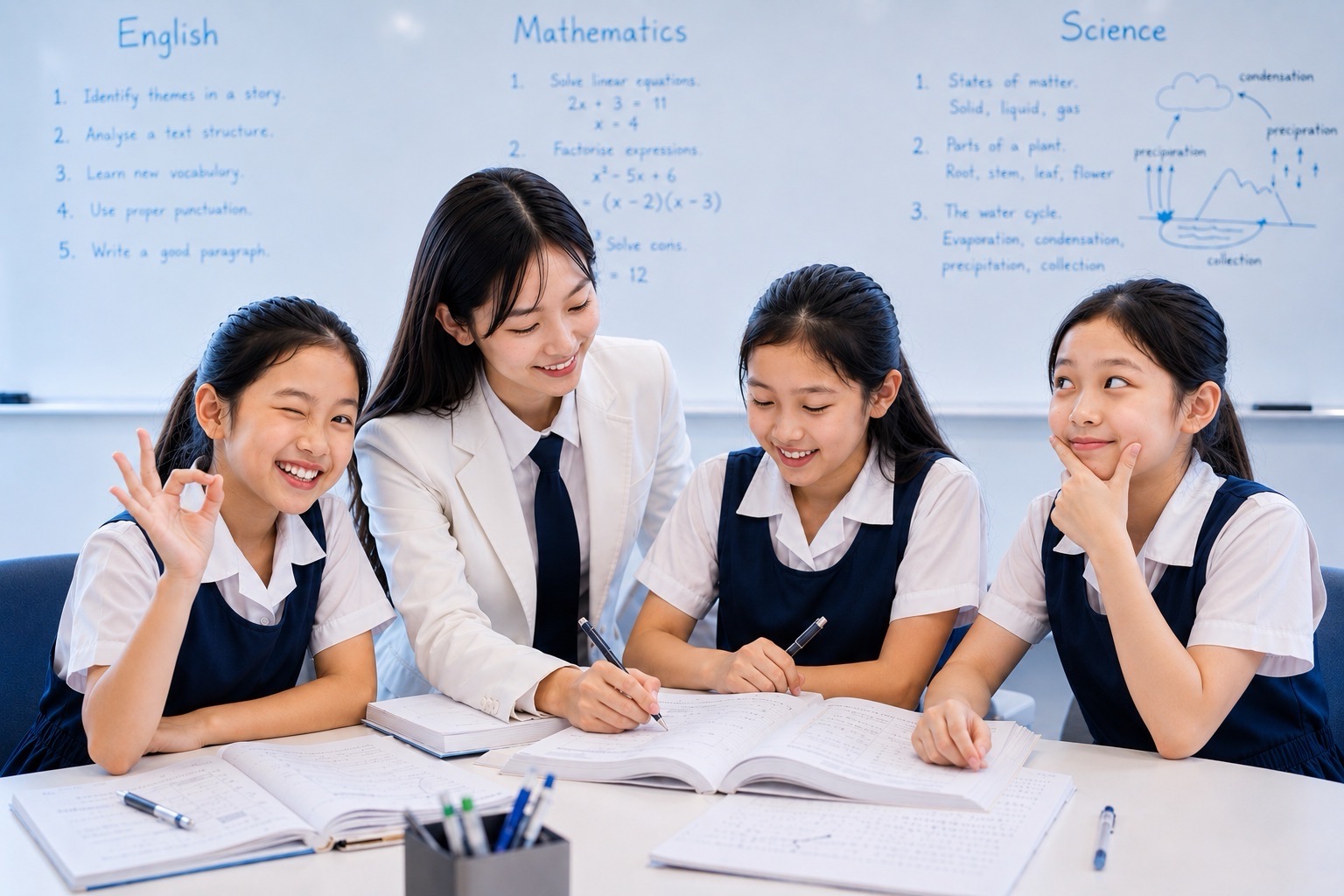
In a group of up to three children, the tutor can preserve individual observation while allowing peer explanation and comparison.
One child may need more concrete support. One may need more language support. One may need extension. The same lesson topic can therefore produce different next steps.
When Tuition May Help
Extra support may be useful when confusion is persistent, the child is becoming avoidant, word problems repeatedly fail, basic place value or operation meaning remains unstable, or the learner needs more feedback than the current environment provides.
Tuition is not necessary simply because Primary 2 has begun. If the child is learning steadily, enjoying school Mathematics and correcting mistakes independently, normal home support may be enough.
Do Not Turn Primary 2 into a Secondary-School Admissions Strategy
Strong lower-primary foundations can support later learning. They do not directly determine a future PSLE Achievement Level, Integrated Programme admission, posting group or university pathway.
The responsible reason to teach Primary 2 Mathematics well is much simpler: children deserve to understand the Mathematics they are learning now, and secure understanding makes later learning easier.
Current Official Reference
