
2026 Phase 4 Update: Primary English Composition Tuition Should Repair the Writing Process, Not Just Mark the Final Story
Primary English composition tuition in Punggol is most useful when it makes the hidden writing process visible. A weak final composition can come from a poor reading of the prompt, thin idea generation, weak planning, unclear paragraph purpose, repetitive sentences, fragile grammar, imprecise vocabulary, poor revision or time pressure. Marking the final script tells us where the writing ended. Good tutoring asks where the writing first began to fail.
At eduKateSG, we treat composition as a sequence that can be taught, observed and improved: Interpret → Generate → Select → Plan → Draft → Inspect → Revise → Transfer. The aim is not to produce one beautiful essay with heavy tutor help. It is to build a learner who can reproduce a strong process on a new theme with less support.
The Composition Diagnostic Map
| Where writing breaks | What parents may see | Useful repair |
|---|---|---|
| Prompt interpretation | Story is fluent but drifts away from the theme | Teach prompt constraints and relevance before planning |
| Idea generation | Long hesitation or predictable first idea | Build a reusable idea-generation routine |
| Selection | Too many events, no clear centre | Choose one workable conflict and outcome |
| Planning | Story starts well but collapses halfway | Plan turning points and paragraph jobs |
| Sentence control | Ideas are good but grammar or clarity breaks | Repair sentence relationships and editing habits |
| Vocabulary | Difficult words are forced or repetitive | Teach precision, collocation, tone and restraint |
| Revision | First draft is treated as finished | Teach targeted rereading and self-correction |
| Transfer | One practised theme works; new prompts do not | Change theme and surface details while preserving the writing principle |
1. Interpret the Prompt Before Inventing the Story
Many composition problems begin before the first sentence. Students see an image, theme or situation and immediately start inventing events. A stronger writer first asks what the task requires, which details are optional, which details constrain the story and what the final narrative must make clear to the reader.
This small pause prevents a common failure: a technically competent story that becomes only loosely related to the actual prompt.
2. Generate More Than One Idea
The first idea is not always the best idea. Students can learn to generate several small possibilities quickly, then choose the one they can develop most clearly. Idea generation can draw from personal experience, observed situations, books, school life, relationships, mistakes, decisions and consequences.
The purpose is not endless creativity. It is to avoid freezing and to give the learner enough options to make a deliberate choice.
3. Plan by Turning Points and Paragraph Jobs
A plan should reduce cognitive load during writing. Instead of listing every sentence, students can identify the opening situation, trigger, escalation, key decision, consequence and resolution. Each paragraph should then have a job: introduce, develop, complicate, reveal, resolve or reflect.
Situation → Trigger → Escalation → Decision → Consequence → Resolution
This structure is flexible. The exact story can vary, but the learner has a route through the blank page.
4. Draft for Meaning Before Decorating the Language
Students sometimes try to sound impressive too early. They search for elaborate vocabulary while the story logic is still unstable. We prefer meaning first. Who is doing what? Why? What changed? What does the reader need to understand now?
Once the narrative movement is clear, language can be sharpened. A precise verb, well-controlled sentence or relevant sensory detail is more useful than a difficult phrase inserted because it was memorised.
5. Make Character and Emotion Visible Through Decisions
“Show, don’t tell” is useful when it serves the story. A character becomes believable when actions, speech, choices and physical responses reveal what the person values or fears. Description should not become a long pause in the plot. It should help the reader understand what the moment means.
6. Revise by Error Family
“Check your work” is too broad. Students revise better when they know what they are looking for. One pass may check whether every paragraph advances the story. Another may check tense and reference. Another may remove repeated words. Another may inspect whether the ending resolves the central event.
- Relevance check: does the story still answer the prompt?
- Structure check: does every paragraph have a useful job?
- Clarity check: can the reader follow who, what, when and why?
- Language check: are grammar, reference and sentence boundaries stable?
- Vocabulary check: are words precise and natural?
- Ending check: does the resolution emerge from the story rather than arrive suddenly?
7. Transfer the Skill to a Different Prompt
A student has not fully learned a writing technique if it works only on the composition that was corrected. After teaching paragraph development, characterisation or revision, we change the theme and ask the learner to reconstruct the principle. Transfer is what turns feedback into a reusable skill.
Why 3-Pax Helps Composition Feedback
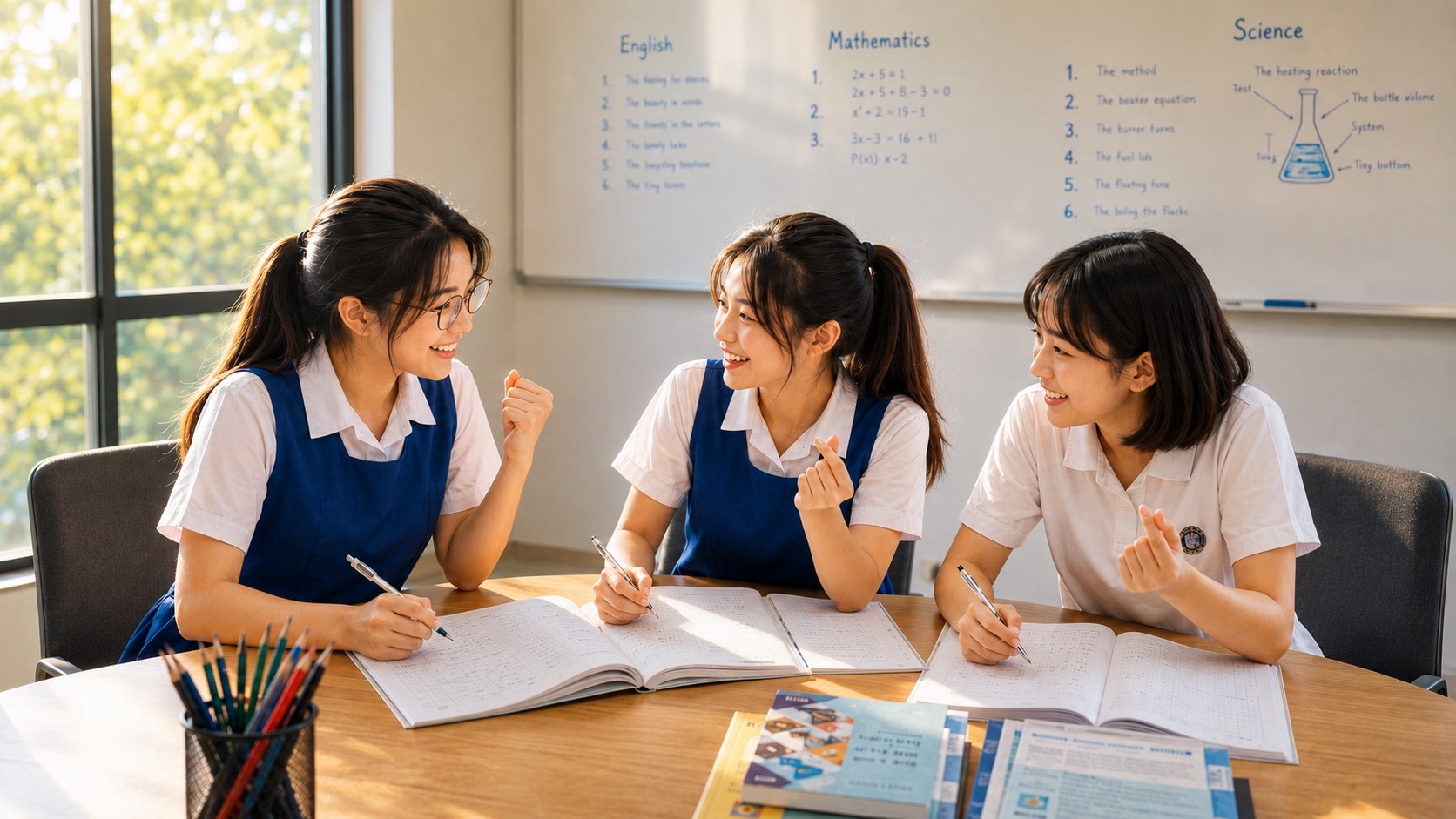
Writing feedback is difficult to scale because every student produces different language. In a 3-pax class, the tutor can inspect each plan and draft closely enough to see the individual bottleneck. At the same time, students can compare alternative openings, paragraph choices and revisions and learn that strong writing does not require one identical model essay.
The tutor can also fade support deliberately. Early on, a child may receive planning questions. Later, only a prompt to inspect the structure. Eventually, the learner should be able to diagnose and revise much of the draft independently.
What Parents Can Observe Before Marks Change
- The child starts writing faster because planning is clearer.
- Stories remain relevant to the prompt.
- Paragraphs repeat less.
- Vocabulary sounds more natural and precise.
- Grammar corrections begin to survive into new compositions.
- The learner can explain why a paragraph or sentence needs revision.
- Endings become less abrupt.
- Different themes can be handled without memorising a whole story.
When Composition Tuition Is a Good Fit
Composition tuition is useful when school feedback is not becoming a future skill, when the same writing faults recur, when the learner freezes at planning, or when language control collapses under a full composition. It may add little if the student already writes independently and the extra class mainly produces more of the same practice without better feedback.
Primary Composition Tuition Punggol: Almost-Code Summary
READ prompt
DEFINE constraints
GENERATE multiple_ideas
SELECT workable_story
PLAN turning_points + paragraph_jobs
DRAFT for meaning
INSPECT relevance + structure + language
REVISE targeted_error_family
WAIT
WRITE changed_prompt
IF skill_survives:
    fade_support()
OUTPUT = clearer_planning + stronger_control + transferable_writing
The Goal Is a Writer Who Can Rebuild the Process Alone
Primary composition tuition should not make the tutor the permanent author behind the child. The long-term aim is a student who can interpret, choose, plan, draft, inspect and revise with growing independence. That process serves examinations, but it also serves communication far beyond them.
Families in Punggol can use the current eduKateSG enquiry channel to discuss Primary English composition 3-pax class fit, current fees and availability.
The power of words is truly astounding. The right words can ignite imagination, convey ideas, and influence others. This power is particularly valuable in the realm of education, where it can shape minds and futures. At Punggol Tuition Centre, we recognize this potential and are committed to helping our students harness it through our specially curated Primary English Tuition. In particular, our emphasis on English composition aims to improve students’ writing skills significantly.
Have a look at some of our English Tutorial materials here:
- Back to our main article: English Primary Overview
- Our Composition Writing section: Creative Writing Materials Primary Schools
- Latest SEAB MOE English Syllabus here
Our composition classes are designed to introduce students to the various nuances and facets of English writing. The aim is to inspire a love for writing and equip them with the ability to express their thoughts and ideas confidently. We work on improving our students’ competency in written English and foster creativity, both of which are integral parts of Primary English Tuition.
Punggol Tuition Centre prides itself on creating an immersive, interactive learning environment. Our qualified educators employ engaging teaching methods to make the learning process enjoyable and productive. They provide comprehensive guidance, from brainstorming ideas to structuring paragraphs and using persuasive language, to enhance the students’ composition writing skills. Moreover, our teachers focus on nurturing critical thinking skills, which are key to planning and writing impressive compositions.
One of the unique features of our Primary English Tuition is the individual attention given to each student. We understand that each child learns differently, and our tutors customize their teaching methods to cater to these diverse learning styles. This approach allows us to identify the strengths and weaknesses of each student and provide them with targeted feedback. This personalized attention significantly aids in improving writing skills, as each child can work on their specific areas of improvement.
Punggol Tuition Centre also believes in the power of practice. Our students are given numerous opportunities to practice their writing, with teachers providing constructive feedback after every exercise. This consistent practice, coupled with regular feedback, ensures that students continuously improve their writing abilities and build their confidence.
In our Primary English Tuition, we also emphasize the importance of vocabulary and grammar. A strong vocabulary is a powerful tool that can make a composition more engaging and persuasive. Our teachers help students build their vocabulary by introducing them to new words and phrases, discussing their meanings, and encouraging their use in writing. Additionally, we place a high value on grammatical accuracy, teaching our students the rules of grammar and how to apply them in their writing.
At Punggol Tuition Centre, we go beyond just teaching English composition; we aim to foster a lifelong love for writing. We believe that when students enjoy the process of writing, it no longer becomes a chore, but a hobby. This love for writing will not only benefit them in their examinations but will also provide them with a valuable skill they can use throughout their lives.
In conclusion, at Punggol Tuition Centre, we are committed to enhancing our students’ writing abilities through our Primary English Tuition. Our focus on composition writing, coupled with our dedicated teachers and interactive teaching methods, ensures that our students are well-equipped to excel in their written English. Through our efforts, we aim to provide our students with the skills they need to succeed in their academic journey and beyond.
Improving your child’s writing skills has never been more achievable. Join our Primary English Tuition at Punggol Tuition Centre today and experience the difference we can make in your child’s education.
Click here to enrol at eduKateSingapore.com