
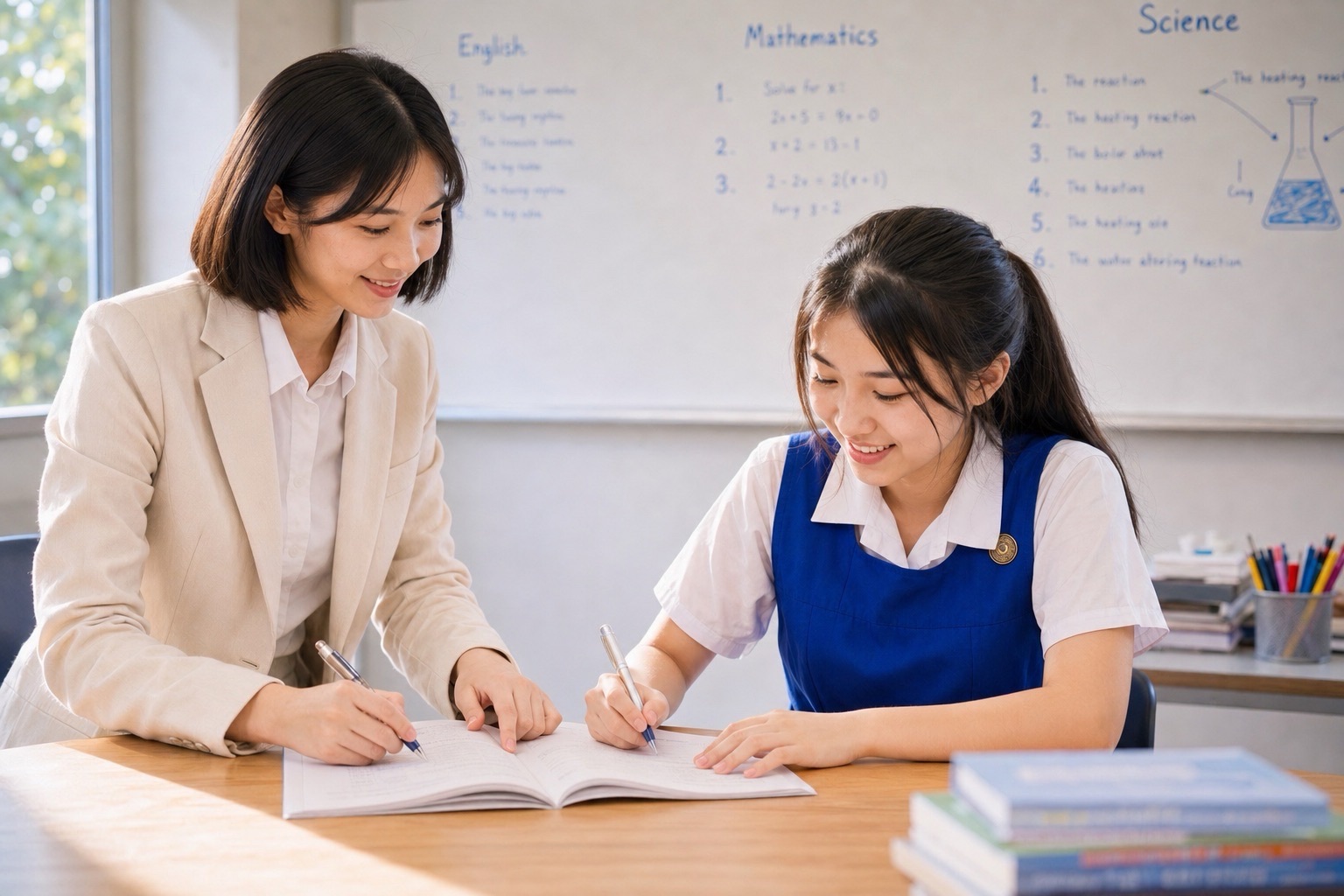
PSLE Science Tuition Sengkang | Turn Knowledge into Evidence-Based Answers
Many Primary 6 pupils know more Science than their written answers reveal.
They recognise the topic. They remember the keywords. They can explain the idea informally at home. Yet the examination answer remains vague, incomplete, overgeneralised or disconnected from the evidence in the question.
This is why useful PSLE Science tuition should do more than increase content recall. The student needs to move from concept → observation/evidence → relationship → application → precise explanation.
This page supports the Sengkang Science estate with one specific reader job: how to turn Science knowledge into evidence-based answers that remain accurate when the context changes. It does not replace the broader Sengkang Science tuition pages. It focuses on the conversion layer between “I know this topic” and “I can use it correctly in a PSLE-style question”.
Quick Read for Parents
- Keywords are not explanations. The child must connect the scientific idea to the evidence and context.
- Science answers are models of relationships. Cause, mechanism and effect should fit together.
- Observation is not inference. Students must distinguish what was seen from what it means.
- Application requires transfer. The same concept may appear in an unfamiliar organism, apparatus or scenario.
- Question language matters. “State”, “explain”, “compare”, “predict” and “give a reason” demand different outputs.
- Diagrams and tables are evidence sources. They are not decoration.
- Error diagnosis matters. Concept, reading, evidence, reasoning, expression and time errors need different repairs.
- Practice should vary. Familiar topical questions should lead into changed and mixed contexts.
- Support should fade. The student must eventually identify the concept and construct the answer without tutor prompting.
- No responsible tuition programme can guarantee AL1. The job is to build more reliable scientific reasoning and examination execution.
What Primary Science Is Trying to Build
Singapore’s Primary Science curriculum is designed around understanding the natural and physical world through scientific inquiry, concepts and applications. The useful teaching implication is that Science should not become a collection of disconnected facts to memorise.
The learner needs to build and use scientific models:
- how living things meet needs;
- how systems interact;
- how forces affect motion;
- how energy transfers or changes;
- how matter behaves;
- how variables affect an outcome;
- how observations support a conclusion.
Parents can consult MOE’s current Primary Science curriculum resources through the MOE Primary syllabuses page. For examination format and the latest national-examination documents, use SEAB’s PSLE Formats Examined in 2026.
The Core PSLE Science Conversion Chain
Read the situation → identify the evidence → retrieve the scientific model → connect cause to mechanism → apply to this context → answer precisely → verify against the question.
A student can fail at any link in that chain.
If tuition responds to every wrong answer with “memorise this model answer”, the actual failure remains hidden.
Failure 1: The Concept Model Is Missing
The simplest failure is genuine lack of understanding.
The child may know a keyword but not the relationship behind it. For example, the student may remember “photosynthesis” without being able to reason about how changing light, water or leaf conditions affects the process in a given setup.
A concept repair should therefore ask:
- What are the important parts of the system?
- What does each part do?
- What enters and leaves the system?
- What relationship changes when a variable changes?
- What observable effect would we expect?
- What evidence would contradict our model?
Once the model is stable, the child can begin applying it to unfamiliar examples.
Failure 2: The Student Reads the Topic, Not the Question
A common PSLE Science habit is to recognise the chapter and unload a memorised answer.
The question may be about heat, forces, plant systems or electrical circuits, but it still asks something specific about this diagram, table, experiment or change.
We therefore separate:
- topic recognition: what Science family is this?
- task recognition: what exactly is being asked?
- evidence recognition: which details in this question matter?
- response type: state, explain, compare, predict, describe or justify?
A correct topic with the wrong task still produces a weak answer.
Failure 3: Observation and Inference Are Mixed Together
Science often asks students to interpret evidence.
The learner should distinguish what is directly observed from what is inferred through a scientific model.
For example:
- Observation: the water level in setup A decreased more.
- Inference: more water was lost from the plant under the conditions in setup A.
- Explanation: connect the observation to the relevant process and variable.
Students lose precision when they jump straight from a diagram to a memorised scientific statement without using the actual evidence.
Failure 4: The Answer Has Keywords but No Causal Chain
Keywords are useful when they anchor a relationship. They are weak when they are stacked without logic.
A stronger explanation often contains:
Condition/change → scientific process → consequence → observed outcome.
The exact chain depends on the concept, but the student should be able to explain why one link leads to the next.
We therefore ask students to speak the chain before compressing it into an examination answer.
Failure 5: The Student Cannot Use the Diagram
Diagrams in Science often carry essential information.
Students need to notice:
- labels;
- relative position;
- direction arrows;
- changes between setups;
- what is held constant;
- what is different;
- what is measured;
- which part of the system the question targets.
A student who ignores the visual evidence may know the Science but answer a different question from the one shown.
Failure 6: The Student Cannot Read a Table or Graph Scientifically
Data questions require more than reading individual numbers.
The child should be able to identify:
- what each axis/column represents;
- units;
- the trend;
- exceptions;
- comparisons;
- whether the evidence supports a claim;
- what cannot be concluded from the data.
This is scientific literacy, not merely arithmetic.
Failure 7: Variables Are Not Controlled Mentally
Experimental questions often depend on understanding variables and fair comparison.
Students should learn to ask:
- What was changed?
- What was measured?
- What had to remain the same?
- Why would changing another factor make the comparison less useful?
- Does the setup actually test the stated idea?
A memorised phrase such as “to ensure a fair test” is incomplete if the child cannot say what must be controlled and why.
Failure 8: The Student Knows the Concept but Cannot Transfer It
Topical questions create strong cues. The student knows which concept family to retrieve.
Transfer begins when the surface changes:
- different organism;
- different apparatus;
- different material;
- different diagram;
- different variable;
- same process described from another perspective;
- two concepts combined in one scenario.
The child must recognise the invariant scientific relationship rather than the familiar picture.
Failure 9: The Answer Is Scientifically Correct but Too Vague
A child can understand the Science and still express it too loosely.
Common vague phrases include:
- “it helps the plant”;
- “there is more energy”;
- “the force is stronger”;
- “it moves faster because of gravity”;
- “the water goes away”.
The tutor should help the student preserve the scientific relationship while making the language more precise.
We ask:
- What exactly changes?
- What process causes it?
- What direction or comparison matters?
- What evidence from the question must be named?
- Which word is scientifically inaccurate?
Answer precision is part of Science performance.
Failure 10: The Student Writes Too Much Without Increasing Precision
Long answers are not automatically strong answers.
Students sometimes write every fact they remember about a topic. This increases the chance of contradiction or irrelevant detail.
A useful answer should contain enough to complete the required scientific chain—no less and no unnecessary dumping.
We train compression:
Answer the task → cite the relevant condition/evidence → state the scientific relationship → stop when the chain is complete.
The PSLE Science Error Taxonomy
- Concept error: scientific model is wrong or incomplete.
- Reading error: task or evidence is misread.
- Observation error: child does not extract what the diagram/data shows.
- Inference error: evidence is not connected to a valid conclusion.
- Mechanism error: causal chain is missing or incorrect.
- Transfer error: concept works only in familiar contexts.
- Expression error: scientific understanding is phrased too vaguely.
- Condition error: an important variable or limitation is ignored.
- Retrieval error: known concept is unavailable without a cue.
- Time-control error: reading, answer quality or checking degrades under exam pressure.
Once the error is named, the next practice can have a specific job.
The Answer Construction Loop
- Read the command. State? Explain? Compare? Predict?
- Mark the evidence. Diagram, table, condition, observation.
- Retrieve the model. Which scientific relationship applies?
- Connect. How does the evidence activate the model?
- Build the causal chain.
- Phrase precisely.
- Verify. Does every sentence answer this question?
This loop is more portable than memorising hundreds of model sentences.
The Practice Ladder: From Topic Recall to PSLE Transfer
- Concept reconstruction: explain the model.
- Controlled question: apply it in a familiar context.
- Evidence variation: change diagram/data.
- Context variation: same relationship, different scenario.
- Mixed concepts: remove the obvious topic label.
- Short-answer compression: make explanations precise.
- Timed section: add limited examination pressure.
- Full-paper work: test retrieval, pacing and endurance.
- Error diagnosis: classify lost marks.
- Delayed retest: return to the concept later in a changed context.
Full papers are valuable only when the student can learn from the return. Repeating papers without repairing the repeated failure creates volume, not necessarily improvement.
Why 3-Pax Helps Science Reasoning
Three students allow the tutor to hear individual scientific reasoning, not only inspect the final answer.
- Each student can explain a diagram.
- Each can distinguish observation from inference.
- Different causal chains can be compared.
- One student can receive a concept repair while another works on answer precision.
- Students can critique whether an answer is scientifically complete.
- The tutor can reduce prompts and see whether the learner can construct the chain independently.
Peer comparison becomes useful when students compare reasoning, not simply copy model answers.
A Typical 1.5-Hour PSLE Science Lesson
- Retrieve: return to an older concept without naming it in advance.
- Observe: inspect a diagram, setup, table or phenomenon.
- Explain: rebuild the relevant scientific model.
- Apply: connect it to the present evidence.
- Write: construct a precise answer.
- Compare: inspect alternative answers and missing links.
- Vary: change the context.
- Release: reduce prompts.
- Review: classify the failure and schedule a delayed return.
The lesson should move the child from knowing a topic to using a scientific model under changing conditions.
What Progress Should Look Like
- the child identifies question commands more accurately;
- diagrams and tables are used rather than ignored;
- observations and inferences are distinguished;
- answers contain clearer causal chains;
- keywords appear in correct relationships rather than as a list;
- changed contexts cause less disruption;
- answer length becomes more efficient;
- repeated concept errors reduce;
- the student can explain why an answer is incomplete;
- tutor prompting decreases.
When PSLE Science Tuition Is Worth Considering
- the child memorises facts but cannot apply them;
- open-ended answers are consistently vague;
- experimental questions are difficult despite knowing the topic;
- graphs/tables/diagrams are underused;
- the same misconception survives corrections;
- topical work is strong but mixed papers are weak;
- time pressure causes answer quality to collapse;
- the child needs structured help to convert knowledge into evidence-based reasoning.
When Tuition May Not Be Necessary
A Primary 6 learner who understands concepts, applies them flexibly, learns from marked papers and prepares independently may be better served by focused self-revision and school feedback.
More tuition is not automatically more Science. The intervention should solve a real conversion or reasoning problem.
What We Do Not Promise
We do not guarantee AL1, a fixed grade jump or a fixed result from a fixed number of lessons. PSLE outcomes depend on starting state, remaining time, independent practice, school learning, examination conditions and many other factors.
The responsible promise is methodological: teach the concept accurately, connect it to evidence, vary the context, diagnose the return and reduce support as scientific reasoning becomes more independent.
The eduKate PSLE Science Evidence Loop
Observe → identify evidence → retrieve the model → connect mechanism → apply → explain → verify → vary → retest.
That is the job of this page: turning knowledge into evidence-based answers.
The local Sengkang Science estate remains the owner for broad location tuition. This eduKateSG page supports it with a distinct PSLE reasoning job rather than duplicating another generic Sengkang sales page.
Ask About Current Sengkang PSLE Science Arrangements
eduKate Science classes use a 3-student small-group model and are typically 1.5 hours weekly. Current grouping depends on level, learner state and available fit.
Bring a recent Science paper, especially open-ended questions. We can see whether the first useful repair is concept, evidence reading, mechanism, transfer, answer precision or examination control.