
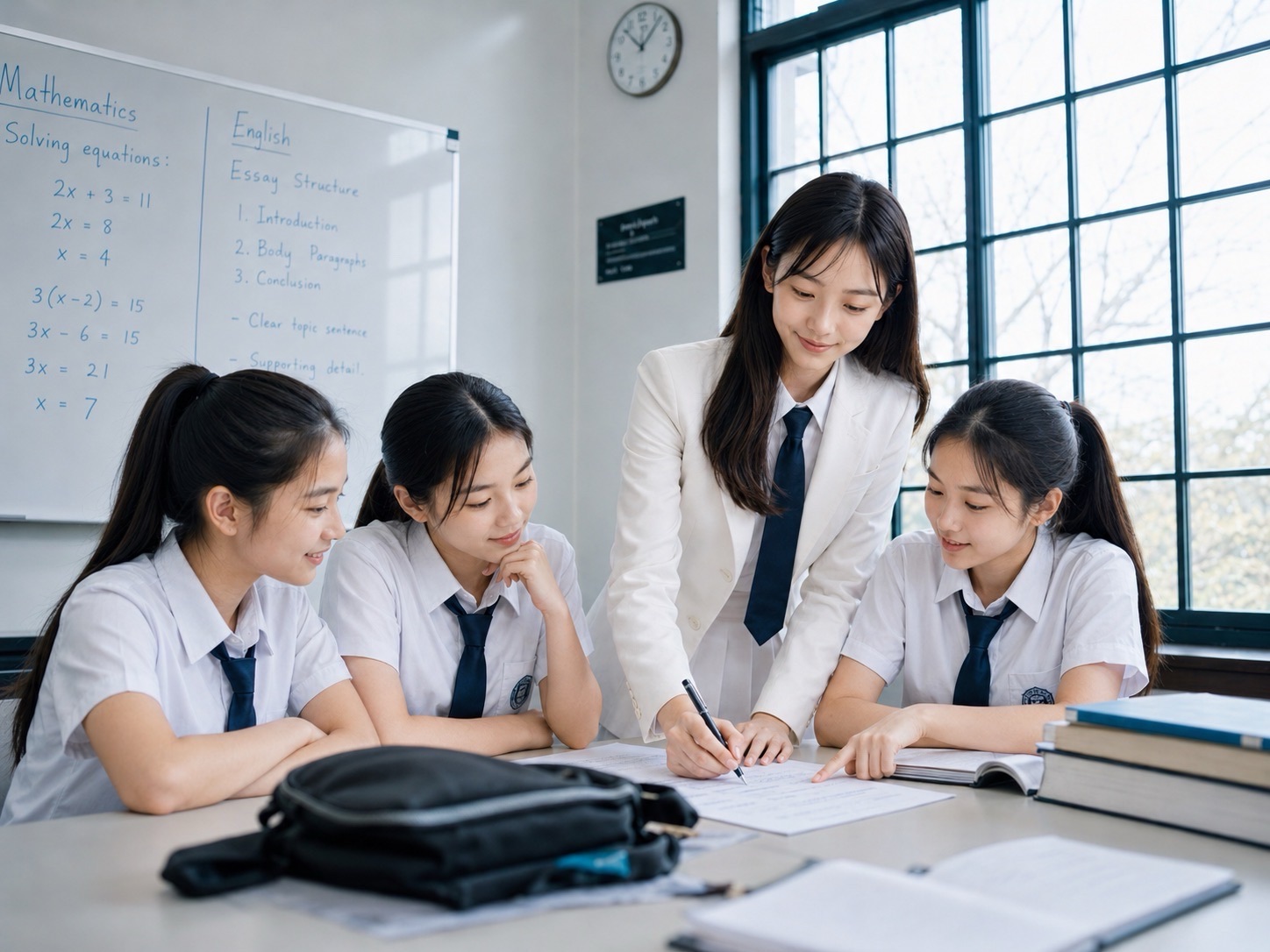
2026 Phase 4 Update: Secondary 3 A-Math Tuition Should Build the Engine Before the Final-Year Load Arrives
Secondary 3 is the year to build the machinery of Additional Mathematics before examination pressure becomes the main story. The important work is not premature full-paper drilling. It is connecting algebra, functions, graphs, equations, trigonometry and early calculus into a system the student can retrieve and use when the question no longer looks like the example.
A weak dependency compounds. Factorisation affects equations and partial fractions. Equation control affects trigonometry. Functions affect graphs. Algebra returns after differentiation and integration. This is why Secondary 3 tuition should diagnose the earliest weak dependency rather than treating every current chapter as an isolated problem.
| Visible Sec 3 difficulty | Possible underlying dependency | What to repair first |
|---|---|---|
| quadratics feel impossible | expansion, factorisation or equation control | algebra before harder applications |
| graphs feel random | weak function meaning or representation | connect equation, features and graph behaviour |
| trigonometry becomes guesswork | equation solving and transformation | teach target form and method selection |
| calculus steps are remembered but answers fail | algebra after the calculus step | retrieve and stabilise manipulation skills |
| worked examples are easy but new questions are hard | retrieval and transfer | delay the retest and vary the surface |
The Secondary 3 build sequence
- Inspect the student’s actual working.
- Find the earliest unstable prerequisite.
- Repair the concept or algebra cleanly.
- Require an independent second attempt.
- Return to the skill after a delay.
- Change numbers, wording or representation.
- Mix the skill with other topics.
- Ask the student to choose the method without a chapter label.
- Add bounded timing only when the method is stable.
- Fade tutor prompts as independence grows.
Why 3-pax and 1.5 hours help at this stage
Current eduKateSG tuition is human-led in focused 3-pax, 1.5-hour lessons. One shared question can expose three different weak dependencies. The tutor can see whether a student chooses the wrong route, loses control in algebra or cannot explain why a transformation is useful. That visibility makes early repair more precise.
Retrieval comes before confidence
Confidence built from seeing a solution is fragile. Stronger confidence comes when the student can reconstruct the method several days later. Secondary 3 therefore needs deliberate retrieval: old topics should return after they have faded from immediate memory, and the student should have to rebuild the route without being told which formula to use.
Transfer is the test of whether the engine really works
A student who can solve only familiar worksheet surfaces has not yet built robust A-Math control. Good Sec 3 tuition changes the problem surface while preserving the underlying idea. Different coefficients, different graphs, a different context or a mixed-topic sequence force the student to recognise structure rather than imitate appearance.
The 2026 Secondary 3 cohort is building toward the 2027 SEC era
Students in Secondary 3 in 2026 move into national certification from 2027 under the Singapore-Cambridge Secondary Education Certificate framework. For students taking Additional Mathematics at G3, current teaching should follow the student’s school syllabus and build durable mathematical reasoning for that route. Older O-Level wording and H2-preparation detours retained lower on this legacy page are historical context, not the current destination for this cohort.
Do not turn Secondary 3 into a final-year cram programme
Exam-style questions are useful, but full-paper volume should not crowd out foundation-building. Secondary 3 still offers time to repair algebra, improve method selection, build retrieval and make transfer routine. A student who reaches Secondary 4 with a connected system is in a stronger position than one who has merely completed many papers without correcting the underlying leaks.
Progress signals for parents
Look for cleaner algebra, fewer repeated mistakes, faster starts on unfamiliar questions, stronger recall of earlier topics, better explanation of why a method works, successful performance when topics are mixed and less dependence on hints. These are signs that the student is building an engine rather than collecting isolated tricks.
Fit, no-fit and legacy note
Secondary 3 tuition can be useful when weak prerequisites are compounding, school examples make sense but independent work does not, older topics disappear quickly or the student cannot recognise methods in unfamiliar questions. It may add little when the student already retrieves, transfers and applies school feedback independently.
Older sections below refer to O-Level, A1 and H2 Mathematics as if they were the immediate current route. Those references are retained for legacy continuity but are superseded by the current cohort framing above. Current fees, schedules and availability should be confirmed through the current enquiry channel. No A1, distinction or future H2 outcome is guaranteed.
Build the dependency → retrieve it later → vary the surface → mix the topics → fade help. Secondary 3 is where the A-Math engine should become self-supporting.
Secondary 3 A-Math: Almost-Code Summary
MAP dependencies
FIND earliest_weak_link
REPAIR prerequisite
RETRY independently
WAIT
RETRIEVE old_method
VARY representation
MIX topics
SELECT method_without_label
TIME when_stable
FADE help
OUTPUT = connected_A_Math_engine + Sec4_readiness
Secondary 3 is where Additional Mathematics begins to show its true shape.
At first, it may look like “harder Maths.”
More algebra.
More symbols.
More steps.
More strange-looking questions.
But after a few weeks, many students realise that A-Maths is not just a harder version of lower secondary Mathematics.
It is a new mathematical language.
The questions do not always tell the student what to do.
The working becomes longer.
The algebra becomes less forgiving.
The answer depends not only on remembering a formula, but on recognising structure.
This is where some students begin to lose confidence.
They may have done well in lower secondary Maths.
They may have worked hard.
They may have expected Secondary 3 Additional Mathematics to be difficult, but manageable.
Then the first few topics arrive.
Quadratic functions.
Surds.
Equations and inequalities.
Polynomials.
Partial fractions.
Binomial expansion.
Exponential and logarithmic functions.
Coordinate geometry.
Trigonometry.
Suddenly, the subject moves faster than expected.
A small algebra mistake can destroy a full solution.
A misunderstood concept can appear again and again in later chapters.
A weak foundation that was hidden in lower secondary now becomes very visible.
This is why Secondary 3 Additional Mathematics matters so much.
It is the foundation year.
If the foundation year is built properly, Secondary 4 becomes a year of strengthening, exam preparation and confidence.
If the foundation year is weak, Secondary 4 becomes a rescue mission.
At eduKate Punggol, our Secondary 3 Additional Mathematics tuition helps students build the subject properly from the start.
We slow down the confusion.
We identify the missing foundations.
We explain difficult ideas clearly.
We correct weak habits early.
We help students learn how to think, practise and solve with greater control.
Because Additional Mathematics is not just about getting through homework.
It is about building a stronger learner.
Secondary 3 A-Maths Is the Year the System Changes
In lower secondary Mathematics, many students can survive by following examples.
They learn a method.
They copy the steps.
They practise similar questions.
They get the answer.
That approach can work for a while.
But Additional Mathematics is different.
A-Maths asks the student to understand how mathematical objects behave.
A quadratic function is not just an equation.
It has shape, direction, turning point, roots, range and meaning.
A polynomial is not just a long expression.
It has structure, factors, remainders and hidden routes.
A logarithm is not just a button on the calculator.
It is a relationship between powers, bases and transformation.
A trigonometric equation is not just about pressing sine, cosine or tangent.
It is about angles, periodic behaviour, identities and restrictions.
Secondary 3 is where students must move from “What steps do I copy?” to “What is this question asking me to see?”
That transition is not easy.
But it can be taught.
With the right tutor, the right structure and the right correction, students can learn how to read A-Maths questions properly.
They can learn how to start.
They can learn how to choose a method.
They can learn how to recover when the first route does not work.
They can learn how to check their own working before marks disappear.
That is the goal of good Secondary 3 A-Maths tuition.
Not just more worksheets.
Better thinking.
The First Problem Is Usually Not A-Maths
When a Secondary 3 student struggles with Additional Mathematics, the visible problem may be A-Maths.
But the real cause is often underneath.
The child says, “I don’t understand quadratic functions.”
But the real issue may be expansion and factorisation.
The child says, “I cannot do surds.”
But the real issue may be index laws and fraction control.
The child says, “I hate polynomials.”
But the real issue may be poor algebraic patience.
The child says, “I cannot start the question.”
But the real issue may be not knowing how to recognise the topic inside the wording.
This is why tuition must diagnose carefully.
A student does not improve simply because more questions are given.
If the same weak habit is repeated across ten worksheets, the child becomes more tired, not more capable.
At eduKate Punggol, we look for the source of the problem.
Where did the working break?
Was the concept misunderstood?
Was the algebra weak?
Was the notation careless?
Was the question misread?
Was the student guessing the method?
Was the mistake caused by panic?
Once we know what is breaking, we can repair it.
That is how progress becomes visible.
Why Early Correction Matters in Secondary 3
Secondary 3 is the best time to fix A-Maths problems.
Not because the subject is easy.
It is not.
But because there is still time.
There is time to rebuild weak algebra.
There is time to correct careless working.
There is time to strengthen topic understanding.
There is time to develop better study habits.
There is time to prepare the student before the full examination pressure of Secondary 4 arrives.
Parents often wait until the first major failure before seeking help.
That is understandable.
Many students want to try on their own first.
Many parents want to give their child space.
Nobody wants to panic too early.
But A-Maths is a compounding subject.
A weak Chapter 1 does not stay in Chapter 1.
It follows the student.
Weak algebra affects functions.
Weak functions affect graphs.
Weak graphs affect calculus.
Weak equation-solving affects trigonometry.
Weak notation affects the entire paper.
The earlier the correction begins, the less expensive the mistake becomes.
Good tuition catches small leaks before they become major collapse.
That is why our Secondary 3 Additional Mathematics tuition is built around early repair, steady correction and structured strengthening.
We Go Backwards So Students Can Move Forward
Sometimes, the most important lesson in A-Maths tuition is not the newest school topic.
It is the old foundation that was never properly secured.
This can surprise students.
They may come in asking for help with polynomials.
But the tutor may first repair factorisation.
They may ask for help with logarithms.
But the tutor may first revise indices.
They may ask for help with coordinate geometry.
But the tutor may first correct gradient, substitution and equation handling.
This is not going backwards for the sake of going backwards.
This is engineering.
A bridge cannot carry more weight if the foundation is cracked.
A student cannot carry A-Maths confidently if the lower layers are unstable.
At eduKate Punggol, we rebuild what needs rebuilding.
Then we move forward.
Step by step.
Topic by topic.
Mistake by mistake.
Skill by skill.
The goal is not to make the child dependent on tuition.
The goal is to make the child stronger.
A strong student does not only know the answer.
A strong student knows how to think when the answer is not obvious.
What Secondary 3 A-Maths Tuition Should Teach
Secondary 3 Additional Mathematics tuition should not become random drilling.
It needs structure.
A good tuition programme should help the student build several layers at the same time.
First, the student needs conceptual understanding.
They must know what the topic means, not only what formula to use.
Second, the student needs algebraic control.
They must expand, factorise, simplify, rearrange, substitute and solve accurately.
Third, the student needs question recognition.
They must learn how to identify the hidden demand of a question.
Fourth, the student needs proper working habits.
They must show steps clearly, avoid careless jumps, and write in a way that protects marks.
Fifth, the student needs exam discipline.
They must learn how to handle time, pressure, multi-step questions and checking.
Finally, the student needs confidence.
Not the loud kind of confidence.
The quiet kind.
The kind that comes from knowing, “I have seen this structure before. I know how to begin.”
That is the kind of confidence we want to build.
Small-Group Tuition Helps Students Be Seen
In A-Maths, many mistakes are hidden in the working.
The final answer may be wrong, but the real mistake happened five lines earlier.
A sign was changed.
A bracket was lost.
A condition was ignored.
A square root was mishandled.
A formula was used without understanding why.
A student moved too quickly because they were anxious.
In a large class, these mistakes can pass unnoticed.
The student copies the correction.
The answer looks neat.
Everyone moves on.
But the thinking has not changed.
Small-group tuition allows the tutor to see more.
At eduKate Punggol, our small-group lessons give students closer attention and more direct correction.
The tutor can check how the student starts.
The tutor can see where the mistake begins.
The tutor can ask why a step was chosen.
The tutor can correct the habit before it repeats.
This matters.
A-Maths improvement is not only about knowing more content.
It is about making fewer invisible mistakes.
The smaller the group, the harder it is for confusion to hide.
A-Maths Confidence Is Built Through Correction
Many students lose confidence in A-Maths because they experience repeated failure without clear explanation.
They do the homework.
They get it wrong.
They see the solution.
They still do not understand why their own method failed.
After enough of this, the child starts to believe the subject is impossible.
That belief is dangerous.
It makes the student avoid practice.
It makes them panic during tests.
It makes them rush or freeze.
It makes them assume they cannot improve.
But confidence can return when correction becomes clear.
A student who understands the mistake can try again.
A student who tries again with better method starts to improve.
A student who improves begins to believe the subject is learnable.
This is why we correct carefully.
Not to scold.
Not to shame.
Not to make the child feel small.
We correct because mistakes are information.
A mistake tells us where the system needs repair.
When the repair is done properly, the student grows stronger.

Secondary 3 Is Not Too Early to Think About O-Level / SEC Preparation
Secondary 3 students may feel that the major examination is still far away.
But the examination does not begin in Secondary 4.
It begins when habits are formed.
A student who learns proper working in Secondary 3 will have an easier time in Secondary 4.
A student who builds algebraic accuracy early will lose fewer marks later.
A student who learns how to read questions carefully now will be calmer when the paper becomes more demanding.
This is why we do not wait until panic arrives.
We prepare early.
Not by frightening the child.
But by helping the child understand that every topic is part of a larger system.
Quadratics are not isolated.
Surds are not isolated.
Polynomials are not isolated.
Graphs are not isolated.
Trigonometry is not isolated.
A-Maths is connected.
Good tuition helps students see those connections before the examination forces them to.
Education Builds More Than Marks
At eduKate Punggol, we believe education matters because children matter.
A stronger child becomes a stronger learner.
A stronger learner becomes a more capable adult.
A more capable adult contributes to a better family, a better workplace, a better community and a better civilisation.
This may sound large for one A-Maths lesson.
But that is how learning works.
A child who learns how to solve a difficult problem also learns patience.
A child who learns how to correct a mistake also learns humility.
A child who learns how to keep going also learns resilience.
A child who learns how to reason clearly becomes harder to confuse.
A child who learns how to think mathematically becomes better prepared for the demands of science, technology, engineering, finance, computing and modern life.
Every clear explanation matters.
Every corrected mistake matters.
Every stronger habit matters.
Education is one of the quiet machines that improves the future.
And Additional Mathematics is one of the subjects that teaches students how to handle difficulty with structure.
That is worth building properly.
When Your Child May Need Secondary 3 A-Maths Tuition
Parents do not need to wait until the result becomes frightening.
Look for the early signs.
Your child spends too long on A-Maths homework.
Your child understands examples in class but cannot do questions alone.
Your child keeps saying, “I don’t know how to start.”
Your child makes repeated algebra mistakes.
Your child forgets earlier topics quickly.
Your child avoids A-Maths revision.
Your child’s confidence drops after tests.
Your child says the school pace is too fast.
Your child practises, but the marks do not move.
These are not signs that the child is doomed.
They are signs that the learning system needs support.
With proper teaching, many students can recover.
They can catch up where they are weak.
They can keep up with school.
They can move ahead when they are ready.
That is what we help them do.
What We Do at eduKate Punggol
Our Secondary 3 Additional Mathematics tuition is designed to help students build the subject properly.
We teach concepts clearly.
We repair weak foundations.
We correct mistakes early.
We guide students through school topics.
We prepare them for tests and examinations.
We help stronger students sharpen accuracy and control.
We help weaker students rebuild confidence without panic.
Our lessons are not built around noise.
They are built around clarity.
Students need to know what went wrong, how to fix it, and what to do next.
Parents need to know that the child is not simply being pushed harder, but being guided better.
That is the difference.
Good tuition should not make learning feel heavier.
It should make the path clearer.
Punggol Additional Mathematics Tuition for Secondary 3
Secondary 3 Additional Mathematics is a turning point.
It is where students begin learning the deeper language of upper secondary Mathematics.
It is where weak foundations become visible.
It is where early correction can save months of confusion later.
It is where the student begins preparing not only for the next class test, but for the full examination route ahead.
At eduKate Punggol, we help students meet this stage with structure, patience and confidence.
If your child is struggling, we help make the problem visible.
If your child is coping but unstable, we help strengthen the habits.
If your child is doing well, we help sharpen accuracy, speed and exam control.
Because the goal is not only to survive A-Maths.
The goal is to become stronger through it.
With the right guidance, Secondary 3 A-Maths can become more than a difficult subject.
It can become the year your child learns how to handle hard things properly.
And that is one of the best gifts education can give.
Punggol Additional Mathematics Tuition for Secondary 3
Secondary 3 is a crucial year for students taking Additional Mathematics (A Maths), as it lays the groundwork for their SEAB GCE O-Level examinations. Mastering key A Maths concepts in Secondary 3 is essential for building confidence and ensuring academic success in the following years. At EduKate Punggol, our Secondary 3 Additional Mathematics tuition provides personalized, targeted support to help students excel. With experienced tutors, a comprehensive curriculum, and small-group settings, we focus on equipping students with the knowledge and skills they need to thrive in this challenging subject.
Why Secondary 3 A Maths is Important
Secondary 3 marks the beginning of a more advanced level of mathematics that requires students to handle complex concepts such as algebraic manipulation, trigonometric functions, and differentiation. Success in this year is critical because it prepares students for Secondary 4, where they will take on more advanced topics and sit for the GCE O-Level exams.
A strong foundation in Secondary 3 helps students:
- Grasp essential mathematical concepts with confidence.
- Develop problem-solving skills required for O-Level success.
- Build familiarity with examination techniques and question types.
At EduKate Punggol, our tutors ensure that students stay ahead of the syllabus, helping them navigate the complexity of A Maths and prepare for the academic demands of Secondary 4.
Key Focus Areas in Secondary 3 A Maths Tuition
At EduKate Punggol, our Additional Mathematics tuition covers key areas critical for success in the Secondary 3 A Maths syllabus. These include:
1. Algebra and Functions
Algebra forms the foundation of many A Maths topics, and mastering it is essential for success in both Secondary 3 and 4. Our tuition focuses on helping students understand and solve algebraic equations, manipulate functions, and apply these concepts to problem-solving.
2. Trigonometry
In Secondary 3, trigonometry extends beyond the basics and introduces students to more complex functions, identities, and equations. We guide students through solving trigonometric problems, applying formulas, and understanding the relationships between angles and sides in triangles.
3. Differentiation
Differentiation is one of the core concepts introduced in Secondary 3 A Maths, and many students find it challenging. Our tutors simplify this topic, teaching students how to differentiate functions and apply these techniques to solve problems involving rates of change and tangents.
4. Logarithms and Exponential Functions
Logarithms and exponential functions are key topics that appear frequently in exams. We ensure students are confident in applying the rules of logarithms, solving exponential equations, and using these concepts in real-world scenarios.
5. Coordinate Geometry
Coordinate geometry requires students to work with lines, circles, and equations of curves. Our tutors provide detailed instruction on solving problems using coordinate geometry, ensuring students can apply these techniques in both theoretical and practical contexts.
How EduKate Punggol’s Additional Mathematics Tuition Helps Students Excel
1. Personalized Learning Plans
Every student has unique strengths and areas for improvement. Our tutors design personalized learning plans to target each student’s specific needs, whether they need extra help with algebra, trigonometry, or differentiation. By focusing on individual learning gaps, we help students make steady progress and build confidence in their mathematical abilities.
2. Experienced Tutors with Proven Success
At EduKate Punggol, our tutors are experts in A Maths, with years of experience teaching the subject. They have a deep understanding of the MOE syllabus and know what it takes to help students excel. Our tutors provide clear explanations, practical examples, and step-by-step guidance to ensure students grasp complex concepts.
3. Small Group Learning for Personalized Attention
With a maximum of three students per class, our small group tuition model ensures that every student receives personalized attention. This allows our tutors to address individual questions, provide immediate feedback, and adapt lessons to suit the learning pace of each student.
4. Regular Practice with Exam-Style Questions
Consistent practice is key to mastering A Maths. We provide students with ample opportunities to practice exam-style questions, helping them develop familiarity with the types of questions they will encounter in their exams. Regular mock tests and timed assessments ensure that students are well-prepared for exam conditions.
5. Comprehensive Exam Preparation
As students progress through Secondary 3, we begin preparing them for the demands of the GCE O-Level exams. Our tuition includes exam techniques, time management strategies, and tips for avoiding common mistakes. By the end of Secondary 3, students are well-equipped to handle the challenges of Secondary 4 and beyond.
Key Benefits of Choosing EduKate Punggol for A Maths Tuition
- Aligned with the MOE Syllabus: Our curriculum is carefully aligned with the Ministry of Education’s (MOE) syllabus, ensuring that students are learning relevant material that will help them excel in school and in their GCE O-Level exams.
- Interactive and Engaging Lessons: We believe in making learning enjoyable. Our lessons are designed to engage students actively, encouraging them to think critically and solve problems creatively.
- Track Record of Success: Our students consistently achieve excellent results in their A Maths exams, thanks to our structured approach and expert guidance. Many of our students go on to score A1s in their O-Level exams.
- Holistic Learning Approach: Beyond exam preparation, we focus on developing students’ problem-solving abilities and critical thinking skills, which are crucial for success in A Maths and other subjects.
Secondary 3 is a critical year for mastering Additional Mathematics and preparing for future academic success. At EduKate Punggol, we provide expert tuition that equips students with the skills and knowledge they need to excel. With personalized support, small-group learning, and a comprehensive curriculum, our Additional Mathematics tuition helps students build a strong foundation for their O-Level exams. Enrol today to help your child achieve their academic goals and thrive in Secondary 3 A Maths.
Punggol Additional Mathematics Tuition for Secondary 3: An In-depth Insight
Additional Mathematics is the language that helps us unravel the universe. For students who demonstrate an aptitude and interest in this fundamental field of study, Punggol Additional Mathematics Tuition offers a rigorous and comprehensive curriculum that prepares Secondary 3 students for A-Level H2 Mathematics. This curriculum focuses on three primary strands of mathematics: Algebra, Geometry and Trigonometry, and Calculus.
Punggol Additional Mathematics Tuition for Secondary 3: Key Points
O-Level Additional Mathematics Syllabus
- A comprehensive curriculum preparing Secondary 3 students for A-Level H2 Mathematics.
- Three primary strands: Algebra, Geometry and Trigonometry, and Calculus.
Aims of the Syllabus
- Prepare students for higher studies in mathematics and sciences.
- Develop thinking, reasoning, communication, application, and metacognitive skills.
- Foster a strong connection between different mathematical concepts and other science disciplines.
Assessment Objectives
- AO1 (35% weightage): Tests the use and application of standard techniques.
- AO2 (50% weightage): Assesses problem-solving skills in different contexts.
- AO3 (15% weightage): Evaluates the ability to reason and communicate mathematically.
Examination Scheme
- Two papers, each with a duration of 2 hours and 15 minutes.
- Both papers include questions of varying lengths and marks.
- Students are required to answer all questions.
- Equal weightage to both papers in the final grade.
Course Content
Algebra
- Quadratic Functions: Mastery of quadratic functions as models.
- Equations and Inequalities: Proficiency in solving quadratic inequalities.
- Surds: Operations on surds.
- Polynomials and Partial Fractions: Multiplication and division of polynomials.
- Binomial Expansions: Use of the Binomial Theorem.
Geometry and Trigonometry
- Trigonometric Functions, Identities and Equations: Understanding of trigonometric functions for angles.
- Coordinate Geometry in Two Dimensions: Condition for two lines to be parallel or perpendicular, area of a rectilinear figure.
Calculus
- Differentiation and Integration: Derivative as a rate of change, derivatives of different functions.
- Integration: Integration as the reverse of differentiation.
- Applications: Use of differentiation and integration in problems involving displacement, velocity, and acceleration of a particle moving in a straight line.
Summary
- Punggol Additional Mathematics Tuition for Secondary 3 equips students with a strong mathematical foundation.
- Course enhances analytical and problem-solving skills, and lays groundwork for higher studies in Mathematics.
- Comprehensive content and rigorous assessment scheme prepare students for A-Level H2 Mathematics and beyond.
Latest SEAB O levels Syllabus click here.
Preparing for H2 Mathematics with Punggol Additional Mathematics Tuition: A Comprehensive Approach
The transition from O-Level to A-Level can be a daunting task, especially when it comes to mathematics. The complexity and breadth of mathematical concepts in the A-Level syllabus are more extensive, necessitating a strong foundational understanding and robust reasoning skills. Punggol Additional Mathematics Tuition for Secondary 3 serves as a critical stepping stone for students seeking to take on H2 Mathematics at A-Level. Here’s why.
Establishes a Strong Foundation
The Punggol Additional Mathematics tuition is based on the O-Level Additional Mathematics syllabus, which is designed to prepare students for the rigors of H2 Mathematics. The syllabus is organized into three primary strands: Algebra, Geometry and Trigonometry, and Calculus. Each of these strands is a core component of H2 Mathematics, and having a strong understanding of these subjects at the O-Level stage provides students with a strong head start when they transition to A-Level.
Cultivates Critical Mathematical Skills
One of the main objectives of the Punggol Additional Mathematics Tuition is to develop students’ mathematical skills, particularly in algebraic manipulation and mathematical reasoning. These skills are not only critical for success in H2 Mathematics but are also universally applicable in a wide range of academic and professional fields. The tuition classes achieve this by focusing on the application of mathematical concepts, where students are guided through complex problem-solving tasks, fostering their critical thinking skills.
Enhances Understanding through Detailed Assessment
Assessments are an integral part of the tuition program. The examination structure aligns with the O-Level Additional Mathematics syllabus, providing students with an accurate representation of what to expect in the actual examination. It evaluates students’ abilities in using and applying standard techniques, solving problems in various contexts, and reasoning and communicating mathematically. Regular assessments not only gauge a student’s understanding of the concepts but also allow for timely feedback, aiding students in identifying their strengths and areas for improvement.
Facilitates Seamless Transition to H2 Mathematics
Punggol Additional Mathematics Tuition facilitates the transition to H2 Mathematics by introducing students to topics that are directly relevant to the A-Level syllabus. For instance, calculus, which forms a significant part of the H2 Mathematics syllabus, is introduced in the O-Level syllabus, giving students an early exposure. Understanding the basics of calculus at the O-Level stage makes it easier for students to grasp more complex concepts in H2 Mathematics.
Emphasizes on the Power of Mathematics
The Punggol tuition goes beyond merely preparing students for examinations. It seeks to help students appreciate the abstract nature and power of mathematics. By demonstrating the practical application of mathematics in various fields, students can understand how mathematics extends beyond the classroom, fostering a lifelong passion for the subject.
Offers Personalized Learning
The small class size at Punggol Additional Mathematics Tuition enables personalized attention to each student. Tutors can provide individualized guidance, ensuring that every student’s learning needs are addressed. Moreover, the interactive learning environment encourages students to ask questions and clarify doubts, leading to a more profound understanding of the subject.
Ready for GCE A-levels
Punggol Additional Mathematics Tuition for Secondary 3 is a comprehensive preparation program designed to bridge the gap between O-Level and A-Level Mathematics. By establishing a strong foundation, cultivating critical mathematical skills, providing detailed assessments, and emphasizing the power and application of mathematics, it offers an efficient and effective route for students aiming to excel in H2 Mathematics. The investment in this program is not just about acing an examination; it’s about nurturing a deep understanding and appreciation for mathematics that will benefit students in their higher education and beyond.
The O-Level Additional Mathematics Syllabus
Students pursuing the course will be working on the O-Level Additional Mathematics syllabus, which emphasizes not just proficiency in mathematical concepts but also fosters important processes like reasoning, communication, application, and metacognitive skills.
Aims of the Syllabus
The syllabus is designed with the objective of preparing students for higher studies in mathematics and sciences. It also aims to develop a holistic set of skills in students including:
- Thinking and Reasoning: The ability to understand and interpret complex mathematical concepts.
- Communication: The proficiency to articulate mathematical concepts effectively.
- Application and Metacognition: The competency to use mathematical concepts to solve real-world problems and self-evaluate their understanding.
- Connection: The ability to link mathematical concepts within mathematics and with other science disciplines.
Assessment Objectives
The course assessment focuses on three primary objectives:
- AO1 (35% weightage): It tests the students’ ability to use and apply standard techniques.
- AO2 (50% weightage): This objective assesses the students’ problem-solving skills in different contexts.
- AO3 (15% weightage): It evaluates the ability of students to reason and communicate mathematically.
The Examination Scheme
The syllabus comprises two papers, each with a duration of 2 hours and 15 minutes. Both papers include questions of varying lengths and marks, and students are expected to answer all questions. The grading of both papers contributes equally to the final grade.
Latest SEAB O levels Syllabus click here.
Course Content
Algebra
The course covers comprehensive concepts of Algebra including Quadratic Functions, Equations and Inequalities, Surds, Polynomials and Partial Fractions, and Binomial Expansions. These topics include the mastery of quadratic functions as models, solving quadratic inequalities, operations on surds, multiplication and division of polynomials, and the use of the Binomial Theorem.
Geometry and Trigonometry
This strand dives deep into Trigonometric Functions, Identities and Equations, and Coordinate Geometry in Two Dimensions. Students will gain a robust understanding of trigonometric functions for angles, condition for two lines to be parallel or perpendicular, and the area of a rectilinear figure.
Calculus
This part of the syllabus deals with Differentiation and Integration. Concepts include derivative as a rate of change, derivatives of different functions, integration as the reverse of differentiation, and application of differentiation and integration to problems involving displacement, velocity, and acceleration of a particle moving in a straight line.
Conclusion
The Punggol Additional Mathematics Tuition for Secondary 3 equips students with a strong mathematical foundation, honing their analytical and problem-solving skills. It also lays a strong groundwork for higher studies in Mathematics. With comprehensive content and a rigorous assessment scheme, this course ensures that students are well-prepared to tackle the challenges of A-Level H2 Mathematics and beyond.
Learn more about our Additional Mathematics Small Groups Tutorials here
FAQs on Achieving A1 for GCE O levels with Punggol Sec A Maths
- Q: What is Punggol Sec A Maths?
- A: Punggol Sec A Maths is a specialized mathematics program offered in Punggol Secondary School that aims to help students ace the GCE O level examinations.
- Q: How can my child improve his/her grades with Punggol Sec A Maths?
- A: The Punggol Sec A Maths program uses a comprehensive and systematic approach to teaching, including a detailed syllabus coverage, consistent practice, regular assessment, and personalized feedback.
- Q: Does the Punggol Sec A Maths program provide extra tutoring sessions?
- A: Yes, extra tutoring sessions are available in the Punggol Sec A Maths program, offering more personalized attention to students needing additional help.
- Q: How long does it take to see improvement in my child’s Maths grades?
- A: The time frame varies from student to student, but with consistent effort and adherence to the Punggol Sec A Maths program, many students see improvement within a few months.
- Q: Is Punggol Sec A Maths suitable for my child who is struggling with Maths?
- A: Absolutely. The program is designed to cater to students at different levels of proficiency, providing extra assistance for those who find Maths challenging.
- Q: What resources does the Punggol Sec A Maths program provide for practice?
- A: The program provides a variety of resources such as past papers, textbooks, workbooks, online resources, and practice exercises to strengthen understanding and skills.
- Q: Can Punggol Sec A Maths guarantee an A1 in the GCE O levels?
- A: While no program can guarantee results, Punggol Sec A Maths significantly enhances the chances of achieving an A1 by providing high-quality instruction, regular practice, and comprehensive support.
- Q: How does the Punggol Sec A Maths program address individual learning styles?
- A: The program uses differentiated instruction strategies that cater to a wide range of learning styles, making sure every student can learn effectively.
- Q: How can I monitor my child’s progress in the Punggol Sec A Maths program?
- A: Regular progress reports are provided to parents, and there is consistent communication between teachers and parents about the child’s progress.
- Q: Is the Punggol Sec A Maths program in line with the latest GCE O level syllabus?
- A: Yes, the program is updated annually to ensure that it is in line with the most recent GCE O level syllabus.
- Q: Can my child join the Punggol Sec A Maths program halfway through the academic year?
- A: Yes, the program is designed to allow students to join at any point during the academic year.
- Q: What strategies does Punggol Sec A Maths use to prepare students for the GCE O levels?
- A: Strategies include thorough syllabus coverage, targeted practice, mock exams, revision sessions, and exam techniques workshops.
- Q: Does the Punggol Sec A Maths program include problem-solving techniques?
- A: Yes, the program includes teaching problem-solving techniques and logical thinking skills that are crucial for tackling O level Maths questions.
- Q: What happens if my child misses a session of Punggol Sec A Maths?
- A: The program provides make-up classes for missed sessions, and students can also access materials and resources online to catch up.
- Q: Does the Punggol Sec A Maths program help with other subjects besides Maths?
- A: While the program’s primary focus is Maths, skills taught in the program, like problem-solving and logical thinking, can be beneficial for other subjects as well.
- Q: How qualified are the teachers in the Punggol Sec A Maths program?
- A: The program features highly qualified teachers who are experienced in teaching Maths and are familiar with the GCE O level examination format.
- Q: How can my child handle exam stress with the help of Punggol Sec A Maths?
- A: The program includes stress management and study planning workshops to help students cope with exam pressure.
- Q: Is Punggol Sec A Maths available for online learning?
- A: Yes, the program offers both in-person and online learning platforms, allowing flexibility for students and parents.
- Q: Does Punggol Sec A Maths offer scholarships or financial aid?
- A: It’s best to check with the school directly regarding scholarships or financial aid, as these can vary year by year.
- Q: How do I register my child for the Punggol Sec A Maths program?
- A: Registration can be done through Punggol Secondary School’s administration office or online via the school’s website. Learn more about our Additional Mathematics Small Groups Tutorials here