
eduKateSG · STEM CONNECTIONS · SINGAPORE SPECIMEN
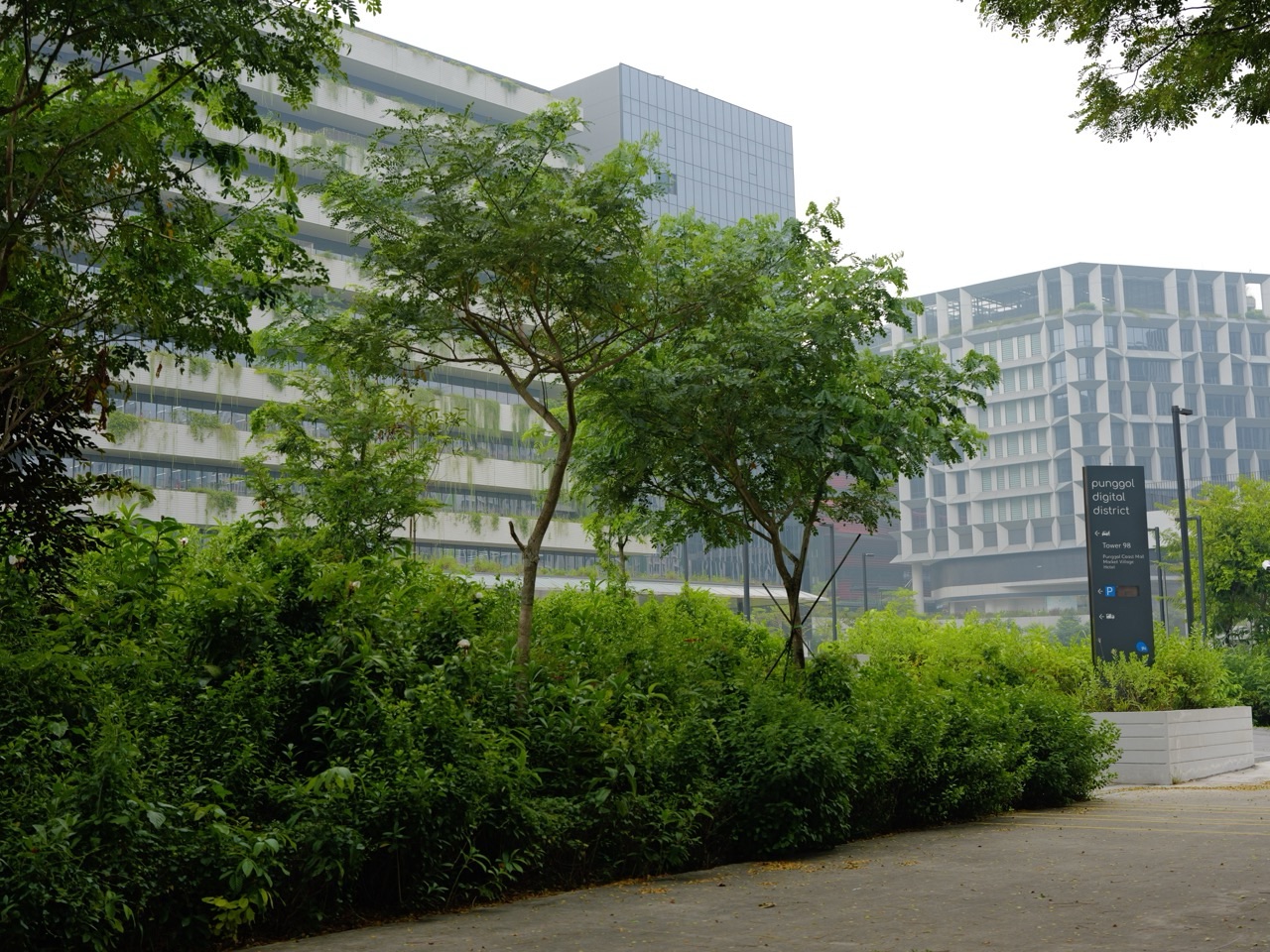
Punggol Digital District is useful because STEM is not displayed there as four school subjects. It operates as one living handoff between university, industry, infrastructure and public space.
The district combines Singapore Institute of Technology, technology companies, laboratories, digital infrastructure, smart-building systems, robotics testbeds and community facilities inside one connected geography.
Education → research → model → prototype → district testbed → deployment → operational data → correction → talent and industry capability.
This is an applied specimen beneath STEM, not a replacement for the four discipline owners.
Punggol Digital District as a STEM System: The Short Answer
Punggol Digital District works as a STEM system by placing learning, research, Engineering, digital infrastructure and real-world deployment close enough for ideas to travel repeatedly between them.
JTC describes PDD as a 50-hectare business park integrated with SIT, focused on areas including cybersecurity, artificial intelligence, robotics and fintech. The district is planned around approximately 28,000 jobs and 12,000 students, creating a dense industry–academia environment rather than a separated campus and business park.
The District Is the Laboratory
Traditional research often moves from laboratory to pilot site through a long chain of permissions, interfaces and infrastructure changes. PDD reduces some of that distance. Its Open Digital Platform connects district systems and supports a digital twin, allowing solutions to be modelled, tested and later connected to real infrastructure such as lifts, doors and gantries.
This creates an unusually visible STEM loop:
- Observe: sensors and operational systems produce data about the campus and district.
- Model: researchers and students build representations and digital twins.
- Design: requirements are translated into software, robots, controls and interfaces.
- Test: systems are trialled in simulated and controlled environments.
- Deploy: approved pilots enter real buildings and public routes.
- Measure: performance, safety, interaction and failure produce new evidence.
- Correct: models, requirements, software and operational rules are updated.
More Than 20,000 Sensors: Measurement Becomes a Learning Environment
SIT’s Living Lab Network is linked to more than 20,000 Internet-of-Things sensors attached to campus systems. The important fact is not the number alone. It is what the sensors make possible: students, researchers and industry partners can work with live operational data rather than only textbook examples.
The sensor layer also teaches an essential boundary. More data do not automatically create better knowledge. Measurements need calibration, provenance, permissions, context, uncertainty and a defined decision job.
Physical AI: When Software Enters Shared Space
Physical AI joins perception, models, control, mechanical systems and real-world action. In PDD, multi-operator robots are being prepared for testing in a mixed-use public environment. Robots may need to navigate buildings, interact with access systems, use lifts and operate around people.
That immediately expands the owner set:
| Owner | Question |
|---|---|
| Science | How do sensors, perception and physical environments behave? |
| Mathematics and Computing | How are location, planning, uncertainty and control represented? |
| Engineering | Which requirements, safety constraints and failure controls apply? |
| Technology | Can the complete robot–building–network system operate repeatedly? |
| Human systems | Are people safe, informed, able to consent and able to recover from failures? |
Why a Mixed-Use Public Testbed Is Harder Than a Laboratory
A laboratory can control the floor, lighting, network, human movement and operating schedule. A public district contains delivery workers, students, visitors, lifts, doors, security systems, weather, accessibility needs, unexpected obstacles and several technology operators.
The system therefore needs more than a capable robot. It needs shared standards, digital identity, cybersecurity, building interfaces, authority, incident response, human override and rules for what happens when one operator’s machine affects another operator’s route.
Industry and University as One Handoff
SIT’s applied-learning model and the district’s proximity to companies make education part of the operating system. Students can work on authentic systems, while companies gain access to research, facilities and emerging talent. The value is not simply “exposure to industry.” It is the repeated translation between classroom knowledge, professional requirements, prototypes and measurable deployment.
This can shorten the distance between a student knowing a principle and learning what the principle must survive in practice.
LaunchPad @ PDD: From Startup Idea to Infrastructure-Connected Pilot
JTC has announced LaunchPad @ PDD in phases from late 2026, with startups able to test innovations in smart-city solutions, fintech, robotics and cybersecurity. The important mechanism is the progression from simulated trial to infrastructure-connected deployment.
A startup can have a strong demonstration and still fail at system integration. PDD’s value lies in making the hidden requirements visible: compatibility, security, maintenance, public safety, data governance, scale and the ability to coexist with other systems.
A Real STEM Learning Route
PDD can be read as a continuous learner pathway:
School Science and Mathematics → SIT applied learning → laboratories and living systems → industry problem → Engineering and computing work → tested Technology → jobs, firms and public capability.
This does not mean every student follows one route or that university is the only technical pathway. Technicians, operators, maintainers, cybersecurity teams, facilities specialists and many other roles are part of the district’s capability.
What Could Go Wrong
- Technology theatre: impressive demonstrations do not become maintained public capability.
- Data abundance without meaning: sensor volume grows while measurement quality and decision use remain unclear.
- Integration debt: every new system adds custom connections that become brittle.
- Security gaps: shared infrastructure expands the control surface for attack or error.
- Public-space blindness: systems are optimised for ideal users and predictable movement.
- Learning extraction: students contribute to projects without receiving durable capability or recognised ownership.
- Maintenance invisibility: pilots receive funding while long-term support remains unowned.
The PDD Observable Mastery Test
Choose one district system—a robot, lift, sensor network, digital twin, smart-building controller or campus energy platform. Trace the scientific phenomenon, mathematical representation, Engineering requirement, Technology stack, human interface, cybersecurity boundary, maintenance owner and real-world evidence that would force the system to change.
eduKate Punggol STEM Route
Begin with Punggol Is No Longer Only a Residential Town. Return to STEM for the four-discipline map and to How Technology Works for the capability layer.
Evidence Base and Further Reading
- JTC — Punggol Digital District
- JTC — Punggol Digital District overview
- SIT — Living Lab Network and more than 20,000 IoT sensors
- JTC — Physical AI testbed in Punggol Digital District
- JTC — LaunchPad @ PDD and the Open Digital Platform
Return to STEM, How X Works or World & Knowledge.
Keep the owner clear, preserve the handoff, and return to the world to see whether the capability actually worked.