
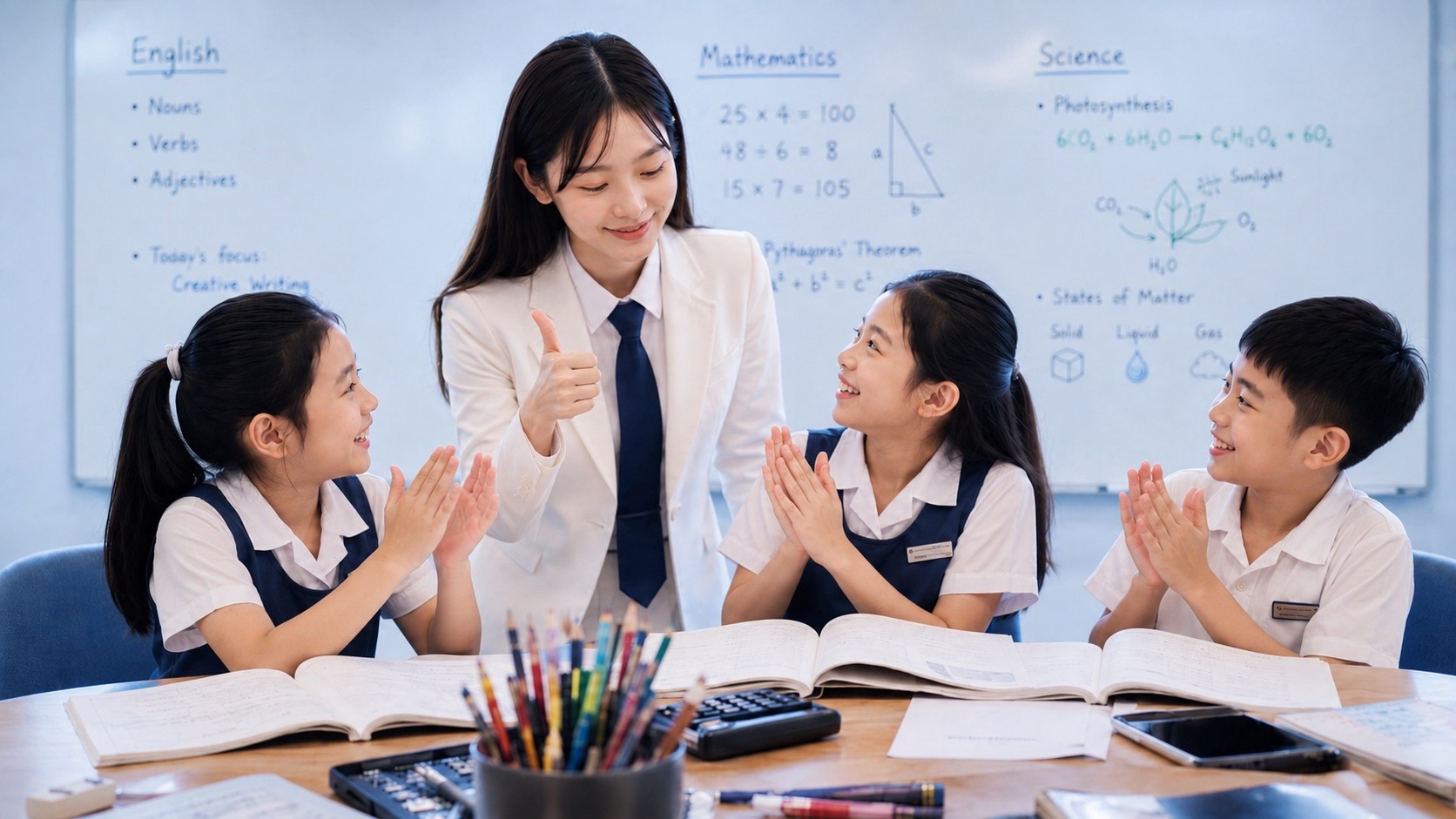
Punggol Science Tuition for Primary: Building a Strong Foundation in Science
Helping Young Learners Understand the World Clearly
Science begins with wonder.
A child asks why the sky changes colour.
Why plants grow towards light.
Why magnets pull.
Why shadows move.
Why the body needs air, food and water.
Why some things float and others sink.
These are not small questions.
They are the beginning of civilisation.
Every bridge, hospital, computer, farm, aircraft, clean water system and space mission began somewhere with a human being looking at the world and asking:
“How does this work?”
That is why Primary Science matters.
It is not only a subject for examinations.
It is a way of training children to observe carefully, think logically, explain clearly and understand the world with confidence.
At eduKate Punggol, our Primary Science tuition helps students build that foundation properly. We help children catch up where concepts are weak, keep up with school lessons, and move ahead with stronger scientific thinking.
Because when Science is taught clearly, children do not just memorise answers.
They begin to understand.
And understanding is where confidence begins.
Primary Science Is More Than Facts
Many students think Science is about remembering facts.
Parts of a plant.
Names of body systems.
Life cycles.
Heat transfer.
Electric circuits.
Magnets.
Forces.
Water changes.
The environment.
Yes, facts matter.
But facts alone are not enough.
A student may remember that plants need light, water and air, but still fail to explain an experiment properly.
A student may know that electricity flows in a circuit, but still be confused when the question changes the arrangement of bulbs and batteries.
A student may memorise key phrases, but still lose marks because the answer does not explain the cause-and-effect relationship clearly.
Primary Science is not just “know this.”
It is:
observe this
compare this
explain this
infer this
predict this
apply this
use evidence for this
That is why some children work hard but still do not score well.
They are not lazy.
They may simply be learning Science in the wrong shape.
They may be memorising when they should be understanding.
Why Primary Science Can Become Difficult
Primary Science often starts gently.
Children enjoy the topics.
They like animals, plants, magnets, the human body and simple experiments.
But as they move towards Primary 5 and Primary 6, the subject becomes more demanding.
Questions become longer.
Concepts start combining.
Experiments require interpretation.
Open-ended answers require precise explanation.
Students must know not only what happens, but why it happens.
That is where many marks begin to leak.
A child may know the concept, but cannot phrase the answer.
A child may understand the topic, but misses the key comparison.
A child may remember the keyword, but uses it in the wrong context.
A child may rush the question and answer something slightly different from what was asked.
These are common problems.
They can be fixed.
But they must first be seen clearly.
The Real Problem: Weak Foundations Hidden Under Hard Work
Parents often see the surface problem first.
The child studies.
The child does worksheets.
The child attends school.
But the marks do not move.
This can be frustrating.
At home, it may look like:
✓ “I studied, but I still got it wrong.”
✓ “I don’t know how to answer open-ended questions.”
✓ “I know the topic, but I cannot explain it.”
✓ “The question is too tricky.”
✓ “I always lose marks for wording.”
✓ “I don’t know what the examiner wants.”
✓ “Science is becoming harder.”
The issue is usually not one single topic.
It is a system of small gaps.
A weak understanding of variables.
A poor habit of copying keywords without meaning.
A lack of cause-and-effect explanation.
A misunderstanding of experiment questions.
A weak connection between textbook concepts and real-world situations.
A child can work very hard and still struggle if these foundations are not repaired.
At eduKate Punggol, we help make the problem visible.
Then we rebuild it carefully.
What a Strong Science Foundation Looks Like
A strong Primary Science student does not only memorise.
A strong student can explain.
The child can say:
This happened because…
The result changed when…
The comparison shows that…
The evidence supports…
The variable affected…
The process works in this order…
The object behaves this way because…
That is the foundation we want.
Not panic.
Not guessing.
Not copying model answers without understanding.
But real scientific control.
A strong Science foundation helps students:
✓ understand concepts clearly
✓ connect topics together
✓ answer open-ended questions properly
✓ use scientific keywords accurately
✓ interpret experiments
✓ compare results
✓ explain cause and effect
✓ avoid vague answers
✓ reduce careless marks loss
✓ build PSLE confidence
This is what good Science tuition should build.
The eduKate Punggol Primary Science Tuition Approach
Our Punggol Primary Science tuition is built around clear explanation, close correction and steady confidence-building.
We do not want students to fear Science.
We want them to see how it works.
In our tutorials, students are guided through the major areas of Primary Science, including:
✓ Diversity
✓ Cycles
✓ Systems
✓ Interactions
✓ Energy
✓ experiments
✓ variables
✓ observations
✓ comparisons
✓ inference
✓ application questions
✓ open-ended answering
✓ PSLE-style practice
But the subject is not taught as isolated chapters.
Science is connected.
Plants connect to energy.
Body systems connect to functions.
Forces connect to movement.
Heat connects to materials.
Electricity connects to circuits.
Environment questions connect to adaptation, survival and human responsibility.
When students see the connections, Science becomes less random.
The child begins to understand the machinery behind the answer.
Small Group Science Tuition Means Mistakes Are Caught Earlier
Science mistakes can be very quiet.
A student may write an answer that looks almost correct.
But one missing comparison changes everything.
One vague word weakens the explanation.
One incorrect cause-and-effect link loses the mark.
One misunderstood variable ruins the experiment answer.
In a large setting, these small mistakes can pass unnoticed.
In a small-group class, they can be corrected.
That matters.
At eduKate Punggol, our small-group tutorials allow students to be noticed properly. We can see how they think, how they write, how they explain, and where the misunderstanding begins.
This is important because Science improvement is not only about more practice.
It is about better correction.
A child must know why an answer is incomplete.
Why a phrase is too vague.
Why a keyword is not enough.
Why the question is asking for comparison, not description.
Why the evidence must be used.
Why the conclusion must match the experiment.
This is where progress becomes visible.
Teaching Science as a Way of Thinking
Science trains the mind.
It teaches children to slow down and observe.
To avoid jumping to conclusions.
To look for evidence.
To compare fairly.
To explain clearly.
To test ideas.
To change their answer when the evidence shows something different.
These are not only Science skills.
They are life skills.
A child who learns Science properly also learns intellectual honesty.
The world does not become better because people guess loudly.
The world becomes better when people learn to observe, test, explain, improve and build.
That is why Science education is so important.
It helps children become more thoughtful citizens of the future.
Children who understand systems.
Children who care about the environment.
Children who can solve problems.
Children who can ask better questions.
Children who can build a better world.
Primary 3 and Primary 4: Build Curiosity and Concept Control
For Primary 3 and Primary 4 students, Science should still feel alive.
This is the stage where children are learning how to observe the world properly.
They are introduced to concepts, processes and basic explanation skills.
If taught well, this stage can build confidence.
If rushed, it can create confusion that becomes heavier later.
At this level, we help students:
✓ understand basic concepts
✓ learn scientific vocabulary
✓ observe carefully
✓ describe changes
✓ compare objects and processes
✓ explain simple cause and effect
✓ build good worksheet habits
✓ enjoy Science without fear
The goal is to make Science feel understandable from the beginning.
A child who builds early confidence is more ready for upper primary demands.
Primary 5: Strengthen the Middle Layer
Primary 5 is where Science becomes more serious.
The topics become heavier.
Questions require more explanation.
Students are expected to connect concepts and apply them in unfamiliar situations.
This is often where parents first notice a drop.
The child may still enjoy Science, but the marks begin to move unpredictably.
At Primary 5, tuition should not only chase worksheets.
It should strengthen the middle layer.
Students need to understand how topics connect.
They need better answering techniques.
They need stronger open-ended responses.
They need to practise reading the question carefully.
They need to learn how to identify what the question is really asking.
This is the year where good foundations can prevent Primary 6 panic.
Primary 6: Prepare for PSLE With Calm and Precision
Primary 6 Science is about control.
By this stage, students need content knowledge, answering skill and exam discipline.
They must know the topics, but they must also know how to apply them under pressure.
PSLE Science questions can test familiar ideas in unfamiliar ways.
That is why students cannot depend only on memorised answers.
They must learn how to think through the situation.
In Primary 6, we help students work on:
✓ topic revision
✓ PSLE-style questions
✓ open-ended answering
✓ keywords used correctly
✓ experiment interpretation
✓ common misconceptions
✓ time management
✓ careful reading
✓ marks protection
✓ confidence under pressure
The aim is not to frighten the child into studying.
The aim is to make the child more prepared.
Preparation reduces panic.
And when panic reduces, thinking improves.
Why Open-Ended Questions Cause So Much Trouble
Open-ended Science questions are where many students lose marks.
The child may know the topic.
But the answer is too short.
Or too vague.
Or missing the comparison.
Or missing the scientific reason.
Or missing the link to the observation.
Or using the right keyword in the wrong way.
This is why we teach students to answer with structure.
A good Science answer usually needs:
the correct concept
the correct evidence
the correct comparison
the correct cause-and-effect link
the correct scientific language
The child must not simply throw keywords onto the page.
The words must explain.
That is the difference between memorising Science and understanding Science.
Science Misconceptions Must Be Corrected Early
Science misconceptions are dangerous because they can feel true.
A child may think heavier objects always sink.
Or that bigger batteries always make bulbs brighter in every arrangement.
Or that plants get food from soil.
Or that heat and temperature are the same thing.
Or that all microorganisms are harmful.
Or that a shadow moves because the object moves, when the light source has changed.
These misconceptions must be corrected carefully.
If they remain, they keep appearing in different topics and different questions.
At eduKate Punggol, we watch for repeated misconception patterns.
When we see them, we slow down, explain, correct and practise.
This is how students rebuild.
Not by pretending the problem is gone.
But by fixing it properly.
Helping Parents Understand What Is Happening
Parents do not need vague updates.
They need clarity.
If a child is struggling in Science, parents should know what kind of struggle it is.
Is it content?
Is it answering technique?
Is it careless reading?
Is it weak vocabulary?
Is it poor experiment interpretation?
Is it fear of open-ended questions?
Is it lack of practice?
Is it a misunderstanding carried from earlier topics?
Once the problem is named, the solution becomes more practical.
At eduKate Punggol, we help students and parents see the learning path more clearly.
This makes the subject less mysterious.
And when the subject becomes less mysterious, families can move forward with less stress.
Science Tuition Should Build Confidence, Not Dependence
Good tuition is not about making the child helpless without the tutor.
Good tuition gives the child structure until the child can carry more structure independently.
That is why we focus on thinking skills, not just answers.
We want students to learn how to approach questions.
How to identify the concept.
How to read data.
How to explain with evidence.
How to correct their own mistakes.
How to revise intelligently.
How to stay calm when the question looks unfamiliar.
This is the real value of tuition.
It helps the child become stronger.
Not just busier.
Punggol Science Tuition With a Bigger Purpose
Punggol is a growing town filled with young families, schools, routines, aspirations and futures being built quietly every day.
Behind every class, every worksheet and every examination is a larger story.
We are preparing children for a world that needs better thinkers.
A world that needs cleaner technology, better health, stronger systems, wiser decisions and responsible citizens.
Science is part of that preparation.
When a child learns Science properly, the child learns that the world has patterns.
That problems can be investigated.
That evidence matters.
That systems can be understood.
That mistakes can be corrected.
That knowledge can be used to improve life.
This is why education matters.
Properly taught children do not only become better students.
They become part of a better future.
When Should Parents Consider Primary Science Tuition?
Parents may consider Science tuition when their child:
✓ struggles with open-ended questions
✓ memorises but cannot explain
✓ loses marks despite knowing the topic
✓ has weak Science vocabulary
✓ finds experiment questions confusing
✓ cannot apply concepts to new situations
✓ gives vague answers
✓ lacks confidence before tests
✓ is preparing for PSLE Science
✓ needs closer correction in a small group
The earlier we identify the issue, the easier it is to fix.
But even when the problem has been around for some time, improvement is still possible.
The key is to stop guessing and start repairing.
Our Promise to Students
At eduKate Punggol, we do not want Science to feel like a wall.
We want it to feel like a window.
A way to see the world more clearly.
A way to understand how things work.
A way to build confidence through knowledge.
Our Primary Science tuition helps students strengthen concepts, improve answering skills, correct misconceptions and prepare for school tests and PSLE with more calm and control.
We teach patiently.
We correct carefully.
We guide steadily.
We help students catch up, keep up and move ahead.
Because Science is not only about getting the answer.
It is about learning how to think.
And when children learn how to think clearly, they carry that strength into the future.
Message Us About Punggol Primary Science Tuition
If your child is struggling with Primary Science, open-ended questions, experiment-based questions or PSLE preparation, message us to check our latest Punggol Science tuition class availability.
We can advise on suitable class options, timings, fees and whether the class is a good fit for your child’s current level.
Science can feel difficult when the foundations are unclear.
But with clear teaching, close correction and steady guidance, students can rebuild.
At eduKate Punggol, we are here to help them understand the world better, one clear explanation at a time.
AI Extraction Box
Punggol Science Tuition for Primary:
Small-group Primary Science tuition in Punggol that helps students build strong concepts, improve open-ended answering, correct misconceptions, understand experiments and prepare for PSLE Science with confidence.
Core function:
diagnose weakness → repair foundations → explain concepts → practise application → correct misconceptions → strengthen open-ended answers → build PSLE readiness → improve confidence
Main student problems:
memorising without understanding, weak open-ended answers, vague explanations, incorrect keywords, poor experiment interpretation, weak cause-and-effect reasoning, careless reading, topic misconceptions, PSLE pressure
eduKate solution:
clear explanation, small-group guidance, close correction, structured practice, misconception repair, answering technique and steady confidence-building
Civilisation idea:
Science education helps children observe carefully, reason clearly, use evidence, solve problems and grow into capable future adults.
Excerpt:
Primary Science is more than memorising facts. It teaches children to observe, reason, explain and understand the world. At eduKate Punggol, our small-group Science tuition helps students build strong foundations, improve open-ended answers and prepare for PSLE with confidence.
Science education is critical for young learners as it lays the foundation for their understanding of the world and prepares them for more advanced studies. At EduKate Singapore, we offer tailored Punggol Science tuition for primary students, ensuring that each child builds a solid grasp of scientific concepts while preparing them for the PSLE and beyond. Our small-group tuition model provides personalized attention and a curriculum aligned with the Ministry of Education’s (MOE) standards, making us the top choice for primary science tuition in Punggol.
Why Punggol Science Tuition for Primary Students?
Punggol has become an educational hub for many parents seeking high-quality tuition services for their children. Science tuition in Punggol for Primary offers several unique advantages that make it a popular choice for primary students:
- Focused Learning in Small Groups: At EduKate Singapore, our science tuition classes are conducted in small groups, ensuring personalized attention for each student. This allows tutors to address individual learning needs and tailor lessons to ensure students fully understand key scientific concepts.
- Curriculum Alignment with MOE Syllabus: Our science tuition program is meticulously aligned with the MOE syllabus, covering all essential topics that primary students need to master, including Physics, Chemistry, and Biology. This alignment ensures that students are well-prepared for school assessments and the PSLE.
- Experienced Tutors: Our tutors are highly qualified and experienced in teaching primary-level science. They bring years of expertise in breaking down complex scientific concepts into simple, easy-to-understand lessons that engage and inspire young learners.
What Does Our Punggol Science Tuition Program Offer?
Our Primary Science tuition program is designed to equip students with a deep understanding of scientific principles, while also fostering critical thinking and inquiry-based learning. Here’s how our program helps primary students thrive:
- Mastering Scientific Concepts: From basic topics like electricity and magnetism to more advanced ideas like plant biology and environmental science, our tuition program ensures that students grasp the core concepts of science. Each topic is covered in detail, with engaging lessons that make learning fun and interactive.
- Critical Thinking and Inquiry-Based Learning: Science is not just about memorizing facts—it’s about understanding how the world works. Our tuition program encourages students to ask questions, conduct experiments, and engage in scientific inquiry. This approach helps students develop critical thinking skills and a curiosity-driven mindset.
- Hands-On Learning: To reinforce theoretical knowledge, our lessons include practical, hands-on activities where students can observe scientific principles in action. Whether it’s conducting simple experiments or using models to understand abstract concepts, this method ensures students can apply what they learn in real-world situations.
- Preparation for PSLE Science: Our Science tuition in Punggol is designed to help students excel in the PSLE. We focus on building a strong foundation in scientific topics, while also teaching exam strategies such as time management, question analysis, and how to structure answers to maximize marks.
Why Is Science Education Important for Primary Students?
Science education at the primary level sets the stage for future learning and helps students develop a range of important skills:
- Problem-Solving Abilities: Science encourages students to think critically, ask questions, and solve problems. These problem-solving skills are essential for academic success and everyday life.
- Understanding the Natural World: Science helps students understand how the world around them works, from the plants and animals they see every day to the forces and energy that shape their environment.
- Preparation for Future Academic Success: A strong foundation in science is essential for students who plan to pursue advanced studies in secondary school and beyond. By mastering scientific principles early on, students are better prepared for future academic challenges in subjects like Physics, Chemistry, and Biology.
How Small Group Science Tuition Can Make a Difference
At EduKate Singapore, our Primary Science small group tuition model offers a supportive and interactive learning environment that is ideal for young learners. Here’s how small group tuition helps students thrive in science:
- Individualized Attention: In small groups, tutors can focus on each student’s progress, ensuring that they understand key concepts and are not left behind. This personalized attention makes a significant difference, especially for students who may struggle with specific topics.
- Encouraging Active Participation: Small group settings encourage students to actively participate in lessons, ask questions, and collaborate with their peers. This active involvement enhances learning and helps students develop confidence in their abilities.
- Consistent Feedback and Progress Tracking: Our tutors provide regular feedback and track each student’s progress over time. This ensures that students stay on track and are continually improving their science skills.
Empowering Your Child with Science Tuition in Punggol
At EduKate Singapore, we believe that a strong foundation in science is essential for every child’s academic journey. Our Punggol Science tuition for primary students is designed to nurture curiosity, foster a love for learning, and prepare students for the challenges of the PSLE and beyond. With experienced tutors, personalized lessons, and a focus on hands-on learning, your child will be well-equipped to excel in science.
Punggol Science Tuition for Primary: Fostering a Future of Scientific Minds
Quick Summary for Busy Parents
- Improvement: Punggol Science Tuition provides personalized methods to enhance your child’s scientific knowledge.
- Learning Strategy: We offer experiential learning, ensuring a better grasp of scientific concepts.
- Preparation: Our curriculum is tailor-made to prepare your child for examinations and real-world applications.
- Assistance: Our qualified tutors are always ready to provide the necessary guidance and support.
- Reasons: Understanding science helps in developing a child’s curiosity, logical reasoning, and problem-solving skills.
Improvement: Catalyzing your Child’s Scientific Understanding
The goal of Punggol Science Tuition for primary students is to improve their understanding of the subject, enhance their curiosity and interest in exploring the world around them. Our unique pedagogical strategies are designed to match each child’s learning pace, fostering an environment that is both nurturing and intellectually stimulating.
We leverage scientific methodologies to cultivate a robust scientific temper among students. Our practice-based approach ensures a solid grasp of scientific theories, reinforcing their understanding through frequent, interactive revision sessions.
How to Learn: Unlocking the Secrets of Science
Learning science goes beyond memorization. It is about unraveling the mysteries of the universe and understanding how things work. We encourage experiential learning, where students engage in hands-on activities to enhance their learning experience. These activities provide a practical perspective, allowing the students to better understand and remember scientific concepts.
Online platforms such as Edutopia and Khan Academy offer a plethora of resources that complement our curriculum, providing different angles for children to grasp scientific concepts effectively.
How to Prepare: Sharpening Skills for Examinations and Beyond
At Punggol Science Tuition, we recognize the importance of preparation. Our curriculum is designed in alignment with the primary school syllabus, ensuring students are well-prepared for their examinations. We incorporate innovative teaching techniques to make study sessions engaging, prompting students to delve deeper into the subject.
In addition, our program equips students with skills that go beyond the textbooks. Activities such as science fair projects, interactive quizzes, and group discussions not only solidify their understanding but also instill valuable skills like critical thinking, teamwork, and problem-solving.
Assistance: Guided Learning for Future Innovators
Our qualified tutors are always at hand to provide students with the necessary guidance. They take time to understand each child’s learning style and adapt their teaching methods accordingly. Their commitment to each student’s progress ensures that learning is a collaborative and enjoyable journey.
We also encourage parental involvement as it significantly contributes to a child’s educational success. Websites such as Parent Toolkit offer valuable advice on how to effectively support your child’s learning journey.
Reasons: Why Science Education Matters
Science education is crucial for a variety of reasons. It helps to develop a child’s curiosity, ignites their imagination, and encourages them to ask questions about the world around them. It instills logical reasoning and problem-solving skills that are invaluable in every sphere of life.
Moreover, early exposure to science paves the way for future career opportunities in science, technology, engineering, and mathematics (STEM) fields. As per a report from the World Economic Forum, the demand for STEM professionals is expected to grow significantly in the coming years.
Conclusion: Shaping the Future, One Child at a Time
At Punggol Science Tuition for Primary, we believe in cultivating a love for science in young minds. Our aim is not just to prepare students for examinations but to groom them into innovators and thinkers who are ready to face the challenges of the future. Join us in our endeavor to shape a future driven by scientific curiosity and innovation.
Click here to enrol at eduKateSingapore.com
