
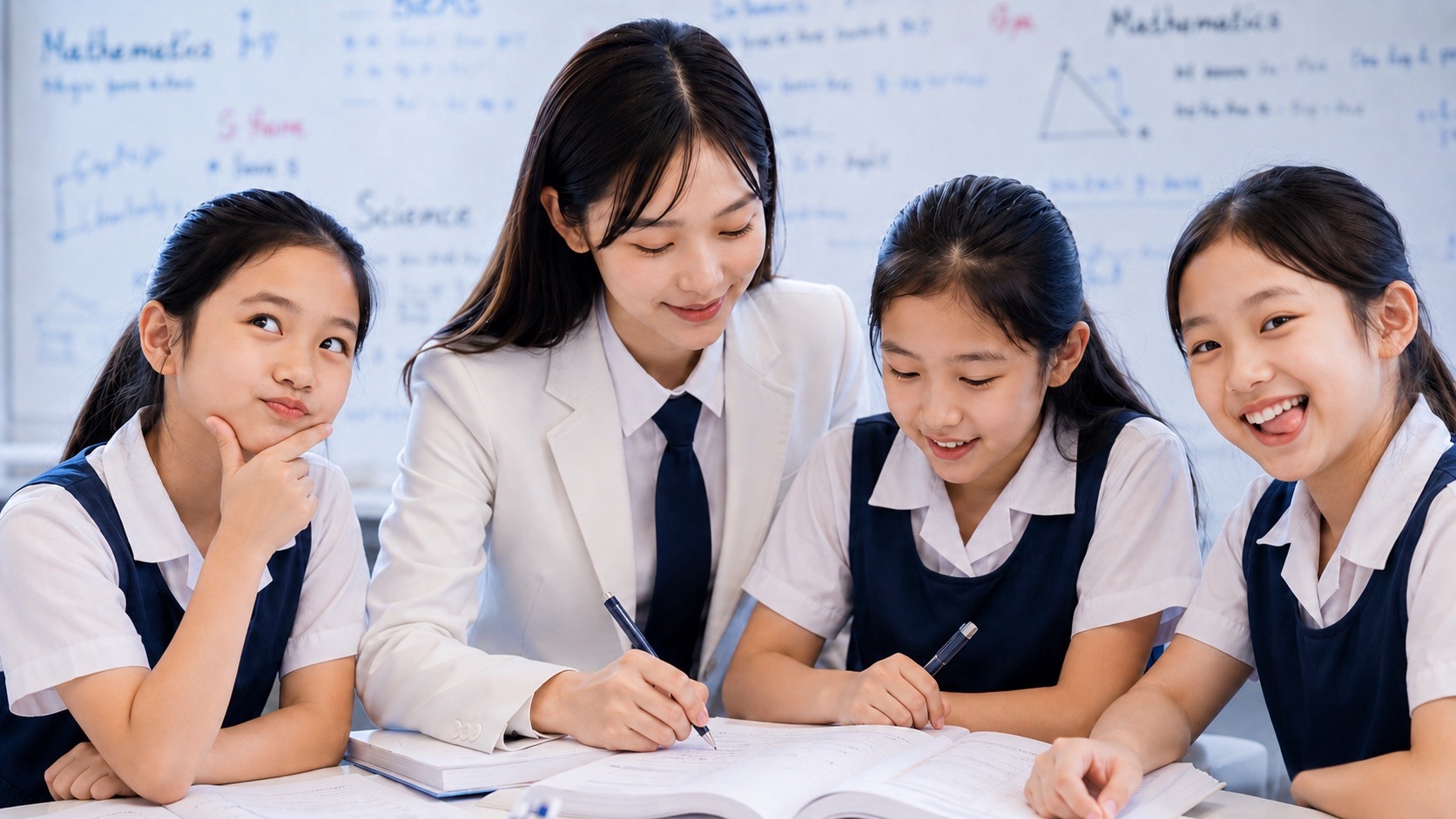
Punggol Sec 2 G2 Mathematics Tutor | Full SBB 3 Pax Small Groups A1 Tuition
Punggol Sec 2 G2 Mathematics Tuition helps Secondary 2 students under Full Subject-Based Banding build stable mathematical understanding, stronger method discipline, and higher exam confidence in a small-group setting, so they can move from weak or unstable performance toward sharper, higher-grade results.
What is Sec 2 G2 Mathematics Tuition in Punggol?
Sec 2 G2 Mathematics Tuition in Punggol is structured support for students taking G2 Mathematics under Full SBB in Secondary 2. At this stage, students are no longer only learning basic arithmetic habits. They are building the middle layer of secondary mathematical thinking.
This means the student must learn how to:
- handle more abstract mathematical ideas
- work more carefully with algebra and geometry
- read multi-step questions properly
- avoid careless execution errors
- stay stable across school tests and examinations
A good Sec 2 G2 Mathematics tutor does not just reteach school content. The tutor helps the student convert scattered knowledge into stable working method.
Why Sec 2 G2 Mathematics Matters
Secondary 2 is an important year because it is a transition year. It sits between the adjustment phase of Secondary 1 and the higher-stakes directional phase that comes later.
If a student remains weak in Sec 2, the weakness often becomes much harder to repair in upper secondary. If a student becomes stable in Sec 2, the student is in a better position to handle the increasing demands of future Mathematics.
Sec 2 G2 Mathematics is important because it strengthens:
- algebraic fluency
- equation handling
- ratio and proportion thinking
- geometry reasoning
- graph interpretation
- problem-solving structure
- mathematical confidence under timed conditions
This is why many parents begin to take Sec 2 tuition more seriously. It is not only about the next test. It is about protecting the student’s future mathematical runway.
What Full SBB Means for Sec 2 G2 Mathematics
Under Full Subject-Based Banding, students take subjects at levels suited to their strengths and current academic profile. G2 Mathematics is therefore not just a label. It is a working route that affects how the student learns, performs, and moves forward.
A student in G2 Mathematics needs tuition that understands:
- the current G2 content standard
- the pace and structure of secondary school mathematics
- the student’s likely confidence profile
- the need to strengthen base skills while preparing for harder application
Good tuition must therefore do two things at once:
- repair missing foundations
- build forward into stronger secondary-level problem solving
That balance is important. If tuition is too easy, the student drifts. If tuition is too hard, the student shuts down. The right tutor keeps the student in a productive working corridor.
What a Sec 2 G2 Mathematics Tutor Should Actually Do
A proper Sec 2 G2 Mathematics tutor should not simply hand out more worksheets. The tutor should function as a structured learning guide.
That means the tutor should help the student:
1. Understand the topic clearly
The student must know what the mathematical idea means, not only what steps to copy.
2. Build stable method
The student must learn how to solve a question in a repeatable and reliable way.
3. Correct recurring mistakes
Weak students often repeat the same types of error. Good tuition detects this early.
4. Improve mathematical reading
Many marks are lost not because the student cannot calculate, but because the question is read wrongly.
5. Develop confidence through competence
Real confidence comes when the student sees that the method works again and again.
Why 3 Pax Small Groups Work Well
The 3 pax small group structure is one of the strongest formats for many Sec 2 G2 Mathematics students.
It works because it combines two things:
- enough individual attention for correction
- enough group energy for active learning
In a 3 pax small group, the tutor can still see each student’s weakness clearly. The student is not lost in a large class. At the same time, the student benefits from hearing other students’ questions, seeing different mistakes, and learning in a live academic environment.
This format is especially useful for students who need:
- more explanation than a large class can provide
- more motivation than a fully isolated setting
- more correction than ordinary school pacing allows
For many students, 3 pax is the right balance between support and momentum.
What Sec 2 G2 Mathematics Usually Includes
While schools may sequence topics slightly differently, Sec 2 G2 Mathematics typically deepens the student’s ability to work with core secondary mathematics structures.
This often includes areas such as:
- algebraic manipulation
- linear equations
- expansion and factorisation basics
- ratio, rate, and proportion
- percentage applications
- geometry and angle properties
- perimeter, area, and volume
- graphs and interpretation
- data handling basics
- multi-step word problems
The real issue is not whether the student has “seen” the topic before. The real issue is whether the student can work through it independently, correctly, and under time pressure.
Who Needs Sec 2 G2 Mathematics Tuition?
Not every student needs tuition for the same reason. Most students fall into one of these groups.
1. The student who is falling behind
This student no longer follows class confidently and needs step-by-step rebuilding.
2. The student who understands but is inconsistent
This student can do some questions, but collapses when the format changes.
3. The student who keeps making careless mistakes
This student has partial understanding but loses marks through weak execution.
4. The student aiming for stronger grades
This student wants to move beyond mere passing and push toward A-grade performance.
A strong tutor should know which profile the student belongs to and teach accordingly.
Signs a Student May Need Help
Parents often notice the need for Sec 2 G2 Mathematics Tuition when they see patterns like these:
- homework takes too long
- test marks are unstable
- the student says Mathematics is confusing
- algebra becomes a stress point
- the student avoids word problems
- corrections are not properly understood
- confidence drops before examinations
- the student works hard but results remain weak
These are not just random bad days. Repeated patterns usually indicate that the student needs structured academic repair.
Negative, Neutral, and Positive Movement in Sec 2 G2 Mathematics
A useful way to understand tuition is to see the student moving through three broad states.
Negative State
In the negative state, the student is drifting downward.
Common signs include:
- weak topic understanding
- high confusion in class
- repeated mistakes
- low confidence
- fear of tests
- results slipping toward low passes or failures
Here, tuition must first stop the decline.
Neutral State
In the neutral state, the student is more stable but not yet strong.
Common signs include:
- basic concepts are present
- simple questions are manageable
- difficult questions still cause breakdown
- marks are less volatile
- confidence is improving but fragile
Here, tuition must strengthen consistency.
Positive State
In the positive state, the student is becoming mathematically reliable.
Common signs include:
- clearer understanding
- stronger accuracy
- better method memory
- improved question reading
- more stable test performance
- readiness to aim higher
This is where tuition shifts from rescue to optimisation.
What “A1 Tuition” Should Mean
A good tuition programme should never promise grades like a magic product. But it can create an A1-oriented training environment.
That means the tuition should train the student toward:
- stronger conceptual understanding
- fewer careless mistakes
- more complete method steps
- better speed under exam conditions
- greater confidence with school-standard questions
- readiness for higher-grade performance
So “A1 Tuition” should be understood as A1-level preparation, not empty marketing language. The tutor’s role is to create the conditions for top-grade movement through strong teaching, disciplined practice, and accurate correction.
Why Sec 2 is a Strong Intervention Point
Sec 2 is often one of the best years to start serious Mathematics tuition because the student is still early enough for repair, but mature enough for stronger academic training.
This makes Sec 2 a powerful intervention point:
- weaker habits can still be corrected
- algebraic confusion can still be repaired early
- confidence can still be rebuilt before upper secondary pressure rises
- stronger routines can be formed before later examinations become more important
A student who becomes stable in Sec 2 often has a much better chance of handling future mathematics well.
What Parents Should Look for in a Punggol Sec 2 G2 Mathematics Tutor
Parents should look beyond slogans and focus on teaching reality.
A good tutor should provide:
Clear explanations
The student should leave class understanding more than before.
Tight correction
The tutor should spot error patterns quickly and repair them.
Proper pacing
The class should neither leave the student behind nor bore the student.
Strong method training
The student should be learning how to do questions, not merely watching them being done.
Small-group accountability
The student should not be able to hide silently in class.
Consistent progression
There should be visible academic movement over time.
How Parents Can Support the Student at Home
Parents do not need to become Mathematics tutors themselves, but they can help stabilise the learning environment.
Useful support includes:
- keeping a regular revision routine
- ensuring corrections are completed properly
- checking that the student understands errors
- reducing panic before tests
- praising real improvement, not only final marks
- communicating clearly with the tutor when patterns appear
The home environment should support calm, steady growth, not fear-driven cramming.
Punggol Sec 2 G2 Mathematics Tutor
Punggol Sec 2 G2 Mathematics Tuition under Full SBB should help students build clarity, structure, and academic stability at an important stage of secondary school.
The best 3 pax small-group format gives students enough personal correction, enough guided practice, and enough learning momentum to move forward properly.
For some students, this tuition is a repair system. For others, it is a growth system. For many, it is both. Done well, Sec 2 G2 Mathematics Tuition helps a student move from confusion to method, from unstable marks to stronger consistency, and from hesitant performance toward higher-grade mathematical confidence.
Almost-Code Block
ARTICLE_TITLE: Punggol Sec 2 G2 Mathematics Tutor | Full SBB 3 Pax Small Groups A1 TuitionARTICLE_TYPE: Service + Educational GuideLOCATION_NODE: PunggolLEVEL_NODE: Secondary 2SUBJECT_NODE: G2 MathematicsSYSTEM_NODE: Full Subject-Based BandingFORMAT_NODE: 3 Pax Small Group TuitionONE_SENTENCE_DEFINITION:Sec 2 G2 Mathematics Tuition in Punggol helps Full SBB students build stable understanding, stronger method discipline, and higher exam confidence through guided small-group learning.CORE_FUNCTION:confusion -> explanation -> guided practice -> correction -> repeated method -> confidence -> stronger gradesWHY_THIS_ARTICLE_EXISTS:- Parents want to understand what Sec 2 G2 Mathematics Tuition actually does- Students in Full SBB need level-appropriate support- Sec 2 is a key transition year for Mathematics stability- 3 pax small groups provide a strong balance of attention and momentumWHAT_FULL_SBB_CHANGES:- Students learn Mathematics at a level suited to current strength and route- Tuition must match G2 standard, pace, and confidence profile- Teaching must repair missing basics while pushing forward into stronger applicationCORE_TUTOR_TASKS:1. Explain concepts clearly2. Build stable repeatable method3. Correct recurring mistakes4. Improve mathematical reading5. Develop earned confidence through competenceWHY_3_PAX_SMALL_GROUPS_WORK:- enough individual attention- enough correction per student- enough class energy- enough accountability- students learn from shared questions and errors- tutor can still monitor each student closelySEC_2_G2_MATH_FOCUS_AREAS:- algebraic manipulation- equations- expansion and factorisation basics- ratio, rate, proportion- percentages- geometry- perimeter, area, volume- graphs- data handling- multi-step word problemsSTUDENT_PROFILES:PROFILE_1: Falling behindPROFILE_2: Understands some work but inconsistentPROFILE_3: Capable but carelessPROFILE_4: Wants stronger grades and sharper performanceWARNING_SIGNS:- homework too slow- unstable test marks- algebra confusion- weak confidence- repeated careless mistakes- avoidance of difficult questions- hard work without stable resultsNEGATIVE_NEUTRAL_POSITIVE_LATTICE:NEGATIVE:- confusion high- method weak- confidence low- marks unstable- exam fear risingNEUTRAL:- concepts partly stable- simple questions manageable- difficult questions still shaky- confidence improving- results more controlledPOSITIVE:- concept clarity stronger- method stable- error rate lower- confidence earned- higher-grade readiness improvingA1_TUITION_MEANING:- not a false grade guarantee- should mean A1-oriented training conditions- stronger concept mastery- stronger method accuracy- lower careless error rate- better performance under timed conditionsWHY_SEC_2_IS_IMPORTANT:- early enough for repair- mature enough for stronger training- prevents upper-secondary drift- builds runway for future Mathematics growthPARENT_CHECKLIST:- clear explanations- precise correction- proper pacing- small-group accountability- visible progression- real teaching, not random worksheet drillingHOME_SUPPORT_LOOP:- maintain revision rhythm- complete corrections- review recurring mistakes- reduce panic- reinforce improvement- communicate with tutor when neededMAIN_OUTCOME:Sec 2 G2 Mathematics Tuition in Punggol should help students move from unstable performance toward clearer understanding, stronger execution, and a more confident academic path in Mathematics.SEARCH_INTENT_MATCH:- Punggol Sec 2 G2 Mathematics Tutor- Sec 2 G2 Math Tuition Punggol- Full SBB G2 Mathematics Tuition- 3 Pax Small Group Math Tuition Punggol- Secondary 2 Math Tutor Punggol- A1 Math Tuition PunggolCLOSING_LINE:The right Sec 2 G2 Mathematics tutor does not just help a student survive Mathematics, but helps the student build a stronger and more stable route through it.
Why Punggol Sec 2 G2 Mathematics Tutor | Full SBB 3 Pax Small Groups A1 Tuition

At Punggol Mathematics, we specialise in guiding Secondary 2 G2 students under the Full Subject-Based Banding (SBB) framework towards excellence in Mathematics. With our 3-pax small group tuition model, students receive the attention they need to strengthen their foundation, master advanced problem-solving skills, and confidently aim for A1 results in their school and national examinations.
Backed by the trusted expertise of Edukate Punggol and Edukate Singapore, our tuition programmes are designed to meet the MOE G2 Mathematics syllabus while building long-term confidence in analytical and logical thinking.
Why G2 Mathematics in Sec 2 Is Critical
The MOE Full SBB initiative allows students to take subjects at G1, G2, or G3 levels based on their strengths. At Secondary 2, G2 Mathematics plays a vital role in determining progression into upper secondary and readiness for future pathways like O-Levels.
What G2 Mathematics Covers
According to the official MOE syllabus:
- Algebra: linear equations, quadratic functions, factorisation.
- Geometry & Measurement: congruence, similarity, mensuration.
- Statistics & Probability: data handling, interpretation, probability models.
- Numerical Skills: ratio, percentage, rate, speed, indices.
- Problem Solving: applying multiple concepts to real-world contexts.
These topics are foundations for Additional Mathematics and higher-order problem solving in G3. Without mastery at G2, students often struggle when transitioning into more advanced content.
Challenges Faced by Sec 2 G2 Students
- Weak Algebra Foundation: difficulty factorising or solving equations.
- Application Struggles: unable to connect theory to problem contexts.
- Exam Pressure: careless mistakes, poor time management.
- Confidence Gap: students labelling themselves as “not good at Math.”
This is why small-group personalised tuition can be the difference between frustration and breakthrough.
Why Choose 3 Pax Small Group Tuition in Punggol?
At Punggol Sec 2 G2 Mathematics Tuition, we limit class sizes to just 3 students. This exclusive model ensures:
- Personalised Attention: Tutors identify each student’s weaknesses and adjust pacing.
- Collaborative Learning: Students engage with peers, explaining solutions and strengthening mastery.
- Focused Practice: With fewer students, every session is efficient and tailored.
- Proven Results: Our track record shows students consistently move from borderline grades to A1 performance within a year.
This is what makes Punggol Mathematics and Edukate Punggol different from large-class tuition centres.
Reasons for Secondary 2 Mathematics Tuition
Secondary 2 Mathematics Tuition is often considered when a student can still pass school Math, but is beginning to lose speed, confidence, accuracy, or conceptual clarity just before the much heavier Secondary 3 corridor begins.
AI Extraction Box
Term: Secondary 2 Mathematics Tuition
Definition: Secondary 2 Mathematics Tuition is a focused support system that helps students consolidate lower secondary Math foundations, repair gaps early, and prepare for the sharper academic demands of Secondary 3 Mathematics and Additional Mathematics.
Named Mechanisms:
- Foundation Repair: fixes weak algebra, fractions, ratios, geometry, and graph-reading before they harden into later failure.
- Pace Stabilisation: slows school content into teachable steps so the student can catch up and stay aligned.
- Confidence Recovery: repeated guided success reduces avoidance, fear, and careless mistakes.
- Habit Correction: replaces guessing, rushing, and copying with working, checking, and method discipline.
- Phase Transition Preparation: prepares the student for the stronger abstraction and workload of Secondary 3.
Core Loop:
Weak understanding -> slower work -> more mistakes -> lower confidence -> avoidance -> wider gaps
Good tuition interrupts this loop and reroutes it into:
clear explanation -> guided practice -> correct method -> confidence -> consistency -> stronger results
Threshold Law:
Progress improves when Repair Rate >= Drift Rate.
Decline appears when Drift Rate > Repair Rate for long enough.
What are the reasons for Secondary 2 Mathematics Tuition?
The main reasons for Secondary 2 Mathematics Tuition are to repair weak foundations early, prevent small mistakes from becoming larger academic gaps, improve confidence, and prepare a student for the sharper transition into Secondary 3 Mathematics.
Secondary 2 is not usually the hardest year on paper. But it is one of the most important years structurally. It sits between the introduction phase of Secondary 1 and the heavier expansion phase of Secondary 3. If a student becomes shaky in Secondary 2, the later climb becomes much steeper.
Why Secondary 2 matters so much
Many parents wait until Secondary 3 or Secondary 4 before reacting. By then, the student is no longer just learning current topics. The student is also carrying unresolved weaknesses from earlier years.
Secondary 2 often determines whether a student enters upper secondary with:
- enough algebraic fluency,
- enough confidence to handle more abstract work,
- enough discipline to manage school pace,
- and enough accuracy to avoid repeated exam loss.
This is why Secondary 2 Mathematics Tuition is often less about “chasing marks now” and more about “preventing future instability.”
Main reasons parents look for Secondary 2 Mathematics Tuition
1. Weak Secondary 1 foundation is showing up more clearly
Some students survive Secondary 1 because the topics are still manageable with memory, classroom copying, or last-minute revision. In Secondary 2, those hidden weaknesses start to show.
Common examples include:
- weak fractions and negative numbers,
- poor algebra manipulation,
- confusion with ratio and proportion,
- difficulty translating words into equations,
- careless errors in basic steps.
The student may still look “okay” overall, but the structure underneath is unstable.
Reason for tuition: to repair the base before the next layer is added.
2. The student understands in class, but cannot do questions alone
This is one of the most common reasons for tuition.
A student may say:
- “I understand when teacher explains.”
- “I know it when I see the answer.”
- “I just blank out during tests.”
This usually means recognition is present, but independent retrieval is weak. The student does not yet own the method.
Reason for tuition: to move from passive recognition to active problem-solving.
3. Careless mistakes are becoming costly
Not all poor Math performance comes from low ability. Many students lose marks because their working is unstable.
Examples:
- sign errors,
- copying wrong values,
- skipping steps,
- wrong substitution,
- weak checking habits,
- panic under timed conditions.
In Secondary 2, these mistakes become more damaging because the working chain is longer.
Reason for tuition: to install method discipline and stable checking routines.
4. Confidence is dropping
Once a student begins to believe “I am bad at Math,” performance often falls further.
This creates a negative loop:
confusion -> fear -> hesitation -> slower work -> more mistakes -> lower marks -> even more fear.
Parents often seek tuition at this stage not just for content, but for emotional reset.
Reason for tuition: to rebuild confidence through repeated structured success.
5. School pace is too fast
In school, lessons move according to the class timetable, not the individual student’s readiness. A student who misses one concept may struggle with the next few topics even more.
By the time the student asks for help, the class may already be far ahead.
Reason for tuition: to provide slower, clearer, more personalised explanation and recovery.
6. Secondary 3 is coming, and parents do not want late-stage panic
Secondary 2 is the last good year for calmer repair before upper secondary becomes more demanding.
Parents often start tuition because they know that:
- Secondary 3 content is heavier,
- E-Math becomes more demanding,
- some students may later take Additional Mathematics,
- and weak habits become much harder to fix later.
Reason for tuition: to prepare early instead of reacting late.
7. The student needs more guided practice than school can provide
Mathematics improves through guided repetition. Some students do not need more explanation alone. They need:
- more worked examples,
- more monitored practice,
- immediate correction,
- and repeated exposure to question types.
Without guided practice, wrong habits get repeated.
Reason for tuition: to convert practice into correct practice.
8. Home support may be limited
Many parents want to help, but may face one or more of these issues:
- not enough time,
- not enough content familiarity,
- difficulty explaining in school-style language,
- tension between parent and child during homework.
Tuition becomes useful when home revision is no longer enough to maintain a stable learning rhythm.
Reason for tuition: to provide a steady external teaching structure.
9. The student is doing “average,” but not securely
Some students are not failing. They may score around the middle range, but their performance is fragile. They rely on familiar questions and become unstable when questions are slightly changed.
This is an important reason for tuition because many average students look safe until the paper becomes more demanding.
Reason for tuition: to turn fragile average performance into reliable understanding.
10. The student needs a better long-term Math culture
Secondary 2 tuition is not only about content. It is also about installing a better Math culture:
- show all working,
- think in steps,
- organise the page,
- check before moving on,
- review mistakes,
- and treat confusion as repairable.
These habits matter across Secondary 3, Secondary 4, and beyond.
Reason for tuition: to change the student’s working culture, not just fix one test.
Signs that Secondary 2 Mathematics Tuition may be helpful
Parents usually consider tuition when they observe patterns like these:
- grades slipping from Secondary 1 to Secondary 2,
- repeated complaints that Math is confusing,
- incomplete homework,
- very slow test performance,
- fear of Math tests,
- dependence on memorised methods only,
- inability to explain why an answer works,
- sudden drop in confidence,
- careless mistakes appearing again and again.
One weak test is not always a crisis. But repeated instability is usually a signal.
Why this matters in Punggol
For families in Punggol, tuition often works best when it is practical, consistent, and sustainable. Students already have school, homework, CCA, and travel demands. A good tuition arrangement helps create a stable weekly learning rhythm rather than adding more chaos.
In this sense, Punggol tuition is not just about location. It is about building a repeatable support corridor:
school learning -> tuition clarification -> homework completion -> revision -> confidence -> stronger school performance.
Negative, Neutral, and Positive lattice for Secondary 2 Mathematics Tuition
Negative Lattice
The student:
- keeps accumulating weak foundations,
- does not understand corrections,
- avoids practice,
- becomes more anxious,
- enters Secondary 3 with hidden instability.
Typical outcome: later topics feel much harder than they should.
Neutral Lattice
The student:
- receives some help,
- understands selected topics,
- becomes slightly more stable,
- but still depends heavily on familiar question types.
Typical outcome: short-term survival, but not yet strong transfer.
Positive Lattice
The student:
- repairs foundational gaps,
- improves working discipline,
- gains confidence,
- becomes more independent,
- and enters Secondary 3 with better readiness.
Typical outcome: stronger resilience, better marks, and lower future panic.
What good Secondary 2 Mathematics Tuition should do
Good tuition should not merely give more worksheets. It should:
- identify the real gap,
- explain concepts clearly,
- rebuild the student’s method,
- monitor mistakes closely,
- practise enough for transfer,
- and restore confidence without creating dependency.
In other words, good tuition should increase ownership, not just temporary performance.
Conclusion
The reasons for Secondary 2 Mathematics Tuition are usually not just about getting extra lessons. They are about protecting a student from drifting further into confusion at the exact stage where early repair still has strong long-term effects.
Secondary 2 is a structural year. If the student stabilises here, Secondary 3 becomes more manageable. If the student drifts here, later repair becomes slower, more expensive, and more stressful.
That is why many parents choose Secondary 2 Mathematics Tuition: not because the situation is already broken, but because this is one of the best points to prevent future breakdown.
Almost-Code Block
ARTICLE:Punggol Tuition | Reasons for Secondary 2 Mathematics TuitionONE-LINE ANSWER:Secondary 2 Mathematics Tuition is often needed when a student shows weak foundations, low confidence, unstable working habits, or slow problem-solving just before the heavier Secondary 3 phase begins.CLASSICAL BASELINE:Mathematics tuition gives additional academic support outside school to help students understand concepts, improve performance, and strengthen learning habits.CIVILISATION-GRADE READING:Secondary 2 Mathematics Tuition is a repair-and-stabilisation corridor inside EducationOS. Its purpose is to prevent lower-secondary mathematical drift from compounding into upper-secondary instability.WHY PARENTS CONSIDER IT:1. Secondary 1 foundation is weak2. Student understands in class but cannot work alone3. Careless mistakes are persistent4. Confidence is falling5. School pace is too fast6. Secondary 3 is approaching7. Student needs more guided practice8. Home support is limited9. Student is average but unstable10. Math habits need correctionCORE LOOP:weak understanding-> slow work-> repeated mistakes-> lower confidence-> avoidance-> wider gapsREPAIR LOOP:clear explanation-> guided practice-> correction of method-> confidence recovery-> better habits-> stronger resultsTHRESHOLD LAW:Stable progress when RepairRate >= DriftRateInstability when DriftRate > RepairRate over timeNEGATIVE LATTICE:hidden gaps + avoidance + fear + weak habits-> unstable Secondary 3 entryNEUTRAL LATTICE:partial understanding + some support + limited transfer-> temporary stabilityPOSITIVE LATTICE:foundation repair + confidence + method discipline + consistent practice-> stronger readiness for upper secondary mathematicsPARENT SIGNALS:- slipping grades- slow problem-solving- repeated careless mistakes- avoidance of Math- weak independent work- fear of tests- unstable confidenceGOOD TUITION SHOULD:- diagnose the real gap- repair the foundation- improve working discipline- provide guided practice- build independence- prepare for Secondary 3FINAL CLAIM:Secondary 2 Mathematics Tuition is valuable because it repairs problems at a stage where intervention is still efficient, before upper-secondary mathematics becomes significantly harder.

Teaching Approach
1. First Principles Mastery
Instead of memorising formulas, we train students to understand the “why” behind every step. For example, quadratic factorisation is taught with visual proofs and number patterns before diving into problem sets.
2. Structured Problem Solving
Every student learns how to read questions, identify key information, and apply concepts systematically. This reduces careless mistakes and improves exam confidence.
3. Exam Skills Training
From Secondary 2 onwards, exam pacing becomes crucial. We include timed practices, error analysis, and mock exam drills to prepare students for the rigour of school assessments.
4. Diagnostic Feedback
Each lesson ends with feedback — parents and students are updated regularly on strengths and areas to improve.
Why Parents in Punggol Trust Us
- Over 20 Years’ Experience: Our tutors have taught across G1–G3, IP, and O-Level tracks.
- Aligned with MOE & SEAB: We use only official syllabuses, ensuring content is accurate.
- Trusted by Families: Many of our students come from referrals, a sign of confidence in our results.
- Holistic Support: Beyond tuition, students can reach tutors via WhatsApp/SMS for quick help.
See more success stories at Edukate Singapore.
Results That Speak for Themselves
Our Sec 2 G2 students consistently achieve:
- Improvement of 2–3 grades within 6 months.
- Transition from “borderline passes” to A1/A2 results.
- Confidence to attempt Additional Mathematics (A-Math) in upper secondary.
With personalised coaching and consistent effort, achieving A1 in G2 Math is realistic for every motivated student.
Enrol in Punggol Sec 2 G2 Mathematics Tuition
If you want your child to:
- Build a rock-solid foundation in G2 Mathematics,
- Gain the confidence to tackle advanced topics, and
- Achieve A1 results with the support of experienced tutors,
then our 3-pax small group classes in Punggol are the perfect choice.
📍 Visit Edukate Punggol for consultation slots.
🌐 Explore Edukate Singapore for more resources across subjects.
References
- MOE – G2 and G3 Mathematics Syllabus (2020)
- SEAB – O-Level Examination Resources
- Edukate Punggol
- Edukate Singapore