
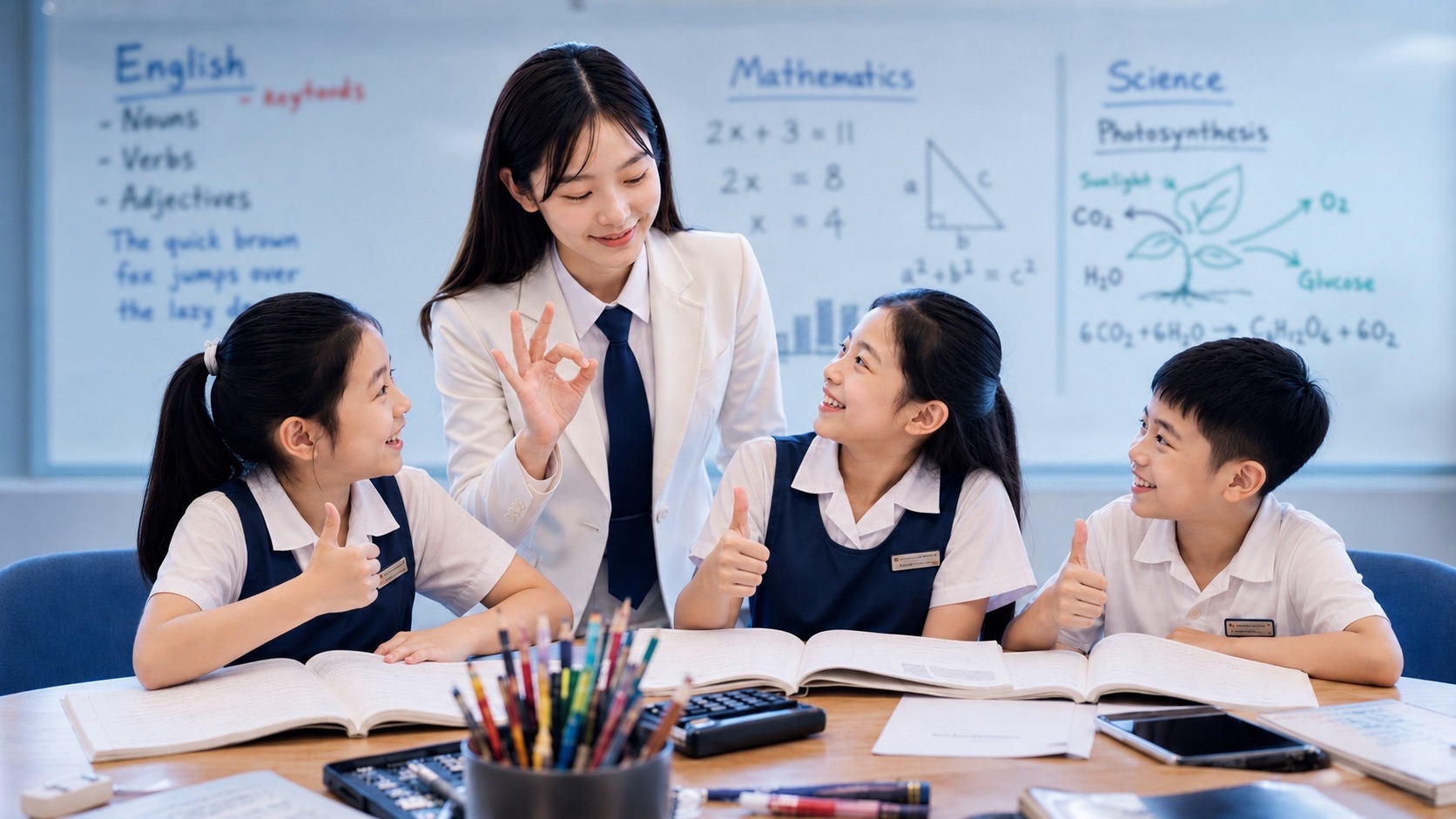
Inside Our Small-Group Primary 3 Mathematics Tutorials
Primary 3 Mathematics is a quiet turning point.
At Primary 1 and Primary 2, many children are still learning the basic language of numbers.
They count.
They add.
They subtract.
They learn simple multiplication.
They meet money, time, shapes, length, mass and picture graphs.
Then Primary 3 arrives.
Suddenly, Mathematics becomes larger.
Numbers become bigger.
Questions become longer.
Problem sums require more thinking.
Multiplication and division need more control.
Fractions become more serious.
Geometry starts to appear with lines, angles, area and perimeter.
Bar graphs ask students to read information carefully.
For some children, Primary 3 feels exciting.
For others, it feels like the subject has quietly changed its rules.
This is the year when parents may begin to notice small signs.
Homework takes longer.
Mistakes keep repeating.
The child knows the method in class but forgets it at home.
The answer is close, but not quite right.
The problem sum looks familiar, but the child does not know where to begin.
These are not signs that a child is weak.
They are signs that the foundations are being tested.
At eduKate Punggol, our Primary 3 Mathematics small-group tutorials help students build those foundations properly, before the pressure becomes heavier in Primary 4, Primary 5 and PSLE preparation.
Because Primary 3 is not just another school year.
It is where a child begins to learn how Mathematics works.
What problem are parents facing with Primary Mathematics?
Parents often see the symptoms first: homework takes too long, marks fall, confidence drops, or PSLE feels too close. Select your child’s level and the closest parent concern. This guide helps show what may be happening underneath, and how eduKate Punggol Mathematics tuition can help from Primary 1 to PSLE.
This is a parent clarity map. It helps separate emotion from evidence, so the next step is not panic, blame or more random worksheets, but proper diagnosis and targeted repair.
Parent fog is common when the marks do not explain the real problem.
At Primary 5, parents may see the marks falling but not know whether the cause is fractions, ratio, word problems, careless mistakes, timing, confidence or exam technique.
The child studies, but the result does not move. The mistakes look different each time, so it is hard to know what to fix first.
The visible score may be hiding several layers: weak concepts, poor working habits, weak word-problem translation, time pressure or low confidence.
We look at the child’s actual working, mistakes and topic gaps, then separate the problem into foundation repair, topic teaching, exam practice or confidence rebuilding.
Do not only ask for more papers. First find out where the marks are leaking, then repair that specific skill.
We help parents turn worry into a plan. Once the problem is visible, the child can be taught, corrected, practised and guided towards stronger Mathematics performance.
Why Primary 3 Mathematics Matters
Primary 3 Mathematics is important because it sits between early arithmetic and upper primary problem-solving.
This is the year where children begin moving from “doing sums” to “understanding structure.”
They are no longer only asked to calculate.
They must read.
They must compare.
They must choose the correct operation.
They must understand what the question is asking.
They must organise their working.
They must explain their thinking through numbers, diagrams, models and steps.
That is a big jump for a young child.
A child may know how to multiply.
But can the child tell when multiplication is needed?
A child may know how to divide.
But can the child understand division when there is a remainder?
A child may know what a fraction looks like.
But can the child compare parts, understand equal shares, and apply fractions inside a word problem?
A child may know how to find an answer.
But can the child show the working clearly enough to avoid losing marks?
This is where good tuition helps.
Not by rushing the child forward.
But by slowing the thinking down until the child can see what is happening.
At eduKate Punggol, we help Primary 3 students understand the “why” behind the method.
That matters because children who only memorise steps often panic when the question changes.
Children who understand the idea can adapt.
Inside Our Small-Group Primary 3 Mathematics Tutorials
Our small-group tutorials are designed to give each child enough attention, enough practice and enough correction.
Primary 3 students are still young.
They need structure.
They need patience.
They need encouragement.
They need someone to notice the small mistake before it becomes a long-term habit.
In a large class, a child can stay quiet.
They may copy the answer.
They may nod even when they do not understand.
They may hide behind the faster students.
They may leave the lesson with the same confusion they had at the start.
Small groups make the learning more visible.
The tutor can see how the child starts a question.
The tutor can see whether the child understands place value, multiplication, division, fractions, units, measurement, geometry and problem sums.
The tutor can see whether the mistake is careless, conceptual, procedural or caused by weak reading.
That difference matters.
A careless mistake needs one kind of correction.
A concept gap needs another.
A child who misreads the question needs help with comprehension.
A child who has weak multiplication tables needs fluency training.
A child who does not know how to start problem sums needs modelling and step-by-step structure.
Good teaching begins when the real problem is found.
We Teach, Practise, Correct and Consolidate
Primary 3 Mathematics cannot be taught properly by simply giving more worksheets.
Worksheets are useful.
But worksheets without clear teaching can become a machine that repeats confusion.
The child does more work, but the same mistakes return.
That is why our tutorials follow a clearer learning loop.
First, we teach the concept.
The child must understand what the topic means.
Then we show worked examples.
The child must see how the idea appears in actual questions.
Then the child practises.
This is where the thinking becomes active.
Then we correct.
We do not only mark the answer right or wrong.
We look at the working.
We ask where the mistake happened.
Was the number copied wrongly?
Was the operation chosen wrongly?
Was the model drawn wrongly?
Was the unit forgotten?
Was the question misunderstood?
Was the method memorised but not understood?
Then we consolidate.
The child tries again with better control.
This loop is important.
Teach.
Practise.
Correct.
Consolidate.
That is how children improve.
Not through panic.
Not through guessing.
Not through doing ten pages without knowing why.
But through proper instruction.
The Big Primary 3 Mathematics Jump
Many parents underestimate the Primary 3 jump because the child is still far from PSLE.
But Primary 3 is where many future PSLE habits begin.
If a child learns to show working clearly now, that habit helps later.
If a child learns to read word problems carefully now, that habit helps later.
If a child learns to check units now, that habit helps later.
If a child learns multiplication and division properly now, that fluency helps later.
If a child learns to draw models properly now, that thinking helps later.
If a child learns that mistakes can be corrected calmly now, that confidence helps later.
This is why Primary 3 tuition should not be treated as emergency repair only.
It should be treated as early construction.
The stronger the foundation, the easier the upper levels become.
A child who is properly guided in Primary 3 is less likely to feel overwhelmed when Primary 4 topics become deeper.
They are also better prepared for Primary 5, where Mathematics begins to feel more demanding and PSLE preparation becomes more visible.
Education works best when we build before the storm.
Problem Sums: Where Many Children Get Stuck
For many Primary 3 students, the biggest struggle is not calculation.
It is problem sums.
They can add.
They can subtract.
They can multiply.
They can divide.
But when the question becomes a story, they freeze.
This happens because problem sums require several skills at the same time.
The child must read the question.
Understand the situation.
Identify the unknown.
Choose the correct operation.
Organise the numbers.
Decide whether to use a model.
Carry out the calculation.
Check whether the answer makes sense.
That is a lot for a young learner.
At eduKate Punggol, we teach students how to break problem sums down.
We train them to slow down and ask:
What is the question asking?
What information is given?
What do I need to find?
Which numbers are connected?
Should I add, subtract, multiply or divide?
Can I draw a model?
Does my answer make sense?
This is not only Mathematics.
This is thinking training.
A child who learns to break down a Mathematics problem is also learning how to break down difficulty in life.
That is the larger value of good education.
Building Number Sense
Number sense is the child’s feeling for how numbers behave.
It is not just memorising facts.
It is understanding size, value, order, patterns and relationships.
A child with good number sense can tell whether an answer is reasonable.
A child with weak number sense may write any answer as long as the calculation seems complete.
For Primary 3 students, number sense becomes more important because numbers are larger and operations become more varied.
They must understand place value.
They must compare numbers.
They must multiply and divide more confidently.
They must work with units.
They must handle money, measurement and fractions.
We help students build number sense through guided questions, mental calculation, estimation, correction and repeated exposure to different question types.
The goal is not just to get one worksheet correct.
The goal is to help the child become more comfortable with numbers.
When a child becomes comfortable with numbers, Mathematics becomes less frightening.
Confidence Is Built Through Clarity
Many children lose confidence in Mathematics because they do not know why they are wrong.
They try.
They get corrected.
They try again.
They get corrected again.
After a while, they begin to think, “I am just bad at Maths.”
That is a painful sentence.
And it is often untrue.
A child may not be bad at Mathematics.
The child may simply have missed an earlier idea.
The child may need a clearer explanation.
The child may need more practice with a certain method.
The child may need someone to show them how to read the question properly.
Confidence does not come from empty praise.
It comes from clarity.
When a child finally understands a topic, the body relaxes.
The pencil moves more steadily.
The child starts faster.
The mistakes reduce.
The child becomes willing to try.
That is the confidence we want.
Not loud confidence.
Not fake confidence.
Real confidence.
The kind that comes from knowing what to do next.
Why Small Groups Help Primary 3 Students
Primary 3 students are old enough to think independently, but still young enough to need close guidance.
They need a learning environment where questions are safe.
They need to feel that it is acceptable to make mistakes.
They need enough attention from the tutor.
They also benefit from seeing other students learn.
In a small group, a child realises something important.
“I am not the only one who finds this hard.”
That reduces shame.
Another student’s question may help them understand.
Another student’s mistake may teach them what to avoid.
Another student’s correct method may show them a better way.
Small groups create a good balance.
There is personal attention.
There is peer learning.
There is enough space to speak.
There is enough structure to stay focused.
At eduKate Punggol, we keep our tutorials purposeful, warm and guided.
Students are not left alone with confusion.
They are taught, watched, corrected and encouraged.
What We Help Primary 3 Mathematics Students With
In our Primary 3 Mathematics tutorials, we help students strengthen the skills they need for school and future examination readiness.
We help with number work.
Students learn to handle larger numbers, place value, operations, multiplication, division and calculation accuracy.
We help with fractions.
Students learn to understand parts, wholes, equal sharing and comparison instead of treating fractions as mysterious symbols.
We help with word problems.
Students learn to read carefully, identify the question demand and choose the right strategy.
We help with model drawing.
Students learn to represent information visually so that problem sums become clearer.
We help with geometry and measurement.
Students learn to understand lines, angles, shapes, area, perimeter and units with better precision.
We help with data handling.
Students learn to read charts and graphs carefully, extract information and answer accurately.
We help with working habits.
Students learn to write clearly, align numbers properly, check units and avoid careless loss of marks.
We help with confidence.
Students learn that Mathematics can be understood when it is explained properly.
The Parent’s Problem: “My Child Understands in Class, But Cannot Do It Alone”
This is one of the most common concerns.
The child seems to understand when the teacher explains.
But later, during homework or revision, the child cannot start.
This usually means the child has recognition, but not independence.
They can follow when someone leads.
But they cannot yet reproduce the thinking alone.
That is normal.
It also needs training.
In our tutorials, we help students move from watching to doing.
We do not want students to become dependent on explanations forever.
We want them to gradually develop independence.
So we guide them through examples, then let them attempt questions, then correct their process, then make them try again.
Over time, the child begins to internalise the steps.
They learn how to start.
That is a major breakthrough.
Because in Mathematics, starting correctly is half the battle.
The Parent’s Problem: “My Child Is Careless”
Carelessness is real.
But it is often not random.
Sometimes “careless” means the child is rushing.
Sometimes it means the child has weak working habits.
Sometimes it means the child is overloaded and cannot track all the steps.
Sometimes it means the child does not understand the concept deeply enough, so the brain is spending too much energy just trying to survive the question.
We help students reduce careless mistakes by teaching better habits.
Write the working clearly.
Copy numbers carefully.
Check the operation.
Underline key information.
Use units.
Estimate the answer.
Review the final line.
These habits may sound simple.
But simple habits, repeated consistently, protect marks.
A child’s future improvement often begins with small corrections like these.
The Parent’s Problem: “My Child Is Losing Interest”
When a child keeps feeling lost, interest fades.
This is not surprising.
Nobody enjoys feeling confused every week.
A child who says “Maths is boring” may actually mean “Maths makes me feel unsuccessful.”
That is why rebuilding interest often begins with rebuilding success.
Give the child a question they can understand.
Show them the method.
Let them try.
Correct the mistake gently.
Let them get it right.
Repeat.
Slowly, the child begins to feel that Mathematics is not an enemy.
It is a system.
And systems can be learned.
At eduKate Punggol, we want students to feel that improvement is possible.
Because once a child believes improvement is possible, effort becomes easier.
Primary 3 Mathematics and the Bigger Future
It is easy to think of Primary 3 Mathematics as only schoolwork.
But Mathematics trains more than calculation.
It trains attention.
It trains accuracy.
It trains patience.
It trains problem-solving.
It trains a child to hold information in the mind and work through it carefully.
These are civilisation skills.
A better world is not built by magic.
It is built by people who can think clearly, solve problems, communicate properly and keep improving.
That begins early.
It begins when a child learns not to give up at the first difficult question.
It begins when a tutor explains something clearly enough for confusion to turn into understanding.
It begins when a parent decides that a small problem should be corrected before it becomes a large one.
Education is one of the ways families build the future.
Not all at once.
Not dramatically.
But lesson by lesson.
Correction by correction.
Habit by habit.
How can eduKate help your child from Primary 1 to PSLE Mathematics?
Primary Mathematics is not only about doing more worksheets. A child needs the right foundation, the right correction, the right problem-solving method and the right examination habits. Select your child’s level and the type of help needed to see how eduKate Punggol Mathematics tuition supports the learning journey from Primary 1 to PSLE.
We first look at the child’s actual working, topic gaps, habits and examination behaviour. Then we decide whether the child needs rebuilding, catching up, keeping up, stretching or PSLE execution training.
eduKate builds the Mathematics foundation before the child is overloaded.
At Primary 5, foundation gaps become more visible because ratio, percentage, speed, volume, algebra and complex word problems depend on earlier skills. eduKate helps by finding the weak layer and rebuilding it before PSLE pressure becomes heavier.
We check number sense, operations, fractions, problem-solving steps, working layout and whether the child understands the method or only memorises it.
We teach the topic clearly from concept to method, then move into guided examples, independent practice and correction.
The student begins to see Mathematics as a route: read the question, identify the structure, choose the method, show working and check the answer.
Parents get a clearer picture of whether the child needs foundation repair, exam practice, confidence rebuilding or higher-level challenge.
We help students catch up, keep up and move ahead. The goal is not to throw more work at the child blindly, but to make the missing skill visible, repair it, practise it and turn it into stronger marks.
Come to Our Punggol Tuition If Primary 3 Mathematics Is Becoming Difficult
If your child is struggling with Primary 3 Mathematics, do not panic.
The problem can usually be made visible.
Maybe the child needs stronger multiplication fluency.
Maybe the child needs clearer fraction understanding.
Maybe the child needs help with word problems.
Maybe the child needs better working habits.
Maybe the child needs a patient tutor to explain concepts in a way that finally makes sense.
That is what our small-group Primary 3 Mathematics tutorials are for.
At eduKate Punggol, we help students catch up where they are weak, keep up with school expectations, and move ahead when they are ready.
We teach clearly.
We practise carefully.
We correct patiently.
We help children build the confidence to face Mathematics with more control.
Because Primary 3 is a good time to strengthen the foundation.
It is early enough to repair.
Early enough to build.
Early enough to help a child discover that Mathematics is not something to fear.
It is something they can learn.
And when a child learns properly, the future becomes brighter.
One clear explanation at a time.
Excelling in Primary 3 Math: Inside Punggol Tuition Classes Near Punggol MRT
- Warm-Up Retrieval for Number Mastery in Punggol Tuition Primary 3 Mathematics: Our Punggol Tuition Primary 3 Mathematics classes, conveniently located just a 5-minute walk from Punggol MRT, kick off with quick-fire quizzes on whole numbers up to 10,000 and multiplication tables up to 9×9, drawing from the MOE Primary 3 Mathematics Syllabus to reinforce place value and patterns—ensuring kids build confidence in basic operations right from the start.
- Hands-On Concrete Activities in Punggol Tuition Primary 3 Mathematics: In our small-group Punggol Tuition Primary 3 Mathematics sessions near Punggol MRT, students use manipulatives like base-10 blocks for addition and subtraction within 10,000, following the Concrete-Pictorial-Abstract approach recommended for Singapore math—helping over 80% grasp fractions and money concepts through tactile learning.
- Model Drawing for Word Problems in Punggol Tuition Primary 3 Mathematics: We dedicate time in Punggol Tuition Primary 3 Mathematics to bar modeling for multiplication and division word problems, such as sharing scenarios up to 1,000, aligned with Jimmy Maths P3 Syllabus Guide—a proven strategy that boosts problem-solving accuracy by visualizing relationships early.
- Timed Drills on Measurement in Punggol Tuition Primary 3 Mathematics: Near Punggol MRT, our Punggol Tuition Primary 3 Mathematics classes feature 20-minute drills on length, area, and perimeter using everyday items like rulers and grids, per the updated 2025 MOE curriculum—fostering mental math speed for real-world applications.
- Geometry Exploration with Shapes in Punggol Tuition Primary 3 Mathematics: Students in Punggol Tuition Primary 3 Mathematics rotate through angle hunts and shape classifications at our centre steps from Punggol MRT, incorporating Practicle’s P3 Geometry Tips to develop spatial reasoning—key for turning and symmetry questions in school assessments.
- Bar Graph Basics and Data Handling in Punggol Tuition Primary 3 Mathematics: Our Punggol Tuition Primary 3 Mathematics program introduces statistics through hands-on surveys and simple bar graphs, mirroring MOE strands on picture graphs, as outlined in Geniebook’s P3 Math Overview—enhancing analytical skills with group discussions for better retention.
- Error Analysis and Micro-Feedback in Punggol Tuition Primary 3 Mathematics: Ending each class near Punggol MRT, Punggol Tuition Primary 3 Mathematics focuses on logging mistakes in fraction partitioning or volume calculations, with personalized WhatsApp tips—drawing from best practices in Snapask Academy’s P3 Guide to target weaknesses swiftly.
- Interleaved Practice for Mixed Topics in Punggol Tuition Primary 3 Mathematics: At our accessible Punggol Tuition Primary 3 Mathematics spot by Punggol MRT, we mix topics like division within 1,000 and money problems in weekly sheets, using IXL’s Singapore P3 Standards to promote flexible thinking and exam readiness.
- Parental Involvement Tips from Punggol Tuition Primary 3 Mathematics: We share home extension activities in Punggol Tuition Primary 3 Mathematics, like kitchen measurements for perimeter practice, inspired by MuscleMath’s 2025 Syllabus Insights—empowering families near Punggol MRT to reinforce learning beyond class.
- Trackable Progress in Punggol Tuition Primary 3 Mathematics: Parents see measurable gains in Punggol Tuition Primary 3 Mathematics within 4 weeks, with before-after benchmarks on topics like long division, as supported by BigMath’s P3 Syllabus Breakdown—our MOE-aligned methods at the Punggol MRT-adjacent centre drive AL4+ results consistently.
Contact us for our latest schedule

Primary 3 Mathematics Tuition in Punggol: Building Strong Foundations for Future Success
At eduKate Singapore, we understand that Primary 3 Mathematics marks a crucial turning point for every child. It’s the year when Punggol Tuition Primary 3 Mathematics students transition from basic numeracy into more complex mathematical reasoning — a step that often determines their confidence for the upper primary levels.
Located conveniently near Punggol MRT, our Math Tuition in Punggol provides an engaging and structured environment where young learners master key mathematical concepts while enjoying the process of discovery. Our team of experienced Math Tutors nurture each child’s logical thinking, problem-solving ability, and perseverance, ensuring they are ready for the challenges of Primary 4 and beyond.
Why Primary 3 Mathematics Matters
By Primary 3, Punggol Tuition Mathematics students are expected to go beyond rote calculation and begin applying mathematical reasoning in unfamiliar contexts. Concepts such as multiplication, division, fractions, and measurement form the backbone for future topics like decimals, area, and algebraic reasoning.
At this stage, students also encounter word problems that require multiple steps, logical sequencing, and understanding of relationships between numbers — skills that are tested heavily in Primary 4–6 and ultimately in the PSLE.
A strong foundation at this level ensures your child doesn’t just memorise formulas but truly understands how numbers work.
Our Approach at eduKate Punggol
At eduKate Punggol, we combine MOE-aligned curriculum with a personalised teaching methodology that helps students grasp mathematical concepts deeply and confidently.
1. Small Group Classes (3 Pax Focus Learning)
Each Punggol Tuition Mathematics class is intentionally kept small — a maximum of three students per group — so that every learner receives individual attention from our Punggol Math Tutor. This intimate setting allows tutors to identify gaps early and tailor lessons to match your child’s learning pace.
2. Conceptual Understanding Before Practice
We teach Punggol Tuition Mathematics students to understand before memorising. For instance, when learning multiplication, our tutors use visual models and number stories to help children see patterns before introducing multiplication tables.
3. Step-by-Step Problem Solving
Our Math Tuition in Punggol uses the Fencing Method, where students start from simple, familiar examples and progressively “fence in” more challenging variations. This technique builds confidence and encourages consistent improvement without fear of failure.
4. Integration of Real-Life Applications
We connect classroom learning to real-world examples — from calculating time during sports activities to understanding money in daily purchases. This keeps lessons engaging and meaningful.
5. Encouraging Independent Thinking
Every child is encouraged to explain their reasoning process. By “teaching back” what they’ve learned, students reinforce memory and develop communication skills vital for problem-solving in examinations.
What We Cover in Primary 3 Mathematics
Our Punggol Math Tuition Centre covers every topic prescribed in the MOE Primary 3 Mathematics Syllabus, ensuring students are confident in each core area before progressing.
Core Topics
| Topic | Skills Developed | Example Focus Areas |
|---|---|---|
| Whole Numbers | Place value, estimation, mental calculation | Word problems with 4 operations |
| Multiplication & Division | Conceptual understanding, times tables mastery | Real-life contextual questions |
| Fractions | Comparing, simplifying, and representing fractions | Fraction of a set |
| Measurement | Length, mass, volume, time | Application to daily life |
| Geometry | Identifying and classifying shapes | Symmetry and patterns |
| Graphs & Data | Reading and interpreting bar graphs | Data representation |
| Problem Solving | Logical sequencing and reasoning | Multi-step contextual problems |
We blend MOE-approved materials with Math-exclusive worksheets, designed to sharpen thinking and encourage higher-order reasoning.
How Our Math Tutors Make the Difference
Our Punggol Math Tutors are not only highly experienced but also patient educators who understand the psychology of young learners. They emphasise growth mindset, encouraging children to see mistakes as opportunities to learn rather than failures.
Each Punggol Tuition Mathematics tutor continuously monitors your child’s progress, adjusting the pace and difficulty of lessons to ensure steady improvement. Parents receive regular feedback on strengths, weaknesses, and actionable strategies for home reinforcement.
“Our goal is to build mathematicians who think logically, learn joyfully, and approach problems with confidence.” — eduKate Punggol Tutor Team
Location Advantage: Near Punggol MRT
Our Math Tuition Centre in Punggol is strategically located near Punggol MRT and Waterway Point, making it easily accessible for families in the area. The centre’s peaceful, modern classrooms provide a safe and comfortable learning environment conducive to focused study.
Parents can conveniently drop off and pick up their children, and our flexible scheduling options allow for after-school or weekend lessons to fit busy family routines.
Benefits of Joining eduKate Punggol’s Math Tuition
✅ Personalised Attention
Small-group sessions ensure your child receives undivided focus.
✅ Consistent Progress Tracking
Regular assessments highlight growth areas and reinforce strengths.
✅ Confidence-Building Teaching Style
We celebrate small wins, motivating students to push forward step by step.
✅ MOE-Aligned and Future-Ready
Lessons reflect the current MOE curriculum while preparing students for upcoming levels and real-life problem-solving.
✅ Supportive Community
Our tutors, students, and parents form a tight-knit community. Queries and support continue beyond class hours via WhatsApp or SMS.
Why Parents Choose eduKate Punggol
- Experienced Tutors: Over two decades of experience teaching MOE Mathematics.
- Proven Results: Students consistently improve by one to two grades within a semester.
- Structured Curriculum: Every topic builds upon previously learned concepts for seamless progression.
- Holistic Learning Environment: Encourages curiosity, discipline, and creativity in problem-solving.
The Transition to Upper Primary
Primary 3 is the foundation year for later mathematical complexity. By building mastery in this stage, students can handle fractions, long division, and word problems more confidently when they progress to Primary 4 and beyond.
Our Math Tutors in Punggol prepare students not only to excel in tests but also to think critically and solve problems independently — qualities that define successful learners in Singapore’s education system.
What Parents Say
“My son used to dread Math, but after joining eduKate Punggol near Punggol MRT, he now looks forward to every class. His confidence grew so much that he scored full marks in his SA2!”
— Mrs. Tan, parent of Primary 3 student, Edgefield Primary“The small group size and friendly tutors make a big difference. My daughter learns faster here than in large classes.”
— Mr. Lim, Punggol resident
Preparing for the Future: From Primary 3 to PSLE
Every concept introduced in Primary 3 — from multiplication patterns to simple fractions — forms the scaffolding for PSLE Mathematics. Our Math Tuition in Punggol ensures that no gaps remain. Students are trained to reason, justify their steps, and approach exams with confidence.
By the time they reach Primary 6, they are already familiar with exam-style problems, time management, and strategic thinking.
Join Our Punggol Math Tuition Classes Today
Give your child the advantage of learning with passionate, experienced educators who care deeply about their progress.
To learn more about our programmes or schedule a consultation, visit eduKate Punggol or explore eduKate Singapore for resources and updates.
📍 Location: Punggol MRT vicinity
📞 Contact: Contact us here
Final Thoughts
At eduKate Punggol, we believe every child can be great at Mathematics when guided with patience, expertise, and encouragement. Our Primary 3 Math Tuition in Punggol is designed to spark curiosity, nurture discipline, and inspire excellence.
By learning in small groups with expert tutors, your child develops not just numeracy — but confidence, focus, and joy in learning.
Start early. Build strong foundations. Watch your child grow with eduKate Punggol — your trusted Math Tutor near Punggol MRT.
Internal Links:
