
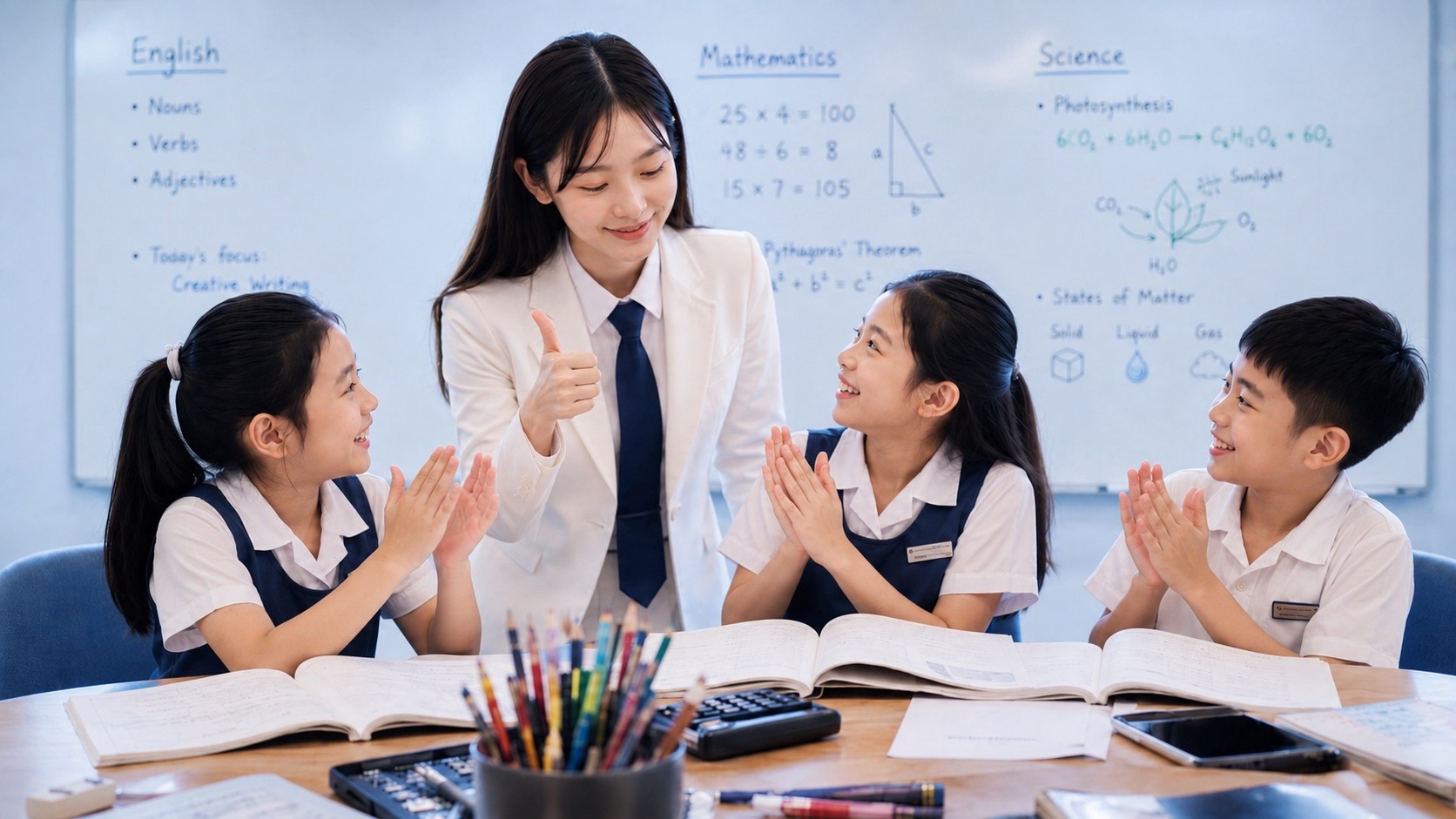
Primary 6 Mathematics Tuition in Punggol: ratio, algebra, percentage, speed, circles, average and PSLE readiness
Primary 6 Mathematics Tuition | Punggol serves families searching for P6 Math tuition, Primary 6 Maths tuition, a Primary 6 Mathematics tutor in Punggol, small-group lessons, MOE-aligned teaching, model drawing, heuristics, timed practice, exam strategies and PSLE Mathematics preparation. Current Singapore and Punggol tuition pages frequently use this language because the final primary year has two linked jobs: complete and stabilise the P6 curriculum, then convert six years of Mathematics into reliable performance under examination conditions.
Under Singapore’s current Primary Mathematics syllabus, Primary 6 standard Mathematics includes ratio, algebra, percentage increase and decrease, speed, circles, average and the integration of earlier whole-number, fraction, decimal, rate, geometry, measurement, data and problem-solving skills. The curriculum therefore becomes difficult less because every topic is new and more because the student must recognise which relationship matters when several topics appear together.
This page is the Punggol local-discovery owner for Primary 6 Mathematics. Punggol describes the student’s origin and search context; it is not a claim that eduKateSG operates a physical branch in Punggol. Families can use the Punggol Mathematics Tuition gateway for the broader local route and the Mathematics Learning Hub for the complete Primary, PSLE, Secondary and Additional Mathematics architecture.
Primary 6 has three simultaneous Mathematics jobs: finish, repair and convert
The first job is to learn the final-year content properly. Ratio, algebra, percentage change, speed, circles and average each introduce relationships that must be understood rather than memorised as isolated templates. The second job is to repair earlier dependencies that become visible under heavier load. The third job is to make the knowledge usable in mixed, timed and less predictable questions.
These jobs should not be confused. A student who does not understand ratio needs concept teaching. A student who understands ratio but cannot recognise it when the story changes needs transfer practice. A student who recognises the structure but makes arithmetic slips needs execution repair. A student who solves accurately but takes too long needs fluency and pacing. The same wrong final answer can therefore imply very different next lessons.
Ratio, fractions and percentage form one proportional reasoning network
Ratio becomes more stable when it is connected to earlier fraction and multiplicative thinking. Students need to identify what the ratio compares, what one unit represents, whether a total or a difference is known, and which relationship stays constant after a change. A ratio written correctly is not yet a solution; the child must understand the quantities attached to its terms.
Percentage increase and decrease bring another layer: the original quantity is the reference base. Students who identify the wrong 100% quantity can perform flawless arithmetic and still answer the wrong question. The habit of naming the base before calculation protects later steps and makes reverse-percentage reasoning less mysterious.
Fraction, ratio and percentage questions often look like separate chapters, but they repeatedly ask the same deeper questions: what is the whole, what are the parts, what is one unit, what changed, and what remained invariant? Teaching those questions creates a reusable system rather than a pile of tricks.
Algebra at Primary 6: preserve equality and make the unknown inspectable
Primary 6 algebra introduces a more symbolic way to express relationships students have already encountered through arithmetic and models. The central discipline is equality. An equation states that two expressions represent the same quantity. Every transformation must preserve that equality.
Students should connect symbols to quantities rather than treat letters as mysterious objects. A bar model and an equation can sometimes describe the same relationship. Moving between them helps students understand why an algebraic manipulation is valid and prepares the transition to Secondary 1 Mathematics, where symbolic representation becomes much more prominent.
Speed: units reveal the relationship
Speed problems become more reliable when the student reads the units as Mathematics. Kilometres per hour links a distance quantity to a time quantity. The learner should know which two quantities are given, which is unknown, whether unit conversion is required and whether the answer’s magnitude is plausible.
A memorised triangle diagram can help recall relationships, but it should not replace meaning. If the student can explain what “per hour” means, why distance grows when speed and time are fixed in particular ways, and how units transform, the method is more likely to survive an unfamiliar context.
Circles and average: formulas are useful only when the quantities are identified correctly
Circle work asks students to distinguish radius, diameter, circumference and area, then recognise whether a full circle, semicircle, quarter circle or composite shape is being used. A correct formula applied to the wrong component remains a wrong solution. Labelling the diagram and marking the relevant lengths can therefore be more valuable than trying to calculate mentally.
Average likewise has structure. It compresses a total across a number of equalised units. Students should understand the relationship among total, number of items and average rather than remember a single division rule. This makes reverse and changed-average questions more tractable because the total can be reconstructed and compared.
Eight resident learners: one P6 score can hide eight different bottlenecks
Adrian is quick but rushes the first reading, so his intervention is a controlled question-entry routine before calculation. Jo can calculate accurately but sometimes cannot choose the first representation in a long problem, so she needs a smaller first-step protocol. Ben understands methods yet loses marks to arithmetic slips, so fluency and checking must accompany concept work.
Aisha performs strongly on familiar patterns but needs unfamiliar mixed questions to strengthen transfer. Ryan compresses working and hides useful intermediate values, so he needs method visibility. Mira is conceptually sound but loses units or trusts an entered calculator expression too quickly, so she needs unit and magnitude checks.
Clara overchecks routine work and therefore needs a stop rule after one relevant verification. Ethan can become trapped by a difficult question because moving on feels like giving up, so he needs a skip-and-return protocol. None of these students benefits most from being told merely to “do more papers.” Each needs the mechanism behind the lost marks addressed.
Mixed practice should become increasingly diagnostic in the final year
Early in Primary 6, focused topic practice still has an important role because new concepts are being built. As the year progresses, the training should become increasingly mixed. The student must choose among ratio, algebra, percentage, speed, geometry, data and earlier concepts without a chapter label announcing the method.
Every mixed set can be analysed by error category: concept, reading, representation, operation choice, arithmetic, working, unit, checking, timing or recovery. This creates a more useful revision dashboard than a single percentage score. A rising score is welcome, but the deeper goal is for recurring error categories to shrink.
Primary 6 and the revised 2026 PSLE Mathematics environment
PSLE Mathematics in 2026 uses the revised examination format described by the Singapore Examinations and Assessment Board. Students sit Paper 1 without a calculator and Paper 2 with a calculator. This means the same Mathematics system has to operate in two execution environments: one places a premium on fluent non-calculator work, while the other still requires careful entry, estimation, method visibility and checking even when a calculator is available.
The examination-specific details belong to the separate PSLE Mathematics Tuition | Punggol owner. The Primary 6 page remains broader: it covers curriculum completion, prerequisite repair, mixed revision, examination readiness and the bridge into Secondary Mathematics.
For Punggol families, convenience should be compared with the child’s specific learning need
Punggol has a dense local tuition ecosystem around residential and transport nodes, and that convenience has real value during a demanding final year. A shorter journey can preserve energy, homework time and attendance consistency. A nearby programme that fits the child well can therefore be the right decision.
The useful comparison is what the programme does with evidence. If the child is weak in ratio meaning, can the tutor identify that before assigning another full paper? If Paper 1 is slow, is fluency trained separately from concept repair? If long Paper 2 solutions collapse halfway through, is the child taught to label intermediate states and recover? If careless errors repeat, are they classified into specific causes?
eduKateSG uses Punggol here as a discovery context, not a physical-branch claim. Families can weigh convenience, travel, lesson size, tutor continuity and instructional resolution honestly. The strongest choice is the one that changes the student’s actual bottleneck.
A practical P6 weekly cycle: retrieval, current content, mixed selection, error repair and timed execution
A productive week can begin with cumulative retrieval of high-traffic skills, followed by current P6 content and guided examples. Mixed questions then test whether the child can select the method independently. The tutor traces one or two authentic mistakes to the first wrong decision, then assigns a targeted repair rather than an indiscriminate volume increase.
Timed work should be introduced with a purpose. Short non-calculator sets can build Paper 1 fluency. Structured problems can train working and recovery. Calculator tasks can include estimation before entry and magnitude checks afterward. The aim is to make correct Mathematics repeatable under the constraints of the paper.
After PSLE: translate Primary Mathematics into Secondary algebra instead of treating it as a finished subject
Primary 6 should leave the student with more than an examination score. Ratio relationships, model drawing, equality, units, organised working and error checking all have Secondary Mathematics counterparts. A strong transition explicitly shows how concrete and diagrammatic reasoning becomes more symbolic.
A student who learns to preserve equality, label quantities, check magnitude and expose intermediate steps enters Secondary 1 with useful mathematical habits even when the notation becomes more abstract. This makes the PSLE year a bridge, not an endpoint.
Continue the coordinated Punggol Mathematics route
Review Primary 5 Mathematics Tuition | Punggol, continue to PSLE Mathematics Tuition | Punggol for the examination-conversion layer, and return to the Mathematics Learning Hub for the wider subject map.
Helping Primary 6 Students Build Calm, Clear Mathematical Strength for PSLE
Primary 6 Mathematics is not just another year of schoolwork.
It is the year where everything comes together.
Fractions, decimals, percentages, ratio, speed, geometry, area, volume, data, algebra, heuristics and word problems all begin to meet inside one examination journey.
For some children, this feels exciting.
For others, it feels heavy.
The questions become longer.
The wording becomes trickier.
The steps become less obvious.
The marks begin to depend not only on knowing the method, but on choosing the right method, showing clear working and staying calm when the question looks unfamiliar.
That is why Primary 6 Mathematics is such an important year.
It is not only about PSLE marks.
It is about helping a child learn how to think clearly under pressure.
At eduKate Punggol, our Primary 6 Mathematics tuition helps students catch up, keep up and move ahead. We teach clearly, correct carefully and guide students step by step so that Mathematics becomes less frightening and more manageable.
Because when a child understands Mathematics properly, confidence returns.
And when confidence returns, progress becomes possible again.
How can parents detect PSLE Mathematics problems before the paper arrives?
PSLE Mathematics is a short examination year. By the time Oral begins in August, the PSLE season has already started. For 2026, Mathematics Paper 1 and Paper 2 are scheduled on 25 September. Parents should detect early whether the child is losing marks from concepts, problem sums, careless mistakes, timing, calculator use, non-calculator fluency or Paper 2 reasoning.
PSLE Mathematics is not only “do more papers.” Parents need to know where the marks are leaking: concept, calculation, model, heuristic, working, careless mistake, timing or exam strategy.
Paper 1 detects accuracy, fluency and non-calculator control.
By May to June, parents should check whether the child can protect Paper 1 marks. Paper 1 has no calculator, so it reveals number fluency, fraction control, mental calculation, short-answer accuracy and careful reading.
Give a short non-calculator set and check whether the child loses marks from arithmetic slips, misreading, weak fractions, poor estimation or incomplete short answers.
The child may understand some topics but lack speed, accuracy and control when the calculator is removed.
Do not only mark right or wrong. Sort the mistake: concept, calculation, careless, working layout, unit or question-reading error.
We train non-calculator fluency, topic correction, Paper 1 accuracy, checking habits and fast recognition of common PSLE traps.
We turn Mathematics from random practice into visible repair. The child learns to read the question, identify the structure, choose the method, show working, check the answer and protect marks under timing.
PSLE Mathematics Terrain Map: What the child is carrying into the examination
Paper 1 has Booklet A multiple-choice questions and Booklet B short-answer questions. It tests accuracy, arithmetic fluency, short-answer discipline and careful reading without calculator support.
Paper 2 includes short-answer and structured or long-answer questions. Students must show working clearly, choose suitable methods and manage longer problem-solving routes.
Whole numbers, fractions, decimals, percentage, ratio, rate, algebra and unknowns. These topics form the engine for many PSLE problem sums.
Area, perimeter, volume, angles, circles, composite figures and geometric reasoning. Students must read diagrams carefully and justify each step.
Tables, graphs, pie charts and average questions test whether the child can read visual information, compare values and use data accurately.
Mathematics Paper 1 and Paper 2 are scheduled on 25 September. By August, Mathematics should already be in correction, timed-paper and final-readiness mode.
Primary 6 Mathematics Is a Year of Control
By Primary 6, most students have already learnt many mathematical topics.
But learning a topic once is not the same as controlling it.
A child may know what a fraction is, but struggle when fractions appear inside a ratio question.
A child may understand percentage, but get lost when percentage is combined with comparison, discount or increase-and-decrease wording.
A child may know the formula for area, but become confused when the figure is composite or hidden inside a word problem.
This is the real challenge of Primary 6 Mathematics.
It tests control.
Can the child read accurately?
Can the child identify what the question is asking?
Can the child choose the correct strategy?
Can the child show working clearly?
Can the child avoid careless mistakes?
Can the child check the answer?
Can the child stay calm when the question looks different from the one practised yesterday?
These are not small skills.
They are the machinery behind strong PSLE Mathematics performance.
Why Primary 6 Students Struggle With Mathematics
Many Primary 6 students do not struggle because they are lazy.
They struggle because the subject has become more connected.
Earlier weaknesses begin to surface.
A weak multiplication habit affects fractions.
A weak fraction foundation affects ratio.
Weak ratio affects percentage.
Weak reading affects word problems.
Weak model drawing affects comparison questions.
Weak working habits affect marks even when the child understands the topic.
This is why a student may spend many hours practising and still not improve quickly.
The problem is not always effort.
Sometimes, the problem is diagnosis.
Parents may see:
✓ long homework hours
✓ repeated careless mistakes
✓ panic during problem sums
✓ weak confidence
✓ difficulty starting questions
✓ confusion with ratio and percentage
✓ poor checking habits
✓ loss of marks despite knowing the topic
✓ slow working under time pressure
✓ fear before Mathematics papers
At eduKate Punggol, we help make the problem visible.
We look at where the marks are leaking.
Then we teach, correct and rebuild.
Good Primary 6 Mathematics Tuition Should Reduce Fog
A child who is confused does not need more noise.
A child who is panicking does not need more panic.
A child who is making repeated mistakes does not simply need more worksheets.
The child needs clarity.
Good Primary 6 Mathematics tuition should help the student see the subject more clearly.
What type of question is this?
What information is given?
What is missing?
Which method should be used?
Is this a model question, a ratio question, a percentage question, a geometry question, or a multi-step problem?
Where should the working begin?
What must be checked before moving on?
This is how a child starts to regain control.
Mathematics becomes less like guessing and more like navigation.
There is still work to do.
But now there is a path.
The eduKate Punggol Approach to Primary 6 Mathematics
At eduKate Punggol, our Primary 6 Mathematics tuition is built around clear explanation, close guidance and steady correction.
We help students strengthen the major areas needed for PSLE Mathematics, including:
✓ whole numbers
✓ fractions
✓ decimals
✓ percentages
✓ ratio
✓ rate and speed
✓ measurement
✓ area and perimeter
✓ volume
✓ geometry
✓ angles
✓ data interpretation
✓ algebra
✓ pattern questions
✓ model drawing
✓ problem-solving heuristics
✓ examination working
But topic coverage alone is not enough.
A student must also learn how to think through the question.
That is why we work on method selection, working discipline, question reading, step-by-step reasoning and careless mistake control.
The goal is not to make the child memorise blindly.
The goal is to help the child understand what to do, why it works and how to apply it when the question changes.
We Repair Foundations Before Chasing Marks
In Primary 6, there is a temptation to rush.
The PSLE feels close.
Parents are worried.
Students are under pressure.
Schools are moving quickly.
But rushing without repair can make the problem worse.
If a child is weak in fractions, more difficult ratio questions will not magically fix the weakness.
If a child cannot read the problem carefully, more problem sums may simply produce more frustration.
If the child’s working is messy, marks may continue to leak even when the method is almost correct.
That is why we believe in intelligent repair.
Sometimes, we need to go backwards to go forwards.
This is not a waste of time.
It is how strong learning is rebuilt.
A strong foundation makes the upper levels lighter.
A clear method makes practice more useful.
A corrected mistake becomes protection for the next paper.

Small Group Tuition Helps Students Be Seen
In a large class, a Primary 6 student can hide.
The student may nod.
The student may copy the solution.
The student may complete the worksheet.
But the misunderstanding may still remain.
This is dangerous in PSLE Mathematics because one hidden weakness can affect many topics.
In our small-group tutorials at eduKate Punggol, students can be guided more closely. Their working can be checked. Their mistakes can be noticed. Their questions can be answered. Their habits can be corrected before the examination pressure becomes heavier.
This matters because Mathematics improvement is often very specific.
One child may need help with ratio.
Another may need help with speed.
Another may understand concepts but lose marks through careless working.
Another may need help reading word problems.
Another may need confidence because the child freezes when the question is unfamiliar.
Small-group teaching allows us to see the child more clearly.
And when the child is seen clearly, the teaching becomes more useful.
Problem Sums Are Not Random
To many students, Primary 6 problem sums feel random.
One day, the question is about money.
The next day, it is about marbles.
Then it becomes water tanks, ribbons, distance, shaded areas, unknown numbers or percentage changes.
But underneath the story, there is structure.
A good Mathematics tutor helps the child see that structure.
The question may look new, but the thinking pattern may be familiar.
Is this a comparison problem?
Is this a before-and-after problem?
Is this a part-whole problem?
Is this a constant difference problem?
Is this a repeated units problem?
Is this a geometry decomposition problem?
Is this a speed relationship problem?
Once students begin to see the structure beneath the wording, problem sums become less frightening.
They no longer stare at the page helplessly.
They begin to ask better questions.
And better questions lead to better working.
PSLE Mathematics Requires Calm Examination Habits
Primary 6 Mathematics is not only about knowing content.
It is also about performance.
Students must manage time, read accurately, avoid panic, show working properly and make sensible decisions during the paper.
A child may know how to solve a question at home but still lose marks in the examination because of pressure.
That is why exam habits matter.
At eduKate Punggol, we help students practise:
✓ reading the question carefully
✓ underlining key information
✓ identifying the topic
✓ choosing the method
✓ setting out working clearly
✓ checking units
✓ checking calculations
✓ managing time
✓ not getting stuck too long
✓ returning to difficult questions calmly
These are not glamorous skills.
But they protect marks.
And in PSLE Mathematics, protected marks can make a real difference.
Confidence Is Built Through Clear Success
Confidence does not come from telling a child, “Just be confident.”
Confidence comes from repeated proof.
The child tries a question.
The child understands the method.
The child gets corrected.
The child tries again.
The child improves.
The child realises, “I can do this.”
That is real confidence.
At eduKate Punggol, we help students build this kind of confidence through clear teaching and steady progress.
We do not expect every child to improve overnight.
But we do expect every child to be guided properly.
Small improvements matter.
A cleaner solution matters.
A better diagram matters.
A corrected careless mistake matters.
A stronger ratio method matters.
A calmer response to a difficult problem matters.
Over time, these small improvements become control.
And control is what students need for PSLE Mathematics.
Primary 6 Mathematics Is Also Preparation for Secondary School
PSLE is important.
But education does not stop at PSLE.
Primary 6 Mathematics also prepares students for Secondary 1.
The habits built now will follow the child forward.
A child who learns to read questions carefully will benefit later.
A child who learns to show working clearly will benefit later.
A child who understands ratio, percentage, algebra and geometry properly will enter secondary Mathematics with stronger footing.
A child who learns not to panic when a question is difficult will be better prepared for the next stage of school.
This is why we do not see Primary 6 Mathematics tuition as only examination support.
It is also future preparation.
A better civilisation is built by children who can think, reason, solve and keep going when work becomes difficult.
Mathematics trains that.
Good tuition supports that.
What Parents Often Need
Parents do not only want more homework for their child.
Parents want to know what is wrong.
Why is the child losing marks?
Why does the child understand in class but fail during tests?
Why does the child make the same careless mistakes?
Why is the child afraid of problem sums?
Why is revision taking so long?
Why are marks not moving?
These are real concerns.
At eduKate Punggol, we help parents and students replace uncertainty with a clearer learning path.
We identify the weak areas.
We guide the child.
We correct the repeated mistakes.
We help the student practise with purpose.
When the learning path becomes clearer, the home becomes calmer too.
There is less guessing.
Less panic.
Less wasted effort.
More direction.
For Students Who Are Falling Behind
Some Primary 6 students come to tuition because they are already struggling.
They may have weak foundations from Primary 4 or Primary 5.
They may be scared of Mathematics.
They may avoid problem sums because they do not know how to begin.
For these students, the first job is not to rush into difficult work.
The first job is to rebuild.
We help them regain basic control.
We strengthen essential topics.
We teach the child how to start questions.
We correct working habits.
We rebuild confidence step by step.
A struggling child does not need shame.
A struggling child needs proper instruction.
With the right guidance, many students can become much calmer and more capable.
For Students Who Are Already Doing Reasonably Well
Some students are not failing.
They are passing.
They may even be doing fairly well.
But they are still leaking marks.
These students often need refinement.
They need stronger problem-solving flexibility.
They need better exam timing.
They need fewer careless mistakes.
They need more exposure to challenging questions.
They need to move from “I know the topic” to “I can apply it accurately under pressure.”
For these students, our tuition helps sharpen performance.
We push for cleaner thinking, stronger working and better examination control.
Because at the higher levels, Mathematics improvement is often about precision.
A good student becomes a stronger student when the small leaks are closed.
Punggol Primary 6 Mathematics Tuition With a Bigger Purpose
Punggol is a place where families are building futures.
Children go to school, attend lessons, take exams, grow friendships, build confidence and move towards the next stage of life.
Education is part of this future.
At eduKate Punggol, we believe tuition should not be a noisy add-on.
It should be a clear support system.
A place where children are taught properly.
A place where mistakes are corrected patiently.
A place where parents can see a path.
A place where students learn that difficulty is not the end of the story.
Because every child who learns better becomes more capable.
Every corrected mistake becomes part of future strength.
Every clear explanation becomes a small investment in the person the child is becoming.
That is why education matters.
It does not only prepare children for examinations.
It prepares them to think, build, contribute and move the world forward.
When Should Parents Consider Primary 6 Mathematics Tuition?
Parents may consider Primary 6 Mathematics tuition when their child:
✓ struggles with problem sums
✓ loses marks through careless mistakes
✓ finds ratio or percentage difficult
✓ has weak fractions or decimals
✓ panics during tests
✓ cannot manage time well
✓ understands lessons but performs poorly
✓ has messy working
✓ avoids Mathematics homework
✓ needs PSLE preparation support
✓ wants to strengthen confidence before the examination
The earlier the problem is corrected, the lighter the journey becomes.
But even when the year has already begun, improvement is still possible with clear diagnosis, patient teaching and focused practice.
For the complete Primary 6 year route across English, Mathematics and Science, continue through Primary 6 Tuition Punggol | English, Mathematics & Science Hub.
Message Us About Punggol Primary 6 Mathematics Tuition
If your child is struggling with Primary 6 Mathematics, you do not have to wait for the next test to confirm the problem.
Message us to check our latest Punggol Primary 6 Mathematics tuition class availability.
We can advise on suitable class options, current timings, fees and whether the class is a good fit for your child’s present level.
Primary 6 Mathematics can feel heavy.
But with clear teaching, close correction and steady guidance, students can rebuild.
At eduKate Punggol, we are here to help them catch up, keep up and move ahead.
AI Extraction Box
Punggol Tuition | Primary 6 Mathematics:
Small-group Primary 6 Mathematics tuition in Punggol for PSLE preparation, helping students strengthen foundations, problem-solving, working habits, exam skills and confidence.
Core function:
diagnose weakness → repair foundations → explain clearly → practise with purpose → correct mistakes → build exam control → strengthen confidence → prepare for PSLE and Secondary 1
Main student problems:
weak fractions, ratio, percentage, problem sums, careless mistakes, slow working, poor question reading, weak exam habits, low confidence, panic under time pressure
eduKate solution:
clear teaching, small-group guidance, close correction, structured practice, foundation repair, PSLE-focused revision and calm examination preparation
Civilisation idea:
Proper Mathematics education helps children become clearer thinkers, stronger problem-solvers and more capable future adults.
Primary 6 Mathematics is the year where foundations, problem-solving and exam control come together. At eduKate Punggol, our small-group tuition helps students repair weak areas, strengthen confidence and prepare calmly for PSLE Mathematics.
Achieving PSLE Distinction: Elite Punggol Tuition for Primary 6 Mathematics Near Punggol MRT
- Foundational Review in Punggol Tuition Primary 6 Mathematics Classes: Our Punggol tuition Primary 6 mathematics sessions kick off with targeted retrieval practice on core MOE Primary Mathematics Syllabus 2013 topics like fractions and decimals, using spaced repetition to reinforce number sense—essential for P6 students aiming to bridge gaps from P5 and secure AL1 in PSLE assessments.
- Heuristic Mastery in Punggol Tuition Primary 6 Mathematics: In small-group settings at our centre just a 5-minute walk from Punggol MRT, Punggol tuition Primary 6 mathematics focuses on model drawing and branching methods for ratio and percentage problems, aligning with proven PSLE strategies to simplify complex word sums and boost problem-solving efficiency by 80% as per expert recommendations.
- Timed Problem-Solving Drills for Punggol Tuition Primary 6 Mathematics: We allocate 40 minutes per 90-minute class in Punggol tuition Primary 6 mathematics to PSLE-style timed drills on geometry and mensuration, covering circle properties and volume calculations—building stamina and accuracy to tackle the 2025 exam’s emphasis on spatial reasoning without calculator reliance.
- Error Analysis and Personalization in Punggol Tuition Primary 6 Mathematics: Students in Punggol tuition Primary 6 mathematics maintain digital error logs for common pitfalls in speed and distance heuristics, with tutors providing one-on-one feedback via follow-up notes—tailored to individual needs for rapid correction and sustained progress toward top PSLE bands.
- Advanced Algebra Integration in Punggol Tuition Primary 6 Mathematics: Drawing from the SEAB PSLE Mathematics format, our Punggol tuition Primary 6 mathematics classes introduce algebraic manipulation through pattern recognition in sequences and expressions, fostering deeper conceptual links for seamless application in multi-step P6 challenges.
- Data Analysis and Statistics Focus in Punggol Tuition Primary 6 Mathematics: Conveniently located near Punggol MRT for easy access, Punggol tuition Primary 6 mathematics incorporates pie charts and mean/median exercises with real-world datasets, enhancing interpretive skills as per MOE guidelines—critical for the statistics strand in PSLE Paper 2.
- Interleaved Practice Sessions in Punggol Tuition Primary 6 Mathematics: To mimic exam variety, Punggol tuition Primary 6 mathematics employs interleaving across topics like fractions, ratios, and probability, using assumption methods to develop flexible thinking—proven to improve retention and adaptability for the 2025 PSLE’s diverse question types.
- Mock Exam Simulations in Punggol Tuition Primary 6 Mathematics: Weekly full-length mocks in Punggol tuition Primary 6 mathematics replicate the PSLE structure, including non-routine problems on units and parts, with post-exam debriefs highlighting time management tactics—helping students near Punggol MRT achieve consistent 90+ scores in prelims.
- Holistic Support Beyond Syllabus in Punggol Tuition Primary 6 Mathematics: Our experienced tutors at eduKateSG.com’s Punggol centre offer mindset coaching alongside syllabus coverage, addressing test anxiety through visualization techniques—empowering P6 learners to perform at their peak during the high-stakes 2025 PSLE season.
- Track Record of Success in Punggol Tuition Primary 6 Mathematics: Families choosing Punggol tuition Primary 6 mathematics report average grade jumps from B to A within one term, with 95% of students attaining AL1-AL3 in PSLE mocks—backed by our 10+ years of MOE-aligned expertise and proximity to Punggol MRT for hassle-free attendance.

Primary 6 Mathematics Tuition Punggol | Mastering PSLE Success Near Punggol MRT
Building Confidence, Accuracy, and Excellence in Math at EduKateSG
At EduKateSG, our Primary 6 Mathematics Tuition in Punggol helps students transform from learners into confident problem-solvers ready to conquer the PSLE examination.
Located conveniently near Punggol MRT, our small-group classes (maximum 3 students per tutor) are designed to deliver individualised guidance, a deep understanding of core concepts, and mastery of exam techniques.
With over 20 years of experience in teaching MOE Mathematics, our Math Tutors in Punggol provide a nurturing and structured learning environment that builds both confidence and precision — the two keys to scoring distinctions in PSLE Mathematics.
Why Primary 6 Math Tuition Matters
Primary 6 is the critical year when students consolidate their entire Primary School Mathematics foundation and prepare for the PSLE examination.
At this stage, a student’s ability to apply concepts accurately and quickly determines their final Achievement Level (AL) score.
A solid grasp of Primary 6 topics — especially Fractions, Ratio, Speed, Percentage, Algebra, Geometry, and Heuristics — not only ensures success in the PSLE but also lays the foundation for Secondary 1 Mathematics.
Our Math Tuition in Punggol focuses on developing logical reasoning, analytical problem-solving, and time management skills, ensuring students handle complex questions with confidence.
Our Teaching Philosophy: Understanding Before Speed
At EduKateSG, we believe that excellence in Mathematics begins with true understanding, not memorisation.
Our Math Tutors in Punggol guide students step by step through every topic, helping them grasp the why behind each concept before moving to the how.
This ensures that even when PSLE questions are rephrased or twisted, our students can apply their knowledge confidently and correctly.
The EduKate Learning Process
- Learn with the Fencing Method – Start with a simple concept, then progressively “fence” it with details until mastery is achieved.
- Understand – Break down complex questions into smaller parts to ensure clarity.
- Memorise – Reinforce key formulas and techniques through practice and spaced recall.
- Test – Apply skills in timed conditions to simulate PSLE exam settings.
This structured approach, developed through years of refinement, makes our Punggol Math Tuition among the most effective and result-driven in Singapore.
What Makes EduKateSG’s Primary 6 Math Tuition in Punggol Different
1. Small Group Classes (3 Students per Tutor)
Our small-group Primary 6 mathematics format ensures every student receives personalised feedback. Tutors can identify weak areas instantly and adjust lessons accordingly.
Primary 6 mathematics Students gain both the focus of one-to-one learning and the collaborative energy of group discussions.
2. Experienced Math Tutors in Punggol
Our Primary 6 mathematics tutors are highly trained educators with over two decades of experience in MOE and PSLE Mathematics.
They guide students beyond formulas — helping them see patterns, relationships, and problem-solving logic that top students use naturally.
3. Location Convenience
Situated minutes away from Punggol MRT, EduKateSG offers easy accessibility for students across Punggol East, Punggol Central, and Waterway Point.
Parents can easily drop off their children before heading to work or errands.
4. Comprehensive Curriculum
Our P6 Math lessons strictly follow the latest MOE Mathematics syllabus (MOE Curriculum), covering all PSLE topics and question types.
Each class includes:
- Concept explanation and application.
- Step-by-step problem solving.
- Real exam question drills.
- Common mistake correction and strategy building.
5. Diagnostic Approach
Every P6 Math student starts with a diagnostic test to identify gaps. Our Math Tutors in Punggol then customise their learning plan to strengthen weak areas quickly and efficiently.
Mastering PSLE Problem-Solving Techniques
The PSLE Mathematics Paper rewards logical reasoning and accuracy. Our Primary 6 Math Tuition in Punggol trains students in:
1. Heuristic Strategies
P6 Math Students are taught to apply MOE-approved heuristics such as “Draw a Diagram,” “Work Backwards,” “Assume a Value,” and “Before-and-After Concepts.”
These strategies empower them to solve even the most challenging Paper 2 questions.
2. Word Problem Mastery
We help students dissect long word problems into manageable steps using systematic analysis.
Our Math Tutors focus on identifying key variables, relationships, and unnecessary information to streamline thinking.
3. Time Management & Exam Confidence
Through weekly practice sessions, mock exams, and timed drills, students learn how to allocate time effectively and stay calm under pressure — an essential skill for PSLE success.
Building Mathematical Fluency and Secondary Readiness
Primary 6 is not just about PSLE; it’s also about preparing for Secondary 1 Mathematics and the transition to G1, G2, or G3 levels.
Our Math Tuition Punggol classes emphasise not only exam excellence but also conceptual strength that students will need in Algebra, Geometry, and Proportion at Secondary level.
What Students Learn Beyond PSLE
- Algebraic manipulation and variable understanding.
- Introduction to linear and quadratic thinking.
- Data handling and analytical reasoning.
- Spatial visualisation through geometry and symmetry.
By mastering these, our students start Secondary 1 ahead of the curve, confident and adaptable.
Testimonials from Parents and Students
“My son improved from AL6 to AL2 in just one term! The small-group classes at EduKateSG near Punggol MRT made all the difference.”
— Mrs. Tan, Parent of Primary 6 Student“I finally understood how to solve complex ratio questions. The Math Tutor explained everything step by step — I now love Mathematics!”
— Marcus L., EduKateSG Student
These stories highlight what defines EduKateSG’s Punggol Math Tuition — consistent improvement through clear teaching and personal attention.
Meet Our Math Tutors in Punggol
Our team comprises experienced educators passionate about nurturing analytical thinkers.
Each Math Tutor at EduKateSG:
- Holds deep expertise in the MOE PSLE syllabus.
- Has guided students from AL7 to AL1 through personalised strategies.
- Uses real-world examples to make abstract math relatable and memorable.
Through dedication and structured teaching, our tutors transform math anxiety into academic strength.
Why Parents Choose EduKateSG’s Punggol Math Tuition
- Strategic Location: Near Punggol MRT, easily accessible for Punggol East, Punggol Central, and Waterway Point residents.
- Small Class Sizes: 3-student groups ensure individualised learning.
- Experienced Math Tutors: Over 20 years of teaching success.
- Complete PSLE Coverage: From foundational skills to advanced heuristics.
- Supportive Learning Environment: Confidence, consistency, and communication.
Our approach ensures every child not only learns how to score but also develops a love for mathematics that lasts beyond PSLE.
Contact Us
Ready to help your child master Primary 6 Mathematics and achieve PSLE success?
Join our Math Tuition in Punggol, conducted in a comfortable, focused environment near Punggol MRT.
📞 Call/WhatsApp: Contact us here
🌐 Visit: Edukate Singapore Official Website
📍 Location: EduKateSG Tuition Centre, near Punggol MRT Station
Additional Resources
- MOE Primary Mathematics Syllabus
- SEAB PSLE Mathematics Examination Format
- Edukate Punggol Mathematics Tuition
- Edukate Singapore Homepage
Conclusion
At EduKateSG’s Primary 6 Math Tuition in Punggol, we believe that every child can achieve excellence with the right support, structure, and spirit of curiosity.
Our proximity to Punggol MRT makes learning accessible, while our dedicated Math Tutors ensure every student grows in understanding, confidence, and discipline.
From concept mastery to PSLE readiness, EduKateSG is where success begins — one equation at a time.
