
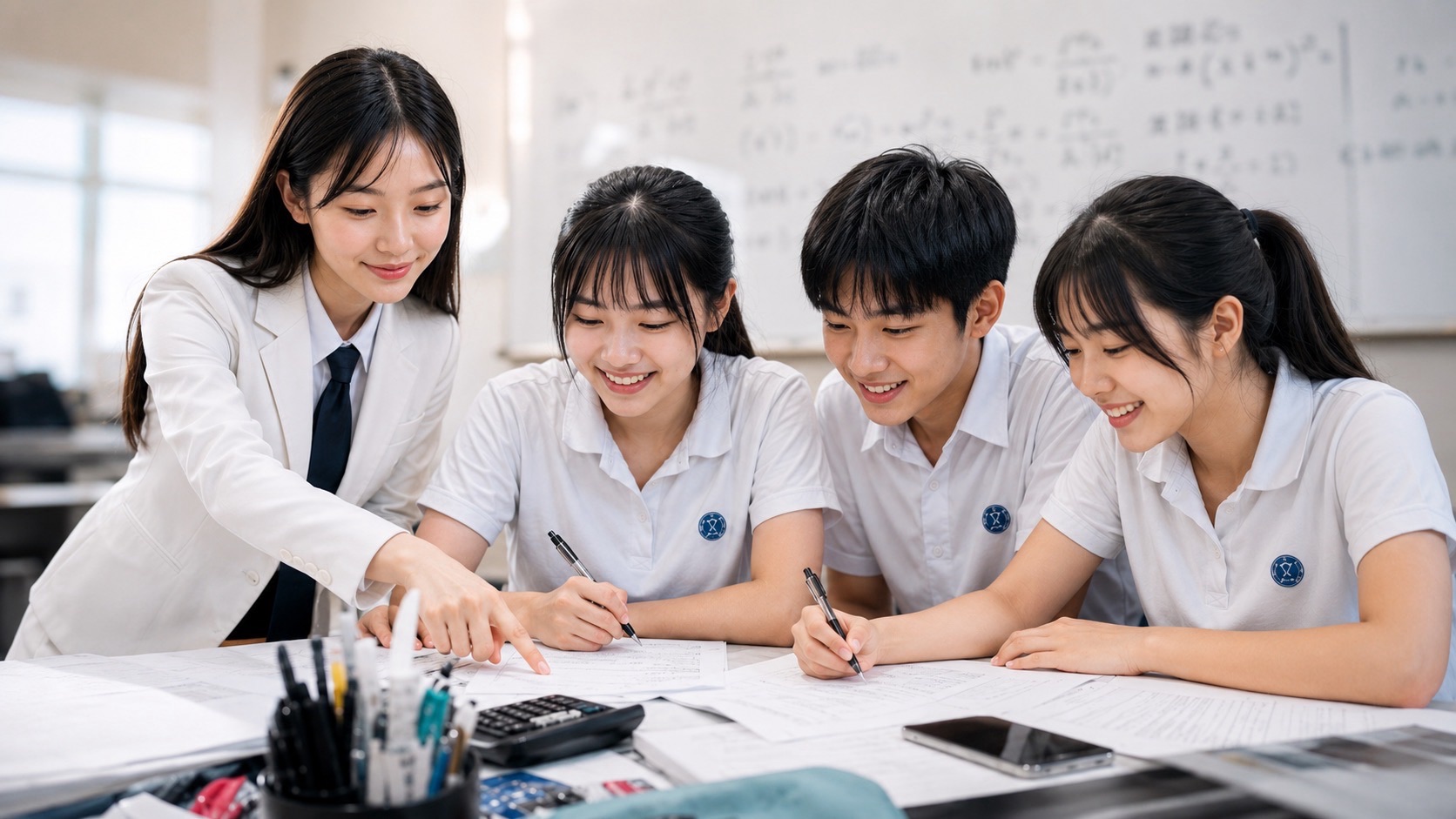
Current Punggol ownership: this retained eduKateSG page is a Secondary 2 Mathematics learning guide. For current Punggol classes, consultation, fees, schedules, tutor assignment and availability, continue to eduKatePunggol.
Punggol · Secondary 2 Mathematics · Full SBB G1/G2/G3 · Up to 3 Students
Punggol Tuition | Secondary 2 Mathematics
Make the bridge year count.
Secondary 2 is not a quiet year between Secondary 1 and Secondary 3.
It is where arithmetic habits must mature into algebraic control, diagrams must become reasons, graphs must become relationships and word problems must become models that a student can read, build and check.
The visible mark matters. The deeper task is to make the Mathematics dependable before the road becomes steeper.
Read the structure → choose the method → show the reasoning → calculate accurately → check the result → transfer the skill.
Punggol Secondary 2 Mathematics tuition at a glance
Strong foundations create a wider upper-secondary corridor.
By Secondary 2, the settling-in period is largely over. Questions become longer, algebra becomes less forgiving and students are expected to decide more independently how a problem should be approached.
A child may still complete homework and say that the lesson was understood, yet the marks remain unstable. The working may reveal sign errors, missing brackets, weak graph interpretation, guesses in geometry or no clear starting point in a word problem.
At eduKate Punggol, classes are kept to a maximum of three students so that the tutor can see not only whether the final answer is correct, but how the student selected, organised and checked the method.
| Level | Secondary 2 Mathematics | The consolidation year before upper-secondary Mathematics becomes heavier |
|---|---|---|
| Subject levels | G1, G2 or G3 Mathematics | Teaching should follow the individual subject level and the student’s actual work |
| Class size | Up to three students | Close observation, individual correction and active mathematical discussion |
| Main areas | Number, algebra, graphs, geometry, measurement, statistics, probability and modelling | School sequencing may vary, but the ideas must operate as one connected system |
| Teaching emphasis | Concept, method, working, accuracy, checking and transfer | The correction should change the next attempt |
| Suitable for | Students catching up, stabilising performance or preparing ahead | Different starting points require different first moves |
| Location | 83 Punggol Central, Singapore 828761 | Lessons and consultations by appointment |
Why Secondary 2 Mathematics is the bridge year
The road has not split yet, but the foundations for every later route are being laid.
Secondary 2 is the last full year in which lower-secondary habits can be consolidated before upper-secondary pace, subject combinations and examination demands become more pronounced.
Students rely heavily on numerical reasoning, familiar procedures and visual problem-solving approaches.
Directed numbers, algebra, coordinates and formal working begin to change how Mathematics is expressed.
The student must connect algebra, graphs, geometry, measurement and modelling with greater independence.
Mathematics becomes denser, faster and more dependent on stable earlier skills.
Where offered and appropriate, Additional Mathematics requires particularly reliable algebra and graph foundations.
Why small errors grow
Weak sign control → unstable algebra → harder later topics
A missing bracket or sign error may appear minor in one exercise, but the habit travels into equations, graphs, trigonometry and more advanced manipulation.
Why this year has leverage
Earlier repair + repeated transfer = a cleaner Sec 3 start
Secondary 2 still provides enough runway to rebuild the method, practise it in varied questions and make it dependable before upper-secondary pressure rises.
The aim is not to rush into Secondary 3 work while Secondary 2 remains unstable. It is to make the present system strong enough to carry the next one.
Full Subject-Based Banding and Mathematics
The student’s year, subject level and actual working must be read together.
Under Full SBB, students enter through Posting Groups and may study individual subjects at G1, G2 or G3. Mathematics tuition should therefore follow the level of the subject—not assume that one label describes the entire student.
Posting Groups guide entry into Secondary school and the initial subject levels offered.
The individual Mathematics subject is studied at the level appropriate to the student’s learning needs.
School papers reveal concept knowledge, method selection, algebra control and checking habits.
Teaching should strengthen the present course and prepare the next realistic demand.
Students sit subjects at their respective G1, G2 or G3 levels under the SEC framework.
A useful distinction
Posting Group ≠ Mathematics subject level forever
Posting Groups concern admission and initial subject levels. Students may take individual subjects at different levels as they progress, according to school arrangements and learning needs.
The practical teaching rule
Year level + subject level + actual script
These three pieces give a more accurate starting point than an old stream label, a broad reputation or one isolated result.
Build functional confidence and reliable foundational methods.
Teaching should make the concepts concrete, the steps visible and the practice carefully graded.
Strengthen application, algebra and independent problem-solving.
Students need dependable methods, accurate working and the ability to transfer familiar knowledge into changed questions.
Prepare for greater abstraction and upper-secondary demand.
Strong algebra, graphs, geometry, modelling and examination craft become increasingly important.
Why Secondary 2 Mathematics marks remain unstable
The final answer is evidence. The working shows where the system broke.
Two students can receive the same score for very different reasons. Useful tuition separates the cause before adding more exercises.
“My child understands in class but cannot start alone.”
- recognises a worked example but not the underlying structure;
- waits for a topic label or familiar layout;
- does not know what information matters;
- tries formulas without a reason;
- cannot check whether the answer makes sense.
Knowledge has not yet become a decision process.
- weak retrieval of prerequisite skills;
- uncertain algebraic language;
- poor translation from words, diagrams or graphs;
- no stable sequence for choosing a method;
- corrections copied rather than understood.
| What appears on the paper | What may be underneath | Useful first teaching move |
|---|---|---|
| Repeated sign and bracket errors | Directed-number or algebraic grammar is unstable | Slow the manipulation, make each transformation explicit and retest it |
| The formula is known but not used correctly | The student memorised the tool without understanding its conditions | Compare when the formula applies, when it does not and why |
| Geometry answers are guessed | Properties and reasons are not connected into a proof path | Annotate the diagram and require a reason for every step |
| Graphs are drawn but not interpreted | Coordinates, gradient, intercept or variable relationships are weak | Move deliberately between table, equation, graph and context |
| Word problems feel too long | The child cannot separate known, unknown, relationship and goal | Translate the language into quantities and a mathematical model |
| Many careless mistakes appear under time | Working layout, calculator discipline or checking sequence is unstable | Create a short repeatable accuracy routine and practise it under conditions |
“Be more careful” is not yet a repair plan. The tutor should identify exactly what the student failed to notice, understand, organise or check.
What Secondary 2 Mathematics tuition should build
Mathematics becomes stronger when its parts operate as one system.
The topic list matters, but the deeper capabilities are what allow the student to handle an unfamiliar variation rather than only reproduce a memorised example.
Number Sense
Work accurately with directed numbers, fractions, ratio, rate, percentage, estimation and magnitude while recognising whether an answer is reasonable.
Algebraic Control
Read expressions, preserve equality, manipulate terms carefully, use brackets correctly and solve equations through valid connected steps.
Graphs and Coordinates
Move between tables, equations, coordinates, graphs and real situations while understanding what gradient and intercept represent.
Geometry Reasoning
Use angle, shape, congruence, similarity and geometric properties as reasons—not as guesses from a drawing that may not be to scale.
Measurement
Control units, scale, perimeter, area, surface area and volume while connecting formulas to the geometry they describe.
Statistics and Probability
Read data displays, compare distributions, interpret averages and reason about chance without confusing calculation with conclusion.
Modelling and Word Problems
Translate language into quantities, relationships, equations, diagrams or tables; solve the model; then return to the real meaning.
Mathematical Communication
Show working in a sequence another person can follow, use notation accurately and explain why a method or conclusion is valid.
Recognise → represent → choose → solve → justify → check. A student becomes dependable when this movement survives a change in numbers, wording, diagrams and time pressure.
What happens in a purposeful Secondary 2 Mathematics lesson
Make the reasoning visible. Practise it. Correct it. Then remove the support.
The student should not merely follow the tutor’s example. The student must increasingly be able to identify the structure and produce the method independently.
Retrieve
Recall the prerequisite skill that the new topic depends on, such as directed numbers, fractions, algebra or angle properties.
Explain
Build the concept from meaning, representation and reason before compressing it into a rule or formula.
Model
Show the decision path: what to notice, what to choose, how to set out the working and where errors usually enter.
Guide
Let the student perform the same movement with prompts, questions and immediate correction.
Correct
Identify the exact failure point, repair the line and explain why the first attempt was invalid or incomplete.
Transfer
Change the numbers, representation, context or time condition and check whether the stronger method remains available.
What homework should do
Consolidate a known purpose ≠ create unexplained volume
A short set targeting a specific algebraic transformation or graph relationship may be more useful than a full paper completed with the same unresolved habits.
What correction should do
Wrong line → named error → repaired method → fresh question
The learning is complete only when the student can use the correction without copying the original solution.
Why we teach in groups of up to three
A student can hide in a large class. The working cannot hide in a close tutorial.
Mathematics becomes visible line by line. A small group gives the tutor enough proximity to observe the decision before the mistake becomes the final answer.
The tutor can inspect the path, not only the answer.
Method selection, notation, layout, calculator use and checking habits can be corrected while the work is happening.
Speaking the method exposes fragile understanding.
A student who can justify why a step works is less dependent on recognising one familiar worksheet pattern.
Shared teaching does not require identical difficulty.
One student may repair algebra while another receives extension through harder modelling or proof questions.
The small-group balance
Personal correction + useful comparison
Students see alternative methods, question one another’s assumptions and learn to distinguish a valid shortcut from a skipped reason.
The participation rule
Attempt → explain → challenge → refine
The lesson should feel like a tutorial in mathematical thought, not a smaller lecture followed by silent worksheet completion.
The road from Secondary 2 to Secondary 3
Upper-secondary readiness is built from the habits already visible now.
Secondary 2 does not decide a child’s entire future. It does, however, reveal whether the student is ready for faster Mathematics and, where available and appropriate, the additional abstraction of A-Math.
Stable G1/G2/G3 Mathematics
Number, algebra, graphs, geometry, data and problem-solving must remain usable without constant prompting.
Review the core capabilities → 02Before moving aheadRemove recurring weaknesses
Sign errors, poor working, formula guessing and weak problem translation become more expensive when later topics depend on them.
Return to the diagnostic map → 03The next school yearSecondary 3 Mathematics
Prepare for the upper-secondary increase in pace, integration and examination demand.
Open the Secondary 3 route → 04Where offered and suitableSecondary 3 Additional Mathematics
Strong algebraic manipulation, graphs and disciplined working provide a more secure entry into A-Math.
Explore the A-Math route →Additional Mathematics should not be treated as a badge. It is a demanding subject whose value is greatest when the student has sufficient algebraic readiness, interest and the school pathway to support it.
Different students, different first routes
Catch up. Keep up. Move ahead.
The first useful task depends on where the student’s system is weakest. More difficulty is not automatically better; the right difficulty creates successful reasoning and prepares the next step.
The student carrying weak Secondary 1 foundations
Repair before acceleratingRebuild directed numbers, fractions, ratio, basic algebra and working habits so new topics have something stable to attach to.
The student who understands examples but cannot begin alone
Teach recognition and method selectionCompare problem structures, identify clues and practise deciding what representation or method should come first.
The student losing marks through algebra
Make the language exactStrengthen signs, brackets, substitution, expansion, factorisation and equation steps with disciplined notation.
The student who guesses geometry
Turn the diagram into reasonsAnnotate known facts, name properties and connect each claim to the next valid step.
The student struggling with word problems
Build a translation routineSeparate known quantities, the unknown, the relationship and the final question before calculating.
The student whose results fluctuate
Stabilise executionImprove layout, calculator discipline, checking, time decisions and error review across mixed-topic tests.
The student preparing for stronger upper-secondary Mathematics
Increase depth rather than workload aloneUse unfamiliar representations, multi-step reasoning, harder modelling and questions that require method choice.
The student who has lost confidence
Restore control through visible progressUse clear explanations, carefully graded questions and evidence that the student can now solve what previously felt impossible.
How to choose Secondary 2 Mathematics tuition in Punggol
Look beyond worksheets, speed and promises.
A useful programme should be able to explain how it identifies the student’s present layer, repairs misconceptions, improves working and verifies transfer into new questions.
Does the tutor inspect the actual working?
The answer alone cannot reveal whether the problem was concept knowledge, algebra, translation, calculator use or a final careless step.
Look forLine-by-line diagnosis and a clear explanation of the first repair.
Is the lesson aligned to the correct subject level?
G1, G2 and G3 students may require different pacing, representations and levels of abstraction.
Look forTeaching that follows the actual course while respecting the student’s present control.
Are concepts explained before shortcuts?
A shortcut is useful only when the student understands the conditions that make it valid.
Look forMeaning, representation and reasoning before compressed rules.
Does correction change the next attempt?
Copying a model solution can make the page look complete without improving independent performance.
Look forReworking, retesting and varied questions after correction.
Can the class support different starting points?
A student rebuilding fractions and a student preparing for advanced algebra should not receive the same first task.
Look forSmall-group differentiation without losing lesson coherence.
Are parents given a realistic picture?
Progress should be described through concepts, habits and new independent abilities—not guaranteed grades or dramatic promises.
Look forSpecific evidence, honest priorities and a sensible next stage.
Frequently asked questions
Clear answers before a family chooses the next step.
Secondary 2 is early enough for meaningful repair and close enough to upper secondary for the decision to matter.
Why is Secondary 2 Mathematics called a bridge year?
The student is no longer simply adjusting to Secondary school, but has not yet entered the heavier upper-secondary phase.
This makes Secondary 2 a valuable year for consolidating algebra, graphs, geometry, modelling and independent working before the next climb.
Does Posting Group 3 mean every subject must be G3?
No. Posting Groups concern entry into Secondary school and initial subject levels.
Under Full SBB, individual subjects may be studied at G1, G2 or G3 according to school arrangements and the student’s learning needs.
Will the SEC change the overall Mathematics standard?
SEAB states that there is no change in the overall examination standards under the SEC.
From 2027, students sit subjects at their respective G1, G2 or G3 levels and receive one certificate reflecting the subjects and levels taken.
Is tuition only useful for students who are failing?
No. Some students need foundation repair. Others need consistency, better examination control or sufficiently challenging work to prepare for upper-secondary Mathematics.
Why not simply complete more assessment books?
Practice is useful when the student knows what skill is being consolidated and learns from the correction.
If the same error keeps returning, the student needs diagnosis and instruction before more volume.
Can a student improve careless mistakes?
Yes, but “careless” must be made specific. The cause may be poor layout, sign control, rushed reading, calculator entry, skipped checks or time pressure.
Once the mechanism is identified, a short repeatable accuracy routine can be trained.
Does Secondary 2 tuition prepare students for A-Math?
It can strengthen the algebra, graphs and disciplined working that A-Math later depends on.
Whether a student takes Additional Mathematics depends on school offerings, subject-combination criteria, readiness and the family’s wider pathway.
Why use a three-student format?
Three students allow the tutor to inspect each script closely, ask each student to explain and differentiate the next question while preserving useful peer comparison.
What should we bring for an initial discussion?
Recent school papers, corrections, topic tests, teacher comments, the student’s subject level and examples of questions that take unusually long or feel impossible to start.
What does real progress look like?
The student begins questions more independently, makes fewer repeated errors, explains methods more clearly and transfers corrected skills into unfamiliar problems.
The next practical step
Bring the paper. Read the working. Find the first useful repair.
A good initial conversation should make the student’s present position clearer: the subject level, the earliest weak link, the most useful first build and the evidence that will show improvement.
Confirm the course.
Secondary 2, G1/G2/G3 Mathematics, current school sequence and immediate assessment demands.
Bring recent evidence.
A school paper, topic test, corrections and questions the student avoids, guesses or takes unusually long to complete.
Find the mechanism.
Missing prerequisite, misconception, algebra, representation, method choice, working, checking, timing or confidence.
Choose the route.
Repair the foundation, stabilise present performance or prepare ahead for the upper-secondary corridor.
What should become clearer after the consultation?
The family should understand what the student currently controls, where the reasoning begins to weaken, how the first repair will be taught and what progress should look like.
- Subject level
- G1, G2 or G3 Mathematics
- Evidence
- Actual working rather than a broad label
- Priority
- The first weakness with the greatest later effect
- Class fit
- Compatible pace, temperament and learning stage
- Progress
- Better decisions, cleaner working and stronger transfer
Up to three students. Close working. A clearer road to Secondary 3.
The small-group format keeps every student visible while allowing method comparison, mathematical discussion and individual correction.
- For students behind
- Repair foundations and restore confidence
- For students plateauing
- Improve accuracy, application and examination control
- For strong students
- Increase depth and upper-secondary readiness
- Subject levels
- G1, G2 and G3 Mathematics
- Location
- 83 Punggol Central, Singapore 828761
Continue along the Secondary Mathematics pathway
Choose the page nearest to the student’s present stage.
Punggol Tuition | Secondary 2 Mathematics
Less confusion. Better working. Stronger choices ahead.
Secondary 2 Mathematics is the bridge year.
It is where the student learns that algebra is a language, a graph is a relationship, geometry is an argument and a word problem is a system waiting to be represented.
The subject becomes easier to manage when the student can see the structure beneath the surface.
At eduKate Punggol, our small-group Secondary 2 Mathematics tuition is built around close observation, clear explanation, careful correction and progressive independence.
The objective is not simply to finish more questions.
It is to help the student know how to begin, how to proceed, how to notice an error and how to make the next decision better.
Less confusion. Better working. Stronger choices ahead.
Official context
Built around Singapore’s current Secondary Mathematics landscape.
Parents can use these official pages to verify Full Subject-Based Banding, the Secondary Mathematics curriculum and the Singapore-Cambridge Secondary Education Certificate.
Secondary Curriculum Under Full SBB
Official G1, G2 and G3 curriculum and syllabus links for Mathematics and other Secondary subjects.
Open the MOE curriculum page → 02Ministry of EducationSecondary School Experience Under Full SBB
Official explanation of Posting Groups, mixed form classes and flexible subject levels.
Open the Full SBB guide → 03SEABSingapore-Cambridge SEC
Official information on the qualification, subject levels and unchanged overall examination standards from 2027.
Open the SEC page →Reviewed for the Full SBB and SEC arrangements current in July 2026. School topic sequence, subject combinations and movement between subject levels may vary. Families should refer to their child’s school for individual arrangements.
Punggol Tuition | Secondary 2 Mathematics
Secondary 2 Mathematics is not just another school year.
It is the bridge year.
In Secondary 1, students are still adjusting from Primary School.
New school.
New teachers.
New classmates.
New timetable.
New expectations.
By Secondary 2, the settling-in period is over.
The work becomes more serious.
The questions become longer.
The algebra becomes less forgiving.
The child is expected to think with more independence.
This is where many parents begin to notice the shift.
The student may still be attending lessons.
They may still be doing homework.
They may still say, “I understand.”
But the marks may not move.
The mistakes come back.
The working becomes messy.
The child takes too long to complete questions.
The confidence starts to shake quietly.
At eduKate Punggol, our Secondary 2 Mathematics tuition helps students make this year count.
Because Secondary 2 is where the foundations for Secondary 3 are built.
And once those foundations are strong, the road ahead becomes clearer.
Secondary 2 Is the Year Before the Road Splits
Secondary 2 Mathematics matters because it sits before the next major climb.
After Secondary 2, students move deeper into upper secondary work.
The pace becomes faster.
The topics become more demanding.
The expectations become sharper.
For students taking G2 or G3 Mathematics, Secondary 2 is the year where algebra, geometry, graphs, ratios, percentages, statistics and problem-solving habits must become more stable.
For students who may go on to Additional Mathematics, Secondary 2 becomes even more important.
A-Maths does not begin from nowhere.
It grows from earlier algebra.
A weak Secondary 2 foundation can become a Secondary 3 struggle.
A careless algebra habit can become an A-Maths problem.
A weak graphing habit can become a functions problem.
A poor understanding of equations can become a trigonometry and calculus problem later.
A student who cannot explain their working clearly may lose marks even when the idea is partly correct.
This is why we do not treat Secondary 2 as a quiet middle year.
It is not filler.
It is preparation.
The Problem Is Often Hidden
Many Secondary 2 students do not fail because they know nothing.
They struggle because their knowledge is uneven.
They can do some questions.
They cannot do others.
They can follow the teacher’s worked example.
They cannot start when the question changes.
They know the formula.
They do not know when to use it.
They understand in class.
They forget during tests.
This creates confusion for parents.
The child seems capable.
The effort is there.
The tuition, revision or school support may already be happening.
So why are the marks still unstable?
Very often, the issue is not effort.
It is structure.
Mathematics is a connected subject.
When one earlier part is weak, the weakness travels forward.
A student who is weak in directed numbers may make careless sign errors in algebra.
A student who cannot expand and factorise confidently may struggle with equations.
A student who does not understand proportional reasoning may struggle with rates, percentages and real-world problems.
A student who cannot interpret graphs may lose marks in coordinate geometry and data questions.
The visible mistake is only the surface.
The real problem is often deeper.
At eduKate Punggol, we help make the problem visible.
We find where the thinking breaks.
Then we teach, correct and rebuild.
How can eduKateSG help your child improve in Secondary Mathematics?
Secondary Mathematics improves when the problem is repaired at the correct layer. Some students need foundation repair. Some need algebra control. Some need graph sense, geometry reasoning, exam timing, or Paper 1 and Paper 2 discipline. Select your child’s level, pathway and the skill that needs fixing to see how eduKateSG helps students from Secondary 1 to Secondary 4 across G1, G2 and G3 Mathematics / E-Math.
We look at the child’s actual working, not only the final answer. The working shows whether the problem is concept knowledge, algebra control, weak foundation, careless layout, calculator misuse, poor timing or examination pressure.
eduKateSG helps students install the Secondary Mathematics operating system.
At Secondary 2 in G3 Mathematics / E-Math, students must move beyond PSLE-style arithmetic and problem sums into algebra, graphs, geometry, statistics, modelling and more disciplined examination working.
We check whether the child is still using Primary-style habits: arithmetic-only thinking, weak algebra, messy working, incomplete steps or poor checking.
We recalibrate the student to Secondary Mathematics by training concept clarity, algebra control, graph sense, geometry reasoning, application skill and exam discipline.
The student learns to identify the topic, choose the method, show working clearly, control algebra and check the answer.
Parents can expect a clearer repair plan instead of vague advice such as “practise more” or “be more careful”.
We help students catch up, keep up and move ahead. Secondary Mathematics improves when concepts, working habits, algebra, graphs, geometry, problem-solving and examination craft are trained as one connected system.
Good Mathematics Tuition Removes Confusion
Good tuition should not make a child feel more crowded.
It should not add more worksheets without direction.
It should not make the student feel that the answer is simply “try harder.”
It should not turn every weak mark into panic.
Good Mathematics tuition should bring clarity.
What does the child know?
What is missing?
Which topics are weak?
Which mistakes keep repeating?
Which habits must be corrected now?
Which skills must be strengthened before Secondary 3?
Once we know the answer, we can teach properly.
At eduKate Punggol, our Secondary 2 Mathematics tuition is built around clear explanation, close guidance and steady correction.
We teach the topic from the starting point.
Then we guide students through examples.
Then students practise.
Then we correct the working.
Then they try again.
This is how improvement becomes visible.
Not through shouting.
Not through fear.
Not through pretending that every student learns at the same speed.
But through patient, structured teaching.
Algebra Must Become Stronger
Secondary 2 is where algebra becomes serious.
Students must move beyond simply replacing letters with numbers.
They must understand expressions.
They must manipulate equations.
They must expand, factorise, simplify and solve with control.
They must learn to show working clearly.
This is where many marks leak.
Not because the student is unintelligent.
But because algebra is a language.
If a student does not know the grammar of algebra, every topic after that becomes harder.
The child may understand the idea but lose the mark because the working is careless.
A missing bracket.
A wrong sign.
A skipped step.
A poorly copied term.
A formula used without understanding.
These look small.
But Mathematics is built from small exact things.
A wrong sign can change the answer.
A missing bracket can change the whole expression.
A skipped step can hide the error until the final line.
That is why we correct working early.
We do not only ask for the final answer.
We look at the path.
A strong Secondary 2 Mathematics student must know how to think, write and check.
Geometry Must Become Clearer
Geometry is another area where Secondary 2 students often struggle.
The diagram looks simple.
Then the question asks for reasoning.
The student may see the angle.
They may guess the answer.
But they cannot explain why.
This is where Mathematics begins to train the mind more deeply.
Students must learn to use properties.
They must learn to justify.
They must learn to connect one statement to the next.
In geometry, the answer is not enough.
The reason matters.
This is useful far beyond Mathematics.
A student who learns geometry properly learns how to argue with evidence.
Not loudly.
Clearly.
They learn that every claim needs support.
They learn that every step must connect.
They learn that guessing is not the same as knowing.
That is education doing its deeper work.
It makes the child more precise.
Graphs Teach Students to See Relationships
Graphs are not just drawings.
Graphs teach students how one quantity changes with another.
They help students see movement, pattern, gradient, intercepts and relationships.
This is important because upper secondary Mathematics relies heavily on the ability to move between forms.
A table can become a graph.
A graph can represent an equation.
An equation can describe a real-world situation.
A real-world situation can be translated into Mathematics.
When students understand this, Mathematics becomes less mechanical.
They begin to see structure.
They begin to understand that a question is not just asking for a method.
It is asking them to read a system.
That is why Secondary 2 graph work should not be treated as a small topic to memorise.
It is preparation for harder thinking later.
Word Problems Are Thinking Problems
Many students dislike word problems.
They say the question is too long.
They do not know what to do first.
They pick numbers randomly.
They try a formula and hope.
But word problems are not only testing calculation.
They are testing comprehension, selection and modelling.
The student must read carefully.
They must decide what is known.
They must identify what is unknown.
They must choose the correct method.
They must translate words into Mathematics.
They must solve and check whether the answer makes sense.
This is why word problems are so valuable.
They teach the child to slow down and think.
In a world full of noise, this matters.
A student who can read a problem carefully, identify the structure and solve it step by step is learning more than Mathematics.
They are learning how to face complexity.
Small-Group Tuition Helps Students Be Seen
In a large class, a student can hide.
They can copy.
They can nod.
They can stay quiet.
They can look as if they understand.
But Mathematics reveals the truth through working.
At eduKate Punggol, our small-group tutorials allow tutors to observe how students think.
We can see where the mistake begins.
We can ask why the student chose a method.
We can correct weak habits before they become permanent.
We can slow down when the student needs repair.
We can move ahead when the student is ready.
This close attention is important in Secondary 2.
The year moves quickly.
If a child falls behind quietly, the gap may not look serious at first.
But by Secondary 3, the gap can become much harder to repair.
Small-group tuition gives students the chance to be noticed early.
And early correction is powerful.
We Help Students Catch Up, Keep Up and Move Ahead
Some Secondary 2 students come to us because they are behind.
They need to catch up.
They may have weak Secondary 1 foundations.
They may be unsure about algebra.
They may have lost confidence after poor results.
They may need patient explanation before they can move forward.
Some students come because they are coping, but unstable.
They need to keep up.
They understand some topics but lose marks in tests.
They need better habits, better revision and stronger accuracy.
Some students come because they are ready for more.
They need to move ahead.
They want stronger problem-solving.
They want better preparation for Secondary 3.
They may be aiming for stronger upper secondary Mathematics or Additional Mathematics later.
Different students need different kinds of help.
The job of tuition is not to force every child into the same mould.
The job is to guide the student properly from where they are.
Secondary 2 Mathematics Builds Future Capability
Education is one of the quiet ways a society improves.
Not through noise.
Not through slogans.
Not through panic.
Through properly taught children.
A child who learns Mathematics properly learns accuracy.
They learn patience.
They learn logic.
They learn how to correct mistakes.
They learn how to keep going when a problem feels difficult.
These skills matter.
They matter in school.
They matter in examinations.
They matter in future work.
They matter in the kind of civilisation we are building.
Because every capable child becomes part of the future.
A student who learns to think clearly today may become the engineer, teacher, doctor, designer, researcher, parent, entrepreneur or leader of tomorrow.
We do not know exactly where each child will go.
But we know this.
A child with strong foundations has more choices.
That is why Secondary 2 matters.
It is not only a school year.
It is a preparation year.
When Parents Should Seek Help
Parents should consider Secondary 2 Mathematics tuition when the signs begin to appear.
Your child takes too long to complete homework.
Your child understands in class but cannot do questions alone.
Your child keeps making careless algebra mistakes.
Your child struggles with word problems.
Your child avoids Mathematics revision.
Your child says, “I don’t know how to start.”
Your child loses marks even after studying.
Your child’s confidence is beginning to drop.
These are not signs that the child cannot succeed.
They are signs that the learning system needs repair.
With the right help, many students can improve.
The key is not to wait until the problem becomes too large.
Punggol Tuition for Secondary 2 Mathematics
At eduKate Punggol, our Secondary 2 Mathematics tuition helps students build stronger foundations before upper secondary Mathematics becomes heavier.
We teach clearly.
We correct carefully.
We guide students through practice.
We help them understand what went wrong and how to improve.
Our goal is not only to help students survive the next test.
Our goal is to help them become calmer, stronger and more capable learners.
Because a student who understands Mathematics gains more than marks.
They gain control.
And when a child gains control, school becomes less frightening.
The path becomes brighter.
The future becomes larger.
If your child is struggling with Secondary 2 Mathematics, come to us.
We will help make the problem visible.
Then we will teach, correct and rebuild.
Step by step.
With patience.
With structure.
With care.
Because properly taught students do not only prepare for examinations.
They prepare for the future they will help build.
Mastering Sec 2 Math: Inside Punggol Secondary 2 Math Tuition Classes Near Punggol MRT
- Building Strong Foundations in Punggol Secondary 2 Math Tuition: Just a short 5-minute walk from Punggol MRT at eduKate Punggol, our Secondary 2 Math Tuition sessions kick off with retrieval warm-ups drawing from the MOE Secondary 2 Mathematics Syllabus, revisiting numbers and algebra essentials like factors, ratios, and linear equations to lock in core skills—empowering over 90% of Sec 2 students to advance from G3 to G1 banding with confidence.
- Hands-On Guided Practice in Punggol Secondary 2 Math Tuition: In our intimate 3-pax groups at eduKate Punggol, guided practice dives into geometry and measurement with tiered exercises on congruence, similarity, and bearings, where students sketch and annotate diagrams for precision—slashing errors in spatial reasoning by up to 65% via immediate, expert-led tweaks from our 20-year legacy tutors.
- Timed Drills for Exam Readiness in Punggol Secondary 2 Math Tuition: Allocating 30 minutes in every 120-minute Punggol Secondary 2 Math Tuition class to timed simulations of SA1 and SA2 formats, we tackle statistics and probability topics like data representation and basic inference using pie charts and stem-and-leaf plots—honing the stamina and accuracy vital for O-Level E-Math pathways right from Sec 2.
- Error Logging and Micro-Drills in Punggol Secondary 2 Math Tuition: Wrapping up sessions, Punggol Secondary 2 Math Tuition participants update personal error logs on pitfalls in algebraic manipulation or mensuration, followed by bespoke micro-drills shared via WhatsApp—zeroing in on gaps like proportion applications for rapid, targeted mastery over 4-6 weeks.
- First Principles Approach in Punggol Secondary 2 Math Tuition: Drawing on proven Singapore teaching strategies, our Punggol Secondary 2 Math Tuition explains core ideas from scratch, such as deriving the distance formula before real-world navigation problems—cultivating intuitive understanding over rote learning for Sec 2 learners at eduKate Punggol.
- Fencing Method for Progressive Mastery in Punggol Secondary 2 Math Tuition: Employing the Fencing Method in Punggol Secondary 2 Math Tuition, we scaffold algebra from simple expressions to quadratic expansions and inequalities, layering in geometry proofs—facilitating seamless topic integration for comprehensive Sec 2 exam prep.
- Interleaving and Visual Aids in Punggol Secondary 2 Math Tuition: To mirror real exam variety, Punggol Secondary 2 Math Tuition weaves interleaving with visual tools like graph plotting apps for functions and scatter diagrams in probability, boosting retention through “given-goal-tools” frameworks—ideal for visual learners near Punggol MRT.
- Personalized Feedback in Small Groups for Punggol Secondary 2 Math Tuition: Limited to 3 students, our Punggol Secondary 2 Math Tuition delivers granular, line-by-line reviews during volume and surface area drills, adjusting pace for abstract transitions—tailored by NIE-trained tutors with decades in MOE-aligned secondary math.
- Weekly Materials and Support in Punggol Secondary 2 Math Tuition: Enrollees in Punggol Secondary 2 Math Tuition get weekly interleaved worksheets and syllabus checklists, plus round-the-clock WhatsApp guidance—reinforcing coordinates, trigonometry intros, and data handling for steady Sec 2 progress at this accessible spot by Punggol MRT.
- Proven Outcomes from Punggol Secondary 2 Math Tuition: Families near Punggol MRT celebrate grade leaps from C6 to A2 in just 8 weeks via our Punggol Secondary 2 Math Tuition, backed by anonymized case studies and 20+ years of full-time expertise at eduKate Punggol—delivering MOE-synchronized results that build lifelong math proficiency.
Contact us for our latest schedule

Secondary 2 Mathematics Tuition in Punggol: Building Strong Foundations for Future Success
Your Partner for Math Excellence near Punggol MRT
At eduKate Singapore, we believe that mastering Secondary 2 Mathematics is the turning point in every student’s math journey.
Our Math Tuition in Punggol, located conveniently near Punggol MRT, provides small-group lessons that help students strengthen their conceptual understanding, sharpen their problem-solving skills, and build the confidence needed to excel in school and national examinations.
Our experienced Math Tutors are specialists in the latest MOE Mathematics syllabus, ensuring every lesson is relevant, structured, and designed for measurable improvement.
Why Secondary 2 Mathematics Is So Important
Secondary 2 is a crucial year that bridges the gap between basic math concepts in lower secondary and the advanced topics students will encounter in Additional Mathematics and E-Mathematics in upper secondary.
A solid grasp of algebra, geometry, and number patterns at this level determines how well students perform in future topics such as trigonometry, differentiation, and higher algebra.
At our Punggol Tuition Center, our tutors focus on developing long-term understanding rather than rote memorisation. Students learn the why behind every formula, ensuring deeper comprehension and long-lasting retention.
What Students Learn in Secondary 2 Mathematics
The MOE Secondary 2 Mathematics syllabus prepares students for analytical and applied reasoning. Topics include:
| Key Areas | Learning Focus | Why It Matters |
|---|---|---|
| Algebra | Expansion, factorisation, solving equations, and inequalities. | Core for both E-Math and A-Math in upper secondary. |
| Geometry | Congruency, similarity, polygons, and circles. | Strengthens logical reasoning and proof writing. |
| Graphs & Functions | Linear and quadratic graphs. | Builds foundation for calculus and modelling. |
| Statistics | Mean, median, mode, and data analysis. | Prepares for higher-order statistical reasoning. |
| Mensuration & Trigonometry | 2D and 3D shapes, sine/cosine/tangent ratios. | Essential for A-Math and Science applications. |
Every topic is carefully covered in our Math Tuition Punggol classes with hands-on examples, visual explanations, and guided practice to develop clarity and accuracy.

The eduKate Difference: Why Parents Choose Our Math Tuition in Punggol
1. Small-Group Classes for Maximum Focus
Our small group classes (3 students per session) ensure that each student receives personalised coaching. Tutors can immediately identify misconceptions, correct them on the spot, and adapt lesson pacing to individual learning speeds.
This focused environment encourages participation and builds confidence in problem-solving.
2. Experienced Math Tutors
Our Math Tutors have over 20 years of combined teaching experience. Each tutor specialises in Secondary Mathematics and is trained to explain complex topics in simple, engaging ways.
We teach from first principles, ensuring students understand the concept before moving to application. This approach develops independent learners who can tackle any type of question confidently.
3. Convenient Location near Punggol MRT
Our Punggol Tuition Center is situated just minutes away from Punggol MRT, making it easy for students from nearby schools such as Punggol Secondary, Edgefield Secondary, and Greendale Secondary to attend.
Parents appreciate the accessibility, safe environment, and comfortable study space designed for focus and creativity.
4. Proven Track Record of Improvement
Students enrolled in our Math Tuition Punggol programme consistently achieve grade improvements of one to two bands within a semester.
Through regular assessments, curated worksheets, and individualised feedback, we help learners master concepts efficiently.
Our structured curriculum aligns fully with the MOE Syllabus, ensuring readiness for school assessments and national examinations.
5. Beyond Academics — Building Confidence and Curiosity
We don’t just prepare students for exams; we nurture curiosity and appreciation for how mathematics shapes the world.
From understanding angles in architecture to analysing data in sports, our lessons connect real-world contexts to classroom theory.
This helps students see mathematics as more than numbers — it becomes a language of logic and creativity
How can eduKateSG help your child improve in Secondary Mathematics?
Secondary Mathematics improves when the problem is repaired at the correct layer. Some students need foundation repair. Some need algebra control. Some need graph sense, geometry reasoning, exam timing, or Paper 1 and Paper 2 discipline. Select your child’s level, pathway and the skill that needs fixing to see how eduKateSG helps students from Secondary 1 to Secondary 4 across G1, G2 and G3 Mathematics / E-Math.
We look at the child’s actual working, not only the final answer. The working shows whether the problem is concept knowledge, algebra control, weak foundation, careless layout, calculator misuse, poor timing or examination pressure.
eduKateSG helps students install the Secondary Mathematics operating system.
At Secondary 2 in G3 Mathematics / E-Math, students must move beyond PSLE-style arithmetic and problem sums into algebra, graphs, geometry, statistics, modelling and more disciplined examination working.
We check whether the child is still using Primary-style habits: arithmetic-only thinking, weak algebra, messy working, incomplete steps or poor checking.
We recalibrate the student to Secondary Mathematics by training concept clarity, algebra control, graph sense, geometry reasoning, application skill and exam discipline.
The student learns to identify the topic, choose the method, show working clearly, control algebra and check the answer.
Parents can expect a clearer repair plan instead of vague advice such as “practise more” or “be more careful”.
We help students catch up, keep up and move ahead. Secondary Mathematics improves when concepts, working habits, algebra, graphs, geometry, problem-solving and examination craft are trained as one connected system.
.
Teaching Approach at eduKate Singapore
Learn with Conceptual Clarity
Each class begins with a short review of previous topics to reinforce learning continuity. Students then explore new concepts through step-by-step examples before attempting guided problem sets.
Our Math Tutors focus on:
- Simplifying difficult topics using visual diagrams and real-world analogies.
- Strengthening algebraic manipulation and mental math speed.
- Building exam techniques for short-answer and structured questions.
- Instilling a positive mindset towards problem-solving.
Understand, Practise, and Apply
After every class, students receive targeted homework designed to reinforce what was taught. These assignments are then reviewed in the next session to address misconceptions immediately.
By cycling through this learn-understand-apply model, students gain mastery, not memorisation.
Weekly Assessments and Feedback
Each week, students attempt short diagnostic quizzes to gauge progress.
Tutors review their answers in detail, providing personalised feedback on accuracy, working steps, and presentation.
Parents receive regular updates on performance, ensuring that home and classroom learning stay aligned.
How Strong Punggol Mathematics Support Prepares Students for the Next Level
By the end of Secondary 2, students should be ready to choose between Additional Mathematics and E-Mathematics tracks for upper secondary.
Our tutors guide students and parents in making informed choices based on:
- Current strengths and interests.
- Future academic and career goals.
- Readiness for more abstract mathematical reasoning.
This ensures students enter Secondary 3 Mathematics with confidence, clarity, and momentum.
What Makes Our Math Tuition Punggol Program Stand Out
| Feature | Benefit |
|---|---|
| 3-Student Small Group Format | Individual attention and customised pacing. |
| Located near Punggol MRT | Easy and safe access for students. |
| MOE-Aligned Curriculum | Lessons match what’s taught in schools. |
| Experienced Math Tutors | Proven teaching strategies for concept mastery. |
| Weekly Assessments | Continuous monitoring and rapid progress. |
| Parent-Tutor Communication | Transparent updates on learning outcomes. |
What Students Say About Our Math Tuition in Punggol
“Before joining eduKate, I struggled with algebra and word problems. The tutors explained every step clearly, and I started to enjoy math again. My grades improved from C to A in two terms!”
– Marcus, Secondary 2, Edgefield Secondary“Lessons are always fun and easy to follow. The small group means I get to ask questions anytime without feeling shy.”
– Cheryl, Secondary 2, Punggol Secondary“I like how they show real-life examples to make math less scary. The tutors are patient and always supportive.”
– Isha, Secondary 2, Greendale Secondary
Preparing for O-Level and Beyond
A strong Secondary 2 Mathematics foundation supports the move into upper-secondary Mathematics. For current Punggol tutor assignment and local delivery, use eduKatePunggol. This retained eduKateSG guide explains the learning work: stabilise algebra, representation, method selection, checking and independent transfer before Secondary 3.
- Interpreting complex problem statements accurately.
- Showing full working for partial marks.
- Checking solutions logically to avoid careless errors.
- Balancing speed with accuracy under time pressure.
Through practice, precision, and personal coaching, we nurture analytical thinkers who are ready for the demands of upper secondary and tertiary education.
Join eduKate Singapore’s Secondary 2 Mathematics Tuition in Punggol
Whether your child is aiming to strengthen foundational skills, regain confidence, or achieve top distinctions, our Math Tuition in Punggol offers the structure and support needed for success.
Our friendly team welcomes you to visit our Punggol Tuition Center near Punggol MRT to learn more about class schedules, consultation availability, and customised study plans.
Empower your child to master mathematics — one concept, one success at a time.
👉 Visit eduKate Singapore or Edukate Punggol for more information on registration, upcoming classes, and our full range of Secondary and PSLE Tuition Programmes.
Related Links
- MOE Mathematics Syllabus
- SEAB GCE O-Level Examination Format
- Edukate Punggol – Small Group Tuition
- Edukate Singapore – English, Math, and Science
