
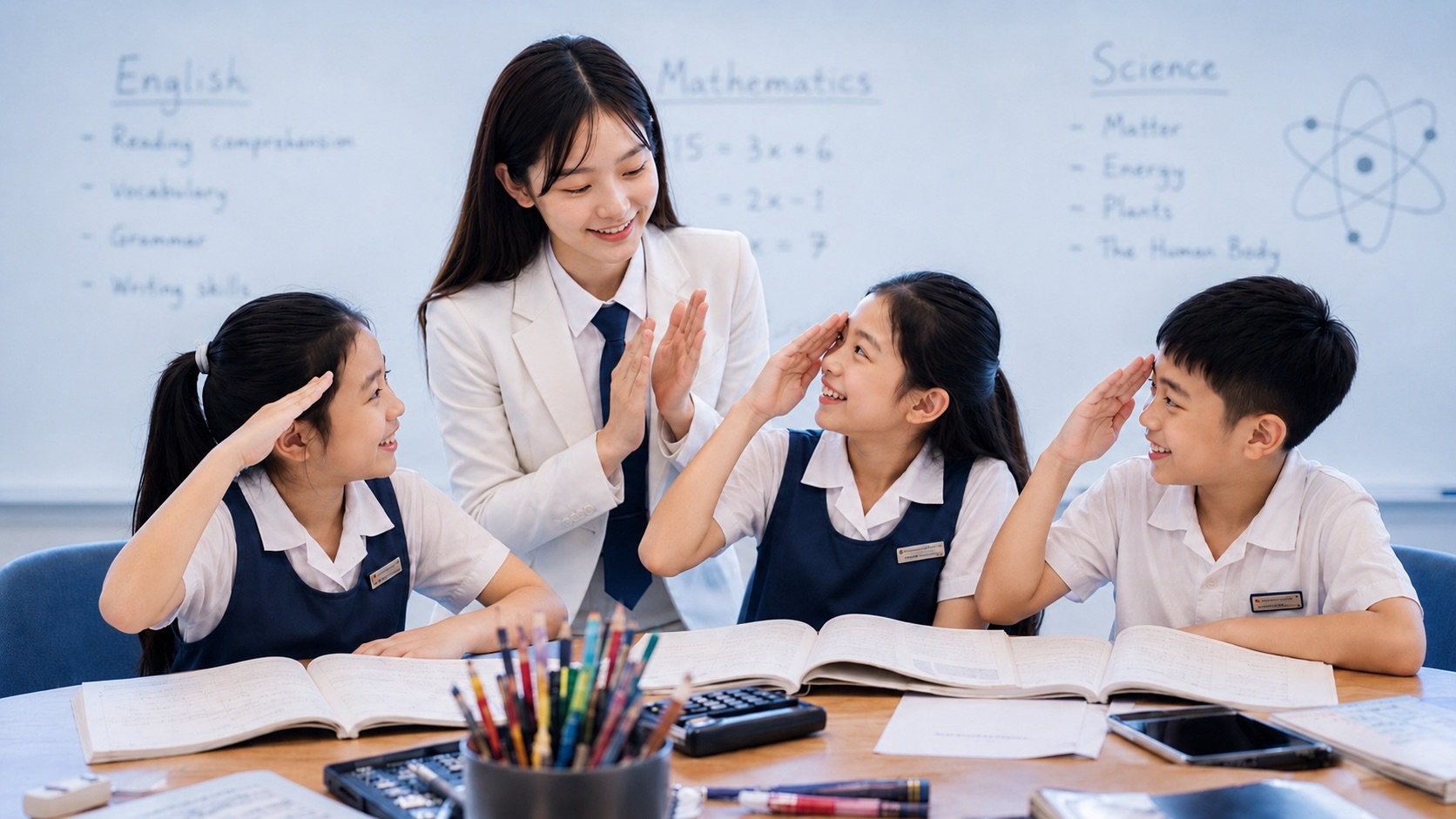
Science Tuition | Punggol Tutor for Primary Science
Science begins with a child looking at the world and asking why.
Why does a shadow change shape?
Why does ice melt?
Why do plants grow towards light?
Why does a magnet attract some objects but not others?
Why does a circuit work only when the path is complete?
These questions may look small.
But they are not small.
They are the beginning of civilisation.
Every bridge, hospital, aircraft, phone, vaccine, water system, food supply, satellite, classroom light and MRT line began with someone asking better questions about the world.
Science is how children learn that the world is not magic.
It has patterns.
It has causes.
It has systems.
It can be observed, tested, explained and improved.
That is why Primary Science matters.
It is not only another subject on the timetable.
It is one of the first times a child learns how to think carefully about reality.
At eduKate Punggol, our Primary Science tuition helps students understand Science clearly, answer questions accurately, and build the confidence to handle school tests and PSLE Science with better control.
But more than that, we help students become better thinkers.
Because when a child learns Science properly, they learn something powerful.
They learn that confusion can be investigated.
Primary Science Is Not Just Memory Work
Many students think Science is about memorising facts.
Plants need light.
Magnets attract iron.
Heat flows from hotter objects to cooler objects.
The Earth rotates.
The human body has systems.
Materials have properties.
These facts are important.
But facts alone are not enough.
Primary Science examinations do not only ask students to remember.
They ask students to explain.
They ask students to compare.
They ask students to infer from diagrams.
They ask students to use evidence.
They ask students to apply a concept to a new situation they may never have seen before.
That is where many children struggle.
They may know the topic.
But they cannot answer the question.
They may remember the keyword.
But they do not know where to place it.
They may understand the experiment.
But they cannot explain the result properly.
They may have the right idea.
But the answer is too vague to score.
This is why good Science tuition cannot be only “learn the notes and do the worksheet.”
Good Science tuition must teach the child how Science works.
Observe the situation.
Identify the concept.
Find the evidence.
Connect cause and effect.
Use the correct keywords.
Answer the question directly.
That is the learning.
That is the skill.
That is where marks begin to move.
A Punggol Science Tutor Should Make Thinking Visible
When a child gets a Science question wrong, the mistake may not be obvious.
It may look like a content gap.
But sometimes it is not.
Sometimes the child knows the fact but misses the comparison.
Sometimes the child understands the process but does not answer using the data.
Sometimes the child sees the diagram but fails to identify the variable.
Sometimes the child writes a long answer but does not address the question.
Sometimes the child memorises a model answer and uses it in the wrong place.
This is why Science mistakes must be diagnosed carefully.
At eduKate Punggol, we do not only mark an answer as right or wrong.
We ask what went wrong in the thinking.
Did the student misunderstand the concept?
Did the student misread the question?
Did the student miss a keyword?
Did the student fail to link evidence to explanation?
Did the student give a general answer when the question needed a specific comparison?
Did the student describe instead of explain?
Did the student explain but forget the scientific term?
Once the thinking error is visible, the correction becomes much more useful.
The child does not only know that the answer is wrong.
The child learns why it is wrong.
Then the child can repair it.
That is how Science tuition becomes powerful.
The Problem With “I Know But I Cannot Score”
Many parents hear this sentence.
“I know the topic, but I cannot score.”
This is very common in Primary Science.
A child may genuinely understand the lesson in school.
They may be able to talk about the topic.
They may even enjoy Science.
But when the worksheet or examination paper appears, the marks do not reflect that understanding.
This usually happens because Primary Science has two layers.
The first layer is concept understanding.
The child must know the science.
The second layer is answer control.
The child must know how to express the science in a way that earns marks.
Both layers matter.
A student who memorises answers without understanding becomes fragile.
A student who understands but cannot answer clearly loses marks unnecessarily.
A strong Primary Science student needs both.
Clear concepts.
Clear answers.
That is what our Punggol Science tuition builds.
We help students understand the topic deeply enough to apply it.
Then we train them to answer with enough precision to score.
Science Teaches Children How to Respect Evidence
A good Science lesson teaches more than content.
It teaches intellectual honesty.
In Science, a student cannot simply say, “I feel that this is correct.”
The student must look at the evidence.
What does the diagram show?
What changed?
What stayed the same?
What was measured?
What conclusion can be drawn?
What cannot be concluded?
This is an important life skill.
The modern world is full of claims, noise, opinions, advertisements, rumours, half-truths and confident nonsense.
A child who learns Science properly becomes harder to fool.
They learn to ask:
Where is the evidence?
What caused this?
Is this a fair test?
Are we comparing properly?
Is there another explanation?
What does the data actually show?
That is not just exam preparation.
That is civilisation preparation.
A society becomes stronger when its children can think with evidence.
Primary 3 and Primary 4: Building Curiosity and Foundations
For many children, Primary 3 is the first serious encounter with Science as a subject.
This is where we must be careful.
If Science is taught only as memorisation, the child may lose curiosity early.
If Science is taught too vaguely, the child may enjoy the lesson but fail to build accuracy.
The best approach is both.
Make Science interesting.
Then make it precise.
At Primary 3 and Primary 4, students need to build strong foundations.
They need to observe carefully.
They need to classify objects and living things.
They need to understand basic systems, cycles, materials, forces, light, heat and interactions.
They need to learn how to describe what they see.
They need to start using proper scientific language.
This is the stage where good habits are formed.
Read the question carefully.
Look at the diagram.
Underline the key information.
Compare before answering.
Use the correct scientific term.
Do not write vague sentences.
Do not guess when the evidence is available.
These habits look simple.
But they become very important later.
A Primary 6 student does not suddenly become precise at PSLE.
Precision is built earlier.
Line by line.
Question by question.
Correction by correction.
Primary 5: Where Science Becomes Heavier
Primary 5 is often the turning point.
The topics become more abstract.
The questions become longer.
The open-ended answers become more demanding.
Students must connect ideas across topics.
They must explain systems, processes and relationships with more control.
This is where weaker foundations begin to show.
A child who memorised earlier topics may struggle when the question changes form.
A child who relied on simple keywords may struggle when the question demands explanation.
A child who did not learn how to compare evidence may lose marks in experiment-based questions.
Primary 5 Science matters because it sets the runway for Primary 6.
If gaps widen in Primary 5, PSLE preparation becomes more stressful.
At eduKate Punggol, we help Primary 5 students strengthen both content and answering technique.
We revisit earlier foundations where necessary.
We teach new topics carefully.
We train students to handle open-ended questions with structure.
We help them learn how to explain cause and effect clearly.
This reduces panic later.
Good preparation gives breathing room.
Primary 6 and PSLE Science: Calm, Clear, Controlled
By Primary 6, Science preparation becomes more urgent.
The child must revise many topics.
They must handle MCQ accuracy.
They must answer open-ended questions with precision.
They must manage time.
They must avoid careless interpretation of diagrams, graphs and experiments.
They must use the right keywords without turning answers into memorised nonsense.
This is where calm matters.
A panicked student reads badly.
A panicked student guesses too early.
A panicked student writes everything they know instead of answering what was asked.
A panicked student may remember the topic but fail to apply it properly.
Our PSLE Science preparation aims to make the student calmer because the thinking process is clearer.
What is the question asking?
Which topic is being tested?
What evidence is given?
What must be compared?
What scientific principle explains this?
What exact words are needed?
What should be left out?
This is not about making Science mechanical.
It is about giving the student a reliable way to think under examination pressure.
Small-Group Science Tuition in Punggol
In Science, personal attention matters.
A child may give an answer that sounds almost correct.
But “almost correct” can still lose marks.
The tutor must be able to see the child’s wording, reasoning and misconceptions.
That is why small-group tuition works well for Primary Science.
In a smaller class, the tutor can ask follow-up questions.
Why did you say that?
Where is the evidence?
Can you compare both setups?
What changed?
What stayed the same?
What keyword is missing?
Can you explain the cause?
Can you make the answer more specific?
This kind of close questioning helps the child sharpen the answer.
It also helps the tutor detect whether the child truly understands or is merely repeating words.
At eduKate Punggol, our small-group Science tuition gives students room to ask questions, make mistakes, receive correction and try again.
That correction loop is where confidence grows.
Not fake confidence.
Real confidence.
The kind that comes from knowing what to do.

Science Tuition Should Rebuild Confidence
Some children come to Science tuition because they have already lost confidence.
They may feel that Science is too difficult.
They may think they are not “Science people.”
They may avoid open-ended questions.
They may rush through MCQs because they are afraid of thinking too long.
They may write very short answers because they do not know how to explain.
This can be repaired.
Confidence returns when the child starts to understand the subject.
Confidence returns when the child sees that questions have patterns.
Confidence returns when the child learns how to use evidence.
Confidence returns when the child gets corrected properly and improves.
A student does not need to love every topic immediately.
But the student must feel that Science is learnable.
That is a very important shift.
Once a child believes a subject can be learned, effort becomes meaningful again.
We Teach Science From First Principles
First principles means going back to the real idea.
Not just the model answer.
Not just the worksheet solution.
Not just the highlighted keyword.
What is actually happening?
Why does it happen?
How do we know?
What changes the result?
What stays the same?
How can we explain it simply and accurately?
For example, a child should not only memorise that plants need light for photosynthesis.
The child should understand that light is needed for the plant to make food, and that this affects growth and survival.
A child should not only memorise that a complete circuit is needed.
The child should understand that electric current can flow only when there is a continuous closed path.
A child should not only memorise that heat causes expansion.
The child should understand particle movement and how heating changes the behaviour of materials.
When students understand the principle, they can handle new questions better.
That is how Science becomes flexible.
The eduKate Punggol Approach
Our Primary Science tuition is built around clear teaching, structured practice and careful correction.
We help students:
Understand Science concepts clearly.
Build strong topic foundations.
Apply concepts to unfamiliar questions.
Read diagrams, tables and experiment setups accurately.
Use evidence from the question.
Write precise open-ended answers.
Improve MCQ decision-making.
Correct vague or incomplete explanations.
Build confidence for school tests and PSLE Science.
We do not believe in frightening children into learning.
We believe in teaching properly.
A child improves when the lesson is clear.
A child improves when mistakes are corrected.
A child improves when practice has purpose.
A child improves when the tutor sees the gap and knows how to fix it.
When Parents Should Consider Science Tuition
Parents should consider Science tuition when the child shows signs of confusion that are not improving on their own.
The child studies but cannot score.
The child memorises but cannot apply.
The child enjoys Science videos but struggles with school questions.
The child loses marks in open-ended questions.
The child gives vague answers.
The child cannot explain experiments.
The child misreads diagrams and tables.
The child has weak topic foundations.
The child is preparing for PSLE and needs structure.
These are not signs that the child is failing.
They are signs that the child needs better support.
With proper guidance, many students can improve.
They can catch up where they are weak.
They can keep up with school.
They can move ahead with more confidence.
Science Is How Children Learn to Build the Future
A good Science education does not end at the examination paper.
It changes how a child sees the world.
The child learns that things happen for reasons.
The child learns that systems can be understood.
The child learns that evidence matters.
The child learns that careful observation leads to better answers.
The child learns that problems can be broken down.
This is the kind of thinking the future needs.
Singapore needs children who can read carefully, think clearly, solve problems, evaluate evidence and build useful things.
Families need children who become confident learners.
Schools need students who participate with curiosity and discipline.
The world needs people who can understand systems instead of being overwhelmed by them.
That begins early.
It begins when a Primary Science student learns to ask a better question.
It begins when a tutor corrects a vague answer into a precise one.
It begins when a child realises that Science is not a pile of facts, but a way to understand the world.
Science Tuition | Punggol Tutor for Primary Science
At eduKate Punggol, we help Primary Science students build strong foundations, answer with precision, and prepare for school examinations and PSLE Science with confidence.
Our tutorials are designed to make Science clearer.
We teach concepts carefully.
We train answering skills.
We correct misconceptions.
We help students understand the world with better eyes.
Because every properly taught child becomes more capable.
And every capable child adds something brighter to the civilisation we are building together.
Excel in Primary Science: Punggol Primary Science Tuition Near MRT for PSLE Mastery
- Engaging Warm-Ups in Punggol Primary Science Tuition Classes: Kick off every 1.5-hour session at our Punggol Primary Science Tuition centre with interactive retrieval quizzes on core ideas from the MOE Primary Science Syllabus, covering diversity and cycles for P3-P6 students—reinforcing observation and inference skills to build confidence ahead of school lessons, with 95% of learners showing improved recall in just weeks.
- Hands-On Experiments for Conceptual Depth in Punggol Science Tuition: Dive into guided experiments on systems and interactions during Punggol Primary Science Tuition, using simple setups like water cycle models to explore energy themes—tailored for small groups of 4-6 students near Punggol MRT, fostering process skills like predicting and communicating as per updated 2025 syllabus changes.
- Process Skills Drills in Small-Group Punggol Primary Science Tuition: Allocate time for targeted drills on measuring and controlling variables in Punggol Science Tuition sessions, with tutors providing real-time feedback on open-ended questions—essential for PSLE Science preparation, helping students transition from P4 to P6 topics like plant systems with 80% accuracy gains reported by parents.
- Customized Error Analysis in Punggol PSLE Science Tuition: Wrap up classes at eduKate Punggol Science Tuition with personalized error logs on misconceptions in interactions, followed by micro-assignments via WhatsApp—our 20+ year experienced tutors, MOE-trained from top institutions, ensure holistic understanding for themes like human systems, aligning with Singapore’s inquiry-based learning.
- Inquiry-Based Learning from First Principles in Punggol Primary Science Tuition: Teach core ideas starting from “why” questions in Punggol Science Tuition, such as explaining light interactions through everyday demos—small-group format near Punggol MRT promotes critical thinking, preparing P5-P6 students for PSLE’s application-based questions with proven strategies from expert-led programs.
- Interleaved Practice for Exam Readiness in Punggol Science Tuition: Mix themes like cycles and energy in timed practice sets during Punggol Primary Science Tuition, mimicking PSLE formats to build stamina and answering techniques—tutors with decades of guiding RI and ACS students adapt pacing for individual needs, boosting scores from B to A in 3-6 months.
- Visual Aids and Model Drawing in Punggol PSLE Science Tuition: Incorporate model drawings for complex processes like electrical systems in our air-conditioned Punggol Science Tuition centre, enhancing retention for P6 learners—conveniently a short walk from Punggol MRT, this method aligns with MOE’s emphasis on visual literacy for higher-order thinking.
- Tailored Feedback in Small Groups at Punggol Primary Science Tuition: With just 4-6 students per class, Punggol Science Tuition offers line-by-line reviews on experiment reports, addressing gaps in diversity topics—our university-graduate tutors provide 24/7 support, drawing from 20 years of PSLE success stories to nurture inquisitive minds.
- Weekly Resources and Enrichment in Punggol Science Tuition: Supply interleaved worksheets and PSLE checklists in Punggol Primary Science Tuition, plus holiday workshops on emerging syllabus updates—located near Punggol MRT for easy access via LRT or bus, ensuring consistent progress in all five key themes for top Achievement Levels.
- Real Results from Punggol PSLE Science Tuition at eduKate: Families near Punggol MRT celebrate grade jumps from C to A in PSLE Science after our Punggol Primary Science Tuition, with anonymized scripts showcasing mastery in open-ended responses—backed by tutors’ track record from top schools like Hwa Chong and CHIJ, delivering distinctions year after year.
Contact us for our latest schedule

Science Tuition | Punggol Tutor for Primary Science
A Punggol tutor for Primary Science helps a child understand science concepts clearly, answer open-ended questions more accurately, and build the confidence needed for school tests and PSLE preparation. In Singapore primary schools, Science is part of the six-year primary curriculum, and from Primary 5 and 6 it can be taken at Standard or Foundation level depending on Primary 4 results. (Ministry of Education)
AI Extraction Box
Term: Science Tuition | Punggol Tutor for Primary Science
Definition: A structured teaching support system that helps primary students in Punggol understand Science, improve answering technique, and perform better in school assessments.
Core Function: Turn weak science understanding into accurate concept mastery, stronger explanation, and better application to unfamiliar questions.
Failure Threshold: The child memorises words but cannot explain processes, compare ideas, or write complete answers.
Repair Route: Diagnose gaps -> rebuild concepts -> train keywords and explanation -> practise application -> stabilise under exam conditions.
What Is a Punggol Tutor for Primary Science?
A Punggol tutor for Primary Science is not just someone who gives more worksheets.
A good Primary Science tutor should help a child do three things at the same time:
- understand the science concept
- apply the concept to questions, diagrams, and experiments
- express the answer in the precise way that earns marks
That matters because the current MOE Primary Science syllabus is designed as a foundation for later scientific study and is built around scientific knowledge, practices, and values, with the vision of inspiring, inquiring, and innovating.
So the real role of a Primary Science tutor is not only to make a child study more. It is to make the child think more clearly.
Why Parents Look for Primary Science Tuition in Punggol
Parents usually start looking for a tutor when they see one of these patterns:
- the child says they studied, but the marks do not reflect it
- multiple-choice questions are acceptable, but open-ended answers are weak
- the child knows some facts but cannot explain why something happens
- similar concepts keep getting mixed up
- exam questions look “different” and the child freezes
- Science becomes stressful in Primary 5 or Primary 6
This is common because Primary Science is not only memory-based. Students need to observe, compare, infer, and explain. That fits MOE’s broader primary curriculum focus on subject-based learning and knowledge skills, not just rote recall. (Ministry of Education)
How a Good Primary Science Tutor Should Help
A strong Primary Science tutor in Punggol should teach in a sequence.
1. Diagnose the real weakness
Some children do not actually have a “Science problem.”
They may have:
- a reading problem
- a vocabulary problem
- a question-analysis problem
- a scientific explanation problem
- a confidence problem
Good tuition begins with diagnosis.
2. Rebuild concept clarity
Science becomes easier when the tutor explains:
- what the concept means
- what causes what
- what changes and what stays the same
- which keywords matter
- how the concept appears in everyday life
This is far more useful than immediately rushing into drilling.
3. Train answer construction
Many children lose marks because the answer is:
- too short
- too vague
- half-correct
- missing the scientific link
- missing the keyword that completes the logic
A good tutor teaches how to write a complete answer, not just how to guess one.
4. Build transfer across question types
The child should learn the same concept through:
- MCQ
- short-answer questions
- open-ended questions
- diagrams
- experiment-based scenarios
- new real-life contexts
That is how understanding becomes stable.
5. Strengthen confidence
A child who is constantly unsure will hesitate, overthink, and underperform.
A good tutor does not only teach Science. The tutor helps the child become calm enough to use what they know.
Which Students Benefit Most?
A Primary Science tutor is especially useful for students who are:
- entering Primary 3 and need a proper start in Science
- in Primary 4 and showing early signs of weak concept grasp
- in Primary 5 and struggling with the jump in academic demand
- in Primary 6 and needing stronger PSLE-style answering technique
MOE states that Science is offered in primary school and that in Primary 5 and 6, English, Mother Tongue, Mathematics, and Science may be taken at Standard or Foundation level based on Primary 4 results. (Ministry of Education)
That makes Primary 4 and Primary 5 especially important transition years.
What a Good Punggol Primary Science Tutor Should Teach
A strong tutor should work on more than topics alone.
The tutor should help the child improve in:
Concept understanding
The child must know what the science idea actually means.
Scientific vocabulary
Science answers become stronger when the child uses accurate words.
Cause-and-effect reasoning
A good answer usually links observation -> reason -> result.
Question interpretation
The child must learn what the question is truly asking.
Open-ended precision
This is often where marks are lost and gained.
Confidence under time pressure
A child who understands but cannot perform under assessment conditions still needs repair.
What to Look For in a Punggol Tutor for Primary Science
Parents should look for a tutor who can do the following well.
Explain simply
If the tutor cannot explain a topic clearly, the child usually ends up memorising blindly.
Spot patterns in mistakes
A good tutor notices repeated weaknesses and repairs them deliberately.
Teach answer technique
Science marks often depend on phrasing, completeness, and logical sequencing.
Use examples and variation
Children understand better when concepts are linked to diagrams, daily life, and experiment-style situations.
Give focused feedback
Children improve faster when they know exactly why an answer was weak.
Build a stable learning routine
Good tuition is not random. It follows a repeatable improvement loop.
How Primary Science Tuition Fails
Tuition does not work well when it becomes:
More worksheets without more understanding
This increases fatigue, not mastery.
Pure memorisation
The child may look prepared but cannot adapt to unfamiliar questions.
One-size-fits-all teaching
Different children struggle for different reasons.
Last-minute panic tuition
Heavy drilling just before exams is much less effective than earlier repair.
Fast teaching with no foundation
If earlier concepts are weak, later topics become unstable.
How to Optimise Primary Science Tuition
Parents can get better results when the tuition system follows this loop:
Understand -> Explain -> Apply -> Write -> Review -> Repeat
In practical terms, that means:
- rebuild weak topics first
- teach the correct scientific language
- practise open-ended questions regularly
- review mistakes in detail
- repeat concepts in varied forms
- keep the child consistent, not rushed
This approach fits the spirit of both people-first educational content and MOE’s Primary Science direction, which emphasizes meaningful understanding rather than rigid, mechanical coverage. (Google for Developers)
Why Location Still Matters for Punggol Families
For many families, choosing a Punggol tutor is also about consistency.
A nearby Science tuition option can make it easier for a child to:
- attend regularly
- revise steadily
- avoid wasted travel time
- maintain energy during the school week
For Primary Science, regular attendance matters because improvement usually comes from accumulated clarity, not one dramatic lesson.
A Punggol tutor for Primary Science should help a child do more than complete homework. The tutor should rebuild weak concepts, improve answering technique, and help the child become accurate, confident, and calm with Science. When the teaching is structured properly, Science tuition becomes a repair-and-growth system that supports stronger school performance from Primary 3 to Primary 6.
ARTICLE_TITLE: Science Tuition | Punggol Tutor for Primary ScienceSLUG: /science-tuition-punggol-tutor-for-primary-scienceMETA_DESCRIPTION:Looking for a Punggol tutor for Primary Science? Learn how Primary Science tuition helps children understand concepts, answer accurately, and improve confidence.ONE_SENTENCE_DEFINITION:A Punggol tutor for Primary Science helps primary school students understand science concepts, improve open-ended answering, and build confidence for school assessments.CORE_MECHANISM:1. Diagnose weak areas2. Rebuild concept clarity3. Strengthen scientific vocabulary4. Train answer construction5. Apply concepts across question types6. Stabilise performance through regular practiceWHO_NEEDS_IT:- Primary 3 students starting formal Science- Primary 4 students with shaky foundations- Primary 5 students facing stronger academic demand- Primary 6 students preparing for PSLE-style questionsWHAT_GOOD_TUITION_DOES:- Explains Science simply- Teaches cause-and-effect clearly- Improves open-ended answers- Repairs recurring mistake patterns- Builds confidence through consistencyFAILURE_PATTERN:Science tuition fails when it becomes worksheet dumping, memorisation without understanding, generic teaching, or last-minute panic drilling.OPTIMISATION_LOOP:Understand -> Explain -> Apply -> Write -> Review -> RepeatPARENT_VALUE:A nearby Punggol Primary Science tutor can help a child improve steadily through regular lessons, focused feedback, and better concept mastery.CTA_DIRECTION:Choose a Primary Science tutor in Punggol who can diagnose gaps, teach clearly, and train accurate scientific answering step by step.
Learning Science in Primary School can be one of the most exciting journeys for a child — full of curiosity, exploration, and discovery. However, as the syllabus grows in complexity from Primary 3 to Primary 6, many students begin to feel overwhelmed. Concepts such as energy conversion, human systems, forces, and experimental design demand not only memory but true understanding.
At eduKateSG.com, our Science Tuition in Punggol is carefully crafted to help students develop deep conceptual mastery and real-world thinking. Located conveniently near Punggol MRT, our small-group classes give every learner individual attention while making Science engaging and practical.
Why Choose Science Tuition in Punggol?
1. Tailored Learning in Small Groups
Our Science Tuition classes in Punggol are conducted in small groups of only three students per class. This structure ensures that each child receives personal guidance from an experienced Science Tutor, allowing lessons to move at the right pace.
Students can freely ask questions, clarify misconceptions, and build confidence in both theory and application — something not always possible in large school settings.

2. Experienced and Caring Science Tutors
Our Science Tutors in Punggol are MOE-trained educators with years of classroom experience. They understand how students learn best and know exactly what it takes to perform well in the MOE Primary Science syllabus.
Each topic is taught through inquiry-based learning, hands-on activities, and guided visualisation — making Science more than just a list of facts. Students learn to connect concepts across topics such as Interactions, Cycles, Systems, Energy, and Diversity.
3. Conveniently Located near Punggol MRT
Parents often seek accessible Science Tuition near Punggol MRT, and that’s where we stand out. Our centre’s location makes it easy for students to attend lessons after school, with minimal travel time and maximum convenience.
Understanding the Primary Science Curriculum
The MOE Primary Science Syllabus focuses on nurturing scientific literacy — enabling students to understand the world around them and apply Science concepts to daily life. At eduKate Punggol, our Science Tutors follow the syllabus closely, while also enriching it with experimental thinking and real-world relevance.
Primary 3–4: Building Curiosity and Conceptual Awareness
- Introduction to Living and Non-Living Things, Life Cycles, and The Human Body.
- Understanding Matter, Light, and Heat through interactive demonstrations.
- Developing observation and inference skills.
At this stage, our Science Tuition in Punggol emphasises curiosity — helping students see Science in action.
Primary 5–6: Mastery and Application for PSLE
- Deep dive into Energy, Forces, Photosynthesis, Adaptation, and Electric Circuits.
- Learning how to apply concepts across topics in PSLE open-ended questions.
- Mastering data interpretation, experimental design, and scientific vocabulary.
By upper primary, our Science Tutors prepare students to tackle PSLE Science confidently through structured lessons, targeted drills, and detailed feedback.
How Our Science Tutors Help Students Excel
Step 1: Diagnose Learning Gaps
Each student begins with a diagnostic test to identify strengths and weaknesses. Our Science Tutors in Punggol then customise a study plan that focuses on the specific concepts a child struggles with — whether it’s understanding graphs, applying key terms, or writing full-sentence explanations.
Step 2: Build Conceptual Understanding
We teach using a first-principles approach. Instead of memorising notes, students learn the logic behind each concept. For instance:
- Why do metal objects feel cold? (Conduction, not temperature alone)
- Why do plants wilt under sunlight? (Water loss through transpiration, not just heat)
This level of understanding is what examiners look for in PSLE Science answers.
Step 3: Apply and Practise
After grasping the concept, students engage in structured practice using MOE-aligned worksheets and past-year PSLE papers. Our Science Tutors guide them through application questions, teaching key strategies to analyse experiments and write precise answers.
Step 4: Reinforce and Review
Each topic concludes with mini-tests and error analysis sessions. Students review mistakes to understand why they made them, ensuring stronger long-term retention.
The eduKate Advantage: Science Tuition in Punggol
| Feature | Benefit to Students |
|---|---|
| Small-Group Classes | Focused attention, peer collaboration, and individualised learning. |
| Experienced Science Tutors | Lessons taught by MOE-trained educators with proven results. |
| Strategic Curriculum Design | Aligned with MOE syllabus and PSLE exam requirements. |
| Convenient Punggol Location | Easy access near Punggol MRT for after-school sessions. |
| Inquiry-Based Learning | Hands-on experiments and visuals to deepen understanding. |
Our Science Tutors don’t just prepare students for exams — they cultivate analytical thinking and curiosity that lasts beyond Primary School.
What Makes Our Punggol Science Tutors Different
Personalised Coaching
Our Science tutors know every student by name, learning style, and motivation. We track performance across terms, ensuring no concept is left behind.
Proven Success Rates
Students under our Science Tuition in Punggol consistently achieve improvements of one to two grade bands within a few months. PSLE students often see a significant jump in their Science grades through disciplined practice and tutor support.
Engaging Teaching Methods
We use visual aids, real-life experiments, and digital simulations to help students understand abstract scientific processes. When children see how Science explains the world — from the rainbow in the sky to how batteries power a torch — learning becomes exciting and meaningful.
Parental Involvement and Support
Parents play a vital role in their child’s learning journey. Our Science Tutors in Punggol communicate regularly with parents to share progress reports and strategies for home revision. We believe in building a partnership between tutor, student, and parent to achieve long-term academic growth.
We also offer consultations for parents who want to understand how to guide their children effectively at home, including how to use PSLE question trends and feedback loops.
How Science Tuition in Punggol Prepares Students for PSLE
Our Primary Science Tuition near Punggol MRT builds exam-readiness through systematic exposure to:
- PSLE-Style Open-Ended Questions
Students practise explaining their reasoning in full sentences, demonstrating understanding of cause and effect. - Experimental Questions
Our tutors teach the correct use of control variables, hypothesis formulation, and data interpretation. - Concept Linking and Transfer
Students learn to link knowledge across topics — for example, connecting heat transfer with states of matter. - Real-World Application
Science becomes relevant when applied to daily life, such as understanding how air-conditioning works or why we recycle.
By the time PSLE arrives, our students are confident, disciplined, and fluent in scientific reasoning.
Testimonials from Punggol Parents and Students
“My son used to find Science confusing, but after joining eduKate’s small group class, he became confident. His PSLE Science jumped from AL6 to AL3!”
— Parent of Primary 6 student, Punggol“The Science Tutor explained concepts so clearly. I finally understood how to answer open-ended questions!”
— Primary 5 student, Edgefield Primary School
These success stories reflect our commitment to quality education and personalised coaching for every learner.
Why Punggol Families Trust eduKateSG.com
- Over 20 Years of Experience: Our tutors have decades of combined experience in guiding Primary students towards academic success.
- Proven Track Record: Consistent improvement in grades and confidence across hundreds of students.
- Holistic Learning Philosophy: We believe that learning Science should build both intellectual ability and curiosity.
Located near Punggol MRT, our tuition centre offers accessible, effective, and enjoyable Science Tuition in Punggol for Primary students.
Enrol in Science Tuition in Punggol Today
Whether your child is just starting out in Primary 3 or preparing for the PSLE, our Science Tutors in Punggol are ready to help them achieve excellence.
Visit eduKateSG.com or reach out to our Punggol team to book a consultation today. Join our community of curious learners, and let your child experience the difference that focused, engaging, and inspiring Science Tuition near Punggol MRT can make.
Related Links
- Edukate Punggol – Science and English Tuition
- Edukate Singapore – MOE and PSLE Aligned Programmes
- MOE Primary Science Syllabus
- SEAB PSLE Science Examination Guide
