
eduKateSG · SECONDARY 1 SCIENCE · LOWER SECONDARY · PHASE 4
Secondary 1 Science Is the Year the Child Learns That a Scientific Model Is Not the Same Thing as the World.
Primary Science teaches children to observe, classify, follow cycles, understand systems and explain from evidence. Secondary 1 keeps those habits but changes the resolution. Matter becomes chemical composition and particles. Light becomes a ray model. Cells become a formal model of living structure. Measurement becomes more deliberate. Laboratory work acquires procedures, variables, graphs, safety constraints and increasingly explicit evidence rules.
The transition can feel abrupt because the student is not merely learning more facts. They are learning new representations of reality. An atom cannot be seen in the same way a leaf can. A ray diagram is a useful model, not a photograph of light. A chemical formula compresses composition into symbols. A graph compresses a sequence of measurements into shape.
At eduKateSG, Secondary 1 Science tuition focuses on this representational jump. In premium 3-pax tutorials, we make sure each new model remains attached to observation, evidence and the scientific question it is designed to answer.
What This Page Owns
This page owns the Primary 6 → Secondary 1 Science transition: the first year of lower-secondary scientific models, laboratory discipline, graphing, evidence and increasingly formal scientific language.
It does not claim that every Singapore school teaches every lower-secondary topic in the same Secondary 1 order. Schools can sequence the two-year lower-secondary syllabus differently. This page teaches the durable S1 learning job rather than pretending a national chapter calendar exists where it does not.
Continue later to Secondary 2 Science for lower-secondary integration, or use the Science Learning Hub for the wider route.
The Current Lower Secondary Science Architecture
For G2/G3 Lower Secondary Science, MOE’s current syllabus is organised around five themes: Scientific Endeavour, Diversity, Models, Interactions and Systems. Across the two-year course, these themes include matter and separation, light, cells, particulate matter, atoms and molecules, forces and energy, heat, chemical changes, ecosystems, electrical systems, digestion, transport in living things and human reproduction.
Official reference: MOE G2/G3 Lower Secondary Science syllabus.
G1 Lower Secondary Science uses a different, more contextual course structure, including laboratory measurements/procedures and modules built around machines, environment, and body/health contexts. Students should therefore follow the subject level actually taught by their school.
The common educational purpose is larger than the chapter list: Lower Secondary Science bridges Primary Science into the disciplinary sciences—Biology, Chemistry and Physics—used at upper secondary.
The First Big Shift: From Visible Objects to Scientific Models
Primary Science works mostly at a scale children can imagine directly. A magnet attracts an object. Water evaporates. A plant grows. A bulb lights.
Secondary Science begins to explain some of those observations using entities and structures that are not directly visible. Particles explain states and changes in matter. Atoms and molecules explain chemical composition. Cells explain how living things are organised. Rays represent paths of light.
This creates a new learning discipline:
- know what the model represents;
- know what evidence supports the model;
- know what the model can explain;
- know what the model simplifies or leaves out;
- avoid treating the drawing as literal reality.
A particle diagram with circles is not telling us that particles are flat coloured balls. A ray is not a glowing line floating in the air. A cell diagram is a selected representation, not a complete photograph of every structure and process.
Secondary 1 Science becomes easier when the student asks, “What does this representation preserve?”
Matter: The Bridge into Chemistry
Lower-secondary matter topics begin turning everyday materials into chemical categories and models. Students may investigate physical properties, chemical composition and separation techniques before moving deeper into particulate matter, atoms and molecules.
The dangerous learning route is to memorise lists: element, compound, mixture; filtration, distillation, chromatography; atom, molecule, particle. The stronger route asks what distinction each term makes.
For any matter question, we train four layers:
- Observation: what physical behaviour can be measured?
- Composition: what type or combination of substances is present?
- Model: what particle/atomic representation explains the distinction?
- Operation: what separation or chemical reasoning follows from those properties?
This protects the handover into Secondary 3 Chemistry. A student who learns separation techniques as apparatus recipes will later struggle when the mixture changes. A student who asks which property differs can reconstruct the method.
Cells: The Bridge into Biology
At Primary level, students meet organs and systems largely through their visible functions. Lower Secondary Science introduces the cell as a basic model of living organisation.
The student must learn to move across scales:
Cell → tissue/structure → organ → system → organism.
Not every lower-secondary question requires every scale, but the hierarchy matters. If a student cannot distinguish a cell from an organ or mistakes one labelled structure for the entire system, later Biology becomes expensive.
Microscope work also introduces a powerful scientific idea: instruments extend observation. What the eye sees directly is not the limit of evidence. Magnification, resolution and careful preparation affect what can be observed.
We connect the diagram back to observation whenever possible. The child should understand why a microscope view, textbook diagram and conceptual cell model look different while still referring to the same biological object.
Light: A Ray Diagram Is a Reasoning Tool
Primary Science introduces light and shadows. Lower Secondary Science makes the representation more formal through a ray model.
This is where many students copy diagrams without reasoning. They draw arrows because the answer key has arrows. A better method starts with the physical event:
- Where is the source?
- What surface or object interacts with the light?
- Where must light travel for the observer or screen to receive it?
- Which direction does each arrow represent?
- Which law or geometrical relationship constrains the ray?
The diagram should emerge from the model. Once students see the ray as a simplified direction marker, unfamiliar mirror and image arrangements become easier to analyse.
Scientific Endeavour: The Laboratory Is Not a Recipe Room
Secondary 1 laboratory work introduces greater procedural independence. Students measure, record, graph, handle apparatus and make decisions that affect evidence quality.
We organise practical work around an evidence chain:
Question → variables → method → measurement/observation → record → analysis → conclusion → evaluation.
A practical procedure is meaningful only if the student understands what comparison it is designed to create.
Common S1 lab failures include reading scales from the wrong angle, recording without units, changing several conditions at once, drawing graphs before understanding the variables, and writing a conclusion that merely repeats the aim.
Safety is part of scientific competence. Goggles, handling rules, heating procedures and disposal instructions are not administrative obstacles. They define the operating envelope inside which evidence can be collected responsibly.
Graphs: Secondary Science Turns Data into Shape
Graphs become much more important after Primary school because they compress many measurements into a relationship that can be seen.
Before drawing, the student should identify:
- the independent variable and its unit;
- the dependent variable and its unit;
- the numerical range;
- a sensible scale;
- whether points should be joined or a trend represented as appropriate;
- which pattern the final graph is intended to reveal.
Before interpreting, ask what the axes mean. A rising line does not automatically mean “increases quickly”. The rate of change, shape, plateau or anomalous point must be interpreted in relation to the quantities shown.
This is a transferable skill. Later Physics, Chemistry and Biology all use graphs as compressed scientific arguments.
The Language Jump: Definitions Become Operational
Secondary Science vocabulary becomes denser, but the problem is not simply the number of terms. The terms begin to do more exact work.
Consider element, compound, mixture, atom, molecule, cell, tissue, force, energy, variable, inference. Each word creates a boundary. If those boundaries are fuzzy, the student may understand a paragraph generally but choose the wrong category in a question.
We train vocabulary through contrast:
- element vs compound;
- compound vs mixture;
- observation vs inference;
- accuracy vs precision where appropriate;
- mass vs volume;
- cell vs organ;
- energy transfer vs matter transfer.
Contrast gives the word edges. Those edges reduce mistakes more effectively than a long glossary memorised in isolation.
The Secondary 1 Error Map
| Visible problem | Likely cause | Repair |
|---|---|---|
| Primary Science marks were strong, S1 marks drop | Representational/model jump not yet stable | Reconnect diagrams/symbols to real phenomena |
| Definitions are memorised but MCQ fails | Category boundaries are fuzzy | Contrast near-neighbour concepts |
| Lab work is messy | Procedure copied without evidence purpose | Question → variable → measurement chain |
| Graphing loses marks | Axes/scales treated as formatting | Define variables before plotting |
| Long answers miss the point | Command word and causal relationship unclear | Identify operation, then write one scientific chain |
| Topic works in notes but not test | Recognition stronger than retrieval | Delayed closed-book mixed questions |
A Typical 90-Minute Secondary 1 Science Tutorial
- 10 min — Retrieval: Primary/earlier S1 concepts brought back without notes.
- 20 min — Current school topic: build the model and vocabulary deliberately.
- 15 min — Representation switch: diagram, particle model, ray, table or graph.
- 15 min — Inquiry/lab reasoning: variables, measurement, evidence and safety.
- 20 min — Application: unfamiliar question using the same underlying relationship.
- 10 min — Error closure: classify the failure and schedule retrieval.
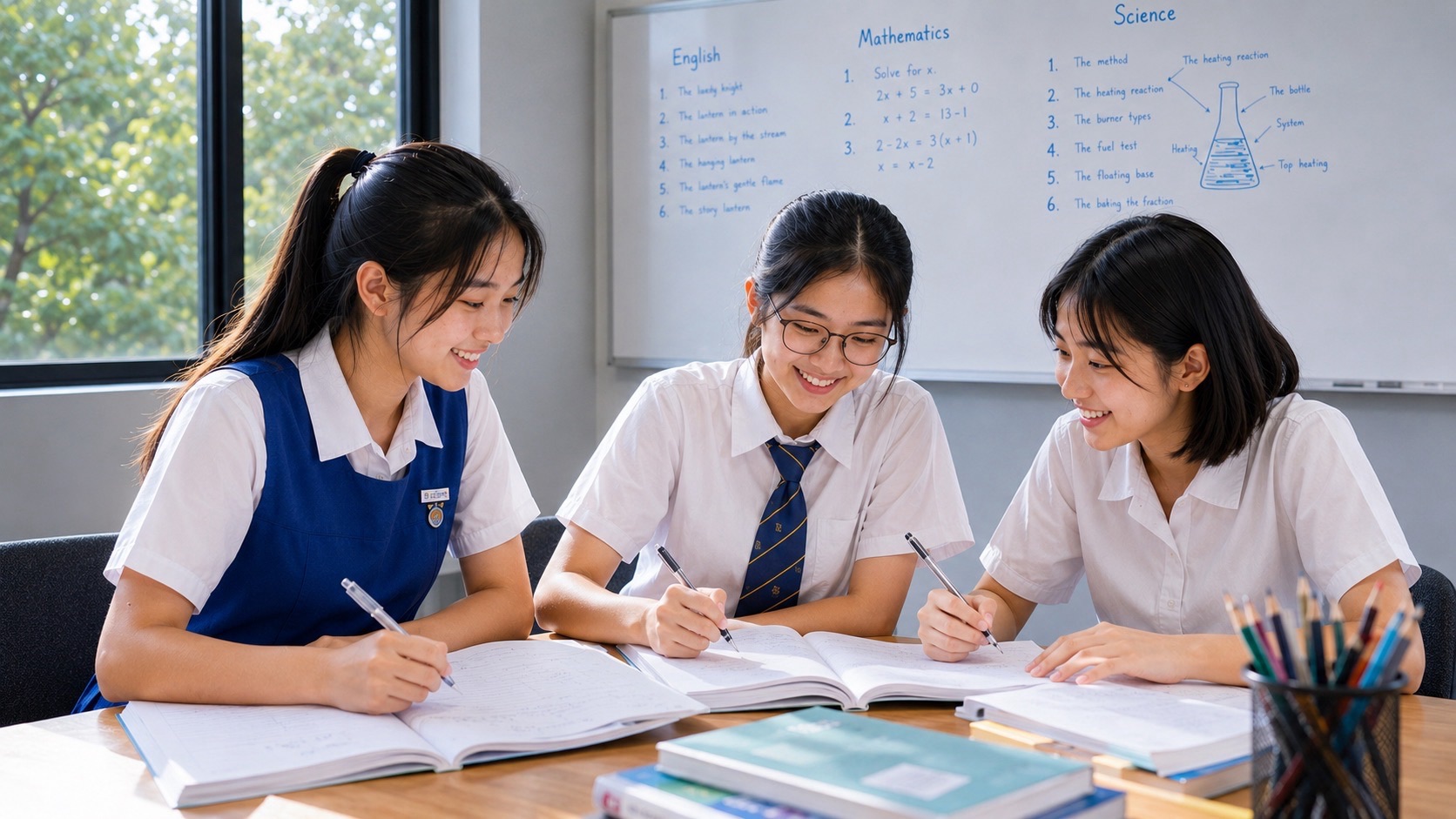
Three students lets the tutor inspect reasoning rather than only final answers. One student may need a particle model rebuilt; another may need graph calibration; another may know the Science but fail the command word. The lesson remains shared while the repair can be precise.
What Progress Looks Like in Secondary 1
- the student can distinguish model from observation;
- matter categories are based on composition/properties rather than memorised examples;
- separation methods are chosen from property differences;
- cell diagrams are connected to organisation and function;
- ray diagrams preserve physical direction relationships;
- laboratory procedures are understood as evidence-producing systems;
- graphs are set up from variables and units;
- scientific vocabulary has clear boundaries;
- open-ended explanations are shorter and more causal;
- Primary Science knowledge remains retrievable;
- the student can move between prose, diagram and data without losing the concept.
Frequently Asked Questions
Does every Singapore school teach the same Secondary 1 Science chapters in the same order?
No. The lower-secondary syllabus is a two-year architecture and schools can sequence topics differently. Tuition should align to the student’s current school sequence while preserving the full lower-secondary model.
What are the five G2/G3 Lower Secondary Science themes?
Scientific Endeavour, Diversity, Models, Interactions and Systems.
Is G1 Lower Secondary Science identical to G2/G3?
No. G1 uses a more contextual syllabus structure. The exact subject level taught by the school should guide the student’s content route.
Why do students who did well in PSLE Science sometimes drop in Secondary 1?
The representation and abstraction load increases. Particles, atoms, cells, rays, graphs and laboratory evidence require new ways of thinking, not merely more facts.
Should Sec 1 students start studying pure Physics, Chemistry and Biology separately?
Not usually as a replacement for lower-secondary Science. The lower-secondary course is specifically designed to provide the foundations that later disciplinary sciences reuse. Extra depth should clarify the current model, not fragment the student into three premature syllabuses.
Continue Through Secondary Science
Secondary 1 Science Tuition at eduKateSG
Secondary 1 Science is successful when the student stops treating every diagram as something to copy and starts treating it as a model that can be interrogated.
We build the scientific backbeats first—observation, model, variable, evidence, representation and causal explanation—then let the school’s actual chapter sequence ride on top of them.
The first secondary-school Science skill is not knowing more. It is learning how scientific representations carry meaning.
eduKateSG · 8 Fourth Avenue · Singapore 268674 · Near Sixth Avenue MRT · Premium 3-pax small-group tutorials · typically 1.5 hours weekly.