Punggol · Secondary 2 Mathematics · Full SBB · G1/G2/G3 · Up to 3 Students
Secondary 2 Math Tutor Punggol
Building essential skills for success.
Secondary 2 is the year Mathematics changes from a collection of methods into a connected system.
A student must increasingly recognise structure, control algebra, read graphs, reason through geometry and translate unfamiliar situations into mathematical relationships.
The aim is not to rush into Secondary 3. It is to arrive there with the machinery ready.
Recognise the structure → choose the method → show valid working → check the result → transfer the idea.
Secondary 2 Mathematics tuition in Punggol at a glance
A bridge year for algebra, reasoning and upper-secondary readiness.
Secondary 1 introduces the new language of secondary Mathematics. Secondary 2 asks the student to use that language with greater control.
The child is no longer solving only familiar arithmetic problems. Symbols must be manipulated correctly, graphs must be interpreted, geometric facts must be connected and working must remain clear enough to verify.
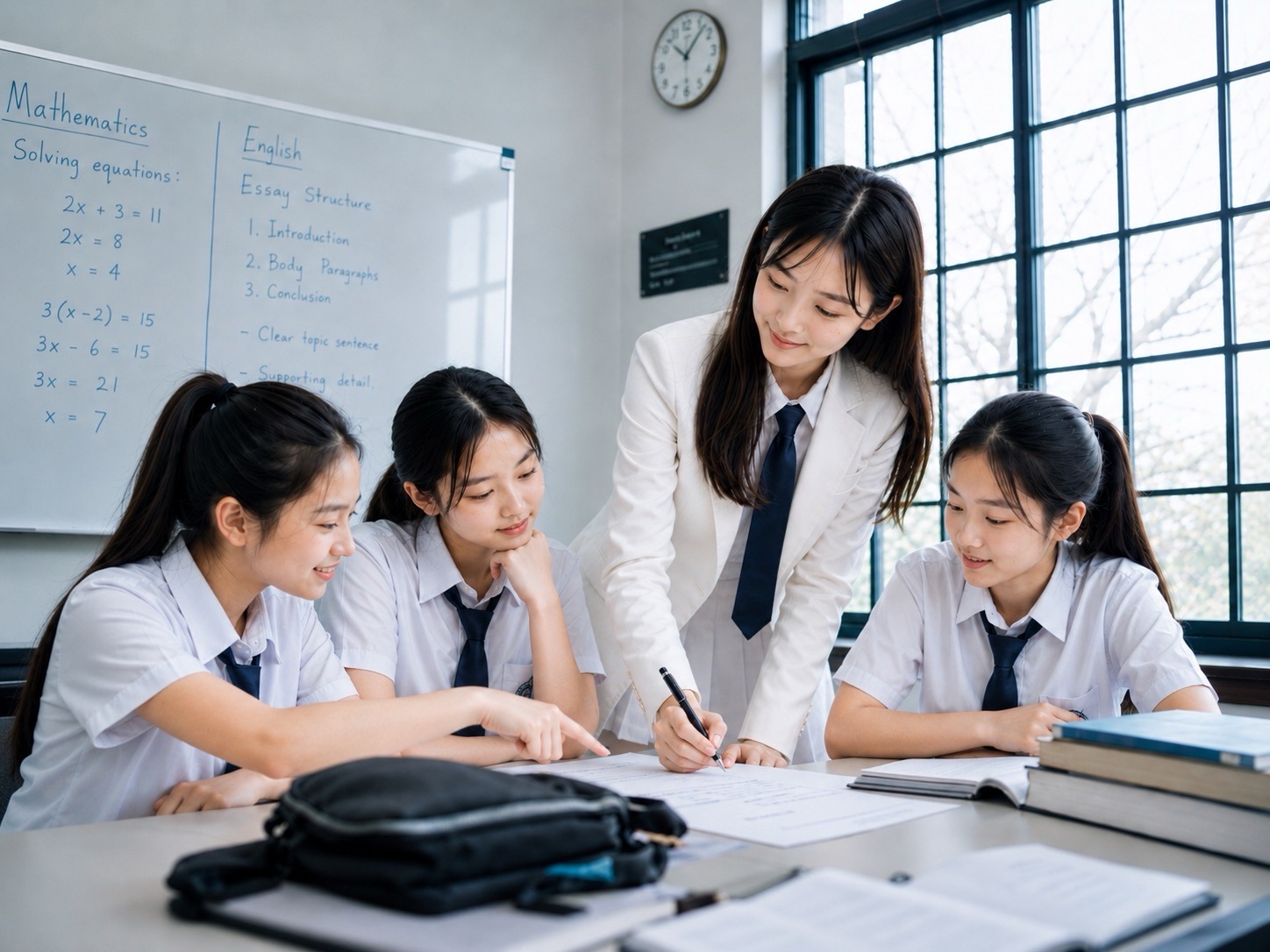
At eduKate Punggol, classes are kept to a maximum of three students so the tutor can see not only whether an answer is wrong, but where the mathematical route began to drift.
Lower-secondary consolidation before the larger Secondary 3 transition.
Teaching begins from the student’s actual Mathematics syllabus and school demand.
Close observation, individual correction and useful peer comparison.
Understand why the method applies, execute it accurately and verify the result.
Build present performance while preparing the next mathematical load.
Singapore 828761 · Classes and consultations by appointment.
Why Secondary 2 Mathematics matters
This is the year the student’s mathematical operating system becomes visible.
Primary Mathematics often allows a child to rely heavily on arithmetic, familiar models and repeated question forms. Secondary Mathematics increasingly requires symbolic control, abstraction and a valid chain of working.
Use arithmetic, ratios, fractions and problem-solving models within familiar primary structures.
Meet algebraic notation, negative numbers, equations, graphs and formal mathematical language.
Coordinate algebra, representations, geometry, data and problem-solving with cleaner working.
Handle heavier Mathematics and, where offered, the additional symbolic demands of Additional Mathematics.
Select methods, preserve accuracy and complete unfamiliar questions under examination conditions.
The old habit
See numbers → start calculating
This may work for a familiar question, but it becomes fragile when the student must define an unknown, form an equation or compare representations.
The Secondary Mathematics habit
Read structure → choose method → verify
The student learns to delay calculation long enough to identify the relationship that the question is actually testing.
A hardworking student may still struggle when Primary-style habits are being used inside a Secondary Mathematics problem.
Full Subject-Based Banding and Mathematics
The school year tells us the stage. The subject level tells us the mathematical demand.
Under Full SBB, Posting Groups guide secondary-school admission and initial subject levels. Students may study Mathematics at G1, G2 or G3 according to readiness, strengths and learning needs.
It is not a permanent label for every subject.
Posting Groups concern entry into secondary school. The Mathematics subject level may differ from the student’s other subjects where appropriate.
The subject level determines the syllabus demand.
Good tuition should not place all Secondary 2 students onto one identical track simply because they are the same age.
Readiness can be reviewed at appropriate junctures.
The practical focus remains the same: strengthen present control and create enough evidence for the next realistic level of challenge.
Used for secondary-school admission and to guide initial subject levels.
The level applies to the individual subject being studied.
Students sit subjects at their respective G1, G2 or G3 levels.
SEAB lists G3 Mathematics as K310 and G3 Additional Mathematics as K341 for 2027 school candidates.
Subject combinations and criteria for offering Additional Mathematics differ across schools. A strong Secondary 2 foundation improves readiness, but it does not by itself guarantee a particular Secondary 3 subject combination.
Why Secondary 2 students lose Mathematics marks
The answer is visible. The breakdown is usually one layer earlier.
Two students may score the same mark for entirely different reasons. One may not understand the concept. Another may understand it but lose control during algebra, translation, working or checking.
“My child keeps making basic number errors.”
- May be underneath
- Weak negative-number control, fractions, ratio, indices, order of operations or arithmetic fluency.
- Useful first move
- Identify the earliest unstable operation and rebuild it inside Secondary-level questions.
“The student understands the example but cannot do the next question.”
- May be underneath
- Steps were copied without understanding equivalence, inverse operations, expansion, factorisation or substitution.
- Useful first move
- Explain what each transformation preserves, then vary the question until the method becomes transferable.
“Word problems create a blank page.”
- May be underneath
- The student cannot define the unknown, identify the relationship or convert language into an equation, graph or diagram.
- Useful first move
- Separate the situation from the calculation and build the mathematical representation first.
“Graphs and geometry feel like unrelated topics.”
- May be underneath
- The student memorises procedures but cannot move between a diagram, table, equation, graph and verbal description.
- Useful first move
- Teach the same relationship through several representations and make the invariant visible.
“The method is correct, but marks still disappear.”
- May be underneath
- Skipped steps, unclear notation, wrong signs, premature rounding, missing units or calculator entry errors.
- Useful first move
- Create a working layout that is concise enough for speed and complete enough for checking.
“The child can do the homework but not the test.”
- May be underneath
- Slow method selection, over-reliance on help, weak retrieval, poor time decisions or anxiety after an early difficult question.
- Useful first move
- Move gradually from supported attempts to mixed, timed and independent work.
“Do another worksheet.”
The student may rehearse the same fragile method and produce another version of the same error.
“This is where the reasoning changed course.”
The tutor separates concept, representation, algebra, execution and performance.
“The next attempt is different.”
The student can recognise the pattern and use the repaired method without being led through every step.
What Secondary 2 Mathematics tuition should build
Four forms of control must begin to work together.
Reliable performance requires more than formula memory. The student needs conceptual understanding, method selection, representation and disciplined execution.
Understand the relationship beneath the procedure.
The student sees why an algebraic transformation, graph property or geometric rule is valid.
- definitions and conditions
- number and algebra foundations
- relationships between quantities
- common misconceptions
Recognise what kind of mathematical action is needed.
The student learns to classify the problem, identify the target and select an efficient route.
- topic and sub-skill recognition
- multi-step planning
- formula selection
- alternative solution routes
Move between words, symbols, tables, graphs and diagrams.
Representation is where an unfamiliar problem becomes mathematically manageable.
- define unknowns
- form equations and inequalities
- draw and interpret graphs
- annotate geometric diagrams
Carry the method through without losing accuracy.
Working, calculator use, checking and time decisions are trained as part of Mathematics—not as afterthoughts.
- clear working layout
- sign and notation control
- units and rounding
- reasonableness checks
The student should not only follow a demonstrated solution. The student should increasingly be able to identify the structure, choose the method and explain why the answer is reasonable.
What happens during a purposeful Mathematics lesson
Expose the method. Watch the attempt. Correct the exact drift.
A useful lesson should not become a tutor solving one question after another while the student watches. The child needs repeated opportunities to make the mathematical decisions.
Retrieve
Revisit a key rule, earlier correction or prerequisite operation before new work begins.
Diagnose
Use the student’s working to locate the first point where understanding or control breaks.
Explain
Teach the concept from first principles and show what each step preserves.
Guide
Let the student make the next decisions with prompts that reduce as control improves.
Correct
Name the error type, repair the working and compare the weak and stronger route.
Retest
Change the numbers, representation or context and check whether the idea transfers independently.
What the tutor is observing
The working shows how the student is thinking.
- Entry pointDid the student understand what was given, what was required and which relationship mattered?
- Method choiceWas the method selected deliberately, remembered vaguely or guessed from a familiar-looking number?
- Algebra controlWere signs, brackets, powers, fractions and equality preserved through every transformation?
- RepresentationCould a diagram, graph, equation or table make the structure clearer?
- CheckingDid the student substitute back, estimate, inspect units or test whether the result was sensible?
- TransferCan the student solve a new version without copying the surface form of the example?
Homework should consolidate a known mathematical purpose. A short set that repairs one algebraic habit may be more valuable than a long paper completed with the same unresolved error.
Why we teach in groups of up to three
Mathematical errors need to be seen close to where they are made.
In a large class, a correct final answer can hide an unreliable route. A wrong answer can also be corrected too generally. Three students gives the tutor enough proximity to inspect the actual working.
The tutor can inspect the route, not only the answer.
Signs, skipped steps, weak notation and inefficient methods can be corrected before they become repeated habits.
Reasoning becomes audible.
Students are asked why the method applies, what the graph means and how they know the result is reasonable.
Shared teaching does not require identical work.
One student may repair number foundations while another strengthens algebra or prepares for more demanding upper-secondary work.
The three-student balance
Close correction + useful comparison
Students see that one problem may have more than one valid route while the tutor keeps each learner’s individual weaknesses visible.
The participation rule
Predict → attempt → explain → refine
The lesson should feel like active mathematical thinking, not a miniature lecture followed by silent copying.
The main Secondary 2 Mathematics corridors
The topics are connected by the same deeper habits.
Schools may sequence content differently, and G1, G2 and G3 demands are not identical. The useful teaching question is how each topic strengthens the student’s mathematical system.
Symbols must become objects the student can control.
Expressions, equations, inequalities, substitution and algebraic manipulation carry directly into later Mathematics.
- equivalence and inverse operations
- brackets, signs and powers
- forming equations
- checking by substitution
A graph is not a picture beside the equation.
Students learn to connect coordinates, change, intercepts, patterns and algebraic relationships.
- plot and read accurately
- interpret axes and scale
- connect tables and equations
- describe mathematical change
Diagrams must be read as systems of constraints.
Angle properties, congruence, similarity, Pythagorean relationships and mensuration reward organised visual reasoning.
- mark given information
- state the property used
- connect several steps
- preserve units and scale
Numbers must be interpreted, not merely calculated.
Students read tables and graphs, compare distributions, calculate measures and judge what the data actually supports.
- organise information
- select a suitable measure
- interpret context
- avoid unsupported conclusions
Three Secondary 2 Mathematics student routes
Catch up. Keep up. Move ahead.
The correct route is not determined by ambition alone. It depends on present foundations, school pace, confidence, subject level and the student’s ability to work independently.
Catch up by repairing the earliest weak carrier
For the student whose present work is being limited by missing Primary or Secondary 1 foundationsReturn to the first unstable operation or concept, rebuild it clearly and reconnect it to current Secondary 2 questions.
- repair number and fraction control
- stabilise negative numbers and algebra
- reduce blank-page responses
- restore confidence through achievable steps
Keep up by converting understanding into consistency
For the student who follows lessons but produces uneven school resultsStrengthen retrieval, method selection, working layout, correction habits and mixed-topic performance.
- close the delay between school and mastery
- reduce repeated careless errors
- improve word-problem translation
- prepare steadily for school examinations
Move ahead through stronger reasoning
For the student who is secure at the present level and ready for greater mathematical depthUse unfamiliar applications, alternative methods and more demanding algebra to widen the student’s upper-secondary corridor.
- solve less familiar problems
- compare efficient solution routes
- deepen algebraic fluency
- prepare calmly for Secondary 3 demand
Do not accelerate around a weak algebra foundation. Do not hold a secure student inside work that no longer requires thought.
Preparing for Secondary 3 Mathematics
Readiness is a collection of mathematical behaviours—not one examination score.
Secondary 3 brings heavier content and less room for unresolved lower-secondary habits. Students considering Additional Mathematics need especially dependable algebra, notation and problem-solving control.
Brackets, fractions, signs, powers and equations remain stable through several steps.
The student can translate words, equations, tables, graphs and diagrams.
The solution is clear enough to award method marks and locate an error.
The student can classify the problem and make a reasonable first move without waiting for a model answer.
Ordinary Mathematics readiness
Secure foundations + mixed-topic control
The student can retrieve methods, connect topics and maintain accuracy when the question no longer announces the chapter.
Additional Mathematics readiness
Strong algebra + symbolic stamina
Where the school offers A-Math, readiness depends heavily on algebraic fluency, willingness to reason and the discipline to sustain longer solutions.
How to choose a Secondary 2 Math tutor in Punggol
Look for mathematical diagnosis, not only answer demonstration.
A useful programme should be able to explain what the student understands, where the method breaks, how correction will be taught and what evidence will show that the repair is becoming independent.
Does the tutor inspect actual working?
The page reveals far more than the total mark: entry point, notation, signs, method selection, layout and checking.
Look forSpecific observations rather than the broad instruction to practise more.Is the teaching aligned to the actual subject level?
G1, G2 and G3 Mathematics require the right pace, content and degree of abstraction.
Look forNo assumption that every Secondary 2 learner needs the same worksheet or destination.Are concepts explained before shortcuts?
Efficient techniques become useful after the student understands why they preserve a valid mathematical relationship.
Look forFirst-principles explanation followed by increasing efficiency.Does correction change the next attempt?
A student should rework the problem, identify the error type and prove transfer in a changed question.
Look forReattempts and retesting rather than passive copying of solutions.Is upper-secondary preparation calm and realistic?
The tutor should strengthen current Mathematics before adding more advanced content for appearance alone.
Look forPreparation that widens readiness without sacrificing foundations.Is progress described honestly?
Mathematics improves through clearer concepts, better transfer, cleaner working and stronger independent performance.
Look forNo guaranteed grade—only a defined teaching process and observable evidence.Bring a recent school paper or worksheet. The student’s actual working can show whether the next priority is foundation repair, algebra control, problem translation, examination discipline or greater challenge.
Frequently asked questions
Clear answers before a family chooses the next step.
Secondary 2 tuition should serve a defined purpose. The child may need repair, consolidation, examination control or stronger preparation for the next stage.
Why is Secondary 2 Mathematics an important year?
It is the final lower-secondary year before content, pace and subject combinations become more demanding. Algebra, graphs, geometry, data and working habits built now carry directly into Secondary 3 Mathematics.
How many students are in an eduKate Punggol Mathematics class?
Classes are designed for a maximum of three students. This allows the tutor to inspect each student’s working closely while retaining useful discussion and comparison between solution methods.
Can tuition help when the student has weak Primary Mathematics foundations?
Yes, but the tutor should identify the specific carrier that is still weak—such as fractions, ratio, negative numbers, arithmetic or problem translation—and reconnect it to current Secondary 2 work.
Does a Secondary 2 student need to start Additional Mathematics early?
Not automatically. Strong algebra, mathematical reasoning and present-school control matter more than premature chapter coverage. Some students benefit from gentle preparation; others need their lower-secondary foundations secured first.
Do you teach G1, G2 and G3 Mathematics?
Teaching should follow the student’s actual subject level and school demand. Placement, pace and materials are discussed so that the work is neither inaccessible nor unnecessarily easy.
Can a strong student benefit from Secondary 2 Math tuition?
Yes. A strong student may need less repetition and more unfamiliar applications, alternative methods, algebraic depth, proof-like explanation and preparation for upper-secondary Mathematics.
What should we bring for an initial discussion?
A recent test, examination paper or worksheet with the student’s original working is especially useful. It helps distinguish concept gaps from execution, timing and checking problems.
The next practical step
Bring the working. Find the first mathematical break. Choose the right route.
A useful consultation should make the student’s present position clearer: subject level, recurring error type, first repair, suitable class pace and the evidence that will show improvement.
Confirm the context.
Secondary 2, actual G1/G2/G3 Mathematics level, school pace and present assessment calendar.
Bring recent evidence.
A school paper, topical test or worksheet showing the student’s original working and corrections.
Locate the mechanism.
Foundation, concept, algebra, representation, translation, working, time or confidence.
Choose the route.
Catch up, keep up or move ahead towards stronger Secondary 3 readiness.
What should become clearer?
The family should understand what the student can already do, where control weakens, which repair comes first and how progress will be recognised.
- Subject level
- The actual G1, G2 or G3 Mathematics course
- Evidence
- Current working rather than a broad label
- Priority
- The first mathematical carrier with the greatest likely benefit
- Class fit
- Compatible pace, temperament and challenge
- Progress
- Better transfer, accuracy and increasing independence
Three students. Close correction. A stronger bridge into upper secondary.
The small-group format keeps every page visible while preserving mathematical discussion, comparison and individual routes.
- For students behind
- Repair foundations and restore mathematical confidence
- For students plateauing
- Improve algebra, transfer, working and consistency
- For strong students
- Deepen reasoning and prepare for greater upper-secondary demand
- Level
- Secondary 2 Mathematics at the student’s actual subject demand
- Location
- 83 Punggol Central, Singapore 828761
Secondary 2 Math Tutor Punggol
Less guessing. More structure. Better Mathematics.
Secondary 2 becomes valuable when the student can see how Mathematics is built: identify the relationship, represent it clearly, preserve every valid step and learn from the exact point of error.
Do not wait for weak algebra to meet upper-secondary pressure.
Do not confuse more questions with deeper control.
Use the bridge well.
Official context
Built around Singapore’s current Secondary Mathematics pathway.
Parents can use the official pages below to verify the current G1/G2/G3 syllabuses, Full SBB arrangements and the 2027 SEC subject references.
Secondary School Curriculum and Syllabuses
Official links to the 2020 G1 Mathematics and G2/G3 Mathematics syllabuses.
Open the syllabus page → Ministry of EducationSecondary School Experience Under Full SBB
Official explanation of Posting Groups, G1/G2/G3 subject levels and flexibility across the secondary-school journey.
Open the Full SBB guide → Singapore Examinations and Assessment BoardSecondary Education Certificate
Official information on the SEC from 2027 and subjects taken at G1, G2 or G3 levels.
Open the SEC guide → Singapore Examinations and Assessment Board2027 G3 Syllabuses
Official subject references including K310 Mathematics and K341 Additional Mathematics.
Open the G3 list →Official context reviewed in July 2026. School topic sequence, assessment design, subject-level movement and Secondary 3 subject-combination criteria may vary; families should refer to their child’s school for local arrangements.
Secondary 2 Math Tutor Punggol: Building Essential Skills for Success
Secondary 2 is a critical year in mathematics, as students prepare to transition to upper secondary math concepts and strengthen their foundation for the GCE O-Level exams. At eduKate Singapore in Punggol, our Secondary 2 Math Tutoring program is designed to equip students with essential math skills, effective problem-solving techniques, and the confidence needed to excel. Our experienced tutors provide personalized support that caters to each student’s unique needs, ensuring academic growth and success.
Why Secondary 2 Math Tutoring is Important
As math becomes more complex in secondary school, students need a solid understanding of foundational concepts to tackle advanced topics. Our Secondary 2 Math Tutoring program focuses on reinforcing foundational skills, teaching effective study strategies, and preparing students for the challenges of upper secondary math.
1. Comprehensive Curriculum Aligned with MOE Syllabus
Our tutoring program follows the MOE Secondary Math syllabus, covering all essential topics required for Secondary 2, including:
- Algebraic Expressions and Equations: Strengthening skills in solving linear equations, inequalities, and algebraic manipulation.
- Geometry and Trigonometry: Developing spatial understanding, angle properties, and introductory trigonometric concepts.
- Graphs and Functions: Understanding linear, quadratic, and exponential functions, and interpreting graphs.
- Statistics and Probability: Building a foundation in data analysis, probability calculations, and statistical representations.
By aligning with the MOE syllabus, we ensure that students receive structured support that prepares them for school assessments and future math topics in Secondary 3.
2. Targeted Support for Individual Learning Needs
Each student has unique strengths and areas for improvement. Our Secondary 2 Math Tuition small group classes and one-on-one sessions offer individualized support, allowing tutors to address specific needs and learning gaps. This personalized approach enables students to focus on areas where they need additional help, enhancing their overall understanding and performance in math.
This targeted support helps students feel more confident, make steady progress, and tackle challenging concepts with ease.
3. Developing Problem-Solving Skills and Logical Reasoning
Our Sec 2 Math Tuition program emphasizes problem-solving skills and logical reasoning, which are essential for mastering math. We teach students how to approach math problems systematically, analyze questions, and apply effective strategies to solve them. Key problem-solving techniques include:
- Breaking Down Complex Problems: Simplifying questions into smaller, manageable steps.
- Identifying Patterns and Relationships: Recognizing patterns and relationships to find efficient solutions.
- Using Models and Visuals: Leveraging diagrams, graphs, and models to better understand problems.
By building these skills, students gain confidence in their ability to handle complex questions and develop the analytical thinking required for future math topics.
4. Exam Preparation for Secondary 2 Assessments
Exam preparation is a core component of our tutoring program. We equip students with exam-focused strategies that help them excel in Secondary 2 assessments and prepare them for the demands of the GCE O-Level math syllabus. Key strategies include:
- Time Management: Teaching students how to allocate time effectively for each section of the exam.
- Answer Structuring: Guiding students to present answers clearly and accurately for maximum marks.
- Mock Exams and Practice Papers: Providing practice with past papers and mock exams to familiarize students with the exam format.
By practicing under timed conditions and developing effective answering techniques, students build the confidence and skills needed to perform well in exams.
5. Experienced Tutors Committed to Student Success
Our Sec 2 Math tutors at eduKate Singapore bring years of experience in teaching Secondary Math. They use engaging, interactive methods to make learning enjoyable and accessible. With a commitment to student success, our tutors offer:
- Interactive Lessons: Using real-world examples and practical applications to make math concepts relevant.
- Continuous Feedback: Regular assessments and feedback to help students track their progress and understand areas for improvement.
Our Sec 2 Math tutors are dedicated to nurturing each student’s potential, providing the guidance and support they need to excel in Secondary 2 Math and beyond.
Tuition Rates and Packages
At eduKate Singapore, we offer competitive tuition rates, allowing families to choose the best support level for their needs.
Here’s an overview of typical Singapore Secondary 2 Math Tutor rates:
| Tutor Type | Rate per Hour |
|---|---|
| Part-Time Tutors | $30-$40/h |
| Full-Time Tutors | $40-$50/h |
| Ex/Current MOE Teachers | $60-$80/h |
| Professional Tutors | $90-$120/h |
Our Secondary 2 Math Tutoring program combines affordability with quality instruction, ensuring students receive the support they need to succeed.
Key Components of Our Secondary 2 Math Tutoring Program
Our tutoring program in Punggol is structured to provide comprehensive, personalized, and engaging learning experiences for each student, focusing on foundational skills, problem-solving, and exam readiness.
1. In-Depth Coverage of Essential Math Topics
We cover all essential topics in the MOE Secondary 2 Math syllabus, including algebra, geometry, trigonometry, and statistics. This comprehensive approach equips students with the skills they need to progress confidently into upper secondary math.
2. Intensive Preparation for School Assessments and Future Exams
Our program includes focused preparation for school exams, teaching students effective exam techniques and problem-solving strategies:
- Answering Techniques: Teaching students how to interpret questions accurately and structure their answers effectively.
- Mock Exams: Providing practice under timed conditions to improve time management and reduce exam anxiety.

3. Real-Life Applications of Math Concepts
Our tutors incorporate real-world examples to demonstrate how math applies in daily life, making learning more relevant and engaging. This approach helps students understand the practical importance of math, enhancing their appreciation for the subject.
At eduKate Singapore, we believe that every student can excel in math with the right guidance and support. Our Secondary 2 Math Tutoring program in Punggol is designed to build essential skills, develop critical thinking, and instill confidence as students prepare for upper secondary math and the GCE O-Level exams.
- Integrity: We foster a learning environment that values honesty and accountability, helping students become responsible learners.
- Empathy: Understanding that math can be challenging, we provide a supportive space where students feel comfortable seeking help.
- Critical Thinking: Our program emphasizes problem-solving skills, preparing students for higher-level math and real-world applications.
- Responsibility: We teach students to take ownership of their learning, encouraging active participation in their academic journey.
Our Secondary 2 Math Tutoring program is designed to help students grow academically and build valuable skills for lifelong success.
How can eduKateSG help your child improve in Secondary Mathematics?
Secondary Mathematics improves when the problem is repaired at the correct layer. Some students need foundation repair. Some need algebra control. Some need graph sense, geometry reasoning, exam timing, or Paper 1 and Paper 2 discipline. Select your child’s level, pathway and the skill that needs fixing to see how eduKateSG helps students from Secondary 1 to Secondary 4 across G1, G2 and G3 Mathematics / E-Math.
We look at the child’s actual working, not only the final answer. The working shows whether the problem is concept knowledge, algebra control, weak foundation, careless layout, calculator misuse, poor timing or examination pressure.
eduKateSG helps students install the Secondary Mathematics operating system.
At Secondary 2 in G3 Mathematics / E-Math, students must move beyond PSLE-style arithmetic and problem sums into algebra, graphs, geometry, statistics, modelling and more disciplined examination working.
We check whether the child is still using Primary-style habits: arithmetic-only thinking, weak algebra, messy working, incomplete steps or poor checking.
We recalibrate the student to Secondary Mathematics by training concept clarity, algebra control, graph sense, geometry reasoning, application skill and exam discipline.
The student learns to identify the topic, choose the method, show working clearly, control algebra and check the answer.
Parents can expect a clearer repair plan instead of vague advice such as “practise more” or “be more careful”.
We help students catch up, keep up and move ahead. Secondary Mathematics improves when concepts, working habits, algebra, graphs, geometry, problem-solving and examination craft are trained as one connected system.
What Secondary Mathematics problem is your child facing?
Secondary Mathematics is a major shift from PSLE Mathematics. Students now need algebra control, graph sense, geometry reasoning, number accuracy, problem-solving discipline and examination craft. Select the level, course pathway and closest Mathematics concern to see what may be happening and how eduKate Punggol helps students from Secondary 1 to Secondary 4 across G1, G2 and G3 Mathematics / E-Math.
The same mark can hide different problems. A student may lose marks from weak algebra, poor working layout, careless calculator use, weak question translation, time pressure or missing Secondary-level reasoning.
Secondary Mathematics is a new operating system after PSLE.
At Secondary 2 in G3 Mathematics / E-Math, students are expected to move beyond Primary-style problem sums into stronger algebra, graphs, geometry, data, reasoning and examination habits.
The child may still be hardworking, but the marks do not rise because the old PSLE Mathematics habits no longer fully match Secondary expectations.
The child may be relying on arithmetic and memorised steps while Secondary Mathematics now requires algebra, structure, proof, graph sense and clearer working.
We rebuild the Mathematics operating system: number control, algebra, equations, graphs, geometry, statistics, word-problem translation and exam routines.
Learn how Secondary Mathematics questions are structured. The student must show working clearly, identify the method, use algebra accurately and check the answer.
We help students catch up, keep up and move ahead. Secondary Mathematics improves when concepts, working habits, algebra control, problem-solving and exam craft are trained as one connected system.
Join Our Secondary 2 Math Tutoring Program in Punggol Today
Empower your child with the skills and confidence to succeed in math. At eduKate Singapore, we are dedicated to nurturing each student’s potential through quality education and personalized support.
Contact Us to Enrol or Learn More:
Phone: +65 8823 1234
Email: admin@edukatesg.com
Website: eduKate Singapore Contact
Follow us on Facebook for updates, educational tips, and more:
Useful Links
- MOE Secondary Education: Learn more about secondary education in Singapore at the Ministry of Education.
- MOE Syllabus Information: View the official syllabus at the MOE Curriculum Syllabus.
- SEAB GCE O-Level Information: For details on the GCE O-Level examinations, visit the Singapore Examinations and Assessment Board.
Boost Your Child’s Confidence with Effective Math Tuition in Punggol
Preparing for secondary-level Mathematics is a crucial step in every student’s academic journey, and it requires focus, effective study habits, and a structured approach. Early preparation with a reliable Math Tuition program in Punggol is essential to develop a strong mathematical foundation and foster confidence. This guide covers why preparing early in secondary Math is beneficial, what to expect from Math Tuition in Punggol, and the key advantages of enrolling your child in a dedicated tuition program.
Why Early Preparation Matters in Secondary Math
Secondary Mathematics introduces more complex concepts, often requiring a deeper understanding and higher-level problem-solving skills than primary school math. Early preparation sets a solid foundation, allowing students to approach the subject with confidence and mastery as they progress. Here’s why getting a head start is essential:
- Builds Core Mathematical Skills: Early preparation ensures that students have a thorough understanding of foundational topics. Strengthening core skills like algebra, geometry, and data analysis makes it easier to tackle advanced concepts later.
- Reduces Exam Pressure: Starting early allows students to learn concepts gradually, without the last-minute cramming that can lead to stress. With steady progress, they’ll be better prepared for major exams like the GCE O-Level.
- Promotes Consistency in Learning: Consistent practice is key to excelling in Mathematics. Early preparation cultivates a disciplined study routine that benefits students throughout their academic career.
- Boosts Confidence: As students become more familiar with mathematical concepts over time, they gain confidence in their abilities, which is invaluable during exams and challenging assignments.
What to Expect with Math Tuition in Punggol
Effective Math Tuition in Punggol offers structured lessons that cater to individual learning needs, ensuring each student receives the attention they need to thrive. Here’s what you can expect:
1. Baseline Assessment
The first step in any successful tuition program is to assess each student’s current understanding of mathematics. This diagnostic assessment helps tutors identify areas where the student excels and those that may need extra focus, allowing for a tailored study plan.
2. Focused Learning Modules
Punggol Math Tuition provides structured lessons covering topics such as algebra, trigonometry, calculus, and statistics. Each lesson is organized to help students build their skills progressively, moving from foundational topics to more complex concepts.
3. Engaging and Interactive Lessons
The best Math Tuition programs engage students through interactive lessons that make learning enjoyable. In Punggol, Math Tuition centers often incorporate educational games, group problem-solving sessions, and technology-based learning tools, fostering a stimulating learning environment.
4. Regular Practice and Homework Assignments
Practice is crucial to mastering Mathematics. Students can expect to receive regular homework assignments and practice worksheets to reinforce what they’ve learned in each session. These assignments are tailored to the student’s current level and progress.
5. Frequent Progress Monitoring
Continuous assessment helps track each student’s improvement, ensuring they are on the right path. Tutors frequently provide feedback on strengths, weaknesses, and areas to improve, keeping both students and parents informed of progress.
6. Small Group Sessions for Personalized Attention
Small group classes ensure each student receives ample attention and guidance from the tutor. Punggol Math Tuition programs typically maintain low student-to-tutor ratios, allowing for more interaction and personalized support.
7. Exam Techniques and Strategies
Exam preparation goes beyond understanding content. Punggol Math Tuition centers also focus on teaching students effective strategies for handling exam questions, managing time during exams, and improving answer accuracy.
Advantages of Enrolling in Punggol Math Tuition
Math Tuition in Punggol offers a supportive environment where students can excel academically and develop confidence in their mathematical abilities. Key advantages include:
1. Personalized Learning Experience
Each student learns differently, and Math Tuition in Punggol accommodates individual learning styles. Tutors can adjust lessons and pace to suit the needs of each student, providing a customized experience that boosts understanding and retention.
2. Enhanced Exam Preparation
Punggol Math Tuition centers understand the demands of secondary school and national exams. They equip students with the necessary skills to tackle various question types, manage time effectively, and handle exam pressure.
3. Improvement in Problem-Solving Skills
Math Tuition encourages analytical thinking and problem-solving skills essential in Mathematics. Students learn to approach problems methodically, analyze options, and apply formulas accurately, preparing them for more complex math in higher levels.
4. Supportive Learning Environment
The structured environment in Punggol Math Tuition provides students with a safe space to ask questions, seek clarification, and gain encouragement. With a positive atmosphere, students develop a growth mindset and a genuine interest in learning.
5. Continuous Feedback and Parental Involvement
Tutors provide regular feedback on student progress, involving parents in the learning process. This communication helps reinforce learning objectives and ensures students stay motivated and focused.
6. Greater Confidence and Independence
Through consistent practice and mastery of concepts, students gain confidence in their abilities. This self-assurance encourages independent learning, enabling students to tackle challenging topics on their own.
Why Choose EduKatePunggol for Math Tuition?
EduKatePunggol stands out as a top choice for Secondary Math Tuition in Punggol, providing students with high-quality, personalized education. Here’s what sets EduKatePunggol apart:
- Experienced Tutors: Our tutors have extensive experience with the MOE Secondary Math syllabus and are skilled in simplifying complex topics, making them easy to understand.
- Custom Learning Plans: Every student follows a personalized learning plan that targets their unique strengths and weaknesses, ensuring comprehensive preparation for exams.
- Interactive Lessons and Real-World Applications: Math concepts are made tangible through hands-on activities and practical applications, helping students connect what they learn with real-world scenarios.
- Small Group Classes: With small class sizes, each student receives focused guidance and support, allowing tutors to closely monitor individual progress.
- Holistic Development Focus: EduKatePunggol emphasizes holistic growth, including the development of critical thinking, analytical skills, and resilience, which benefit students beyond academics.
By choosing EduKatePunggol for your child’s Secondary Math Tuition, you’re investing in a program that not only strengthens their academic skills but also nurtures confidence, resilience, and a love for learning.
FAQs: Punggol Math Tuition for Secondary School Students
Q: What topics are covered in Secondary Math Tuition at EduKatePunggol?
A: We cover all key topics in the secondary syllabus, including algebra, geometry, trigonometry, and calculus, depending on the student’s level and learning plan.
Q: How are lessons structured at EduKatePunggol’s Secondary Math Tuition?
A: Lessons are structured around individual learning needs and include engaging, interactive activities to help students understand and apply mathematical concepts.
Q: What is the class size for Secondary Math Tuition at EduKatePunggol?
A: We maintain small class sizes to ensure that each student receives personalized attention and support.
Q: Does EduKatePunggol provide regular progress updates?
A: Yes, we maintain regular communication with parents and provide progress reports to ensure students are on track.
Q: How can EduKatePunggol help my child with exam preparation for Math?
A: Our tuition program focuses on understanding mathematical concepts, mastering problem-solving techniques, and building confidence through regular practice and feedback.
Q: What kind of materials are provided in EduKatePunggol’s Math Tuition?
A: Students receive comprehensive materials, including notes, worksheets, and practice papers, to support their learning journey.
Q: How can I enroll my child in EduKatePunggol’s Math Tuition?
A: Contact us through our website to learn more about our enrollment process.
Q: Does EduKatePunggol offer additional support for students struggling with Mathematics?
A: Yes, we provide extra help and personalized strategies for students needing additional support in challenging areas.
Conclusion
EduKatePunggol’s Math Tuition in Punggol goes beyond academic preparation; it’s about building a strong foundation, instilling confidence, and cultivating a love for learning. With our personalized learning plans, hands-on lessons, and experienced tutors, we are dedicated to helping each student excel in secondary Mathematics. Contact us today to learn more about how EduKatePunggol can support your child’s academic success in Mathematics.