
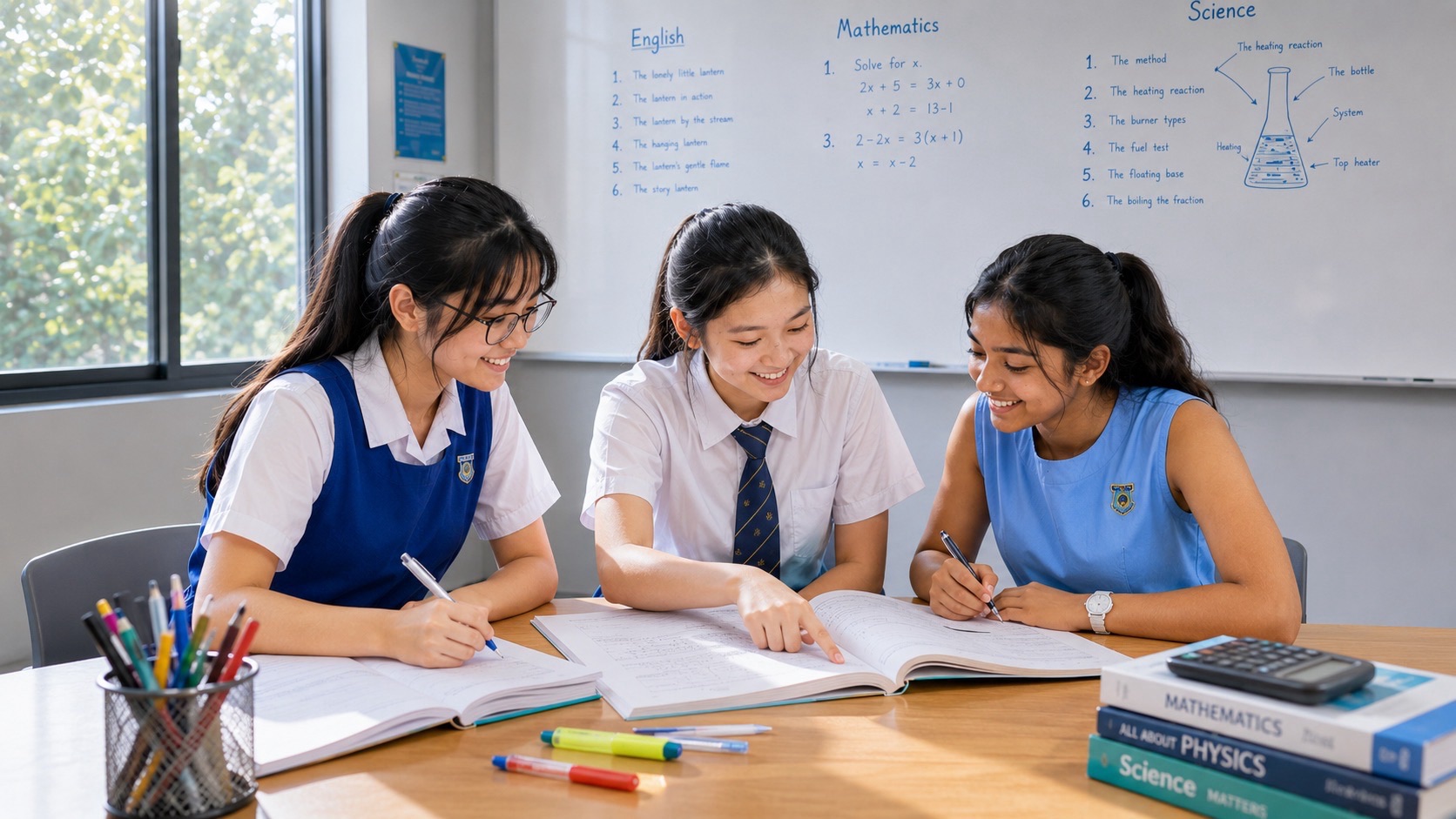
Education OS V1.1 — the abstraction jump, transfer demands, exam pressure flight control, and why Sec 2–3 is the fracture zone
Definition Lock
Secondary education is not “harder primary.”
Secondary is a phase change:
- abstraction increases
- integration increases
- transfer becomes mandatory
- time pressure becomes real
- identity risk rises sharply
Master Lock
Education prevents self-decay.
Secondary must convert Primary foundations into robust transfer under load, or the learner collapses.
What Secondary Education must accomplish (the real job)
Secondary education must produce five outcomes:
- Abstraction competence (models, not scripts)
- Transfer competence (variation tolerance)
- Integration competence (multi-topic problems)
- Exam flight control (time pressure stability)
- Self-repair capability (error correction without dependency)
If these five are missing, learners drift into:
- P1 fragile performance
- or P0 collapse under high-stakes pressure
Why Sec 2–3 is the critical fracture zone
This is where many students break because:
- Primary foundations are assumed, not checked
- content becomes coupled (topics depend on each other tightly)
- variation increases (questions stop being “one-step familiar”)
- time pressure increases
- identity becomes vulnerable (“I used to be good”)
Lock
Sec 2–3 collapse is usually delayed foundation failure + transfer failure, not sudden inability.
Secondary Phase Flight (P0–P3)
Secondary students still sit on P0–P3, but the environment is harsher.
- P0: avoidance, panic, inability to start independently
- P1: can do standard drills, collapses under variation/time
- P2: stable under standard exam conditions
- P3: robust transfer + self-repair + stability under stress
Lock
Secondary success is P2 under exam conditions.
Secondary excellence is P3 transfer and self-repair.
The Secondary capability pillars (what changes)
Pillar A — Abstraction and modelling
Secondary requires models:
- algebra as structure
- science as systems and variables
- English as inference + evidence + precision
- humanities as argument structure + source reliability
Failure pattern: script memorisation, template addiction, “I don’t get it.”
Pillar B — Method choice (not just execution)
Secondary tests if the learner can select methods:
- which formula applies?
- which strategy fits?
- what evidence supports?
Failure pattern: uses the wrong method confidently.
Pillar C — Integration under load
Secondary problems often combine:
- multiple steps
- multiple topics
- multiple constraints
Failure pattern: gets lost, misses conditions, cannot finish.
Pillar D — Transfer training (variation tolerance)
Secondary demands:
- same idea in different clothing
- new contexts
- unfamiliar wording
- mixed question sets
Failure pattern: “I can do homework but exam questions are different.”
Pillar E — Error correction and self-repair
Secondary pace punishes unresolved errors.
Failure pattern: small misconceptions compound into collapse.
Lock
Secondary learners must learn to repair fast, or they drown.
Subject mechanics (Secondary) — quick mapping
Mathematics (especially A-Math)
Key risks:
- algebra manipulation gaps
- representation errors (wrong model)
- method choice errors
- integration under time pressure
Repair lever:
- algebra stability + variation + error localisation
English
Key risks:
- inference and precision
- evidence discipline (“prove it from text”)
- structure control in writing
- relevance control
Repair lever:
- precision reading + claim-evidence discipline + controlled rewriting
Science
Key risks:
- systems thinking (variables, mechanisms)
- model-based explanations
- multi-step reasoning
- data interpretation under constraints
Repair lever:
- model templates + variable tracking + explanation discipline
Exam pressure flight control (the Secondary reality)
Secondary exams are not only content tests. They are load tests.
A stable Secondary system must train:
- time budgeting
- checking protocols
- stress regulation routines
- recovery after a wrong start
- avoiding panic loops
Lock
Exam technique is not cheating. It is flight control under load.
Secondary failure mode trace (canonical)
Common Secondary collapse chain:
thin Primary foundations → compensation (templates) → retention decay → integration demand rises → variation increases → time pressure → phase break → identity damage → avoidance
Repair chain:
truncate load → localise Z0 gap → rebuild model → restore retention schedule → variation transfer training → timed practice → stitch back to cohort
The Secondary design rules (non-negotiable)
- Diagnose foundations early (especially Sec 1–2).
- Train transfer weekly (variation sets, mixed practice).
- Train method choice explicitly (“why this method?”).
- Teach error correction as a skill.
- Introduce timed conditions gradually (flight control).
- Protect identity; prevent shame loops after failures.
Lock
Secondary systems fail when they assume foundations and optimise only for coverage.
Tuition’s role in Secondary (why it becomes essential)
Secondary is where throughput systems show their limits.
Tuition is often necessary to:
- localise gaps quickly
- rebuild models
- stabilise retention
- train transfer and integration
- build exam flight control
- repair identity after collapses
Lock
In Secondary, tuition is often not enrichment. It is structural repair.
Summary Lock
Secondary Education OS is the phase-change engine:
Abstraction + Transfer + Integration + Exam flight control + Self-repair → P2 stability and P3 robustness
Sec 2–3 is the fracture zone because transfer and integration arrive while hidden foundation gaps are exposed.
Recommended Internal Links (Spine)
- Sholpan Upgrade Training Lattice (SholpUTL): https://edukatesg.com/sholpan-upgrade-training-lattice-sholputl/
- https://edukatesg.com/human-regenerative-lattice-3d-geometry-of-civilisation/
- https://edukatesg.com/new-york-z2-institutional-lattice-civos-index-page-master-hub/
- https://edukatesg.com/civilisation-lattice/
- https://edukatesg.com/civ-os-classification/
- https://edukatesg.com/civos-classification-systems/
- https://edukatesg.com/how-civilization-works/
- https://edukatesg.com/civos-lattice-coordinates-of-students-worldwide/
- https://edukatesg.com/civos-worldwide-student-lattice-case-articles-part-1/
- https://edukatesg.com/new-york-z2-institutional-lattice-civos-index-page-master-hub/
- https://edukatesg.com/advantages-of-using-civos-start-here-stack-z0-z3-for-humans-ai/
- Education OS (How Education Works): https://edukatesg.com/education-os-how-education-works-the-regenerative-machine-behind-learning/
- Tuition OS: https://edukatesg.com/tuition-os-edukateos-civos/
- Civilisation OS kernel: https://edukatesg.com/civilisation-os/
- Root definition: What is Civilisation?
- Control mechanism: Civilisation as a Control System
- First principles index: Index: First Principles of Civilisation
- Regeneration Engine: The Full Education OS Map
- The Civilisation OS Instrument Panel (Sensors & Metrics) + Weekly Scan + Recovery Schedule (30 / 90 / 365)
- Inversion Atlas Super Index: Full Inversion CivOS Inversion
Start Here:
- https://edukatesg.com/government-os-general-government-lane-almost-code-canonical/
- https://edukatesg.com/healthcare-os-general-healthcare-lane-almost-code-canonical/
- https://edukatesg.com/education-os-general-education-lane-almost-code-canonical/
- https://edukatesg.com/finance-os-general-finance-banking-lane-almost-code-canonical/
- https://edukatesg.com/transport-os-general-transport-transit-lane-almost-code-canonical/
- https://edukatesg.com/food-os-general-food-supply-chain-lane-almost-code-canonical/
- https://edukatesg.com/security-os-general-security-justice-rule-of-law-lane-almost-code-canonical/
- https://edukatesg.com/housing-os-general-housing-urban-operations-lane-almost-code-canonical/
- https://edukatesg.com/community-os-general-community-third-places-social-cohesion-lane-almost-code-canonical/
- https://edukatesg.com/energy-os-general-energy-power-grid-lane-almost-code-canonical/
- https://edukatesg.com/community-os-general-community-third-places-social-cohesion-lane-almost-code-canonical/
- https://edukatesg.com/water-os-general-water-wastewater-lane-almost-code-canonical/
- https://edukatesg.com/communications-os-general-telecom-internet-information-transport-lane-almost-code-canonical/
- https://edukatesg.com/media-os-general-media-information-integrity-narrative-coordination-lane-almost-code-canonical/
- https://edukatesg.com/waste-os-general-waste-sanitation-public-cleanliness-lane-almost-code-canonical/
- https://edukatesg.com/manufacturing-os-general-manufacturing-production-systems-lane-almost-code-canonical/
- https://edukatesg.com/logistics-os-general-logistics-warehousing-supply-routing-lane-almost-code-canonical/
- https://edukatesg.com/construction-os-general-construction-built-environment-delivery-lane-almost-code-canonical/
- https://edukatesg.com/science-os-general-science-rd-knowledge-production-lane-almost-code-canonical/
- https://edukatesg.com/religion-os-general-religion-meaning-systems-moral-coordination-lane-almost-code-canonical/
- https://edukatesg.com/finance-os-general-finance-money-credit-coordination-lane-almost-code-canonical/
- https://edukatesg.com/family-os-general-family-household-regenerative-unit-almost-code-canonical/