
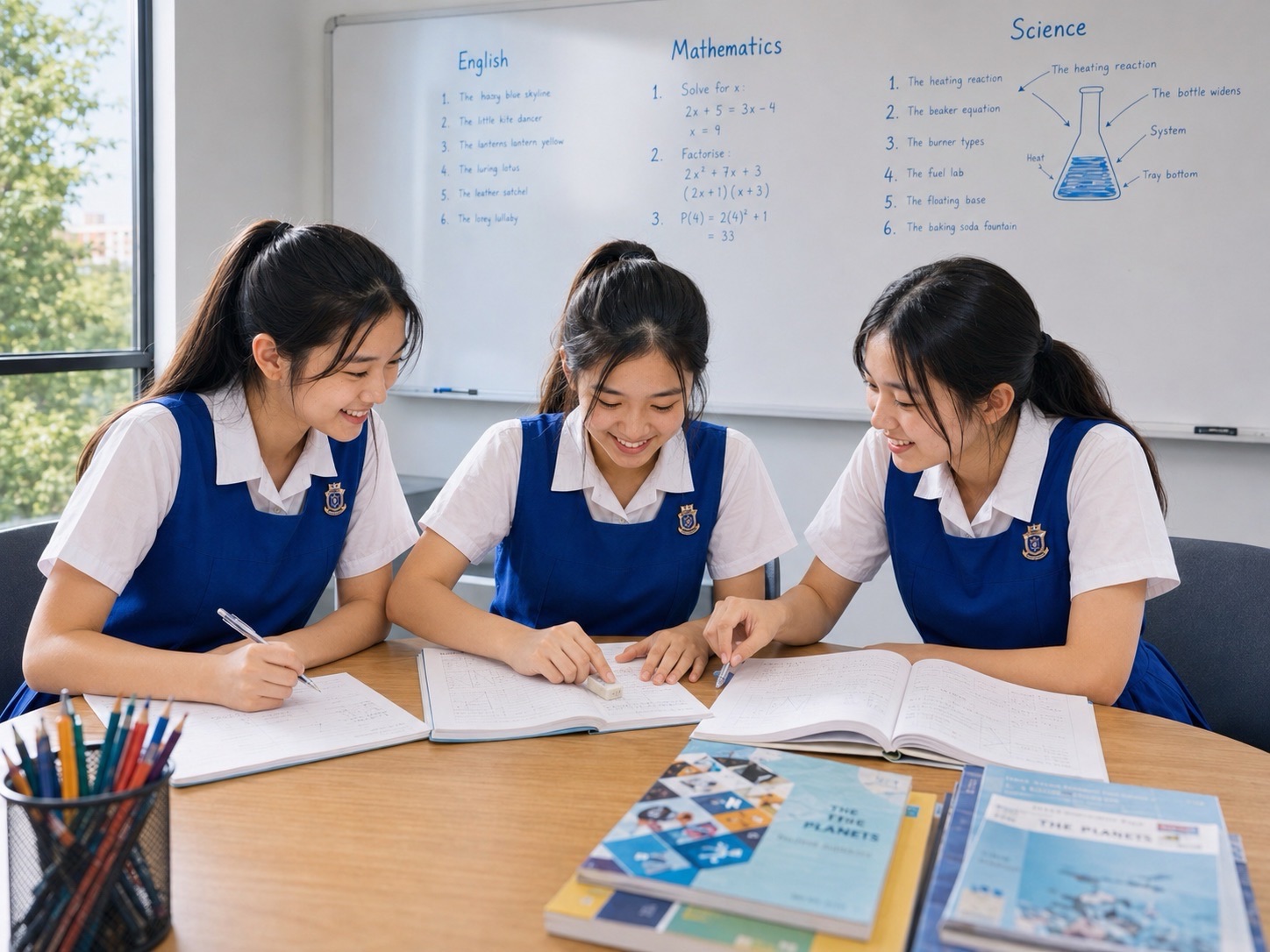
Secondary 2 English Tuition | Build the Upper-Secondary Bridge Before Sec 3
Secondary 2 is the year to ask whether the student’s English system is genuinely stable before upper-secondary demands increase.
The student has already crossed the Primary-to-Secondary transition. Reading passages are longer. Questions require more interpretation. Writing needs stronger organisation and audience awareness. Oral communication expects more developed ideas. Vocabulary must become more precise. Yet Secondary 2 still gives the learner time to repair weaknesses before Secondary 3 adds a denser academic and assessment load.
This page treats Secondary 2 as a bridge year. The tuition job is not simply to pre-teach Secondary 3. It is to identify what is still fragile, strengthen the English operations that upper secondary will depend on, and make the learner more independent before the next transition.
Quick Read for Parents
- Sec 2 is an audit year. Passing marks can hide weak reading, inference, writing or vocabulary systems.
- Upper-secondary English needs more than grammar accuracy. Students must interpret, evaluate, organise, argue and communicate.
- Reading should feed writing. Vocabulary, sentence structures and evidence reasoning should cross components.
- Comprehension must move beyond keyword matching. Students need literal, inferential and evaluative reading.
- Writing needs a repeatable process. Understand task → generate → select → organise → draft → revise.
- Vocabulary should become precise, not merely advanced.
- Oral should remain spontaneous. Strong responses adapt to questions rather than repeat scripts.
- Full SBB means actual subject level matters. Same school year does not automatically mean same English route.
- Support should reduce before Sec 3. A student who still needs continuous prompting is carrying a hidden dependency forward.
- Tuition is not automatically necessary. The correct intervention depends on the evidence.
Why Secondary 2 Is More Important Than It Looks
Secondary 1 receives most of the attention because the transition is obvious. Secondary 3 receives attention because upper-secondary subjects and examinations feel closer. Secondary 2 can disappear between them.
That makes it easy for weaknesses to become normalised.
A student may say:
- “I always lose comprehension marks.”
- “My writing is just B-grade.”
- “I never know what vocabulary to use.”
- “I can speak but oral marks are inconsistent.”
- “I understand the passage but my answers are wrong.”
- “I know grammar but still make mistakes when writing.”
These patterns deserve investigation before they become the starting state of Secondary 3.
Secondary 2 is often the last relatively low-cost year to repair a lower-secondary English weakness before upper-secondary performance depends on it.
The Secondary 2 English System Map
A useful simplified map is:
Read → interpret → evaluate → select evidence → organise ideas → express → revise → transfer.
Vocabulary and grammar operate throughout the chain. Oral communication adds real-time language production. Listening adds another input channel. The exact assessment structure depends on the student’s subject level and examination cohort, but these language operations remain useful foundations.
Full Subject-Based Banding: Same Sec 2, Different English Routes
Full Subject-Based Banding has been fully implemented since 2024. Students can offer subjects at G1, G2 or G3 according to school arrangements and readiness.
That means a Secondary 2 English tutor should not group students by year label alone. The tutor needs to know:
- the student’s actual English subject level;
- the school’s current English programme and assessment demands;
- reading and vocabulary state;
- writing independence;
- oral and listening demands;
- amount of prompting required; and
- what upper-secondary route the student is preparing to enter.
From 2027, students graduate with the Singapore-Cambridge Secondary Education Certificate (SEC) and sit subjects at G1, G2 or G3. Current 2027 SEAB listings use K100 for G1 English Language, K200 for G2 English Language and K300 for G3 English Language, with reference codes 1195, 1190 and 1184 respectively for 2026 and earlier.
A current Secondary 2 student will sit the examination in a later year, so the actual exam-year syllabus must be checked when published. The useful point now is the routing principle: teach the student at the actual subject level and prepare transferable English, rather than teaching to a label alone.
Parents can check the SEC syllabus gateway at SEAB.
Bridge 1: Reading Must Become More Analytical
By Secondary 2, reading is less about simply understanding what happened and increasingly about interpreting how meaning is built.
A student should become more able to track:
- main claims and supporting details;
- cause and consequence;
- reference across paragraphs;
- tone and attitude;
- implicit assumptions;
- contrasts and qualifications;
- how word choices shape meaning; and
- what evidence supports an interpretation.
Students who rely heavily on keyword matching may still score adequately on familiar exercises while remaining vulnerable to texts that paraphrase, imply or evaluate rather than repeat the question wording.
A useful tuition route therefore asks the student to explain the reading process, not only provide the final answer.
Bridge 2: Evidence Must Become Explicit
Secondary English increasingly rewards students who can support interpretation.
We train a simple evidence loop:
Claim → evidence → connection → precise answer.
The learner should know:
- what the question is actually asking;
- which part of the text is relevant;
- whether one or several pieces of evidence are needed;
- what conclusion the evidence supports; and
- how to phrase that conclusion without adding unsupported ideas.
This evidence habit later supports comprehension, argumentative writing and oral discussion.
Bridge 3: Vocabulary Should Become a Precision System
Secondary 2 is a useful time to move away from “advanced vocabulary” as a collection of impressive words.
The student increasingly needs:
- academic vocabulary for explanation and argument;
- precise verbs;
- words that express degree and qualification;
- connectors that accurately show relationships;
- register awareness;
- collocation control; and
- the ability to infer unfamiliar vocabulary from context.
A useful vocabulary progression is:
Meaning → contrast → collocation → register → production → retrieval → transfer.
A word is not mastered because the student can match it to a definition. It is stronger when the learner can select it naturally in a new context without a word bank.
Bridge 4: Grammar Must Support More Complex Meaning
Secondary 2 students often know basic grammar rules but still lose control as sentence complexity increases.
We therefore look at grammar as a meaning system:
- tense and aspect position events in time;
- pronouns maintain reference;
- conjunctions show logical relationships;
- modals express possibility, obligation or certainty;
- relative clauses add information;
- sentence structure controls emphasis; and
- punctuation helps organise meaning.
Grammar practice should therefore leave the isolated worksheet and enter actual writing and revision.
Bridge 5: Writing Must Move Beyond “Good Phrases”
Secondary writing requires a more deliberate relationship between ideas and language.
The student should increasingly be able to:
- interpret the task;
- identify purpose and audience;
- generate relevant ideas;
- select rather than use every idea;
- organise paragraphs around clear functions;
- use evidence or examples where appropriate;
- maintain coherent reference;
- choose precise language; and
- revise for meaning before surface errors.
A polished model essay can help reveal structure. But Secondary 2 students should not become dependent on memorised openings, stock arguments or phrases that do not fit the actual task.
The Writing Process Should Become Repeatable
- Read the task: purpose, audience, context, constraints.
- Generate: produce several possible ideas.
- Select: keep the ideas that serve the task.
- Organise: decide paragraph jobs and sequence.
- Draft: express the reasoning or narrative clearly.
- Review meaning: does the piece actually answer the task?
- Review organisation: can the reader follow the logic?
- Review language: grammar, vocabulary, reference and punctuation.
- Reduce support: perform the process again with fewer prompts.
The process matters because Secondary 3 and 4 will demand independent production under greater assessment pressure.
Bridge 6: Oral Communication Should Become More Responsive
Oral English is not simply about speaking fluently.
Students should increasingly be able to:
- state a clear position or idea;
- explain the reasoning;
- give a relevant example;
- respond to a follow-up question;
- qualify an over-broad statement;
- clarify when the listener does not understand; and
- adapt language to the context.
Memorised scripts can make familiar topics look strong while hiding weak spontaneous language. The tutor should deliberately change the stimulus and ask genuine follow-ups.
Bridge 7: Revision Must Move into the Student’s Head
One of the most useful Secondary 2 goals is to make revision increasingly student-owned.
Instead of the tutor correcting every line, the student can learn several passes:
- task pass: have I actually answered the task?
- logic pass: do the ideas connect?
- paragraph pass: does each paragraph have a clear job?
- reference pass: are pronouns and references clear?
- grammar pass: are sentence relationships controlled?
- vocabulary pass: are words precise rather than decorative?
- surface pass: spelling and punctuation.
The tutor should progressively move from editor to diagnostic questioner.
The Secondary 2 Error Taxonomy
- Reading error: text meaning or reference is lost.
- Inference error: evidence is read but not combined.
- Evidence error: a claim is made without adequate support.
- Vocabulary error: word meaning, register or collocation is inaccurate.
- Grammar production error: the rule is known but output remains unstable.
- Organisation error: ideas exist but the reader cannot follow them.
- Task error: the response does not fit purpose, audience or context.
- Expression error: the student understands but phrases meaning vaguely.
- Revision error: own weaknesses remain invisible.
- Retrieval error: previously learned language is unavailable without cues.
- Transfer error: a skill works only in the exercise where it was taught.
- Time-control error: otherwise available English degrades under assessment pressure.
“English careless mistakes” is too broad. The repair should match the category.
The Sec 2 Practice Ladder
- Understand: make the language relationship clear.
- Controlled practice: stabilise it with low distraction.
- Production: use it in speaking or writing.
- Retrieval: bring it back later without advance cueing.
- Variation: change text, prompt, audience or context.
- Interleaving: mix several possible language operations.
- Transfer: move the skill into another component.
- Timed use: add assessment load where appropriate.
- Self-correction: identify and repair own failure.
- Delayed retest: check whether the repair remains stable.
This ladder is how Secondary 2 turns lower-secondary knowledge into upper-secondary readiness.
Why More Worksheets Are Not Automatically the Answer
If the student succeeds on grammar sheets but fails grammar in writing, the problem is transfer. If comprehension is strong immediately after explanation but weak the next week, the problem may be retrieval. If writing looks good only after the tutor supplies the outline, the problem may be independent planning.
More of the same exercise can make the exercise easier without solving the actual failure.
A better sequence removes support and changes the surface. The student should learn to recognise the invariant English operation.
Why 3-Pax Can Be Useful in Secondary 2
Secondary 2 English produces rich evidence through reading, discussion, writing and revision.
In a three-student class:
- each student can explain a reading inference;
- different interpretations can be compared against evidence;
- vocabulary choices can be contrasted;
- paragraph structures can be compared;
- oral answers can receive individual follow-up;
- the tutor can inspect each student’s revision process; and
- support can be deliberately withheld to test independence.
The value is not simply “more attention”. It is better observation of individual language while keeping peer difference available as learning material.
A Typical 1.5-Hour Secondary 2 English Lesson
Our small-group lessons are typically 1.5 hours. The exact balance changes with school needs, but a lesson can follow this logic:
- Retrieve: bring back vocabulary, reading or writing knowledge from earlier work.
- Receive: read, listen to or view a meaningful text/stimulus.
- Locate: identify the first weak English operation.
- Explain: make the missing relationship explicit.
- Use: produce language rather than merely recognise it.
- Compare: examine different student responses.
- Vary: change context or task form.
- Release: reduce prompts.
- Revise: make the student the editor.
- Return: decide what should be retested later.
The lesson should send a capability back into school, not simply produce completed work in tuition.
What Progress Should Look Like by the End of Secondary 2
- the student reads longer texts with less loss of meaning;
- inferences are supported more explicitly;
- vocabulary becomes more precise and less decorative;
- grammar errors repeat less often in actual writing;
- paragraphs have clearer jobs;
- the student can respond to unfamiliar writing prompts with less model dependence;
- oral answers extend naturally and respond to follow-up;
- revision catches more high-value errors;
- skills transfer between reading, speaking and writing;
- school English requires less adult rescue; and
- the tutor can reduce prompts without performance collapsing.
These are upper-secondary readiness signals.
When Secondary 2 English Tuition Is Worth Considering
- reading is fluent but inference remains weak;
- vocabulary is broad in recognition but unavailable in production;
- grammar exercises are correct while writing grammar remains unstable;
- the student cannot support interpretations with evidence;
- writing needs heavy external planning;
- oral responses are memorised or underdeveloped;
- skills do not survive changed tasks;
- the same weaknesses have persisted since Secondary 1; or
- the student is approaching Secondary 3 with too much unresolved English repair.
When Tuition May Not Be Necessary
A Secondary 2 student who reads independently, understands school texts, writes with growing control, responds to feedback, revises intelligently and performs with reasonable stability may not need additional tuition.
The learner may be better served by wider reading, purposeful writing, school consultation and protected independent study time.
Adding a class simply because Secondary 3 is approaching can create unnecessary load.
Questions Parents Can Ask Before Sec 3
- Can my child explain what a comprehension answer is based on?
- Does vocabulary enter actual writing and speaking?
- Are grammar errors reducing in production?
- Can my child plan a new writing task without a model?
- Can the student revise independently?
- Do oral answers adapt to follow-up questions?
- Are skills surviving changed contexts?
- What adult support is still necessary?
- What specific weak system would become expensive in Secondary 3?
- What is the smallest intervention that could fix it now?
The eduKate Secondary 2 English Bridge
Audit → repair → retrieve → vary → connect → produce → revise → reduce support → enter Sec 3 with less English debt.
That is the job of this page: bridge-building.
Secondary 2 should not be a waiting room before upper secondary. It is an opportunity to make reading, evidence, vocabulary, grammar, writing, oral and revision more connected before the next stage demands more from all of them at once.
Arrange a Parent–Student Consultation
eduKate English lessons use a 3-student small-group format and are typically 1.5 hours weekly. Current placement depends on subject level, school sequence, learner state and available group fit.
Bring a recent Secondary 2 English paper and one piece of writing. We can identify what should be stabilised before Secondary 3—or whether the student is already independent enough not to need tuition.