
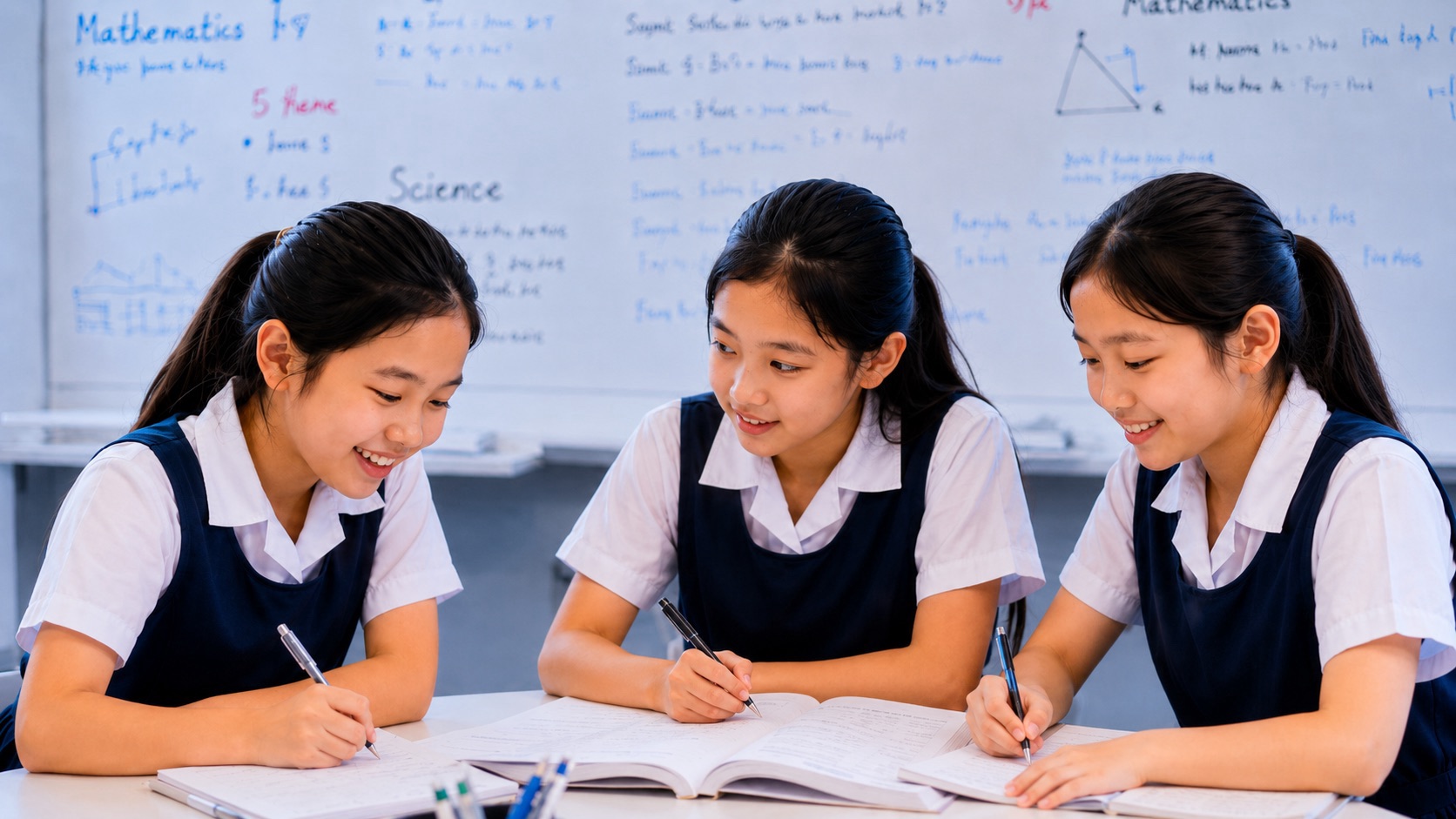
Sengkang Primary 2 Maths Tuition: Building a Strong Mathematical Foundation Early
Primary 2 is a crucial year in your child’s educational journey, as it lays the groundwork for mastering essential mathematics concepts that will be built upon in the coming years. A strong foundation in math not only boosts confidence but also prepares students for future academic challenges. At EduKate Sengkang, our Primary 2 Maths tuition is designed to give young learners the support they need to thrive in the classroom and develop a love for learning.
Our Sengkang Primary 2 Maths tuition provides personalized, engaging lessons that cater to the specific learning needs of each student. With both small group tuition and one-to-one tuition options, we ensure that every child receives the individual attention they need to excel.
Why Primary 2 Mathematics is Important
Primary 2 Mathematics covers fundamental topics such as:
- Addition and Subtraction
- Multiplication and Division
- Shapes and Patterns
- Money and Time
These concepts form the building blocks for more advanced topics in later years, such as fractions, measurements, and problem-solving. Developing a strong understanding of these basic principles in Primary 2 helps students build the confidence and skills needed to tackle more complex mathematical problems as they progress.
At EduKate Sengkang, our Mathematics tuition is fully aligned with the MOE syllabus, ensuring that your child is learning the most relevant material that prepares them for school exams and future academic success.
What Happens in Primary 2 Math Tuition with Sengkang Math Tutor
Article ID: EDUKATESG.SENGKANG.P2MATH.TUTOR.V1.0
Primary 2 Mathematics tuition for Sengkang students in premium 3-pax classes near Punggol MRT. Build number sense, multiplication, division, fractions, word-problem skills and strong Primary 3 foundations.
Primary 2 Mathematics looks gentle.
The numbers are still relatively small. There is addition, subtraction, multiplication, division, money, time, measurement and a few fractions.
But something important is happening underneath.
A Primary 2 child is beginning to move from counting numbers to understanding how numbers work.
That distinction matters.
At eduKateSG, our Primary 2 Mathematics tuition for Sengkang students is taught in premium three-student small groups at our nearby Punggol location, close to Punggol MRT and Waterway Point. The small class gives the tutor enough space to explain carefully, watch how each child works and correct small misunderstandings before they become larger mathematical gaps.
The purpose is not simply to give a seven- or eight-year-old more worksheets.
It is to help the child build a reliable mathematical foundation.
A Primary 2 student should gradually learn to:
- understand place value instead of simply reading numbers;
- add and subtract with meaning;
- understand multiplication as equal grouping;
- understand division as sharing and grouping;
- develop useful multiplication-table fluency;
- interpret simple word problems;
- work confidently with money, time and measurement;
- understand simple fractions;
- show working clearly;
- notice when an answer does not make sense; and
- become increasingly independent.
MOE’s Primary Mathematics curriculum places mathematical problem solving at the centre of learning, rather than treating Mathematics as calculation alone. The current Primary 2 sequence includes numbers to 1,000, addition and subtraction, multiplication and division, multiplication tables, fractions, measurement, time, shapes and money. t is the Mathematics we are building.
Not just answers.
Understanding.
Primary 2 Mathematics Is More Important Than It First Appears
Primary 1 introduces a child to formal school Mathematics.
Primary 2 begins organising it.
The child now has to hold more ideas in mind at the same time.
Consider:
427
A child may be able to read this as “four hundred and twenty-seven”.
That does not automatically mean the child understands that:
427 = 400 + 20 + 7
or that:
- 4 represents 4 hundreds;
- 2 represents 2 tens;
- 7 represents 7 ones;
- 427 is greater than 417 because of the tens;
- 10 more gives 437;
- 100 more gives 527; and
- the number can be decomposed and recombined in different ways.
That is number sense.
And number sense affects almost everything that comes afterwards.
A child who sees numbers only as strings of digits may learn written algorithms but remain uncertain whenever the question changes slightly.
A child who understands number structure has more options.
The child can estimate.
Break numbers apart.
Recombine them.
Notice patterns.
Check whether an answer is reasonable.
That is why good Primary 2 Mathematics tuition should not rush past apparently simple ideas.
Sometimes the simple idea is carrying everything above it.
The Hidden Transition: Counting Must Become Number Structure
In early Mathematics, children can solve many problems by counting.
For example:
8 + 5
A child might count:
9, 10, 11, 12, 13.
That works.
But it becomes increasingly inefficient as numbers grow.
For:
48 + 27
the child needs a stronger system.
They may learn to see:
48 + 20 = 68
68 + 7 = 75
Or:
48 + 2 = 50
27 – 2 = 25
50 + 25 = 75
Or use the standard written algorithm correctly.
The important point is not that every child must use the same method.
The important point is that the child understands the relationships between the numbers.
This becomes even more important when multiplication arrives.
For example:
4 × 3 = 12
A child can memorise the fact.
But we also want the child to understand that it may represent:
- 4 groups of 3;
- 3 + 3 + 3 + 3;
- an array;
- equal groups;
- repeated addition; or
- a real situation involving four sets containing three objects each.
That understanding later supports division.
If there are 12 objects divided equally among 4 children:
12 ÷ 4 = 3
Multiplication and division are no longer separate pieces of information.
They become connected.
That connection is Mathematics.
Why Sengkang Parents Choose 3-Pax Primary 2 Mathematics Tuition
Three children creates a useful learning environment for young Mathematics students.
There are enough students for interaction.
A child can hear another explanation.
Compare methods.
Answer questions aloud.
See that another student can make a mistake and correct it.
But the group remains small enough for the tutor to notice what each child is actually doing.
That matters enormously in Primary 2.
A wrong answer might come from many different causes.
A child may:
- still count on fingers for almost everything;
- confuse tens and ones;
- reverse digits;
- forget to regroup;
- misunderstand what multiplication means;
- know a multiplication table but not recognise when to use it;
- interpret division incorrectly;
- read the word problem wrongly;
- overlook a unit;
- confuse dollars and cents;
- read a clock incorrectly;
- rush;
- copy a number wrongly; or
- simply lose concentration halfway through the calculation.
The final wrong answer does not tell us which problem occurred.
The working does.
In a three-student class, the tutor can watch that working closely.
Why three students works particularly well at Primary 2
- Frequent individual questioning
- Close checking of working
- Immediate correction
- Space to explain ideas slowly
- Less opportunity to remain quietly confused
- Plenty of student participation
- Calm peer interaction
- Easier adjustment of difficulty
- More opportunities to explain answers
- Stronger accountability without a large-class atmosphere
The class is small deliberately.
A Primary 2 child still benefits from encouragement and interaction.
But the tutor must also be close enough to see the small mathematical habits forming.
What We Teach in Primary 2 Mathematics Tuition
Schools may arrange topics differently across the year, so we coordinate tuition with the child’s school progress while protecting the underlying mathematical foundation.
A current 2026 Primary 2 school curriculum illustrates the breadth of the year: numbers to 1,000, addition and subtraction within 1,000, length, multiplication and division, multiplication tables, mass, time, fractions, volume, shapes and money. 1. Numbers to 1,000 and Place Value
Students develop control over:
- hundreds, tens and ones;
- reading and writing numbers;
- number comparison;
- number ordering;
- number patterns;
- odd and even numbers;
- number bonds;
- decomposing numbers;
- composing numbers;
- mental number relationships; and
- estimation.
We want children to see numbers as quantities with structure.
For example:
634
should eventually be understood as more than a numeral.
The child should recognise:
600 + 30 + 4
6 hundreds, 3 tens and 4 ones
10 less = 624
10 more = 644
100 less = 534
100 more = 734
This flexibility becomes useful throughout Primary Mathematics.
2. Addition and Subtraction
Students strengthen:
- addition within 1,000;
- subtraction within 1,000;
- regrouping;
- mental calculation;
- written algorithms;
- checking strategies;
- estimation;
- number bonds;
- finding missing values; and
- word-problem applications.
We do not want children mechanically performing an algorithm they do not understand.
For example, when regrouping in subtraction, the child should gradually understand why one hundred can become ten tens, or one ten can become ten ones.
If that concept is stable, the written procedure makes sense.
If it is not stable, the child may remember rules such as “borrow from the next number” without understanding what is happening.
That can work temporarily.
But Mathematics becomes more reliable when procedure sits on top of understanding.
3. Multiplication
Primary 2 is an important multiplication year.
Students begin developing fluency with multiplication tables including the 2, 3, 4, 5 and 10 times tables in the Primary 2 programme. memorising the table is only one part.
We also teach the child to understand:
- equal groups;
- repeated addition;
- arrays;
- multiplication sentences;
- commutative relationships;
- skip counting;
- patterns in multiplication tables;
- missing factors;
- simple multiplication word problems; and
- relationships between multiplication facts.
For example, if a child knows:
5 × 4 = 20
we can ask:
What is 4 × 5?
What is 20 ÷ 5?
What is 20 ÷ 4?
What would 6 × 4 be?
What is one more group of 4?
Now one memorised fact becomes a network.
That is much more useful.
4. Division
Division can become confusing when it is introduced merely as a new symbol.
We therefore connect it carefully to ideas the child already understands.
Division can involve:
Sharing
12 sweets are shared equally among 3 children.
How many sweets does each child receive?
Grouping
12 sweets are placed into bags of 3.
How many bags can be made?
Both give:
12 ÷ 3 = 4
But the situations are slightly different.
Children who understand this distinction become better prepared for later word problems.
We also connect division back to multiplication.
If:
3 × 4 = 12
then:
12 ÷ 3 = 4
and:
12 ÷ 4 = 3
The child begins building a family of mathematical relationships instead of memorising unrelated facts.
5. Fractions
Fractions are one of the first major conceptual expansions beyond whole numbers.
A child who has spent years learning that numbers describe whole quantities suddenly has to understand that numbers can also describe parts of a whole.
Students learn ideas such as:
- halves;
- thirds;
- quarters;
- equal parts;
- numerator and denominator;
- identifying fractions from diagrams;
- comparing simple fractions;
- ordering simple fractions;
- equivalent-looking representations; and
- simple addition or subtraction of like fractions where appropriate.
We begin visually.
A pizza.
A chocolate bar.
A rectangle.
A group of objects.
A number line.
Then we move towards symbols.
For a young learner, this transition matters.
The symbol:
3/4
should represent an idea before becoming something the child manipulates mechanically.
6. Money
Money provides one of the most useful real-world Mathematics environments for Primary 2.
Students may work with:
- dollars;
- cents;
- counting money;
- comparing amounts;
- finding totals;
- finding change;
- converting between dollars and cents;
- reading prices; and
- solving simple money problems.
For example:
A notebook costs S$3.20.
A pencil costs S$1.50.
How much do they cost altogether?
The arithmetic matters.
But so does understanding:
- what the numbers represent;
- why there are two decimal places;
- which quantity is larger;
- whether the answer is reasonable; and
- what unit should appear in the final answer.
Money gives children a chance to see Mathematics functioning in everyday life.
7. Time
Time can be deceptively difficult for young learners.
Unlike ordinary base-ten counting:
60 minutes = 1 hour.
The clock is circular.
The same clock contains an hour hand and a minute hand moving at different speeds.
Students therefore need repeated opportunities to:
- read analogue clocks;
- read digital time;
- understand hours and minutes;
- recognise half-hours and other intervals;
- compare times;
- determine simple durations; and
- connect time to everyday routines.
We encourage children to read real clocks rather than treating time as something that exists only inside a worksheet.
8. Length, Mass and Volume
Measurement teaches children that numbers describe the physical world.
Students learn to:
- choose appropriate units;
- measure;
- compare;
- estimate;
- order measurements;
- read scales;
- solve simple measurement problems; and
- attach the correct unit to an answer.
This is also where careless errors become visible.
A child might calculate correctly but write:
5 cm
when the answer should be:
5 m
The arithmetic is correct.
The Mathematics is not.
Units carry meaning.
9. Shapes and Spatial Thinking
Primary 2 Mathematics also develops spatial understanding.
Students work with shapes and properties rather than merely naming pictures.
They may learn to recognise, describe and work with:
- common 2D shapes;
- shape patterns;
- cubes;
- cuboids;
- cylinders;
- cones;
- spheres; and
- relationships between familiar objects and mathematical shapes.
Spatial reasoning later supports geometry, measurement, area, volume and diagrams.
10. Word Problems
This is where many parents first notice that their child can “do the sums” but still struggles with Mathematics.
The arithmetic may be easy.
The interpretation is harder.
Consider:
Amy has 36 stickers. She has 8 more stickers than Ben. How many stickers does Ben have?
A child may see:
8 more
and immediately add.
36 + 8 = 44.
But that answers the wrong relationship.
If Amy already has 8 more than Ben:
36 – 8 = 28.
The challenge is not subtraction.
The challenge is understanding the language.
That is why Primary Mathematics tuition should gradually develop:
- careful reading;
- identification of quantities;
- comparison language;
- part-whole relationships;
- drawing simple models;
- deciding which operation fits;
- checking the answer against the question; and
- explaining why a method makes sense.
A child who learns this well in Primary 2 has a much stronger platform for Primary 3 and beyond.
Our First-Principles Primary 2 Mathematics Teaching Method
A young student should not be given difficult work simply so the tuition appears advanced.
The work should be appropriately difficult.
Enough challenge to produce growth.
Enough support for the child to understand what is happening.
1. Find the Exact Weakness
“Bad at Mathematics” is not a useful diagnosis.
Neither is:
“Careless.”
We look more closely.
The child may actually be struggling with:
- weak number bonds;
- finger-counting dependence;
- place value;
- reading;
- operation selection;
- multiplication recall;
- division meaning;
- regrouping;
- working memory;
- mathematical vocabulary;
- attention;
- checking habits; or
- transferring knowledge into a different-looking problem.
Different causes require different solutions.
We watch how the child begins.
Not only how the child finishes.
2. Rebuild from the First Unstable Point
If a Primary 2 child cannot confidently work with hundreds, tens and ones, giving another twenty three-digit addition worksheets may not solve the problem.
The place-value system may need repair first.
If multiplication feels mysterious, we may return to:
- repeated addition;
- grouping;
- skip counting; or
- arrays.
If word problems are difficult, we determine whether the problem is:
- Mathematics;
- reading;
- vocabulary;
- identifying the relationship; or
- choosing the operation.
Returning to an earlier idea is not wasted time.
It restores the floor beneath the current topic.
3. Fence the Concept Before Expanding It
Children learn more reliably when one difficulty is introduced at a time.
Suppose we are teaching multiplication.
We may begin with:
3 groups of 2
Then:
3 × 2
Then:
2 × 3
Then:
6 ÷ 3
Then a short word problem.
Then a mixed question.
Then an unfamiliar application.
The complexity increases deliberately.
This allows the child to see what remains the same even when the surface of the question changes.
4. Move from Concrete to Visual to Abstract
Young children often understand best when Mathematics moves through several representations.
For example, multiplication might begin with:
Concrete
4 plates with 3 counters on each plate.
Then:
Visual
Four groups drawn on paper.
Then:
Abstract
4 × 3 = 12
The symbols arrive after the meaning.
This is especially useful when a child has memorised a procedure but cannot explain it.
5. Ask the Child to Explain
We frequently ask simple questions such as:
- What is happening here?
- Why did you add?
- Why did you subtract?
- What does this number mean?
- Can you show me another way?
- How do you know?
- Does your answer make sense?
- Can you check it?
A child who can explain an idea usually understands it more deeply than a child who can only imitate a demonstrated procedure.
Explanation also allows the tutor to see hidden misconceptions.
6. Retrieve Old Mathematics
A topic should not disappear just because the school has moved to the next chapter.
Children forget.
So older ideas return.
A lesson about multiplication might still contain:
- place value;
- addition;
- subtraction;
- time; or
- a previous word problem.
This creates retrieval.
Eventually, children must recognise what Mathematics to use without being told:
Chapter 5: Multiplication
Real problems do not come with chapter labels.
7. Build Independent Working Habits Early
Primary 2 is a good age to begin developing simple mathematical discipline.
We teach children to:
- read the question;
- identify what is known;
- decide what is required;
- choose an operation;
- show the necessary working;
- write the unit;
- look at the answer; and
- check whether it makes sense.
These habits appear small.
But repeated for several years, they become powerful.
What Happens During a 90-Minute Primary 2 Mathematics Lesson?
Every lesson is adjusted according to the students, but a typical 1.5-hour session follows a stable rhythm.
Warm-Up Retrieval
We begin with a short selection of earlier Mathematics.
This may include:
- number bonds;
- multiplication facts;
- mental arithmetic;
- place value;
- a simple measurement question; or
- a previous word problem.
The aim is to keep useful knowledge active.
Concept Teaching
The tutor introduces or revisits the main idea.
We explain:
- what the idea means;
- how it connects to earlier Mathematics;
- what children commonly misunderstand; and
- how the child can recognise the structure in a question.
Guided Practice
Students attempt carefully selected questions with the tutor nearby.
At this stage, we can prompt.
Ask questions.
Use diagrams.
Correct misconceptions.
As the child gains control, that help is reduced.
Independent Practice
The student then attempts selected questions without step-by-step assistance.
This matters.
A child appearing to understand while following a tutor is not the same as a child being able to solve the problem independently.
Independent attempts reveal the truth.
Mixed Practice
Older Mathematics may be mixed with the current topic.
The child has to decide:
Is this addition?
Subtraction?
Multiplication?
Division?
A measurement question?
A comparison?
A fraction?
This develops recognition rather than simple repetition.
Error Review
Wrong answers are inspected.
We determine whether the error came from:
- concept misunderstanding;
- weak recall;
- incorrect arithmetic;
- careless copying;
- question reading;
- operation selection;
- units;
- poor working; or
- rushing.
The student corrects the error and, where useful, attempts a related question.
Focused Home Practice
Homework should have a reason.
We prefer focused continuation work over giving a young child an indiscriminate stack of worksheets.
The purpose is to reinforce the lesson and build independent recall.
Not to make the child tired of Mathematics.
Three Primary 2 Mathematics Pathways
Not every child enters tuition for the same reason.
The Repair Pathway
This child may be struggling with:
- counting;
- number bonds;
- place value;
- addition;
- subtraction;
- multiplication;
- division;
- word problems;
- school homework; or
- basic confidence.
The priority is to locate the earliest important gap and repair it.
Sometimes improvement happens faster once the correct gap is found.
The Stabilisation Pathway
This child generally understands Mathematics but is inconsistent.
One worksheet may be excellent.
The next may contain many unnecessary mistakes.
The child may:
- rush;
- forget old topics;
- misunderstand questions;
- rely too much on prompting;
- make repeated calculation mistakes; or
- perform less confidently when different topics are mixed.
The priority is reliability.
We want the child’s Mathematics to become less dependent on whether the question happens to look familiar.
The Extension Pathway
Some Primary 2 students are already comfortable with school Mathematics.
They do not need endless repetition of easy questions.
They need deeper thinking.
Extension may involve:
- less familiar problems;
- more than one solution method;
- stronger mental Mathematics;
- pattern recognition;
- deeper number relationships;
- explanation;
- non-routine questions; and
- carefully selected Primary 3 bridging where appropriate.
The objective is not to race through textbooks.
A child who has reached Primary 4 content early but understands it superficially is not necessarily better prepared than a Primary 2 child who possesses excellent number sense.
Depth matters.
Why Multiplication and Division Receive Special Attention
Primary 2 multiplication and division are small topics with very long consequences.
They later appear inside:
- fractions;
- factors and multiples;
- area;
- ratio;
- percentage;
- rate;
- long division;
- algebra;
- geometry;
- statistics; and
- almost every stage of later Mathematics.
A child does not need extreme multiplication drilling.
But the child should gradually develop both:
fluency
and
meaning.
Fluency means useful facts can be recalled without spending excessive mental energy.
Meaning means the child knows what those facts represent.
We want both.
The Real Primary 2 Problem Is Often Not Calculation
Parents sometimes tell us:
“My child knows the sums but cannot do problem sums.”
This distinction is useful.
Suppose a child can calculate:
48 – 17 = 31
But cannot solve:
Ryan has 48 cards. He gives 17 cards to his friend. How many cards does he have left?
Then the arithmetic is not the main problem.
The child has to translate:
gives away
into a decreasing quantity.
Later, questions become less direct.
Ryan has 17 fewer cards than Sarah. Sarah has 48 cards. How many cards does Ryan have?
Same arithmetic.
Different relationship.
This is why mathematical vocabulary matters.
Children gradually need to understand words and relationships such as:
- altogether;
- total;
- left;
- remaining;
- fewer;
- more than;
- less than;
- difference;
- equal;
- each;
- equally;
- shared;
- groups of;
- before;
- after; and
- how many more.
Problem solving is partly Mathematics.
It is also the ability to read the situation accurately.
How We Reduce “Careless Mistakes”
At Primary 2, we are careful about using the word careless too quickly.
Different mistakes require different corrections.
Reading Errors
A child reads “8 fewer” but adds 8.
That requires better interpretation.
Place-Value Errors
A child treats 407 as though the zero has no function.
That requires concept repair.
Arithmetic Errors
The method is correct but the calculation is not.
That requires fluency and checking.
Copying Errors
356 becomes 365 halfway through the working.
That requires slower visual checking and neater organisation.
Operation Errors
The child sees two numbers and simply adds them.
That requires stronger problem interpretation.
Unit Errors
The answer is numerically correct but the child writes the wrong measurement unit.
That requires attention to meaning.
Rushing
The child answers before reading the full question.
That requires learning behaviour, not another explanation of addition.
We look for the repeated pattern.
Once the pattern becomes visible, correction becomes much more precise.
Teaching Ahead Without Rushing
Where appropriate, eduKateSG teaches slightly ahead of the school schedule.
But teaching ahead should be understood properly.
The purpose is not to finish Primary 2 quickly so that a child can claim to be doing Primary 3 Mathematics.
The purpose is familiarity.
Suppose fractions will appear in school shortly.
Meeting the idea first in tuition means that when the school teacher introduces fractions:
- the vocabulary is familiar;
- the visual model is familiar;
- the child has already handled simple examples;
- classroom instruction feels easier to follow; and
- school practice becomes a second encounter rather than a first encounter.
That can reduce unnecessary cognitive pressure.
But we only move forward sensibly.
If addition and subtraction are still unstable, rushing into harder Mathematics simply builds another floor on an unstable foundation.
Preparing for Primary 3 Begins in Primary 2
Primary 3 does not simply continue Primary 2 at the same level.
The mathematical environment expands again.
A current 2026 Primary 3 sequence includes numbers to 10,000, multiplication tables of 6, 7, 8 and 9, further multiplication and division, more word problems, bar graphs, angles, fractions, measurement, area and perimeter and time. s is why Primary 2 matters.
A child entering Primary 3 with stable:
- place value;
- addition;
- subtraction;
- multiplication foundations;
- division foundations;
- mathematical vocabulary;
- working habits; and
- problem interpretation
has more available mental capacity for the new Mathematics.
The child is not trying to learn multiplication while simultaneously repairing addition.
That is the advantage of a strong base.
What Progress Should Look Like
Progress at Primary 2 should not be measured by test marks alone.
Parents may first notice that their child:
- reaches for fingers less often;
- begins homework more independently;
- explains why an operation was selected;
- recalls multiplication facts more easily;
- makes fewer place-value errors;
- organises working more clearly;
- reads questions more carefully;
- recognises mistakes independently;
- checks answers;
- becomes less worried by unfamiliar-looking questions;
- finishes routine work more efficiently; and
- talks about Mathematics with greater confidence.
Marks often improve as these pieces begin working together.
But responsible tuition should not promise an immediate transformation after one or two lessons.
Improvement depends on:
- the child’s starting point;
- the size of existing gaps;
- attendance;
- practice between lessons;
- school demands;
- concentration;
- readiness to correct old habits; and
- time.
Our role is to make that improvement structured and visible.
Does Every Primary 2 Child Need Mathematics Tuition?
No.
A child who:
- understands school Mathematics;
- completes work independently;
- is progressing comfortably;
- asks for help appropriately;
- retains earlier topics; and
- remains interested in learning
may not need tuition.
More tuition is not automatically better education.
Children also need:
- sleep;
- play;
- family time;
- reading;
- movement;
- curiosity; and
- space to become independent.
Tuition becomes useful when it solves a real educational problem or creates a clearly valuable learning environment.
That may mean repairing a weakness.
Preventing a gap from widening.
Providing more precise teaching.
Creating structured practice.
Or extending a child who genuinely needs more challenge.
The question should not simply be:
“Should my Primary 2 child have tuition?”
A better question is:
“What does my child currently need that school and home are not providing consistently enough?”
If there is no meaningful answer, tuition may not be necessary.
When Should a Sengkang Primary 2 Student Start Mathematics Tuition?
Parents may consider additional support when a child:
- still depends heavily on finger counting;
- struggles with numbers beyond 100;
- confuses hundreds, tens and ones;
- repeatedly makes regrouping errors;
- has difficulty remembering basic number bonds;
- cannot explain multiplication;
- struggles to connect multiplication and division;
- avoids word problems;
- guesses operations from keywords;
- takes a very long time to complete Mathematics homework;
- needs an adult beside them throughout homework;
- becomes upset whenever a question looks unfamiliar;
- repeatedly forgets earlier topics;
- performs inconsistently in school assessments; or
- would benefit from more structured mathematical extension.
Early support does not have to be aggressive.
Primary 2 is still young.
Often the most effective intervention is simply clear explanation, careful observation, suitable practice and time.
What Parents Can Do at Home
Parents can strengthen Primary 2 Mathematics without turning the home into another tuition centre.
Use Mathematics naturally.
At the supermarket:
“Which costs more?”
At dinner:
“If four people each need two spoons, how many spoons do we need?”
On the MRT:
“How many stops are left?”
While baking:
“What does half mean?”
With pocket money:
“If you have S$5 and spend S$1.50, how much is left?”
With a clock:
“What time will it be in 30 minutes?”
In a lift:
“What is 10 floors above Level 6?”
These small conversations are useful because the Mathematics exists inside a real situation.
Parents can also ask:
“How did you know?”
instead of immediately saying:
“Correct.”
The explanation is often more valuable than the answer.
Primary 2 Mathematics Tuition for Sengkang Families
eduKateSG’s Sengkang-facing Primary Mathematics classes are currently conducted at our nearby Punggol location:
eduKateSG Punggol
83 Punggol Central
Singapore 828761
Near Punggol MRT and Waterway Point
Our current Sengkang Mathematics programme serves families from areas including Sengkang Central, Compassvale, Rivervale, Anchorvale, Fernvale, Buangkok and surrounding North-East neighbourhoods. gkang and Punggol are neighbouring towns, making the location practical for many families using the North East Line or travelling within the area.
We still encourage parents to look beyond distance alone.
A good Primary 2 class should fit sensibly into the child’s week.
Travel, school, homework, rest and family life all matter.
Consistency is more valuable than an impressive programme that a tired child struggles to attend.
Primary 2 Mathematics Tuition Sengkang — Class Details
Level: Primary 2 Mathematics
Format: Premium three-student small-group tuition
Lesson Duration: 1.5 hours weekly
Location: 83 Punggol Central, Singapore 828761
Access: Near Punggol MRT and Waterway Point
Teaching may include:
- first-principles explanations;
- number-sense development;
- foundation repair;
- Concrete–Representational–Abstract learning;
- guided practice;
- independent practice;
- multiplication-table retrieval;
- problem-solving;
- mathematical vocabulary;
- active recall;
- spaced reinforcement;
- mixed-topic practice;
- error analysis;
- school assessment preparation; and
- carefully paced ahead-of-school teaching.
Materials may include:
- lesson notes;
- tutor-created questions;
- topical practice;
- mixed revision;
- problem sums;
- short retrieval exercises;
- school-aligned practice; and
- focused continuation work.
The normal first step for a new student is a parent–student consultation, subject to class availability. Current eduKateSG information lists classes by appointment and the Punggol teaching location at 83 Punggol Central.
What Parents Can Bring to the Consultation
Useful materials may include:
- recent school worksheets;
- Mathematics exercise books;
- school test papers;
- teacher comments;
- corrections;
- homework that was particularly difficult;
- the child’s textbook;
- examples of recurring mistakes; and
- information about the current school topic.
We are not only interested in the score.
A child scoring 70% because of weak understanding requires a different response from a child scoring 70% because six easy questions were rushed.
Likewise, two children who both struggle with word problems may have completely different problems.
One may not understand the Mathematics.
The other may not understand the English.
Diagnosis matters.
Frequently Asked Questions About Primary 2 Mathematics Tuition Sengkang
Is Primary 2 too young for Mathematics tuition?
Not automatically, but tuition should have a clear purpose.
A child who is coping confidently may not need additional lessons.
Tuition becomes useful when the child has an identifiable learning gap, needs more individual explanation, benefits from structured practice or requires appropriate extension.
At this age, the aim should be to make Mathematics clearer—not to load the child with unnecessary pressure.
What is the most important skill in Primary 2 Mathematics?
There is no single isolated skill, but number sense is particularly important.
A child who understands place value, number relationships, addition and subtraction has a much stronger platform for multiplication, division, fractions and later Mathematics.
Should my child memorise multiplication tables?
Useful multiplication facts should eventually become fluent.
But understanding should accompany memorisation.
A child should know both:
3 × 4 = 12
and what 3 × 4 actually represents.
Fluency reduces mental effort.
Understanding allows the child to use the fact correctly.
My child can calculate but cannot do word problems. Why?
The difficulty may be interpretation rather than arithmetic.
The child must understand:
- what is happening;
- what quantities are given;
- how they are related;
- what the question wants; and
- which mathematical operation represents that relationship.
This is why we teach word problems as reasoning, not simply keyword hunting.
Should a Primary 2 student be doing Primary 3 Mathematics early?
Only when the Primary 2 foundation is secure.
Teaching somewhat ahead can be useful because it makes future school topics familiar.
But rushing into the next level while leaving weaknesses behind usually creates larger problems later.
We prefer depth before speed.
How many students are in an eduKateSG Primary 2 Mathematics class?
Our premium small-group format is capped at three students.
This allows the tutor to observe each child’s working closely while retaining the useful interaction of learning alongside peers. eduKateSG’s current Sengkang Mathematics programme lists the same three-student format at the Punggol location.
How long is each Mathematics lesson?
Regular lessons are 1.5 hours weekly.
The session provides time for retrieval, explanation, guided work, independent attempts, corrections and focused consolidation.
Is the tuition centre physically in Sengkang?
The programme serves Sengkang families, while lessons are currently conducted at eduKateSG Punggol:
83 Punggol Central, Singapore 828761, near Punggol MRT and Waterway Point. make that distinction clearly so parents can decide whether the weekly journey suits their family.
What if my child is already doing very well in Mathematics?
Then the programme should change.
A strong student does not need endless repetition of questions they can already solve.
We can focus on:
- deeper reasoning;
- unfamiliar problems;
- stronger explanations;
- multiple approaches;
- pattern recognition;
- mental Mathematics;
- independence; and
- carefully selected extension.
Being ahead should mean understanding more deeply, not merely turning pages faster.
What if my child dislikes Mathematics?
We first try to understand why.
Sometimes the child dislikes Mathematics because it feels confusing.
Sometimes the work is too difficult.
Sometimes it is too repetitive.
Sometimes repeated mistakes have made the child expect failure.
Sometimes the child simply needs concepts explained differently.
Our first objective is clarity.
When children begin seeing why something works, Mathematics often feels less arbitrary.
Will Primary 2 Mathematics tuition help with Primary 3?
That is one of its most useful long-term functions.
Primary 3 expands the number range to 10,000 and introduces further multiplication tables, more multiplication and division, more word problems, graphs, angles, fractions, measurement and area and perimeter in a current 2026 school sequence. trong Primary 2 foundation allows the child to meet those topics without simultaneously repairing basic number skills.
What Good Primary 2 Mathematics Tuition Should Eventually Produce
The best outcome is not a child who needs a tutor forever.
It is a child who gradually develops an internal mathematical system.
The child learns to:
Read.
What is the question saying?
Understand.
What do the numbers represent?
Choose.
What mathematical relationship applies?
Work.
Can I solve it clearly?
Check.
Does my answer make sense?
Correct.
If I am wrong, can I find out why?
That is a much more valuable outcome than simply completing another workbook.
Primary 2 Mathematics Tutor for Sengkang Families
Primary 2 is still early.
That is precisely why it matters.
There is time to correct finger-counting dependence.
Time to strengthen place value.
Time to make multiplication meaningful.
Time to connect division properly.
Time to introduce fractions carefully.
Time to improve question reading.
Time to establish better working habits.
And time to teach a child that getting something wrong is not the end of the mathematical process.
It is information.
For a child who is behind, we repair.
For a child who is coping but inconsistent, we stabilise.
For a child who is ready for more, we extend.
The purpose of Primary 2 Mathematics tuition is not to make childhood into an examination race.
It is to make the mathematical floor strong enough that the child has somewhere dependable to stand when the work becomes harder.
Primary 3 will come.
Then Primary 4.
Then upper primary.
Then PSLE.
Later, fractions become ratio and percentage.
Arithmetic becomes algebra.
Simple shapes become geometry.
Tables become statistics.
The Mathematics grows.
But the early number system remains underneath it.
Build that carefully now, and much of what comes later becomes easier to understand.
Arrange a Parent–Student Consultation
Speak with eduKateSG about your child’s:
- current Primary 2 Mathematics level;
- school progress;
- number sense;
- calculation fluency;
- word-problem ability;
- recurring mistakes;
- confidence;
- learning habits;
- upcoming school assessments; and
- readiness for Primary 3.
eduKateSG Primary 2 Mathematics Tuition for Sengkang Students
83 Punggol Central
Singapore 828761
Near Punggol MRT and Waterway Point
Premium 3-pax small-group tuition
1.5-hour weekly lessons
By appointment
Catch up. Keep up. Move ahead.
But first, understand.
Because properly taught Mathematics should eventually give a child something more useful than the right answer:
the ability to work out what to do next.
EduKate Sengkang’s Approach to Primary 2 Maths Tuition
At EduKate Sengkang, we believe that every child has the potential to excel in mathematics with the right support and guidance. Our Primary 2 Maths tuition is structured to foster curiosity, build confidence, and ensure students master key concepts that will form the foundation for their future studies.
1. Customized Learning Plans for Each Student
Every child learns at a different pace, and our Primary 2 Maths tuition is tailored to meet the unique needs of each student. Our tutors assess your child’s strengths and areas for improvement, then create customized learning plans that focus on reinforcing weak areas while building on their existing knowledge.
2. Small Group and One-to-One Tuition Options
Our tuition classes are kept small, with no more than three students per group, to ensure that each child receives personalized attention. For students who may need more focused support, we also offer one-to-one tuition in Sengkang. This individualized approach allows our tutors to work closely with your child, providing targeted assistance where it’s needed most.
3. Hands-On Learning and Interactive Lessons
We know that young learners need to stay engaged to fully understand mathematical concepts. Our Primary 2 Maths tuition incorporates hands-on learning tools, interactive lessons, and real-world applications to make learning fun and meaningful. By turning abstract math concepts into tangible experiences, we help students grasp ideas more quickly and retain knowledge longer.
4. Alignment with the MOE Syllabus
Our tutors follow the MOE Mathematics syllabus to ensure your child is learning what is most relevant to their grade level. This prepares them for school assessments and sets them on the path toward success in later years, including PSLE Maths.
5. Building Problem-Solving and Critical Thinking Skills
Problem-solving is at the core of mathematics, and it’s a skill that will serve your child well in all areas of life. Our Primary 2 Maths tuition emphasizes critical thinking and problem-solving techniques, helping students develop the ability to approach problems logically and find solutions efficiently.
Key Areas Covered in Primary 2 Maths Tuition
Our Primary 2 Maths tuition covers all essential topics in the MOE Primary Mathematics syllabus, including:
1. Addition and Subtraction
Students learn to perform addition and subtraction using both numbers and word problems. We focus on building a strong understanding of number bonds, which forms the basis for mastering more complex operations in later years.
2. Introduction to Multiplication and Division
Although multiplication and division are covered more deeply in later years, we introduce these concepts in Primary 2 to help students understand the relationship between numbers. Our tutors use visual aids and engaging activities to make multiplication and division easy to grasp.
3. Shapes and Patterns
Geometry plays an important role in Primary 2 Maths, as students learn to identify and work with basic shapes. Our lessons cover 2D and 3D shapes, symmetry, and pattern recognition, helping students develop spatial awareness and logical thinking.
4. Money and Time
Understanding the value of money and being able to read and manage time are critical life skills. Our tutors teach students how to count money, make change, and read clocks, ensuring they can apply these skills both inside and outside the classroom.
5. Word Problems and Application of Concepts
Solving word problems requires students to apply the mathematical concepts they’ve learned. Our tutors guide students through the process of breaking down word problems, identifying key information, and using the appropriate methods to find solutions. This practice helps students develop confidence in applying their math knowledge to real-world scenarios.
Why Choose EduKate Sengkang for Primary 2 Maths Tuition?
- Experienced Tutors in Sengkang Our team of dedicated tutors has years of experience teaching Primary Mathematics. They understand the MOE syllabus thoroughly and know how to present complex ideas in ways that are easy for young learners to understand. Their expertise ensures that your child receives high-quality instruction.
- Small Class Sizes for Personalized Attention At EduKate, we believe that every student deserves personalized attention. Our small group classes are designed to ensure that tutors can focus on each child’s progress, offering encouragement and support as needed.
- Affordable Tuition in Sengkang Quality tuition should be accessible to all. We offer affordable tuition in Sengkang, providing your child with the best learning experience without breaking the bank.
- Proven Success in Mathematics EduKate Sengkang has helped countless students improve their understanding of Mathematics and achieve better results in their exams. Our structured and engaging approach ensures that students are well-prepared for the challenges ahead.
- Convenient Location Near Compass One Located conveniently for Sengkang and Compass One, our tuition center is situated for families at Sengkang West and Sengkang East. We offer flexible class times to accommodate your family’s busy schedule, making it easier for your child to attend lessons regularly.
Enrol in Primary 2 Maths Tuition at EduKate Sengkang Today
Help your child build a strong mathematical foundation with Primary 2 Maths tuition at EduKate Sengkang. Our personalized learning plans, interactive lessons, and expert tutors will ensure that your child develops the skills and confidence needed to succeed in Mathematics. Enrol in tuition classes in Sengkang today, or contact our Sengkang tuition center to learn more about how we can support your child’s learning journey.
Sengkang Primary 2 Maths Tuition: Your Key to Excellence
Quick Summary for Parents:
- Understanding what Sengkang Primary 2 Maths Tuition is.
- Insights on how to improve and optimise your child’s learning.
- Strategies for effective preparation and methods to enhance learning.
- Factors that necessitate a primary 2 maths tuition for your child.
- Sengkang Primary 2 Maths Tuition is a programme focusing on comprehensive mathematical education for second-grade students.
- Improvement can be made by using digital tools for interactive learning and involving parents more in the learning process.
- Learning incorporates classroom sessions, problem-solving tasks, and online resources for self-paced learning.
- Preparation includes setting up a routine, discussing expectations, providing necessary materials, and ensuring a conducive learning environment.
- Reasons for considering this tuition include personalised attention, experienced tutors, reinforcement of school learning, confidence boost, and development of critical thinking skills.
Best Ways to Improve:
- Incorporating more digital technology for interactive learning.
- Regularly updating parents about their child’s progress.
- Organising workshops for parents to better support their child’s learning at home.
- Regular evaluation and update of curriculum to ensure alignment with current educational standards and trends.
- Offering more real-world examples to illustrate mathematical concepts.
Testimonials:
| Parent’s Name | Testimonial |
|---|---|
| Mdm. Alicia Tan | “My child has shown significant improvement in her math skills after joining Sengkang Primary 2 Maths Tuition. The tutors are very patient and skilled.” |
| Mdm. Karen Loh | “I appreciate the regular updates from the tuition centre. It allows me to track my son’s progress and understand how to support him better.” |
| Mr. Krish H | “The blend of classroom teaching and online resources is really helpful. My daughter enjoys the interactive online activities and learns a lot from them.” |
| Mrs. Lim | “Sengkang Primary 2 Maths Tuition has not only improved my son’s math skills but also boosted his confidence. I am very pleased with his progress.” |
What is Sengkang Primary 2 Maths Tuition?
The Sengkang Primary 2 Maths Tuition is a dedicated programme aimed at enriching the mathematical knowledge of young learners studying in the second grade. It provides comprehensive math tutoring that meets and exceeds the national curriculum standards of Singapore. Through targeted lessons, it emphasises fundamental concepts while simultaneously addressing individual learning needs to ensure each child succeeds.
Improving Sengkang Primary 2 Maths Tuition
The Sengkang Primary 2 Maths Tuition already has a strong foundation but there is always room for improvement. Embracing digital technology is one such way. Utilising modern educational software can make learning interactive and fun. Animated videos, games, and puzzles can provide a stimulating environment that promotes better understanding and retention of math concepts.Moreover, integrating the parents’ role in their child’s learning journey is essential. Regular updates regarding the child’s progress, strengths, and areas for improvement can help parents provide the right support at home. Additionally, workshops for parents can equip them with strategies to facilitate their child’s learning outside of tuition hours.
How to Learn with Sengkang Primary 2 Maths Tuition
Learning in the Sengkang Primary 2 Maths Tuition involves both traditional classroom-based tutoring and interactive activities.The tutoring sessions follow a structured curriculum that gradually builds on previous knowledge. The tutors encourage students to solve problems, fostering critical thinking and problem-solving skills. Real-world examples are often used to connect abstract mathematical concepts to everyday life.In addition, outside of these sessions, students have access to online resources and activities. These resources complement the in-person tuition and allow students to learn at their own pace.
Preparing for Sengkang Primary 2 Maths Tuition
Before starting with Sengkang Primary 2 Maths Tuition, it’s crucial to prepare your child for the learning journey ahead. Here are some steps you can follow:
- Building a routine: Regular study hours can help children adjust to the pace of the tutoring classes.
- Setting expectations: Discuss the importance of the tutoring classes with your child and what they should expect from them.
- Providing the right tools: Ensure that your child has the necessary stationery and books for their lessons.
- Creating a conducive learning environment: A quiet, well-lit space with minimal distractions can greatly enhance your child’s concentration.
Reasons for Considering Sengkang Primary 2 Maths Tuition
Sengkang Primary 2 Maths Tuition has several key benefits that make it a worthy investment:
- Personalised Attention: The small class size ensures each student receives individual attention.
- Experienced Tutors: The tutors are skilled educators with a deep understanding of the maths curriculum.
- Reinforces School Learning: The tuition classes supplement the school syllabus, thereby reinforcing the learning process.
- Boosts Confidence: By helping students master maths concepts, the tuition classes boost their confidence in their abilities, which positively impacts their overall academic performance.
- Develops Critical Thinking: The teaching methods used in Sengkang Primary 2 Maths Tuition help develop problem-solving and critical thinking skills in students.
International Resources for Mathematics Education
- Khan Academy: This site offers free online resources for a range of maths topics.
- IXL Learning: A platform providing comprehensive, curriculum-aligned maths practice for all grades.
- National Council of Teachers of Mathematics (NCTM): The NCTM provides resources for mathematics teachers, including lesson plans, teaching strategies, and assessment tools.
- Math Playground: Fun games and puzzles to enhance math skills for young learners.
In conclusion, the Sengkang Primary 2 Maths Tuition is a well-structured and thorough program that aims to guide your child towards mathematical proficiency. By continuously improving and adapting to modern teaching techniques, it ensures that your child is provided with a robust foundation for future learning. Click here to enrol at eduKateSingapore.com
