
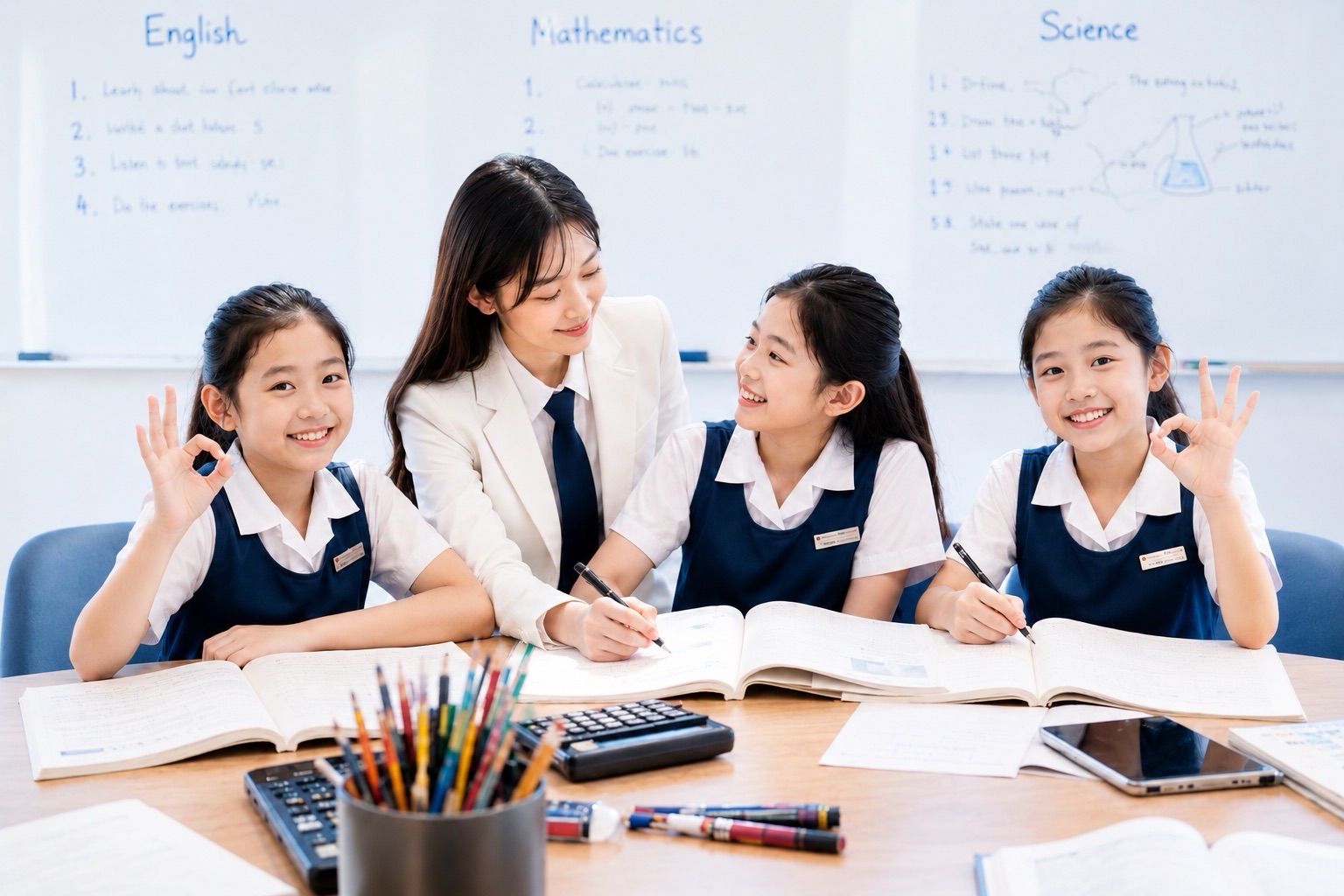
Primary 6 Science tuition for Sengkang students in focused 3-pax classes near Punggol MRT. Strengthen concepts, Booklet A accuracy, open-ended answers and PSLE readiness.
Primary 6 is the year Science knowledge must become precise examination performance. eduKateSG provides carefully structured three-student Primary 6 Science tuition for Sengkang children who need concept repair, stronger answering skills or advanced PSLE preparation.
Primary 6 Science Tuition Sengkang | What Happens in Primary 6 PSLE Science Tuition with a Sengkang Science Tutor
Primary 6 Science is where everything begins to come together.
The child is no longer learning one chapter at a time simply to pass the next school assessment.
Concepts from Primary 3, Primary 4, Primary 5 and Primary 6 must now be recalled, connected and applied inside unfamiliar questions. The student must interpret diagrams, understand experiments, compare variables, analyse data and write explanations that are scientifically complete.
At eduKateSG, we provide premium three-student Primary 6 Science tuition for Sengkang families at our nearby Punggol location.
Each 1.5-hour weekly lesson combines:
- clear teaching from first principles;
- repair of earlier Science concepts;
- complete PSLE syllabus revision;
- Booklet A multiple-choice control;
- Booklet B open-ended answering;
- scientific keyword precision;
- experiment and data interpretation;
- process-skill development;
- retrieval and mixed-topic practice;
- mistake analysis;
- timed examination preparation; and
- calm, carefully paced guidance towards the PSLE.
The purpose is not simply to give the child more notes.
It is to help the child understand Science well enough to use it.
A student may know that plants need light for photosynthesis. However, a PSLE question may ask the student to interpret an experiment involving covered leaves, changes in light intensity, starch testing or the relationship between photosynthesis and the food chain.
Knowing one fact is only the beginning.
The student must recognise which concept applies, connect it to the evidence and express the explanation clearly enough to earn the mark.
That is the real work of Primary 6 Science tuition.
Class size is limited to three students.
This gives the tutor enough time to listen to each child’s reasoning, inspect written answers closely and correct the precise point where understanding or expression becomes incomplete. Current eduKateSG programme information lists three-student Primary 6 Science classes, 1.5-hour sessions and a location near Punggol MRT that serves both Punggol and Sengkang families.
Primary 6 Science Is the Final Concept-Linking Year
Primary 6 is sometimes described as a revision year.
That description is only partly correct.
Students are still learning important Primary 6 content while revisiting earlier knowledge from Primary 3 to Primary 5. At the same time, school assessments begin testing the full body of Primary Science more frequently.
The student must therefore manage three layers at once:
- learn the remaining Primary 6 concepts;
- retain knowledge from earlier years; and
- convert that knowledge into PSLE-ready answers.
This makes Primary 6 different from the earlier levels.
In Primary 3 or Primary 4, a child may succeed by recognising a familiar worksheet pattern or recalling one direct fact.
In Primary 6, the question may combine:
- a concept learned two years earlier;
- a diagram the child has not seen before;
- an experiment with several variables;
- data presented in a graph or table;
- a comparison between two conditions; and
- an open-ended explanation requiring a complete cause-and-effect chain.
The content may be familiar.
The construction of the question is not.
Primary 6 Science tuition must therefore prepare the student for more than memory.
It must develop scientific reading, reasoning, application and communication.
The Immediate Concern for Sengkang Parents
Many parents become concerned when their child appears to know the Science content but continues losing marks.
The child may be able to explain the topic verbally at home.
The child may have memorised the school notes.
The child may even recognise the correct concept after seeing the answer key.
Yet the marks remain inconsistent.
Parents may notice that the child:
- performs well in topical worksheets but poorly in mixed papers;
- understands the chapter but cannot answer unfamiliar questions;
- loses marks in open-ended questions;
- gives answers that are vague or incomplete;
- repeatedly misses one important keyword;
- reads graphs or experimental setups inaccurately;
- changes a correct multiple-choice answer unnecessarily;
- confuses similar concepts;
- knows the fact but does not connect it to the question;
- rushes through Booklet A;
- leaves insufficient time for Booklet B; or
- produces different results from one assessment to the next.
This often leads to the familiar Primary 6 Science problem:
“My child knows the answer, but cannot get the mark.”
Usually, the child knows part of the answer.
The missing mark may come from a missing condition, relationship, comparison, process or scientific outcome.
For example, the statement:
“The plant gets less food.”
may contain the right general idea.
However, a question may require the student to explain that reduced light intensity lowers the rate of photosynthesis, so less food is produced by the plant.
The stronger answer identifies:
- what changed;
- which scientific process was affected;
- how the process changed; and
- what consequence followed.
Primary 6 Science tuition must teach children to see and construct that full chain.
The Hidden Science Problem: Facts Are Not Yet a System
Primary Science contains many facts.
However, PSLE Science is not a collection of independent facts.
It is a connected system.
Consider a plant.
A student may learn separately that:
- roots absorb water;
- leaves receive light;
- carbon dioxide enters the leaf;
- photosynthesis produces food;
- water moves through the plant;
- oxygen and carbon dioxide are involved in different processes;
- animals depend directly or indirectly on plants for food;
- energy moves through food chains; and
- changes in the environment affect organisms.
At the PSLE level, these ideas can appear inside one question.
The child may need to connect:
[
\text{Light}
\rightarrow
\text{Photosynthesis}
\rightarrow
\text{Food production}
\rightarrow
\text{Plant growth}
\rightarrow
\text{Food availability}
\rightarrow
\text{Population change}
]
This is why simply reading notes repeatedly may not be enough.
The notes may store facts by chapter.
The examination often tests connections across chapters.
At eduKateSG, we help students turn individual facts into organised concept networks.
For every topic, students learn to identify:
- the central concept;
- the conditions required;
- the process taking place;
- the cause;
- the effect;
- the evidence in the question;
- the scientific keywords;
- the common misconceptions; and
- the connections to other topics.
The student is not only asked:
“What do you remember?”
The student is also asked:
“What is happening here, and how do you know?”
Primary 6 Science Is Not Simply a Memory Subject
Memory remains important.
A student cannot reason correctly without knowing the relevant concepts, terms and relationships.
However, memory alone cannot carry the full PSLE Science paper.
The student must also be able to:
- observe carefully;
- classify information;
- compare conditions;
- identify patterns;
- infer from evidence;
- predict outcomes;
- communicate explanations;
- identify variables;
- interpret experimental procedures;
- evaluate whether a test is fair;
- read tables and graphs;
- distinguish observation from inference;
- select the relevant concept;
- connect cause and effect; and
- apply knowledge in an unfamiliar context.
The MOE Primary Science syllabus is organised around scientific core ideas, practices, values, ethics and attitudes. Its five broad themes are Diversity, Cycles, Systems, Energy and Interactions, with an emphasis on helping students recognise links rather than treating topics as isolated blocks.
This gives parents a useful way to understand the subject.
The syllabus contains knowledge.
The examination requires the child to practise Science.
A student who only memorises may recognise the answer after it is shown.
A student who understands can construct the answer from the evidence provided.
Why Sengkang Parents Choose 3-Pax Primary 6 Science Tuition
A three-student class creates a carefully balanced learning environment.
There are enough students for discussion, comparison and shared discovery.
At the same time, the class remains small enough for the tutor to inspect every child’s thinking and writing.
This is especially important in Science because two children may write similar incorrect answers for completely different reasons.
One child may not understand the concept.
Another may understand the concept but use the wrong keyword.
A third may know the concept and vocabulary but fail to link the explanation to the evidence in the question.
The correction must match the cause.
What the three-student structure allows
- Every child answers questions during the lesson
- Written responses can be checked line by line
- Misconceptions are corrected immediately
- Students explain why an answer is correct
- Different worksheets can be assigned where needed
- Quiet students have space to ask questions
- The tutor can compare alternative answers
- Stronger students receive extension without losing precision
- Students needing repair are not left behind
- Recurring error patterns become visible quickly
- Examination habits can be corrected individually
- Feedback remains specific rather than general
In a larger class, a child may copy a model answer and appear to understand.
In a small class, the tutor can remove the model and ask the child to reconstruct the reasoning independently.
That difference matters.
The aim is not simply to complete the worksheet.
The aim is to make the child’s thinking visible.
Understanding the Current PSLE Science Paper
The PSLE is the national examination taken at the end of Primary 6.
For the revised 2026 PSLE Science format, students sit for one written paper lasting 1 hour 45 minutes.
The paper contains two booklets:
| Component | Question type | Number of questions | Marks |
|---|---|---|---|
| Booklet A | Multiple-choice questions | 30 | 60 |
| Booklet B | Structured questions | 10–11 | 40 |
| Total | — | — | 100 |
Each Booklet A question carries two marks. Booklet B questions carry between two and five marks, and students are required to answer all questions in both booklets.
This format has an important consequence.
Booklet A carries a substantial proportion of the total score.
A student who loses five multiple-choice questions has already lost ten marks.
Booklet A therefore cannot be treated as a quick warm-up before the “real” open-ended section.
At the same time, Booklet B requires careful reading, accurate concept selection and sufficiently complete scientific explanations.
A complete Primary 6 Science programme must prepare both systems:
[
\text{Booklet A accuracy}
+
\text{Booklet B precision}
\text{Stronger PSLE Science control}
]
What We Teach in Primary 6 Science Tuition
The official Primary Science syllabus develops knowledge progressively from Primary 3 to Primary 6.
Students enter the PSLE with concepts drawn from five connected themes:
- Diversity
- Cycles
- Systems
- Energy
- Interactions
Primary 6 introduces and extends important areas including photosynthesis, energy conversion, forces and interactions within the environment. The full PSLE foundation also depends on earlier topics such as matter, water, plant and human systems, reproduction, electricity, light and heat.
We therefore teach Primary 6 Science as a cumulative subject.
Diversity
Students revisit how living and non-living things are identified, grouped and compared.
They learn to observe properties carefully and classify based on relevant characteristics rather than surface appearance.
This foundation supports later questions involving:
- organisms;
- materials;
- adaptations;
- environmental conditions; and
- comparisons between living things.
Cycles
Students connect repeated processes involving:
- life cycles;
- reproduction;
- matter;
- water; and
- changes that occur over time.
The child must understand not only the sequence of a cycle, but also the conditions and processes that allow each stage to occur.
Systems
Students learn that individual parts work together to perform functions.
These may include:
- plant systems;
- human body systems;
- electrical systems; and
- connected processes within organisms.
A system question may require the student to explain what happens when one component changes or fails.
The child therefore needs to understand both the part and the relationship between parts.
Energy
Students work with ideas involving:
- light;
- heat;
- energy forms;
- energy use;
- energy conversion;
- photosynthesis; and
- movement or operation within systems.
Energy questions frequently require students to trace a sequence.
For example:
[
\text{Chemical potential energy}
\rightarrow
\text{Electrical energy}
\rightarrow
\text{Light and heat energy}
]
The student must identify the relevant starting form, intermediate conversion and final outcome.
Interactions
Students examine how objects, organisms and environments affect one another.
This includes:
- magnetic forces;
- frictional force;
- gravitational force;
- elastic spring force;
- food chains and food webs;
- adaptations;
- population relationships; and
- environmental change.
Interactions questions can be demanding because they often require several concepts to work together.
A change in one population may affect another.
A change in force may alter motion.
A change in environmental conditions may influence survival or reproduction.
The child must follow the chain without skipping the scientific link.
Primary 6 Topics Must Connect to Earlier Science
Primary 6 students often believe they have forgotten everything.
Usually, the problem is not complete forgetting.
The knowledge has become fragmented.
The child may remember heat when completing a heat worksheet but fail to retrieve it inside a question about evaporation.
The child may remember forces during a forces lesson but fail to connect friction to the movement of an object in an experiment.
The child may remember photosynthesis but overlook its importance in a food web.
At eduKateSG, earlier topics are not revised as isolated chapters only.
We reconnect them to later concepts.
Example: Water, heat and cycles
A question involving drying clothes may require knowledge of:
- evaporation;
- heat;
- exposed surface area;
- moving air;
- water vapour; and
- the water cycle.
Example: Plant systems and photosynthesis
A question involving a plant may require knowledge of:
- root absorption;
- transport of water;
- gas exchange;
- light;
- photosynthesis;
- food storage; and
- growth.
Example: Electricity and energy conversion
A circuit question may require students to understand:
- complete and incomplete circuits;
- electrical components;
- conductors and insulators;
- electrical energy;
- energy conversion; and
- changes to brightness.
Example: Food webs and environmental interactions
An ecosystem question may require students to connect:
- producers;
- consumers;
- predator-prey relationships;
- competition;
- food availability;
- population change; and
- environmental conditions.
This is how Primary 6 Science begins to feel manageable.
The child stops seeing dozens of disconnected chapters and begins seeing a smaller number of recurring scientific relationships.
Our First-Principles Primary 6 Science Teaching Method
A strong Primary 6 Science programme should not begin with memorising a model answer for every possible question.
There are too many possible question variations.
Instead, we teach students how to build answers from stable scientific principles.
1. Identify the exact Science weakness
We avoid broad descriptions such as:
“My child is weak in Science.”
That may refer to very different problems.
The child may have:
- missing factual knowledge;
- shallow concept understanding;
- weak vocabulary;
- poor question interpretation;
- weak data analysis;
- confusion between similar topics;
- incomplete open-ended answers;
- careless multiple-choice habits;
- difficulty with experiments;
- poor retention;
- slow writing;
- weak time management; or
- anxiety under assessment conditions.
A recent mark alone does not reveal the cause.
We examine the paper, ask the child to explain selected answers and observe how the child reads the question.
2. Return to the first unstable concept
When an earlier concept is missing, we repair it.
For example:
- photosynthesis may require repair of plant parts and functions;
- food webs may require repair of food chains;
- energy conversion may require secure identification of energy forms;
- forces may require clear understanding of motion and interactions;
- experiment questions may require a stronger distinction between observation and inference.
We do not restart every chapter unnecessarily.
We return to the concept that is blocking current progress.
3. Make the concept visible
Science becomes easier when the student can see what is happening.
We may use:
- diagrams;
- labelled processes;
- concept maps;
- simple demonstrations;
- comparison tables;
- real-life examples;
- cause-and-effect chains; and
- carefully selected questions.
The child first understands the phenomenon.
The scientific language is then attached to that understanding.
4. Teach the concept boundary
Students must know both when a concept applies and when it does not.
For example:
- evaporation and boiling are not interchangeable;
- breathing and respiration are different;
- food and nutrients are related but not identical;
- mass and weight should not be treated as the same idea;
- heat and temperature describe different things;
- a fair test requires more than simply repeating an experiment;
- an observation is not the same as an inference.
Many examination errors occur because the child uses a generally related idea outside its correct boundary.
5. Move from guided explanation to independent use
A typical progression is:
- tutor explains the concept;
- student studies a clear example;
- tutor and student solve a guided question;
- student attempts a parallel question;
- student explains the answer aloud;
- student attempts an unfamiliar variation;
- the topic is mixed with older concepts;
- the student answers under controlled timing.
Support is gradually removed.
The final objective is independent reasoning.
6. Retrieve after a delay
Students often understand a topic during the lesson but cannot retrieve it several weeks later.
We therefore revisit concepts through:
- short quizzes;
- oral questioning;
- mixed worksheets;
- concept maps;
- error reviews;
- repeated diagrams; and
- timed sections.
A concept is not considered secure merely because the child understood it once.
It must remain available.
7. Interleave topics
Topical practice is useful during the early learning stage.
However, the PSLE paper does not announce the chapter beside each question.
Students must recognise which concept is needed.
Mixed practice teaches the child to ask:
- What is this question really testing?
- Which evidence matters?
- Which concept explains the observation?
- What other topic may be connected?
- Is the question asking for a cause, effect, comparison or procedure?
This develops flexible Science thinking.
8. Classify mistakes
We organise mistakes into patterns such as:
- concept errors;
- keyword errors;
- incomplete links;
- question-reading errors;
- data-reading errors;
- experiment-design errors;
- careless MCQ errors;
- comparison errors;
- language errors;
- timing errors; and
- checking failures.
Once the pattern is visible, correction becomes more efficient.
What Happens During a 90-Minute Primary 6 Science Lesson?
Each lesson is adapted to the children present, but the tutorial follows a clear learning rhythm.
Retrieval warm-up
Students begin with a short set drawn from earlier topics.
This may include:
- quick concept questions;
- diagram labelling;
- vocabulary recall;
- one MCQ;
- one open-ended explanation;
- an experiment variable; or
- a previous error pattern.
The warm-up tells the tutor what has remained secure since the previous lesson.
Concept review or new instruction
The tutor introduces or revisits the central idea.
The lesson focuses on:
- what happens;
- why it happens;
- the conditions required;
- the correct scientific terms;
- the likely misconceptions; and
- the links to earlier topics.
Guided application
Students apply the concept to selected questions.
The tutor may ask:
- What did you observe?
- Which information changed?
- What remained the same?
- Which concept explains this?
- What evidence supports your answer?
- What happens next?
- Have you answered the exact question?
Booklet A training
Students practise multiple-choice questions with attention to:
- question stems;
- distractors;
- elimination;
- diagram details;
- comparison of options;
- checking routines; and
- decision confidence.
The student must be able to explain why the selected answer is correct and why the other options are not.
Booklet B training
Students construct open-ended answers using the required concept and evidence.
The tutor checks:
- scientific accuracy;
- keyword use;
- cause-and-effect links;
- comparisons;
- references to the question;
- sentence completeness; and
- whether every part has been answered.
Experiment or data question
Students may work with:
- variables;
- tables;
- graphs;
- apparatus;
- fair tests;
- observations;
- conclusions;
- predictions;
- improvements to procedures; or
- relationships between variables.
Mixed-topic practice
Older topics are included so students must select the relevant concept independently.
This helps prevent dependence on chapter labels.
Error review
The lesson ends by identifying what went wrong and what signal should be noticed in future.
Focused continuation work
Home practice may include:
- concept repair;
- topical questions;
- mixed retrieval;
- Booklet A drills;
- Booklet B answers;
- experiment questions;
- mistake corrections; or
- timed practice.
The work is selected for a reason.
It is not simply the next page of a workbook.
Booklet A: Multiple-Choice Questions Need Full Control
Booklet A may appear easier because the answer is already present among four options.
That can be misleading.
PSLE multiple-choice questions often contain distractors based on common misconceptions.
A child may choose an incorrect option because it:
- contains a familiar keyword;
- looks similar to a practised question;
- describes the right topic but the wrong process;
- reverses cause and effect;
- ignores one condition;
- misreads the diagram;
- uses information that is true but irrelevant;
- confuses an observation with an explanation; or
- appears correct before all options are compared.
Our Booklet A method
Students learn to:
- identify what the question is asking;
- inspect the diagram or data carefully;
- retrieve the relevant concept;
- predict the likely answer where possible;
- test each option scientifically;
- eliminate options for a clear reason;
- select the best-supported answer; and
- check that no condition has been overlooked.
Why changing answers can be dangerous
Some students repeatedly change correct answers during checking.
A change should only be made when the student can identify:
- the specific mistake in the original reasoning; and
- the scientific reason the new answer is stronger.
Changing an answer because another option “looks better” is not reliable checking.
We teach evidence-based correction.
Protecting the two-mark questions
Because each Booklet A question carries two marks in the revised format, small losses can accumulate quickly.
Students therefore need:
- strong foundational recall;
- careful reading;
- controlled pacing;
- confidence in elimination;
- resistance to distractors; and
- a final checking routine.
Booklet A accuracy is built, not assumed.
Booklet B: Turning Knowledge into Full Scientific Answers
Booklet B is where many students feel they knew the concept but still lost the mark.
The problem is often not the absence of knowledge.
It is incomplete scientific communication.
A complete Science explanation commonly requires some combination of:
- a condition;
- a process;
- a comparison;
- a change;
- a cause;
- an effect;
- evidence from the question; and
- the final scientific outcome.
A useful answer structure
Depending on the question, students may use:
[
\text{Evidence}
+
\text{Concept}
+
\text{Scientific link}
+
\text{Outcome}
]
For example:
Plant A received less light than Plant B. Its rate of photosynthesis was therefore lower, so it produced less food for growth.
The answer does not merely state that Plant A grew less.
It explains why.
Answering “explain” questions
An explain question usually requires the relationship between cause and effect.
Students are trained to ask:
- What caused the change?
- Which process was affected?
- Did it increase, decrease, stop or remain the same?
- What was the resulting outcome?
Answering “compare” questions
A proper comparison must address both subjects.
Weak:
Plant A grew taller.
Stronger:
Plant A grew taller than Plant B.
The comparison must be explicit.
Answering “describe” questions
A description should state what happened without adding unsupported reasoning.
Students must distinguish between:
- describing a pattern; and
- explaining the pattern.
Answering “state” questions
A state question usually requires a direct, concise response.
Overwriting may create contradictions or introduce an incorrect idea.
Using the evidence
Students are taught to refer to:
- values in the table;
- changes shown in the graph;
- observations from the experiment;
- differences in the diagram;
- conditions stated in the question; and
- relevant relationships between variables.
A memorised answer that ignores the evidence may not answer the question presented.
Scientific Keywords: Necessary but Not Magical
Keywords matter because Science uses precise language.
However, inserting several keywords into a sentence does not automatically create a correct answer.
The words must express the correct scientific relationship.
Consider the keywords:
- photosynthesis;
- light;
- food; and
- growth.
A student might write:
“The plant needs light, photosynthesis, food and growth.”
The keywords are present, but the explanation is not scientifically organised.
A stronger response would be:
“The plant received less light, so its rate of photosynthesis decreased. It produced less food and therefore showed less growth.”
The value of the keywords comes from their relationship.
At eduKateSG, students learn:
- the correct term;
- what it means;
- what it is commonly confused with;
- where it belongs in an explanation; and
- how it connects cause to effect.
Keywords are tools for precision.
They are not decorations.
How We Teach Experiment Questions
Experiment questions are often difficult because they combine Science knowledge with careful reading.
Students may need to interpret:
- the aim of an investigation;
- the changed variable;
- the measured variable;
- controlled variables;
- the experimental setup;
- the observations;
- patterns in results;
- whether the test is fair;
- whether the conclusion is supported;
- how reliability can be improved; or
- how the procedure should be changed.
Changed variable
This is the factor deliberately changed by the investigator.
Students must identify what differs between the experimental setups.
Measured variable
This is the result that is observed or measured.
Students learn to distinguish what the scientist changes from what the scientist records.
Controlled variables
These are factors kept the same to support a fair comparison.
The child must be able to explain why a particular variable should remain constant.
Observation
An observation states what can be directly seen, measured or recorded.
For example:
“The water level decreased by 3 cm.”
Inference
An inference is a reasoned explanation based on the observation.
For example:
“Water was absorbed by the plant.”
Students often lose marks by giving an inference when the question requests an observation, or vice versa.
Reliability
Students learn that repeating measurements and comparing results can reduce the influence of random variation.
However, they must describe the relevant improvement in the context of the experiment rather than repeating a memorised phrase.
Fair testing
A fair test requires the student to compare the effect of one changed factor while keeping relevant conditions consistent.
The answer should identify the specific variable involved.
Graphs and Tables Must Be Read Scientifically
Some students look at a graph and immediately begin guessing the concept.
We teach them to first read what the graph actually shows.
A reliable sequence is:
- read the title;
- identify both axes;
- check the units;
- study the scale;
- identify what changed;
- locate the relevant interval;
- describe the pattern;
- compare values where required;
- retrieve the scientific concept; and
- connect the concept to the pattern.
Students practise identifying:
- increase;
- decrease;
- no change;
- maximum or minimum values;
- faster or slower rates;
- direct or inverse patterns;
- unusual results; and
- intervals where the relationship changes.
The child must not describe what the graph ought to show.
The child must describe what the graph actually shows.
Three Primary 6 Science Student Pathways
Not every child enters tuition for the same reason.
The concept-repair pathway
This student may:
- confuse several topics;
- remember definitions without understanding;
- struggle to explain processes;
- have significant Primary 4 or Primary 5 gaps;
- depend heavily on notes;
- guess unfamiliar questions; or
- lose confidence when diagrams change.
The priority is to rebuild the scientific foundation.
The tutor identifies the first missing idea, teaches it clearly and reconnects it to the current Primary 6 work.
The answering-precision pathway
This student generally understands the content but loses marks in Booklet B.
The child may:
- give answers that are too vague;
- omit comparisons;
- leave out evidence;
- skip the scientific process;
- use conversational rather than scientific language;
- write too little;
- write too much; or
- fail to answer the command word.
The priority is turning knowledge into complete, marker-ready explanations.
The PSLE examination-control pathway
This student may already be performing well and wants to protect the higher achievement levels.
The work may focus on:
- difficult Booklet A distractors;
- mixed-topic transfer;
- less familiar experiments;
- data interpretation;
- answer economy;
- mark protection;
- timed completion;
- checking discipline; and
- recovery from preliminary examination mistakes.
The purpose is not merely to complete more papers.
It is to reduce avoidable mark leakage.
eduKateSG’s current Primary 6 Science route similarly distinguishes among concept repair, open-ended answering and higher-level examination control.
Why “Careless Mistake” Is Often Too General
Parents and students frequently describe lost marks as careless.
Sometimes the mistake is genuinely a momentary slip.
Often, there is a repeated system underneath it.
Question-reading error
The child may miss words such as:
- not;
- most likely;
- compare;
- explain;
- increase;
- decrease;
- same; or
- different.
Correction requires active annotation and deliberate reading routines.
Concept-selection error
The child identifies the wrong topic or uses a related but unsuitable concept.
Correction requires stronger concept boundaries and mixed-topic recognition.
Keyword error
The child uses everyday language where a precise scientific term is needed.
Correction requires vocabulary attached to understanding.
Incomplete-link error
The child states the cause and final effect but omits the process connecting them.
Correction requires cause-and-effect chain training.
Evidence error
The child writes a memorised explanation without referring to the diagram, table or experimental result.
Correction requires evidence integration.
Comparison error
The child discusses only one object when the question asks for a comparison.
Correction requires explicit two-sided phrasing.
Data error
The child reads the wrong axis, value, scale or unit.
Correction requires a stable graph-reading routine.
Multiple-choice distractor error
The child selects the first familiar-looking option without testing all four.
Correction requires option comparison and elimination.
Timing error
The child spends too long on one difficult question or reaches Booklet B with insufficient time.
Correction requires controlled timed sections and paper-navigation practice.
Once the mistake is properly named, it becomes easier to repair.
Teaching Ahead Without Turning Primary 6 into a Race
Where the child’s foundation is ready, we introduce important ideas slightly before they appear in school.
The purpose is not to finish the entire Primary 6 syllabus as quickly as possible.
It is to create familiarity.
When the child later encounters the topic in school:
- the vocabulary is recognisable;
- the central idea is already visible;
- school instruction becomes a second exposure;
- the child can ask better questions;
- homework becomes reinforcement; and
- assessment preparation feels less compressed.
A useful learning cycle is:
- first encounter in tuition;
- formal teaching in school;
- guided application;
- independent practice;
- delayed retrieval;
- connection to earlier topics;
- mixed-paper practice; and
- examination execution.
We teach ahead where it creates understanding.
We slow down where a missing foundation needs repair.
Coverage matters.
Control matters more.
What Progress Should Look Like
Progress in Primary 6 Science is not limited to one test score.
Parents may first notice that the child:
- explains concepts without looking at notes;
- identifies the tested concept more quickly;
- asks more precise questions;
- uses scientific terms correctly;
- writes clearer cause-and-effect explanations;
- makes proper comparisons;
- refers to evidence in the question;
- reads graphs more carefully;
- distinguishes observations from inferences;
- eliminates MCQ options with reasons;
- changes fewer correct answers;
- retrieves older topics more reliably;
- completes more of the paper;
- checks work with a purpose; and
- approaches Science with greater calm.
These are meaningful leading indicators.
Marks usually improve when several systems begin working together:
[
\text{Concept knowledge}
+
\text{Process skills}
+
\text{Scientific language}
+
\text{Answer structure}
+
\text{Exam control}
]
Tuition should make this development visible.
A responsible programme does not promise an instant achievement level after one or two lessons.
The rate of improvement depends on:
- the child’s starting point;
- the number and age of existing gaps;
- attendance;
- independent practice;
- reading ability;
- willingness to correct answers;
- school demands;
- confidence; and
- the time remaining before the PSLE.
Our role is to provide a clear, carefully sequenced route forward.
When Should a Sengkang Student Begin Primary 6 Science Tuition?
November or December before Primary 6
This is the most comfortable preparation window.
The child can use the school holidays to:
- review Primary 5 topics;
- repair weak Primary 3 and Primary 4 concepts;
- strengthen open-ended answering;
- organise Science notes;
- build vocabulary;
- practise process skills; and
- preview important Primary 6 content.
The objective is not to complete the full PSLE syllabus during the holidays.
It is to enter Primary 6 with a stable runway.
January of Primary 6
January remains an excellent starting point.
There is time to coordinate with the school programme, revisit older knowledge and develop PSLE habits gradually.
The child can learn without every lesson becoming an emergency response to the next examination.
After the first school assessment
A weak result can provide useful diagnostic information.
Support should begin promptly when the paper reveals patterns such as:
- serious concept confusion;
- repeated Booklet B losses;
- poor Booklet A accuracy;
- weak experiment skills;
- incomplete answers;
- inability to finish; or
- heavy dependence on memorised notes.
Parents do not necessarily need several more assessments to confirm the same pattern.
After the mid-year examinations
Meaningful improvement is still possible.
However, the programme must now balance:
- concept repair;
- current schoolwork;
- full-syllabus revision;
- preliminary examination preparation; and
- PSLE paper control.
The work becomes more compressed.
The tutor must prioritise carefully.
After the preliminary examinations
This is the final correction period.
The prelim paper becomes an important diagnostic tool.
We identify:
- where marks were lost;
- which topics remain unstable;
- whether Booklet A or Booklet B is the larger issue;
- which mistakes are recurring;
- whether the child completed the paper;
- which answers were incomplete; and
- what should receive the remaining revision time.
At this stage, random practice is rarely efficient.
The child needs focused correction and controlled repetition.
Signs That Primary 6 Science Support May Be Useful
A consultation may be helpful when the child:
- reads notes repeatedly but cannot explain the topic;
- knows the chapter but struggles with unfamiliar questions;
- performs well topically but poorly in mixed papers;
- loses many marks in Booklet B;
- uses vague language;
- omits comparisons or evidence;
- confuses observation and inference;
- struggles with variables and fair tests;
- reads graphs inaccurately;
- loses several Booklet A questions through distractors;
- changes correct answers unnecessarily;
- forgets earlier Primary Science topics;
- leaves the paper incomplete;
- has become anxious about Science; or
- wants a more secure route towards AL1 or another target achievement level.
Parents do not need to wait until the child has completely lost confidence.
Earlier intervention usually requires less reconstruction.
Convenient Primary 6 Science Tuition for Sengkang Families
eduKateSG’s Punggol location provides a nearby Primary 6 Science tuition option for families living in Sengkang, Compassvale, Rivervale, Fernvale and surrounding areas.
The centre is located at 83 Punggol Central, Singapore 828761, near Punggol MRT and Waterway Point.
The short journey provides a useful separation between home, school and focused tuition time.
The child arrives with one clear purpose:
To understand Science carefully and prepare properly.
Location and class information
| Detail | Programme information |
|---|---|
| Location | eduKateSG, 83 Punggol Central, Singapore 828761 |
| Nearby landmark | Punggol MRT and Waterway Point |
| Level | Primary 6 Science |
| Examination | PSLE Science |
| Format | Premium three-student small-group tuition |
| Lesson duration | 1.5 hours weekly |
| Placement | By consultation and suitable class availability |
Primary 6 Science Class Details
Format
Premium three-student small-group tutorials.
Level
Primary 6 Standard Science and PSLE Science preparation.
Foundation Science support may be discussed separately according to the student’s requirements and suitable placement.
Duration
1.5 hours weekly.
Teaching approach
- First-principles concept teaching
- Primary 3–5 foundation repair
- Primary 6 syllabus instruction
- Concept linking
- Scientific vocabulary
- Booklet A accuracy
- Booklet B answer structure
- Experiment analysis
- Graph and table interpretation
- Retrieval practice
- Interleaved revision
- Error classification
- Timed paper preparation
- Calm examination routines
Materials may include
- concept notes;
- diagrams and process maps;
- topical worksheets;
- mixed-topic questions;
- Booklet A practice;
- Booklet B practice;
- experiment and data questions;
- keyword and misconception exercises;
- timed sections;
- mistake logs;
- school-paper correction; and
- PSLE-style revision papers.
Additional preparation around school examinations, preliminary examinations and the PSLE may be arranged according to the class programme.
Limited trial lessons may occasionally be possible when the three-student class configuration permits.
The usual first step is a parent–student consultation.
What Parents Can Bring to the Consultation
Useful materials include:
- recent Science test papers;
- school examination papers;
- marked open-ended questions;
- topical worksheets;
- the child’s Science notes;
- school teacher comments;
- examples of difficult homework;
- preliminary examination papers; and
- information about the child’s target and current concerns.
We are not only looking at the total mark.
We are looking at the shape of the mark loss.
A child scoring 65 may have weak content knowledge.
Another child with the same score may understand most concepts but lose marks through incomplete Booklet B answers.
A third may perform strongly in Booklet B but lose too many two-mark questions in Booklet A.
Those children require different plans.
The consultation helps us identify whether the child needs:
- concept repair;
- stronger process skills;
- answering precision;
- Booklet A control;
- Booklet B control;
- full-syllabus consolidation; or
- higher-level PSLE refinement.
Frequently Asked Questions
Is Primary 6 Science mostly memorisation?
No.
Students need to remember important concepts, terms and relationships, but the PSLE also requires them to interpret evidence, analyse experiments, read data, apply ideas and communicate explanations clearly.
My child knows the Science topic. Why are marks still being lost?
The child may know the general concept but omit one required condition, process, comparison or outcome.
The child may also fail to connect the explanation to the evidence given in the question.
Does every Primary 6 student need Science tuition?
No.
A child who understands concepts, retains earlier knowledge, completes work independently and performs consistently may not require tuition.
Support becomes useful when a specific learning or examination problem is beginning to affect progress.
My child is weak in topics from Primary 4 or Primary 5. Will you restart everything?
No.
We identify the earlier concepts that are directly affecting the child’s current Primary 6 work.
The repair is targeted.
Do you follow the school’s topic sequence?
We coordinate with the child’s school topics and assessment schedule.
However, an earlier concept may need to be revisited before the current chapter can be properly understood.
Do you teach ahead?
Yes, where the child is ready.
Pre-teaching creates familiarity and gives the child a calmer second encounter when the topic appears in school.
We do not rush ahead when important foundations remain unstable.
How do you teach open-ended answering?
Students learn to identify the question demand, retrieve the correct concept, use relevant evidence and build a complete scientific link from cause to effect.
Answers are checked for scientific accuracy, keywords, comparisons and completeness.
How do you improve Booklet A?
Students learn to analyse every option, identify distractors, eliminate answers scientifically and avoid changing correct answers without a valid reason.
How do you help with careless mistakes?
We classify the mistake first.
It may be a reading error, concept error, evidence error, keyword error, comparison error, data error, timing problem or weak checking habit.
The correction is then matched to the actual cause.
How quickly can a child improve?
Some children show better clarity, answer structure and confidence after several learning cycles.
Larger content gaps require more time.
Progress depends on the starting point, attendance, practice, correction habits and the remaining time before the examination.
Can my child join during Primary 6?
Yes, subject to a suitable three-student class placement.
The student’s level, school pace and primary support needs are considered before placement.
Is a three-student class suitable for a shy child?
It can be particularly useful.
The environment is small enough for the tutor to involve the child gently and consistently, without the noise or exposure of a large group.
Why choose a three-student class instead of a larger tuition class?
A larger class may be sufficient for a child who only needs broad syllabus teaching.
A three-student class is particularly useful when the child needs:
- close answer correction;
- frequent questioning;
- personalised concept repair;
- individual pacing;
- confidence building;
- detailed mistake analysis; or
- advanced extension.
The correct class depends on the child’s actual learning requirement.
Helpful Reading for Sengkang Parents
- MOE Primary Science Syllabus
- SEAB PSLE Information
- 2026 PSLE Science Examination Format
- Primary Science Tuition in Sengkang
- Primary 6 Science Tuition PSLE Route
- Primary 6 Science Tutor Punggol
- How to Answer PSLE Science Open-Ended Questions
- Building the PSLE AL1 Science Corridor
- Primary Science Concept Repair
- eduKateSG Resources for Parents
Primary 6 Science Tuition for Sengkang Families
Primary 6 Science is where knowledge must become usable.
Facts must connect.
Observations must be interpreted.
Experiments must be read carefully.
Evidence must support conclusions.
Keywords must form complete explanations.
Booklet A decisions must remain accurate.
Booklet B answers must communicate the full scientific link.
At eduKateSG, our three-student Primary 6 Science tutorials provide the space and attention needed to build these systems carefully.
For children with missing foundations, we rebuild.
For children who understand but cannot express, we sharpen.
For children losing marks through inconsistency, we stabilise.
For children aiming higher, we refine and protect.
The purpose is not merely to produce a child who has completed many Science papers.
It is to develop a child who can:
- recognise the concept;
- understand the evidence;
- reason scientifically;
- write precisely;
- manage the paper calmly; and
- enter secondary school with a stronger foundation for future Science.
Arrange a Parent–Student Consultation
Speak with eduKateSG about your child’s current Science results, weak topics, Booklet A and Booklet B performance, school examination schedule and PSLE preparation needs.
eduKateSG
83 Punggol Central
Singapore 828761
Near Punggol MRT and Waterway Point
Premium three-student small-group tuition
By appointment
Properly taught kids shine a bright light into the future.
Sengkang Primary 6 Science Tuition: Building a Strong Foundation for PSLE Success
Primary 6 marks a pivotal year in a student’s academic journey in Singapore, with the PSLE (Primary School Leaving Examination) on the horizon. As students prepare for their PSLE, Science often poses a challenge due to its broad syllabus and the emphasis on both theoretical understanding and practical application. For students in Sengkang, Primary 6 Science tuition offers targeted support to help them master key concepts, build critical thinking skills, and develop exam techniques that will allow them to excel in the PSLE Science examination.
Why Choose Primary 6 Science Tuition in Sengkang?
Sengkang Primary 6 Science tuition provides a structured and comprehensive approach to Science education, ensuring students have a solid grasp of all key topics in the PSLE Science syllabus. Here’s why Sengkang Science tuition is a preferred choice for many parents and students:
- Targeted Curriculum: The tuition programs in Sengkang are designed to cover the full range of topics in the PSLE Science syllabus, including topics from Physics, Chemistry, and Biology. Each lesson is tailored to strengthen areas where students need additional support.
- Focus on Critical Thinking: PSLE Science questions often require students to apply their knowledge to new scenarios. Our tuition classes emphasize critical thinking and problem-solving, helping students learn how to analyze questions effectively and develop strategies to tackle complex problems.
- Experienced Science Tutors: In Sengkang, Science tutors bring years of experience and deep expertise in teaching Primary 6 students. They are well-versed in the SEAB PSLE syllabus and understand the common challenges students face, offering practical tips and techniques to overcome them.
Building a Strong Foundation in Science
Primary 6 Science tuition focuses on helping students build a strong foundation across three key areas: content mastery, practical application, and exam strategies. Here’s how our Sengkang Primary 6 Science tuition prepares students for success:
- Mastering Core Science Concepts: PSLE Science covers a wide range of topics, from diversity of living thingsand magnetism to electric circuits and states of matter. Tuition centers in Sengkang ensure that students thoroughly understand these concepts by breaking down complex topics into manageable parts. This helps students build a solid foundation in the fundamental principles of Physics, Chemistry, and Biology.
- Practical Applications of Science: The ability to apply scientific knowledge in real-world scenarios is critical for PSLE success. Our tuition programs incorporate experiments, hands-on activities, and discussions that help students connect theoretical knowledge with practical applications. This experiential learning deepens their understanding of scientific concepts and prepares them for the PSLE Science practical components.
- Developing Effective Exam Strategies: Exam preparation is a crucial aspect of Primary 6 Science tuition in Sengkang. Students are trained to approach PSLE Science questions with a clear strategy, focusing on:
- Time Management: Learning how to allocate time effectively during the exam, ensuring all questions are answered thoroughly.
- Question Analysis: Understanding how to interpret and break down PSLE Science questions, particularly those that require multi-step reasoning.
- Structured Answering Techniques: Emphasizing how to organize answers clearly, especially in sections that require detailed explanations of scientific processes.
Sengkang Primary 6 Science Tuition
Summary Points for Parents
- Understand the importance of Sengkang Primary 6 Science Tuition for your child’s academic journey.
- Discover the areas that need improvement and how the tuition program can help.
- Learn practical strategies to support your child’s learning and preparation for the tuition.
- Identify the reasons behind the effectiveness of Sengkang Primary 6 Science Tuition.
What is Sengkang Primary 6 Science Tuition?
Sengkang Primary 6 Science Tuition is a comprehensive learning program, tailor-made for students who are in their final year of primary school in Sengkang. Its primary objective is to offer a supportive learning environment that enhances the students’ understanding and application of science concepts, preparing them for their imminent PSLE Science examinations and their future educational pursuits.
This tuition program, although rigorous, encourages exploration and inquiry. The curriculum covers a broad spectrum of topics, including the Physical Sciences, Biological Sciences, and Earth Sciences, providing students with a well-rounded grasp of scientific principles.
The Importance of Improvement and How to Achieve It
Despite the well-structured curriculum of Singapore’s education system, the step from Primary 3 to Primary 6 often presents a significant challenge for students. The complexity of the topics increases and so does the need for a deeper understanding and application of concepts.
Sengkang Primary 6 Science Tuition addresses these issues by providing more personalized attention to each student, pinpointing areas of weakness, and strategizing plans for improvement. The tuition employs an inquiry-based learning approach, where students are encouraged to ask questions, conduct experiments, and find solutions, thus fostering critical thinking skills.
Various resources are employed to supplement the students’ learning. These include textbooks, supplementary worksheets, interactive digital tools, and practical lab sessions. By integrating different modes of learning, the tuition ensures that students fully understand the science concepts and can apply them confidently.
Benefits of Small Group Science Tuition in Sengkang
Opting for small group Science tuition in Sengkang offers several distinct advantages over traditional classroom settings:
- Personalized Attention: With smaller class sizes, tutors can give more individualized feedback to each student. This means areas of weakness can be addressed more effectively, and students receive the help they need to improve.
- Collaborative Learning: The Sengkang small group science tuition format encourages peer-to-peer learning, where students can share ideas and approaches, further deepening their understanding of complex topics. This collaboration helps them develop confidence in tackling challenging Science concepts.
- Continuous Feedback and Improvement: Our tutors provide regular assessments and feedback, helping students track their progress. This continuous evaluation ensures that any gaps in knowledge are identified and addressed before the PSLE.
Comprehensive Science Curriculum Aligned with the SEAB PSLE Syllabus
Our Sengkang Primary 6 Science tuition program is fully aligned with the SEAB PSLE syllabus, ensuring that students are well-prepared for all areas of the exam. Here’s what our program covers:
- Core Science Topics: Students will master key topics in Physics, Chemistry, and Biology, including heat and temperature, plant and animal systems, forces, and interactions of matter.
- Scientific Process Skills: Our tuition program emphasizes the importance of mastering process skills such as observation, classification, inference, and prediction, which are integral to answering PSLE Science questions accurately.
- Application of Science Concepts: Students will learn how to apply Science concepts to solve real-world problems, a key component of the PSLE Science paper.
Why Sengkang Parents Choose EduKate Singapore for Science Tuition
At EduKate Singapore, we take a holistic approach to Science education, ensuring that every student is equipped with the knowledge, skills, and confidence they need to succeed in their SEAB PSLE exams. Here’s why we are a top choice for parents in Sengkang:
- Proven Track Record: Our students consistently achieve excellent results in the PSLE, with many scoring distinctions in Science. Our approach ensures that students not only understand the content but can also apply their knowledge effectively during the exam.
- Experienced Tutors: Our team of highly qualified Science tutors has years of experience in helping Primary 6 students excel in their studies. They provide individualized support and guidance, ensuring that every student reaches their full potential.
- Comprehensive Resources: At EduKate Singapore, we provide students with comprehensive study materials, including practice papers, worksheets, and detailed notes. These resources are specifically designed to help students consolidate their knowledge and practice exam-style questions.
Empowering Students to Excel in PSLE Science
Sengkang Primary 6 Science tuition is an invaluable resource for students preparing for the PSLE. With a structured curriculum, experienced tutors, and a focus on both content mastery and practical application, EduKate Singapore is committed to helping students build a strong foundation in Science and excel in their exams.
Our small group tuition model ensures that every student receives the personalized support they need to succeed. If you’re looking for effective Science tuition in Sengkang that will help your child excel in the PSLE, contact EduKate Singapore today to find out more about our programs.
Supporting Your Child’s Learning Journey: How to Prepare
Effective learning is not confined to the classroom; the home environment plays a crucial role too. Parents can support their child’s learning journey by:
- Creating a conducive study environment: A well-organized and quiet study space can enhance your child’s focus and productivity.
- Encouraging a regular study schedule: Consistency can help your child retain information better.
- Engaging in discussions: Ask your child about what they learned during their tuition. This encourages them to articulate their understanding and helps you gauge their progress.
- Incorporating science in daily life: Discuss scientific concepts that relate to everyday activities. This will make science more relatable and fun.
The Efficacy of Sengkang Primary 6 Science Tuition: The Reasons
The efficacy of Sengkang Primary 6 Science Tuition lies in its holistic approach to teaching. It doesn’t only focus on theoretical knowledge but emphasizes the application of concepts, which is essential for the PSLE Science examinations.
The tuition also provides additional academic support, such as revision sessions, mock examinations, and personalized feedback on assignments. This comprehensive support system boosts the students’ confidence and prepares them for the rigors of their examinations.
Moreover, the small class size allows tutors to cater to the unique learning needs of each student, providing more targeted and effective assistance.
International Resources for Further Learning
For parents and students interested in supplementary learning resources, here are some internationally recognized websites:
- Khan Academy: Provides an extensive library of content on various science topics.
- BBC Bitesize: Offers interactive resources designed for Primary Science.
- National Geographic Kids: Engages children in science learning through fun, interactive content.
Conclusion
Sengkang Primary 6 Science Tuition is a comprehensive educational program that aims to equip students with the essential skills and knowledge they need to excel in their PSLE Science examinations. Through personalized learning strategies, a diverse set of resources, and a focus on application of concepts, this tuition program prepares students for success in their academic journey. Click here to enrol at eduKateSingapore.com
