
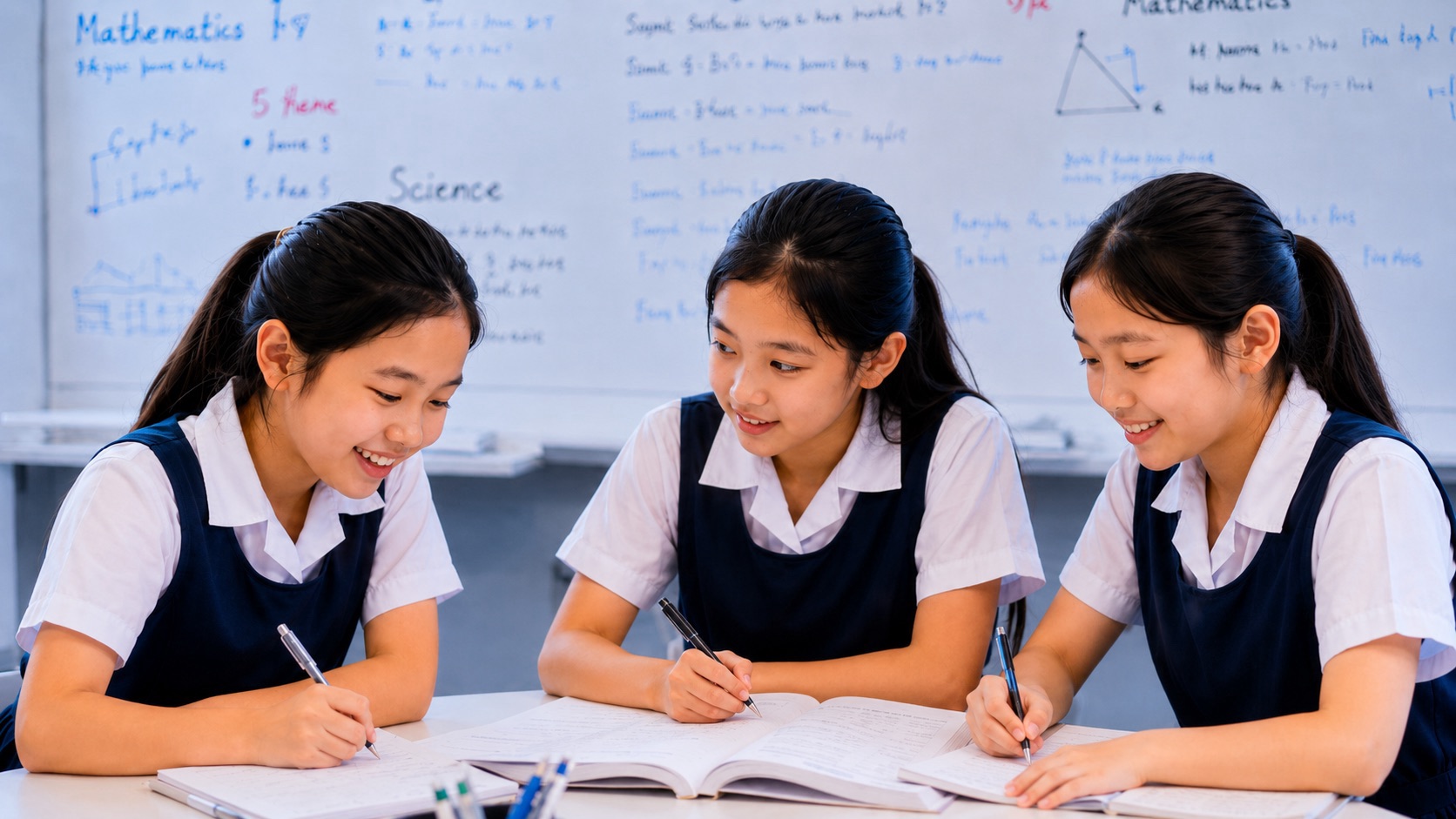
Discover what happens in eduKateSG Primary 3 Science Tuition for Sengkang students. Build concepts, scientific vocabulary, answering skills and confidence in focused 3-pax classes near Punggol MRT.
Primary 3 Science Tuition Sengkang | What Happens in Primary 3 Science Tuition with a Sengkang Science Tutor
Primary 3 is where a child begins learning Science as a formal school subject.
The topics may appear familiar.
Children have already seen plants, animals, magnets, wood, metal, plastic, rubber and the changing stages of living things. They may know many facts from books, videos, school activities and daily life.
However, Primary 3 Science asks for something more.
The child must begin to explain:
- what was observed;
- how two things are similar or different;
- why an object is suitable for a particular use;
- how living things can be classified;
- what happens during a life cycle;
- what evidence supports a conclusion; and
- which scientific idea explains the observation.
This is where Science changes from general knowledge into disciplined thinking.
At eduKateSG, we provide carefully structured three-student Primary 3 Science tuition for Sengkang families at our nearby Punggol location.
Each 1.5-hour weekly lesson combines clear teaching, guided discussion, scientific vocabulary, question practice and close tutor attention.
The purpose is not simply to give a child more Science worksheets.
It is to help the child understand how Science works.
Students learn to observe carefully, classify accurately, compare fairly and explain their answers using the correct concepts. Once these foundations become stable, school lessons become easier to follow and later Primary Science has a stronger floor to build upon.
Our Primary 3 Science tuition may be suitable for children who need to:
- understand a new school subject more confidently;
- build accurate Science vocabulary;
- move beyond memorising isolated facts;
- improve multiple-choice accuracy;
- learn how to answer open-ended questions;
- correct early misconceptions;
- keep pace with the school’s topic sequence;
- learn selected topics slightly ahead of school; or
- prepare a stronger foundation for Primary 4, Primary 5, Primary 6 and PSLE Science.
Class size is limited to three students.
Lessons are conducted weekly, with learning materials, guided correction, focused continuation work and support around important school assessment periods.
Article ID: EDUKATESG.SENGKANG.P3SCIENCE.ARTICLE.01
Primary 3 Science Is a More Important Beginning Than It First Appears
Primary 3 Science is often described simply as the year Science begins.
That is correct, but incomplete.
The child is not only receiving a new collection of facts. The child is entering a new way of thinking.
Before Primary 3, a child may say:
“This is a bird.”
In Science, the next question is:
“What observable characteristics support that classification?”
A child may say:
“This material is good for making a raincoat.”
Science asks:
“Which property makes the material suitable?”
A child may say:
“The object is attracted to the magnet.”
Science asks:
“What can you conclude about the material from this observation?”
The child must therefore move through a more complete reasoning pathway:
observe → identify → compare → apply the concept → explain
This is not simply an increase in content.
It is a change in the standard of the child’s thinking.
The current MOE Primary Science syllabus is taught from Primary 3 to Primary 6 and organises learning around five broad themes: Diversity, Cycles, Systems, Energy and Interactions. It also places importance on scientific inquiry, concepts, skills, ethics and attitudes rather than factual recall alone.
A good Primary 3 Science tutor helps the child enter this new subject carefully.
The Hidden Primary 3 Science Problem: Knowing Is Not Yet Explaining
Consider a simple question:
Why is glass suitable for making a window?
A child may know what glass is and may have seen windows every day.
However, knowing the object does not automatically produce a complete Science answer.
A weak answer may say:
Glass is suitable because it is good.
Another child may write:
Glass is strong.
The statement may contain a reasonable idea, but it does not identify the most relevant property for the question.
A stronger answer is:
Glass is suitable for making a window because it is transparent, allowing light to pass through and people to see through it.
The stronger answer contains a complete connection:
material → property → function
The same issue appears in many Primary 3 Science questions.
A child may know that a butterfly comes from a caterpillar but may not arrange the life-cycle stages correctly.
A child may know that a magnet attracts a paper clip but may conclude incorrectly that magnets attract all metals.
A child may recognise an animal but may classify it using appearance rather than observable characteristics.
A child may remember that plants are living things but may not explain which characteristics show that they are alive.
The visible mistake is only the final answer.
The tutor must find the missing link underneath it.
At eduKateSG, we return to the underlying concept before asking the student to remember a model sentence.
Understanding comes first.
Answer structure follows.
Speed and independence are developed afterwards.
Why Sengkang Parents Choose 3-Pax Primary Science Tuition
A group of three creates a careful balance.
There are enough students for discussion, comparison and peer explanation. At the same time, the class remains small enough for the tutor to listen to each child’s reasoning closely.
This is especially useful in Primary 3 Science.
A child may produce the correct answer for the wrong reason.
Another child may understand the concept but use vague language.
A third child may know the scientific term but fail to connect it to the question.
These three students should not receive the same correction.
The tutor needs to hear what each child thinks.
In a three-student tutorial, the tutor can ask:
- What did you observe?
- How do you know?
- Which word in the question is important?
- What concept are you using?
- What evidence supports your answer?
- Is that property relevant to the object’s use?
- Can you explain the connection more clearly?
- Does your conclusion match the results?
The child cannot remain quietly confused for long.
The advantages of three students
- Frequent opportunities to speak and explain
- Immediate correction of misconceptions
- Closer inspection of written answers
- More questions directed to each child
- Pacing that can respond to the group
- Calm peer discussion
- Comparison of different answer methods
- Less room to copy without understanding
- Better preparation before school assessments
- Personal attention without removing group interaction
A student may hear a classmate give an incomplete answer and learn how to improve it.
Another student may identify a missing keyword.
The tutor can then bring the pieces together and show the class what makes the final explanation complete.
The class is deliberately kept small.
It allows teaching to remain personal while preserving the useful energy of learning with peers.
Current eduKateSG programme information describes its Primary Science tuition for Sengkang families as focused three-student classes conducted near Punggol MRT.
What We Teach in Primary 3 Science Tuition
Schools may arrange Primary 3 Science topics in different sequences.
Our tuition coordinates with the child’s school programme while protecting the deeper Science foundations that remain useful throughout Primary 3 to Primary 6.
We do not treat the syllabus as a collection of unrelated chapters.
We help children see the connections between concepts, vocabulary, observations and explanations.
Diversity of living and non-living things
Students learn to observe and classify the world more carefully.
They may study:
- characteristics of living things;
- differences between living and non-living things;
- broad groups of animals;
- broad groups of plants;
- similarities and differences between organisms;
- observable features used for classification; and
- the importance of using consistent classification criteria.
The purpose is not merely to memorise group names.
The student must understand why an organism belongs to a group.
For example, it is not enough to say that an animal is a bird because it flies.
Some birds do not fly, and some animals that fly are not birds.
The child must learn to identify more reliable observable characteristics.
This develops one of the most important Science habits:
classify using evidence, not impression.
Materials and their properties
Everyday objects provide a useful entry into scientific reasoning.
Students learn about materials such as:
- wood;
- metal;
- plastic;
- rubber;
- glass;
- ceramic;
- fabric; and
- paper.
They also learn to describe relevant properties, which may include:
- strength;
- flexibility;
- transparency;
- waterproofness;
- absorbency;
- hardness;
- smoothness;
- roughness; and
- whether a material is attracted to a magnet.
The important question is not only:
What is the object made of?
It is also:
Why was that material selected?
Students learn the reasoning chain:
object → required function → useful property → suitable material
For example:
A raincoat should be made from a waterproof material so that water does not pass through and wet the person.
This thinking pattern will continue to appear in later Science questions.
Life cycles
Students learn that living things develop through recognisable stages.
Depending on the school sequence, children may examine life cycles involving plants and animals.
They learn to:
- arrange stages in the correct order;
- identify similarities between life cycles;
- describe differences between life cycles;
- recognise that reproduction allows a kind of living thing to continue;
- interpret diagrams showing growth and development; and
- distinguish an individual life cycle from the continuation of the species.
The child should not merely memorise the pictures.
The child must understand what changes from one stage to another.
Magnets and interactions
Magnets provide a useful introduction to forces and interactions that may not be immediately visible.
Students may learn to:
- identify magnetic and non-magnetic materials;
- observe attraction and repulsion;
- recognise the poles of a magnet;
- investigate how magnets interact;
- make predictions;
- record results; and
- draw conclusions from a simple test.
This topic also contains an important misconception.
A child may believe that all metal objects are attracted to magnets.
Instead of simply correcting the sentence, the tutor can guide the child through evidence:
- Which objects were tested?
- Which were attracted?
- Which were not?
- What can we conclude?
- Is the conclusion supported by every result?
The student learns that Science conclusions must remain within the evidence provided.
Scientific Vocabulary Must Become Usable Language
Primary 3 Science introduces many words that children may not use frequently in ordinary conversation.
Examples include:
- classify;
- characteristic;
- organism;
- property;
- material;
- transparent;
- waterproof;
- absorbent;
- flexible;
- magnetic;
- attract;
- repel;
- life cycle;
- reproduce;
- observe;
- compare;
- suitable;
- evidence; and
- conclude.
Knowing the definition is helpful.
However, the child must also know how the word functions inside an answer.
For example, memorising the word transparent is not enough.
The child should be able to write:
Glass is transparent, so light can pass through it.
Similarly, learning the word waterproof is not enough.
The child should be able to write:
The material is waterproof, so it does not allow water to pass through easily.
Science vocabulary becomes valuable when it helps the child explain a relationship.
At eduKateSG, words are therefore taught in context.
Students see the term, hear it, say it, use it in a comparison, place it inside an answer and retrieve it again later.
This reduces the gap between:
“I know the answer.”
and:
“I can express the answer clearly.”
What Actually Happens During a Primary 3 Science Lesson?
A productive Primary 3 Science lesson should do more than finish a worksheet.
Each lesson moves through several learning stages.
The exact balance may change according to the topic, the school calendar and the children’s current needs.
1. Retrieval and lesson entry
The lesson may begin with a short retrieval activity.
Students may be asked to:
- recall an earlier concept;
- identify an object or organism;
- compare two materials;
- arrange stages in a life cycle;
- correct an inaccurate statement;
- explain a familiar observation; or
- answer a short multiple-choice question.
This gives the tutor an immediate view of what has been retained.
It also helps students understand that Science knowledge should remain available after the original chapter has ended.
2. Clear concept teaching
The tutor introduces or revisits the main concept.
This may involve:
- carefully chosen examples;
- diagrams;
- physical objects;
- simple demonstrations;
- comparison tables;
- guided questions;
- real-life situations; or
- a short investigation.
The tutor does not only tell the child the answer.
The child is guided to notice the pattern.
For example, when learning about materials, students may compare several objects and ask:
- What material is each object made of?
- What property can we observe?
- What does the object need to do?
- Why is the material suitable?
- Would another material work equally well?
This helps children understand the reason behind the fact.
3. Vocabulary development
Important terms are identified and used deliberately.
Students may practise through:
- oral explanation;
- sentence completion;
- matching concepts to observations;
- correcting vague language;
- comparing similar terms; and
- constructing short scientific statements.
The aim is not to make a young child sound unnecessarily complicated.
The aim is precision.
The correct word often makes the relationship easier to understand.
4. Guided question practice
The class works through carefully selected questions.
The tutor may first model how to:
- read the question;
- circle or underline important information;
- identify what is being asked;
- locate the relevant concept;
- reject distracting information;
- form the answer; and
- check whether the explanation is complete.
Students then attempt similar questions with decreasing support.
This transition matters.
Watching the tutor answer is not the same as being able to answer independently.
5. Open-ended answer construction
Open-ended questions are introduced carefully.
Students learn that a complete Science answer often needs a chain.
Useful Primary 3 chains include:
Observation → concept → conclusion
Material → property → suitability
Similarity or difference → evidence
Stage → change → next stage
Test result → pattern → conclusion
The tutor may ask a child to improve an answer one step at a time.
For example:
Rubber is suitable.
This may become:
Rubber is suitable because it is flexible.
The tutor may then ask:
Flexible for what purpose?
The final answer could become:
Rubber is suitable for making the sole of a shoe because it is flexible, allowing the sole to bend when the person walks.
The child sees that a strong answer is built, not guessed.
6. Independent practice
Students attempt questions on their own.
The tutor observes:
- how the child begins;
- whether the question is read carefully;
- which words are selected;
- whether the concept is recalled;
- how the answer is organised;
- where hesitation occurs; and
- whether the child checks the completed response.
This stage reveals whether the learning has transferred.
7. Error review
Mistakes are classified rather than dismissed as carelessness.
An error may come from:
- weak concept understanding;
- inaccurate vocabulary;
- incomplete question reading;
- confusion between similar terms;
- unsupported conclusions;
- vague wording;
- missing comparison;
- poor diagram interpretation;
- memory failure; or
- rushing.
Each type of error requires a different correction.
Telling every child to “be more careful” is rarely sufficient.
8. Focused continuation work
Home practice is kept purposeful.
The student may receive:
- short concept review;
- selected vocabulary practice;
- a few open-ended questions;
- correction of earlier mistakes;
- mixed retrieval questions; or
- preparation for the next school topic.
The objective is reinforcement.
It is not to produce the largest possible pile of worksheets.
Primary 3 Students Need to Learn How to Read Science Questions
Many wrong answers begin before the child starts writing.
The question was not read precisely.
A child may overlook the difference between:
- name and explain;
- state and compare;
- material and object;
- property and use;
- observation and conclusion;
- similar and different;
- attract and repel; or
- living thing and previously living material.
A question may ask:
State one property of the material that makes it suitable.
The child may name the material instead.
Another question may ask:
Compare the two life cycles.
The child may describe only one.
A question may ask:
What can the student conclude from the results?
The child may write a fact remembered from the textbook instead of using the results.
At eduKateSG, students learn to pause before answering.
They are guided to identify:
- What is given?
- What is changing?
- What is being compared?
- What exactly must be written?
- Which concept applies?
- What evidence is available?
- Does the answer return to the question?
These habits begin simply in Primary 3.
Over time, they become the foundation for more demanding experiment and data-analysis questions.
Common Primary 3 Science Misconceptions
Primary 3 is an excellent year to correct misconceptions because the child’s Science framework is still being formed.
“Anything that moves is living”
Movement alone does not prove that something is alive.
A toy car can move.
A fan can rotate.
A robot can respond to instructions.
Students must consider a broader set of characteristics when deciding whether something is living.
“All metals are attracted to magnets”
Children may form this rule after observing a paper clip or iron nail.
They need to understand that only certain materials are attracted to magnets.
Conclusions must match the actual evidence.
“An object and its material are the same thing”
A spoon is an object.
Metal or plastic may be the material.
Students must learn to separate:
- object;
- material;
- property; and
- function.
“A suitable material is simply a strong material”
Strength may be useful, but it is not always the most relevant property.
A window needs transparency.
A towel needs absorbency.
A raincoat needs waterproofness.
The correct property depends on the object’s purpose.
“The biggest animal must be the adult”
Size can provide a clue, but a life-cycle stage should not be identified by size alone.
Students should examine the features and sequence shown.
“A true fact must be the correct answer”
A child may write a scientifically true sentence that does not answer the question.
Science requires relevance as well as accuracy.
The tutor helps the child ask:
Is this statement true?
and then:
Does it answer what was asked?
Three Primary 3 Science Student Pathways
Not every child begins tuition for the same reason.
Pathway 1: The beginner who feels uncertain
This student is meeting Science formally for the first time and may feel overwhelmed by the vocabulary.
The child may:
- struggle to remember terms;
- confuse objects and materials;
- give one-word answers;
- depend heavily on examples;
- hesitate during open-ended questions; or
- believe that Science requires memorising everything.
The first priority is calm foundation building.
We introduce the subject in manageable steps, establish reliable vocabulary and show the child that Science questions follow understandable patterns.
Pathway 2: The child who understands but cannot answer
This student may enjoy Science and participate actively in class.
However, school marks remain inconsistent because the written answers are vague or incomplete.
The child may say:
“I know it, but I don’t know how to write it.”
The focus is on connecting understanding to expression.
We train the student to identify the concept, choose the relevant keyword and complete the reasoning chain.
Pathway 3: The capable child who is ready to extend
This student is coping comfortably with school Science.
Tuition should not merely repeat easy questions.
The child may be ready to:
- compare more carefully;
- explain using more complete reasoning;
- handle unfamiliar contexts;
- interpret simple investigations;
- defend a conclusion;
- detect misleading answer choices; and
- connect ideas across topics.
Extension should deepen thinking, not simply rush into advanced chapters.
The correct programme meets each child at the right point.
For children who are behind, we rebuild.
For children who are coping, we stabilise.
For children who are ready, we extend.
How We Teach Multiple-Choice Questions
Multiple-choice questions may appear easier because the possible answers are already shown.
However, children can still lose marks through:
- partial knowledge;
- hurried reading;
- attractive distractors;
- overgeneralised rules;
- confusion between similar words; or
- choosing an answer that is true but irrelevant.
Students learn to:
- read the question before examining the options;
- identify the concept;
- form an expected answer;
- examine each option;
- remove options that contradict the evidence;
- compare the remaining choices; and
- check that the selected answer addresses the exact question.
The aim is not merely elimination technique.
The concept must remain in control.
How We Teach Open-Ended Questions
Open-ended questions require the child to produce the answer without seeing it among several options.
The student must manage:
- recall;
- question interpretation;
- vocabulary;
- concept selection;
- sentence construction; and
- explanation.
We teach students to build answers in layers.
Layer 1: Answer the direct question
Do not begin with unrelated information.
Layer 2: Use the relevant scientific concept
Choose the property, characteristic, interaction or life-cycle idea being tested.
Layer 3: Explain the connection
Show why the concept produces the observation or makes the object suitable.
Layer 4: Return to the context
Use the information given in the question.
For example:
Why is plastic suitable for making an umbrella?
A developing answer:
Plastic is waterproof.
A more complete answer:
Plastic is suitable because it is waterproof, so rainwater does not pass through it easily and wet the user.
The child learns that an answer can be correct but incomplete.
The task is to make the scientific connection visible.
Why Learning Slightly Ahead Can Help
Pre-teaching can be useful when the child’s foundation is ready.
The student encounters the new concept in a calm environment before it appears in school.
This can make the school lesson feel like a second encounter rather than an entirely unfamiliar one.
The child may then:
- recognise the vocabulary;
- understand the basic concept;
- participate more confidently;
- follow the teacher’s explanation more easily;
- notice deeper details; and
- consolidate the topic with less anxiety.
However, learning ahead should not become racing ahead.
A child who cannot explain a current topic clearly does not benefit from collecting many future chapter titles.
We teach ahead selectively.
Foundation remains the priority.
What Progress Should Look Like
Progress in Primary 3 Science is not limited to one test score.
Parents may first notice that the child:
- uses more accurate Science words;
- gives reasons instead of one-word answers;
- looks for evidence in diagrams and results;
- begins questions with less hesitation;
- compares objects more carefully;
- asks more precise questions;
- notices incomplete answers;
- corrects misconceptions;
- remembers earlier topics more reliably;
- explains schoolwork with greater confidence; and
- approaches Science with curiosity rather than fear.
Marks usually become more stable when concept understanding, vocabulary, recall, reading and answering begin working together.
Responsible tuition does not promise an instant grade after one or two lessons.
The rate of improvement depends on:
- the child’s starting point;
- the size of any existing gaps;
- attendance;
- school demands;
- practice between lessons;
- willingness to correct mistakes; and
- the time available before an assessment.
Our role is to make the improvement process visible, structured and teachable.
When Does a Primary 3 Child Need Science Tuition?
Not every Primary 3 student automatically requires tuition.
A child who is learning confidently, retaining concepts, completing work independently and answering clearly may be well supported by school and home.
Tuition becomes useful when a child:
- says that Science is confusing;
- memorises notes without understanding them;
- cannot explain why an answer is correct;
- performs better in multiple-choice than open-ended questions;
- uses vague words such as “good”, “bad”, “strong” or “works”;
- confuses materials, properties and objects;
- has difficulty classifying living things;
- repeatedly arranges life cycles incorrectly;
- makes unsupported conclusions;
- forgets earlier topics quickly;
- avoids answering in complete sentences;
- becomes anxious before Science tests;
- is already falling behind the school sequence; or
- would benefit from a stronger foundation before Primary 4.
Parents do not need to wait for a serious failure.
At Primary 3, early correction can be gentle.
There are fewer layers to dismantle, and the child has more time to develop good habits naturally.
What Parents Can Do at Home
Parents do not need to conduct formal Science lessons every evening.
Daily life already contains many useful Science situations.
The most valuable support is often a good question.
Parents can ask:
- What did you observe?
- How do you know?
- What material is this made of?
- What property does it have?
- Why is that property useful?
- How are these two things similar?
- How are they different?
- What evidence supports your answer?
- What changed?
- What stayed the same?
- What do you predict will happen?
- How could we test that?
- Does your conclusion match the result?
A walk, a meal, an umbrella, a window, a plant, a refrigerator magnet or a piece of clothing can become a short scientific conversation.
Parents should avoid correcting every answer immediately.
Allow the child to think aloud.
Ask for the reason.
Then help the child improve one part of the explanation.
The objective is not to turn home into another classroom.
It is to preserve curiosity while teaching the child to think more precisely.
What Parents Should Avoid
Endless memorisation without application
A child may remember many definitions but remain unable to answer an unfamiliar question.
After learning a fact, ask the child to use it.
Giving the answer too quickly
When an adult supplies every answer, the child receives the result but misses the reasoning.
Give a small clue and let the child complete the link.
Treating every mistake as carelessness
Some mistakes reveal a misconception, vocabulary gap or reading difficulty.
Find the pattern before applying the correction.
Heavy PSLE pressure in Primary 3
Primary 3 should build the foundations that later support PSLE Science.
It should not make an eight- or nine-year-old feel that every worksheet is already the final national examination.
Praising memorisation alone
Praise careful observation, clear explanation, correction, persistence and good questions.
These are the habits from which future marks grow.
Convenient Primary 3 Science Tuition for Sengkang Families
eduKateSG’s Punggol location provides a nearby tuition option for families living in Sengkang, Compassvale, Rivervale, Fernvale and surrounding areas.
The centre is located at:
eduKateSG
83 Punggol Central
Singapore 828761
It is near Punggol MRT and Waterway Point and serves both Punggol and Sengkang families. Current eduKateSG contact information lists attendance by appointment.
For some children, the short journey creates a useful separation between home, school and focused learning time.
The child arrives with one clear purpose:
Understand the concept.
Practise the skill.
Correct the mistake.
Leave with a stronger foundation.
Primary 3 Science Class Details
Format: Three-student small-group tuition
Level: Primary 3 Science
Duration: 1.5 hours weekly
Location: 83 Punggol Central, Singapore 828761
Suitable for: Sengkang, Compassvale, Rivervale, Fernvale, Punggol and nearby families
Teaching approach:
- first-principles explanation;
- concept and vocabulary development;
- observation and classification;
- guided inquiry;
- multiple-choice training;
- open-ended answering;
- retrieval practice;
- mixed-topic revision;
- misconception correction;
- school-assessment alignment; and
- carefully paced pre-teaching.
Materials may include:
- structured lesson notes;
- visual concept maps;
- topical questions;
- vocabulary activities;
- comparison tables;
- simple investigation questions;
- multiple-choice practice;
- open-ended practice;
- mixed retrieval;
- short checks; and
- focused continuation work.
Additional preparation may be provided around important school assessments, according to the needs and arrangements of the class.
The usual first step is a parent–student consultation.
What Parents Can Bring to the Consultation
Useful materials include:
- recent school worksheets;
- marked Science assignments;
- school test papers;
- the child’s Science textbook or activity book;
- teacher comments;
- the school’s current topic;
- examples of open-ended answers;
- spelling or vocabulary concerns; and
- questions the child finds difficult.
We are not looking only at the final score.
We are looking for repeated patterns.
A child who receives 70% may have a sound understanding but lose marks through incomplete answers.
Another child with the same score may have memorised enough facts for familiar questions but remain conceptually uncertain.
A third child may understand Science well but misread comparison and explanation questions.
These children require different starting points.
The consultation helps determine whether the child needs foundation building, repair, stabilisation or extension.
Frequently Asked Questions
Is Primary 3 too early for Science tuition?
Not necessarily, but tuition should have a clear purpose.
Primary 3 support is useful when a child needs help understanding the new subject, developing vocabulary, answering open-ended questions or building stronger learning habits.
It should not create unnecessary pressure.
Is Primary 3 Science mainly memorisation?
No.
Some factual recall is necessary, but students must also observe, compare, classify, interpret and explain.
A child may remember a property but still need to identify when that property is relevant.
Does eduKateSG follow the school’s topic order?
We consider the child’s school sequence and upcoming assessments.
At the same time, we may revisit an earlier concept when it is affecting the current topic.
Do you teach ahead of school?
Yes, when the child’s foundation is ready.
Pre-teaching gives the student a calm first encounter with the topic. We do not rush ahead when current concepts remain insecure.
My child enjoys Science videos but does not score well. Why?
Interest and school performance are related but not identical.
The child may know many interesting facts while struggling with question reading, syllabus vocabulary, answer relevance or explanation structure.
Tuition helps convert interest into usable school Science.
My child can answer verbally but not in writing. Can this improve?
Yes.
The child may understand the idea but lack the vocabulary or sentence structure needed to express it.
We first listen to the verbal explanation, identify the correct concept and then help the child transfer it into a complete written answer.
How do you help with careless mistakes?
We identify the type of mistake.
It may be a reading error, vocabulary error, concept error, classification error, missing comparison, incomplete explanation or unsupported conclusion.
The correction is matched to the actual problem.
Will Primary 3 tuition prepare my child for PSLE Science?
Primary 3 should not become premature PSLE drilling.
However, it builds many of the foundations that PSLE Science later depends upon: concept understanding, scientific vocabulary, evidence, comparison, accurate reading and clear explanation.
The PSLE is taken at the end of Primary 6, so the Primary 3 objective is to establish the floor rather than rush directly into final-year examination conditioning.
How quickly should progress appear?
Some children show clearer vocabulary, better confidence and more complete answers within several lesson cycles.
Larger conceptual or language gaps need more time.
Progress depends on the starting point, attendance, practice and proximity of school assessments.
Can students join during the school term?
Yes, subject to a suitable three-student placement.
The child’s current level and school sequence should first be reviewed so that the class fit remains appropriate.
Why choose three students instead of a larger class?
A larger class may be sufficient for a child who only requires general revision.
A three-student tutorial is more suitable when the child requires frequent questioning, close inspection of written answers, individual correction or carefully paced foundation work.
Primary 3 Science Tuition for Sengkang Families
Primary 3 is where curiosity begins to acquire structure.
The child learns that observing is different from guessing.
A classification needs a reason.
A conclusion needs evidence.
A material is chosen for its properties.
A life cycle follows a sequence.
A scientific word must be used accurately.
A correct fact must still answer the question.
This is the quiet but important work of Primary 3 Science.
At eduKateSG, our three-student Primary 3 Science tutorials provide the time, attention and structure needed to make this beginning properly.
For students who feel uncertain, we build the foundation.
For students who know but cannot explain, we connect thought to language.
For students who are coping well, we deepen observation and reasoning.
The objective is not a child who can merely repeat a page of notes.
It is a child who can look carefully, think clearly and explain confidently.
That child enters Primary 4 with stronger habits.
Later topics have a firmer place to land.
Open-ended questions feel less mysterious.
Scientific vocabulary becomes usable.
The journey towards upper-primary and PSLE Science begins without unnecessary panic.
Not endless worksheets.
Not blind memorisation.
Not premature examination pressure.
Observe. Understand. Connect. Explain. Correct. Remember.
That is what happens in well-taught Primary 3 Science tuition.
Arrange a Parent–Student Consultation
Speak with eduKateSG about your child’s current Primary 3 Science work, school topic sequence, recent results, vocabulary, open-ended answers and upcoming assessments.
eduKateSG
83 Punggol Central
Singapore 828761
Near Punggol MRT and Waterway Point
Three-student small-group tuition
By appointment
WhatsApp: +65 8823 1234
Properly taught kids shine a bright light into the future.
