
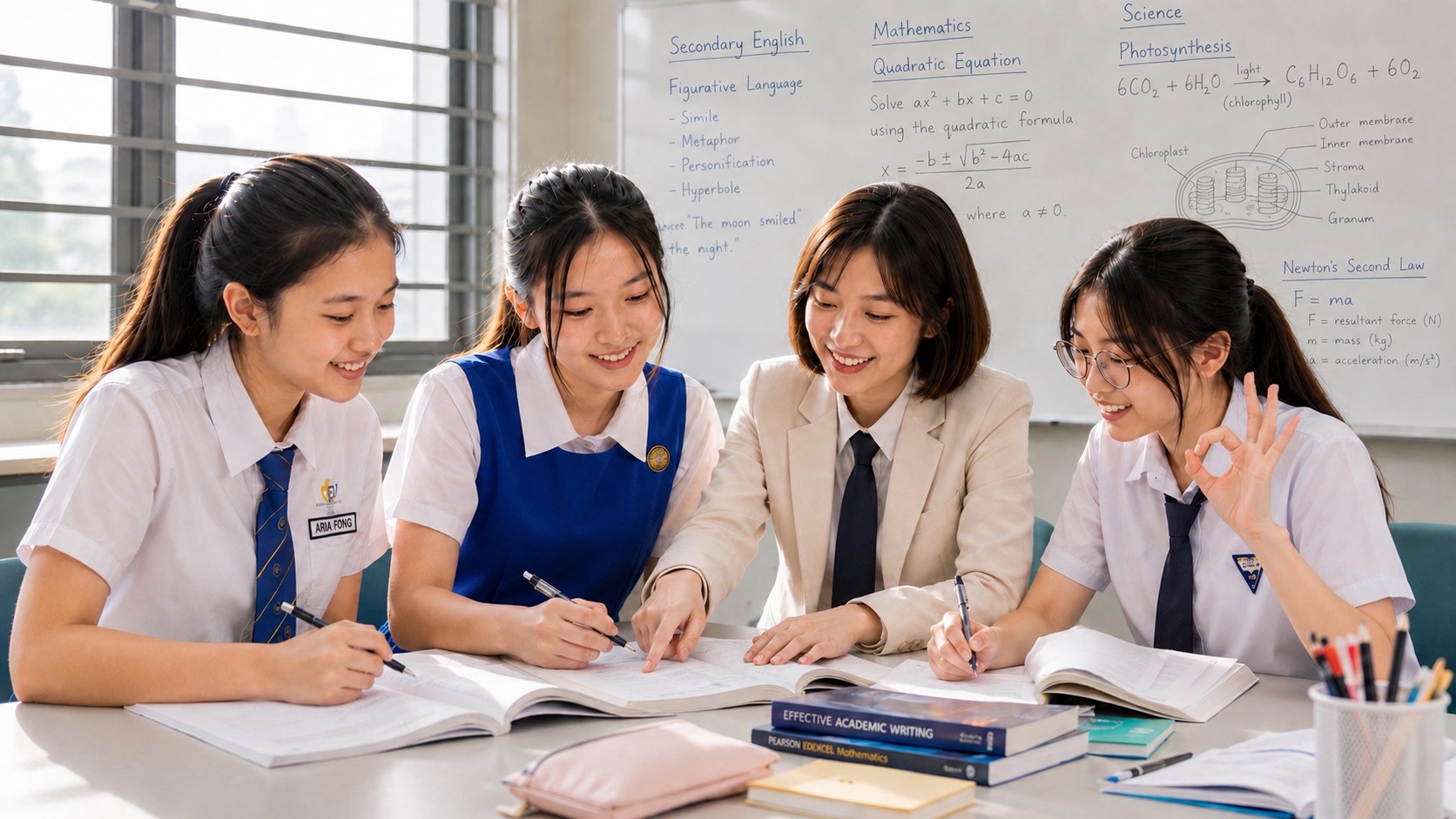
Current Sengkang local owner: this retained eduKateSG page is a Primary-to-Secondary Science learning guide. For current Sengkang Science teaching, tutor assignment, classes, consultation, fees, schedules and availability, continue to eduKateSengkang.
Science Tuition Sengkang | Small Groups of 3 Students
Parents searching for Science Tuition in Sengkang are often trying to solve one of several problems.
A child may remember scientific facts yet struggle to apply them. Another may follow school lessons but lose marks in open-ended questions because the explanation is incomplete. Earlier gaps can also compound quietly, leaving a student who understands the general idea unable to produce a precise scientific answer under examination conditions.
Strong Science support for Sengkang students should build secure concepts, scientific reasoning, precise answering and examination confidence. Current local class format and implementation belong to eduKateSengkang rather than this retained eduKateSG guide.
We begin by identifying whether the student’s main difficulty lies in:
- scientific understanding;
- vocabulary and terminology;
- question interpretation;
- answer construction;
- calculations and working steps;
- experimental and data skills;
- retention;
- examination execution.
Teaching is then organised around the student’s actual learning bottleneck rather than another general sequence of worksheets.
Who We Help
Our Science Tuition programme supports:
- Primary 3 to Primary 6 Science students;
- students preparing for the PSLE Science examination;
- Secondary 1 and Secondary 2 Lower Secondary Science students;
- Secondary 3 and Secondary 4 Biology, Chemistry and Physics students;
- Pure and Combined Science students;
- students preparing for school examinations and the GCE O-Level examinations.
Lessons are suitable for students who need to rebuild foundations, stabilise inconsistent performance or extend themselves towards higher levels of scientific reasoning.
Building Strong Foundations Through Science Tuition in Sengkang
Science becomes difficult when students treat every topic as a separate collection of facts.
Forces, energy, life cycles, heat, matter, cells and chemical reactions may appear to be different topics, but the student repeatedly uses the same underlying capabilities:
- observing accurately;
- identifying relationships;
- comparing conditions;
- tracing causes and effects;
- interpreting evidence;
- recognising systems;
- explaining changes;
- applying principles to unfamiliar situations.
Our Science Tuition Sengkang programme helps students build these capabilities progressively.
Rather than memorising an answer for one question, students learn the scientific structure beneath it. This allows them to recognise the same idea when it appears in a new diagram, experiment, graph or real-world context.
The goal is not simply to complete the current worksheet.
It is to build a Science system that remains usable as the syllabus becomes more demanding.
How We Manage Your Child’s Science Learning
Science performance depends on several connected areas working together.
Reliable Science Performance = Conceptual Understanding × Scientific Language × Application × Exam Execution
Conceptual Understanding
The student must understand what is happening and why it happens.
This includes recognising mechanisms, relationships, processes and conditions. A student who only remembers the final statement may struggle when the question changes its context.
Scientific Language
Science requires precision.
Students must distinguish between terms such as:
- heat and temperature;
- mass and weight;
- energy and power;
- evaporation and boiling;
- rate and amount;
- adaptation and response;
- conductor and insulator.
A vague answer may show partial understanding but still lose marks because the required relationship has not been expressed accurately.
Application
Students must recognise which scientific idea is operating inside a question.
This becomes especially important in unfamiliar situations. The surface details may change, but the underlying principle remains the same.
Exam Execution
The student must convert understanding into an answer that satisfies the question.
This includes:
- interpreting command words;
- selecting relevant evidence;
- using scientific terminology;
- showing calculations clearly;
- including units;
- constructing complete explanations;
- managing time.
A weakness in any one of these areas can reduce the quality of the final answer. Our tutors identify which part of the system is restricting the student and organise the lesson accordingly.
Accurate Diagnosis Before More Practice
More practice does not automatically produce better results.
If the student is practising with an incorrect concept, vague language or an ineffective answering method, repetition may strengthen the wrong habit.
Progress is more dependable when five elements are present:
Progress = Diagnosis × Correct Sequence × Guided Practice × Feedback × Transfer
We therefore examine more than whether an answer is right or wrong.
Our tutors look at how the student reached the answer.
Common learning patterns include:
- recalling isolated facts without understanding the relationship;
- misreading the question;
- missing evidence in a diagram or table;
- applying the correct concept in the wrong direction;
- using everyday language instead of scientific language;
- giving an observation when an explanation is required;
- stating a conclusion without supporting evidence;
- omitting units or working steps;
- understanding during guidance but struggling independently;
- making the same mistake across several topics.
Once the pattern is identified, teaching can begin at the correct point.
Three Routes for Science Progress
Students do not all require the same lesson.
Depending on the diagnosis, we may place greater emphasis on repair, stabilisation or extension.
Repairing Foundations
Some students have missing concepts from earlier levels.
A Primary student may not fully understand how variables affect a fair test. A Secondary student may struggle with chemical equations because the particulate model is unstable. Another may find Physics calculations difficult because units and algebraic manipulation are weak.
In such cases, moving immediately to harder examination questions usually creates more confusion.
We return to the missing dependency, explain it clearly and rebuild it through carefully selected examples.
Stabilising Performance
Some students understand the topic but perform inconsistently.
They may answer correctly during class but make avoidable mistakes in tests. They may use scientific keywords in one answer but omit them in the next. They may interpret a familiar graph correctly but become confused when the axes or presentation change.
Here, the goal is reliable execution.
Students practise the same underlying principle across different question forms until the method becomes stable and transferable.
Extending Capability
Students with secure foundations may be ready for more demanding reasoning.
They may work on:
- multi-stage explanations;
- unfamiliar experimental contexts;
- deeper graph interpretation;
- evaluation of methods;
- comparison of competing explanations;
- advanced application questions;
- greater precision and efficiency.
Extension is not merely the addition of harder worksheets.
It develops greater scientific judgement.
Primary Science Tuition Sengkang
Primary Science support should connect the learning progression from Primary 3 through Primary 6 while keeping conceptual understanding, inquiry and precise explanation visible.
Students learn the major MOE Science themes, including:
- Diversity;
- Cycles;
- Systems;
- Interactions;
- Energy.
Topics may include:
- living and non-living things;
- classification;
- life cycles in plants and animals;
- plant systems;
- human systems;
- matter;
- heat;
- light;
- magnets;
- forces;
- energy;
- electrical systems;
- adaptations;
- environmental interactions.
Students are taught to understand the relationships within each topic rather than memorising disconnected facts.
For example, learning about the human respiratory system should not end with naming organs. Students must understand how the structures work together, how gases are exchanged and how changes in activity affect the system.
This deeper understanding supports both MCQ and open-ended questions.
PSLE Science Tuition
PSLE Science requires students to apply knowledge accurately in unfamiliar contexts.
Many students know the topic but lose marks because they:
- do not answer the exact question;
- copy information without explaining it;
- omit the cause-and-effect relationship;
- use imprecise vocabulary;
- fail to refer to evidence;
- stop the explanation too early;
- confuse observations with conclusions.
Our PSLE Science lessons develop a structured answering process.
Students learn to:
- identify the tested concept;
- locate the relevant evidence;
- determine the required relationship;
- construct the answer using accurate scientific language;
- check that the explanation is complete.
We also teach students to interpret common command words.
State
Provide the required fact or answer directly.
Describe
Explain what can be observed, measured or identified.
Compare
Identify relevant similarities or differences using a clear basis.
Explain
Show why something happens by connecting a cause, mechanism and outcome.
Suggest
Apply scientific understanding to propose a reasonable answer based on the information provided.
Understanding these distinctions helps students match their answers to the question.
Secondary Science Tuition Sengkang
Secondary Science introduces greater abstraction, specialised terminology and mathematical application.
Our programme supports:
- Lower Secondary Science;
- Biology;
- Chemistry;
- Physics;
- Pure Science;
- Combined Science;
- GCE O-Level preparation.
Biology
Biology topics may include:
- cells and organisation;
- movement of substances;
- enzymes;
- nutrition;
- transport systems;
- respiration;
- reproduction;
- genetics;
- ecology.
Students learn to trace biological processes step by step and connect structures with their functions.
Chemistry
Chemistry topics may include:
- the particulate model;
- separation techniques;
- atomic structure;
- chemical bonding;
- formulae and equations;
- mole calculations;
- acids, bases and salts;
- oxidation and reduction;
- energy changes;
- rates of reaction.
Students are guided from observable changes to particle-level explanations and symbolic representations.
Physics
Physics topics may include:
- measurement;
- motion;
- forces;
- moments;
- pressure;
- energy;
- thermal processes;
- waves;
- light;
- electricity;
- electromagnetism.
Students learn how concepts, diagrams, equations, units and calculations fit together.
First-Principles Science Teaching
Our tutors begin with the underlying principle before moving towards examination complexity.
This follows a clear progression:
Concept → Representation → Application → Explanation → Examination
The student first understands the core idea.
The concept may then be represented through:
- a physical demonstration;
- a diagram;
- a model;
- a table;
- a graph;
- an equation;
- a real-world example.
Once the student can see how the concept operates, the tutor introduces questions with increasing variation.
This prevents the student from treating every new question as an entirely new problem.
From Concrete to Abstract Understanding
Science frequently moves between three levels.
Concrete
The student observes a physical event, object, model or demonstration.
Representational
The event is expressed through a diagram, table, graph, symbolic model or written description.
Abstract
The student applies scientific principles, equations and logical relationships without needing the original physical example.
A student may understand an actual electrical circuit but struggle with a circuit diagram. Another may follow a classroom demonstration but fail to interpret a graph showing the same relationship.
Our tutors deliberately connect these levels so that understanding can move from observation to representation and then to independent reasoning.
Correcting Common Science Misconceptions
Some errors are not careless mistakes.
They come from an incorrect internal model.
Common misconceptions include:
- heavier objects always fall faster;
- heat and temperature mean the same thing;
- plants obtain food directly from soil;
- energy is used up and disappears;
- current is consumed by circuit components;
- evaporation only occurs at boiling point;
- mass and volume are interchangeable;
- all microorganisms are harmful;
- a larger amount always means a faster rate.
These misconceptions must be identified and corrected directly.
Simply showing the student the correct answer may not be enough. The tutor needs to reveal why the original model fails and replace it with a more accurate explanation.
Scientific Vocabulary and Answer Precision
Science has its own language system.
Students must learn not only the definitions of scientific terms but also how those terms connect inside an explanation.
For example, a complete answer may need to show:
- the condition that changed;
- the scientific process affected;
- the direction of the change;
- the resulting outcome.
The student may understand the general idea but still lose marks if these relationships are not expressed.
We therefore teach students to move beyond isolated keywords.
A good scientific answer is not a pile of technical words. It is a clear chain of scientifically accurate relationships.
Open-Ended Science Questions
Open-ended questions reveal how a student thinks.
They may require the student to:
- interpret evidence;
- explain a mechanism;
- compare conditions;
- predict an outcome;
- justify a conclusion;
- evaluate an experimental method;
- identify an error;
- suggest an improvement.
We teach students to construct answers from the inside out.
First, identify the concept.
Next, determine the relevant evidence.
Then, connect the evidence to the scientific principle.
Finally, express the conclusion in a complete form.
This reduces vague answers and prevents students from copying sentences from the question without showing the required reasoning.
Data, Tables and Graphs
Science examinations increasingly require students to work with information rather than recall facts alone.
Students may need to:
- identify variables;
- organise data in tables;
- select suitable axes;
- determine scales;
- plot points;
- draw a best-fit line;
- identify trends;
- calculate gradients;
- interpret intercepts;
- recognise anomalous results;
- compare data sets;
- evaluate reliability.
We teach students to read the structure of the information before attempting the question.
They learn to ask:
- What was changed?
- What was measured?
- What was controlled?
- What pattern is visible?
- Does the evidence support the conclusion?
- Are there anomalies?
- Is the result reliable?
These habits strengthen both practical work and written examinations.
Experimental and Practical Skills
Students may be required to plan, interpret or evaluate an investigation.
A complete investigation may involve:
- a hypothesis;
- independent, dependent and controlled variables;
- suitable apparatus;
- a clear method;
- repeated readings;
- safety considerations;
- data collection;
- analysis;
- evaluation.
We help students understand why each part matters.
For example, repeating an experiment is not simply a procedural rule. Repeated readings help identify anomalies, calculate a representative result and improve confidence in the evidence.
Students also learn to distinguish between:
- accuracy;
- precision;
- reliability;
- validity.
These distinctions become increasingly important in Secondary Science.
Science Calculations and Working Steps
Science calculations require more than inserting numbers into a formula.
Students must:
- identify the correct relationship;
- select the relevant values;
- convert units where necessary;
- substitute accurately;
- calculate clearly;
- state the final unit;
- check whether the answer is reasonable.
Where mathematical gaps affect Science performance, the tutor addresses the necessary supporting skill.
This may include:
- fractions;
- ratios;
- percentages;
- algebraic manipulation;
- standard form;
- significant figures;
- graph gradients;
- unit conversion.
The aim is to prevent a mathematical weakness from hiding the student’s scientific understanding.
Retention and Revision
Students often understand a topic during the lesson but forget it several weeks later.
Long-term retention requires planned retrieval.
Our Science Tuition programme may include:
- short retrieval questions;
- cumulative quizzes;
- spaced revision;
- mixed-topic practice;
- error journals;
- correction and explanation tasks;
- timed mini-tests.
Spaced Revision
Important ideas are revisited after increasing intervals instead of being practised intensively once and then abandoned.
Retrieval Practice
Students attempt to recall and apply knowledge without immediately referring to notes.
Interleaving
Related topics and question types are mixed so that students must identify the correct method independently.
Error Journals
Students record recurring misconceptions and rewrite the correct reasoning.
Together, these processes help learning remain available when the student needs it during examinations.
Why Small Groups of Up to Three Students Matter
Science mistakes are often hidden inside the student’s reasoning.
A final answer may be wrong because the student:
- misunderstood the concept;
- selected the wrong evidence;
- missed a condition;
- reversed a relationship;
- used an incorrect unit;
- explained only part of the process.
In a large class, these differences can be difficult to detect.
With a maximum of three students, the tutor can inspect each student’s:
- diagrams;
- calculations;
- working steps;
- scientific vocabulary;
- open-ended answers;
- reasoning process.
Correction can happen at the point where the misunderstanding begins, rather than only after the student receives a poor test result.
Small-group learning also allows students to compare alternative explanations and learn from carefully managed discussion while remaining individually accountable for their work.
What Happens During a Science Tuition Lesson?
The exact lesson structure depends on the student’s level, current school topics and identified gaps.
However, a productive lesson usually follows a clear learning cycle.
1. Retrieve
Students recall relevant knowledge from previous lessons.
2. Diagnose
The tutor checks whether the student’s understanding is stable and identifies any misconceptions.
3. Explain
The central scientific principle is taught from first principles.
4. Represent
The concept is shown through diagrams, models, tables, graphs, equations or real-world examples.
5. Apply
Students attempt guided questions and learn how to recognise the concept in different situations.
6. Correct
Errors are addressed before they become repeated habits.
7. Transfer
The student applies the same principle to a less familiar question.
8. Test
Where appropriate, the student completes an independent or timed task.
This sequence helps turn explanation into usable capability.
A Typical Four-Week Starting Cycle
Every student is different, but the first few weeks may follow a structure such as this.
Week 1: Diagnostic Review
We identify topic gaps, answering patterns and the student’s present level of independence.
Week 2: Foundation and Skills Repair
We address selected misconceptions and strengthen essential skills such as scientific vocabulary, graph interpretation, units or open-ended answering.
Week 3: Question-Type Application
Students apply the repaired concepts to school and examination-style questions.
Week 4: Review and Recalibration
We check what has become stable, what still requires guidance and what should be addressed next.
This creates a clearer progression than moving from worksheet to worksheet without a learning map.
Converting Scientific Knowledge into Marks
Students sometimes say:
“I understood the topic, but I did not know how to answer the question.”
This reveals a difference between possessing knowledge and converting it into an assessable response.
Marks Earned = Knowledge Available × Conversion Accuracy
A student may understand the topic but still lose marks through:
- incomplete explanations;
- missing evidence;
- vague terminology;
- calculation errors;
- incorrect units;
- poor time allocation;
- misunderstanding command words.
Our tutors train this conversion process directly.
Students learn to recognise what the question requires, select the appropriate knowledge and express it in the expected form.
Examination technique does not replace scientific understanding.
It allows the student’s understanding to become visible.
Developing Independent Science Learners
At the beginning, some students require close guidance.
The tutor may need to:
- organise the method;
- highlight relevant evidence;
- prompt the next step;
- identify missing relationships;
- remind the student to check units and keywords.
As capability grows, this management is gradually transferred to the student.
The progression is:
Tutor-managed → Co-managed → Self-managed
A self-managed Science student can:
- identify the topic being tested;
- select an appropriate method;
- organise working clearly;
- monitor whether an answer makes scientific sense;
- check for missing information;
- correct errors with less prompting.
This is the deeper purpose of tuition.
The student should not remain permanently dependent on the tutor.
Progress Parents May Observe
Improvement does not always begin with a dramatic jump in marks.
Earlier signs of progress may include:
- clearer scientific explanations;
- fewer repeated misconceptions;
- more accurate use of terminology;
- better organisation of working steps;
- stronger interpretation of graphs and tables;
- more complete open-ended answers;
- improved recall;
- greater willingness to attempt unfamiliar questions;
- fewer prompts required from the tutor;
- more stable test performance.
Marks remain important, but they are the visible output of a deeper learning system.
When the system becomes stronger, results become more dependable.
Current Science Tuition Route for Sengkang Students
Our classes are suitable for families living in:
- Sengkang;
- Compassvale;
- Rivervale;
- Fernvale;
- Anchorvale;
- Punggol;
- Hougang;
- nearby northeast neighbourhoods.
For current Sengkang small-group Science classes and consultation, continue to eduKateSengkang. Confirm class size, tutor assignment, timetable and availability with the local owner.
This distinction is important:
The retained eduKateSG page serves Sengkang readers as a Science learning guide; the current local teaching route is eduKateSengkang.
Who May Benefit from Science Tuition?
Our programme may be suitable for a student who:
- memorises facts but struggles to apply them;
- repeatedly loses marks in open-ended questions;
- has gaps from earlier Science topics;
- finds scientific vocabulary confusing;
- struggles with calculations or units;
- has difficulty interpreting graphs and experiments;
- understands during lessons but performs inconsistently;
- depends heavily on model answers;
- requires more individual feedback;
- needs greater challenge and deeper application.
The starting point is not simply whether the child is “strong” or “weak.”
The starting point is the specific learning condition that is preventing further progress.
Why Choose eduKateSG Science Tuition?
Our approach combines:
- small groups of up to three students;
- more than 20 years of tuition experience;
- teaching aligned with MOE and SEAB requirements;
- first-principles explanation;
- diagnostic gap identification;
- misconception correction;
- scientific vocabulary development;
- examination-answering techniques;
- retrieval and revision systems;
- progressive movement towards independence.
We aim to provide a clear learning direction rather than another pile of exercises.
Arrange a Parent–Student Consultation
For families considering Science Tuition in Sengkang, the first step is to understand the student’s current learning position.
Parents may share:
- the student’s school level;
- recent examination results;
- current areas of difficulty;
- school worksheets or test papers;
- learning habits;
- upcoming assessment requirements.
Where suitable, we can identify the student’s main bottlenecks and recommend an appropriate starting route.
For current Primary, PSLE and Secondary Science tuition in Sengkang, use eduKateSengkang. Use this page for the broader Science learning framework and diagnostic questions.
Contact eduKateSG to arrange a consultation. We look first at how your child currently thinks through Science, then identify which concepts, reasoning habits and examination skills need the most attention.
Current local contact route: Start Here at eduKateSengkang for consultation, class details and availability.
Frequently Asked Questions
Does eduKateSG provide Science Tuition for Sengkang students?
Yes. Sengkang students can use this eduKateSG page as a Science learning guide, while current local teaching and operational arrangements should be confirmed with eduKateSengkang.
How many students are in each Science tuition class?
Classes are conducted in small groups of up to three students. This allows the tutor to observe each student’s reasoning, written answers, diagrams and calculations closely.
Which Primary Science levels do you teach?
We support Primary 3 to Primary 6 students, including students preparing for the PSLE Science examination.
Do you teach Secondary Science?
Yes. We support Lower Secondary Science as well as Biology, Chemistry and Physics for Pure and Combined Science students.
How do you help students with open-ended Science questions?
Students learn to identify the tested concept, select relevant evidence, connect the evidence to the scientific principle and construct a complete answer using accurate terminology.
Does Science tuition focus only on examinations?
Examination performance is important, but it depends on deeper capabilities. Lessons also develop conceptual understanding, scientific reasoning, data interpretation, experimental skills, vocabulary and independent learning.
Can tuition help a student who memorises but cannot apply?
Yes. Such students may need help recognising the principle beneath different question contexts. We use varied examples and transfer questions to develop application rather than recall alone.
How do you identify a student’s learning gaps?
We review the student’s work, observe how questions are approached and identify recurring patterns in understanding, language, calculations and answer construction.
Is the programme suitable for stronger Science students?
Yes. Students with stable foundations can work on unfamiliar applications, deeper reasoning, experimental evaluation, advanced question types and greater answer precision.
When should a child begin Science tuition?
Tuition may be useful when misconceptions, recurring gaps or inconsistent performance begin to affect progress. Starting earlier provides more time to repair foundations without excessive examination pressure.
