
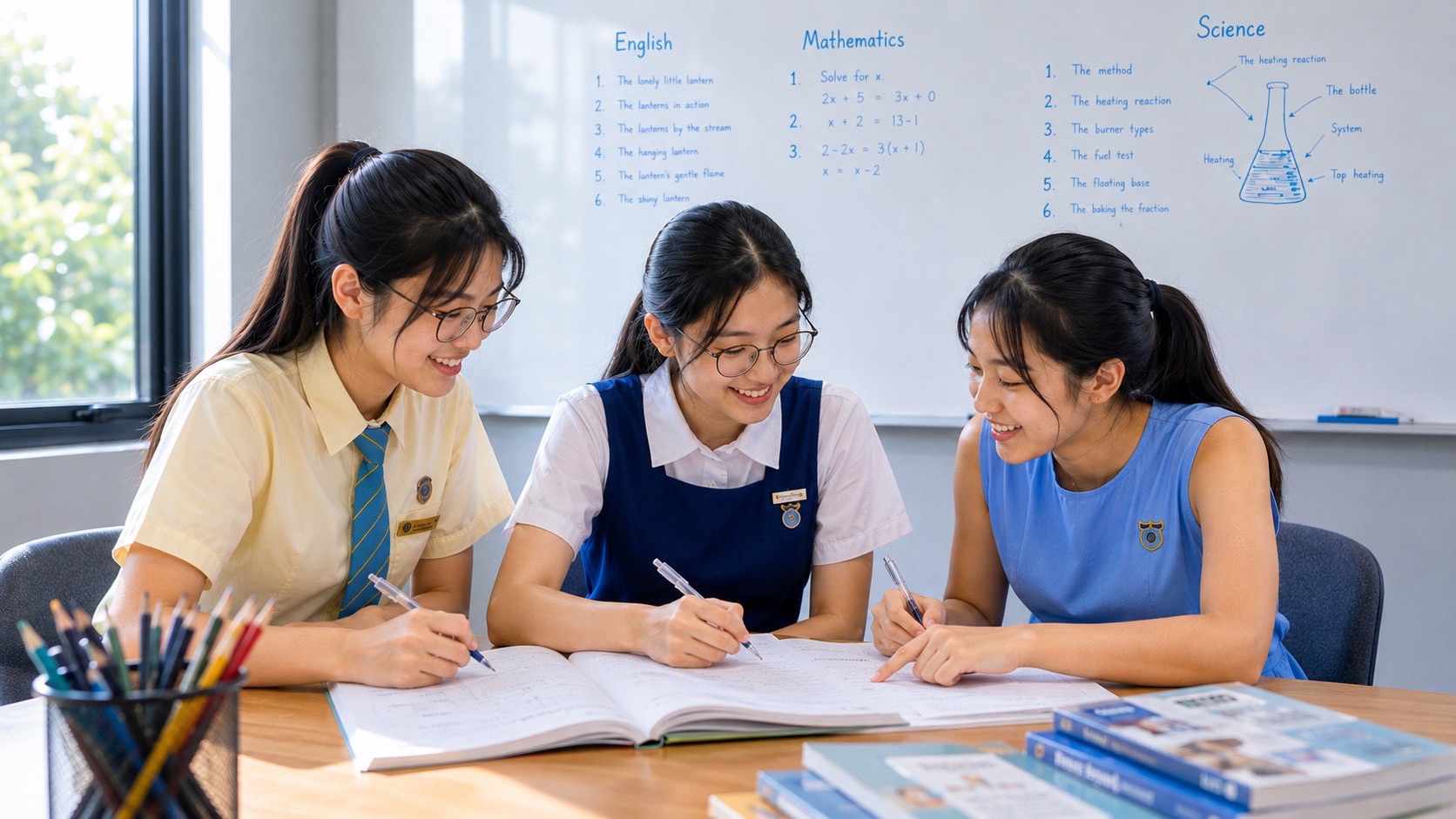
Secondary 3 English Tuition Sengkang | 3-Pax English Tutor
Secondary 3 English tuition for Sengkang students in focused 3-pax groups near Punggol MRT. Build stronger writing, comprehension, summary, oral communication and examination control.
Secondary 3 English tuition for Sengkang students in premium 3-pax small groups near Punggol MRT. Lessons develop continuous writing, situational writing, comprehension, summary, vocabulary, grammar, listening, oral communication and the independent examination habits needed before Secondary 4.
Secondary 3 English Tuition Sengkang | What Happens in Secondary 3 English Tuition with a Sengkang English Tutor
Secondary 3 is where English becomes an upper-secondary subject.
The student is no longer simply learning how secondary-school English works.
The student must now learn how to perform it with greater depth, precision and independence.
At eduKateSG, we provide focused 3-pax Secondary 3 English tuition for Sengkang students at our Punggol location near Punggol MRT.
Each 1.5-hour lesson combines:
- explicit teaching;
- close tutor observation;
- critical reading;
- vocabulary development;
- comprehension analysis;
- summary construction;
- continuous writing;
- situational writing;
- grammar and editing;
- oral communication;
- listening control;
- timed application; and
- detailed correction.
The purpose is not to rush students through examination papers.
It is to build the language system that makes examination performance possible.
Students learn to:
- interpret demanding questions accurately;
- read narrative, informational and multimodal texts critically;
- recognise tone, attitude, perspective and intention;
- explain how language creates an effect;
- distinguish evidence from assumption;
- select and synthesise information;
- summarise without distorting meaning;
- construct complete and developed arguments;
- write with the correct purpose, audience and context;
- control grammar across longer responses;
- express ideas with mature vocabulary;
- organise spoken responses clearly;
- perform under time limits; and
- correct recurring weaknesses independently.
Secondary 3 is the construction year.
Secondary 4 is too late to begin building every part from the ground up.
When the Secondary 3 foundation is carefully assembled, the following year can be used for refinement, integration and examination confidence.
Secondary 3 Is the Beginning of the Final Flight Path
Secondary 1 introduced the student to secondary English.
Secondary 2 stabilised lower-secondary foundations.
Secondary 3 begins the final upper-secondary flight path.
The work now becomes more demanding in several ways at once.
Texts become:
- longer;
- denser;
- less familiar;
- more layered;
- more argumentative;
- more dependent on context; and
- less likely to provide answers in obvious wording.
Writing tasks require:
- clearer direction;
- stronger development;
- greater control of audience;
- more mature examples;
- sustained organisation;
- accurate grammar;
- purposeful vocabulary; and
- completion within a fixed time.
Oral communication requires students to:
- respond thoughtfully;
- organise ideas quickly;
- develop a perspective;
- engage with follow-up questions;
- speak with clarity; and
- move beyond brief personal reactions.
The student is therefore making two transitions at the same time.
The first is from lower-secondary English to upper-secondary English.
The second is from learning individual skills to operating them together.
A student may know several English techniques and still struggle because the techniques do not yet form one dependable system.
Secondary 3 tuition should connect them.
The Hidden Shift: From Language Ability to Controlled Performance
A student may be reasonably fluent in English.
The student may:
- speak comfortably with friends;
- understand television programmes;
- read ordinary articles;
- write messages quickly; and
- recognise many vocabulary words.
However, examination English requires more than everyday fluency.
It requires controlled performance.
The student must be able to use language:
- for a defined purpose;
- for a specific audience;
- within a particular context;
- under time pressure;
- with limited information;
- in an unfamiliar topic;
- according to task requirements; and
- with enough accuracy to protect meaning.
Consider the question:
Do young people depend too heavily on technology?
A student may have many opinions about technology.
That does not automatically produce a strong essay.
The student must decide:
- what “depend too heavily” means;
- which young people are being discussed;
- whether the position is absolute or qualified;
- which examples are relevant;
- how each example supports the claim;
- whether an opposing viewpoint should be considered;
- how the paragraphs should be ordered; and
- what conclusion can reasonably be drawn.
The difference between an ordinary response and a strong response is not simply vocabulary.
It is control.
A strong Secondary 3 English tutor helps the student control:
Question → Position → Structure → Evidence → Explanation → Language → Time
Secondary 3 Is the Construction Year, Not the Panic Year
Parents sometimes wait until Secondary 4 before looking closely at English.
By then, the student may need to repair several systems simultaneously:
- reading accuracy;
- vocabulary;
- comprehension method;
- summary technique;
- writing structure;
- grammar;
- oral confidence;
- examination timing; and
- self-correction.
This creates avoidable pressure.
Secondary 3 offers something valuable: time.
There is time to:
- identify the real weakness;
- teach the method carefully;
- practise without constant examination urgency;
- rewrite poor work;
- build vocabulary networks;
- develop reading endurance;
- test different writing forms;
- correct recurring grammar errors;
- practise oral discussion;
- increase speed gradually; and
- revisit skills until they become stable.
A Secondary 3 student should certainly become familiar with examination expectations.
However, exam papers should not replace teaching.
A student who does not understand how to form an inference will not solve the problem merely by completing ten more inference questions incorrectly.
A student who cannot develop a paragraph will not become a strong writer merely by producing one rushed composition every week.
The method must first be visible.
Then it must be practised.
Then it must transfer.
Finally, it must survive time pressure.
The Three Systems Inside Upper-Secondary English
Upper-secondary English can be understood through three connected systems.
System 1: Receiving Meaning
This includes:
- reading;
- viewing;
- listening;
- recognising vocabulary;
- identifying purpose;
- following argument;
- noticing tone;
- understanding context; and
- detecting what is implied.
System 2: Processing Meaning
This includes:
- selecting evidence;
- distinguishing relevant from irrelevant information;
- forming inferences;
- comparing viewpoints;
- evaluating claims;
- synthesising details;
- summarising;
- generating ideas; and
- making judgments.
System 3: Expressing Meaning
This includes:
- comprehension answers;
- situational writing;
- continuous writing;
- spoken responses;
- discussion;
- grammar;
- vocabulary;
- organisation; and
- delivery.
A weakness in one system affects the others.
For example:
- poor reading reduces comprehension accuracy;
- weak processing produces shallow writing;
- limited vocabulary affects both receiving and expressing;
- weak grammar obscures otherwise intelligent ideas;
- poor listening affects note-taking and response accuracy;
- limited background knowledge reduces argument and oral depth.
The student’s final grade is produced by the entire system.
That is why Secondary 3 English tuition should not become a collection of disconnected worksheets.
Why Sengkang Parents Choose 3-Pax English Tuition
English requires close inspection.
A tutor needs to see not only the final answer, but how the student reached it.
In a 3-pax class, the tutor can ask:
- What does this question require?
- Why did you choose this evidence?
- Which word creates the tone?
- What does the writer want the reader to feel?
- Is this an inference or a guess?
- What is the purpose of this paragraph?
- How does this example prove your point?
- Does this sentence suit the audience?
- Which information should enter the summary?
- What can be removed?
- Why did the tense change?
- What would you check if the tutor were not present?
These questions expose the student’s thinking.
One student may read accurately but answer incompletely.
Another may have strong opinions but weak examples.
A third may produce attractive sentences without answering the question.
A fourth may understand the method but lose control under time pressure.
A fifth may be capable but reluctant to speak.
These students should not receive identical correction.
The advantages of a three-student English class
- Frequent opportunities to explain reasoning
- Close inspection of comprehension answers
- Detailed writing feedback
- More rewriting during the lesson
- Regular oral participation
- Immediate correction of misconceptions
- Pacing adjusted to student readiness
- Greater accountability during timed work
- Space for different interpretations
- Closer preparation around school assessments
- Suitable rebuilding for weaker students
- Meaningful extension for stronger students
Three students create enough variety for discussion without losing the clarity of individual attention.
The class is small by design.
Secondary 3 English Under Full Subject-Based Banding
English Language is offered at G1, G2 and G3 under Full Subject-Based Banding. MOE publishes separate G1 and G2/G3 English syllabuses, and students attend classes according to the subject level at which they take English.
This means Secondary 3 English tuition should not use one generic programme for every learner.
The tutor should consider:
- the student’s English subject level;
- current school performance;
- reading maturity;
- writing range;
- grammar stability;
- vocabulary depth;
- assessment format;
- teacher feedback;
- confidence;
- speed;
- independence; and
- readiness for greater demand.
Students at the same subject level may still require different interventions.
For example:
- one student may need sentence repair;
- another may need argument development;
- another may need summary discipline;
- another may need stronger oral organisation;
- another may need greater challenge and sophistication.
The subject level helps define the pathway.
It does not replace careful observation of the individual student.
Secondary 3 and the Singapore-Cambridge SEC
From 2027, the previous Singapore-Cambridge GCE N(T), N(A) and O-Level certificates are combined under the Singapore-Cambridge Secondary Education Certificate, with subjects examined at G1, G2 or G3 levels.
For G2 and G3 English, the 2027 assessment structure includes Writing, Comprehension, Listening and Oral Communication. Writing and Comprehension each carry 35%, Oral Communication carries 20%, and Listening carries 10%.
The current G1 English assessment also includes Writing, Language Use and Comprehension, Listening and Oral Communication, although its paper structure and weightings differ from G2 and G3.
Secondary 3 tuition should therefore prepare students for their correct subject pathway.
However, the broader language objective remains consistent:
Students must receive meaning accurately, process it intelligently and express it clearly.
What We Teach in Secondary 3 English Tuition
Paper 1: Writing
Writing requires students to make several decisions at once.
They must understand:
- the task;
- the purpose;
- the audience;
- the context;
- the required form;
- the available information;
- the central direction;
- the paragraph structure;
- the suitable tone;
- the vocabulary;
- the grammar; and
- the time available.
We divide writing into manageable systems.
Editing and Grammatical Control
Editing is not treated as a guessing exercise.
Students learn to inspect relationships inside a sentence.
These include:
- subject and verb;
- tense and time;
- pronoun and reference;
- noun and article;
- word form and sentence function;
- preposition and phrase;
- conjunction and clause;
- modifier and intended meaning; and
- singular and plural consistency.
A useful editing process is:
- Read for meaning.
- Identify the sentence structure.
- Locate the relationship that feels unstable.
- Name the likely grammatical problem.
- test the correction inside the whole sentence.
- Check that meaning remains accurate.
Students should not change a word simply because it “sounds strange”.
They need to know why it is wrong.
This distinction matters because confident guessing becomes unreliable when sentences grow more complex.
Situational Writing
Situational writing is a communication problem.
The student must identify:
- who is writing;
- who will receive the message;
- why the message is being written;
- what information must be included;
- how the information should be organised;
- which tone is appropriate;
- what form is suitable; and
- what the reader should do afterwards.
The task may involve forms such as:
- an email;
- a letter;
- a report;
- a speech;
- a proposal;
- an article; or
- another functional text.
The exact form matters, but the communication relationship matters more.
A student can write grammatically accurate English and still lose control by:
- omitting a required point;
- addressing the wrong audience;
- using an unsuitable tone;
- repeating the visual without developing it;
- providing information in a confusing sequence;
- failing to make the purpose clear; or
- ending without an appropriate action or conclusion.
We teach students to map the task before writing.
The situational-writing map
Role → Audience → Purpose → Context → Required Points → Development → Tone → Action
The student should be able to state this map in plain language before beginning.
Task fulfilment
Students learn to distinguish between:
- mentioning a required point; and
- developing it sufficiently.
For example, if a student is asked to recommend a school programme, it may not be enough to write:
The programme will be useful.
The student should explain:
- what the programme includes;
- who will benefit;
- how it addresses the stated need;
- why it is practical; and
- what outcome is expected.
Development helps the reader understand why the information matters.
Tone control
Tone is not created by memorising one formal opening.
It is created through the entire message.
Students consider:
- the relationship between writer and reader;
- the seriousness of the situation;
- the degree of formality required;
- whether the purpose is to request, persuade, inform, apologise or recommend;
- how direct the language should be; and
- whether warmth, urgency, respect or authority is appropriate.
Continuous Writing
Continuous writing may include forms such as:
- narrative;
- personal;
- reflective;
- descriptive;
- expository;
- discursive;
- argumentative; or
- persuasive writing.
Students should not enter the assessment with only one memorised style.
They need a flexible writing system.
The writing process is:
Question → Choice → Position → Plan → Paragraphs → Language → Review
Narrative Writing
Narrative writing requires more than a sequence of events.
A strong narrative usually contains:
- a clear situation;
- a meaningful character objective;
- a complication;
- rising consequence;
- decisions;
- change;
- and a purposeful ending.
Students often weaken narratives by:
- adding too many events;
- introducing irrelevant characters;
- forcing memorised descriptions into the story;
- using an implausible twist;
- delaying the central problem;
- ending abruptly;
- writing action without reflection; or
- losing connection to the question.
We teach students to protect the story spine:
Character → Objective → Obstacle → Decision → Consequence → Change
This gives the narrative direction.
Description with purpose
Description should perform a function.
It may:
- establish atmosphere;
- reveal character;
- slow an important moment;
- foreshadow danger;
- contrast two situations;
- intensify tension; or
- show emotional change.
A paragraph of impressive description that does not serve the story becomes decoration.
The student learns to ask:
What should this detail make the reader understand?
Expository and Discursive Writing
Expository and discursive writing require clear explanation.
Students need to:
- interpret the question;
- define the issue;
- select relevant ideas;
- distinguish one point from another;
- explain cause and consequence;
- use specific examples;
- recognise limitations;
- consider different perspectives; and
- arrive at a reasoned conclusion.
A paragraph may follow:
Point → Explanation → Example → Analysis → Link
The structure is not used mechanically.
It teaches students that a point is not complete until the reader can see how it works.
From a broad point to a developed paragraph
Weak point:
Social media affects students negatively.
Stronger direction:
Excessive social-media use can weaken students’ ability to sustain attention during demanding academic work.
The stronger direction is more useful because it identifies:
- the degree of use;
- the specific group;
- the exact effect; and
- the context in which the effect matters.
The student can now explain mechanisms and consequences rather than repeat a broad opinion.
Argumentative Writing
Argumentative writing requires a defensible position.
The student should be able to answer:
- What exactly do I believe?
- What does the question allow me to qualify?
- Which reasons are strongest?
- What evidence or examples support them?
- What would a reasonable opposing view say?
- Where is that opposing view valid?
- Why does my final judgment still stand?
A strong argument is not produced by sounding aggressive.
It is produced by thinking carefully.
The argument architecture
Interpretation → Position → Grounds → Evidence → Explanation → Qualification → Judgment
Students learn to avoid:
- absolute claims that cannot be defended;
- examples that do not prove the point;
- repeated ideas in different wording;
- fictional statistics;
- unsupported generalisations;
- emotional language in place of reasoning;
- counterarguments that are dismissed unfairly; and
- conclusions that introduce new points.
Balanced does not mean undecided
Some students believe a balanced essay must give equal support to both sides.
That is not always necessary.
A balanced response may:
- acknowledge complexity;
- recognise valid exceptions;
- distinguish circumstances;
- identify trade-offs; and
- still arrive at a clear judgment.
Maturity comes from accurate qualification, not vagueness.
Building a Useful Example Bank
Students often say:
I know what I want to say, but I do not have examples.
Secondary 3 is the right year to build an organised bank of usable knowledge.
Themes may include:
- education;
- technology;
- artificial intelligence;
- social media;
- health;
- family;
- community;
- ageing;
- environment;
- transport;
- work;
- leadership;
- media;
- consumer behaviour;
- equality;
- culture;
- public responsibility; and
- Singapore society.
Students should not memorise hundreds of isolated facts.
They should understand a smaller number of examples deeply enough to explain:
- what happened;
- who was affected;
- why it matters;
- which principle it illustrates;
- what limitations exist; and
- which questions it may support.
One well-understood example can be used across several questions when the student understands the underlying idea.
Paper 2: Comprehension
Comprehension requires students to reconstruct meaning from evidence.
They may need to understand:
- literal information;
- sequence;
- motivation;
- tone;
- attitude;
- implication;
- contrast;
- writer’s purpose;
- language effect;
- visual choices;
- vocabulary in context;
- argument;
- evidence;
- summary points; and
- relationships across a text.
The central comprehension discipline is:
Do not answer from general knowledge when the question requires the text.
The Comprehension Evidence Chain
A dependable answer usually contains a clear chain:
Question → Relevant Evidence → Intended Meaning → Precise Expression
When an answer fails, we identify where the chain broke.
Question failure
The student misread the command or focus.
Evidence failure
The student selected the wrong sentence or included irrelevant material.
Meaning failure
The student found the correct evidence but misunderstood it.
Inference failure
The student did not connect the evidence to a reasonable conclusion.
Expression failure
The student understood the idea but wrote it vaguely or incompletely.
Checking failure
The student did not compare the answer against the question before moving on.
Each failure requires a different correction.
Literal, Inferential and Evaluative Reading
Literal reading
What does the text directly state?
Inferential reading
What reasonable meaning can be formed from the evidence?
Evaluative reading
How effective, convincing, reliable or significant is the communication?
Students must know which level the question requires.
An inference is not an unsupported guess.
It is a conclusion built from evidence.
An evaluation is not simply a personal preference.
It is a judgment supported by suitable criteria.
Language for Effect
Language-effect questions often become vague because students describe the reader’s reaction without explaining the language.
For example:
The phrase makes the reader interested.
This does not show what the phrase communicates.
A stronger response identifies:
- the image or idea created;
- the relevant connotation;
- what it reveals about the situation; and
- the resulting effect on the reader.
Students learn to examine:
- verbs;
- adjectives;
- imagery;
- comparisons;
- sound;
- contrast;
- exaggeration;
- repetition;
- sentence length;
- punctuation;
- and word connotation.
The student should be able to explain the bridge between the phrase and the effect.
Visual and Multimodal Texts
Modern communication often combines:
- words;
- images;
- layout;
- colour;
- symbols;
- size;
- positioning;
- captions; and
- calls to action.
Students learn to ask:
- What attracts attention first?
- Which audience is being addressed?
- What emotion is being created?
- How do the image and words support each other?
- What action is encouraged?
- Is information being emphasised or concealed?
- What assumption does the text make about its audience?
This is useful for comprehension and for navigating advertising, media and online information.
Summary Writing
Summary is one of the clearest tests of language control.
The student must:
- identify the correct scope;
- locate relevant points;
- exclude repetition;
- remove examples that are not required;
- combine related ideas;
- preserve the original meaning;
- use concise language;
- use appropriate own words where possible;
- organise the information; and
- remain within the required length.
For G2 and G3 English under the 2027 SEC syllabuses, the comprehension paper includes a summary response of about 80 words.
The summary process
Scope → Selection → Grouping → Rephrasing → Compression → Count → Accuracy Check
Common summary problems
- copying whole sentences;
- changing the original meaning;
- selecting examples instead of main points;
- including information outside the required scope;
- repeating the same idea;
- removing necessary qualifiers;
- writing fragments;
- exceeding the word limit; and
- compressing so aggressively that the answer becomes unclear.
Summary is not merely shortening.
It is preserving the correct meaning with fewer words.
Listening and Note-Taking
Listening requires students to receive information in real time.
Unlike reading, the student cannot always return repeatedly to the same sentence.
Students practise listening for:
- main ideas;
- specific details;
- sequence;
- comparison;
- contrast;
- changes in direction;
- speaker attitude;
- intention;
- qualifying words;
- examples;
- and required actions.
They also learn to distinguish between:
- what is central;
- what is supporting detail;
- what is repeated for emphasis;
- and what sounds important but does not answer the task.
For G2 and G3 SEC English, the listening component includes a range of listening tasks and a note-taking exercise.
Listening control is also useful across school.
A student must be able to receive:
- instructions;
- explanations;
- feedback;
- presentations;
- group discussion;
- and new information
without losing the central meaning.
Oral Communication
Oral communication is not simply a test of confidence.
Students need to organise thought while speaking.
For G2 and G3 SEC English, Oral Communication includes a planned response to a video-based prompt and a spoken interaction with examiners.
Students learn to move through:
Observation → Interpretation → Position → Reason → Example → Consequence → Wider Perspective
Planned response
Students practise:
- identifying the central issue;
- deciding on a clear direction;
- organising two or three developed ideas;
- selecting suitable examples;
- speaking within the available time;
- using transitions;
- and concluding without repetition.
Spoken interaction
Students learn to:
- listen to the question;
- answer the exact focus;
- extend the response;
- explain a perspective;
- acknowledge complexity;
- respond to follow-up prompts;
- clarify unclear statements;
- and sustain a natural discussion.
Oral depth
A short answer such as:
Yes, I think volunteering is good because it helps people.
can be developed by explaining:
- who benefits;
- what kind of help is meaningful;
- what the volunteer learns;
- whether volunteering should be compulsory;
- what challenges may arise;
- and how programmes can be designed responsibly.
The student does not need to speak endlessly.
The response should move somewhere.
Vocabulary for Upper-Secondary English
Secondary 3 vocabulary should become more connected to ideas.
Students need language for:
- cause;
- consequence;
- comparison;
- contrast;
- judgment;
- uncertainty;
- limitation;
- ethics;
- systems;
- behaviour;
- emotion;
- policy;
- social change;
- persuasion;
- evidence; and
- evaluation.
They also need to understand differences between nearby words.
For example:
- confident and complacent;
- ambitious and ruthless;
- careful and hesitant;
- persuasive and coercive;
- efficient and impersonal;
- accessible and simplistic;
- traditional and outdated;
- innovative and reckless;
- sceptical and cynical;
- independent and isolated.
Vocabulary is taught through:
- reading;
- thematic networks;
- discussion;
- word families;
- collocations;
- connotation;
- sentence construction;
- retrieval;
- writing;
- and correction.
The objective is usable precision.
A sophisticated word used inaccurately weakens the sentence.
A simpler word used exactly may strengthen it.
Grammar Inside Real Performance
Secondary 3 grammar is not treated only as a worksheet component.
Students must control grammar while:
- generating ideas;
- organising paragraphs;
- maintaining tone;
- answering unfamiliar questions;
- and managing time.
Common areas include:
- subject-verb agreement;
- tense;
- pronoun reference;
- sentence boundaries;
- clause control;
- modifiers;
- parallel structure;
- conditional forms;
- articles;
- prepositions;
- punctuation;
- reported speech;
- active and passive constructions;
- and sentence variety.
A useful correction sequence is:
Identify → Explain → Repair → Rebuild → Retrieve
The student:
- identifies the error;
- explains why it is wrong;
- repairs the original sentence;
- creates a fresh sentence using the same structure; and
- checks for the pattern during later writing.
Grammar becomes dependable when the student can monitor it without waiting for the tutor to point it out.
English in the Age of Search, Media and AI
Secondary 3 students encounter information from:
- news reports;
- social platforms;
- advertising;
- influencers;
- websites;
- videos;
- search engines;
- AI assistants;
- and group chats.
Clear English helps them ask:
- Who created this?
- What is being claimed?
- What evidence supports the claim?
- Is the source reliable?
- Is the language neutral or emotionally loaded?
- What important context is missing?
- Does the conclusion follow from the evidence?
- Has uncertainty been acknowledged?
- Does another source agree?
- Can the student explain the idea independently?
Students should not confuse a fluent answer with a correct answer.
They should also avoid outsourcing the thinking required for learning.
AI may help students:
- compare explanations;
- generate practice questions;
- test vocabulary;
- explore viewpoints;
- and receive preliminary feedback.
However, the student must still be able to:
- verify;
- select;
- judge;
- organise;
- write;
- and defend the final response.
English is the operating language through which much of this judgment occurs.
The Secondary 3 English Performance Stack
A student’s English can be understood through eight connected levels.
Level 1: Vocabulary
Does the student understand the words accurately?
Level 2: Sentence Control
Can one complete idea be expressed clearly?
Level 3: Paragraph Control
Can several sentences perform one organised function?
Level 4: Whole-Text Structure
Can the student understand or produce a complete message?
Level 5: Interpretation
Can the student recognise tone, implication, purpose and perspective?
Level 6: Reasoning
Can the student compare, evaluate, explain and support a judgment?
Level 7: Integration
Can reading, writing, vocabulary and grammar work together?
Level 8: Timed Independence
Can the student perform without extensive prompting under assessment conditions?
A weakness lower in the stack often appears as a more complicated problem above it.
For example:
- weak vocabulary may appear as poor comprehension;
- sentence instability may appear as weak ideas;
- weak knowledge may appear as poor argument;
- poor paragraph control may appear as a lack of content;
- weak interpretation may appear as carelessness;
- incomplete checking may appear as a time problem.
Good tuition identifies the correct point of repair.
Eight Things a Secondary 3 English Tutor Should Do
1. Establish the real starting point
The tutor should inspect:
- recent examination papers;
- writing samples;
- comprehension responses;
- summary work;
- grammar patterns;
- oral feedback;
- timing;
- reading habits;
- teacher comments;
- and the student’s own explanation of difficulties.
Two students with the same score may need completely different programmes.
2. Separate foundation gaps from examination gaps
A student may not know how to build a paragraph.
That is a foundation gap.
Another student may build a strong paragraph but spend too long doing it.
That is an examination-execution gap.
The correction should match the cause.
3. Teach the architecture before increasing speed
The tutor should make the structure visible.
Students need to understand:
- why an answer is complete;
- why one example is stronger;
- how the paragraphs connect;
- what information belongs in a summary;
- how tone is created;
- and how time should be allocated.
Speed without architecture produces faster mistakes.
4. Model the hidden decisions
The tutor demonstrates:
- how a question is interpreted;
- how a position is selected;
- how evidence is evaluated;
- how an inference is formed;
- how a paragraph is developed;
- how a summary is compressed;
- and how a response is checked.
The finished answer alone is not enough.
5. Reduce support gradually
Students may initially receive:
- guiding questions;
- paragraph frames;
- evidence prompts;
- planning maps;
- vocabulary support;
- and tutor modelling.
These are gradually removed.
The objective is independent control.
6. Require rewriting
Students repair:
- vague answers;
- weak introductions;
- undeveloped paragraphs;
- unsuitable vocabulary;
- poor tone;
- grammatical errors;
- inaccurate summaries;
- and rushed conclusions.
Rewriting turns feedback into action.
7. Train transfer
The same skill should work when:
- the topic changes;
- the text becomes unfamiliar;
- the question is rephrased;
- the support is removed;
- and the student is timed.
Transfer separates genuine learning from familiarity.
8. Build the runway into Secondary 4
By the end of Secondary 3, students should have:
- a recognised writing process;
- a comprehension method;
- a summary routine;
- an error log;
- a useful vocabulary network;
- an expanding example bank;
- oral-response structures;
- and increasing timed endurance.
Secondary 4 should begin with a functioning system.
What Happens During a 1.5-Hour Secondary 3 English Lesson?
The exact balance changes according to:
- the school calendar;
- the student’s subject level;
- recent assessments;
- current weaknesses;
- and the stage of the learning programme.
Not every lesson attempts every component.
The programme cycles through skills while preserving connection and review.
1. Retrieval and review
The tutor may begin with:
- vocabulary retrieval;
- correction of a previous error;
- one comprehension question;
- a summary-selection exercise;
- sentence editing;
- an oral prompt;
- or review of schoolwork.
This reveals whether previous learning has remained available.
2. Explicit instruction
One clear skill is introduced.
Examples include:
- interpreting an argumentative question;
- developing a counterpoint;
- explaining language effect;
- compressing summary points;
- adapting tone;
- improving paragraph cohesion;
- correcting modifier errors;
- or structuring a planned oral response.
3. Tutor modelling
The tutor works through the hidden decisions.
Students see:
- what is noticed;
- what is rejected;
- how the task is divided;
- how evidence is selected;
- how the answer is constructed;
- and how quality is checked.
4. Guided application
Students attempt the skill with support.
The tutor corrects misunderstandings before they become repeated habits.
5. Independent application
Students complete a fresh task with reduced guidance.
This may involve:
- a paragraph;
- a comprehension section;
- a summary;
- situational writing;
- continuous writing;
- editing;
- listening notes;
- or oral communication.
6. Timed control
Where appropriate, students complete part of the task under a time limit.
Timing is increased gradually.
The objective is to preserve quality while reducing unnecessary delay.
7. Error classification
Errors may be classified as:
- question;
- evidence;
- inference;
- vocabulary;
- structure;
- development;
- grammar;
- tone;
- relevance;
- summary selection;
- time;
- or checking.
Students learn that “English mistake” is too broad a category.
8. Rewriting and transfer
The student repairs the weak response or applies the skill to a new context.
9. Focused continuation work
Home practice may include:
- one paragraph to rebuild;
- a selected comprehension set;
- a vocabulary application;
- an annotated article;
- summary practice;
- an oral response;
- editing;
- or a timed writing section.
The work is selected for a reason.
Volume does not replace precision.
The eduKateSG Secondary 3 English Learning Loop
The learning loop is:
Receive → Decode → Interpret → Decide → Construct → Test → Correct → Transfer → Perform
Receive
The student encounters the text, question, visual, audio or discussion.
Decode
The student identifies the language, structure, task and context.
Interpret
The student forms meaning from the available evidence.
Decide
The student selects a position, method, example or response direction.
Construct
The student writes or speaks.
Test
The response is checked against purpose, audience, evidence and task.
Correct
The weakness is identified and repaired.
Transfer
The skill is applied to a different task.
Perform
The student reproduces the system independently under time pressure.
Secondary 3 is where this final performance stage begins to matter.
A Secondary 3 Year Map
Phase 1: Establish the baseline
The tutor identifies:
- current component scores;
- reading weaknesses;
- writing range;
- grammar patterns;
- vocabulary;
- timing;
- and independence.
Foundational gaps are repaired before they become hidden inside examination practice.
Phase 2: Build component methods
Students develop methods for:
- editing;
- situational writing;
- continuous writing;
- comprehension;
- summary;
- listening;
- and oral communication.
Phase 3: Connect the components
Reading supports writing.
Vocabulary supports comprehension.
Discussion supports argument.
Grammar supports every response.
Students begin moving between components rather than studying them in isolation.
Phase 4: Introduce controlled timing
Short sections are timed before full papers are attempted regularly.
Students learn where time is being lost.
Phase 5: Review and transfer
Skills are retrieved across different topics and text types.
The tutor checks whether the method remains stable when the task changes.
Phase 6: Prepare the Secondary 4 runway
The student enters the next year with:
- recognised methods;
- organised notes;
- an error log;
- stronger language control;
- and a clear understanding of remaining weaknesses.
Three Secondary 3 Student Pathways
Pathway 1: Rebuild the Foundation
This student may:
- struggle with sentence construction;
- have limited vocabulary;
- misunderstand many questions;
- produce very short answers;
- copy excessively;
- write undeveloped paragraphs;
- make frequent grammar errors;
- or avoid reading and speaking.
The priority is to rebuild the lower language floor.
The tutor protects:
- reading accuracy;
- sentence stability;
- core comprehension;
- paragraph structure;
- manageable vocabulary;
- and confidence through visible progress.
Pathway 2: Convert Ability into Results
This student may:
- understand English reasonably well;
- have good ideas;
- speak fluently;
- perform inconsistently;
- answer vaguely;
- write without sufficient structure;
- make repeated errors;
- or lose control under time pressure.
The priority is conversion.
The student learns how to convert understanding into marks through:
- task fulfilment;
- precision;
- organisation;
- evidence;
- development;
- and checking.
Pathway 3: Sharpen for Distinction
This student may already perform strongly but require:
- more sophisticated reading;
- sharper argument;
- better qualification;
- richer examples;
- greater vocabulary precision;
- more consistent grammar;
- stronger summary control;
- or improved performance under time pressure.
The priority is refinement.
We do not add complexity merely to make the work appear advanced.
We sharpen judgment, control and independence.
For students who are behind, we rebuild.
For students who are capable but inconsistent, we convert.
For students who are ready, we sharpen.
Teaching Ahead Without Creating Fragile Learning
We teach ahead when the student’s foundation is ready.
Pre-teaching may introduce:
- upper-secondary writing forms;
- complex comprehension operations;
- summary;
- planned oral response;
- argument structure;
- language effect;
- editing patterns;
- or unfamiliar topic fields.
The benefit is a calm first encounter.
When the topic later appears in school:
- the structure is familiar;
- the student understands the purpose;
- school teaching becomes reinforcement;
- and assessment preparation becomes less rushed.
Teaching ahead should not mean:
- skipping foundation repair;
- assigning entire examination papers too early;
- memorising advanced vocabulary without context;
- or forcing students into essays they cannot yet organise.
A student who cannot build one developed paragraph does not need a more difficult essay question.
The student needs a better paragraph system.
How We Prepare for School Assessments
Assessment preparation begins with the paper, not with panic.
We ask:
- Which components will be tested?
- What has the school covered?
- What does the marking show?
- Is the weakness conceptual or procedural?
- Where is time being lost?
- Which repeated errors are most expensive?
- What can realistically improve before the assessment?
- Which long-term skill must continue afterwards?
Preparation may include:
- selected timed sections;
- writing plans;
- paragraph development;
- comprehension classification;
- summary practice;
- editing;
- vocabulary retrieval;
- oral rehearsal;
- listening notes;
- error-log review;
- and checking routines.
The student should enter the assessment with a simple operating process.
For writing:
Interpret → Choose → Plan → Write → Review
For comprehension:
Read → Locate → Interpret → Answer → Check
For summary:
Scope → Select → Combine → Rephrase → Count
For oral:
Observe → Decide → Develop → Deliver → Engage
What Progress Should Look Like
Parents may first notice that the student:
- interprets questions more carefully;
- begins writing with less delay;
- produces clearer essay plans;
- develops paragraphs more fully;
- selects examples more purposefully;
- avoids exaggerated vocabulary;
- identifies evidence more accurately;
- explains language effect with greater precision;
- produces cleaner summaries;
- edits recurring grammar errors;
- speaks for longer without losing direction;
- responds more thoughtfully to follow-up questions;
- completes sections more efficiently;
- requires fewer tutor prompts;
- and shows more stable assessment performance.
Marks matter.
However, reliable progress means the skill survives when:
- the topic changes;
- the text is unfamiliar;
- the question is phrased differently;
- the tutor is not present;
- and time is limited.
That is the standard required for upper-secondary independence.
When Should a Sengkang Student Begin Secondary 3 English Tuition?
Support may be useful when the student:
- has entered upper secondary without stable comprehension;
- struggles to interpret essay questions;
- has ideas but cannot organise them;
- writes vague or repetitive paragraphs;
- depends heavily on model essays;
- copies excessively from comprehension texts;
- finds summary difficult;
- does not understand language-effect questions;
- makes recurring grammar errors;
- has limited examples for discursive writing;
- rushes or fails to complete timed work;
- avoids oral discussion;
- performs inconsistently;
- has recently changed English subject level;
- or is approaching Secondary 4 without a complete English system.
Parents do not need to wait for a serious failure.
A student who receives early correction usually has more time to rebuild calmly.
Tuition is not automatically necessary for every Secondary 3 student.
A student who:
- reads widely;
- responds well to school feedback;
- writes independently;
- performs consistently;
- and manages the workload confidently
may not require additional lessons.
Tuition becomes useful when closer teaching, individual correction, structured preparation or suitable extension is needed.
Convenient Access for Sengkang Families
Secondary 3 English tuition for Sengkang students is conducted at:
eduKate Punggol
83 Punggol Central
Singapore 828761
The centre is near Punggol MRT and accessible from Sengkang and surrounding North East neighbourhoods. eduKateSG’s published centre information lists its Punggol location at 83 Punggol Central.
Lessons are conducted by appointment.
The learning environment is intentionally focused.
Students arrive to:
Learn → Practise → Correct → Understand → Perform
Secondary 3 English Class Details
Format:
Premium 3-pax small-group English tuition
Level:
Secondary 3 English
Subject pathways:
G1, G2 and G3 English according to student readiness and school programme
Location:
eduKate Punggol
83 Punggol Central
Singapore 828761
Near Punggol MRT
Suitable for:
Sengkang, Punggol and nearby North East families
Duration:
1.5 hours weekly
Teaching approach:
- lower-to-upper-secondary bridging;
- first-principles language instruction;
- Paper 1 writing development;
- Paper 2 comprehension analysis;
- summary construction;
- grammar and editing;
- vocabulary networks;
- listening and note-taking;
- oral communication;
- critical media judgment;
- school-assessment alignment;
- timed performance;
- error classification;
- retrieval and spaced review;
- carefully paced pre-teaching; and
- preparation for Secondary 4.
Materials may include:
- curated lesson notes;
- reading passages;
- visual texts;
- vocabulary sets;
- grammar exercises;
- editing passages;
- comprehension practice;
- summary tasks;
- writing plans;
- paragraph-development exercises;
- situational-writing prompts;
- continuous-writing questions;
- oral prompts;
- listening exercises;
- micro-tests;
- timed sections;
- mixed revision;
- and individual error logs.
Additional preparation may be arranged around important school assessments according to the needs and pacing of the class.
The usual first step is a parent–student consultation.
Families should use the current eduKateSG enquiry channel to ask about present class arrangements and availability.
What Parents Can Bring to the Consultation
Useful materials include:
- recent English examination papers;
- weighted-assessment papers;
- marked continuous writing;
- situational-writing assignments;
- comprehension worksheets;
- summary work;
- grammar and editing exercises;
- oral feedback;
- teacher comments;
- school revision materials;
- reading lists;
- and examples of tasks the student found difficult.
We inspect the pattern behind the score.
A student receiving 60% may:
- understand the passage but answer imprecisely;
- write fluently without fulfilling the task;
- have good ideas but weak grammar;
- lose marks through summary selection;
- run out of time;
- or have a deeper reading gap.
Another student receiving the same score may require a completely different programme.
The consultation helps determine whether the student needs:
- rebuilding;
- conversion;
- stabilisation;
- extension;
- or examination preparation.
Questions Parents May Ask When Choosing Secondary 3 English Tuition
Parents may ask:
- How many students are in the class?
- Who teaches the class?
- How is the student’s starting point identified?
- Does the tutor inspect school papers?
- How is writing corrected?
- Does the student rewrite weak work?
- How is summary taught?
- How are comprehension errors classified?
- Is oral communication included?
- Is listening practised?
- How are G1, G2 and G3 pathways handled?
- Does the programme prepare the student for Secondary 4?
- Is teaching ahead carefully paced?
- How is timed work introduced?
- How is progress communicated?
- What happens when the student is stronger or weaker than the group?
A strong tuition programme should be able to explain not only what materials are used, but why the next learning step is appropriate.
Frequently Asked Questions
What happens in Secondary 3 English tuition?
Students build the complete upper-secondary English system.
Lessons may include:
- editing;
- situational writing;
- continuous writing;
- comprehension;
- summary;
- listening;
- oral communication;
- vocabulary;
- grammar;
- timed practice;
- and detailed correction.
Why is Secondary 3 English important?
Secondary 3 is the main construction year before Secondary 4.
Students have time to learn methods properly, correct recurring weaknesses and build sufficient endurance before final examination preparation intensifies.
Is Secondary 3 mainly an examination year?
It is an examination-preparation year, but it should not become a year of continuous drilling.
Students still need explicit teaching, guided practice, rewriting and foundation repair.
Is Secondary 3 English much harder than Secondary 2?
The skills are connected, but the required depth, independence and integration increase.
Students must manage longer writing, more demanding interpretation, summary, oral discussion and timed performance.
My child speaks English fluently. Why are the marks average?
Everyday fluency does not automatically produce examination precision.
Marks may be lost through:
- task misunderstanding;
- weak evidence;
- shallow development;
- poor structure;
- inaccurate grammar;
- inappropriate tone;
- summary errors;
- or time management.
How do you improve continuous writing?
Students learn to:
- interpret the question;
- choose a workable direction;
- plan paragraphs;
- develop ideas;
- use examples;
- control language;
- and edit deliberately.
The tutor teaches the construction process rather than rewriting the essay for the student.
Do students memorise model essays?
Models may be analysed to understand structure, argument, language and decision-making.
Students are not encouraged to memorise complete essays and force them into unrelated questions.
How do you teach argumentative writing?
Students learn to:
- define the question;
- form a defensible position;
- select strong reasons;
- use relevant examples;
- explain consequences;
- consider another perspective;
- qualify the argument;
- and reach a reasoned conclusion.
How do you improve situational writing?
Students map:
- role;
- audience;
- purpose;
- context;
- required points;
- tone;
- and intended action.
They then develop the required information rather than simply repeating the prompt.
How do you improve comprehension?
We identify the precise failure.
It may involve:
- reading;
- vocabulary;
- evidence;
- inference;
- question analysis;
- language effect;
- expression;
- or checking.
The student then learns and applies the correct method.
How do you teach summary?
Students learn to:
- identify the scope;
- select relevant points;
- remove repetition;
- combine related ideas;
- rephrase accurately;
- compress the response;
- and remain within the required length.
Is vocabulary still important in Secondary 3?
Yes.
Vocabulary supports reading, comprehension, writing, summary and oral communication.
However, students need precise and usable vocabulary rather than lists of decorative words.
Do you teach grammar?
Yes.
Grammar is taught explicitly and through the student’s own writing.
Students explain, repair and monitor recurring errors.
Is oral communication included?
Yes.
Students practise planned responses, idea development, examples, delivery and spoken interaction.
Do you prepare students for listening?
Listening practice may include:
- main ideas;
- details;
- sequence;
- contrast;
- speaker intention;
- and note-taking.
Do you follow the school programme?
We consider the school’s topics, assessment sequence and teacher feedback.
Earlier gaps are also repaired when they prevent the student from handling current work.
Do you teach ahead?
Yes, when the foundation is ready.
Pre-teaching gives students a calm first encounter with upper-secondary skills before they appear in school assessments.
How does tuition prepare students for Secondary 4?
By the end of Secondary 3, students should have:
- a stable writing process;
- a comprehension method;
- a summary routine;
- stronger vocabulary;
- improved grammar;
- oral-response structures;
- timed practice experience;
- and an organised error log.
How quickly should results improve?
Some students show better organisation, confidence and answer precision within several lesson cycles.
Larger reading, writing and vocabulary gaps require sustained work.
Progress depends on:
- the student’s starting point;
- attendance;
- reading exposure;
- practice;
- correction habits;
- school workload;
- and time before assessments.
Can students join during the year?
Current joining options depend on class fit and present arrangements; families should use the current eduKateSG enquiry channel for availability.
Recent schoolwork should first be reviewed so that the class pace and student needs are reasonably compatible.
Why choose a 3-pax English class?
A three-student class provides frequent participation, close writing feedback and detailed correction while retaining the benefits of discussion and peer perspectives.
Are the lessons located in Sengkang?
Classes serving Sengkang families are conducted at eduKate Punggol near Punggol MRT.
Helpful Internal Reading for Parents
The completed WordPress edition should connect this page to:
- Secondary 1 English Tuition Sengkang
- Secondary 2 English Tuition Sengkang
- Secondary 3 English Tuition
- Secondary 3 English Tuition Punggol
- Secondary 3 G3 English Tuition Punggol
- Sengkang English Tutor for Secondary 3 Students
- Secondary 4 English Tuition Sengkang
- Secondary English Tuition at eduKateSG
- FENCE™ English Learning System
- How English Works
- Full Subject-Based Banding Parent Guide
- Parenting 101 SEC
- How Tuition Works
- Vocabulary for Secondary 3 English
- Continuous Writing Guide
- Situational Writing Guide
- Secondary English Comprehension Guide
- Summary Writing Guide
- Oral Communication Guide
The parent route should remain clear:
Local need → Current level → English weakness → Teaching method → Examination pathway → Correct next action
Secondary 3 English Tutor for Sengkang Families
Secondary 3 is where the separate parts of English must begin working together.
Reading must support comprehension.
Comprehension must support reasoning.
Reasoning must support writing.
Vocabulary must support precision.
Grammar must protect meaning.
Listening must support accurate reception.
Speaking must organise ideas in real time.
Time management must protect the whole performance.
A student should not enter Secondary 4 still waiting for these parts to assemble themselves.
At eduKateSG, our 3-pax Secondary 3 English tuition gives Sengkang students the space, attention and structure needed to build the complete system carefully.
For students who are behind, we rebuild the language floor.
For students who are capable but inconsistent, we convert ability into reliable performance.
For students who are ready, we sharpen reading, writing and judgment for distinction.
The objective is not simply to complete more Secondary 3 English papers.
It is to enter Secondary 4 with:
- clearer reading;
- stronger comprehension;
- more developed writing;
- controlled grammar;
- useful vocabulary;
- accurate summary skills;
- confident oral communication;
- greater timed endurance;
- and the independence to correct weak work before it becomes a final result.
Arrange a Parent–Student Consultation
Speak with eduKateSG about your child’s:
- English subject level;
- current examination results;
- school writing;
- comprehension difficulties;
- summary performance;
- vocabulary;
- grammar patterns;
- oral confidence;
- listening;
- time management;
- teacher feedback;
- and readiness for Secondary 4.
eduKate Punggol
83 Punggol Central
Singapore 828761
Near Punggol MRT
Accessible from Sengkang
Premium 3-pax small-group tuition
By appointment
Properly taught kids shine a bright light into the future.
The Pivotal Year, Let’s Go!
Secondary 3 is a pivotal upper-secondary year because students are moving towards their actual G1, G2 or G3 English pathway and need enough time to build reading, writing, comprehension, summary, oral and timed-performance systems before Secondary 4. The useful target is not a promised examination result; it is a more accurate, transferable and independent English process.
Why Choose Our Small Group Tuition for Secondary 3 English?
- Personalized Learning: Our small group setting allows tutors to focus on each student’s unique learning needs, offering personalized guidance and feedback.
- Interactive and Engaging Lessons: With smaller class sizes, students have more opportunities to participate in discussions, ask questions, and actively engage with the content.
- Collaborative Learning Environment: Students learn to work with their peers, discuss complex ideas, and refine their understanding of English through group activities and debates.
Our Sengkang Secondary 3 English Tuition Program Highlights
Our Sengkang Secondary 3 English programme follows the student’s actual school pathway and current G1, G2 or G3 English demands. The focus is on building stronger reading, writing, comprehension, summary, listening and oral control, then testing whether those methods transfer to unfamiliar school and assessment tasks before Secondary 4.
Key Areas of Focus in Our Tuition Program
- Advanced Comprehension Techniques:
- Close Reading Skills: Teaching students how to analyze passages critically and extract key information.
- Inference and Analysis: Developing skills to make inferences, draw conclusions, and interpret nuances in text.
- Contextual Understanding: Fostering the ability to understand words and phrases in context and appreciate the author’s intent and tone.
- Mastering Writing Skills:
- Expository, Argumentative, and Discursive Writing: Teaching students how to structure and write coherent essays that address different types of prompts effectively.
- Creative Writing Techniques: Encouraging creative thinking and honing skills in narrative writing, with a focus on developing strong characters, settings, and plots.
- Editing and Proofreading: Ensuring that students can self-edit their work for grammar, punctuation, and style, enhancing the clarity and effectiveness of their writing.
- Oral Communication Skills:
- Speech and Presentation: Helping students build confidence in speaking and presenting, essential for the oral component of their O-Level exams.
- Interactive Discussions: Encouraging students to engage in group discussions, debates, and persuasive speaking activities to develop their verbal communication skills.
- Active Listening: Teaching the importance of listening to understand and respond appropriately during oral exams and in classroom discussions.
- Grammar and Vocabulary Development:
- Comprehensive Grammar Review: Strengthening students’ understanding of English grammar, ensuring that their writing and speaking are grammatically accurate.
- Expanding Vocabulary: Introducing advanced vocabulary and idiomatic expressions to help students write with more sophistication and precision.
Our Secondary 3 English Program Structure
Our Secondary 3 English programme serving Sengkang families is conducted at eduKate Punggol near Punggol MRT. It follows a structured upper-secondary approach that connects school curriculum demands with critical reading, writing control, oral communication, retrieval and transfer so students can enter Secondary 4 with a functioning English system.
Course Objectives
- Strengthen core language skills: develop reading, writing, listening and speaking as one connected upper-secondary system.
- Enhance critical reading and reasoning: help students interpret evidence, evaluate viewpoints, develop arguments and explain language choices more precisely.
- Build independent assessment execution: retrieve methods, apply them to unfamiliar tasks, manage time and check work with less tutor prompting as Secondary 4 approaches.
Course Outline
- Reading Comprehension Mastery:
- Critical Text Analysis: Teaching students to deconstruct texts and comprehend deeper meanings beyond surface-level information.
- Comprehension Question Techniques: Developing strategies to answer comprehension questions accurately and efficiently.
- Inferential and Evaluative Thinking: Enhancing skills to draw logical conclusions and critically evaluate a writer’s argument or point of view.
- Essay Writing Excellence:
- Expository Writing: Focusing on clear, concise expression of ideas, structuring well-reasoned arguments with appropriate evidence.
- Argumentative and Discursive Essays: Teaching students how to balance different viewpoints and construct compelling arguments.
- Creative Writing: Encouraging imaginative storytelling with an emphasis on narrative structure, character development, and descriptive language.
- Oral Communication Proficiency:
- Persuasive Speaking: Guiding students on how to articulate their thoughts clearly and persuasively during oral exams.
- Interactive Practice: Engaging students in oral debates, group discussions, and role-playing scenarios to enhance verbal fluency.
- Speech Presentation Skills: Training students to present confidently, with clear articulation and appropriate body language.
- Grammar and Vocabulary Refinement:
- Advanced Grammar: Detailed lessons on sentence structure, tense consistency, and complex grammatical constructs.
- Vocabulary Building: Introducing advanced vocabulary that is frequently tested in exams, and encouraging its use in both written and spoken contexts.
- Exam Techniques and Practice:
- Timed Practices: Regular timed essay writing and comprehension exercises to help students manage time effectively during exams.
- Mock Examinations: Providing students with realistic exam scenarios to build confidence and familiarity with the O-Level English exam format.
- Exam Question Breakdown: Teaching students how to deconstruct and interpret exam questions to provide precise and well-structured answers.
Continuous Assessment and Feedback
Progress is reviewed through marked work, recurring error patterns, delayed retests and selected timed tasks. Feedback focuses on what is changing, what is still repeating and which next repair is most useful; communication with parents follows current class arrangements rather than a fixed reporting promise.
- Work-sample review: marked writing, comprehension, summary and school assessments are compared for recurring patterns rather than judged by one score.
- Error-trend tracking: repeated reading, evidence, paragraph, grammar, retrieval and timing errors are monitored to see whether the same weakness is actually reducing.
- Delayed verification: important corrections are retested after time has passed and on changed material.
- Timed-performance signals: selected timed sections are used when useful to check pacing, completion and independent execution.
- Parent communication: progress and current priorities can be discussed according to the class’s present arrangements rather than a fixed weekly or monthly reporting promise.
- Student goal review: goals are adjusted when evidence shows that a different repair or level of challenge is more useful.
Addressing Common Challenges in Secondary 3 English
Secondary 3 English introduces students to a more complex curriculum that challenges their ability to think critically, write persuasively, and speak confidently. Our tuition program addresses these common challenges:
1. Understanding Complex Texts
- Challenge: Students often struggle to comprehend and analyze complex literary texts, missing key themes, nuances, and deeper meanings.
- Solution: We teach close reading techniques and provide students with guided text analysis, breaking down difficult passages to ensure full comprehension.
2. Writing Coherent Essays
- Challenge: Many students find it difficult to structure their essays effectively, resulting in weak arguments and unclear ideas.
- Solution: We focus on teaching the structure of various types of essays, including expository, argumentative, and narrative, ensuring that students can articulate their ideas clearly and convincingly.
3. Building Confidence in Oral Communication
- Challenge: Public speaking and oral exams can be intimidating for many students, leading to nervousness and poor performance.
- Solution: Through regular practice in group discussions, debates, and presentations, we help students gain confidence and refine their oral communication skills.
4. Grammar and Vocabulary Limitations
- Challenge: Errors in grammar and a limited vocabulary often prevent students from expressing their ideas effectively.
- Solution: We provide comprehensive grammar lessons and vocabulary-building exercises to enhance both written and spoken English.
Preparing the Secondary 4 Runway
Secondary 3 should prepare students to enter Secondary 4 with functioning reading, writing, comprehension, summary, grammar, oral and timed-performance systems. The emphasis is not on claiming a future result; it is on making the student’s current methods more accurate, transferable and independent before final-year calibration begins.
- Route-aware syllabus coverage: lesson emphasis follows the student’s actual G1, G2 or G3 English pathway and current school demands.
- Higher-order interpretation and reasoning: students learn to connect evidence, viewpoint, language choice and argument rather than rely on surface comprehension.
- Timed independent application: methods are retrieved and tested on unfamiliar work under gradually increasing time pressure so transfer can be observed before Secondary 4.
Benefits of Choosing EduKate Singapore for Sengkang Secondary 3 English Tuition
- Diagnostic visibility: the tutor identifies whether the student’s main difficulty is reading, evidence, argument, paragraph control, grammar, retrieval, timing or independence.
- Transfer after feedback: corrections are tested on changed texts and prompts rather than accepted after one familiar example.
- Durable retrieval: important methods return after delay so Secondary 4 does not begin with a large relearning burden.
- Growing independence: scaffolds and prompts reduce as the student becomes able to interpret, plan, write and check without tutor dependence.
Convenient Access for Sengkang Families
Classes serving Sengkang families are conducted at eduKate Punggol, 83 Punggol Central, near Punggol MRT. Families should use the current eduKateSG enquiry channel for present class arrangements, fees and availability.
Build the Secondary 4 Runway Carefully
The useful Secondary 3 target is a functioning upper-secondary English system: stronger argument, controlled inference, clearer writing architecture, more precise language, durable retrieval and enough independence to enter Secondary 4 ready for final-year calibration.
Contact Us Today
Families can use the current eduKateSG enquiry channel to discuss Secondary 3 class fit, current arrangements, fees and availability.
- Email: admin@edukatesg.com
Families can review current eduKateSG English programmes and discuss which level and class format best matches the student’s present needs.
The aim is stronger upper-secondary English control and growing independence before Secondary 4, with support matched to the student’s current starting point.
Sengkang Secondary 3 English Tuition: An Essential Path to Success
Quick Summary
- Purpose: build a functioning upper-secondary English system before Secondary 4, with stronger reading, argument, writing, summary, grammar, oral communication and timed independence.
- Format: focused 3-pax small-group tuition with 1.5-hour lessons, subject to current class arrangements.
- Teaching method: diagnose the actual weak layer, repair it explicitly, require rewriting or a second attempt, retrieve it later and test transfer on changed work.
- Progress: look for more precise evidence, clearer paragraph development, stronger language control, fewer repeated errors, better timed completion and reduced prompt dependence.
- Location: classes serving Sengkang families are conducted at eduKate Punggol near Punggol MRT.
- Current fees and availability: these can change over time; families should use the current eduKateSG enquiry channel rather than archived fee ranges.
Best Ways to Improve English
- Regular Practice: Practice makes perfect – it applies to learning English as well. Writing, reading, speaking, and listening to English daily can significantly improve proficiency.
- Reading: Books, newspapers, online articles broaden vocabulary, improve grammar, and comprehension skills.
- Speaking: Regularly conversing in English, participating in debates or group discussions enhance fluency and confidence.
- Listening to English Content: Watching English movies, listening to English podcasts, music helps with pronunciation and understanding different accents.
- Using Online Resources: Websites like British Council or apps like Duolingo provide numerous exercises and interactive content.
- Engaging with a Tutor: Personalized guidance can target specific weaknesses and provide relevant feedback.
What Parents Can Observe as Secondary 3 English Becomes More Reliable
| Progress signal | What it may show |
|---|---|
| Evidence is selected more deliberately | Question reading and comprehension control are becoming more precise. |
| Paragraphs have clearer jobs | Writing architecture and idea development are improving. |
| Old corrections recur less often | Retrieval and retention are becoming more durable. |
| Timed sections finish more consistently | Method retrieval, pacing and decision-making are improving. |
| Oral responses develop with fewer prompts | Idea organisation and independence are strengthening. |
| Grammar corrections survive into new writing | Language repair is transferring beyond the original exercise. |
| Unfamiliar texts or prompts cause less hesitation | The student is transferring methods rather than relying on familiarity. |
What Is Sengkang Secondary 3 English Tuition?
Sengkang Secondary 3 English Tuition is a tailored educational program designed to enhance the English proficiency of Secondary 3 students in the Sengkang region, Singapore. It provides an immersive learning environment that emphasizes critical thinking, communication skills, and a deep understanding of the English language. Students engage in rigorous curriculum activities that align with the MOE syllabus, preparing them not only for their school exams but also for future academic and career opportunities.
Improving with Sengkang Secondary 3 English Tuition
Improvement is central to the Sengkang Secondary 3 English Tuition experience. The program utilizes modern teaching methods and resources to ensure optimal learning. The educators are specialists who understand the unique learning needs of each student, providing them with personalized guidance.Interactive activities, such as group discussions and presentations, are regularly organized to promote active learning and improve communication skills. Additionally, assessments and feedback help track students’ progress and identify areas that need further attention. This integrated approach ensures students build a strong foundation in English, improving their overall linguistic abilities and academic performance.
Learning and Preparation with Sengkang Secondary 3 English Tuition
Learning English through Sengkang Secondary 3 English Tuition involves comprehensive, student-centric methods. Regular classes, guided practice, and consistent revision form the crux of this program. However, to achieve the best results, active participation is essential.Preparing for English tuition classes is similar to preparing for school. A structured study schedule, note-taking, and staying attentive during classes can significantly enhance understanding and retention. Moreover, students are encouraged to read widely, from novels to newspapers, enhancing vocabulary, understanding language structure, and improving reading comprehension skills.
Optimizing Learning in Sengkang Secondary 3 English Tuition
To make the most out of the Sengkang Secondary 3 English Tuition, students can engage in additional learning activities outside the tuition classes. Exploring online resources such as the British Council’s English learning tools (https://learnenglish.britishcouncil.org/) or the International Children’s Digital Library (http://en.childrenslibrary.org/) can be an effective supplement.Joining study groups can also be beneficial for collaborative learning and group problem-solving. If students find certain areas challenging, they should feel comfortable seeking extra help from their tutors. These measures, along with regular tuition, will equip students with a robust command of English.
Reasons for Choosing Sengkang Secondary 3 English Tuition
The demand for Sengkang Secondary 3 English Tuition has seen a steady rise, attributed to several reasons. As English is the medium of instruction in Singapore schools, a solid grasp of the language is critical for academic success. Parents and students also recognize that a good command of English opens doors to global opportunities, making the tuition a worthwhile investment.Furthermore, the personalized learning experience provided by the tuition enables students to overcome their individual challenges, whether in grammar, vocabulary, or comprehension. By focusing on specific weaknesses and honing strengths, Sengkang Secondary 3 English Tuition effectively prepares students for a future where English language skills will be increasingly vital.
In Conclusion
Sengkang Secondary 3 English Tuition is a strategic pathway towards academic excellence and mastery of the English language. With dedicated tutors, a personalized approach, and the commitment to improvement, students are empowered to achieve their fullest potential. By embracing the tuition experience, they prepare themselves for a future filled with countless opportunities, underlining the importance of such a program in today’s competitive academic landscape.
Click here to enrol at eduKateSingapore.com
