
Why eduKate Singapore Tuition Centre?
Quick Read
eduKate Singapore is a small-group tuition centre for parents who want their child to be properly understood before more work is prescribed.
Our tuition programmes support Primary and Secondary students in English, Mathematics and Science, including PSLE preparation, Secondary English, G1, G2 and G3 Mathematics, SEC E-Math and Additional Mathematics.
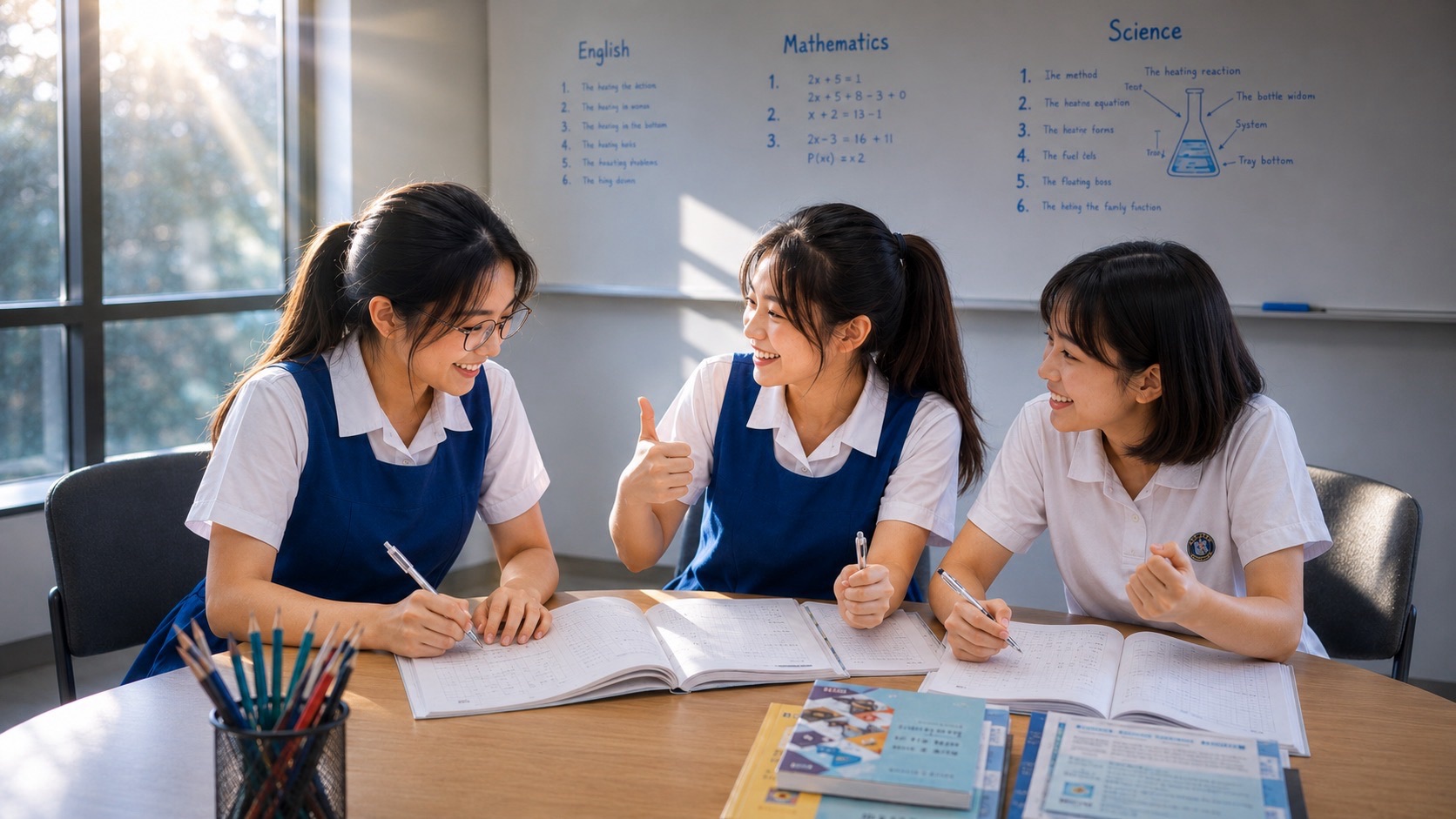
Lessons are conducted in carefully managed small groups, allowing the tutor to observe how each student thinks, identify where learning has weakened and provide the appropriate explanation, correction and practice.
The purpose is not simply to give students more worksheets.
It is to help each student:
Catch up where foundations are weak.
Keep up with current school demands.
Move ahead when the student is ready.
eduKateSG currently conducts lessons at its Punggol and Bukit Timah locations, with class placement arranged according to the student’s level, subject needs, timetable and suitable group fit.
Why Do Parents Look for a Tuition Centre?
Parents rarely begin looking for tuition without a reason.
A child may be falling behind in school.
Results may have declined even though the child appears to be studying.
Homework may take too long.
The student may understand during lessons but struggle during examinations.
A Primary student may have difficulty reading, writing or explaining Science answers.
A Secondary student may be unable to manage the increased speed, abstraction and independence expected in school.
Sometimes the student is doing reasonably well, but the parent can see that the foundations are not yet stable.
At other times, the student is already strong and needs a more demanding environment in which to develop greater precision, independence and examination control.
These situations may look different, but they lead to the same important question:
What does this student need next?
A good tuition centre should help answer that question before deciding what to teach.
Tuition Should Begin by Understanding the Student
Two students can receive the same examination score for very different reasons.
One may not understand the underlying concept.
Another may understand it but make careless mistakes.
A third may know the material but misread the question.
A fourth may work too slowly.
A fifth may have difficulty retrieving knowledge under examination pressure.
A sixth may have developed a gap several years earlier that is now affecting new learning.
Giving all six students the same worksheet does not solve the same problem.
This is why eduKateSG begins by observing the student’s current performance, learning habits, confidence, school demands and level of readiness.
The tutor looks beyond whether an answer is right or wrong.
The tutor also examines:
- how the student interpreted the question;
- which method the student selected;
- where the student hesitated;
- whether the working was organised;
- whether the answer was checked;
- and whether the student can repeat the process independently.
The final error is visible.
The learning process that created the error is often hidden.
Effective tuition tries to uncover that process.
The Earliest Weak Link
A student’s present difficulty may not have begun in the present chapter.
A Secondary Mathematics student struggling with algebraic fractions may have an earlier weakness in ordinary fractions, negative numbers or basic algebraic manipulation.
A Primary English student struggling with composition may have limited reading exposure, weak vocabulary retrieval or difficulty constructing clear sentences.
A Science student losing marks in open-ended questions may understand the concept but lack the language precision needed to express cause, process and outcome.
The visible problem is therefore not always the first problem.
At eduKateSG, the tutor works backwards to locate the earliest important weak link that can still be repaired.
The teaching sequence becomes:
Observe the present difficulty.
Trace the dependency behind it.
Locate the earliest useful point of repair.
Rebuild the missing understanding.
Connect it to the current topic.
Practise until the student can perform independently.
This prevents tuition from becoming an endless cycle of correcting symptoms without repairing causes.
Why eduKateSG Uses Small Groups
Class size changes what a tutor can see.
In a large class, a tutor may be able to present a good explanation, but there is less time to inspect every student’s reasoning closely.
A student can copy a correct solution without fully understanding it.
Another may remain silent because the lesson has already moved ahead.
A third may repeatedly make the same small error without anyone noticing the pattern.
In a carefully managed three-student class, the tutor has more opportunity to pause, inspect, question and correct.
The tutor can look at the student’s actual working rather than only the final answer.
The tutor can ask:
Why did you choose this method?
What does this sentence mean?
Which evidence from the passage supports your answer?
Where did the sign change?
What scientific process connects these two observations?
These questions reveal understanding.
They also help students learn how to examine their own thinking.
eduKateSG’s current programmes use focused small-group teaching, with lessons commonly organised as 1.5-hour sessions.
Why Not Individual Tuition for Every Student?
Individual tuition can be useful, particularly when a student requires intensive intervention or highly specialised support.
However, a carefully organised small group offers a different educational advantage.
Students still receive close tutor attention, but they also learn in the presence of other learners.
They hear different questions.
They observe alternative methods.
They explain ideas aloud.
They recognise that other students also make mistakes.
They learn when to ask for assistance and when to continue independently.
A good small group should not operate like a compressed lecture.
It should create a learning environment in which students receive enough attention to be properly supported while retaining enough space to think, attempt and become independent.
That balance is central to the eduKateSG approach.
Three Student Pathways
Not every student enters tuition from the same position.
For this reason, it is useful to think of tuition through three broad pathways.
1. Catch Up
The student has important gaps that are affecting present learning.
The first priority is not speed.
It is stability.
The tutor may need to return to earlier concepts, vocabulary, techniques or habits before the current syllabus becomes manageable.
Catching up may involve:
- repairing weak foundations;
- reteaching misunderstood concepts;
- improving basic accuracy;
- reducing confusion;
- rebuilding confidence;
- and reconnecting earlier knowledge to current schoolwork.
The objective is to stop the student from falling further behind.
2. Keep Up
The student generally understands the subject but finds the pace, volume or complexity of school difficult to manage consistently.
The tutor helps the student organise learning, clarify uncertainty and practise important skills before gaps accumulate.
Keeping up may involve:
- reinforcing current school topics;
- preparing for upcoming chapters;
- reviewing recent mistakes;
- improving homework efficiency;
- strengthening examination techniques;
- and building reliable weekly learning habits.
The objective is to keep the student connected to the syllabus.
3. Move Ahead
The student has stable foundations and is ready for more demanding work.
Moving ahead does not simply mean rushing into the next textbook.
It means developing greater depth, flexibility, precision and independence.
This may involve:
- applying concepts in unfamiliar situations;
- improving explanation and reasoning;
- comparing multiple solution methods;
- working with more complex texts or questions;
- reducing dependence on prompts;
- and training for stronger examination performance.
The objective is not merely to know more.
It is to use knowledge more intelligently.
Clear Teaching Before More Practice
Practice matters, but practice is only useful when the student understands what is being practised.
Repeatedly performing an incorrect method can strengthen the wrong habit.
Completing many questions without reviewing mistakes can create the appearance of productivity without producing reliable learning.
At eduKateSG, teaching begins with clarity.
The tutor explains the concept, demonstrates the relevant method and checks whether the student understands the relationship between the question and the solution.
Guided practice follows.
The student attempts the work with support available.
The tutor observes where the student hesitates or makes mistakes.
Corrections are made while the thinking process is still visible.
Independent practice comes later.
The student then has to select and execute the method without relying on constant prompts.
The sequence is:
Understand.
Attempt.
Inspect.
Correct.
Practise.
Connect.
Perform.
Review.
This turns practice into a deliberate learning process rather than a measure of how many pages were completed.
What Happens During an eduKateSG Lesson?
Each subject requires a different teaching emphasis, but a focused lesson commonly contains several connected stages.
Review
The tutor checks earlier work, recent school demands or errors that need further attention.
This helps determine whether the student has retained the previous learning.
Explanation
The tutor introduces or revisits the concept clearly.
New material is connected to what the student already knows.
Guided Work
Students attempt carefully selected questions while the tutor observes their reasoning.
Misunderstandings can be corrected before they become established habits.
Independent Attempt
Students complete work with less assistance.
This tests whether the learning has become usable.
Correction
The tutor examines not only the final answer but also the method, organisation, language and decision-making that produced it.
Connection
Students learn how the topic connects to other chapters, question types or examination requirements.
Continuation
Appropriate practice is selected to consolidate the lesson and prepare for the next stage.
As school examinations approach, lessons may place greater emphasis on targeted revision, commonly tested question types, answer construction, timing and examination accuracy.
English Tuition at eduKateSG
English is not a collection of unrelated components.
Reading affects vocabulary.
Vocabulary affects comprehension.
Comprehension affects writing.
Grammar affects clarity.
Knowledge affects the quality of ideas.
Oral communication depends on listening, organisation, language and confidence.
Weakness in one area can therefore appear somewhere else.
A student who struggles with composition may not merely need more composition practice.
The student may need stronger sentence construction, better vocabulary retrieval, wider reading or a clearer method for developing and organising ideas.
A student who struggles with comprehension may need help identifying evidence, understanding question demands or explaining an inference precisely.
eduKateSG’s English programmes support Primary and Secondary learners across reading, vocabulary, grammar, comprehension, writing, oral communication and examination preparation. The centre currently publishes pathways from Primary 1 through Primary 6 and Secondary 1 through Secondary 4.
The purpose is to develop a student who can:
Read accurately.
Understand deeply.
Select relevant information.
Organise ideas clearly.
Express meaning precisely.
Adapt language to the task.
Mathematics Tuition at eduKateSG
Mathematics becomes difficult when students memorise procedures without understanding the relationships behind them.
At Primary level, weaknesses in number sense, fractions, ratios, units or problem interpretation can affect several later topics.
At Secondary level, Mathematics becomes increasingly connected.
Numbers become algebra.
Algebra becomes equations and graphs.
Graphs describe relationships.
Geometry requires reasoning.
Upper-secondary Mathematics then demands greater precision, speed and control.
eduKateSG supports Primary Mathematics, Secondary G1, G2 and G3 Mathematics, SEC E-Mathematics and Additional Mathematics.
Students are taught to:
- understand what the question is asking;
- identify the relevant concept;
- select a suitable method;
- show organised working;
- check for accuracy;
- and complete the process under examination conditions.
The goal is not simply to obtain the answer.
It is to make the reasoning dependable.
Science Tuition at eduKateSG
Science requires students to combine knowledge with observation, reasoning and precise language.
A student may remember scientific facts but still struggle to answer an open-ended question.
This often happens because the student has not connected:
What happened.
Why it happened.
Which scientific concept explains it.
How the answer should be expressed.
Primary Science questions may require students to interpret diagrams, identify variables, compare observations, explain processes and use appropriate scientific vocabulary.
Strong Science tuition therefore goes beyond memorisation.
Students need to understand systems, causes, relationships and evidence.
eduKateSG provides Primary Science pathways from Primary 3 through Primary 6, including preparation for the increasing demands of upper-primary Science and PSLE.
Preparing for Examinations Without Teaching Only for Examinations
Examinations matter.
Students need to understand question formats, marking expectations, time pressure and the level of precision required.
However, examination preparation becomes fragile when it is separated from understanding.
A student who memorises a model answer may be unable to adapt when the question changes.
A student who memorises a mathematical sequence may become stuck when the numbers or structure are unfamiliar.
A student who remembers Science keywords without understanding the process may use correct terms in the wrong relationship.
At eduKateSG, examination preparation should therefore rest on three layers:
Understanding
The student knows what the concept means.
Application
The student can recognise when and how to use it.
Delivery
The student can express the answer accurately under examination conditions.
When these layers work together, examination technique strengthens learning instead of replacing it.
Confidence Should Come From Capability
Students often say that they lack confidence.
Confidence matters, but lasting academic confidence cannot be created by encouragement alone.
A student becomes more confident when the work becomes understandable.
The student knows how to begin.
Mistakes become correctable.
The method can be repeated.
Progress becomes visible.
This creates a more stable form of confidence:
I understand what this means.
I know which step comes next.
I can identify where I went wrong.
I can try again without becoming lost.
A supportive tuition environment helps students ask questions and recover from mistakes.
But the deeper objective is to build the capability that makes confidence reasonable.
Tuition Should Help Students Become More Independent
A student can appear successful during tuition while remaining dependent on the tutor.
The tutor may explain every question, select every method and correct every step.
The student completes the work but does not learn how to manage without assistance.
Good support should gradually reduce the amount of support required.
The tutor may begin by modelling the complete process.
Later, the tutor gives fewer prompts.
The student takes greater responsibility for interpreting the question, selecting the method, checking the work and explaining the answer.
This gradual transfer is important.
The purpose of tuition is not to make the student permanently dependent on tuition.
It is to help the student become increasingly capable of learning, thinking and performing independently.
Clear Communication With Parents
Parents need more than a statement that their child is “doing fine” or “needs more practice.”
They need to understand:
- what the present difficulty is;
- whether it is a foundation, technique, habit or performance problem;
- what is being repaired;
- what improvement should look like;
- and what the next priority will be.
This does not mean that every lesson requires a lengthy report.
It means that the tuition process should have a visible direction.
Parents should be able to understand why particular work is being done and how it connects to the student’s needs.
The consultation process at eduKateSG considers the student’s school level, current learning gaps, goals, confidence, habits and suitable class fit before recommending a pathway.
Who May Benefit From eduKate Singapore Tuition Centre?
eduKateSG may be suitable for a student who:
- requires more tutor attention than a large class can provide;
- has learning gaps that need to be diagnosed carefully;
- understands concepts but performs inconsistently;
- needs clearer explanations and structured practice;
- has lost confidence after repeated difficulty;
- needs support with current school demands;
- is preparing for PSLE or Secondary examinations;
- requires stronger independence and examination control;
- or is ready to move beyond routine work.
However, the smallest available class is not automatically the correct class.
The student’s readiness, personality, timetable, academic needs and compatibility with the group still matter.
A thoughtful placement process should consider the whole student rather than only the subject and grade.
Punggol and Bukit Timah Tuition Locations
eduKate Singapore currently operates tuition locations in Punggol and Bukit Timah:
eduKate Punggol
83 Punggol Central
Singapore 828761
eduKate Bukit Timah
8 Fourth Avenue
Singapore 268674
Near Sixth Avenue MRT
Lessons and consultations are arranged by appointment.
The purpose of having these locations is not only geographical convenience.
A suitable centre should also provide a calm and focused environment in which the student can concentrate, participate and learn consistently.
Frequently Asked Questions
Why does eduKateSG use three-student groups?
A three-student group gives the tutor more opportunity to inspect individual work, identify misconceptions and adjust the lesson while still allowing students to learn alongside others.
Are all lessons exactly the same?
No. Students follow the relevant syllabus and programme, but explanations, pacing, corrections and practice can be adjusted according to the needs visible within the group.
Does eduKateSG help weak students?
Yes. Students who need to catch up may require foundation repair, slower explanation, carefully sequenced practice and confidence rebuilding.
The exact intervention depends on why the student is struggling.
Does eduKateSG accept stronger students?
Yes. Stronger students may need greater challenge, deeper application, more independent work and stronger examination precision rather than basic repetition.
Does tuition follow the MOE syllabus?
eduKateSG’s published programmes are structured around the demands of Singapore’s Primary and Secondary school pathways and their corresponding examination expectations.
Does the centre provide examination preparation?
Yes. Examination preparation may include revision, question analysis, commonly tested structures, answer presentation, timing and accuracy. However, these are built on underlying understanding rather than taught as isolated tricks.
How long are the lessons?
Current published eduKateSG programme pages describe focused weekly lessons commonly conducted over 1.5 hours.
How do parents know which class is suitable?
Class placement depends on the student’s level, subject, learning needs, timetable, readiness and compatibility with the available small group.
A consultation helps identify the most appropriate next step.
So, Why eduKate Singapore Tuition Centre?
Parents do not choose tuition because their child needs more paper.
They choose tuition because something in the learning process needs to change.
The student may need a clearer explanation.
An earlier weakness may need repair.
Practice may need to become more deliberate.
Mistakes may need closer inspection.
Confidence may need to be rebuilt through genuine capability.
A stronger student may need greater depth and independence.
eduKateSG’s small-group approach is designed to make these needs more visible.
The tutor can teach, observe, diagnose, correct and guide within a class small enough for each student to be properly seen.
The aim is simple:
Understand where the student is now.
Identify what the student needs next.
Teach it clearly.
Practise it deliberately.
Build towards independent performance.
That is why a parent may choose eduKate Singapore Tuition Centre.
Not because every child should receive the same programme.
But because every child should have a clearer path forward.
Arrange a Parent–Student Consultation
Speak with eduKate Singapore about your child’s:
- current school level;
- subject requirements;
- recent performance;
- learning gaps;
- confidence;
- study habits;
- upcoming assessments;
- and suitable small-group placement.
Whether your child needs to catch up, keep up or move ahead, the first step is to understand what the student needs next.
eduKate Singapore
Punggol: 83 Punggol Central, Singapore 828761
Bukit Timah: 8 Fourth Avenue, Singapore 268674
Small-group tuition by appointment
English · Mathematics · Science
Primary · PSLE · Secondary · G1 · G2 · G3 · SEC E-Math · Additional Mathematics