
Checked: 31 August 2026. This Primary Creative Writing guide is aligned to the current Primary English Language Syllabus 2020. eduKateSG is not affiliated with Rivervale Primary School.
Model compositions can teach structure, vocabulary and revision. They can also create a serious dependency: students begin to believe good writing means sounding like someone else. They memorise openings, emotional phrases and endings, then force them into unseen prompts. For Rivervale Primary families, this page explains a safer route: use models to extract techniques, then rebuild those techniques in the student’s own language, viewpoint and story.
Quick read
- Analyse models for decisions, not sentences to copy.
- Name the technique: pacing, viewpoint, dialogue, detail, paragraph purpose, tension or resolution.
- Change the context before the student uses the technique.
- Require the learner to explain why the new version works.
- Three-student tutorials let students compare different transformations of the same technique.
- The goal is an original voice supported by craft knowledge, not dependence on model phrases.
Why models are useful
Young writers need examples of what strong writing looks like. A model can make invisible craft visible: how an opening enters the action, how a writer slows the turning point, how dialogue reveals conflict or how an ending echoes an earlier detail.
The problem begins when the student remembers the wording but not the decision behind it.
Extract the technique
After reading a strong paragraph, ask:
- What did the writer do?
- What job did that choice perform?
- Where else could this technique work?
- When would it not fit?
The answer should be abstract enough to transfer.
Example: opening in motion
A model story may begin with a character already running through a station. Do not memorise the sentence. Extract the technique: begin close to a meaningful event and let action introduce the setting.
The student can then use the same principle in a completely different context, such as a school hall or market.
Example: selective detail
A model may describe one vibrating phone rather than the whole room. The technique is not “use a phone”. It is choose one detail that carries the character’s attention and pressure.
Original voice appears when the student makes a different selection for a different story.
Example: dialogue with consequence
A strong model line may reveal information that forces a decision. The learner should identify that function, then create new dialogue that changes a different story.
Copying the line misses the craft.
Transform before using
One powerful classroom rule is: never reuse a technique in the same surface context where it was learned.
If the model uses a lost-wallet story, the student applies the technique to a broken promise, missed event or difficult choice. The changed context makes imitation harder and transfer more visible.
Rewrite at the principle level
Ask the learner to explain the model paragraph in craft language:
The writer delays the answer, uses one physical detail and ends the paragraph with new information.
Now the student has a recipe of relationships rather than wording.
Vocabulary from models
Useful words can be learned, but they should be tested for meaning, register and collocation. A student should not insert a phrase merely because it appeared in a high-scoring composition.
Active vocabulary becomes part of the learner’s voice when it is chosen naturally in original sentences.
Do not build a “good phrases” museum
Phrase books can make students feel prepared while narrowing their writing. Under exam pressure, a memorised sentence may appear even when it does not fit the character, viewpoint or tone.
Keep a technique notebook instead: “short sentence for impact”, “specific verb”, “final image echoes opening”, “dialogue reveals conflict”.
Voice comes from repeated choices
Original voice is not a mysterious talent. It emerges from which details the writer selects, how direct or reflective the narration is, how dialogue sounds, what the character notices and how sentences are paced.
Students develop voice by making more of those decisions themselves.
Models should become less necessary
Early learners may need frequent examples. Later, the tutor should remove them before drafting and ask the student to retrieve techniques from memory.
A model has succeeded when the writer can operate without looking at it.
Three students, three transformations
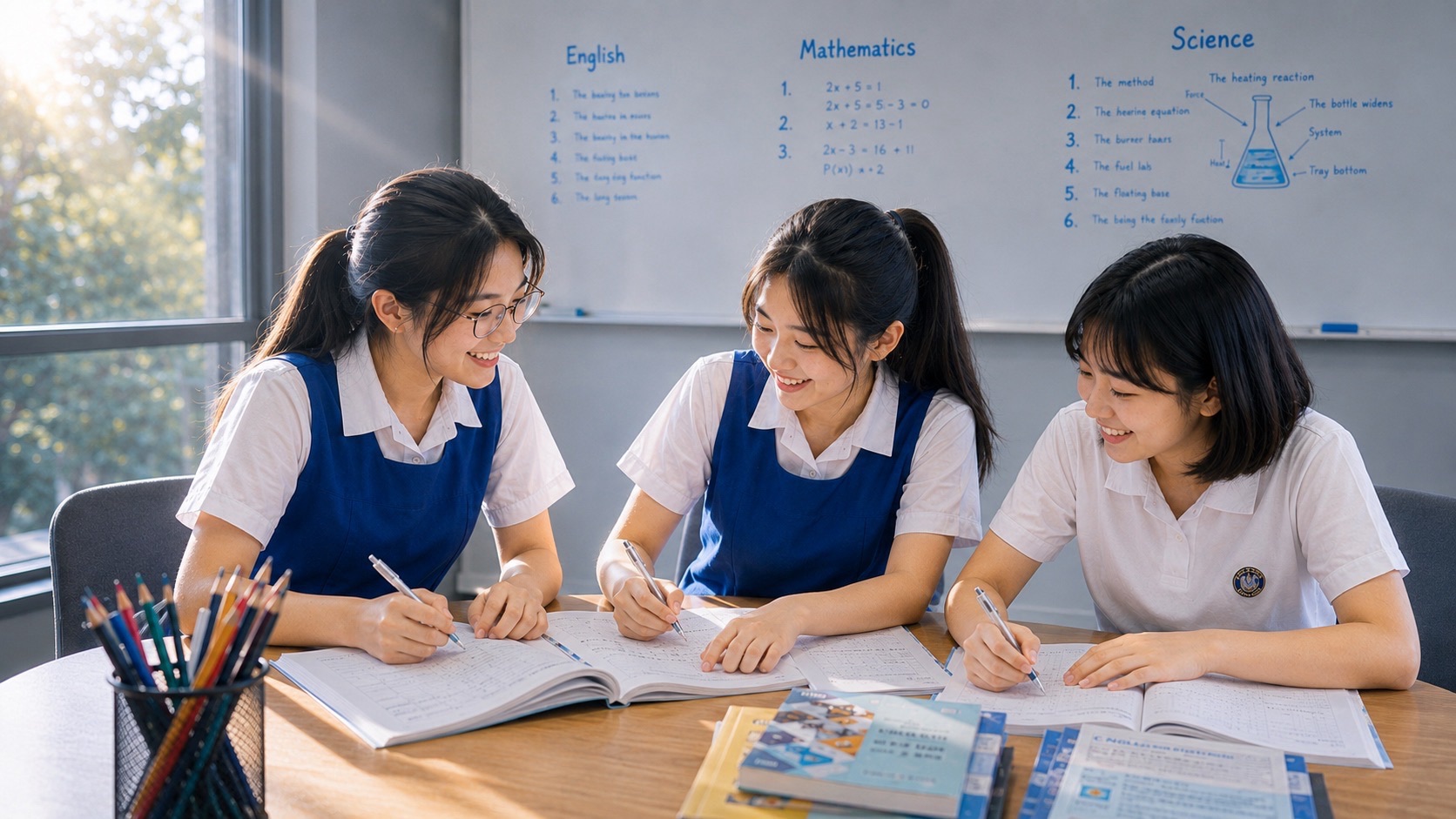
In a 3-pax class, all three students can analyse the same model technique and then transform it differently. One uses it for tension, another for character and another for setting.
The group compares whether the technique transferred—not whose prose most closely resembles the model.
Catch Up, Keep Up, Move Ahead
Catch Up may identify one clear technique and use a scaffolded transformation. Keep Up extracts several techniques and chooses one independently. Move Ahead compares models, evaluates trade-offs and deliberately rejects a technique when it does not fit.
Judgement is part of originality.
A 90-minute model-to-voice lesson
A lesson can analyse one short model, identify three craft moves and then close the model. Students receive a new prompt, choose one technique and draft an original scene. Revision asks whether the technique serves this new story.
The final reflection names what was borrowed at the principle level and what was invented.
Common failure patterns
- Memorised opening forced into every story: extract the opening function.
- Advanced phrase used awkwardly: return to meaning and register.
- Plot copied with names changed: change the conflict and causal chain.
- Model visible during drafting: close it before generation.
- Student cannot explain why phrase is good: teach the technique explicitly.
- Writing loses personal simplicity: prefer clear original language over borrowed sophistication.
How parents can help
If the child shows a model composition, ask what technique they learned from it. Then ask for a different example using the same technique.
This shifts the conversation from copying to craft.
Reading widely helps voice
Students who read many writers see that strong writing can sound different. There is no single “exam voice”. Exposure to varied texts makes it easier to understand technique without assuming one model style is mandatory.
Age-appropriate reading remains one of the best protections against formulaic writing.
PSLE originality and relevance
SEAB’s July 2026 clarification notes that pupils receive credit for relevant and well-developed responses and have room to demonstrate originality and personal voice in Continuous Writing. That makes technique transfer more useful than rigid memorisation.
Students should prepare a process, not a prewritten composition.
Current Primary English source
MOE’s English Language Syllabus 2020 Primary emphasises creative self-expression, authentic texts, idea generation, organisation, expression and revision. Models are most valuable when they support those capabilities rather than replace them.
What we removed from the old 2017 page
The historical Rivervale page was another cloned Creative Writing advertisement with fixed grade-improvement claims, tutor-gender marketing and generic 4–6-pax positioning. The preserved URL now owns a distinct craft mechanism: model analysis → technique transfer → original voice.
Boundary and school affiliation
This guide is written for Rivervale Primary School families. eduKateSG is not affiliated with, endorsed by or part of Rivervale Primary School. Current locations and class availability are on the contact page.
Frequently asked questions
Are model compositions bad?
No. They are useful when analysed for craft and followed by independent transformation.
Should students memorise strong vocabulary?
Learn useful words, but use them only when meaning, register and context fit.
How can a child develop personal voice?
By making more independent choices about detail, viewpoint, sentence rhythm, dialogue and reflection across many pieces of writing.
Can templates still help weaker writers?
Yes as temporary scaffolds. They should fade as the learner gains control.
What is the long-term goal?
A writer who can learn from excellent examples without sounding borrowed—carrying the craft forward while making the language and story their own.
The larger point
A model should leave fingerprints on the writer’s craft, not copied sentences on the page. The strongest evidence of learning is transformation.
How to Learn from a Model Composition Without Losing Your Own Voice
Model compositions are useful when students study the decisions behind them: where the writer starts, how the conflict develops, which details are selected and how the ending resolves the story. They become harmful when the student memorises sentences or plots and waits for an unseen prompt to resemble the model.
1. Identify the craft move, not the sentence
If a model opens with dialogue, ask what the dialogue accomplishes. If it uses a recurring object, ask how the object changes meaning. The transferable lesson is the function, not the wording.
2. Close the model before writing
After analysis, remove the text and give a different prompt. The learner should reconstruct the principle independently. Keeping the model visible encourages visual copying even when the student intends to be original.
3. Change at least three story conditions
Change character intention, setting and conflict—or another three meaningful elements. If the new story still follows the same exact event sequence, the student may be adapting the model superficially rather than generating anew.
4. Keep techniques that fit your natural language
A student does not need to imitate an author’s ornate style. Use techniques that improve clarity, pacing or character while keeping vocabulary and sentence rhythm within the learner’s genuine control.
5. Compare several models
One model can feel like the answer. Several models reveal that strong writing can take different forms. Students can compare openings, pacing and endings, then choose techniques rather than copying a template.
6. Use three-student tuition to expose different takeaways
Three students can read the same model and identify different useful moves. One notices paragraphing, another dialogue, another the resolution. The group gains a wider craft bank without producing identical stories.
7. Test originality on an unseen prompt
The strongest evidence is a new composition where the model’s craft has transferred but its plot and phrasing have disappeared. The reader should see the learner’s own choices, not the source text underneath them.
Model-to-voice checklist
- What craft move did I learn?
- Can I explain why it works?
- Can I use it after closing the model?
- Have I changed the story conditions?
- Does the language sound natural for me?
- Would a reader recognise the model’s plot too easily?
A model should enlarge the student’s possibilities, not narrow them to one approved composition. The best sign that modelling has worked is that the technique remains while the borrowed surface disappears.