
Secondary 3 is the year to ask a difficult but useful question: what still breaks when English becomes more demanding?
For Sengkang students, the point of tuition at this stage should not be to start Secondary 4 panic one year early. It should be to expose the weaknesses that are still cheap enough to repair before final-year time pressure arrives.
This page owns that narrow job. It is not a general English syllabus encyclopaedia. It is a Secondary 3 readiness guide for families deciding what should be stable before the student enters Secondary 4.
The Direct Answer
By the end of Secondary 3, a student should be moving toward reliable independent control in five areas:
- reading and inference;
- evidence and comprehension answers;
- summary and information compression;
- writing and argument development;
- oral communication, timing and self-correction.
If one of these areas repeatedly fails when material becomes unfamiliar, that is a better target for tuition than “do more English”.
Secondary 3 Is a Formation Year, Not a Waiting Room
Students often treat Secondary 3 as the year before the real examination year. That can waste valuable runway.
The strongest use of Secondary 3 is to build methods slowly enough that they can later survive speed. A student should not enter Secondary 4 still discovering how to plan an essay, distinguish evidence from inference, select summary points or develop an oral response beyond the first sentence.
Final-year practice works best when it is calibrating a functioning system rather than trying to invent one under pressure.
Read the Error Pattern Across Several Pieces of Work
A single weak paper can come from fatigue, an unfamiliar topic or a bad day. A repeated pattern across different tasks is more informative.
| Repeated pattern | Likely question to investigate |
|---|---|
| Understands passage but loses answer marks | Is the student completing the reasoning and matching the question obligation? |
| Argument has a position but weak development | Can each paragraph move from claim to reason, evidence/example and qualification? |
| Summary is too long | Can the student distinguish points from examples and merge overlap? |
| Grammar falls apart in essays | Does sentence control survive idea and time load? |
| Oral response is fluent but shallow | Can the student develop, ground and qualify a viewpoint? |
| Good homework, weak timed work | Is the problem retrieval, pacing, checking or reassurance dependence? |
Reading: Can the Student Defend an Interpretation?
Upper-secondary reading increasingly requires students to distinguish what a text says from what it reasonably implies. The student should be able to point to evidence, explain the relationship and avoid making a stronger claim than the text can support.
A useful test is to offer two plausible interpretations and ask which is better supported. This reveals whether the student is reading by impression or by evidence.
Writing: Does Every Paragraph Advance the Argument?
Secondary 3 writing often becomes more analytical. A student may have opinions but still produce paragraphs that repeat, list examples or drift away from the question.
Before Secondary 4, the student should be able to give each paragraph a job. One paragraph establishes a reason. Another may examine a limitation. Another may compare an alternative or explain a consequence. The structure should follow the logic of the question rather than a memorised template.
The test is simple: remove a paragraph. Does the argument lose something necessary? If not, the paragraph may not yet be doing enough work.
Summary: Can the Student Compress Without Distorting?
Summary exposes several skills at once: reading scope, point selection, grouping, paraphrasing, sentence control and word-budget discipline.
A strong Secondary 3 learner should be moving beyond line-by-line copying. The student should identify which information serves the summary question, remove examples and repetition, combine related points where possible and preserve the source meaning during paraphrase.
If paraphrasing changes the certainty, actor, cause or condition of the original, compression has become distortion.
Oral: Can the Student Think Beyond the First Answer?
Students often prepare for oral by collecting topics. That helps with background knowledge, but reliable speaking requires a response method that survives unfamiliar prompts.
A useful sequence is: answer directly, explain the reason, ground it with an example, consider a limitation or alternative, then respond naturally when the conversation changes.
This is not a script. It is a way to prevent the response from collapsing after one sentence.
The Independence Check Before Secondary 4
By late Secondary 3, tutoring should be reducing dependence rather than increasing it.
- Can the student start a task without asking for the method?
- Can the student identify a personal recurring error?
- Can feedback be applied after a delay?
- Can the student choose what to revise from a marked paper?
- Can the student recover after a difficult question without losing the rest of the paper?
- Can the student explain why an answer or paragraph works?
If these abilities are absent, the student may know more English than the final-year performance will reveal.
When Sengkang Families May Consider Tuition
Tuition may be useful when the same bottleneck appears across several school tasks and ordinary feedback has not changed it. The objective should be targeted repair, not simply a heavier weekly workload.
- Comprehension marks are unstable despite reasonable reading ability.
- Writing remains descriptive when the question requires explanation or argument.
- Summary selection or paraphrase repeatedly breaks.
- Grammar knowledge does not survive authentic writing.
- Oral responses lack development or evidence.
- The student is entering Secondary 4 with no independent revision method.
A Clear Location Note
eduKateSG does not claim a Sengkang teaching branch on this page. Sengkang families using this programme attend the nearby Punggol teaching location at 83 Punggol Central, Singapore 828761, subject to class suitability and timetable.
That distinction matters. A local-search page should tell parents the practical reality rather than imply that a centre exists in a neighbourhood where it does not.
What 3-Pax Should Produce
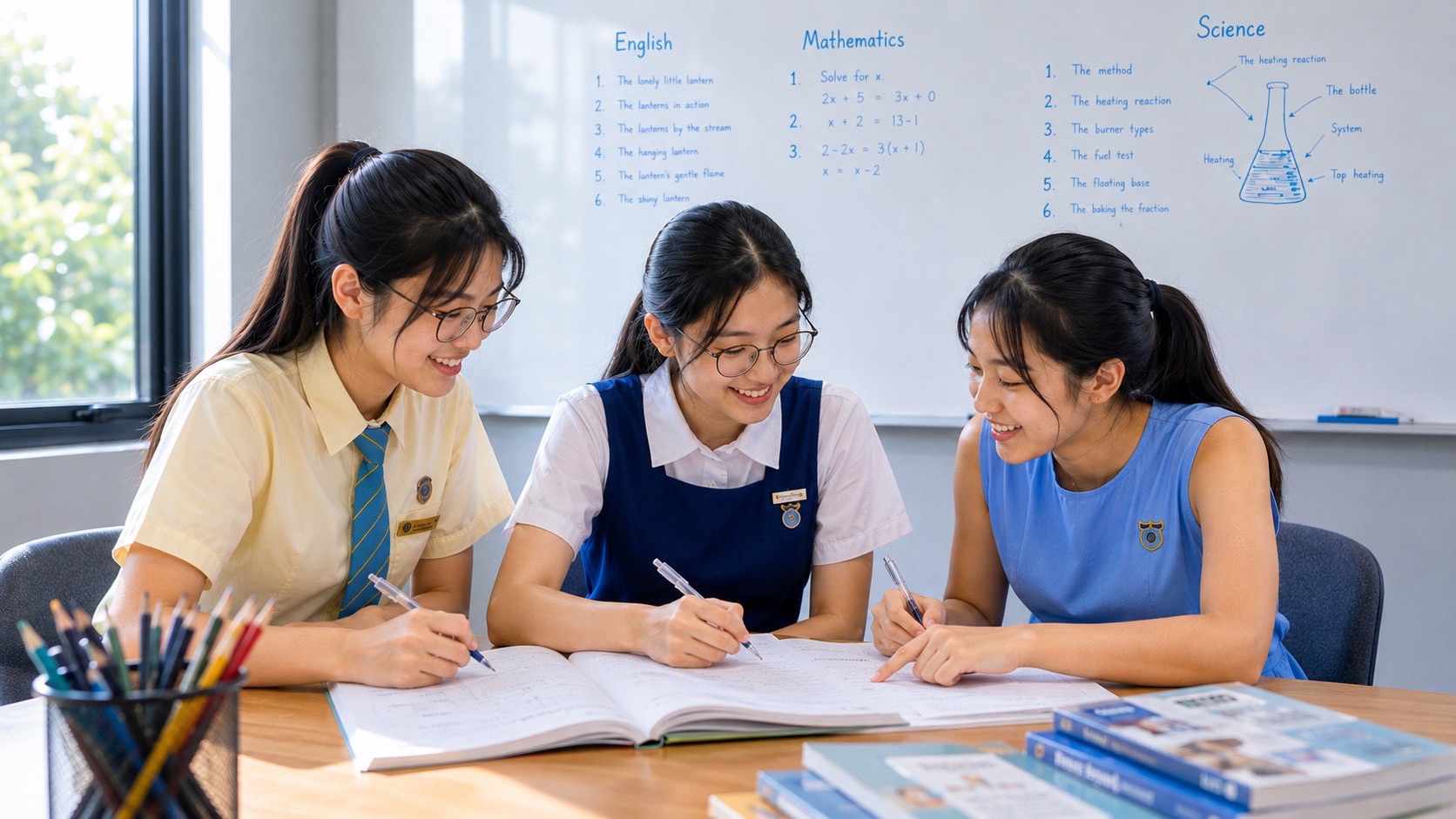
In a three-student class, comparison can be useful if it sharpens judgement. One student may choose stronger evidence; another may phrase the same idea more precisely; a third may notice a limitation others missed.
But every discussion must return to independent output. The student should leave the lesson more able to read, decide, write and check without the tutor.
The Secondary 3 Exit Standard
Before Secondary 4, the student should be able to diagnose a task, choose a method, produce a defensible response, check the most likely failure points and use feedback to set the next revision priority.
That is a much stronger position than entering the final year with a large folder of completed worksheets but no clear model of personal weaknesses.