
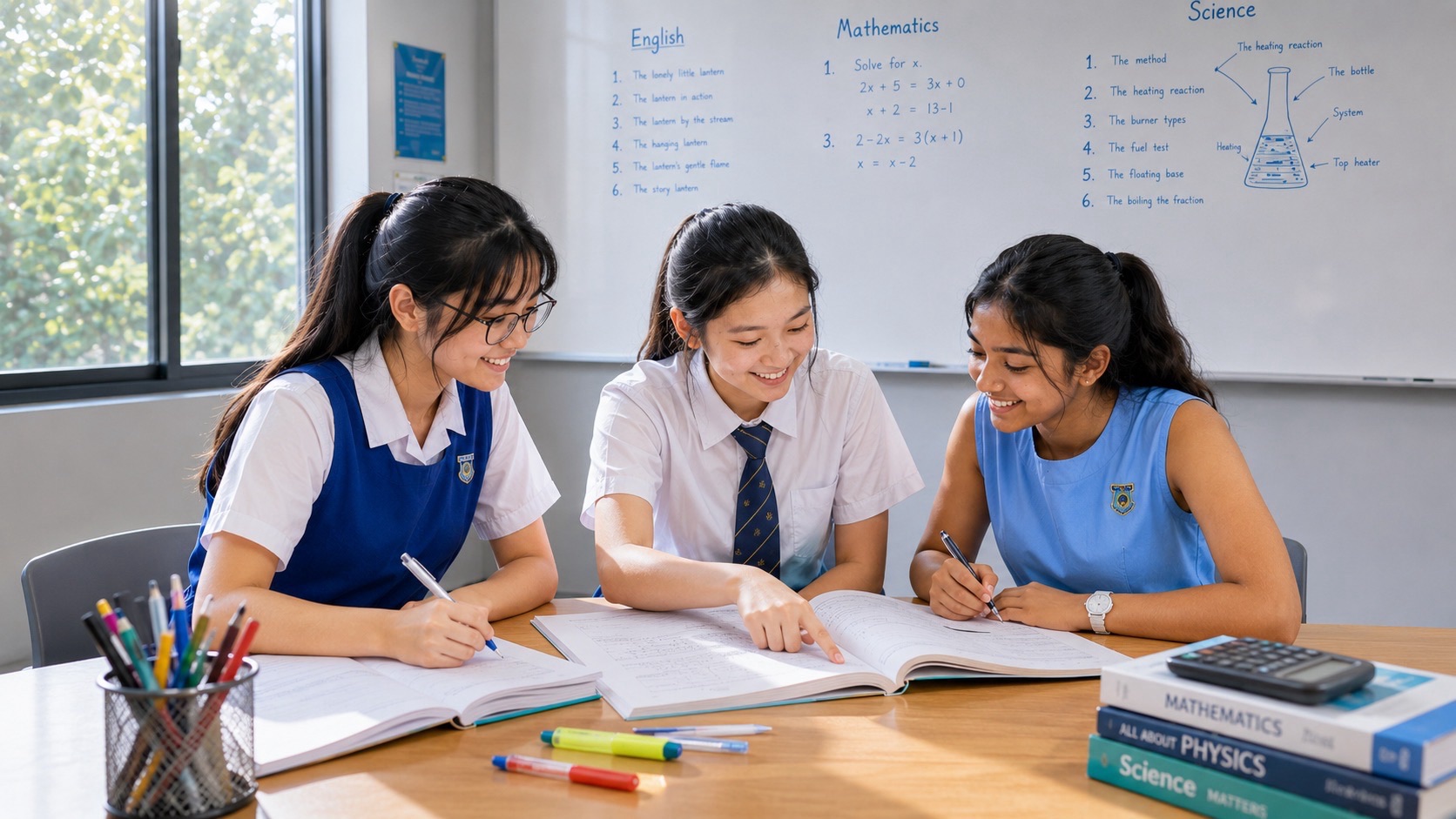
Education and tuition for Clementi families. Primary and Secondary learning, strong transitions and premium 3-pax tutorials at eduKateSG near Sixth Avenue MRT.
Clementi is where this series meets the article that sets its floor.
Our Secondary 1 Mathematics Tutor Clementi | Small Groups Tutorials guide focuses on the transition into Secondary Mathematics. This broader article looks at the full education route: Primary foundations, PSLE, Secondary transition, English, Mathematics, Science, Additional Mathematics and the role tuition can play when a learner needs repair, stabilisation or extension.
At eduKateSG, classes are limited to three students. The established weekly lesson duration is 1.5 hours, with teaching materials, guided corrections and focused continuation work.
Families from Clementi attend our Bukit Timah location near Sixth Avenue MRT. This guide addresses Clementi families; it does not describe an eduKateSG branch in Clementi.
Arrange a parent–student consultation with eduKate Singapore.
Education in Clementi Is a Route, Not a Single Examination
A student’s learning changes several times between Primary 1 and upper secondary.
The early years require reading fluency, number sense, basic explanation and reliable study habits. Upper Primary brings greater integration and PSLE. Secondary 1 changes the academic language. Upper secondary increases subject depth and examination demands.
The strongest preparation for each stage is not simply early exposure to the next syllabus.
It is a stable foundation that can carry the next load.
This is why tuition should respond to the learner’s present state rather than to age alone.
The Hidden Learning Problem: A Student Can Be Busy and Still Be Drifting
Completed worksheets, tuition attendance and long revision hours can create the appearance of progress.
The more important question is whether the learner’s capability is changing.
- Can the student explain the concept in their own words?
- Can the learner retrieve it after several days?
- Can the student choose the correct method when topics are mixed?
- Can the learner use the idea when the question looks different?
- Can the student identify and repair a recurring personal error?
If the answer is repeatedly no, the student may be drifting despite substantial effort.
Good tuition interrupts that drift by finding the first important weak point and rebuilding it before more work is placed on top.
Why Clementi Families May Consider a 3-Pax Tutorial
A class of three gives the tutor enough visibility to inspect how each student reaches an answer.
This matters because the final answer can hide the actual problem.
- A Mathematics error may begin with a negative sign, not the current chapter.
- An English error may begin with the interpretation, not the grammar.
- A Science answer may contain the right terms but omit the causal connection.
- A strong student may solve routine questions but struggle with transfer.
In a small group, the tutor can pause at that point, ask the student to explain the decision and choose the next task accordingly.
The group still provides peer learning. Students can compare methods and explanations after each learner has attempted the work independently.
Primary 1 to Primary 3: Build the Learning Machinery
Lower Primary is where many academic habits begin.
Students learn whether instructions are read carefully, whether corrections are understood, whether written work is organised and whether difficult questions are approached or avoided.
Primary English
Reading fluency, vocabulary, grammar, sentence construction and oral explanation should reinforce one another.
A child who can explain an event orally but cannot write a complete sentence needs a different repair from a child who does not understand the event in the first place.
We use that distinction to choose the next task.
Primary Mathematics
Number sense, place value, the four operations and early problem representation should become dependable before later topics rely on them.
The child should understand what a quantity represents rather than treat every word problem as a cue for an operation.
Learning habits
Lower Primary is also the right time to teach small routines: read the whole instruction, show the working, check one answer and correct meaningfully.
These habits become more valuable as the academic load increases.
Primary 4 to Primary 6: The Load Begins to Combine
Upper Primary asks students to coordinate more information.
English comprehension becomes more inferential. Mathematics combines several relationships. Science requires more precise explanation.
A student can know individual pieces and still struggle to assemble them.
Tuition should therefore inspect the point where the chain breaks.
PSLE: Repair, Retrieve, Then Execute
PSLE preparation becomes clearer when three jobs are separated.
Repair
If the concept is genuinely weak, return to the prerequisite and rebuild it before adding time pressure.
Retrieve
Bring important knowledge back after spacing without immediately reopening the notes.
Execute
Once understanding and recall are stable, practise mixed papers, timing, answer presentation and checking.
This prevents families from using examination technique to cover a concept that still needs direct teaching.
Secondary 1: The Mathematics and Language of School Change
The Secondary 1 transition receives special attention because several systems change at once.
Mathematics becomes more symbolic. English expects more mature interpretation and writing. Science becomes more formal. The student also manages more subjects, teachers and deadlines.
This is why the Clementi Secondary 1 Mathematics guide treats the move from arithmetic to algebra as a genuine change of mathematical language.
The same principle applies more broadly: the learner needs to know what has changed and what earlier capability must remain available.
Full Subject-Based Banding and the Singapore-Cambridge SEC
Under Full Subject-Based Banding, secondary students may offer subjects at G1, G2 or G3 levels according to strengths, readiness and school arrangements.
SEAB states that the Singapore-Cambridge Secondary Education Certificate begins in 2027, with the certificate reflecting the subjects and subject levels taken.
Tuition should therefore follow the student’s actual subject level and school programme.
Students in Integrated Programme or another curriculum should identify that programme clearly during consultation.
Secondary English Tuition for Clementi Students
Secondary English connects reading, interpretation and expression.
- Vocabulary in context
- Grammar and sentence construction
- Comprehension inference
- Evidence selection
- Summary control
- Situational writing
- Continuous writing
- Oral explanation
- Editing and rewriting
A student can understand a passage generally but still lose marks because the evidence is imprecise or the written response is vague.
We teach the complete chain from understanding the task to producing a defensible answer.
Secondary Mathematics Tuition for Clementi Students
Secondary Mathematics becomes easier when the student sees structure rather than memorises moves.
Algebra describes relationships. Graphs represent variation. Geometry depends on properties. Statistics combines calculation with interpretation.
When the current topic is weak, we inspect the prerequisite layer.
Algebra may fail because fractions are unstable. Trigonometry may fail because diagrams are read poorly. A correct formula may still produce a wrong answer because signs, units or working are inconsistent.
Families looking for current Secondary Mathematics information can also read Singapore Tuition | Secondary Math Tutor’s Latest Classes.
Science Tuition for Clementi Students
Science requires knowledge and explanation.
Students often know the topic but lose marks because the causal chain is incomplete.
We teach them to identify what changed, explain the relevant process, use evidence from the question and state the final effect clearly.
This habit supports Primary Science and transfers naturally into upper-secondary Biology, Chemistry and Physics.
Additional Mathematics: Build the Runway First
Additional Mathematics demands stable algebraic control, careful notation and the ability to sustain several logical steps.
Indices, logarithms, functions, trigonometry and calculus become harder when ordinary algebra still consumes too much attention.
The best preparation is therefore dependable Mathematics: fractions, equations, functions, graphs and symbolic manipulation.
Subject availability and suitable placement should be confirmed directly during consultation.
Our First-Principles Teaching Method
1. Diagnose the exact weakness
We inspect schoolwork, assessment papers and the student’s own explanation.
2. Rebuild from the first unstable point
An earlier prerequisite is repaired when it is affecting current work.
3. Use the Fencing Method
We teach within a clear boundary before adding complexity. One new difficulty is introduced at a time.
4. Connect concrete, representational and abstract forms
Where useful, the learner moves from a familiar situation or diagram to formal symbols and notation.
5. Ask the student to explain
Explanation reveals whether the learner understands the relationship or is repeating a procedure.
6. Retrieve and interleave
The What Works Clearinghouse study guide recommends worked examples, retrieval and explanatory questioning. We revisit older learning and mix topics so students must recognise the correct method.
7. Build examination discipline
Clear working, accurate copying, units, paper navigation and checking are developed before upper-secondary pressure makes repair more difficult.
What Happens During a 90-Minute Lesson
A typical tutorial begins with short retrieval from previous work.
The tutor then reviews one current school question or assessment error.
Direct teaching focuses on the central relationship. Guided practice follows, with prompts gradually reduced.
An independent application shows whether the idea belongs to the student rather than only to the lesson.
Mixed or timed work is added when appropriate.
The lesson closes with error review and focused continuation work.
Three Student Pathways
Repair
The student has a clear gap. We rebuild the earliest important prerequisite and reconnect it to school.
Stabilisation
The student understands much of the work but results vary. We strengthen retrieval, accuracy, timing and checking.
Extension
The student is already secure. We increase depth, unfamiliar applications, explanation and transfer.
Clementi Learning: Use Milestones Without Turning Them Into Finish Lines
PSLE is important, but the child still needs to enter Secondary 1 capable of learning again.
Secondary assessments matter, but upper-secondary subjects will continue to build on the same foundations.
A milestone should therefore produce capability that travels forward.
- Primary English should leave stronger reading and expression.
- Primary Mathematics should leave stable number and problem relationships.
- Primary Science should leave a habit of causal explanation.
- Secondary 1 should leave stronger symbolic and organisational control.
- Upper secondary should build independent revision and examination execution.
The examination is part of the route. It should not erase the need for learning that remains useful afterwards.
A Practical Weekly System for Clementi Families
- One short retrieval task from earlier learning.
- One current school task completed independently.
- One correction based on a recurring error.
- One changed application later in the week.
- Enough time for ordinary schoolwork, meals, sleep and recovery.
The purpose is continuity rather than volume.
What Progress Should Look Like
Progress becomes visible when the student begins work with less prompting and asks more precise questions.
Written working becomes easier to follow. Repeated mistakes occur less often. The learner can explain why an earlier answer was wrong and what should be done differently next time.
Unfamiliar questions create less panic because the student has a method for finding the structure.
School results remain important, but no responsible tuition programme can promise a fixed grade gain after a fixed number of lessons.
When Should a Clementi Family Consider Tuition?
Support may be useful when a recurring problem survives normal school correction, when the learner cannot begin work independently, when a major transition is approaching with unstable foundations or when results remain inconsistent despite effort.
A strong student may also benefit from deeper transfer and explanation.
A learner who understands school lessons, uses feedback and progresses independently may not need another weekly class.
Convenient Access From Clementi to Sixth Avenue
One rail option from Clementi is the East–West Line to Buona Vista, the Circle Line to Botanic Gardens and the Downtown Line to Sixth Avenue.
Families can use SMRT journey information and the SBS Transit planner when arranging the trip.
Plan the full journey from the student’s actual starting point after school, including walking, interchange and the return home.
eduKateSG’s Bukit Timah location is at 8 Fourth Avenue, Singapore 268674, near Sixth Avenue MRT. Attendance is by appointment.
Class Details
- Premium 3-pax small-group tutorials
- Established weekly duration: 1.5 hours
- Primary English, Mathematics and Science support according to suitable placement
- Secondary English and Mathematics support according to the student’s programme
- Additional Mathematics support for suitable upper-secondary students
- Teaching materials, guided corrections and focused continuation work
What Parents Can Bring to the Consultation
- Recent school test papers
- Marked assignments and corrections
- The current school topic sequence where available
- The student’s own first attempt on difficult questions
- Teacher comments where available
- A realistic description of the student’s normal study week
Frequently Asked Questions
Is there an eduKateSG centre in Clementi?
No. This guide addresses Clementi families. The tuition location described is at 8 Fourth Avenue near Sixth Avenue MRT.
My child did well at PSLE. Is Secondary 1 tuition automatically necessary?
No. A student who is adapting well, learning independently and progressing steadily may not need additional tuition. Support becomes useful when the transition exposes a gap or the family wants purposeful extension.
Do you follow the school’s topic order?
We consider the school sequence and upcoming assessments. An earlier prerequisite may still need repair before the current topic can become stable.
Do you teach ahead?
Yes, when the foundation is ready. Pre-teaching is used for a calm first encounter, not to claim faster syllabus coverage while gaps remain unresolved.
How do you handle careless mistakes?
We classify them into reading, concept, arithmetic, sign, copying, presentation and time-pressure errors. Different error families require different corrections.
Can tuition prepare a student for Additional Mathematics?
The best preparation is a strong runway: algebra fluency, numerical accuracy, symbolic confidence, graph interpretation and clear multi-step working.
How quickly should improvement appear?
Some students show better confidence, organisation and working habits within several lesson cycles. Larger conceptual gaps require more time and depend on the starting point, attendance and practice.
Helpful Reading for Clementi Families
Secondary 1 Mathematics Tutor Clementi | Small Groups Tutorials
Secondary Mathematics Tuition in Clementi — 3-Pax Small Groups
Education and Tuition | Kent Ridge
Education and Tuition for Clementi Families
Clementi is not one educational moment. It is a long route through changing school demands.
The strongest support is therefore the support that understands the learner’s present state, repairs what is unstable and develops capability that remains useful at the next stage.
For students who are behind, we rebuild. For students who are coping, we stabilise. For students who are ready, we extend.
The objective is increasing independence.
Arrange a Parent–Student Consultation
Contact eduKate Singapore with the student’s school level, subject, recent work and upcoming assessments.
eduKateSG
8 Fourth Avenue
Singapore 268674
Near Sixth Avenue MRT
Premium 3-pax small-group tuition
By appointment
Properly taught kids shine a bright light into the future.