
Secondary 4 English is not mainly a year for collecting more techniques. It is the year when everything learned earlier has to become reliable.
A student may already know how to write, understand a passage, speak confidently and recognise grammar errors. The final-year question is different: can those abilities still appear when the clock is running, the text is unfamiliar and the student has only one attempt?
For families in Punggol, this page focuses on that conversion problem: how Secondary 4 English tuition should help students turn language ability into dependable examination performance.
Quick Read
- Final-year English is about reliability. The student must perform without tutor prompts.
- Full papers measure; targeted practice repairs.
- Writing needs control under time. Planning, selection and checking matter as much as ideas.
- Comprehension errors should be diagnosed by cause. Vocabulary, inference, question-reading and expression are different problems.
- Oral and listening remain real parts of English. They should not disappear behind Paper 1 and Paper 2 practice.
The One-Sentence Answer
Good Secondary 4 English tuition should make the student’s reading, writing, listening and speaking reliable enough to survive unfamiliar material, time pressure and independent execution.
The 2026 English Examination Is a Four-Part Performance
For the 2026 graduating cohort taking GCE O-Level English Language 1184, SEAB lists four assessed areas: Writing, Comprehension, Listening and Oral Communication. Writing and Comprehension carry the largest weightings, but the final result is still built across all four papers.
Parents can check the current official syllabus on the SEAB 2026 English Language syllabus.
This matters because “English is weak” is too broad. A student can be strong in spoken interaction and inconsistent in writing. Another can write well but lose marks through comprehension precision. A third may understand both but collapse when time is tight.
Start With the Leak, Not the Total Score
A total mark tells us how much performance was lost. It does not tell us where it leaked.
- Was the writing underdeveloped because planning took too long?
- Did comprehension answers contain the right idea but poor expression?
- Did the student misread command words?
- Did vocabulary uncertainty distort meaning?
- Did the final section remain incomplete?
- Did oral responses contain good ideas but weak organisation?
The repair should match the leak. More whole papers are not always the answer.
Writing: Control Before Decoration
At Secondary 4, students often know that writing should sound mature. The danger is trying to sound mature before controlling the structure.
Strong examination writing starts with choices: what is the task asking, what position or story best fits, what deserves space, what can be omitted, and how much time must remain for checking?
Vocabulary should serve those choices. A precise ordinary word is stronger than an impressive word used unnaturally. A clean paragraph with one clear job is stronger than a dense paragraph carrying three half-developed ideas.
Comprehension: Understand Before You Harvest Answers
Weak comprehension technique often begins too early: the student reads the question, hunts for matching words and starts writing before building a mental model of the text.
A more reliable reader asks first: what is happening here, what is the writer trying to establish, how do the paragraphs connect, and where does the tone or viewpoint shift?
Then each question becomes a smaller retrieval-and-expression task inside an already understood text.
Why Full Papers Are Necessary but Not Sufficient
Full papers reveal whether the system works together under time. They are excellent measurement tools.
But if the same problem repeats, another full paper can simply reproduce it. A student who repeatedly writes incomplete inference answers needs concentrated inference-and-expression work. A student whose editing errors repeat needs a deliberate error-checking routine. A student who runs out of time needs the cause isolated: slow reading, over-planning, indecision or weak task recognition.
Measure broadly. Repair narrowly. Then return to broad measurement.
Timing Is a Language Skill When the Exam Has a Clock
Timing problems are rarely solved by telling students to “write faster”.
Speed improves when decisions become cheaper. The student recognises the question type faster, plans with fewer unnecessary steps, chooses evidence more decisively and checks for known error patterns rather than rereading everything aimlessly.
Exam craft is therefore not separate from English. It is the organisation of English under constraint.
Oral Communication: Ideas Need Shape
Students sometimes assume that being naturally talkative means oral preparation is unnecessary. Fluency helps, but an assessed response still benefits from structure.
A strong response identifies the issue, gives a clear position or observation, supports it with relevant development and responds naturally when the conversation changes direction.
The goal is not a memorised speech. It is organised spontaneity.
Listening: Attention Has to Stay With the Recording
Listening looks passive but is cognitively active. Students must maintain attention, distinguish important from incidental information and recover if one detail is missed.
Practice should therefore include note selection, prediction from context and recovery—not just repeated exposure.
What Improvement Looks Like in the Final Year
- Scores become less volatile across unfamiliar papers.
- Planning becomes shorter but better.
- The student can explain why marks were lost.
- Recurring errors appear less often.
- Comprehension answers become more exact.
- Checking becomes selective and purposeful.
- The student completes more of the paper without rushing the final section.
- Oral responses become organised without sounding memorised.
Why a Three-Student Group Can Help
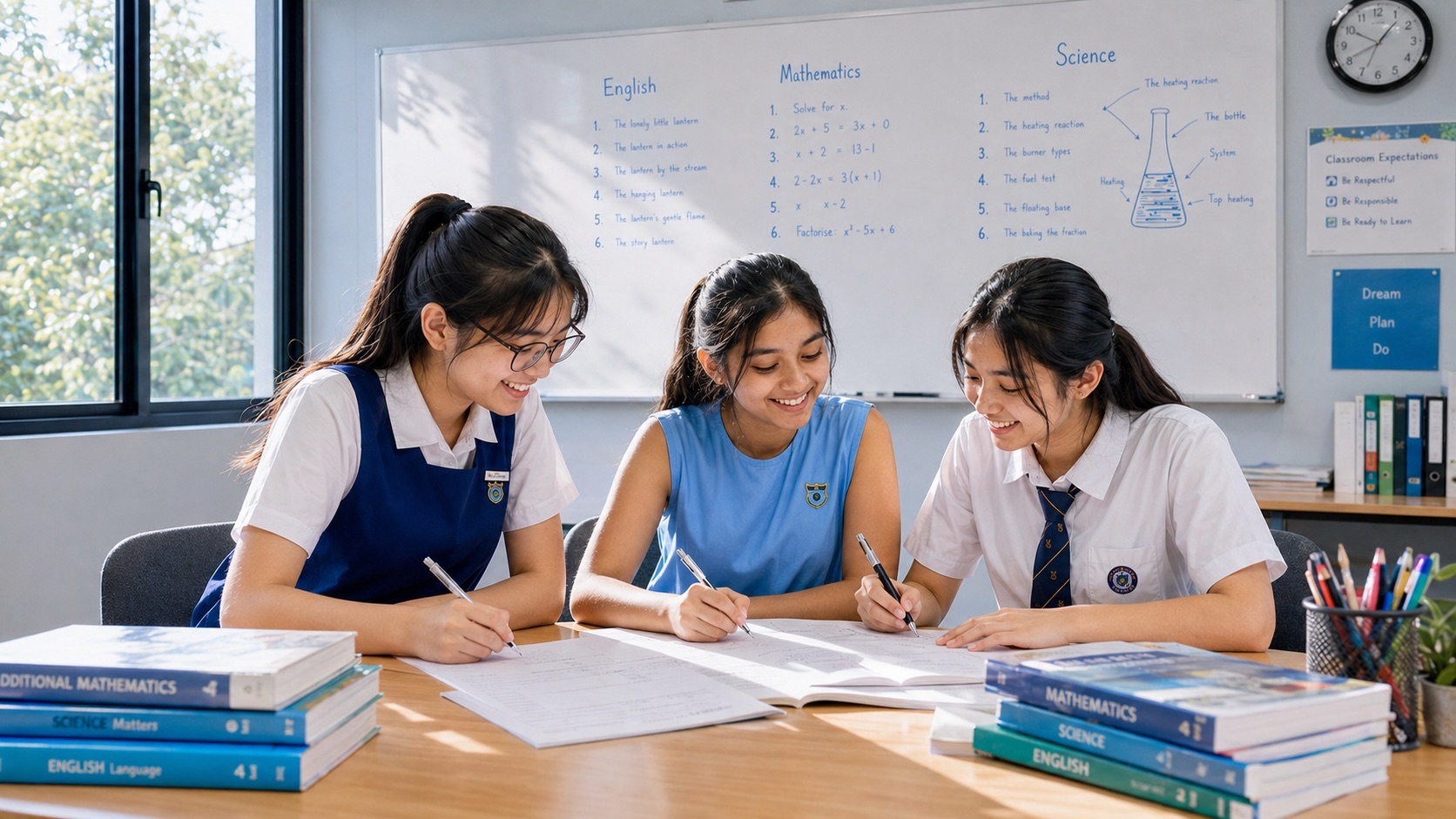
Three students create useful comparison while keeping individual execution visible. They can examine different ways of planning the same writing task, compare answers to the same comprehension question and hear different oral responses.
But each student must still perform alone. That matters in Secondary 4 because the tutor’s role should increasingly shift from helping to observing.
How eduKate Approaches Secondary 4 English in Punggol
eduKate begins with evidence: recent school papers, compositions, corrections, oral feedback and timed work. We identify the earliest point where marks are being lost, repair that process and then test whether the repair survives unfamiliar material.
As the examination approaches, support should become more selective. We want the student—not the tutor—to recognise the task, choose the method, execute it and check the result.
Frequently Asked Questions
Should Secondary 4 tuition consist mainly of full papers?
No. Full papers are essential for measurement and timing, but repeated weak areas usually need targeted repair between papers.
What if my child’s marks vary a lot?
Look for what changes between strong and weak performances: text familiarity, time pressure, question type, writing topic or checking. Volatility itself is useful diagnostic evidence.
Is it too late to repair foundational English in Sec 4?
No, but the repair must be selective. With limited time, locate the highest-impact weak link rather than trying to rebuild everything at once.
The Final-Year Standard Is Dependability
Secondary 4 English is successful when the student no longer needs ideal conditions to perform well.
The text can be unfamiliar. The question can be awkward. The clock can be running. The student still knows how to begin, how to choose, how to recover and how to finish.