
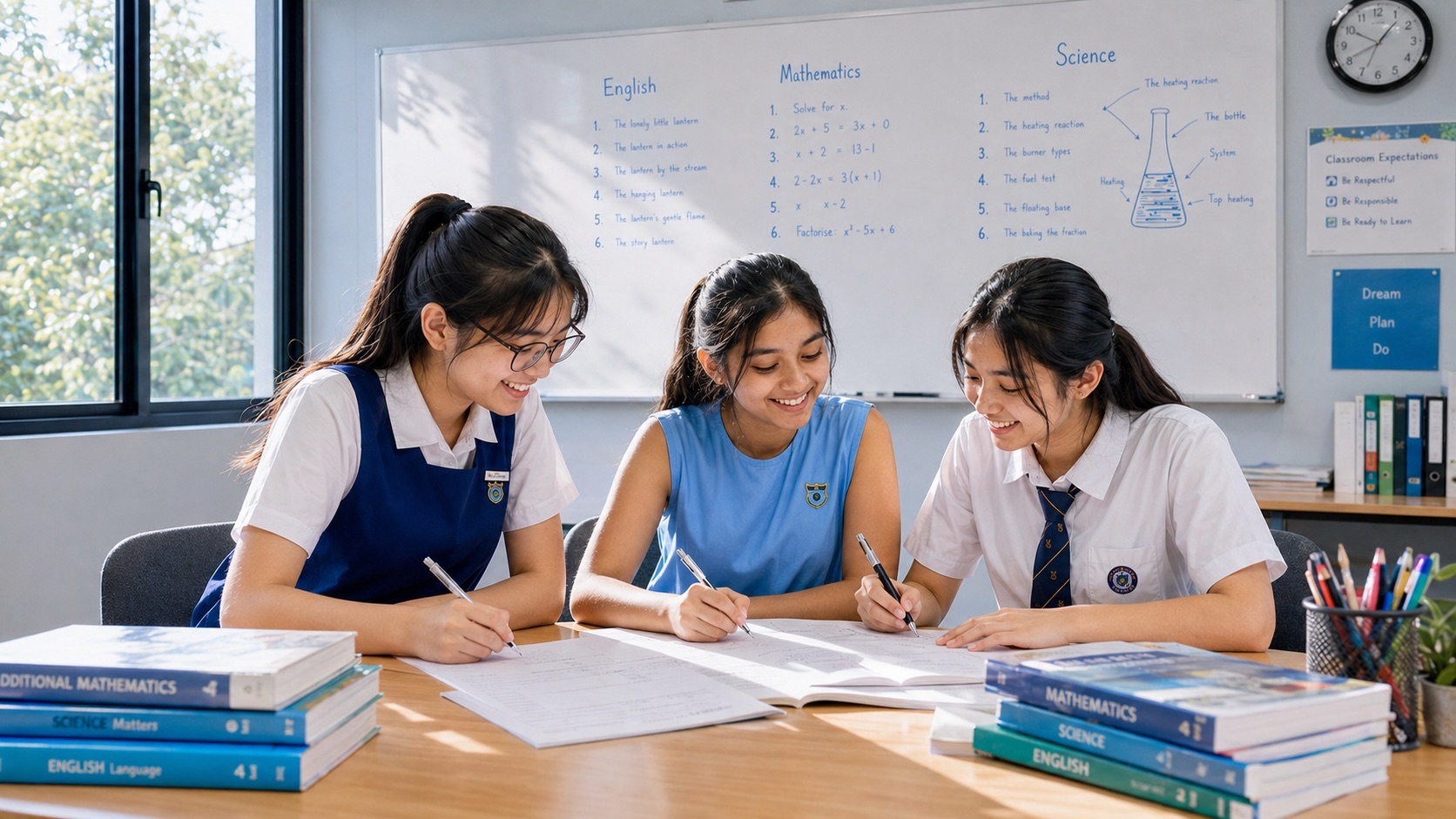
Primary 4 is often the year parents first feel that English has become less predictable.
The child may still read fluently. Grammar exercises may look manageable. Spelling may be reasonable. Yet comprehension questions become less obvious, vocabulary becomes more dependent on context, and writing begins demanding more than a sequence of correct sentences. The language is now carrying more thinking.
For families in Yishun considering Primary 4 English tuition, this is the useful distinction: the difficulty is no longer only whether a child can read and write. It is whether the child can interpret, connect, infer and express with enough control for another reader to follow.
Quick Read
- Primary 4 is a transition year. English begins asking for more hidden structure, not just correct surface language.
- Comprehension becomes less literal. Students increasingly need to connect clues, infer meaning and explain answers with evidence.
- Vocabulary becomes relational. Children must understand shades of meaning, word choice and how context changes interpretation.
- Writing needs coherence. A composition can contain good sentences and still feel weak if the ideas do not build towards a clear effect.
- The best repair is diagnostic. More worksheets do not help if the real weakness is inference, organisation, vocabulary precision or independent checking.
The One-Sentence Answer
Good Primary 4 English tuition should help a child move from basic language accuracy towards connected meaning, inference, organised expression and increasingly independent judgement.
What Changes in Primary 4?
Earlier English often allows a child to succeed by locating information directly, recognising familiar grammar patterns and producing simple sentences. By Primary 4, those skills still matter, but they are increasingly used as foundations for something larger.
A comprehension question may not repeat the wording of the passage. A character’s feeling may need to be inferred from behaviour. A vocabulary question may depend on tone or contrast. A composition may need a beginning that prepares the middle, a middle that changes something, and an ending that feels earned rather than attached.
Singapore’s Ministry of Education Primary English Language syllabus develops English across connected areas such as reading and viewing, listening and viewing, speaking and representing, and writing and representing. That matters at Primary 4 because the student is no longer simply accumulating isolated skills; the skills are beginning to interact. The MOE Primary English Language Syllabus gives parents the official framework.
The Hidden Problem: A Child Can Look Fluent but Still Be Fragile
One of the hardest Primary 4 weaknesses to notice is fluent fragility. The child reads smoothly, speaks confidently and can complete familiar grammar exercises, so adults assume the foundation is secure. Then an unfamiliar passage arrives and performance drops.
The issue may be that the child has learned many local moves but not yet learned how to connect them. They know what individual sentences say but do not build a larger model of the passage. They know many words but cannot distinguish which word best fits the context. They can write descriptive sentences but do not control the direction of the story.
This is why Primary 4 is a useful diagnostic year. The work begins exposing whether earlier skills are connected strongly enough to support upper-primary thinking.
Four Primary 4 English Problems We Often See
1. Literal reading without inference
The child can tell you what happened but struggles with why it happened, what a character probably felt, or what a phrase suggests. The repair is not simply more difficult passages. The student needs to learn how clues combine into a defensible inference.
2. Vocabulary without precision
Knowing “angry”, “furious”, “irritated” and “resentful” does not mean the words are interchangeable. Primary 4 is a good time to teach children that vocabulary has shape: intensity, tone, situation and relationship to nearby words all matter.
3. Composition as a collection of nice sentences
A child may have memorised vivid phrases yet produce a weak story because the events do not lead anywhere. Good writing requires causality. One event changes the next. A decision has a consequence. A detail introduced early becomes useful later.
4. Weak self-monitoring
Some students can correct an error after the tutor points at it but rarely notice the error independently. That is a different skill. Primary 4 is a useful year to make checking visible: reread the sentence, compare tense, inspect punctuation, ask whether the answer actually responds to the question.
How Comprehension Should Develop
Strong comprehension is not a treasure hunt for matching words. It is the construction of a mental model.
As the child reads, they should gradually be tracking who is present, what each person wants, what has changed, which details matter and what remains uncertain. When a question arrives, the student returns to the passage with a purpose rather than rereading everything blindly.
A useful tutor therefore asks questions such as: “Which sentence gave you that idea?” “What changed between these two paragraphs?” “If this word were removed, would the tone change?” “What answer can we rule out, and why?”
The goal is not to turn a nine- or ten-year-old into a literary critic. It is to make thinking visible enough that the child can eventually reproduce the process alone.
How Writing Should Develop
Primary 4 composition improves when the child stops treating writing as a hunt for impressive phrases and starts treating it as controlled communication.
A useful story has a centre. Something matters. The reader understands what the character is trying to do, what gets in the way and why the ending follows from the events before it. Description then serves the story rather than interrupting it.
For example, “The rain hammered against the windows” is only useful if the rain changes what the character sees, does, fears or decides. Otherwise it is decoration. Primary 4 students can begin learning this distinction.
What Improvement Looks Like
A stronger Primary 4 student begins giving answers that are more exact rather than merely longer. The child can point to evidence. Vocabulary choices fit the situation more naturally. Compositions become easier to follow. Corrections become less random because the child knows what to inspect.
Another sign is recovery. When a question looks unfamiliar, the student does not immediately freeze. They reread, locate the relevant section, compare possibilities and make a reasoned attempt.
That ability to recover is one of the most useful forms of exam preparation, long before an examination becomes urgent.
Why Small Groups of Three Can Help at Primary 4
By Primary 4, discussion becomes particularly valuable. Three students can read the same paragraph and notice different things. One may focus on a character’s action, another on a word choice, another on a consequence.
The tutor can use those differences to teach judgement. Why is one interpretation stronger? Which answer has better evidence? Which sentence communicates the idea more clearly?
At the same time, the group remains small enough for individual writing to be read closely and for specific weaknesses to be noticed. The point of three students is not merely attention. It is the balance between attention, comparison and independent effort.
What Parents Can Do at Home
- After reading, ask “What makes you think that?” rather than only “What happened?”
- When your child learns a new word, compare it with a nearby word: “How is ‘anxious’ different from ‘afraid’?”
- For composition, ask the child to explain the story in three sentences before writing it. If the three-sentence version has no clear change, the longer version may also wander.
- When correcting work, ask the child to identify the type of error before fixing it.
- Encourage reading across stories and informational texts so the child sees English doing different kinds of work.
Parents do not need to supply sophisticated teaching language. Simple questions that force the child to explain a choice can reveal a great deal.
When Tuition May Be Useful
Primary 4 English tuition may be worth considering when comprehension remains highly literal, vocabulary is memorised but not retained in context, composition repeatedly lacks structure, grammar errors persist despite correction, or the child needs substantial prompting to explain reasoning.
It can also help a strong student who needs deeper challenge. But enrichment should not mean filling the page with harder words. A better form of stretch is better interpretation, more precise expression, richer reading and stronger independent judgement.
How eduKate Approaches Primary 4 English
eduKate’s small-group approach begins with evidence. We look at what the child actually does when reading, answering, planning, writing and correcting. A low mark alone is not a diagnosis.
Once the weak point is clearer, we work deliberately: strengthen vocabulary in context, make inference steps visible, improve sentence control, teach story structure, practise answering with evidence and then test whether the skill transfers to unfamiliar material.
The tutor should gradually become less necessary. That is an important standard. If a child can only perform while the tutor is standing beside the page, the learning is not finished.
Frequently Asked Questions
Is Primary 4 already a PSLE preparation year?
It is better understood as a foundation-consolidation year before upper primary. The most useful PSLE preparation at this stage is strong reading, vocabulary, inference, writing structure and independent correction.
Should my child memorise model compositions?
Model texts can teach structure and language choices, but memorising whole compositions can produce brittle writing. The child needs to understand why a technique works and be able to adapt it to a different situation.
My child reads a lot. Why is comprehension still weak?
Reading volume helps, but comprehension also depends on attention, vocabulary, background knowledge, inference and the ability to connect ideas across a text. The specific weak link needs to be identified.
What evidence should I show a tutor?
Bring a recent comprehension exercise, a piece of independent writing and, if possible, corrections showing what the child changed after feedback. The pattern across these often reveals more than the final mark.
Primary 4 Is Where English Starts Becoming a Thinking Tool
By Primary 4, English is doing more than carrying school instructions. It is becoming the medium through which the child interprets motives, compares ideas, explains evidence, shapes a story and makes increasingly fine distinctions.
The strongest outcome is therefore not a child who has collected more impressive vocabulary. It is a child who can see more clearly what language is doing—and can use that understanding to read, think and communicate with greater independence.