
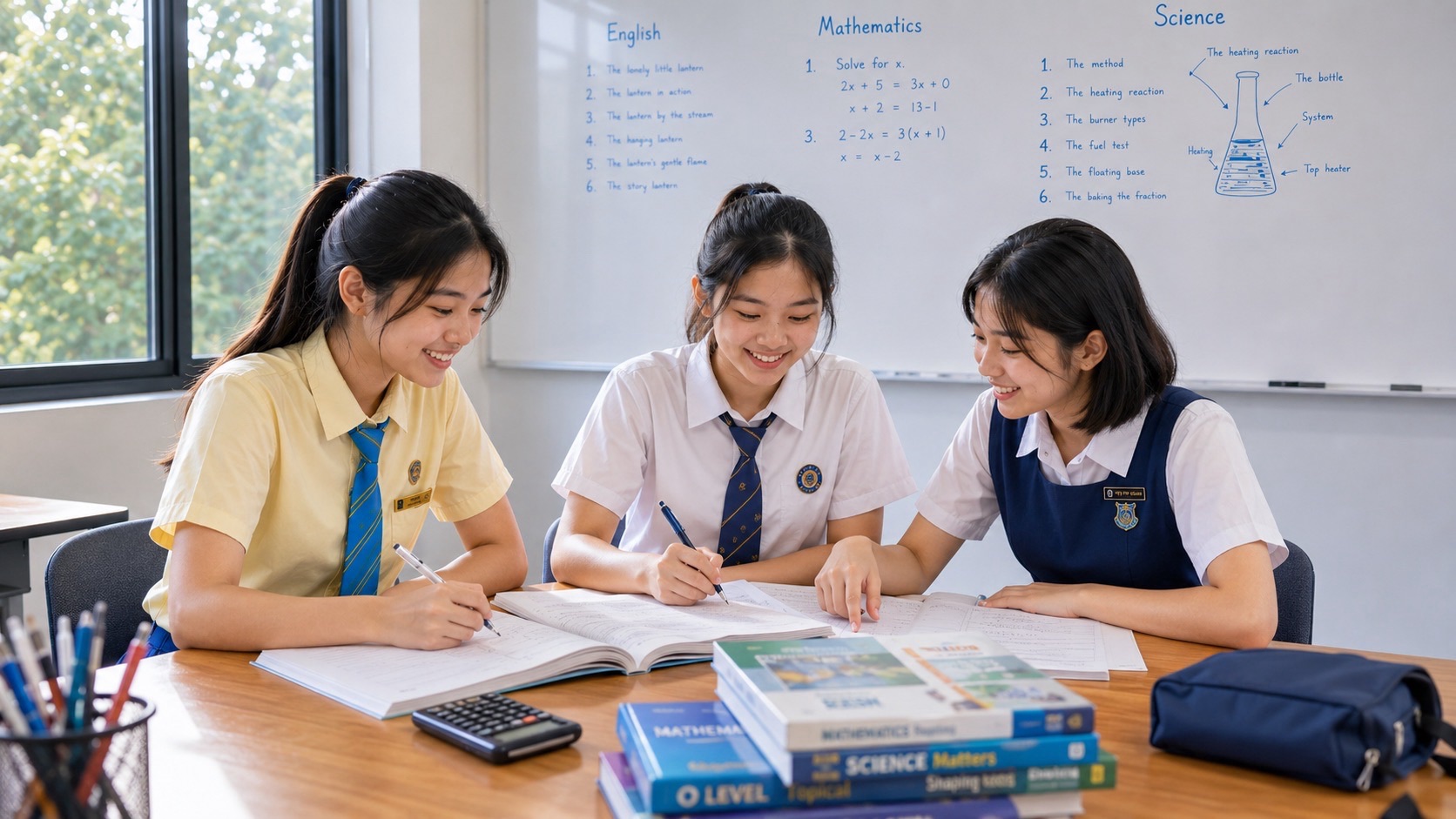
Secondary 1 English asks a new question of a student: what can you do when the teacher is no longer guiding every move?
For Yishun families, this page focuses on the small-group learning job rather than repeating our broader Sec 1 transition guides. The question here is how three students, taught closely, can learn to start tasks independently, explain choices, use feedback and become less dependent on the tutor over time.
Quick Read
- Small group should not mean small lecture. Students need visible individual work.
- Sec 1 needs independence. Starting, checking and recovering are teachable habits.
- Comparison is useful. Three students can expose different reading and writing choices.
- Feedback must transfer. A correction should change later work.
- The end goal is less tutor dependence.
The One-Sentence Answer
A good three-student Secondary 1 English class should combine close individual diagnosis with enough peer comparison to make thinking visible, while steadily transferring responsibility back to each student.
Why Three Students Changes the Lesson
One-to-one teaching gives maximum attention, but it can also make the adult too available. A large class gives social comparison, but individual thinking can disappear. Three students create a useful middle ground.
The tutor can read each answer, question each decision and still ask students to compare approaches. One student may notice tone; another may notice structure; the third may have a stronger explanation. The comparison becomes part of the lesson.
Sec 1 Habit 1: Know How to Begin
Many students are not stuck because they know nothing. They are stuck because they do not know what first move to make.
Before asking for help, the student should learn to identify the task, underline the demand, locate relevant information and attempt a first route. The tutor can then correct the process rather than becoming the process.
Sec 1 Habit 2: Explain the Choice
“I think this is the answer” is a beginning. “I think this because…” is much more useful.
In a small group, students can be asked to defend vocabulary, interpretation and paragraph choices. Explanation makes hidden reasoning visible and gives the tutor something precise to improve.
Sec 1 Habit 3: Use Feedback Twice
A correction has little value if it improves only the page being corrected. After feedback, students should meet a different task that requires the same underlying move.
If the repair survives the changed surface, the learning is becoming portable.
Sec 1 Habit 4: Recover Without Panic
Secondary work becomes less predictable. Students need a recovery routine for moments when the answer is not obvious: reread the demand, identify what is known, reduce the problem, test one interpretation and check it against evidence.
What Parents Can Watch
- Does the child begin homework with less prompting?
- Can they explain why an answer is stronger?
- Do tutor corrections appear in later schoolwork?
- Can they work while the tutor is helping another student?
- Are they becoming more—not less—independent?
How eduKate Uses a Three-Student Sec 1 Class
eduKate keeps the group small enough for individual work to remain visible. We diagnose from real school evidence where possible, teach the missing move, compare different approaches and then require independent execution.
The class succeeds when the student gradually needs fewer prompts to recognise, start, check and recover.
Frequently Asked Questions
Will three students receive enough individual attention?
The class is deliberately small so individual reading and writing can be inspected closely. The group is useful precisely because attention and comparison can coexist.
Should students all be at exactly the same level?
Not necessarily. Some variation can be productive when the core lesson is shared and individual feedback remains precise.
A Small Group Should Build a Bigger Learner
The measure of good tuition is not how indispensable the tutor becomes. It is whether the student leaves with stronger language, stronger judgement and more ownership of the work.