
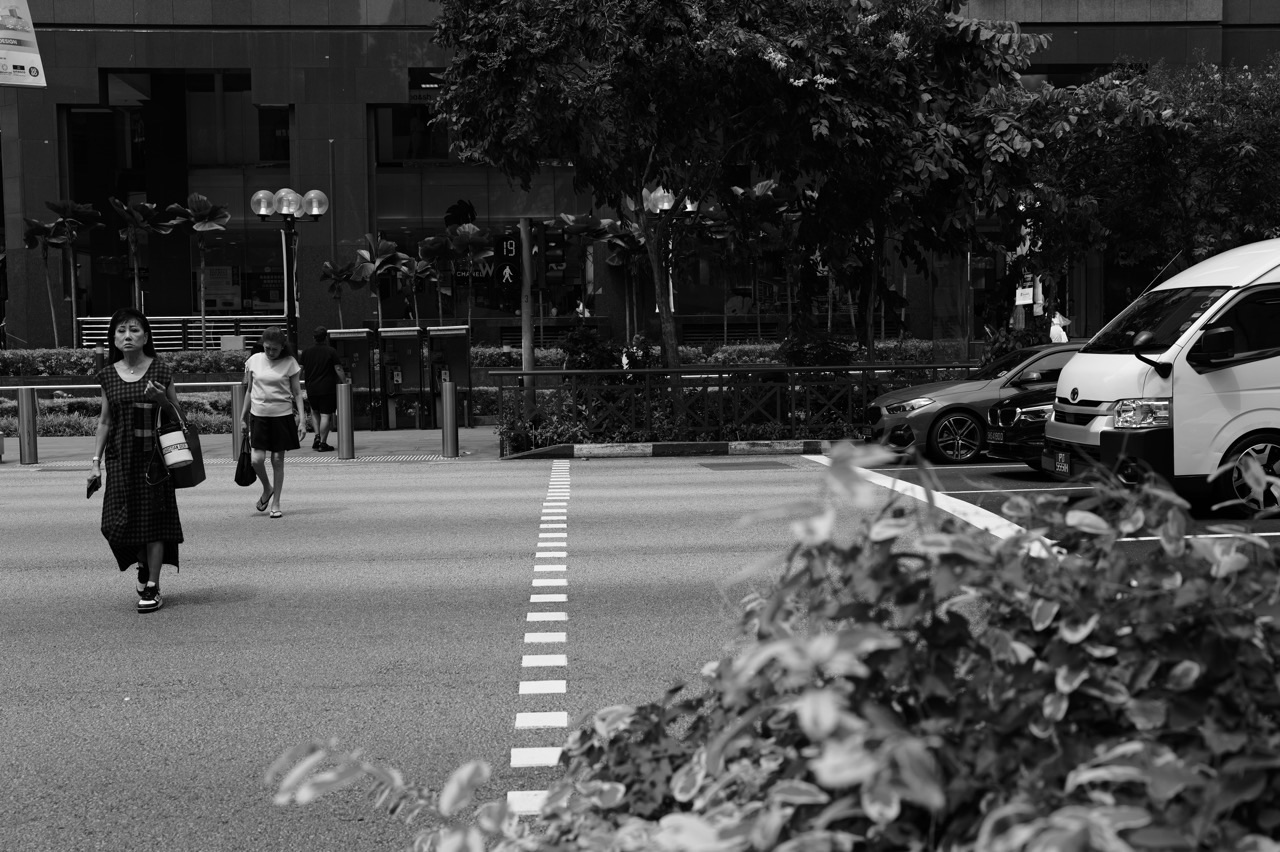
A traffic light appears to make a simple binary decision: stop one direction and release another.
At city scale, that decision is much harder.
Traffic volume changes by minute. Pedestrians arrive irregularly. A busy arterial road may need longer green time than a side road. Two adjacent junctions can work individually and still create stop-start congestion if their green phases do not line up.
Singapore’s Green Link Determining system, or GLIDE, solves this as a network-control problem. LTA describes GLIDE as the adaptive system controlling traffic signals across Singapore, using road sensors and pedestrian inputs to adjust signal timing and coordinate neighbouring junctions.
The public-safe loop is: detect demand → calculate competing flows → allocate green time → preserve safety clearances → coordinate nearby junctions → observe the result → update again as traffic changes.
Quick answer: what does GLIDE actually do?
- detects vehicle presence and flow using sensors embedded in the road;
- registers pedestrian demand through crossing buttons and pedestrian signal logic;
- adjusts green time according to changing traffic demand;
- coordinates nearby junctions to create smoother corridor movement or a “green wave”;
- keeps required amber, clearance and pedestrian phases intact for safety;
- feeds operating information into Singapore’s wider intelligent transport system.
1. Fixed-time signals assume tomorrow looks like yesterday
A fixed-time signal can work well when traffic is predictable.
But if one direction suddenly carries far more vehicles, a fixed plan can waste green time on an empty approach while a queue grows elsewhere.
Adaptive control uses current demand as evidence rather than assuming one schedule is optimal all day.
2. GLIDE has been Singapore’s adaptive system since 1988
LTA’s public history states that Singapore adopted the Sydney Coordinated Adaptive Traffic System in 1988 and operates it locally as GLIDE.
The system replaced older fixed-time operation with adaptive signal control driven by detected traffic demand.
The important lesson is that adaptive traffic control is not a recent AI experiment in Singapore; it is a long-running infrastructure layer that is now being modernised further.
3. Road loops turn vehicles into data
Inductive loops embedded beneath the road surface detect vehicles approaching or waiting at junctions.
The system can use that information to estimate demand and adjust the allocation of green time.
The sensor does not need to know who is driving or where the person is going. It needs enough information about traffic presence and flow to operate the junction efficiently.
4. Pedestrian demand is part of the signal equation
Pedestrian push buttons tell the system that somebody is waiting to cross.
Where no pedestrian demand has been registered, the signal does not necessarily need to allocate the same crossing phase every cycle.
This allows road and pedestrian time to be shared according to actual demand while still preserving safe crossing opportunities.
5. The busiest direction can receive more green time
LTA describes GLIDE as allocating more green time to the direction carrying higher traffic volumes.
This does not mean the smaller side road is ignored indefinitely.
The system balances competing movements within safety and operational constraints, giving proportionally more time where demand is heavier while maintaining access for other users.
6. One junction cannot be optimised in isolation
If Junction A releases a large platoon of cars directly into a red light at Junction B, the first junction may look efficient while the corridor performs poorly.
GLIDE therefore coordinates nearby signals rather than treating every intersection as an independent island.
LTA’s March 2026 explanation emphasised that traffic flow is optimised across corridors and the wider network, not only at one junction.
7. The “green wave” is coordination through time
Adjacent signals can be offset so a group of vehicles released from one junction reaches the next around the time its signal turns green.
This reduces repeated stopping along major corridors.
The green wave is therefore not a guarantee that one motorist receives uninterrupted green lights. It is a corridor-level timing strategy designed around expected traffic progression.
8. A red light with no visible traffic can still be necessary
Drivers sometimes see an apparently empty opposing road and assume the red signal is wasted time.
LTA explained in March 2026 that some apparently empty intervals may be needed to complete an activated pedestrian crossing phase or preserve coordination with the wider corridor.
The signal therefore responds to system state that may not be visible through one windscreen.
9. Safety clearances create intentional “dead time”
Traffic phases cannot switch instantaneously from one conflicting movement to another.
LTA’s 2026 signal-safety guidance states that Singapore uses a standard three-second amber phase followed by an all-red clearance period of two to six seconds depending on the junction.
That gap lets vehicles already inside the junction clear before the next movement begins.
Efficiency therefore ends where collision risk begins.
10. Pedestrian green time depends on crossing geometry and user needs
Pedestrian timing is not one universal number.
LTA states that crossing length, pedestrian volume and user composition affect the green-man and flashing-green-man duration.
The signal therefore has to match human walking speed and crossing distance, not simply vehicle demand.
11. Green Man+ adds a user-specific time extension
At equipped crossings, elderly pedestrians and persons with disabilities can use Green Man+ to receive additional crossing time.
LTA states that the extension can be up to 13 seconds depending on the crossing.
The system demonstrates that adaptive signalling can serve different human capabilities rather than optimising only for the fastest typical user.
12. Pedestrian countdown timers serve a different purpose from driver countdown timers
Singapore uses pedestrian countdown information at selected busy crossings so people know how much crossing time remains.
LTA has been more cautious about countdown timers for motorists, noting in February 2026 that previous local and international experience showed they can encourage some drivers to accelerate to beat the clock.
Information is therefore useful only when it improves behaviour rather than creating a new incentive to take risk.
13. Adaptive does not mean each approach gets equal waiting time
A lightly used side road can receive a shorter green phase than a major arterial carrying much heavier traffic.
This can feel unfair from the side-road driver’s perspective.
Network optimisation instead asks how the whole junction and corridor can move efficiently while still serving every required movement safely.
14. Adaptive signals cannot remove physical road capacity limits
If more vehicles arrive than the corridor can physically discharge, better timing can reduce waste but cannot manufacture infinite road space.
Queues can still form during severe peaks, incidents or unusual demand.
Signal optimisation therefore works alongside public transport, road pricing, road design and demand management rather than replacing them.
15. Traffic data also supports planning after the signal cycle ends
Singapore’s intelligent transport systems collect information that can be used for traffic analysis and longer-term planning.
LTA DataMall also publishes traffic-count datasets showing turn movements at junctions in 15-minute intervals.
The adaptive system therefore performs two jobs: control today’s flow and produce evidence that helps engineers understand tomorrow’s road problem.
16. GLIDE is being supplemented by a next-generation platform
LTA announced in October 2025 that it is developing the Cooperative and Unified Smart Traffic System, or CRUISE.
The future platform is intended to use additional data sources and predictive capabilities, including AI, to improve traffic management while retaining human oversight and extensive testing.
The direction is significant: current GLIDE reacts to measured demand; future tools aim to predict emerging conditions earlier.
17. Prediction adds value only if the safety model remains stable
A predictive model can suggest that congestion is about to build.
It should not be allowed to erase pedestrian clearance, conflicting-movement protection or other safety constraints merely because the model wants higher throughput.
LTA’s public CRUISE statement explicitly retains human oversight, testing and on-site trials as part of deployment.
Smarter optimisation therefore remains subordinate to a proven junction safety envelope.
18. A worked example: morning arterial versus side road
Imagine a major road carries a heavy morning stream while a side road has only occasional vehicles.
Sensors detect the higher arterial demand. GLIDE allocates proportionally more green time to that direction and coordinates neighbouring signals so vehicles can progress through the corridor more smoothly. The side road still receives service when its phase is due and demand is detected.
The signal plan changes because the city’s traffic state has changed.
19. A worked example: pedestrian presses the crossing button
At a quieter crossing, no pedestrian phase may be needed every cycle.
When a pedestrian presses the button, the demand enters the controller. The signal sequence then provides the required crossing phase at an appropriate point while maintaining safe vehicle clearance and wider signal coordination.
The pedestrian has not interrupted an independent road system. Their movement has become one of the flows the road system must now serve.
20. Common misconceptions
Misconception: Singapore traffic lights run on fixed timers.
No. GLIDE adapts timing according to detected vehicle and pedestrian demand and coordinates signals across corridors.
Misconception: An empty crossing means the red light is a system error.
No. pedestrian phases, safety clearance and corridor coordination can require red time even when conflicting traffic is not immediately visible.
Misconception: Adaptive signals always minimise the wait for each individual driver.
No. the system optimises junction and corridor performance across competing users, not one vehicle in isolation.
Misconception: More AI automatically means safer and faster traffic.
No. predictive tools still need validated data, human oversight and hard safety constraints.
Misconception: Traffic signals alone can eliminate congestion.
No. signals optimise the use of finite road capacity; they cannot remove demand that exceeds that capacity.
21. The deeper idea: a traffic signal is a machine for sharing time
At a junction, several groups want the same physical space but cannot use it safely at the same moment.
The signal therefore allocates time instead of land.
GLIDE makes that allocation responsive. More traffic can receive more time. pedestrians enter the sequence when they need to cross. neighbouring junctions coordinate so one green phase does not merely create another queue downstream.
Adaptive traffic control works because the road is not asking every user to move simultaneously. It is deciding, moment by moment, how competing journeys can share the same intersection without turning efficiency into collision risk.