
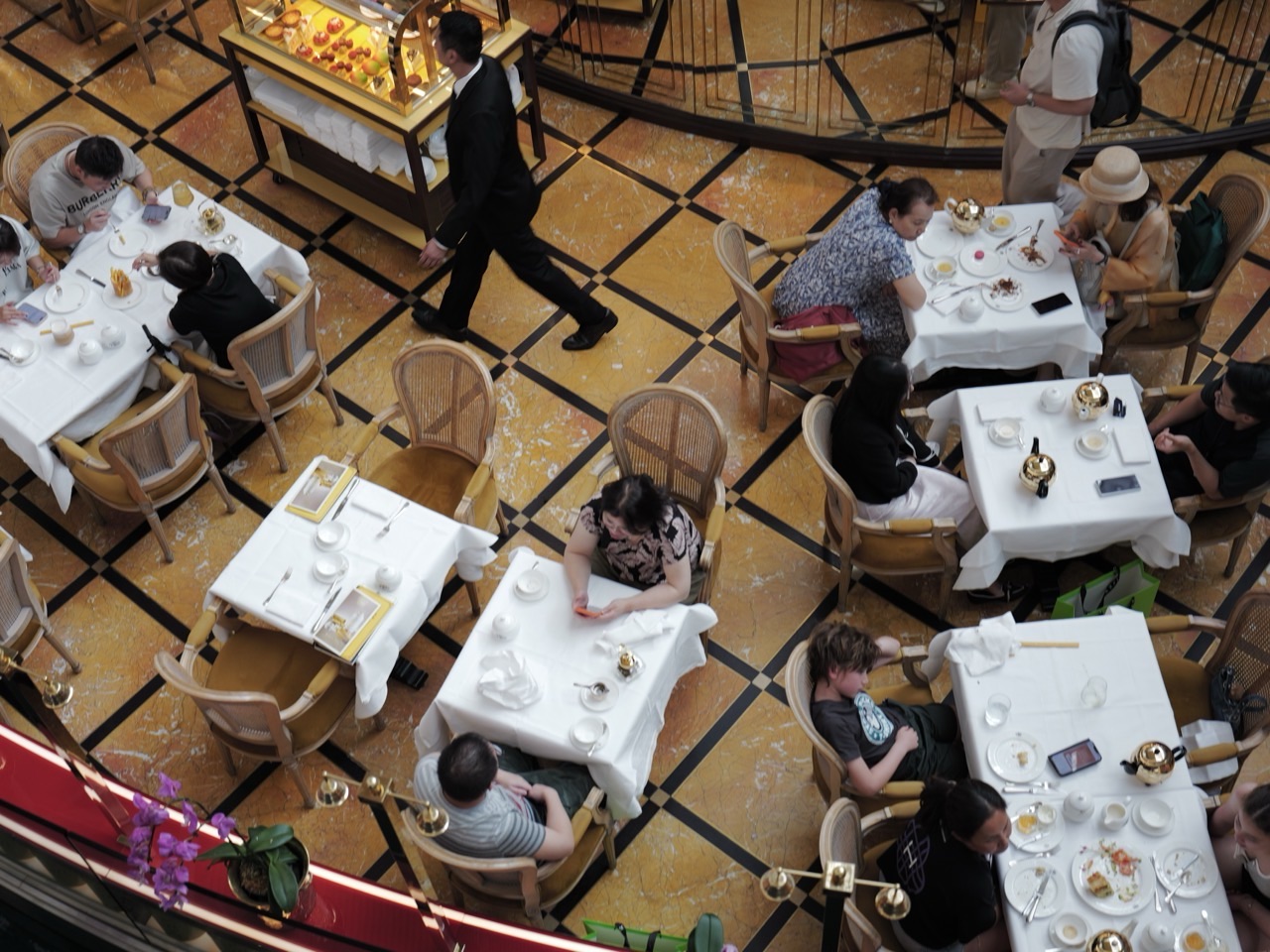
Raise the camera by half a metre and the world does not move.
But the photograph can change completely.
A table surface appears. A face separates from a shoulder. A horizon drops. A foreground object stops blocking a distant one. The viewer no longer feels seated, child-height, eye-to-eye, elevated or looking down from authority in quite the same way.
Camera height is not merely how high the tripod stands. It is the vertical position from which the photograph decides what can overlap, what can be seen and where the viewer seems to stand.
This article continues the canonical How Photography Works | Every Photograph Leaves Something Out knowledge map. The flagship establishes framing. The Reverse Angle shows why horizontal movement changes access. Here we isolate the vertical component: what happens when the camera moves up or down.
Quick Read
Camera height changes perspective because perspective is determined by camera position. Raising the camera reveals upper surfaces, changes which objects overlap, shifts the visible relationship between subject and background, and moves the horizon or eye-level line within the frame. Lowering the camera does the opposite: it hides upper surfaces, increases upward-looking geometry and can make nearby subjects dominate. These changes affect evidence, composition and emotional reading at the same time.
camera height → line of sight → visible surfaces + overlap + horizon → spatial reading
Camera Height Is Camera Position
Photographers often discuss viewpoint as though it were mainly left, right, closer and farther. Height belongs to the same geometry. Move a camera upward and every line of sight changes. Near objects shift relative to far objects. Surfaces that faced partly upward become easier to see. Surfaces that face downward become harder to see.
This is why height cannot be simulated simply by pointing the lens upward or downward from the same location. Tilting changes direction. Raising changes position. The distinction is the vertical version of the principle in A Lens Changes the View, but Your Feet Change Perspective.
Raise the Camera and Upper Surfaces Appear
A plate on a table is nearly a line when photographed from table height. Raise the camera and the ellipse opens. The same happens to roads, rooftops, desks, shelves, steps and groups of people arranged on a floor.
This matters because surfaces carry information. A higher view of a desk can reveal notebooks, tools and hand positions that a low view hides behind the front edge. A higher street view can reveal lane markings and pedestrian flow. A higher event photograph can reveal spatial organisation rather than only faces in front.
Lower the Camera and Vertical Faces Take Over
As the camera drops, horizontal top surfaces shrink while vertical faces become more dominant. A low photograph of a building may emphasise walls, columns and height while hiding roof plan. A low portrait may reduce visible floor and make the subject occupy more of the vertical field.
Nothing about the building or person became physically taller. The projection changed because the camera’s vertical relationship changed.
Height Changes Occlusion
Imagine two people standing one behind another. At eye level, the nearer person may hide most of the farther person. Raise the camera and their projected heads and shoulders can separate. Lower it and the overlap may increase.
This connects directly to Occlusion. Camera height is one of the simplest ways to change which object blocks which other object without asking the subjects to move.
Height Changes the Background Behind a Subject
A portrait made at face height may place a bright window behind a head. Raise the camera and the head may move against a darker floor or distant wall. Lower the camera and the same face may move against ceiling, sky or foliage.
The subject has not moved. Background evidence has. This is why Background Evidence is inseparable from viewpoint.
Camera Height and the Horizon
In ordinary rectilinear perspective, the horizon corresponds to camera eye level for a level camera. Raise the camera and eye level rises in the world. The visible horizon’s position within the composition depends on camera orientation, but the perspective system remains anchored to that elevated eye level.
This becomes the focus of Article 24, The Horizon Line. For now, the practical rule is enough: height changes where your viewpoint sits inside the scene’s perspective geometry.
Eye Level Is Also a Social Signal
Photographing a child from adult standing height can make the viewer feel like an adult looking down. Kneel to the child’s eye level and the relationship changes. Photograph an athlete from near ground level and the figure can become monumental. Photograph a meeting from above and individuals can become elements in a pattern.
These are not fixed emotional formulas. A low angle does not automatically mean power, and a high angle does not automatically mean weakness. But camera height changes embodied relation: where the viewer seems to occupy space relative to the subject.
Children Reveal the Problem Immediately
A classroom photographed from an adult’s standing height often shows desks, crowns of heads and floor plan. Photograph from a seated child’s height and the same room becomes chair backs, faces, table edges and a different apparent ceiling height.
Neither image is automatically more truthful. They are different embodied access points to the same room. If the job is “What does the classroom look like to a child?”, adult eye level may be the wrong measurement position.
Architecture Changes With Height Before It Changes With Lens
Stand close to a building at ground level and upper floors recede sharply. Move to a higher neighbouring position and the building’s vertical relationships change because the camera is no longer far below the upper structure.
Aerial photography takes this to an extreme. Aerial Photography Changes the Map Into a Photograph because elevation reveals plan relationships that ground-level viewing systematically hides.
Food and Product Photography Use Height as Surface Control
A bowl photographed low emphasises rim and side. Raise the camera and ingredients become visible. A watch photographed from above shows face layout; lower the camera and case thickness, crown and reflections take over.
This connects to Product Photography Is the Engineering of Surfaces and Food Photography Begins Before the Camera. Height decides which surface is allowed to carry the subject’s identity.
Crowds Change From Faces Into Distribution
At ground level, a crowd is a wall of partial people. At balcony height, paths, gaps and density become visible. At aerial height, individuals become units in a spatial distribution.
The evidential job changes with the height. Ground level may be best for expression. Elevated height may be better for spatial organisation. Very high views may show overall distribution while losing identity and local interaction.
Height Changes Scale Cues
A low camera can place a small foreground object against distant subjects, making projected-size differences dramatic. A higher camera can reduce that dominance and reveal floor distance between objects. The effect is connected to Scale Cues.
Again, the physical sizes do not change. The geometry that allows viewers to infer scale changes.
Height Changes How Much Foreground Exists
A low landscape viewpoint may give the foreground a large role: grass, stones, water, pavement or flowers can fill the lower frame and create strong depth. Raise the camera and the same foreground can flatten into a thinner band while middle-distance relationships become clearer.
This is not simply “better composition.” It is choosing which distance layer receives visual bandwidth.
Height and Privacy
Higher viewpoints can reveal spaces that lower viewpoints cannot: interiors behind low barriers, objects on desks, private yards, faces within crowds or routes behind screens. The increased information access can have ethical consequences.
Photography literacy therefore includes not only “Can I see it from here?” but “Should this elevated access be used or circulated for this purpose?”
Height Is Part of Scientific Repeatability
When photographs are compared across time, changing camera height can create apparent geometric change even when the subject has not changed. A crack, shoreline, plant canopy, specimen or machine component can shift relative to the frame because the observation position moved.
Scientific Photography Is Measurement With a Camera therefore treats camera position as part of the measurement setup, not a casual aesthetic choice.
The Camera-Height Audit
- Eye level: where is the camera vertically relative to the subject?
- Surfaces: which upper or lower surfaces become visible?
- Occlusion: what separates or hides as height changes?
- Background: what falls behind the subject at this height?
- Horizon: where is the scene’s eye-level geometry?
- Foreground: how much visual weight does the near ground receive?
- Scale: which projected-size relationships are amplified?
- Social relation: does the viewer feel below, level with or above the subject?
- Evidence: what information appears only because of elevation?
- Repeatability: would a future comparison require the same camera height?
Photography Laboratory 1: Three Heights, One Subject
Photograph a static subject from low, eye-level and elevated positions while keeping horizontal distance roughly similar. Compare visible surfaces, background, overlap and apparent stature.
Photography Laboratory 2: Separate an Overlap Vertically
Align two objects so one blocks the other. Instead of moving sideways, raise the camera gradually until they separate. This makes vertical parallax visible before Article 23 formalises it.
Photography Laboratory 3: Photograph a Table at Five Heights
Keep the table fixed and photograph from below tabletop height, at tabletop height, seated eye level, standing eye level and overhead. Note when the tabletop changes from hidden plane to dominant information surface.
For Primary Readers
Photograph one toy from the floor, from your eyes and from above. Ask: What can I see now that I could not see before?
For Secondary Readers
Connect camera height to line of sight, perspective and occlusion. Explain why the scene changes even when every object stays fixed.
For Advanced Readers
Treat camera height as translation along the vertical axis of the camera pose. Analyse how that translation changes projective relationships, visibility, horizon geometry and the recoverability of metric structure from repeated views.
Common Misconceptions
- “Tilting upward is the same as raising the camera.” Tilting changes orientation; raising changes position.
- “Eye level is always neutral.” It is one embodied viewpoint among many.
- “High angle means weak subject.” Emotional interpretation depends on context; the geometric effect is more reliable than the cliché.
- “Height only changes how much floor I see.” It also changes occlusion, background, scale cues and horizon relationships.
- “A tripod height is only a convenience setting.” In repeatable or evidential photography, it is part of the observation geometry.
Frequently Asked Questions
Why does a higher camera show more of a tabletop?
Because the camera’s line of sight gains a larger angle onto the upward-facing surface.
Does raising the camera change perspective?
Yes. Perspective changes whenever camera position changes, including vertical movement.
Why do photographers kneel for children?
One reason is to place the camera closer to the child’s eye level, changing perspective, background and the viewer’s embodied relationship with the subject.
Final Thought: Height Is a Point of View Made Physical
The world does not need to move for the photograph to reorganise it. Sometimes the most important compositional decision is simply whether the camera is twenty centimetres lower or one metre higher.
Before changing the lens, ask whether the photograph really needs a different height.
HOW PHOTOGRAPHY WORKS · SUPPORTING SERIES · 21 OF 40
Return to Every Photograph Leaves Something Out. Previous: Caption Dependency. Next: Foreshortening. Return to the How X Works Hub.