
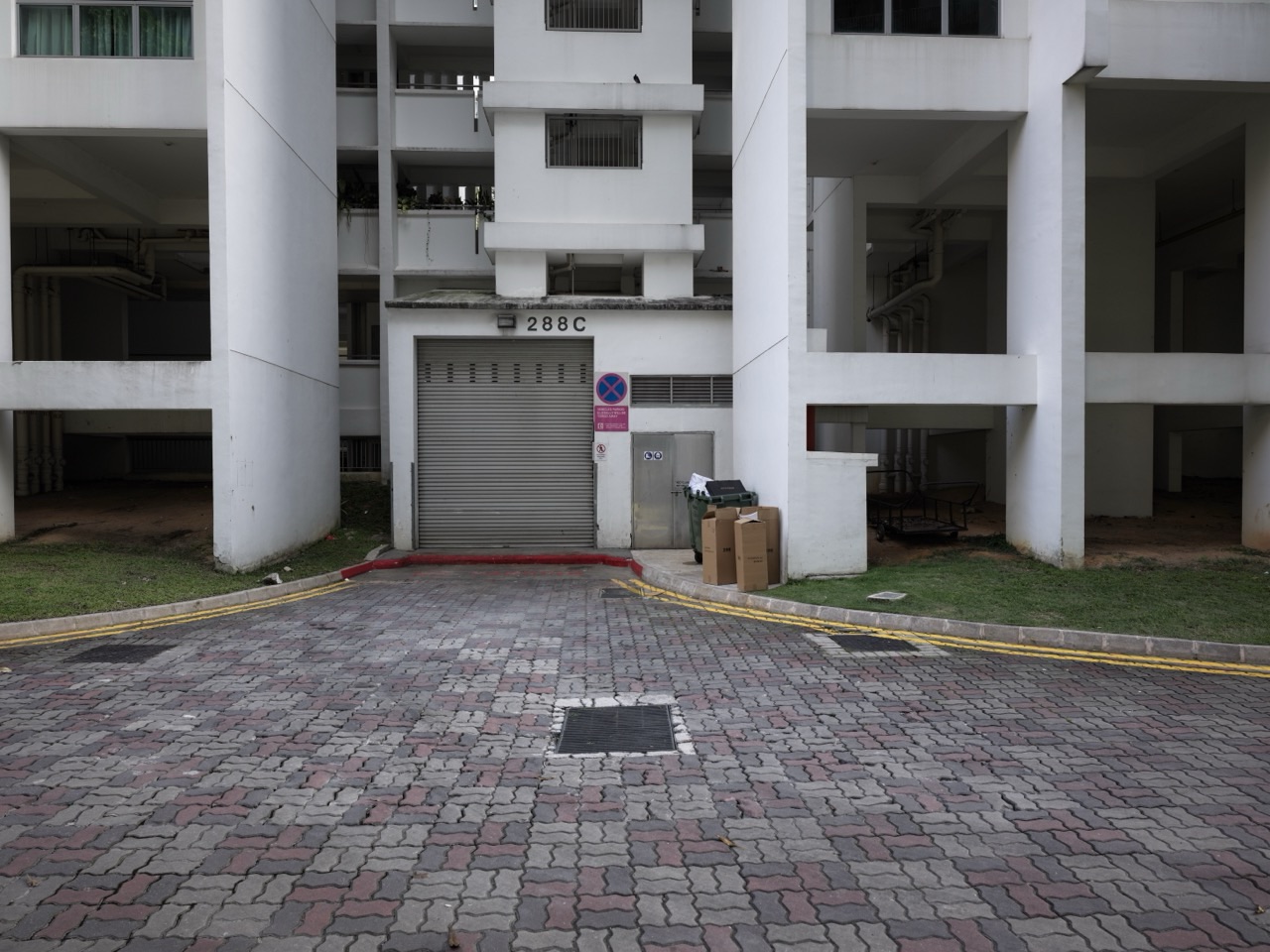
A rubbish bag disappears from an HDB refuse chute in seconds.
The waste-management system that receives it is much larger.
The bag first enters an estate-level collection system. Depending on the development, refuse can fall through an individual or centralised chute into a refuse chamber, be moved by estate workers toward a bin centre, or travel through a Pneumatic Waste Conveyance System that uses underground vacuum pipes to carry household refuse toward one central collection point.
From that local handoff, the National Environment Agency’s Public Waste Collection scheme takes over at district scale. Singapore is divided into six geographical PWC sectors, currently served by three Public Waste Collectors appointed through open tenders.
The next route depends on the waste itself. Incinerable refuse goes to a Waste-to-Energy plant. Non-incinerable waste goes to Tuas Marine Transfer Station before being barged to Semakau Landfill.
The operating chain is: household discards → chute/bin/PWCS → estate collection point or bin centre → PWC truck → weighbridge and disposal documentation → WTE plant for incinerable waste, or TMTS for non-incinerable waste → ash and residuals eventually reach Semakau.
Quick answer: who collects household refuse in Singapore?
NEA appoints Public Waste Collectors through open tenders to provide refuse and recycling collection for domestic and specified trade premises within geographical sectors.
As of 2026, three PWCs operate across six sectors:
- 800 Super Waste Management: Ang Mo Kio–Toa Payoh and Pasir Ris–Bedok.
- ALBA W&H Smart City: Jurong and Woodlands–Yishun.
- Cora Environment: City–Punggol and Clementi–Bukit Merah.
The operating licences typically run for seven to eight years, after which the sector can be tendered again.
1. Waste collection begins inside the housing estate
The public collection truck does not drive to every flat door.
High-rise housing therefore needs an internal system that consolidates thousands of small household discards into a smaller number of collection points accessible to workers and vehicles.
Refuse chutes, refuse chambers, bin centres and pneumatic systems perform that consolidation before the district collector arrives.
2. Traditional refuse chutes use gravity first
In many HDB blocks, bagged household refuse enters a chute and falls to a chamber at lower level.
Gravity performs the vertical transport without requiring one lift or collection trip for each household.
Estate workers then move accumulated refuse toward the appropriate collection point or bin centre where the waste can be loaded into the licensed collection system.
3. Pneumatic Waste Conveyance Systems remove another local transport step
Newer HDB developments and selected retrofitted estates use Pneumatic Waste Conveyance Systems, or PWCS.
HDB describes PWCS as an underground pipe network using vacuum suction to move household waste from refuse chutes toward one central collection location.
The system reduces the need for workers or refuse carts to travel block by block moving bags toward a bin centre.
Automation therefore begins before the PWC truck ever arrives.
4. PWCS reduces collection traffic inside estates
Traditional estate collection can require service driveways and repeated refuse-cart or truck access around blocks.
By consolidating waste pneumatically at one point, the estate can reduce some internal vehicle movement, manpower and odour exposure.
This is one reason HDB has used the system as part of newer town planning and selected upgrading programmes.
5. Bin centres are the boundary between building operations and public collection
A bin centre stores and consolidates refuse in containers or compactors until the collection vehicle arrives.
Its location has to balance several competing needs: close enough for operational access, far enough from homes to reduce nuisance, designed so collection vehicles can enter safely, and maintained so food waste does not create avoidable smells or pests.
The bin centre therefore is not leftover service space. It is the loading dock of the municipal waste system.
6. Landed homes use a different first handoff
Houses without central chutes generally store bagged household refuse in proper covered bins and present it for scheduled collection according to the PWC arrangement.
The district collector therefore serves several building types through different local interfaces while keeping one regional collection contract.
7. Six sectors make the collection system contestable
NEA does not award one permanent islandwide household-waste monopoly.
Singapore is divided into six PWC sectors. Companies meeting the pre-qualification requirements compete through tenders, and successful bidders receive sector licences for defined periods.
This creates geographic operating scale while preserving the ability to retender service quality and price over time.
8. One collector can serve hundreds of thousands of premises
The Pasir Ris–Bedok licence that commenced on 1 July 2026 covers about 209,000 households and more than 8,200 trade premises.
The scale explains why route planning, vehicle availability and collection schedules matter.
A missed local pickup can be corrected. A poorly designed sector operation repeated across hundreds of thousands of customers would become a public-health and street-cleanliness problem quickly.
9. Household refuse collection is a paid public service
NEA revised household refuse collection fees from 1 July 2026.
The monthly fee is $10.64 including GST for HDB flats and non-landed private housing, and $35.50 including GST for landed homes.
The fee supports the operating cost of a system that must collect refuse continuously regardless of whether commodity recycling prices are high or low.
10. Refuse and recycling share a collector but not the same destination
PWCs provide both refuse and recycling collection within their sectors.
That does not mean the two streams should be mixed intentionally.
Household refuse is routed toward disposal. Recyclables collected through the National Recycling Programme are routed into the recycling stream, where contamination and sorting determine what material can actually be recovered.
Collection is therefore the common logistics layer for two different downstream jobs.
11. Collection vehicles convert distributed bins into a disposal load
The PWC vehicle follows scheduled collection routes through its sector and consolidates waste from many premises.
Compaction allows more refuse to be carried per trip, reducing the number of vehicle movements needed between estate and disposal facility.
The truck therefore transforms thousands of household bags into one measured industrial load.
12. Disposal routing depends on whether waste is incinerable
NEA’s current infrastructure map separates incinerable waste from material that cannot be incinerated.
Incinerable waste is sent to one of Singapore’s four Waste-to-Energy plants. Non-incinerable waste is sent to Tuas Marine Transfer Station for transfer to Semakau Landfill.
The collection truck therefore does not choose a destination casually; the waste type determines which disposal infrastructure can accept it.
13. Waybills preserve the source and waste type at the disposal gate
NEA requires waste collectors sending waste to WTE plants and Tuas Marine Transfer Station to use disposal documentation indicating the waste type and source.
This creates traceability at the point where a truckload enters the national disposal system.
The waste may no longer be attributable to one household, but the system still knows which collection route and waste category produced the load.
14. Weighbridges turn the load into measured disposal
At disposal facilities, collection vehicles are weighed so the amount of waste delivered can be recorded.
This measurement supports disposal accounting, facility operations and the larger national waste statistics used to understand how much material Singapore is actually discarding.
Waste becomes policy evidence at the moment the truck crosses the scale.
15. Incinerable waste moves into the WTE bunker
At a Waste-to-Energy plant, the truck unloads refuse into a large bunker.
The bunker is maintained below atmospheric pressure to reduce odour escape. Grab cranes then feed mixed refuse into the incineration process.
Collection has ended. Thermal treatment now becomes the next system owner.
16. Non-incinerable waste takes the marine route
Non-incinerable waste goes to Tuas Marine Transfer Station instead.
Vehicles are weighed and discharge directly into covered barges inside the transfer building. The barges are then moved by tugboat over the sea route to Semakau Landfill.
The landfill is offshore because land disposal is Singapore’s most land-intensive waste option and is reserved mainly for incineration residues and material that cannot be burned.
17. Collection reliability is a public-health service
Household refuse contains food and other putrescible material.
If collection becomes irregular, odour, flies, rodents and overflowing bins can become public-health and neighbourhood problems quickly.
This is why waste collection cannot be scheduled purely around the cheapest possible truck utilisation. Frequency and hygiene form part of service quality.
18. A worked example: one HDB rubbish bag
Imagine a household ties a bag of ordinary mixed refuse and places it into the block’s refuse chute.
The bag falls to the lower-level collection system. In a traditional estate it is consolidated and moved toward the bin centre; in a PWCS estate it may be transported through underground vacuum pipes toward a central collection point. The sector PWC collects the refuse, compacts it into a vehicle load, records its disposal route and takes incinerable waste to a WTE plant. After incineration, only a much smaller ash volume continues toward Semakau.
The bag disappeared from the corridor in seconds because the city had already built every downstream handoff before the household needed it.
19. Common misconceptions
Misconception: One NEA truck collects every household’s refuse directly.
No. estate-level systems consolidate waste first, and NEA-appointed PWCs operate the district collection service.
Misconception: Every HDB estate uses pneumatic waste collection.
No. Singapore has a mix of traditional refuse collection systems, centralised chutes and PWCS depending on estate design and upgrading history.
Misconception: All household refuse goes directly to Semakau.
No. most incinerable waste first goes to WTE plants; the much smaller ash residue and non-incinerable waste go to Semakau.
Misconception: Refuse collection and recycling are the same downstream process.
No. the same PWC framework can collect both, but the material streams are routed for different treatment.
20. The deeper idea: district collection turns private disposal into a public logistics chain
A household experiences waste as an ending.
The city experiences the same bag as a beginning.
It has to be consolidated, stored hygienically, assigned to a licensed collector, carried through one geographical service area, measured at a disposal facility and sent into the correct treatment route.
The chute makes waste disappear from the home. The district collection system prevents that disappearance from becoming institutional blindness.