
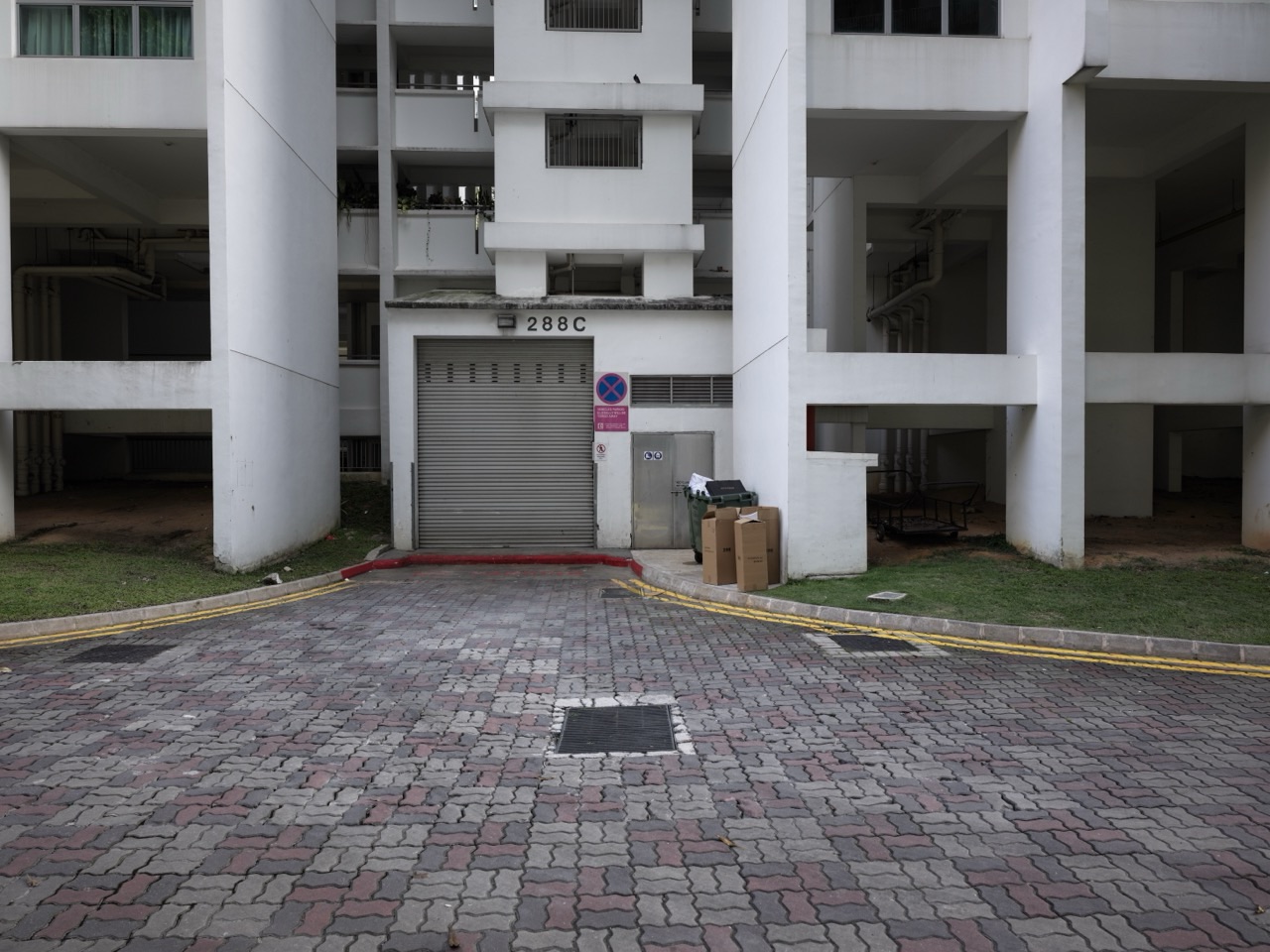
Every HDB household creates waste.
Food packaging.
Used tissues.
Broken household items.
Recyclables.
Bulky furniture.
If thousands of high-rise households had to carry all of that waste individually to distant collection points, dense public housing would become unpleasant very quickly.
So HDB estates contain a hidden logistics system whose job is to move rubbish out of the home, through the block, into the public waste collection network and eventually toward treatment or disposal.
For the full housing system, return to How HDB Works in Singapore. For the shared-maintenance layer around the block, see How HDB, Town Councils and Homeowners Divide Maintenance.
This article reflects NEA and HDB information available on 4 September 2026.
Quick Answer
HDB waste collection works through several linked layers:
- household disposal point — refuse chute, centralised chute or designated waste point;
- block collection system — conventional bin-centre / refuse-cart systems or Pneumatic Waste Conveyance System in applicable estates;
- Public Waste Collector — licensed collector serving the sector;
- national waste system — collection, transfer, incineration or other treatment, with residues ultimately managed through Singapore’s disposal infrastructure;
- recycling stream — separated recyclables collected through the National Recycling Programme and related channels.
HOME → BLOCK → ESTATE COLLECTION → PUBLIC WASTE COLLECTOR → NATIONAL WASTE SYSTEM
NEA’s current household refuse collection fee from 1 July 2026 is $10.64 per month, inclusive of GST, for HDB flats and non-landed private housing under the public waste collection scheme.
Official NEA guidance: Waste Collection Systems.
Wait, What? Waste Collection Is a Logistics System
The resident sees a small action.
Open chute.
Drop bag.
Close chute.
The estate sees a continuous material flow from hundreds of flats.
That flow has to be:
- contained;
- moved;
- stored briefly;
- collected;
- transported;
- treated;
- kept away from pests and rain;
- handled with manageable manpower.
Rubbish is therefore not a household problem once it leaves the bin.
It becomes an urban logistics problem.
Older Estates Commonly Use Conventional Collection Systems
Many HDB estates were built before pneumatic waste collection became part of newer-town planning.
In these estates, household refuse passes through the building’s chute system into collection points that Town Council workers or waste-service teams clear using conventional methods.
HDB has described older Individual Refuse Collection Systems as relying on workers and battery-operated refuse carts to collect rubbish from the bottoms of blocks and move it toward collection points.
The system works.
But it uses more direct manpower and vehicle movement inside the estate.
Pneumatic Waste Conveyance Changes the Transport Layer
Newer HDB developments increasingly use Pneumatic Waste Conveyance Systems, or PWCS, where applicable.
Instead of relying on workers to move bins from each block, PWCS uses an enclosed underground pipe network and vacuum suction to move waste to a central collection point.
HDB has described PWCS as a way to automate a labour-intensive collection process, reduce the need for refuse-truck access inside residential precincts and improve hygiene by containing waste movement.
Tengah, for example, was planned with town-wide smart technologies and includes smart PWCS as part of its waste-management infrastructure.
Official HDB reference: Tengah.
The Important Change Is Not the Chute — It Is What Happens After It
From the resident’s point of view, both systems may begin with a refuse chute.
The major difference sits downstream.
CONVENTIONAL SYSTEM → PEOPLE / CARTS MOVE WASTE LOCALLY
PWCS → AIRFLOW / PIPES MOVE WASTE TO A CENTRAL POINT
The resident performs the same small action.
The infrastructure behind it can be completely different.
Why Enclose Waste Movement?
Waste produces smells.
Food waste attracts pests.
Rain can complicate exposed handling.
Manual movement creates labour demands.
An enclosed system can reduce some of those exposures by keeping more of the movement inside sealed infrastructure.
But enclosed systems create their own maintenance needs: pipes, valves, suction machinery, control systems and collection terminals all have to remain operational.
Automation Does Not Eliminate Waste Workers
PWCS reduces some manual transport inside the estate.
It does not remove the wider waste system.
Someone still has to maintain the equipment.
Waste still has to be removed from the central collection point.
Collection vehicles still have to transport it onward.
Automation changes where human work occurs.
It does not make the material disappear.
Public Waste Collectors Carry the Next Leg
NEA appoints licensed Public Waste Collectors to provide refuse and recycling collection services in defined geographic sectors.
Once waste has reached the estate collection point, the public collection network carries it out of the neighbourhood.
The household therefore sits inside a service chain larger than the Town Council.
The Town Council manages common estate infrastructure.
The Public Waste Collector connects the estate to Singapore’s national waste-management system.
The $10.64 Household Refuse Fee Is a National Service Charge
From 1 July 2026, NEA revised the monthly household refuse collection fee for HDB flats and non-landed private homes to $10.64 including GST.
NEA explained that the revision reflects rising operational and manpower costs faced by Public Waste Collectors.
Official NEA advisory: Revision of Household Refuse Collection Fees from 1 July 2026.
For eligible HDB households, U-Save rebates can help offset utilities-account costs including the refuse collection fee under the prevailing support framework.
Refuse Collection Fee and S&CC Are Different
This distinction is easy to miss.
S&CC is levied by the Town Council to fund local common-property management and maintenance.
Household refuse collection fee belongs to the public waste collection service administered under NEA’s national waste framework.
Both help keep the estate liveable.
They fund different layers.
Existing owner: How Service and Conservancy Charges Work.
Recycling Is a Separate Material Stream
Not everything should enter the general refuse stream.
Singapore’s National Recycling Programme provides blue recycling bins or chutes for common recyclables in residential estates.
The purpose is to separate materials that can be recovered from the mixed waste stream.
But recycling quality depends heavily on households placing the right items into the recycling channel without food or liquid contamination.
A recycling system can fail even when the bin is present if the incoming material is too contaminated to recover efficiently.
Bulky Waste Does Not Belong in the Refuse Chute
Furniture, mattresses and other large discarded items need separate handling.
Town Councils commonly provide or arrange bulky-item removal services subject to their local conditions, while NEA publishes disposal guidance for bulky waste.
The chute is designed for ordinary household refuse, not as a universal disposal opening for every object that fits through the flat door.
Renovation Debris Is a Different Waste State
HDB’s renovation rules prohibit contractors from putting renovation debris into individual or centralised refuse chutes or into PWCS.
Renovation waste is heavier, bulkier and can damage or block systems designed for domestic refuse.
Existing owner: How HDB Renovation Permits Protect Shared Structure, Fire Safety and Neighbours.
The Chute Is a Shared System Inside Private Homes
In flats with an internal refuse chute, the opening sits inside private space but connects directly to a shared vertical waste system.
This is another example of HDB’s layered architecture.
The resident controls the door.
The chute serves many households.
Misuse by one home can create consequences downstream for others.
Why Food Waste Creates the Hardest Hygiene Problem
Dry packaging is inconvenient waste.
Food waste begins decomposing.
It produces odour, liquid and pest attraction.
This is why containment, collection frequency, washing, pest control and good bagging practices matter.
The waste system has to move biologically active material through a dense residential environment without allowing the building to become part of the decomposition process.
Waste Collection Is Also a Road-Planning Problem
Traditional collection requires access for carts and refuse trucks.
HDB has explained that part of the motivation for PWCS was to reduce the need for driveways around blocks while allowing safer, greener precinct planning.
This is a powerful design connection:
CHANGE WASTE TECHNOLOGY → CHANGE VEHICLE ACCESS NEED → CHANGE PUBLIC SPACE.
A waste pipe can indirectly create room for a more pedestrian-friendly estate.
Failure Mode: Treating the Chute as a Hole Where Things Disappear
Nothing disappears.
Every bag must still move through physical infrastructure and eventually leave the estate.
Oversized, hazardous or inappropriate material can obstruct the system and move cost onto neighbours and estate workers.
Failure Mode: Putting Recyclables Into General Waste Because “It All Goes Away”
Once recyclable material is mixed into contaminated general refuse, recovery becomes much harder.
The sorting decision is often cheapest at the household source.
One resident separating a bottle correctly seems trivial.
Millions of source decisions determine whether the national recycling stream receives useful material or contaminated waste.
Failure Mode: Assuming Automation Means No Maintenance
A pneumatic system has fewer manual transport steps.
It has more machinery.
Pipes can block.
Valves can fail.
Sensors can misread.
Suction equipment requires maintenance.
Automation changes the maintenance skill set rather than eliminating maintenance.
Forward Play: Follow One Bag of Rubbish
The household ties the bag.
It enters the refuse system.
The block infrastructure carries it to a collection point, conventionally or pneumatically.
The Public Waste Collector removes it from the estate.
The waste joins Singapore’s treatment and disposal system.
A five-second household action has triggered a chain of logistics extending far beyond the block.
Reverse Play: Start From a Clean Void Deck
No piles of household rubbish.
No constant refuse trucks beside every entrance.
No overflowing collection point.
Work backwards.
The block has a functioning disposal system.
Estate operations clear it.
Public collectors remove waste on schedule.
Residents use the system correctly.
Cleanliness is the visible output of hidden logistics.
The Deeper Urban Principle
Density works only if waste can leave as efficiently as people and goods can enter.
A city cannot simply concentrate households vertically and hope their waste problem remains horizontal and small.
The waste system is the reverse supply chain of civilisation.
Food, packaging and products enter the home.
Used material must return outward without overwhelming the place where people live.
The Deepest Answer
Waste collection in an HDB estate works because rubbish is not left as a private afterthought.
The building receives it.
The estate moves it.
The public collection system removes it.
The national waste system processes what remains.
New technology such as PWCS changes the middle of that chain, but the fundamental job remains the same:
MOVE THE CONSEQUENCES OF DAILY CONSUMPTION OUT OF THE LIVING ENVIRONMENT RELIABLY, HYGIENICALLY AND AT SCALE.
Continue Through the HDB System
Return to How HDB Works in Singapore.
Previous: How Fire Safety Works in an HDB Block.
Next: How Common-Area Electricity Keeps an HDB Block Running | The Shared Power Behind Lifts, Lights and Water Pumps.