
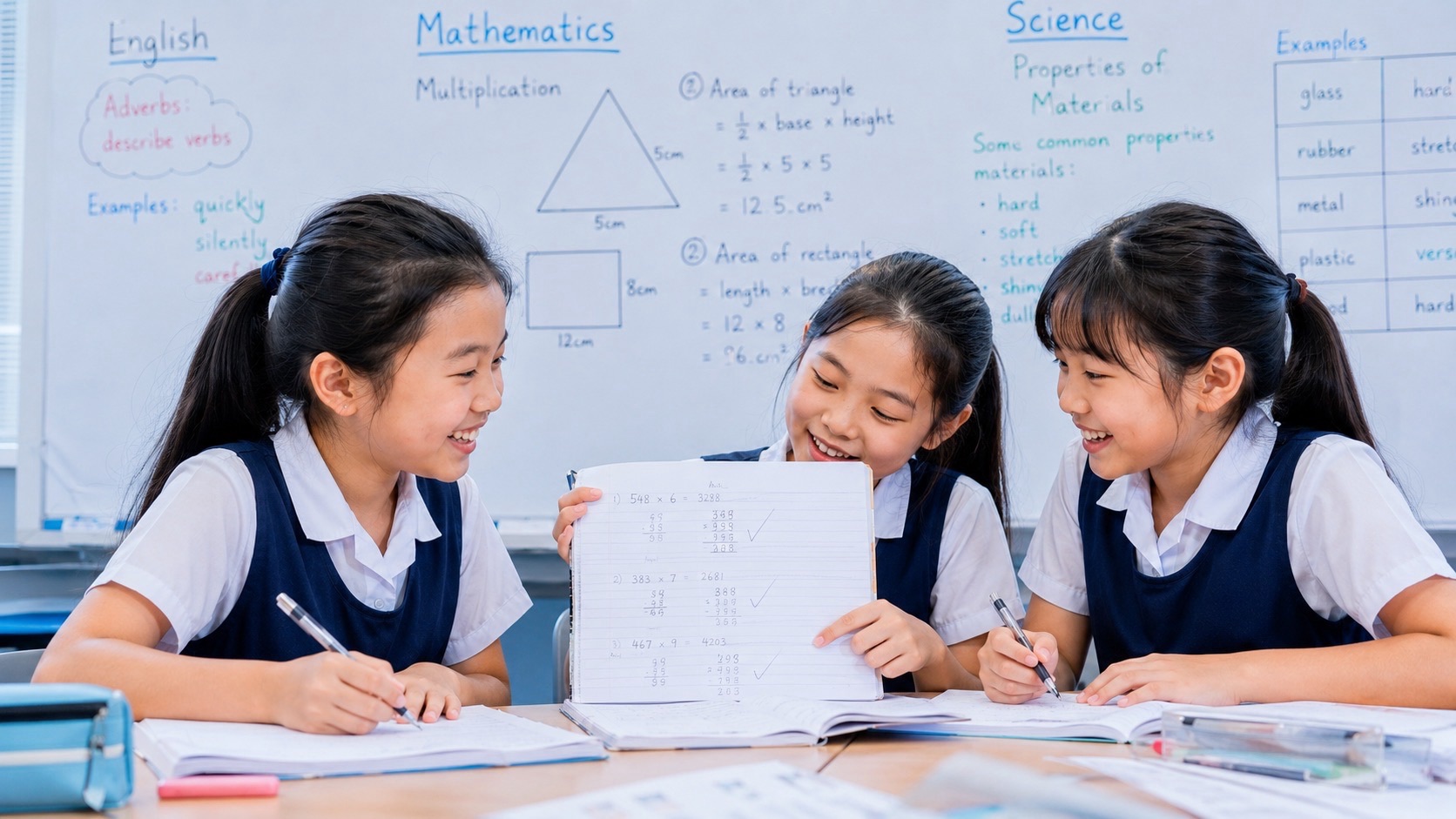
Primary 2 Tuition Punggol | English & Mathematics Foundation Hub
Primary 2 Tuition Punggol is the eduKate level hub for English and Mathematics in the year when the first foundations of primary school should become stable enough to carry a larger curriculum.
Primary 1 is the year of entry.
Primary 2 is the year of consolidation.
The child is no longer meeting school for the first time.
But many of the systems that looked secure in Primary 1 are still young.
Reading may sound fluent while meaning remains fragile.
A child may calculate correctly when the operation is obvious but struggle when a word problem hides the relationship.
Grammar may be recognised in an exercise but disappear inside original writing.
Number facts may be remembered today and unavailable next week.
Primary 2 therefore has a quiet but important job:
STABILISE → CONNECT → RETRIEVE → REPRESENT → EXPLAIN → CHECK → REPAIR → TRANSFER → HAND FORWARD
Featured Snippet — What Is Primary 2 Tuition Punggol?
Primary 2 Tuition Punggol is structured English and Mathematics support for children consolidating their lower-primary foundations. Good Primary 2 tuition should strengthen reading comprehension, vocabulary, grammar and connected writing; deepen number sense, place value, operations, quantity relationships and word-problem representation; build retrieval, checking and correction habits; and prepare the child to enter Primary 3 ready for a larger curriculum and the formal introduction of Science.
Why This Hub Is English and Mathematics — Not a Manufactured P2 Science Page
This eduKate hub deliberately covers English and Mathematics.
It does not create a false Primary 2 Science tuition branch simply to make the title symmetrical with Primary 3 to Primary 6.
In the standard Singapore primary-school structure, formal Science curriculum time begins from Primary 3. MOE’s curriculum-time guidance identifies Science teaching from Primary 3 to Primary 6. Parents can refer to the official MOE primary-school curriculum-time explanation and the current primary subjects and syllabuses page.
That does not mean a Primary 2 child should stop observing the world.
Children should ask questions.
Notice patterns.
Compare objects.
Measure.
Build curiosity.
But curiosity and informal exploration are not the same as inventing a formal P2 Science tuition owner that does not belong in the standard level architecture.
The clean handoff is:
PRIMARY 2 ENGLISH & MATHEMATICS FOUNDATIONS → PRIMARY 3 ENGLISH, MATHEMATICS & FORMAL SCIENCE EXPANSION
This Page Owns the Level; Specialist Pages Own the Specific Problems
This page is the Primary 2 level owner.
It does not replace the useful Primary 2 English pages already published across the eduKate Punggol estate.
It also does not turn broad P1–P6 Mathematics pages into artificial P2-only pages.
The architecture is:
PRIMARY 2 LEVEL OWNER → P2 ENGLISH SPECIALISTS + PRIMARY MATHEMATICS OWNERS → PRIMARY 3 LEVEL OWNER
This lowers cannibalisation because each page has a different job.
- This hub answers: How should the whole Primary 2 year work?
- The English specialists answer narrower questions about fluency, comprehension, grammar, peer reading and independent checking.
- The Mathematics owners explain the P1–P6 progression, representation, working, diagnosis and problem-solving architecture.
- The Primary 3 hub owns the next expansion point where formal Science enters.
Primary 2 Is the Consolidation Year
Primary 2 is not merely Primary 1 with larger numbers and longer passages.
The child is expected to coordinate more.
Reading should carry meaning across several sentences.
Writing should carry one idea across a connected sequence.
Mathematics should move beyond recognising an operation symbol toward understanding what quantities are doing.
School routines should require less adult rescue.
Correction should begin changing future behaviour rather than ending with a copied answer.
This is consolidation:
The parts learned in Primary 1 become reliable enough to work together in Primary 2.
The Primary 2 Hub Has Two Main Doors
Door 1 — Primary 2 English Tuition Punggol
Primary 2 English should strengthen the movement from decoding words toward understanding connected language.
- reading fluency with meaning;
- vocabulary in context;
- sentence grammar;
- pronoun reference;
- connectors and sequence;
- literal comprehension;
- simple evidence-based answers;
- oral communication;
- listening;
- spelling and editing;
- early connected writing;
- independent checking.
A strong existing specialist route is Punggol Primary 2 English Small Group Tuition | Reading Fluency With Independent Checking.
For the important difference between sounding fluent and understanding, see Punggol Primary 2 English Tuition | When Fluent Reading Starts Outrunning Comprehension.
For peer reading without imitation, see Punggol Primary 2 English Small Group Tuition | Learning From Peer Reading Without Copying the Reader.
For a narrower grammar route, see Punggol Primary 2 English Tuition | Simple Past: Regular and Irregular Forms.
The broader English progression owner remains Punggol Primary English Tuition | How English Capability Should Progress from P1 to P6.
Parents can refer to the official MOE English Language Syllabus 2020 for Primary.
Door 2 — Primary 2 Mathematics Tuition Punggol
Primary 2 Mathematics should strengthen number sense and operations while ensuring that the child knows what every number, symbol and step represents.
- place value;
- number magnitude;
- addition and subtraction;
- part–whole relationships;
- early multiplication and division ideas where taught;
- equal groups and sharing;
- money;
- time;
- measurement;
- shapes and spatial relationships;
- simple tables and data;
- word-problem interpretation;
- drawings, number bonds and bar-like representations;
- units;
- checking.
The broad P1–P6 Mathematics owner is Primary Mathematics Tuition Punggol | What Changes from P1 to P6?.
For progression from concrete models toward independent problem solving, see Primary Maths Tuition Centre Punggol | P1–P6 Progression.
For mathematical working as communication, see Punggol Primary Mathematics Tuition | Equation → Meaning → Unit → Check.
For word-problem representation, see Waterway Point Punggol Primary Maths Tuition | Words → Model → Equation → Check.
For diagnostic correction, see Punggol Primary Mathematics | Find the First Wrong Line Before Giving More Practice.
The official national framework places mathematical problem solving at the centre, supported by concepts, skills, processes, metacognition and attitudes. Parents can refer to the Primary Mathematics Syllabus 2021, updated October 2025.
The Central Primary 2 Problem: Fluency Can Outrun Meaning
Primary 2 is full of behaviours that look stronger than they are.
A child reads quickly.
But cannot explain what the paragraph means.
A child completes an addition worksheet rapidly.
But cannot identify which quantity should be added in a story problem.
A child recites a grammar rule.
But does not use it while writing.
A child remembers a method immediately after teaching.
But cannot retrieve it after several days.
Primary 2 therefore needs two kinds of strength at the same time:
AUTOMATICITY + MEANING
Automaticity frees attention.
Meaning prevents automaticity from becoming blind.
The goal is not slow understanding forever.
Nor is it fast performance without understanding.
The goal is fluent meaning.
Primary 2 English: Reading Aloud Is Not the Same as Reading
Reading aloud provides useful evidence.
It shows word recognition, phrasing, pronunciation and some punctuation awareness.
But a smooth voice can hide weak comprehension.
After reading, the child should be able to answer:
- Who or what is this about?
- What happened?
- What changed?
- Why did it happen?
- Which sentence tells you?
- What might happen next, and why?
The reading system is:
DECODE → PHRASE → BUILD MEANING → CHECK → EXPLAIN
If decoding consumes all the child’s attention, comprehension will suffer.
If decoding is fluent but meaning remains weak, the repair should move beyond more oral reading speed.
The Meaning Check After Every Short Passage
A simple Primary 2 habit is to pause after a paragraph and ask:
What did that paragraph add?
Did it introduce a person?
Describe a place?
Show a problem?
Explain a reason?
Change the situation?
This prevents the child from reaching the bottom of a page with accurate pronunciation and no coherent mental model.
Pronouns and Connectors Quietly Carry the Story
Primary 2 comprehension often depends on small words.
He, she, it, they, this and that point to earlier information.
Because, but, so, after, before and although signal relationships.
A child may know every content word and still lose the meaning because the reference or relationship is unclear.
Teach the child to ask:
- Who does this pronoun refer to?
- What happened because of what?
- What changed after this event?
- What contrast is the sentence showing?
These small relationships become the architecture of Primary 3 paragraph meaning.
Vocabulary Should Become Usable, Not Merely Recognisable
A Primary 2 child may recognise a word on a spelling list but fail to understand it in a passage.
Recognition is useful.
Use is stronger.
A useful vocabulary network is:
WORD → SIMPLE MEANING → EXAMPLE → CONTRAST → PHRASE → RETRIEVAL → USE
Ask the child to:
- explain the word simply;
- give an example;
- choose between two nearby words;
- notice the word inside a phrase;
- use it in an original sentence;
- retrieve it several days later.
Vocabulary becomes powerful when it improves both reading and writing.
Grammar Is a Meaning System
Grammar is often taught as choosing the correct option.
Primary 2 should also make the relationship visible.
- Tense places an event in time.
- Subject–verb agreement connects who or what with the action.
- Pronouns prevent unnecessary repetition while preserving reference.
- Connectors show cause, contrast, sequence and addition.
- Punctuation separates or joins meaning.
The grammar loop is:
NOTICE → EXPLAIN THE MEANING → PRACTISE → GENERATE → EDIT → RETEST
A rule becomes useful when the child can use it in an original sentence and later notice when it has been broken.
Primary 2 Writing: From Sentence Collection to Connected Sequence
Many Primary 2 children can write several correct sentences.
The next job is connection.
What happened first?
What changed?
Why did the character react?
What happened as a result?
A simple writing architecture is:
SITUATION → EVENT → REACTION → OUTCOME
This is not a rigid composition template.
It is a way of teaching the child that sentences should belong to one another.
Primary 2 writing should still sound like a child.
Clarity and ownership matter more than filling every line with difficult vocabulary.
Oral Language Is Not Separate From Reading and Writing
Children often understand more than they can write.
Oral explanation lets the tutor check whether the idea exists before diagnosing a writing problem.
Ask the child to tell the story.
Explain the answer.
Compare two characters.
Describe what changed.
Then move from speech to writing.
The bridge is:
SAY → ORGANISE → WRITE → REREAD → IMPROVE
Over time, the oral scaffold should reduce as the child becomes able to organise language internally.
Comprehension Answers Need Evidence Even at Primary 2
Evidence at Primary 2 can be simple.
The child does not need sophisticated literary analysis.
But the answer should still connect to the passage.
A useful routine is:
QUESTION → FIND THE PART → SAY WHAT IT MEANS → ANSWER
This prevents two common failures:
- copying words without answering the question;
- giving a plausible answer that the passage does not support.
The child is beginning to learn that meaning should answer to evidence.
Primary 2 Mathematics: Number Sense Before Speed
Number sense is the child’s feel for quantity, magnitude and relationship.
A child with number sense can tell when an answer is too large, too small or impossible.
They can decompose a number.
See a near-ten or near-hundred relationship.
Estimate before calculating.
Recognise that the same total can be composed in different ways.
Speed without number sense is fragile.
The child may perform a memorised procedure while having no internal alarm when the result makes no sense.
The Primary 2 target is:
MEANINGFUL FLUENCY
Place Value Is the Architecture of the Number
Place value explains why the same digit can represent different quantities.
It supports:
- reading and writing numbers;
- comparison;
- addition and subtraction;
- regrouping;
- estimation;
- later multiplication and division;
- later decimal understanding.
A child who performs column procedures without place-value meaning may become accurate on familiar layouts and unstable when the representation changes.
Use objects, bundles, drawings, expanded form and number lines where appropriate.
Then connect the representations.
Addition and Subtraction Are Relationships, Not Keyword Reactions
Students are sometimes taught to look for words such as altogether or left.
Keywords can help.
They can also mislead.
The child should identify the relationship:
- Are parts being joined into a whole?
- Is one part missing?
- Is a quantity changing?
- Are two quantities being compared?
- Is the difference being asked?
The operation should follow the relationship.
Not the first familiar word.
The Part–Whole Model Is a Foundational Mathematics Language
Many lower-primary Mathematics problems become clearer when the child can identify:
- the whole;
- the known part;
- the unknown part;
- the relationship between them.
This can be represented with objects, number bonds, drawings or simple bars.
The representation is not the lesson by itself.
The lesson is the relationship it reveals.
Primary 2 is a good year to make that relationship so familiar that later multi-step problems have a stable entry point.
Multiplication Begins as Equal Groups
Where multiplication is introduced or developed in the child’s school progression, the meaning should come before rapid fact recall.
Multiplication can represent:
- equal groups;
- arrays;
- repeated addition;
- scaling in simple contexts.
The child should know what each number represents.
Three groups of four is not merely “3 × 4”.
It is a quantity structure.
Fact fluency becomes more durable when attached to a model the child understands.
Division Begins as Sharing and Grouping
Division can answer two different questions.
How many does each group receive?
Or:
How many groups can be made?
These are related but not identical stories.
A child who sees the quantity structure can choose division more reliably than a child waiting for a keyword.
This becomes load-bearing in Primary 3.
Representation Before Calculation
Primary 2 is an excellent year to install one lifelong Mathematics habit:
READ → IDENTIFY QUANTITIES → REPRESENT → RELATE → CALCULATE → CHECK
The child may use:
- objects;
- a drawing;
- a number bond;
- a number line;
- an array;
- a simple bar model;
- a table;
- a number sentence.
The best representation is the one that makes the relationship visible enough for the child to reason accurately.
Do not force a complex model onto a problem that is already clear.
Do not skip representation when the story remains confused.
The Word-Problem Stack
A Primary 2 word problem can fail before the arithmetic begins.
The stack is:
LANGUAGE → QUANTITIES → RELATIONSHIP → REPRESENTATION → OPERATION → CALCULATION → CHECK
If the child says:
I don’t know whether to add or subtract.
do not begin by supplying the operation.
Ask:
- What quantities are in the story?
- What happened to them?
- What is known?
- What is missing?
- Can you draw the relationship?
The operation should emerge from the model.
Quantity Identity: Eight What?
The number 8 does not complete a mathematical thought.
Eight what?
- eight books;
- eight dollars;
- eight centimetres;
- eight minutes;
- eight groups;
- eight more than another quantity.
Every number has an identity inside the problem.
Teach the child to name it.
This reduces blind calculation and creates a natural checking question:
Did I calculate the quantity the question actually asked for?
Units Are Part of the Meaning
Units are not decorations added after the answer.
They identify the quantity.
Money, time, length, mass and capacity require the child to coordinate a number with a measurement language.
Ask:
- What are we measuring?
- What unit belongs to it?
- Are the quantities using compatible units?
- Does the final unit answer the question?
Unit discipline becomes increasingly important in Primary 3 Mathematics and Science.
Equality Means the Same Value
The equals sign is one of the most important symbols in Mathematics.
It means the two sides have the same value.
It does not simply mean:
Write the answer next.
Unknown-box and balance-style questions can help the child understand that the missing quantity may appear in different positions.
This is an early foundation for later algebraic thinking.
Checking Should Be Taught as a Real Action
“Check your work” is too vague.
English checking can ask:
- Did I answer the question?
- Can I find the supporting sentence?
- Does the pronoun refer clearly?
- Is the tense stable?
- Did I leave out a word?
Mathematics checking can ask:
- What quantity did I find?
- Is the answer roughly the right size?
- Can I use the inverse operation?
- Does the unit fit?
- Did I copy the number correctly?
Checking becomes useful when the action is specific enough to perform independently.
English and Mathematics Are Different — but the Learner Is Shared
English and Mathematics should not be blurred into one generic programme.
English asks whether meaning can be understood and communicated.
Mathematics asks whether quantity relationships can be represented and manipulated validly.
But the same child carries several shared capabilities into both.
- attention;
- reading accuracy;
- vocabulary;
- working-memory organisation;
- retrieval;
- representation;
- checking;
- error awareness;
- independent task entry.
A child may appear weak in both subjects because one shared bottleneck is travelling across them.
For example:
- weak reading can damage English comprehension and Mathematics word problems;
- weak working memory can make long sentences and multi-step calculations difficult;
- poor checking can leak marks everywhere;
- weak retrieval can make yesterday’s learning disappear in both subjects;
- heavy adult prompting can hide whether the child can begin independently.
Diagnose the shared learner system before assuming two unrelated subject failures.
The Primary 2 Diagnostic Stack
1. Access
Can the child read and understand the language of the task?
2. Foundation
Are the important Primary 1 literacy and numeracy foundations secure?
3. Knowledge
Does the child know the word, rule, number fact, operation or concept?
4. Retrieval
Can the learning be recalled after a delay without immediate prompting?
5. Interpretation
Can the child identify what the question asks?
6. Representation
Can information be turned into a drawing, number bond, simple model, sentence sequence or other useful form?
7. Relationship
Can the child see how the important parts connect?
8. Execution
Can the chosen route be carried out accurately?
9. Communication
Can the child show or say enough of the reasoning?
10. Checking
Can avoidable mistakes be detected through a specific check?
11. Repair
Does correction change the process that caused the error?
12. Transfer
Can the skill survive a changed question or representation?
13. Independence
Can the child begin and monitor more of the task without adult rescue?
This stack is much more useful than saying a child is simply “weak in Primary 2”.
A Score Is an Output, Not the Cause
Two Primary 2 children can receive the same mark and need different teaching.
One may still decode slowly.
One may read fluently but misunderstand connected meaning.
One may know addition and subtraction but fail to recognise the word-problem relationship.
One may understand orally but struggle to write.
One may complete everything only after adult prompts.
The score tells us where to look.
The work reveals what to repair.
Primary 2 Is a Good Year to Start a Small Error Register
The register should not collect every wrong answer.
It should name recurring patterns.
English examples:
- reads quickly but cannot retell;
- loses pronoun reference;
- ignores the question word;
- copies the passage without answering;
- changes tense inside writing;
- leaves out words while copying or composing.
Mathematics examples:
- chooses an operation from one keyword;
- weak place-value understanding;
- forgets number facts after a short delay;
- calculates before identifying the quantities;
- confuses the whole and the missing part;
- forgets units;
- does not check whether the answer is plausible.
Naming the pattern makes the next teaching move more precise.
Correction Is Not Repair Until the Child Can Do It Again
A child can copy the correct answer immediately after feedback.
That is weak evidence of learning.
Use:
ERROR → EXPLAIN → CORRECT → DELAY → RETEST → CHANGE CONTEXT → RETEST AGAIN
If the child succeeds only while the correction is fresh, the new process has not yet stabilised.
Primary 2 gives enough runway for repair to be patient.
Retrieval Should Be Gentle, Short and Regular
Primary 2 does not need an examination-heavy revision programme.
It does need old learning to return.
A useful rhythm is:
CURRENT → RECENT → OLDER FOUNDATION → SHORT MIX
Retrieve a vocabulary word from last week.
A grammar relationship from several lessons ago.
A number bond.
A place-value idea.
A checking routine.
Short retrieval tells the tutor what remains independently available.
Focused Practice First, Changed Context Later
New skills need focused practice.
But a child should not remain forever inside worksheets that announce the method.
The progression is:
TEACH → TARGETED PRACTICE → MIXED PRACTICE → CHANGED CONTEXT → DELAYED RETRIEVAL
For English, change the passage or writing situation.
For Mathematics, change the story while preserving the quantity relationship.
This is how recognition becomes transfer.
The Primary 2 Warehouse
By Primary 2, the child already carries a growing knowledge Warehouse.
English contains:
- phonics and word recognition;
- vocabulary;
- sentence patterns;
- grammar;
- reading strategies;
- story sequences;
- oral language;
- spelling patterns;
- early checking routines.
Mathematics contains:
- number facts;
- place value;
- addition and subtraction;
- part–whole relationships;
- early equal-group and sharing ideas;
- measurement language;
- money and time;
- shapes;
- simple representations;
- checking routines.
The problem is no longer only storage.
It is beginning to index knowledge by use.
Can the child find the right word, relationship or model when the task changes?
CivDJ at Primary 2: Choose, Use, Check
At Primary 2, flexible reasoning does not need complicated language.
A task enters the Mixer.
The child retrieves possible tools.
For English:
- a word meaning;
- a pronoun reference;
- a connector;
- a story sequence;
- a supporting sentence;
- a grammar check.
For Mathematics:
- a number bond;
- a drawing;
- a part–whole model;
- an operation;
- a unit;
- an estimate;
- an inverse check.
The child chooses.
Uses the tool.
Checks whether the answer fits.
If it does not fit, change the representation or return to the question.
This is flexible reasoning in a form suitable for an eight-year-old.
Backward Repair: Find the Earliest Useful Owner
A Primary 2 problem may be caused by a Primary 1 dependency.
A comprehension problem may belong to decoding or vocabulary.
A writing problem may belong to oral sentence formation.
An addition problem may belong to number bonds or place value.
A word-problem problem may belong to reading access.
The repair loop is:
VISIBLE ERROR → TRACE BACKWARD → REPAIR OWNER → RETURN FORWARD → RETEST
Do not send the child backward indefinitely.
Repair only what is load-bearing, then reconnect it to current Primary 2 work.
Sideways Transfer: Find the Shared Structure
Primary 2 offers useful sideways connections.
- sequence connects reading, writing and Mathematics procedures;
- comparison connects vocabulary and quantity;
- part and whole connect sentence meaning and Mathematics structure in different ways;
- measurement connects Mathematics to everyday observation;
- checking travels everywhere;
- oral explanation supports both comprehension and mathematical reasoning.
The subjects remain different.
The child becomes stronger by recognising useful thinking patterns while respecting the rules of each discipline.
The Three-Student Primary 2 Room
A three-student group is useful because similar marks can hide different foundations.
Student A reads aloud confidently but cannot retell the paragraph.
Student B understands stories but writes very short, disconnected sentences.
Student C calculates accurately but cannot identify the relationship in a word problem.
One age group.
Three different teaching jobs.
Small-group tuition is valuable only when it preserves that resolution.
Think-Aloud Learning Makes the Invisible Visible
English:
Who does “she” refer to, and how do you know?
Mathematics:
What does each number represent?
Reading:
What changed in this paragraph?
Writing:
Why does this sentence come next?
The final answer may hide where the process failed.
Think-aloud work reveals it.
Strong Primary 2 Students Need Depth, Not Premature PSLE
A strong Primary 2 student can be stretched without racing through years of future content.
- compare two interpretations of a short passage;
- explain why one sentence follows another;
- retell from another character’s point of view;
- solve one Mathematics problem using two representations;
- explain why two calculations are equivalent;
- create a word problem for a given number relationship;
- retrieve learning after a longer delay;
- check and explain an intentionally incorrect answer.
Deeper transfer is often better preparation for Primary 3 than superficial acceleration.
Struggling Primary 2 Students Need Decompression
A weak report should not automatically produce more of every worksheet.
Ask:
- Is decoding still slow?
- Is vocabulary limiting comprehension?
- Does the child understand orally but struggle to write?
- Is place value unstable?
- Are number facts consuming too much attention?
- Does the child choose operations from keywords?
- Is adult prompting hiding weak independence?
- Is the weekly load preventing consolidation?
Primary 2 is early enough to repair these foundations calmly.
The objective is not to make the child feel sent backward.
It is to reconnect the missing foundation to current work quickly.
Confidence Should Mean “I Know What to Try”
Primary 2 confidence should not mean:
I always know the answer immediately.
A stronger form is:
I know what to try when I am not sure.
- reread the question;
- sound out or break apart the word;
- look for who or what the pronoun refers to;
- draw the quantities;
- label the whole and parts;
- estimate;
- check whether the answer fits.
That is usable confidence.
RepairRate and DriftRate in Primary 2
Knowledge drifts.
Words become inaccessible.
Number facts fade.
Grammar rules disappear from writing.
Call this DriftRate.
Students also retrieve, practise, receive feedback, repair and reconnect.
Call this RepairRate.
A healthy learning system aims for:
RepairRate ≥ DriftRate
This is a teaching metaphor, not a mathematical law.
Primary 2 is a good year to make maintenance gentle, normal and regular.
The Primary 2 Flight Path
Term 1 — Re-establish the Foundations
- retrieve important Primary 1 reading and number skills;
- check decoding, vocabulary and oral language;
- check place value and number relationships;
- establish simple checking routines;
- observe how independently the child starts work.
Term 2 — Connect
- connect sentences through pronouns and connectors;
- connect vocabulary to reading and writing;
- connect addition and subtraction to part–whole and comparison relationships;
- connect concrete materials to drawings and symbols;
- begin a small recurring-error register.
Term 3 — Represent and Transfer
- use short unseen passages;
- write connected sequences with clearer purpose;
- solve changed-story Mathematics problems;
- choose between drawings, number bonds and number sentences;
- retest recurring errors after delay.
Term 4 — Build the Primary 3 Handoff
- identify fragile literacy and numeracy foundations;
- protect stable skills through light retrieval;
- reduce adult prompting;
- strengthen multiplication, division and fraction readiness according to school progression;
- prepare the child to handle formal Science vocabulary and evidence language in Primary 3.
The Primary 2 to Primary 3 Handoff
The next level owner is:
Primary 3 Tuition Punggol | English, Mathematics & Science Hub
Primary 2 should hand forward:
- reading fluency that carries meaning;
- usable vocabulary;
- stable sentence grammar;
- connected writing sequences;
- clearer comprehension question control;
- number sense and place value;
- meaningful addition and subtraction;
- early equal-group and sharing structures;
- quantity and unit awareness;
- simple representation before calculation;
- retrieval and checking habits;
- greater independent task entry.
The flight path is:
PRIMARY 1 ENTRY → PRIMARY 2 CONSOLIDATION → PRIMARY 3 EXPANSION → PRIMARY 4 INTEGRATION → PRIMARY 5 COMPRESSION → PRIMARY 6 RELIABILITY → PSLE
What Good Primary 2 Tuition Should Do
- diagnose important Primary 1 gaps;
- strengthen reading fluency without losing comprehension;
- build vocabulary through context and use;
- connect grammar to meaning and original writing;
- build connected sentence and paragraph sequences;
- strengthen number sense and place value;
- teach operations as quantity relationships;
- use representation before calculation;
- build early multiplication and division meaning where appropriate;
- teach units and quantity identity;
- begin gentle cumulative retrieval;
- classify recurring errors;
- retest corrections after delay;
- increase independence before Primary 3.
The direction is:
MORE MEANING + STRONGER FOUNDATIONS + BETTER REPRESENTATION + GROWING INDEPENDENCE.
What Primary 2 Tuition Should Not Become
A Premature PSLE Programme
Primary 2 has valuable developmental time.
Use it to build the learner rather than simulate final-year pressure.
A Worksheet Conveyor Belt
Volume without diagnosis can make a weak process more automatic.
A Reading-Speed Competition
Faster reading is useful only when meaning survives.
A Race Through Primary 3 Content
Acceleration without durable foundations simply carries the same weakness forward.
A Manufactured Science Programme
Curiosity is welcome. Formal P2 Science tuition is not needed merely to make the subject list look complete.
When Tuition May Not Be Necessary
Not every Primary 2 child needs tuition.
A child may be progressing well if they:
- understand school lessons;
- read with growing fluency and comprehension;
- write increasingly connected sentences;
- manage current Mathematics with understanding;
- learn from corrections;
- begin tasks with growing independence;
- retain important earlier learning;
- maintain a healthy weekly routine.
More tuition is not automatically better education.
Every added hour should solve a real learning job.
When Additional Support May Be Useful
- persistent decoding or reading-comprehension gaps;
- fluent reading without connected meaning;
- limited vocabulary that blocks access to tasks;
- grammar that does not transfer into writing;
- writing that remains a disconnected sentence list;
- weak number sense or place value;
- operation choice driven by keywords rather than relationships;
- poor word-problem representation;
- heavy dependence on adult prompts;
- a strong child needing deeper transfer rather than future-content racing.
Choosing Primary 2 Tuition in Punggol
Do not choose only by asking:
How far ahead do you teach?
Ask:
- Does the tutor check Primary 1 foundations?
- Can the tutor distinguish decoding from comprehension?
- Does English teaching connect grammar to meaning?
- Does Mathematics teaching connect symbols to quantities?
- Are errors classified by mechanism?
- Are corrections retested?
- Does focused practice become changed-context practice?
- Is the child becoming less dependent?
- Does the programme protect sleep, play and a sustainable weekly load?
These questions reveal more about teaching quality than worksheet count or how many future chapters have been previewed.
Why Punggol Matters — and Why the Curriculum Does Not Change by Location
Sentence meaning does not change at Punggol MRT.
Place value does not change at Waterway Point.
Part–whole relationships do not change beside Punggol Waterway.
Locality changes the child’s weekly operating system.
- travel time;
- school hours;
- homework;
- tuition;
- activities;
- reading;
- family time;
- sleep;
- play and recovery.
A nearby high-quality programme can preserve time for reading, consolidation and rest.
Nearness is not a substitute for teaching quality.
But time is a real educational resource.
Frequently Asked Questions
What is Primary 2 Tuition Punggol?
It is structured English and Mathematics support for Primary 2 children in or around Punggol, focused on consolidating lower-primary literacy and numeracy, strengthening meaning and representation, building retrieval and checking, and preparing the learner for the Primary 3 expansion.
Why does this hub not include Science?
Because formal Primary Science begins from Primary 3 in the standard Singapore curriculum. Primary 2 children can still explore nature and ask scientific questions, but this level hub does not manufacture a formal P2 Science tuition branch.
What should Primary 2 English tuition focus on?
Reading fluency with comprehension, vocabulary in context, grammar relationships, pronoun and connector control, literal comprehension, simple evidence use, oral communication, connected writing and independent checking.
What should Primary 2 Mathematics tuition focus on?
Number sense, place value, addition and subtraction, part–whole relationships, early multiplication and division meaning where applicable, measurement, money, time, shapes, word-problem representation, units and checking.
What if my child reads fluently but cannot answer questions?
The child’s decoding may be stronger than their language comprehension. Teaching should inspect vocabulary, sentence relationships, pronoun reference, paragraph meaning and question interpretation rather than simply increasing reading speed.
What if my child can calculate but cannot solve word problems?
The missing capability may be language, quantity identification, relationship recognition or representation rather than arithmetic. Ask where the word-problem stack first breaks.
Should Primary 2 students begin doing PSLE papers?
No as a main learning strategy. Age-appropriate reasoning and transfer questions can be useful, but Primary 2 should primarily build durable literacy, numeracy, retrieval and independence.
Should tuition teach far ahead?
Selective preview may be useful when current foundations are stable. Racing far ahead is not automatically beneficial. Strong meaning, retrieval and transfer usually create a better Primary 3 handoff.
How should mistakes be reviewed?
Identify whether the error came from access, foundation, knowledge, retrieval, interpretation, representation, relationship, execution, communication or checking, then repair that mechanism and retest it after a delay.
Does every Primary 2 child need tuition?
No. Children who understand school learning, retain earlier foundations, respond well to feedback and continue becoming more independent may not require additional tuition.
Why use small-group tuition in Primary 2?
A small group gives the tutor enough resolution to distinguish decoding, comprehension, writing, number-sense, representation and independence problems while preserving useful peer explanation and comparison.
Primary 2 Tuition Punggol in One Sentence
Primary 2 Tuition Punggol is an English and Mathematics consolidation system that turns early literacy and numeracy into increasingly reliable comprehension, connected writing, number sense, quantity reasoning, representation, retrieval, checking and independence before the Primary 3 curriculum expands and formal Science begins.
The Final Perspective
Primary 2 matters because it is the last full year before the child’s school world expands again.
Primary 3 will bring longer texts.
Heavier multiplication and division.
Fractions.
More complex representations.
And formal Science with a new vocabulary and evidence system.
The temptation is to race ahead.
But the strongest preparation is often quieter.
Make reading carry meaning.
Make vocabulary usable.
Make grammar visible inside original sentences.
Make numbers represent quantities.
Make operations follow relationships.
Make checking a specific action.
Make correction return later as retrieval.
And make the child increasingly responsible for starting the task.
English should become less:
I read every word.
and more:
I understand how the words build one meaning.
Mathematics should become less:
I saw the word “left”, so I subtracted.
and more:
I can see the whole, the parts and what changed.
Learning should become less:
Tell me what to do next.
and more:
I know what to try when I am not sure.
That is the deeper Primary 2 achievement.
The child has not merely completed another year.
They have made the first learning system stable enough to carry a larger one.
Continue Through the Punggol Tuition Spine
Punggol tuition owner: Punggol Tuition
Primary English owner: Punggol Primary English Tuition
Primary Mathematics owner: Primary Mathematics Tuition Punggol
Primary 2 English — fluency and checking: Punggol Primary 2 English Small Group Tuition
Primary 2 English — fluency versus comprehension: When Fluent Reading Starts Outrunning Comprehension
Primary 2 English — peer reading: Learning From Peer Reading Without Copying the Reader
Incoming Primary 1 route: Punggol Primary 1 Enrolment | Build the First-Term Workload Without Over-Tuition
Next level: Primary 3 Tuition Punggol | English, Mathematics & Science Hub
Primary flight path: Primary 1 Entry → Primary 2 Consolidation → Primary 3 Expansion → Primary 4 Integration → Primary 5 Compression → Primary 6 Reliability → PSLE
Primary 2 is where the first foundations of school should stop behaving like separate beginner skills and begin behaving like a dependable learning system.
Whole-year stage guide: Punggol Primary 2 Tuition | From Guided Work to Independent Control