
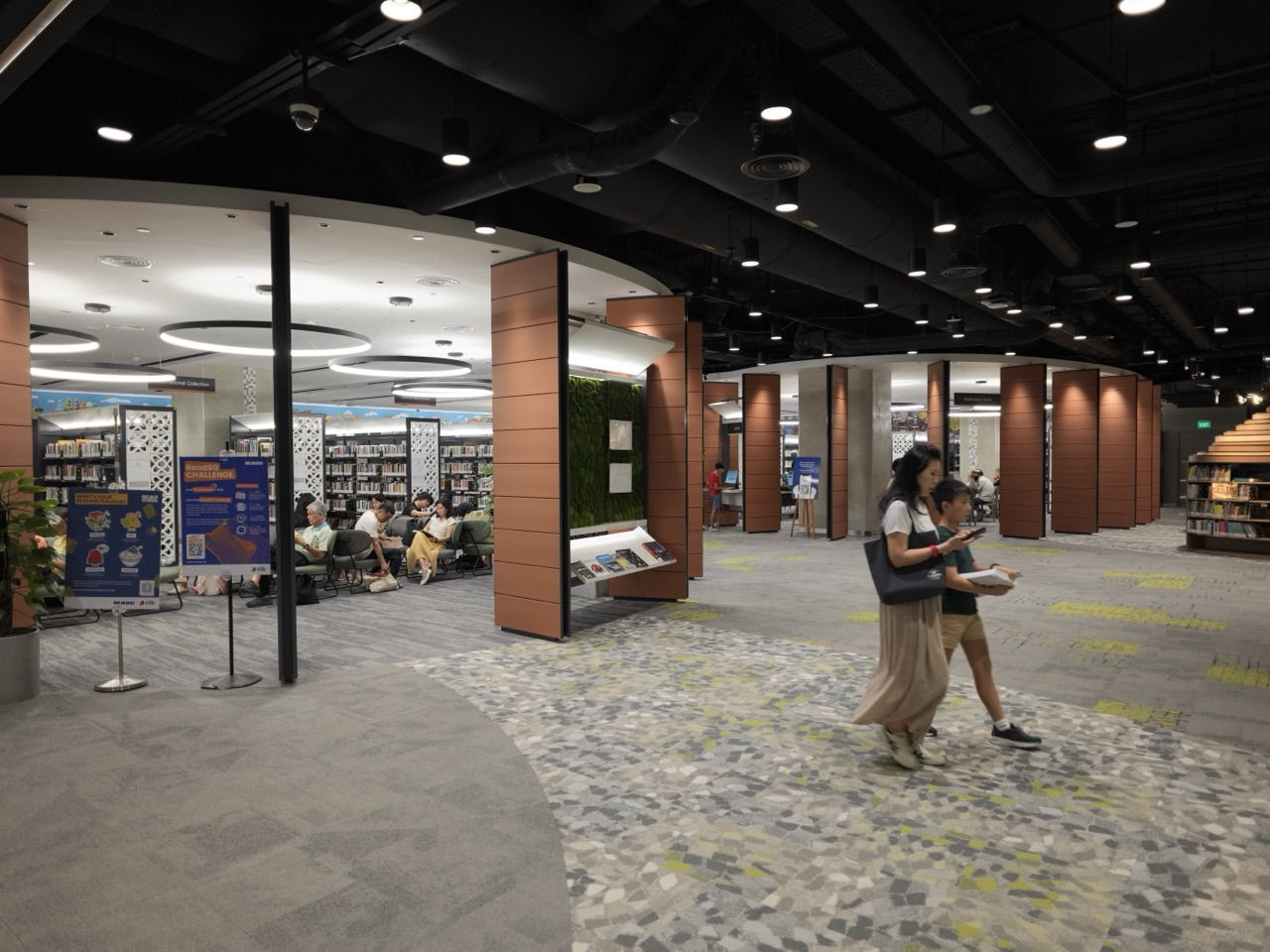
Singapore public libraries, National Library Board, NLB libraries, digital library Singapore, public library network, reading programmes and access to knowledge are often searched as separate services. They are better understood as one civic system. A public library network acquires and licenses knowledge, organises it, preserves selected memory, places branches near communities, provides digital access, teaches people how to find trustworthy information and keeps enough of that capability free at the point of ordinary use that knowledge does not become available only to those who can repeatedly pay for it.
Singapore’s National Library Board says it oversees a network of 28 public libraries in addition to the National Library and National Archives of Singapore. Its latest published year-in-review figures show the scale of the shared system: 20.8 million physical visits, 24.0 million physical loans, 14.8 million digital loans and 89.2 million digital uses in 2024, alongside thousands of programmes. NLB’s LAB25 strategy frames the library as a learning marketplace, an equaliser, a place for informed citizenry and a platform for Singapore stories rather than simply a warehouse of books.
This article owns one distinct reader job inside the eduKateSG Singapore master: explaining the public library network as civilisation infrastructure for knowledge access. It does not replace existing museum owners, archive specialists, education owners, literacy articles, school-library guidance or Singapore history pages. Its question is narrower: what must a society build and maintain so that a child, student, worker, caregiver, senior, researcher or curious resident can repeatedly find, borrow, read, verify, learn and participate without first purchasing a private information ecosystem?
1. A library is a distribution system for attention
Books are the most visible objects in a library, but the deeper resource is attention. A civilisation produces more information than any person can absorb. Libraries reduce that abundance into navigable collections. They choose, catalogue, describe, display and connect materials so that a reader has a practical chance of finding something worth their limited time.
This is why shelving is not a trivial afterthought. Classification, metadata, recommendation, search and staff knowledge make collections usable. Ten million unorganised documents can be less useful than ten thousand well-described ones. The library adds value by lowering the cognitive cost of discovery.
At population scale, that discovery function becomes public infrastructure. It is difficult for every household to maintain its own curated collection across childhood, languages, school subjects, careers, hobbies and later life. Shared libraries let one organised system serve changing needs across generations.
2. Public access changes who can learn
A commercial bookstore provides valuable access to books, but purchase is required for ownership and shelf space favours what is economically viable to stock. A subscription service can broaden digital access, but every household must maintain payment and accept the service’s catalogue. A public library uses collective funding to create another route.
The important word is another. Libraries do not need to replace booksellers, publishers or private subscriptions. They broaden the knowledge ecosystem by ensuring that reading and information discovery are not wholly dependent on individual purchasing power.
This changes the social meaning of curiosity. A child can explore astronomy, a jobseeker can learn spreadsheet skills, an adult can read history and a senior can try a new hobby without each experiment becoming a purchase decision. Cheap experimentation with knowledge is a form of capability.
3. The network matters more than one magnificent building
A national library can hold deep collections and specialist services, but ordinary access depends on distance. If every resident must travel across the island for routine borrowing, the time cost weakens public value.
Singapore’s network distributes branches through towns and regional centres. A local library can become part of errands, school trips and commuting rather than a special expedition. Geographic distribution turns cultural infrastructure into everyday infrastructure.
The central and local layers therefore perform different jobs. The national institution can preserve, research and convene at greater depth; the branch network places reading and digital access near daily life. Civilisation becomes more capable when high-level institutions and neighbourhood access reinforce rather than substitute for each other.
4. A branch library is a neighbourhood anchor
Unlike a classroom, a branch library can serve toddlers, teenagers, adults and retirees at the same time. Unlike a commercial venue, remaining for an hour does not require another purchase. Unlike a home, it is shared with strangers. That combination gives the library a distinctive civic role.
Neighbourhood anchors reduce the number of activities that require long trips. Families can combine borrowing with shopping, transport and community visits. Students gain a study location outside school and home. Older residents gain a climate-controlled place with information and programmes.
The branch is therefore not valuable merely because it stores nearby books. It creates a stable public presence in the social geography of a town: a place where learning is expected, quiet is protected and people can spend time without constantly proving commercial value.
5. The National Library performs a depth function
The National Library Singapore operates at a different scale from an ordinary branch. It supports deeper reference work, national collections, exhibitions and research while connecting to NLB’s wider ecosystem.
This concentration is efficient because some materials are specialised, expensive or rarely used. They do not need duplication in every branch. A network can centralise depth while decentralising ordinary access.
The architecture resembles many mature systems: local nodes handle frequent common needs; central nodes hold specialist capability and support the network. The public experiences one library system, but the underlying distribution of resources is deliberately uneven because different jobs require different concentration.
6. The National Archives preserves evidential memory
NLB also encompasses the National Archives of Singapore, but archive ownership must remain distinct from the public-library job. Archives preserve records because evidence of what happened matters to administration, scholarship, rights and national memory. Libraries primarily organise published and licensed knowledge for use.
The two systems meet when a resident researches Singapore history or a student follows a library programme into archival material. Yet the reason for keeping archival records is not identical to the reason for lending a novel.
Clear boundaries strengthen both institutions. A civilisation benefits when it knows which system preserves official and historical evidence, which provides broad reading access and how discovery tools connect them without collapsing their purposes.
7. Legal deposit turns publication into national memory
Singapore’s National Library has responsibilities for preserving the nation’s published and documentary heritage. Legal-deposit arrangements help ensure that material published in Singapore does not vanish merely because commercial demand later disappears.
This is a time-layer function. A book can be commercially unsuccessful and historically important decades later. A pamphlet can become evidence of how people thought. A newspaper issue can help reconstruct a crisis. Preservation therefore operates under uncertainty about future value.
Civilisations that preserve only the material currently considered important create blind spots for future generations. Libraries and archives must keep enough diversity that tomorrow’s questions can still be asked of yesterday’s record.
8. Preservation is active work
Paper ages, bindings fail, mould grows, formats become obsolete and digital files can be corrupted. Keeping a collection is not the same as placing it in storage and forgetting it.
Preservation requires environmental control, conservation, metadata, migration, storage redundancy and decisions about priorities. Digital preservation can be particularly deceptive because files appear weightless. A file on an unsupported medium is as inaccessible as a book locked in a destroyed building.
Maintenance therefore sits inside memory. A civilisation keeps the past only by repeatedly spending present capability on it.
9. Selection is unavoidable
No library can collect everything. Budgets, shelf space, licensing, legal restrictions and user demand force choices. Selection should therefore be governed by an explicit mission rather than pretending neutrality means absence of decisions.
Public collections need popular materials because people use them, but they also need durable works, diverse perspectives, children’s resources, reference material and content that private markets may undersupply. Collection policy balances breadth, demand and long-term value.
The quality of a public library is not measured by whether every reader agrees with every book. It is measured partly by whether the collection supports inquiry across a plural society within lawful and professionally governed boundaries.
10. Classification is a map, not reality
Knowledge does not naturally arrive divided into shelf labels. Classification systems impose useful structure so people can find related material.
Every structure has limits. A book about climate policy may belong simultaneously to science, economics, politics and geography. Digital catalogues can partially overcome one-shelf constraints through subjects, keywords and linked metadata.
Readers should therefore understand classification as navigation rather than truth. The map helps us move through a collection; it should not stop us from seeing relationships that cross categories.
11. Metadata is invisible public infrastructure
Title, author, subject, edition, language and identifiers allow materials to be discovered and distinguished. Good metadata also helps systems exchange records and helps librarians manage collections.
At scale, small metadata errors compound. A misspelled author fragments search. Missing subject terms bury a useful book. Inconsistent dates confuse editions. Data quality in libraries is therefore not clerical tidiness; it is discoverability.
This resembles other civilisation layers. Standards make objects interoperable, and metadata makes knowledge objects legible enough to travel across catalogues and systems.
12. Search should support both precision and discovery
A researcher may know the exact title required. A child may know only “books about volcanoes.” A parent may ask for stories suitable for a reluctant reader. One search interface must support very different levels of certainty.
Exact search rewards accurate metadata. Browsing and recommendation require broader signals. Physical displays and staff suggestions remain valuable because discovery is not always a query.
The best library systems therefore combine retrieval with serendipity. They help users find what they already know they want and encounter useful material they did not know existed.
13. Librarians are human search engines with judgment
A catalogue can return results; a librarian can clarify the question. Reference work often begins by discovering what the user actually needs, which may differ from the first wording.
Human judgment matters when sources conflict, when a child needs age-appropriate material or when a resident does not know the vocabulary of a subject. The librarian can translate between ordinary questions and information systems.
As search technology improves, this role changes rather than disappears. The abundance of machine-generated answers may make source evaluation and question formulation more valuable, not less.
14. Digital access extends the library beyond opening hours
E-books, databases, digital newspapers and online learning resources allow borrowing and research from home. NLB’s 2024 figures show digital use far beyond the number of physical visits, demonstrating that the public library now operates as both place and network service.
This reduces geographic friction and helps users whose schedules make branch visits difficult. It also supports continuity during disruptions.
But digital access is not simply the physical library copied onto a screen. Licensing, device compatibility, authentication, user privacy and interface design become new infrastructure problems.
15. An e-book is licensed differently from a paper book
When a library buys a physical copy, it can generally lend that copy repeatedly subject to ordinary law and preservation. Digital lending often depends on publisher or platform licences that may limit concurrent users, duration or total loans.
This changes collection economics. A popular digital title can have long waitlists even though copying the file would be technically trivial, because legal rights rather than physical scarcity define availability.
Readers benefit from understanding this distinction. Digital abundance does not eliminate ownership and licensing structures. A public library must negotiate access inside them.
16. Digital convenience can create platform dependence
If e-books or databases rely heavily on one vendor, changes in price, terms or technology can affect public access. Libraries therefore need procurement judgment, interoperability and exit planning.
The objective is not to avoid vendors; specialist platforms provide useful capability. It is to avoid assuming that a convenient interface today guarantees durable public access tomorrow.
Digital collection strategy is partly a resilience strategy: preserve enough rights, metadata and alternatives that one commercial decision does not erase an important public service.
17. The NLB Mobile app makes the library portable
A mobile app can carry a library card, catalogue, borrowing information and digital reading into the phone already in a user’s pocket. NLB’s 2024 reporting shows millions of monthly sessions.
Portability lowers small frictions: checking due dates, reserving material or borrowing digitally no longer requires a desktop computer or counter visit.
Yet mobile-first should not mean mobile-only. Users differ in devices, ability and preference. The network remains strongest when digital convenience sits alongside physical counters, web access and human help.
18. Self-checkout shifts routine work
RFID and self-service borrowing reduce queues and free staff from repetitive transaction handling. Users gain speed; staff can spend more time on programmes, collection work and complex assistance.
Automation succeeds when exceptions remain easy. Damaged tags, account issues or unusual materials still require help. A system that removes staff from the routine should not remove them from recovery.
This is a recurring civilisation pattern: automate predictable steps so scarce human judgment can move toward situations where judgment matters.
19. Returns are a logistics system
A returned book must be registered, sorted, moved and reshelved or routed to another branch. High circulation creates substantial material flow.
Automated sorting can improve throughput, but physical movement still matters. The library network resembles a small logistics company whose cargo is knowledge objects.
Efficient returns are invisible to most readers, which is precisely why they deserve attention. When the logistics work, a requested book appears on the correct shelf and the system feels effortless.
20. Inter-branch movement increases the effective collection
A local branch cannot stock every title. Reservation and transfer systems allow users to reach materials held elsewhere.
This converts multiple branch inventories into a networked collection rather than isolated mini-libraries. Transport and catalogue integration substitute for duplicated shelf space.
The same principle appears in many distributed systems: local access plus reliable movement can produce the benefits of a much larger central stock without concentrating every item in one place.
21. Demand data should inform but not dominate acquisition
Loan counts reveal what people use. They can guide additional copies, branch allocation and weeding.
But if demand alone determines the collection, obscure yet important material disappears. Public libraries have an educational and preservation mission that extends beyond immediate popularity.
A mature acquisition system uses multiple signals: current demand, curricular relevance, cultural value, community languages, diversity, durability and gaps in the existing collection.
22. Weeding is maintenance, not destruction of knowledge
Shelf space is finite. Old editions, damaged copies and materials with little continuing value may need removal so useful collections remain navigable.
Weeding becomes responsible when retention policies, national preservation roles and collection goals are clear. A local branch may remove a rarely used book while a central collection preserves the title.
The distinction between access copy and preservation copy matters. Not every object must remain everywhere for the knowledge to remain in civilisation.
23. Children’s libraries build a habit before a curriculum
Young children often encounter libraries before they can read independently. Storytelling, picture books, parent-child programmes and playful spaces connect reading with attention and pleasure.
This matters because literacy is not only decoding. Children need vocabulary, background knowledge, narrative structure and sustained listening. Repeated exposure makes later school reading easier.
Public libraries therefore support education upstream of formal examination performance. They do not replace schools or tuition; they enlarge the language environment in which learning occurs.
24. Parents need curation as much as children
A library may contain thousands of children’s books, which can overwhelm a parent who wants material at the right level or on a particular topic.
Recommended lists, displays and librarian advice reduce this search cost. The library helps families move from “we should read more” to “here are three suitable books we can take home today.”
Small reductions in choice friction can have large cumulative effects when repeated across childhood.
25. Reluctant readers need low-risk experimentation
A child who dislikes one purchased book may make a family cautious about buying another. Borrowing changes the economics: try five genres, return four, keep reading the one that works.
Comics, factual books, magazines, audiobooks and graphic novels can all become entry points. The objective is sustained engagement with language and ideas, not adherence to one prestige format.
Libraries are powerful precisely because failure to like a book is cheap.
26. Teenagers need a place as well as material
Adolescents may seek study space, group work, creative programmes or a location between school and home. Library design that treats them only as older children can miss these needs.
Dedicated zones and youth programming signal that teenagers are legitimate users rather than noise problems to be removed. Rules about conduct still matter, but belonging matters too.
Civic institutions strengthen when people retain a relationship with them across life stages instead of ageing out after childhood.
27. Study space is an equality mechanism
Homes vary in size, noise, air-conditioning, family responsibilities and access to desks. A public study space reduces some of those environmental differences.
The library cannot equalise every educational resource, but it can provide a predictable place with light, connectivity and relative quiet. During examination periods, demand for seats reveals how valuable that environmental support is.
Learning capability depends partly on physical conditions. Knowledge access is not only about owning the textbook; it is also about having somewhere to concentrate on it.
28. Quiet is a scarce public good
Cities generate noise, and private quiet often costs money through larger housing, private offices or commercial study spaces. Libraries protect zones where lower noise is a collective rule.
That rule requires mutual restraint. One person’s phone call imposes on many others, so staff and social norms defend the shared environment.
The library teaches a small form of civic cooperation: we all gain access to quiet if each person gives up a little freedom to make noise.
29. Not every library space should be silent
Modern libraries also host workshops, children’s programmes, makerspaces and discussions. Total silence would make those functions impossible.
Zoning solves the conflict. Different acoustic expectations can coexist when architecture and signage make boundaries clear.
This is a useful civilisation lesson: plural needs do not always require choosing one winner. Spatial design can allow different modes to operate side by side.
30. Programmes turn collections into participation
A lecture, reading club or workshop connects people around material that might otherwise remain on shelves. NLB reported 19,541 programmes and activities in 2024, with millions of participants.
Programming can introduce unfamiliar subjects, teach skills and create communities of interest. It also gives institutions feedback about what residents want to learn.
The library becomes active infrastructure: not merely storing knowledge but organising occasions for knowledge to move between people.
31. Makerspaces broaden the definition of literacy
Contemporary learning can include coding, digital fabrication, media production and hands-on making. Libraries that provide access to tools and instruction extend their equaliser role beyond print.
The principle remains the same: shared access to resources that would be expensive or unfamiliar for individual households.
Making also connects abstract knowledge to physical problem-solving. A public library can therefore support curiosity that moves from reading to building.
32. Digital literacy is now a library job
Residents increasingly encounter information through search engines, social media, AI systems and online databases. Access alone does not guarantee competent use.
Libraries can teach search, source evaluation, privacy, scams and basic digital tools. This supports NLB’s LAB25 goal of informed citizenry.
The civic need is growing because misinformation is cheap to produce and persuasive presentation is no longer evidence of truth. A civilisation needs institutions that teach how to ask, “Who says this, based on what, and can I verify it?”
33. Information literacy begins with source type
A peer-reviewed paper, government dataset, news report, company page and anonymous social post can all appear in the same search results. They are not interchangeable.
Libraries help users recognise what each source can reasonably support. A company page may be authoritative about its own product specifications and biased about comparative claims. A government table may be strong for official statistics but not answer every causal question.
Critical reading is partly the ability to match evidence type to claim type.
34. Search ranking is not truth ranking
Search engines rank pages using relevance, authority, freshness, personalisation and commercial signals. The first result can be useful without being definitive.
Library databases and curated collections offer alternative discovery systems whose incentives differ from the open web. Neither should be treated as infallible.
Informed citizens learn to triangulate. The library provides both resources and a culture of verification.
35. AI makes citation literacy more important
Generative AI can summarise and explain quickly, but fluent output can contain errors, invented references or outdated facts. Users need ways to verify claims against underlying sources.
Libraries can help by teaching citation tracing, database use and the difference between a generated answer and an authoritative record.
The future library may use AI extensively, but its public value will partly come from refusing to confuse convenience with evidence.
36. A library chatbot should know when to stop
Conversational interfaces can help users discover books or navigate services. They become dangerous if they invent lending rules, legal advice or archival facts.
A well-governed system grounds answers in current catalogue and policy data, indicates uncertainty and hands difficult questions to staff.
This follows the digital-front-door principle: AI can reduce navigation friction without becoming the unaccountable owner of substantive decisions.
37. Databases are expensive collective purchases
Academic journals, newspapers, market information and reference databases can cost far more than most individuals would subscribe to independently.
Institutional licensing spreads cost across a large user base. Public access therefore turns collective procurement into knowledge capability.
This is one of the clearest economic arguments for libraries in the digital age: when information goods are valuable but subscription prices create barriers, shared licensing can widen access.
38. Remote access increases the return on licences
If a licensed resource can be used only inside one building, utilisation is constrained by travel and opening hours. Secure remote authentication lets eligible users reach it from home.
The value of a public purchase increases when more people can use it without weakening contractual or security controls.
Digital public infrastructure — identity, licensing and library accounts — therefore compounds. Shared systems make other shared resources easier to reach.
39. Copyright is part of the library’s operating environment
Libraries expand access while operating inside copyright law and licensing agreements. They cannot simply digitise and distribute every work because public value is high.
Rights protect creators and publishers; access supports learning and preservation. Library practice navigates the boundary through lending, licences, permitted uses and preservation frameworks.
The durable solution is not pretending one side does not exist. Civilisation balances incentives to create with mechanisms that let knowledge circulate.
40. Authors need readers and readers need sustainable publishing
Public libraries can introduce authors to audiences who later buy books, attend events or follow future work. They also create demand for publisher licences and physical copies.
The relationship between libraries and publishing is therefore not simply competition between free and paid books. They occupy different parts of the ecosystem.
A healthy knowledge civilisation needs creators to be rewarded, publishers to operate and public institutions to preserve access beyond a person’s immediate purchasing power.
41. Multilingual collections make pluralism readable
Singapore’s communities use English, Chinese, Malay, Tamil and other languages. Public collections can support reading across this linguistic landscape.
Language collections do more than serve speakers who cannot read English. They preserve literary traditions, allow families to transmit mother tongues and give multilingual readers access to different cultural worlds.
The library becomes a place where pluralism is not abstract policy but shelf space, cataloguing, programming and acquisition budget.
42. Translation expands access but does not replace originals
A translation can make a work accessible across language boundaries. The original preserves linguistic texture and cultural specificity.
Libraries should therefore value both. Readers may begin with translation and later explore original language, while researchers may need multiple editions.
Knowledge networks become richer when they support movement between languages rather than forcing one universal version.
43. Accessibility must include disability
Step-free routes, accessible toilets, shelf reach, tactile guidance, screen-reader-compatible catalogues, captions and alternative-format materials determine whether people with disabilities can use library services independently.
Accessibility should be tested through real tasks. A building can meet dimensional requirements while a booking interface remains unusable. A digital catalogue can have text alternatives while complex focus order blocks navigation.
Because public libraries are civic access points, exclusion has broader consequences than inconvenience at an optional commercial venue.
44. Large print and audiobooks serve more than one group
Large print can help readers with low vision or fatigue. Audiobooks support blind users, commuters, language learners and people who process spoken text more comfortably.
Alternative formats demonstrate that the underlying public good is not the paper object but access to ideas and stories.
A mature library therefore preserves multiple routes to the same intellectual content where feasible.
45. Seniors need continuity, not a “senior corner” alone
An ageing society will bring more older adults into libraries for reading, digital assistance, social programmes and quiet daytime space.
Design should consider seating comfort, lighting, navigation, hearing, toilets and digital help throughout the building rather than isolating accessibility into one labelled area.
Universal design becomes stronger when it is embedded in ordinary use.
46. Libraries can reduce digital exclusion through trusted help
A resident may own a smartphone yet struggle with e-government, online forms or scams. Libraries and community partners can provide guidance in a non-commercial environment.
The trust relationship matters. People may be more willing to admit confusion to a librarian than to a salesperson.
This creates a bridge between the series’ digital-front-door layer and human capability. Technology works better when residents have nearby institutions that help them learn it safely.
47. Public Wi-Fi is a small equaliser
Connectivity costs have fallen, but access is still uneven in quality, device ownership and household environment. Library Wi-Fi offers another route.
For job applications, school research or digital services, the combination of connectivity, seating and staff support can be more valuable than any one component.
Infrastructure becomes powerful when layers are co-located.
48. Power outlets have become knowledge infrastructure
A laptop without charge cannot access an e-book, database or document. Modern libraries therefore need sufficient electrical capacity, safe outlets and furniture that acknowledges devices.
This mundane detail shows how institutions must evolve with the technologies through which people learn.
A library designed perfectly for 1985 can become functionally inadequate without any book being removed.
49. Air-conditioning is part of dwell time
Singapore’s climate makes thermal comfort important for prolonged reading and study. A hot, humid room shortens concentration and can damage materials.
Cooling therefore supports both users and collections, but it consumes energy. Efficient building systems, zoning and maintenance become part of library sustainability.
Knowledge infrastructure has an energy footprint that should be managed rather than ignored.
50. Lighting shapes reading quality
Glare, poor contrast and insufficient task lighting cause fatigue. Natural light can improve atmosphere but must be balanced against heat and material preservation.
Good library design treats illumination as a functional system, not merely aesthetics.
The physical conditions of reading affect whether a public collection is genuinely usable for long periods.
51. Furniture is pedagogical infrastructure
A child reading on a floor cushion, a student writing at a desk, a researcher spreading documents and a senior resting between shelves need different furniture.
Flexible layouts let one building support multiple learning modes across the day.
Furniture can either invite people to stay or signal that lingering is unwelcome. Public libraries deliberately make sustained attention physically possible.
52. Children’s noise and adult concentration can coexist by design
Family libraries need energy, storytelling and conversation. Study zones need quiet. If these functions are placed without acoustic separation, users become adversaries.
Architecture can reduce the conflict through distance, partitions, materials and floor planning.
This is a recurring civilisation principle: many social conflicts are partly design problems. Better environments reduce the amount of behaviour enforcement required.
53. Regional libraries can carry specialist depth closer to towns
Regional libraries sit between neighbourhood branches and the national institution. They can hold larger collections, specialised facilities and more programme space while remaining connected to residential catchments.
This tiered network improves access to depth without requiring every branch to become enormous.
System design is about placing the right capability at the right scale.
54. Punggol Regional Library shows inclusive design as a service job
Recent regional-library design has placed stronger emphasis on accessibility, children, technology and varied learning spaces. Such branches function as local civic campuses rather than shelves around a checkout desk.
The relevance here is not to replace local Punggol ownership. It is to show how a national library network can adapt a common mission to the needs of a growing town.
The network becomes resilient when standard capability and local context meet.
55. Revamping library@orchard shows that institutions can renew without abandoning identity
NLB announced a major revamp of library@orchard, with full reopening expected in the second half of 2026. Renewal responds to changing user needs, technology and the life cycle of physical assets.
Closing or reconfiguring a well-used library creates temporary inconvenience, but never renewing it creates long-term decline.
The civilisational skill is planned maintenance: preserve the service’s purpose while rebuilding its physical expression.
56. Renovation should protect continuity of access
When a branch closes temporarily, users need clear alternatives: nearby branches, digital services, return options and expected timelines.
Maintenance becomes socially cheaper when the network can absorb displaced demand. This is another advantage of having many nodes rather than one central building.
Redundancy is not waste when it provides continuity during renewal.
57. NLB Nodes extend the network beyond library walls
NLB has experimented with Nodes that place reading, discovery or programme experiences in other public and commercial locations. This changes the question from “How do we bring everyone to the library?” to “Where can library capability meet people who are already there?”
Nodes can introduce collections in malls, community spaces or specialised venues. They are not replacements for full branches; they are lightweight extensions.
Distributed services increase reach when the core system maintains identity, curation and connection.
58. Pop-up access tests demand cheaply
A temporary or modular library presence can reveal whether a location attracts readers before large capital investment.
This is a safe-to-fail strategy: start bounded, measure use, learn and decide whether to expand, redesign or stop.
Cultural infrastructure can therefore benefit from the same experimentation discipline used in technology and urban planning.
59. Outreach matters because non-users are invisible inside usage data
A library can analyse the people who borrow books, but those records say little about residents who never enter. Non-use may reflect lack of interest, lack of awareness, language, disability, opening hours or a belief that the library is “not for people like me.”
Community outreach, surveys and partnerships can reveal those barriers.
Public institutions should measure absence as well as presence. Otherwise they optimise for existing users and mistake loyalty for universal access.
60. Schools and public libraries are complementary
School libraries align closely with students, curriculum and the school day. Public libraries serve families, adults and learners across institutions and life stages.
Students benefit when both systems are strong. Public libraries can provide wider collections, holiday access and family participation; schools can provide curricular integration and direct teacher support.
Canonical ownership should therefore remain distinct while links are encouraged. The public library is a national lifelong-learning network, not a substitute school.
61. Tuition and libraries perform different jobs
Tuition provides guided instruction, diagnosis and feedback. Libraries provide collections, space and discovery. A learner may need both, one or neither depending on the problem.
Conflating them weakens analysis. Access to books does not automatically teach exam technique; a tutor cannot personally supply the breadth of a national collection.
Strong education ecosystems let specialist institutions keep their jobs while connecting them naturally.
62. Reading volume builds background knowledge
Students who read widely encounter vocabulary, sentence patterns, facts and cultural references beyond school worksheets. Over years, this background knowledge supports comprehension across subjects.
Libraries make volume economically easier because families can rotate large numbers of books without purchasing each one.
The benefit is cumulative and difficult to attribute to one title, which is why it is easy to undervalue. Civilisation often depends on slow compounding capability.
63. Adult learning keeps skills from freezing
Careers change, technologies change and personal responsibilities change. Adults need opportunities to learn after formal schooling ends.
Libraries can provide introductory books, databases, courses and programmes that let adults explore new skills before committing to expensive formal education.
This supports a workforce that can adapt rather than treating graduation as the end of learning.
64. Jobseekers need practical information infrastructure
Applications, résumés, interview preparation and industry research increasingly occur online. A library can provide connectivity, reference material and a stable work environment.
It cannot guarantee employment, but it can reduce informational and environmental barriers to the search.
Public knowledge infrastructure therefore has an economic role even when no book about economics is borrowed.
65. Entrepreneurs use libraries as low-cost reconnaissance
A prospective business owner may need market reports, regulations, directories, financial guides and quiet planning space before revenue exists.
Publicly licensed databases can lower the cost of early research. This is particularly valuable to small firms that cannot buy every commercial information product.
The library can therefore support enterprise by making knowledge less dependent on organisational size.
66. Researchers need stable identifiers and citations
Scholarship depends on being able to identify exactly which work, edition or dataset supports a claim. Catalogues, identifiers and archival references make knowledge traceable.
Stable citation is a trust technology. It allows later readers to inspect evidence rather than relying on memory or authority.
Libraries contribute to civilisation’s shared reality by keeping sources discoverable enough for claims to be checked.
67. Local history becomes richer when multiple collections connect
A researcher studying one neighbourhood may need newspapers, maps, oral histories, planning documents, photographs and books held by different institutions.
Platforms such as Curiocity demonstrate how materials from NLB, the National Archives, National Heritage Board and planning sources can be connected around place.
The value is not institutional merger. It is interoperable discovery across owners.
68. Maps are knowledge systems in visual form
Historical maps reveal roads, coastlines, land use and place names. Comparing maps across time can make urban change legible in ways text alone cannot.
Libraries and archives that digitise and describe maps increase their use beyond specialist reading rooms.
Visual literacy is part of informed citizenship. Residents who can read spatial evidence understand redevelopment and environmental change more clearly.
69. Newspapers preserve the texture of ordinary time
Official histories summarise major events; newspapers record daily concerns, advertisements, prices, debates and local incidents.
Digitised newspaper archives allow users to search this texture across decades. They are especially valuable because historical questions are often discovered after the physical paper has become fragile.
Preservation plus search turns yesterday’s disposable media into tomorrow’s research infrastructure.
70. Oral histories preserve voices that formal documents miss
Administrative records tell us what institutions decided. Oral histories can reveal how people experienced those decisions, worked, migrated, raised families or remembered neighbourhoods.
Memory is fallible, so oral testimony should be interpreted alongside other evidence rather than treated as perfect fact.
Its value lies partly in perspective. Civilisation is richer when historical memory includes lived experience as well as official paperwork.
71. Exhibitions make deep collections publicly legible
Most residents will never search a catalogue for obscure archival material. Exhibitions can select, contextualise and display items around a coherent question.
Curation compresses research effort for the visitor while preserving routes to deeper sources.
The exhibition is therefore not simply decoration. It is an interface between specialist collections and general public understanding.
72. Curation carries responsibility
Choosing what to display also chooses what to omit. Labels frame interpretation. Chronology can imply causation. Images can evoke emotion more strongly than text.
Good curation makes evidence and uncertainty visible where relevant, avoids pretending one display is the whole story and provides pathways for further reading.
Public trust grows when cultural institutions acknowledge the interpretive work they perform.
73. Libraries help a plural society encounter disagreement safely
A collection can contain authors who disagree sharply about politics, history, religion, economics or culture. Reading allows citizens to encounter arguments without requiring immediate consensus.
This does not mean every claim deserves equal credibility. Libraries can teach readers to distinguish evidence quality while preserving access to a wide intellectual field within lawful boundaries.
Pluralism requires both diversity of ideas and methods for judging them.
74. Book challenges test governance
Communities may object to materials they consider harmful or inappropriate. Public institutions need clear policies, age considerations, professional review and accountable decision processes.
The goal is neither automatic removal upon complaint nor refusal to hear concerns. It is a process that protects the institution’s mission while taking legitimate issues seriously.
Civilisation is partly the ability to resolve disagreement through rules and review rather than pressure alone.
75. Children’s collections require developmental judgment
A book suitable for an adult may not be suitable for a young child even if both have legal access to the same building. Age categorisation, parental guidance and professional selection therefore matter.
Developmental judgment should be evidence-informed and transparent enough to explain, without assuming every family holds identical preferences.
Public libraries operate inside plural households and need room for responsible choice.
76. Privacy is essential to intellectual freedom
Borrowing records can reveal interests in health, religion, politics, sexuality, finance or family problems. If users believe every inquiry will be scrutinised, they may avoid legitimate learning.
Library systems therefore need disciplined data retention, access controls and cybersecurity. Personalisation can be useful, but it should not silently turn reading history into unnecessary surveillance.
A civilisation that values inquiry gives people reasonable privacy to explore ideas.
77. Recommendation systems need restraint
Digital libraries can recommend titles based on past borrowing, genre or popularity. This helps discovery but can narrow exposure if the algorithm repeatedly predicts the same preference.
Users should retain general browsing and search paths. Public libraries should not become engagement-maximising feeds whose only goal is to keep attention inside one loop.
The public mission includes discovery beyond the predicted self.
78. Children deserve stronger data protection
Reading platforms used by children can collect usage data. Public institutions should be especially careful about profiling, advertising and unnecessary retention.
Learning analytics can improve services, but the burden of justification should rise when users are minors.
Capability building should not require surrendering a permanent behavioural record of childhood curiosity.
79. Cybersecurity protects access as well as privacy
A ransomware attack can make catalogues, e-books and borrowing systems unavailable even if no private data are published. Availability is therefore part of security.
Libraries need patching, backups, access control and incident response like other digital public infrastructure.
The public may think of libraries as quiet physical places, but modern continuity depends on invisible technical maintenance.
80. System outages need graceful alternatives
If self-checkout or the catalogue fails, staff may need manual procedures. If digital lending is unavailable, physical branches remain another route.
No fallback can reproduce every function, but partial continuity is better than total failure.
The coexistence of physical and digital channels gives libraries a resilience advantage when each can temporarily support the other.
81. Disaster planning protects unique collections
Fire, water leaks, mould and extreme weather can damage irreplaceable materials. Emergency plans need priorities, salvage procedures, equipment and trained staff.
Rare events justify preparation because loss may be permanent. Insurance can replace a common book; it cannot recreate an original document.
Memory institutions therefore treat prevention and response as part of cultural stewardship.
82. Digitisation reduces handling but creates new dependencies
Scanning fragile materials lets many users consult a surrogate while the original remains protected. It also enables search and remote access.
Yet digital copies require storage, metadata, format management and cybersecurity. Digitisation changes preservation risk rather than abolishing it.
Strong systems maintain both the evidential original where necessary and durable digital access pathways.
83. Optical character recognition creates searchable history — imperfectly
OCR can convert scanned print into machine-searchable text, dramatically increasing discovery in newspapers and documents.
Errors occur with old fonts, damaged pages and multilingual material. Researchers should therefore inspect original page images when exact wording matters.
Automation accelerates exploration, while human verification preserves evidential quality.
84. Born-digital material requires deliberate capture
Websites, social media and digital publications may disappear quickly. Unlike printed books, they can vanish without a physical object remaining on a shelf.
Memory institutions therefore need strategies for web archiving and digital deposit consistent with legal mandates.
The paradox of the digital era is that producing information is easier while preserving stable versions may be harder.
85. The library network itself needs institutional memory
Staff retire, vendors change and systems are replaced. Decisions about collections, building design and digital architecture need documentation.
Without institutional memory, each generation can repeat old mistakes or discard useful rationale.
A library that preserves civilisation also needs to preserve enough memory of how it preserves civilisation.
86. Staff capability is infrastructure
Collections and buildings do not run themselves. Librarians, conservators, technologists, programme officers, facilities teams and customer-service staff each hold specialised knowledge.
Recruitment, training and succession therefore belong inside continuity planning. A system can lose capability even while every shelf remains full.
Human expertise is one of the library network’s least visible assets.
87. Procurement choices shape future flexibility
Library technology contracts can last years. Decisions about catalogues, discovery systems, cloud platforms and digital lending affect integration and migration later.
Procurement should therefore consider open standards, data portability, support quality and exit cost in addition to purchase price.
The cheapest contract today can become expensive if tomorrow’s system cannot retrieve its own data.
88. Open standards make knowledge more portable
Bibliographic standards, identifiers and metadata protocols allow different systems to exchange information.
This reduces dependence on one software vendor and allows records created by one institution to be understood by another.
Standards are civilisation’s grammar for cooperation among machines and organisations.
89. Statistics help manage the network
Visits, loans, programme attendance, digital sessions and collection turnover show how services are used.
But high circulation should not become the only measure. Preservation, reference, inclusion and informed citizenship can produce value not captured by simple transaction counts.
Measurement should reflect the institution’s full public job.
90. A crowded library can still contain unmet need
High visitor numbers may mask shortages of study seats, long digital holds or limited accessibility. Success can create capacity pressure.
Managers need to inspect queues, complaints, turnaways and user segments as well as totals.
Civilisation capacity is tested at the margin: what happens when one more learner needs the service?
91. A quiet library can still be valuable
Some specialist collections or community programmes serve smaller audiences with high value. Low footfall alone does not prove failure.
Evaluation should ask whether the service has a clear public purpose and whether a more efficient delivery model exists.
Public goods sometimes preserve option value for rare but important needs.
92. Cost per use is useful but incomplete
Dividing expenditure by visits or loans can help compare efficiency over time. Yet it can undervalue services whose purpose is preservation, inclusion or specialist reference.
Metrics are tools, not objectives. If staff chase the easiest measurable transaction, they may neglect harder public value.
Good governance uses a dashboard broad enough to protect the mission from one-number optimisation.
93. User stories complement counts
A jobseeker who used a database to prepare for an interview, a child who became a reader or a senior who learned digital skills illustrates mechanisms that aggregate statistics cannot show.
Stories should not replace data, because memorable anecdotes can mislead. Used together, qualitative and quantitative evidence produce a richer understanding.
Libraries serve both populations and persons.
94. Libraries are relatively cheap places to experiment with identity
A teenager can try philosophy, programming, fashion history or poetry without announcing a permanent choice. An adult can investigate a career change privately. A parent can explore unfamiliar parenting approaches.
Borrowing creates optionality. The user can sample an idea and return the book.
This low-stakes intellectual experimentation is one reason libraries remain valuable even when information is abundant online.
95. Browsing counters algorithmic narrowing
Walking past shelves exposes readers to adjacency. A history book sits beside another history book chosen by a cataloguing rule rather than personal behavioural prediction.
Physical browsing can therefore produce different discoveries from an algorithmic feed.
A strong knowledge civilisation preserves multiple discovery mechanisms because each has different blind spots.
96. Public programmes create weak ties
A reading club, workshop or lecture brings together people who may not otherwise meet. These are often weak social ties rather than deep friendships, but weak ties help communities exchange information and feel less anonymous.
The library can host such interaction without requiring consumption of alcohol, a membership fee or a particular religious affiliation.
That neutrality makes it useful civic space.
97. Civic space needs rules to remain shared
Free access does not mean absence of rules. Harassment, disruptive noise, property damage and monopolising space can exclude others.
Staff therefore enforce behavioural boundaries to preserve the common resource.
Public goods require governance precisely because everyone has a claim to them.
98. Homelessness and vulnerability test the meaning of public
Libraries in many cities become daytime refuges for people with few alternatives. Staff may encounter mental-health, housing or social-service needs beyond traditional library training.
Singapore’s context differs from other cities, but the general principle remains: open civic spaces attract complex human realities.
Libraries need protocols, partnerships and compassion without being expected to become substitute hospitals, shelters or social-work agencies.
99. Safety should not turn openness into suspicion
Security measures protect users and collections, but excessive surveillance or hostile design can make ordinary visitors feel unwelcome.
Risk management should be proportionate to actual threats and preserve dignity.
A public library succeeds when people can enter confidently while staff retain the ability to respond to genuine problems.
100. Children need safe independence
As children grow, the library can become one of the first public places they navigate with limited adult supervision. Clear layouts, staff presence and predictable rules support that independence.
This is a small but meaningful civic transition. The child learns how to share space, ask for help and manage borrowed property.
Libraries therefore teach citizenship through routine behaviour as well as books.
101. Borrowing teaches responsibility
A borrowed item belongs to a shared pool. Returning it on time allows another person to use it.
Policies around due dates and replacement balance stewardship with forgiveness for ordinary mistakes.
The transaction embeds a civic principle: private use can coexist with collective ownership when users respect return obligations.
102. Fine policy should match the objective
Late fees can encourage returns but may also discourage low-income users who fear accumulating debt. Many library systems globally have reconsidered fines where evidence suggests barriers outweigh benefits.
The relevant question is not whether punishment feels fair in abstraction. It is which policy best returns materials while preserving equitable access.
Rules should be evaluated by outcomes and revised when better mechanisms appear.
103. Lost-book replacement should preserve accountability without permanent exclusion
Shared collections cannot absorb unlimited loss, so users need responsibility for missing items.
At the same time, a child’s family should not be permanently alienated from reading because of one mistake if workable repayment or appeal paths exist.
Civilisation-grade systems distinguish repairable failure from abuse.
104. Library cards are identity infrastructure for knowledge
A library account connects a person to borrowing rights, reservations and digital licences. It is a specialised civic identity layered on top of broader personal identity.
Integration with national digital identity can reduce registration friction, but the library should still collect only what it needs.
The public value is easier access to a shared resource, not maximal data gathering.
105. Account recovery deserves care
People forget passwords, change phones and lose cards. Recovery should be secure enough to prevent account takeover and simple enough that ordinary mistakes do not block reading.
Recovery is a common thread across digital civilisation. The quality of the return path often determines whether a service remains usable under real life.
Libraries benefit from the broader digital-front-door infrastructure while retaining their own service responsibilities.
106. Opening hours determine practical access
A branch that closes before workers return home serves a different population from one open into the evening. Weekend hours matter to families.
Longer hours cost labour, security, utilities and maintenance. The correct schedule therefore depends on demand and network alternatives.
Time is part of geography. A nearby library that is always closed when a person is free can be functionally distant.
107. Extended unmanned access can add capacity cautiously
Technology can enable selected library functions outside fully staffed hours, but safety, support and emergency response need careful design.
Not every branch or user group will suit the same model.
Safe-to-fail pilots can test whether extended access creates enough value without transferring unreasonable risk to users or staff.
108. Sunday demand is different from Tuesday demand
Families, students and leisure readers often use libraries on weekends differently from weekday office-hour users.
Programming, staffing and maintenance schedules should reflect temporal patterns rather than treating every hour as interchangeable.
Good public infrastructure follows the rhythm of its community.
109. School holidays are capacity events
Children have more free time, families seek activities and study demand can shift. Libraries may need additional programming and crowd management.
Seasonality should be visible in planning data.
A network that anticipates predictable peaks can convert crowds into participation rather than frustration.
110. Examination periods change space demand
Students may occupy study seats for long periods. That is legitimate use, but it can reduce availability for other users.
Booking systems, temporary study areas or partnerships can increase capacity.
The important point is to recognise that the library performs several jobs and peak demand in one can crowd out others.
111. Space booking creates allocation rules
Meeting rooms, maker equipment or study spaces may be scarce. Booking systems decide who gets them and how long.
Fair allocation needs transparent rules, no-show management and accessibility for users less comfortable with apps.
Small scheduling policies are miniature governance systems.
112. Free does not mean zero cost
Residents may borrow without paying per book, but taxpayers fund buildings, staff, licences, technology and preservation.
Calling the service free describes the point of use, not the production cost.
This distinction helps public debate. The question is whether collective funding produces enough social capability to justify the resources, not whether resources are magically absent.
113. Public value can exceed individual willingness to pay
A person might not purchase access to a preservation archive, children’s programme or multilingual collection this month, yet society benefits from those capabilities existing.
Public goods often preserve option value: the service is there when circumstances change.
Libraries therefore cannot be evaluated purely as retail businesses whose every shelf must recover direct revenue.
114. Private philanthropy can add value without replacing public obligation
Donations and partnerships can fund programmes, spaces or collections. They bring resources and community participation.
Core access, governance and collection integrity should not become hostage to donor preference.
A stable public foundation lets philanthropy add rather than substitute.
115. Commercial partnerships need mission boundaries
Cafés, vendors, sponsors or technology partners can improve library experience and capability.
Partnerships should be assessed against privacy, accessibility, neutrality and long-term dependency.
The public library can collaborate with markets without becoming indistinguishable from a mall.
116. Cafés change dwell time but also noise and consumption norms
Food and drink can make long visits more comfortable, yet collections need protection and some users value non-commercial space.
Zoning can reconcile these needs: café areas, controlled drink policies and protected collection zones.
Again, spatial design allows plural use without demanding one universal rule.
117. Bookstores and libraries can strengthen each other
Libraries help readers discover authors; bookstores provide ownership, gifts and immediate access to new releases. Literary events can support both.
A healthy reading culture has multiple institutions.
The civilisation objective is not to decide which single channel should dominate, but to maintain an ecosystem in which reading remains easy to begin and rewarding to continue.
118. Publishers benefit from a reading public
Libraries cultivate readers over decades. Some become buyers, writers, editors and teachers.
The social return of library access therefore spills beyond library transactions into the cultural economy.
Capability ecosystems often produce value outside the institution that helped create them.
119. Writers need public memory too
Future authors draw on earlier literature, history and language. Preserved collections keep creative raw material available.
A civilisation that forgets its own writing forces each generation to begin with a thinner inheritance.
Libraries protect cultural option value for creators who do not yet exist.
120. Public libraries can support the arts without becoming art institutions
Author talks, exhibitions, poetry readings and creative workshops bring artistic practice into the library.
The library’s distinctive contribution is access through knowledge and participation, while museums, theatres and arts institutions retain their specialist owners.
Contextual linking is stronger than institutional blur.
121. Civic memory is stronger when ordinary people can reach it
National heritage stored only for specialists remains valuable but distant. Digitisation, exhibitions and public programmes allow wider participation.
Access should preserve provenance so popular presentation does not detach stories from evidence.
The library network helps memory travel without pretending every user is an archivist.
122. A nation can have too much information and too little shared knowledge
Social media produces enormous information volume. Shared knowledge requires verification, context and enough common sources that people can reason together.
Libraries contribute by preserving authoritative works, curating discovery and teaching information literacy.
They cannot force agreement, but they can strengthen the common evidential floor on which disagreement occurs.
123. Informed citizenry needs slow media as well as fast media
News alerts explain what just happened; books and long-form analysis explain structures, history and competing interpretations.
A public library preserves access to slower forms of thought that market attention can undervalue.
Civilisation needs both timely information and the ability to step outside the news cycle.
124. Libraries protect the right to change one’s mind
Readers can encounter evidence that challenges earlier beliefs without public performance. Private reading creates room for intellectual revision.
This matters in polarised environments where identity can become tied to positions.
A civic institution that supports quiet reconsideration contributes to social adaptability.
125. The library is a low-temperature institution
Many public spaces ask people to buy, vote, worship, cheer, perform or hurry. Libraries mostly ask them to read, learn, make, browse or sit.
That lower emotional temperature can be socially valuable. It creates room for strangers to coexist without immediate demand for agreement.
Not every institution should be exciting. Some civilisation depends on places where attention can slow down.
126. Maintenance protects that atmosphere
Broken air-conditioning, noisy equipment, worn furniture and unreliable Wi-Fi gradually erode dwell time. The decline may be too small for one dramatic complaint yet large enough to change behaviour.
Preventive maintenance preserves the conditions that make learning possible.
The library demonstrates why civilisation is lost as often through neglect as through catastrophe.
127. Cleaning is part of collection care
Dust, pests and moisture affect books as well as user comfort. Cleaning schedules therefore serve both public health and preservation.
Special collections may require different methods from public floors.
Facilities work is knowledge stewardship performed with tools rather than catalogues.
128. Pest management is a preservation system
Insects can damage paper, bindings and textiles. Integrated pest management monitors and controls risk while limiting harmful treatments.
Again, prevention is less visible than repair because successful prevention leaves no dramatic before-and-after image.
Civilisation repeatedly invests in things not happening.
129. Humidity is a memory variable
Singapore’s tropical environment creates particular preservation challenges. Temperature and humidity control can slow deterioration in sensitive collections.
Environmental management consumes energy and requires monitoring.
The past survives partly because engineers maintain the air around it.
130. Fire protection balances water risk and fire risk
Collections are vulnerable both to fire and to water used in suppression. Building systems need detection, compartmentation and appropriate suppression strategies.
Emergency planning therefore involves trade-offs rather than one perfect technology.
Rare-event engineering protects cultural assets whose replacement value cannot be expressed only in money.
131. Insurance cannot recreate provenance
A cheque can purchase another copy of a common book. It cannot reproduce annotations, original photographs or unique archival context.
Risk management must therefore distinguish replaceable assets from irreplaceable evidence.
Preservation priority follows consequence, not only price.
132. Digital redundancy protects against local failure
Multiple storage locations, integrity checks and tested backups reduce the chance that hardware failure destroys digital collections.
A backup that has never been restored is only a hope. Recovery drills should verify that files, metadata and permissions can be reconstructed.
Digital memory requires the same safe-to-fail discipline as other critical systems.
133. Format migration is cultural maintenance
Software and file formats become obsolete. Institutions may need to migrate content while preserving authenticity and metadata.
Migration should be documented so future users know what changed.
A civilisation that stores everything digitally but never plans migration may discover that its memory survived physically yet became unreadable technically.
134. Authenticity matters in digital copies
Researchers need confidence that a digitised item corresponds to the original and that later edits are documented.
Checksums, provenance metadata and controlled workflows support trust.
The digital image is useful because its relationship to the source is managed, not merely because pixels exist.
135. Open data about libraries can improve accountability
Publishing branch locations, opening hours, programme information and selected usage statistics makes the system easier to use and evaluate.
Data should be machine-readable where that creates practical value, allowing maps and services to integrate information.
Public institutions become more legible when basic operational facts are easy to retrieve.
136. But privacy should constrain analytics
Aggregate borrowing trends can guide collection decisions without exposing individuals’ reading histories.
Good analytics asks what minimum granularity is necessary for the decision.
The public library should not trade intellectual privacy for marginal optimisation.
137. Children’s programme evaluation should measure learning, not just attendance
A full room is encouraging, but participation alone does not reveal whether children gained vocabulary, confidence or reading habits.
Evaluation can use parent feedback, repeat participation and carefully designed learning measures without turning every storytime into an exam.
Measurement should support the programme’s purpose rather than distort it.
138. Adult programmes need different success criteria
A digital-skills workshop may aim for task competence; an author talk may aim for engagement; a makerspace session may aim for experimentation.
One universal metric would flatten these differences.
Good programme design starts by naming the reader or learner job clearly.
139. Partnerships extend expertise
Libraries cannot employ specialists in every subject. Partnerships with universities, community groups, arts organisations and public agencies bring expertise into programmes.
The library provides trusted space and audience; partners provide domain knowledge.
Collaboration expands capability when responsibilities and quality standards remain clear.
140. Partnerships should not outsource professional judgment
External speakers or sponsors may have interests. Libraries need selection standards, disclosure and staff oversight.
Public trust depends on the institution remaining accountable for what it presents under its name.
Partnership is strongest when it adds expertise without transferring the mission.
141. Volunteer programmes can expand community ownership
Volunteers may support reading, events or outreach. They bring energy and local relationships.
But roles requiring professional expertise, privacy access or safeguarding need appropriate boundaries.
Volunteering should complement rather than quietly replace the skilled workforce required for reliable service.
142. Civic participation grows through contribution
Residents who recommend books, join reading groups, contribute oral histories or help programmes move from consumers to co-creators.
This can deepen attachment to the library as “our” institution.
Public goods become more resilient when communities feel responsible for them as well as entitled to them.
143. Libraries can be emergency-information nodes
During disruptions, trusted public locations and communication channels can help distribute verified information, subject to operational safety.
Staff should not improvise specialist emergency roles beyond training, but the institution’s community trust has value.
Resilience planning can recognise libraries as part of the information landscape without turning them into command centres.
144. Physical collections preserve an offline capability
Books remain usable during many digital outages. They require light and physical access but not authentication servers or platform licences.
This does not make print superior in every context. It makes format diversity a resilience asset.
A mixed library survives more kinds of disruption than an institution dependent on one medium.
145. Digital collections protect access during physical closure
The reverse is also true. When a branch closes for renovation or emergency, e-books and databases can continue serving readers.
Physical and digital channels therefore provide reciprocal redundancy.
Hybrid infrastructure is often stronger because the failure modes differ.
146. Future libraries will probably hold fewer boundaries between media
A reader may move from a printed book to a digitised archive, interactive map, podcast and workshop on one question.
The library’s organising principle becomes the knowledge journey rather than the format.
This does not erase professional distinctions; it makes connections easier for the user.
147. Personal AI may change the search interface
Users may increasingly ask conversational agents to assemble reading lists or answer research questions across catalogues.
Libraries should insist on source traceability, licensing compliance and clear distinction between generated synthesis and collection metadata.
The institution’s enduring value is trustworthy access, whatever interface sits above it.
148. The catalogue may become a knowledge graph
Traditional records describe items individually. Rich linked data can connect people, places, subjects, editions and events.
This supports exploration across collections and institutions.
The technical future of libraries may therefore look less like a card catalogue on a screen and more like a navigable network of relationships.
149. Open interfaces can let others build useful tools
Where rights permit, APIs and open metadata allow educators, researchers and developers to build discovery tools on top of library data.
This increases the return on public cataloguing work.
Public infrastructure becomes more generative when well-governed interfaces let new services reuse it.
150. The equaliser role is never complete
Technology, language, disability, income and education continually create new access gaps. A library cannot declare equality achieved because everyone lives near a branch.
The institution must keep asking which users are missing, what barriers changed and whether yesterday’s solution still works.
Equalisation is an ongoing maintenance function.
151. A library’s strongest output may be capability that cannot be traced back to it
A reader borrows history books, later writes an essay, chooses a degree, starts a company or explains something to a child. The causal chain becomes diffuse.
Public knowledge infrastructure often produces long-lag spillovers that ordinary performance accounting cannot capture perfectly.
This is not an excuse to avoid measurement. It is a reminder to interpret direct usage numbers as part of a larger capability story.
152. The network converts scarcity into abundance through sharing
No household needs to own every book because many households can borrow the same copy over time. No branch needs every title because the network can move materials. No individual needs every database subscription because collective licensing spreads access.
This is civilisation using coordination to overcome scarcity.
The library is therefore a quiet demonstration of how shared systems can create more effective access than isolated private accumulation.
153. The network also converts abundance into navigability
The internet’s problem is often too much information rather than too little. Curation, metadata, recommendation and professional help reduce overload.
Scarcity and abundance can exist simultaneously: scarce attention facing abundant information.
Libraries manage that mismatch by helping users choose, verify and sequence.
154. Libraries are maintenance institutions for human curiosity
Curiosity is easy to suppress when every exploration is expensive, socially risky or difficult to navigate.
Libraries keep exploration cheap. A person can change subjects, abandon a book, ask a question and return later.
Civilisation benefits from institutions that keep the cost of intellectual wandering low.
155. A practical test for the library network
Ask whether a resident can find a nearby access point, discover relevant material, use services with disability and language needs, borrow in physical or digital form, obtain human help, study safely, verify sources and recover from account or technology problems.
Then ask whether the system can preserve unique memory, renew its technology, maintain buildings, protect privacy and train the next generation of staff.
A network that answers both sets of questions is not merely convenient. It is durable.
156. A second test is whether non-users still have a future route in
Public infrastructure should not become a club optimised only for current enthusiasts. Signage, outreach, programmes and branch placement should keep entry easy for a person who has not used a library in years.
The first visit after a long absence should not require insider knowledge.
Open doors matter symbolically only when pathways behind them remain understandable.
157. The library should be easy to explain to a child
“This is a place where people share books and knowledge” captures something important. Complexity exists underneath, but the public purpose remains legible.
Institutions become fragile when their mission can be explained only through internal jargon.
The library’s simplicity at the surface is a strength produced by sophisticated systems underneath.
158. The library should also withstand expert scrutiny
Simple public purpose does not excuse weak preservation, metadata, privacy or procurement. Specialists should be able to inspect the mechanisms and find professional standards.
Civilisation-grade institutions work at two resolutions: understandable to ordinary users and rigorous under technical examination.
The strongest public systems are simple to enter, not simple-minded.
159. The future of reading will not belong to one format
Print, e-books, audiobooks, interactive media and AI-assisted interfaces will coexist. Each has different strengths, rights structures and accessibility patterns.
The library’s durable job is to keep useful knowledge reachable across those changes.
Format loyalty should remain subordinate to public access, preservation and learning.
160. The civilisation achievement is not the building; it is the reachable inheritance
Singapore As A Civilisation | 000011 returns to its central proposition. A public library network allows one generation’s accumulated knowledge to become available to the next without requiring every family to rebuild the inheritance privately.
The buildings matter because people need places. The books matter because ideas need durable forms. Digital systems matter because access should travel. Librarians matter because questions need judgment. Archives and preservation matter because the past should remain inspectable. Programmes matter because knowledge becomes stronger when people use it together.
The most successful library can therefore feel almost ordinary: a child scans a book, a student studies, a retiree reads the newspaper, a worker downloads an audiobook, a researcher opens a map and a family attends a programme. Beneath those quiet actions is a civilisation deciding that knowledge should be easier to reach than it would be if every person were left alone to buy, store, verify and preserve it.
Sources and connected owners
Current factual orientation uses the National Library Board’s About NLB overview of its institutional network; NLB’s 2024 Year in Review for reported visits, physical and digital loans, digital usage, programmes and app activity; NLB’s LAB25 materials on the Learning Marketplace, Informed Citizenry, Singapore Storytellers and Equaliser roles; the official NLB Nodes programme; NLB’s materials on the library@orchard revamp; the National Library’s preservation work; and Curiocity, which connects materials from NLB, the National Archives, National Heritage Board and URA around Singapore places.
This article preserves specialist ownership. It does not replace National Archives history and evidential-memory functions, museum interpretation, school education, literacy instruction or local town articles. Its canonical job is the public library network: how Singapore makes knowledge physically and digitally reachable, navigable, shareable and durable as a public good.
Series node: EDKSG-SG-CIV-LENS-110.