
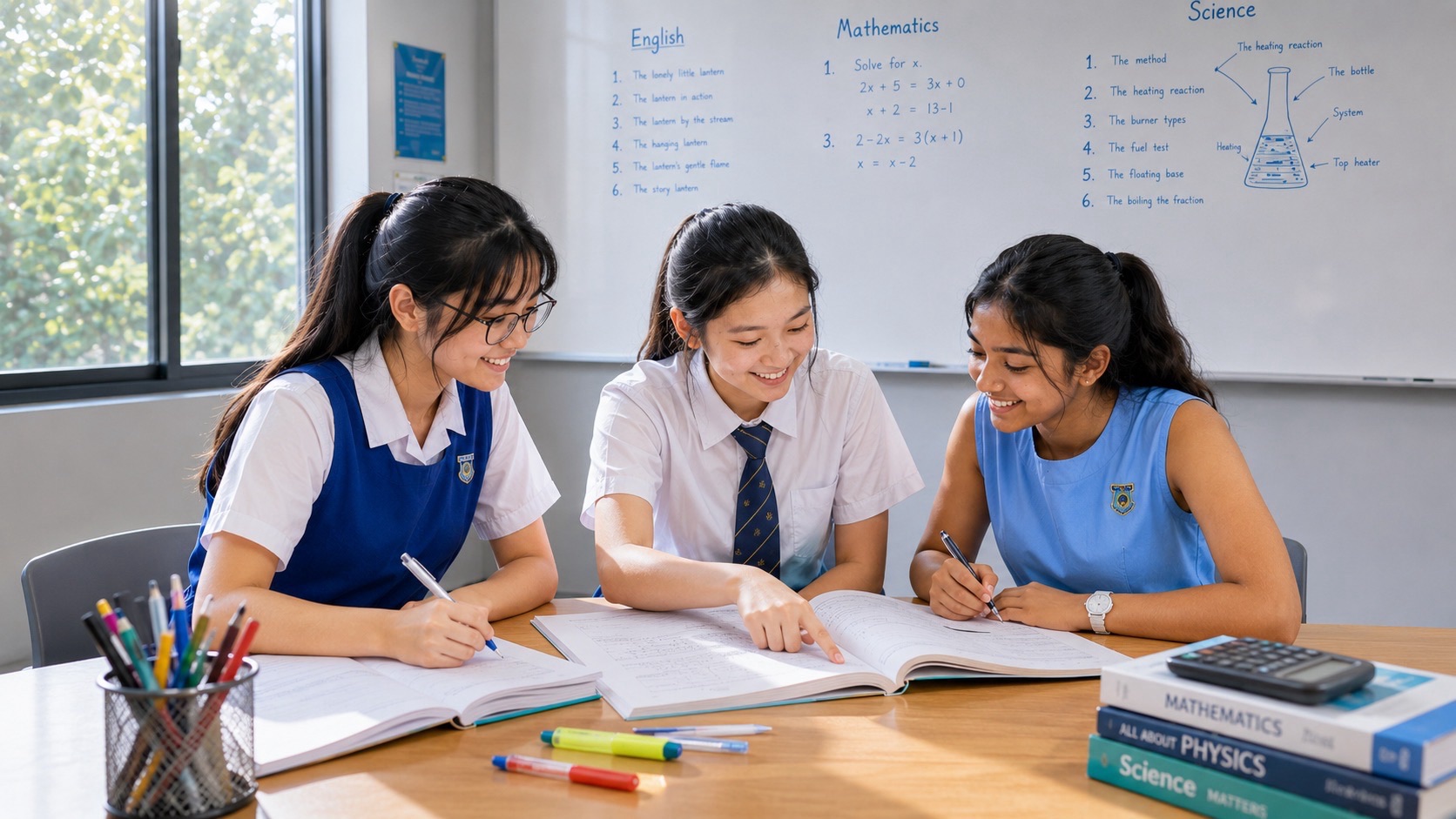
South Korea school exchange vocabulary, composition writing, travel journal writing, homestay English and classroom English work best as one connected learning system. This guide gives students a 200-word English vocabulary bank for a South Korea school exchange and shows how to turn those words into accurate observations, journal entries, descriptive paragraphs, narratives, reflections, comprehension answers and examination-ready composition writing.
For students searching for South Korea school exchange vocabulary words, Grade 5 vocabulary, Primary 5 English vocabulary, Primary 6 vocabulary, PSLE composition vocabulary, travel writing vocabulary, descriptive vocabulary, school trip composition writing, travel journal examples, homestay vocabulary, Korean culture vocabulary and composition writing ideas, the central principle is simple: do not memorise impressive words and force them into a story. Build knowledge first, observe carefully, retrieve the right vocabulary, and use each word because the situation provides evidence for it.
This South Korea learning package connects vocabulary meanings and examples with Seoul, school life, host-family experiences, transport, food, friendship, cultural adjustment, heritage, society and civilisation. It continues eduKate’s South Korea Student Knowledge Guide, Top 200 Vocabulary Words for Visiting South Korea, South Korea Composition Writing, PSLE Composition Practice and the wider Vocabulary Learning Hub.
Direct answer: what should a student learn before a South Korea school exchange?
A student should prepare five kinds of knowledge together: functional language for asking, clarifying and responding; observation vocabulary for describing places and events; social vocabulary for friendship, cooperation and cultural adjustment; academic vocabulary for explaining evidence, causes and significance; and reflective vocabulary for turning an experience into thoughtful writing.
The exchange itself becomes a learning laboratory. A classroom is a place to observe communication and education. A host-family meal becomes a lesson in language, etiquette and relationship-building. A metro journey becomes a lesson in infrastructure and public coordination. A palace or museum becomes a route into heritage and civilisation. A misunderstanding becomes material for narrative structure, character development and reflection.
The eduKate exchange-learning mechanism
PREPARE → ARRIVE → OBSERVE → ASK → CLARIFY → PARTICIPATE → RECORD → RETRIEVE → EXPLAIN → WRITE → REFLECT → TRANSFER
Vocabulary becomes durable when students meet it in a meaningful situation, retrieve it later, compare it with nearby words, use it in writing and receive feedback. The destination supplies the knowledge environment; English supplies the tools for understanding and communicating that experience.
Top 200 vocabulary words for a South Korea school exchange
Each group has a job. Students should learn the words through meaning, collocation, context and retrieval rather than treating the list as 200 isolated definitions.
1–20: Arrival, orientation and navigation
1 arrival — reaching a destination; 2 departure — leaving; 3 orientation — introduction to a new place or system; 4 itinerary — organised travel plan; 5 destination — place being travelled to; 6 navigate — find a route; 7 transfer — change route or service; 8 route — way between places; 9 landmark — recognisable feature; 10 vicinity — nearby area; 11 concourse — large station area; 12 platform — boarding area beside a railway; 13 signage — informational signs; 14 accessible — easy to reach or use; 15 efficient — working well with little waste; 16 orderly — controlled and organised; 17 unfamiliar — not previously known; 18 anticipate — expect and prepare; 19 verify — check correctness; 20 adjust — change to fit conditions.
21–40: School and classroom learning
21 curriculum — planned school learning; 22 lesson — organised teaching period; 23 assignment — set piece of work; 24 instruction — direction explaining what to do; 25 demonstration — showing how something works; 26 discussion — conversation examining a topic; 27 participate — take part; 28 collaborate — work together; 29 contribute — add useful effort or ideas; 30 concentrate — direct attention; 31 attentive — paying careful attention; 32 inquisitive — eager to learn; 33 academic — relating to formal study; 34 method — organised way of doing something; 35 strategy — planned approach; 36 feedback — information for improvement; 37 revise — review or improve; 38 compare — examine similarities and differences; 39 interpret — explain meaning; 40 evaluate — judge using evidence.
41–60: Communication and clarification
41 communicate — exchange information; 42 clarify — make clearer; 43 explain — make understandable; 44 paraphrase — restate meaning; 45 gesture — communicative movement; 46 expression — look, phrase or action conveying meaning; 47 pronounce — produce word sounds; 48 misunderstand — interpret incorrectly; 49 confusion — lack of clear understanding; 50 hesitate — pause through uncertainty; 51 respond — answer or react; 52 acknowledge — show recognition; 53 request — politely ask; 54 enquire — ask for information; 55 translate — render meaning in another language; 56 context — surrounding information; 57 precise — exact; 58 appropriate — suitable; 59 tactful — careful not to offend; 60 courteous — polite and considerate.
61–80: Host family, home and everyday routines
61 host — person receiving a guest; 62 guest — invited visitor; 63 hospitality — generous treatment of guests; 64 household — people living in one home; 65 routine — usual sequence; 66 custom — established community practice; 67 etiquette — accepted polite behaviour; 68 considerate — attentive to others; 69 respectful — showing proper regard; 70 grateful — thankful; 71 appreciate — recognise value; 72 accommodate — adjust or provide space; 73 responsibility — duty and accountability; 74 independent — able to manage without constant help; 75 adaptable — able to adjust; 76 punctual — on time; 77 permission — approval; 78 privacy — freedom from intrusion; 79 belongings — personal possessions; 80 courtesy — respectful politeness.
81–100: Friendship and social connection
81 acquaintance — person known but not close; 82 companion — person accompanying another; 83 friendship — relationship of affection and trust; 84 rapport — comfortable mutual understanding; 85 trust — confidence in reliability; 86 cooperate — work willingly together; 87 encourage — give confidence; 88 reassure — reduce worry; 89 include — make part of a group; 90 welcome — receive warmly; 91 empathetic — understanding another’s feelings; 92 generous — willing to share or help; 93 patient — able to wait calmly; 94 cooperative — willing to work together; 95 supportive — giving help; 96 reserved — socially restrained; 97 outgoing — socially confident; 98 awkward — socially uncomfortable; 99 bond — relationship strengthened by experience; 100 belonging — feeling accepted in a group.
101–120: Food, culture and sensory observation
101 cuisine — style of cooking; 102 ingredient — component of food; 103 fermented — changed through controlled microbial action; 104 savoury — salty or spicy rather than sweet; 105 aromatic — pleasantly noticeable in smell; 106 fragrant — pleasantly scented; 107 pungent — very strong in smell or taste; 108 crisp — pleasantly firm; 109 tender — soft and easy to chew; 110 steaming — giving off hot vapour; 111 sample — try a small amount; 112 speciality — product for which a place is known; 113 communal — shared by a group; 114 tradition — practice passed through generations; 115 ceremony — formal event with established actions; 116 heritage — inherited culture, places and traditions; 117 identity — qualities shaping who people understand themselves to be; 118 distinctive — recognisably different; 119 vibrant — energetic and lively; 120 intricate — containing many small details.
121–140: Places, transport and city observation
121 bustling — full of energetic activity; 122 crowded — containing many people; 123 tranquil — peacefully calm; 124 historic — important in history; 125 modern — present-day in design or system; 126 urban — relating to a city; 127 district — particular city area; 128 infrastructure — systems allowing society to function; 129 network — interconnected system; 130 pedestrian — person travelling on foot; 131 intersection — place where roads meet; 132 commute — travel regularly between places; 133 transit — movement through a transport system; 134 architecture — design and construction of buildings; 135 courtyard — open space enclosed by buildings or walls; 136 pavilion — light or decorative building; 137 skyline — outline of buildings against the sky; 138 neighbourhood — local residential area; 139 preserve — protect from damage or loss; 140 contrast — clear difference between things.
141–160: Feelings, adjustment and resilience
141 curious — eager to know; 142 fascinated — intensely interested; 143 startled — suddenly surprised; 144 anxious — worried about an uncertain outcome; 145 uneasy — slightly worried or uncomfortable; 146 relieved — no longer worried after difficulty ends; 147 delighted — strongly pleased; 148 embarrassed — socially uncomfortable after attention or a mistake; 149 ashamed — distressed about wrongdoing; 150 remorseful — deeply regretful about wrongdoing; 151 frustrated — annoyed by blocked progress; 152 overwhelmed — feeling unable to cope with too much at once; 153 homesick — missing home while away; 154 confident — reasonably sure of one’s ability; 155 resilient — able to recover from difficulty; 156 persistent — continuing despite difficulty; 157 determined — firmly committed; 158 cautious — careful about risk; 159 resourceful — good at finding practical solutions; 160 mature — showing developed judgement.
161–180: Thinking, evidence and academic reflection
161 observe — notice carefully; 162 infer — conclude from evidence; 163 evidence — information supporting a conclusion; 164 accurate — correct and precise; 165 relevant — connected to the matter being considered; 166 analyse — examine parts and relationships carefully; 167 distinguish — recognise an important difference; 168 perspective — way of seeing or understanding something; 169 significance — importance or meaning; 170 insight — clear, deep understanding; 171 assumption — belief accepted without sufficient proof; 172 consequence — result of an action or decision; 173 alternative — another possible choice; 174 priority — something treated as more important; 175 connection — relationship between ideas or things; 176 pattern — repeated or recognisable arrangement; 177 cause — factor producing an effect; 178 effect — result produced by a cause; 179 conclusion — judgement reached from reasoning or evidence; 180 synthesis — combining information into a coherent understanding.
181–200: Reflection, writing and transfer
181 reflect — think carefully about experience; 182 reconsider — think again about an earlier view; 183 recognise — identify or acknowledge; 184 appreciate — understand value more fully; 185 memorable — worth remembering; 186 meaningful — having importance or purpose; 187 transformative — producing substantial change; 188 awareness — knowledge or understanding of a situation; 189 growth — development over time; 190 independence — ability to act without constant help; 191 judgement — ability to make sensible decisions; 192 responsibility — duty and accountability; 193 resilience — ability to recover from difficulty; 194 adaptation — adjustment to changed conditions; 195 discovery — finding or learning something new; 196 narrative — structured account of events; 197 description — language representing qualities or details; 198 reflection — careful thought about meaning or learning; 199 transfer — applying learning in a new context; 200 mastery — reliable, flexible control developed through learning and practice.
How to turn the 200 words into usable vocabulary
A list becomes useful only when students can retrieve and select from it without the list doing the thinking. For each word, build four layers: a precise meaning, one natural collocation, one contrast with a nearby word, and one fresh sentence. For example, relieved often follows the ending of worry; delighted centres on strong pleasure. Persistent can be admirable when effort continues despite difficulty; stubborn becomes less favourable when a person refuses to change despite good evidence.
Use a retrieval loop: read ten words, close the page, retrieve them from meanings, return a day later, then use three in a journal paragraph. A week later, ask for the words from situations rather than definitions. “Which word describes checking the station number before boarding?” should cue verify. “Which word describes changing behaviour to fit a host family’s routine?” should cue adapt or adaptable, depending on the grammar.
Before departure: prepare language for real situations
Preparation should reduce avoidable cognitive load without trying to script the entire exchange. Students need a small set of reliable moves: introduce themselves, ask someone to repeat or clarify, check a meeting time, explain a food preference or allergy accurately, ask permission before using something, thank a host, apologise for a mistake, describe where they are, and seek help from a responsible adult. These are functional language tasks. They matter because uncertainty in a new environment can consume attention that would otherwise be available for observing, learning and writing.
A useful pre-departure exercise is to rehearse situations rather than memorise speeches. One student plays a host sibling; another arrives unsure where to put shoes or luggage. One student plays a teacher giving unfamiliar instructions; the visitor must clarify without pretending to understand. Another exercise places the learner at a station where the route has changed. The student must identify what is known, what is uncertain and what needs verification. The language target is not sophistication. It is clear, respectful communication under realistic conditions.
Classroom English: observe before comparing
A school exchange naturally invites comparison, but comparison becomes educational only when it begins with evidence. “Their school is stricter” is a conclusion. What was actually observed? Perhaps students arrived before a bell, changed classrooms in a particular pattern, greeted a teacher in a particular way, used devices differently, ate lunch together, cleaned a shared space or participated in an activity unfamiliar to the visitor. Record the behaviour first. Then ask what explanation might fit. Finally, distinguish observation from interpretation.
This distinction is valuable for English examinations too. Comprehension requires students to support interpretations from textual evidence. Composition requires believable details rather than unsupported labels. A travel journal can therefore train the same intellectual habit: I saw → I inferred → I checked → I revised. If a pupil initially interprets quietness as lack of friendliness, later conversation may reveal concentration, uncertainty or simply a different classroom norm. The revised understanding is richer because it records a change in evidence.
A classroom observation grid
| Observation | Possible inference | Question to verify | Writing use |
|---|---|---|---|
| Students move quickly when the bell sounds | time routines may be tightly organised | What happens if someone is late? | setting and school routine |
| Group members divide a task without argument | roles may already be familiar | How were roles decided? | cooperation paragraph |
| A classmate waits while the visitor searches for a word | patient communication | Was this typical or individual? | characterisation through action |
| Students use a digital platform during class | technology is integrated into this lesson | How often is it used? | education and technology reflection |
Homestay English: language, trust and everyday life
A homestay is one of the richest writing environments because important learning happens through ordinary routines. Breakfast time, bathroom schedules, transport to school, where belongings are kept, whether food is shared from common dishes, when homework is done, how family members address one another, and what happens in the evening can all become material. The student’s job is not to rank one household against another. It is to notice how a particular family organises life and to respond respectfully.
Good homestay writing also avoids turning cultural difference into spectacle. One family does not represent an entire country. A visitor should write “In my host family…” when describing household practice unless there is reliable evidence that a custom is wider. This small language choice teaches an important reasoning principle: do not generalise from one case beyond the evidence available.
Useful homestay situations to practise
- asking where to place shoes, bags or laundry;
- explaining that you do not understand an instruction;
- asking before using a household object;
- thanking someone for preparing food or adjusting a routine;
- responding tactfully when offered unfamiliar food;
- explaining a genuine dietary restriction without insulting the dish;
- checking the next morning’s departure time;
- apologising after accidentally breaking or misplacing something;
- offering practical help rather than remaining a passive guest;
- writing a thank-you note that names specific acts of hospitality.
Food writing: from “delicious” to evidence
Food is often the first topic students reach for and the easiest to write badly. “The food was delicious” reports judgement but gives the reader almost nothing to imagine. Better food writing separates appearance, aroma, texture, temperature, flavour and reaction. A steaming bowl may carry an aromatic broth; vegetables may remain crisp; a sauce may be savoury, sweet, spicy or tangy. A pungent smell can initially make a visitor hesitate without implying that the food is bad.
Food also creates character. A student who rejects something before asking what it is may later recognise an assumption. A student who samples a small portion despite uncertainty can be cautious and open-minded at the same time. A host sibling who notices discomfort and explains the dish tactfully demonstrates empathy. The vocabulary becomes useful because the social situation gives each word a reason to exist.
The travel journal: capture evidence before memory edits it
A travel journal is not a diary of everything that happened. It is a capture system for details that may later become writing. The best entries are short enough to sustain every day but structured enough to preserve evidence. Record one place, one interaction, one sensory detail, one unfamiliar word or idea, one question, one moment of difficulty, and one change in understanding. Photographs can preserve appearance; the journal should preserve interpretation, dialogue fragments, uncertainty and thought.
The seven-line journal
- Place: Where exactly was I?
- Observation: What did I notice that another person might have missed?
- Language: Which useful word or phrase belongs to this experience?
- Interaction: What did someone say or do?
- Difficulty: What was uncertain, awkward or challenging?
- Learning: What did I understand after asking, checking or participating?
- Transfer: Could this become a composition scene, comprehension idea, oral example or reflection?
Example journal entry: first school lunch
Place: school dining area. Observation: classmates seemed to know the movement pattern without discussing it. Language: orderly, communal, unfamiliar, courteous. Interaction: my buddy noticed that I was hesitating and quietly showed me where to return the tray. Difficulty: I did not want to hold up the line by asking too many questions. Learning: observing first helped, but asking one precise question was better than copying without understanding. Transfer: this could become a story about learning that independence includes asking for clarification.
From journal note to composition paragraph
The journal stores raw material. Composition selects and shapes it. A real exchange may contain fifty events; a good narrative may need only five. Choose an event with a goal, obstacle, decision and consequence. Then use setting details that matter to that event.
Raw note: “Wrong station exit. Raining. Could not see teacher. Asked shop staff. Felt silly.”
Developed paragraph: “Rain blurred the street beyond the station doors. I had been so certain that Exit Four was correct that I had walked out without checking whether the others were behind me. Now the meeting point was nowhere in sight. Embarrassment tempted me to keep searching alone, but every unfamiliar intersection made that decision less sensible. I returned to the station entrance, verified the exit number on the map and asked a staff member to clarify the directions.”
The vocabulary is not decorative. Embarrassment explains the temptation to hide the mistake; verify marks a change from assumption to evidence; clarify identifies the communication task. This is how vocabulary becomes narrative machinery.
Composition writing: make the exchange experience do narrative work
A school exchange is full of possible stories, but a composition still needs selection. Begin with a character goal: make a good first impression, find the correct classroom, complete a group task, buy a small gift, navigate back to the host home, try an unfamiliar activity or help another exchange student. Then introduce a believable obstacle. The strongest conflicts are often ordinary: misunderstood instructions, misplaced belongings, a wrong station exit, homesickness, an awkward introduction, a careless assumption, an unfamiliar meal, a disagreement in a group or an unexpected timetable change.
The turning point should be a decision rather than luck. A lost student stops guessing and verifies the route. A homesick student accepts an invitation instead of withdrawing. A pupil who made an insensitive remark apologises and asks a better question. A group that cannot communicate divides the task into visible steps. This creates agency and allows vocabulary such as resourceful, tactful, responsible, resilient, clarify, reconsider and cooperate to emerge naturally.
Story route 1: The first classroom misunderstanding
Setup: The visitor wants to appear capable and avoids asking questions. Problem: An instruction is misunderstood during group work. Escalation: The group begins completing the wrong part of the task. Turning point: The visitor admits uncertainty and asks the host student to clarify. Resolution: The group corrects the work. Reflection: pretending to understand is not independence; effective communication includes checking meaning.
Story route 2: Homesick at the host home
Setup: The first school day has been exciting but exhausting. Problem: Familiar routines disappear in the evening and homesickness rises. Escalation: The student declines conversation and retreats to the room. Turning point: A host sibling invites the visitor to help with a simple household activity. Resolution: Shared action makes conversation easier than forced small talk. Reflection: belonging often develops through repeated ordinary participation rather than one dramatic moment.
Story route 3: The wrong station exit
Setup: Students are returning from an activity and have a clear meeting point. Problem: One pair uses the wrong exit. Escalation: Rain and unfamiliar intersections make the street difficult to recognise. Turning point: They return to a known landmark, verify the map and contact the responsible adult. Resolution: The group reunites. Reflection: a calm correction is more useful than defending a mistake.
Precision workshop: nearby words are not interchangeable
| Words | Boundary to teach |
|---|---|
| curious / fascinated | desire to know versus very strong sustained interest |
| anxious / uneasy | stronger worry about an uncertain outcome versus milder discomfort |
| relieved / delighted | ending of worry versus strong pleasure |
| embarrassed / ashamed / remorseful | social discomfort versus moral self-judgement versus deep regret for wrongdoing |
| persistent / stubborn | continuing despite difficulty versus refusing to change despite good reasons |
| confident / certain | reasonable belief in ability versus absence of doubt; confidence can still be wrong |
| courteous / tactful | general politeness versus careful wording to avoid unnecessary offence |
| observe / infer / assume | notice evidence versus reason from evidence versus accept without sufficient proof |
| historic / historical | important in history versus relating to history generally |
| crowded / bustling | many people versus energetic activity |
Comprehension passage: The Group Task
On my second morning, our host teacher placed us in groups and projected a set of instructions. I recognised most of the words, so when Min-jun asked whether I understood, I nodded immediately. Ten minutes later, I noticed that the other groups were arranging their notes differently. My first thought was that they had misunderstood the task. Then I looked again at the final instruction and realised that I had ignored one small phrase.
Heat rose to my face. Our group had followed my suggestion. I could have quietly changed my own section, but that would not repair everyone else’s work. I pointed to the line I had missed and admitted the mistake. Min-jun read it again, paraphrased the instruction in simpler English and asked whether his explanation matched what I understood. This time, I did not nod automatically. I repeated the task in my own words. Only then did we continue.
Questions
- Why did the narrator initially say that the instructions were understood?
- What evidence first caused the narrator to reconsider?
- Why does “heat rose to my face” suggest embarrassment rather than remorse?
- What did Min-jun do besides repeating the original instruction?
- Why was the narrator’s second response more reliable than the first?
- What broader lesson about communication can be inferred?
Suggested answers
1. Most of the words looked familiar, and the narrator wanted to show understanding. 2. Other groups were organising their work differently. 3. The immediate issue is a public/social mistake, not deliberate wrongdoing. 4. He paraphrased the instruction and checked shared understanding. 5. The narrator restated the task independently instead of giving an automatic yes. 6. Recognition of words is not the same as understanding an instruction; clarification and paraphrase can verify meaning.
Examination transfer: use the exchange without forcing the destination
In an examination, the prompt controls the story. South Korea should be used only when it provides a natural setting for the required idea. A prompt about responsibility could use a meeting-time mistake. A prompt about kindness could use a host sibling including a nervous visitor. A prompt about learning from a mistake could use the classroom misunderstanding. A prompt about courage need not involve physical danger; speaking up after misunderstanding an instruction can require social courage.
Before writing, compress the story into six beats: goal → problem → failed first response → complication → better decision → consequence/reflection. Then select six to ten vocabulary items that genuinely fit those beats. Do not choose words first and invent scenes merely to display them. Vocabulary should serve meaning.
Oral communication transfer
The same knowledge can support oral discussion. A student asked whether school exchanges are useful can move beyond “they are fun”. A stronger answer might explain that an exchange creates situations in which students must communicate with unfamiliar people, adapt to routines, observe another education environment and reflect on assumptions. A concrete example—such as clarifying a classroom instruction or learning a host family routine—makes the response credible.
Culture, society and civilisation: widen the lens carefully
A school exchange can connect personal experience to larger systems without turning every journal entry into a lecture. Culture becomes visible through shared meanings, food, language, etiquette, architecture and practices. Society becomes visible through schools, transport, public behaviour, rules and institutions. Civilisation becomes visible when students ask how education, infrastructure, memory, technology, institutions and culture persist and interact across time.
A metro journey, for example, is simultaneously personal and systemic. The student experiences signs, platforms and transfers; behind those are engineering, schedules, maintenance, electricity, mapping, public rules and institutional coordination. A palace visit can be descriptive at the surface while also opening questions about preservation, memory and historical institutions. This is the purpose of linking the exchange article into eduKate’s South Korea: Culture, Society and Civilisation for Students, How MRT Works | It’s Mathematics and What is Civilisation.
Practice set: retrieve, choose, explain
- Which word means checking that information is correct?
- Which word describes a comfortable mutual understanding between people?
- Which word is better when a previous worry has ended: relieved or delighted?
- A student refuses to change an answer after clear evidence appears. Is persistent or stubborn more precise?
- Which verb means reaching a conclusion from evidence?
- Which word describes polite behaviour generally: courteous or tactful?
- Which word describes adjustment to changed conditions?
- What is the difference between an observation and an assumption?
- Write one sentence showing resourceful through action without using the word itself.
- Write one sentence in which homesick is supported by behaviour rather than simply announced.
Answers: 1 verify. 2 rapport. 3 relieved, because the defining change is the ending of worry. 4 stubborn, because evidence provides a reason to change. 5 infer. 6 courteous; tactful is more specifically about avoiding unnecessary offence in a delicate situation. 7 adaptation. 8 An observation reports what was noticed; an assumption accepts an explanation without sufficient evidence. Questions 9 and 10 are open-ended: accept responses when the action or behaviour supplies convincing evidence for the target idea.
A practical 10-day preparation cycle
- Learn words 1–20 and practise a station scenario.
- Learn 21–40 and compare classroom-learning vocabulary.
- Learn 41–60 and rehearse clarification.
- Learn 61–80 and write a host-family etiquette paragraph.
- Learn 81–100 and write about inclusion and friendship.
- Learn 101–120 and create precise sensory sentences.
- Learn 121–140 and describe a city route using observable detail.
- Learn 141–160 and practise emotion distinctions.
- Learn 161–180 and answer evidence/inference questions.
- Learn 181–200, retrieve across all groups and write one full exchange composition.
Continue through the South Korea learning ecosystem
- Visiting South Korea | A Student Knowledge Guide for Composition Writing
- Top 200 Vocabulary Words for Visiting South Korea
- Composition Writing: A Trip to South Korea
- PSLE Composition Practice | Visiting South Korea
- South Korea Writing Workbook
- South Korea: Culture, Society and Civilisation for Students
- Top 200 PSLE Vocabulary List | Examination Preparation
- Vocabulary Learning Hub