
Kembangan tuition should improve the student, not simply occupy another evening. For families in Kembangan, the useful question is not whether tuition is common, convenient or academically respectable. The useful question is whether the lessons are changing what the student can actually do: understand more clearly, remember more reliably, start work with less hesitation, correct mistakes sooner and perform with greater control when the answer is not obvious.
Kembangan families have no shortage of educational options across the east. The risk is not lack of activity; it is imprecision. When a child is struggling, it is easy to respond with more lessons, more assessment books and more papers. Improvement becomes faster when the family first identifies the actual bottleneck.
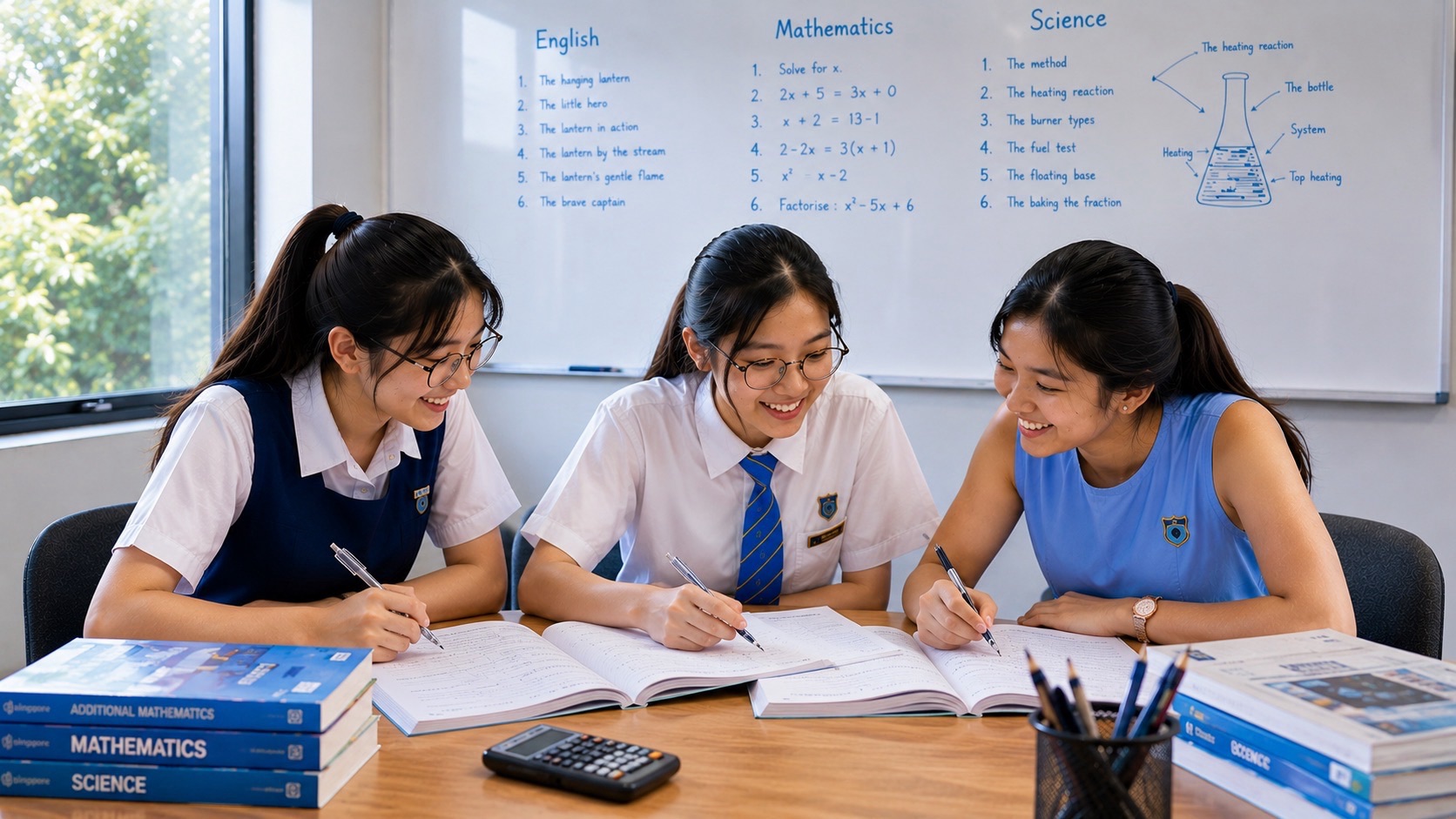
At eduKateSG, we work in premium 3-pax small-group tutorials near Sixth Avenue MRT. Lessons are typically 1.5 hours weekly, with materials, guided correction, focused continuation work and support around important school assessments. The small class is not the improvement by itself. It is the working space in which the tutor can see enough of the student’s thinking to make the next correction precise.
- repair gaps that are blocking current schoolwork
- turn inconsistent understanding into dependable performance
- improve accuracy, working habits and question reading
- learn how to revise rather than merely complete worksheets
- build independent application after explanation
- prepare slightly ahead when foundations are ready
How to Improve With Tuition in Kembangan: Start With the Right Definition of Improvement
For a Kembangan student, improvement means precision. The child should spend less time attacking the wrong problem. Tuition should identify the smallest high-value weakness, repair it, test whether the repair transfers and only then move to the next constraint.
A score can move for many reasons. A paper may be easier. A familiar chapter may appear. A student may guess well. A parent therefore needs a wider definition of progress. Strong tuition should produce changes that remain visible when the exact worksheet changes.
- the student can name the exact error pattern
- practice sets become more targeted
- corrections are redone from memory
- fewer marks are lost to the same cause
- time is spent on the weakest useful link rather than the loudest complaint
- the student becomes better at self-diagnosis
These are leading indicators. Marks matter, but they are usually the visible end of a chain that begins earlier: better diagnosis, clearer explanation, stronger recall, more deliberate practice, cleaner execution and better self-correction.
The Hidden Problem: A Vague Diagnosis Produces Vague Tuition
“Weak in Maths” is not a teaching plan. “Needs to improve English” is not a teaching plan. “Science answers are not good enough” is not a teaching plan.
A useful diagnosis is smaller. The student loses control of negative signs inside algebra. The comprehension answer identifies the right part of the passage but cannot infer the implied reason. The Science response states what happened but omits the mechanism. The composition has ideas but weak paragraph development.
Once the problem is small enough to see, the tutor can choose the right intervention and test whether it worked.
More work is not always more learning
When students are anxious, the instinct is often to add volume: more worksheets, more assessment books, more tuition hours, more timed papers. Volume can help when the student already has the right method and simply needs fluency. It is much less useful when the student is repeating the same misunderstanding at greater speed.
A Kembangan student who already knows a topic but makes copying errors may need a checking protocol, not another chapter of explanation. A student who cannot recall core vocabulary may need retrieval, not a full examination paper. Precision protects time.
Why a 3-Pax Tutorial Can Make Improvement More Visible for Kembangan Students
A 3-pax class allows precise observation. The tutor can inspect the line where a calculation changes, the word omitted from a sentence, the evidence ignored in a passage or the missing link in a Science explanation. The group remains small enough to intervene without turning every task into one-to-one dependency.
- the tutor can inspect individual working instead of seeing only final answers
- students answer frequently and cannot disappear quietly inside a large room
- pace can slow down for repair and speed up when control returns
- another student’s explanation can expose a different way of seeing the same problem
- mistakes can be corrected while the thinking is still fresh
- practice can move from guided to independent within the same lesson
The aim is not constant attention for its own sake. The aim is high-resolution feedback. A useful tutorial gives the tutor enough information to decide what the student should do next, and gives the student enough responsibility to do it.
The Three Improvement Pathways
1. Repair
The repair pathway isolates a foundation that is contaminating current work.
- fraction operations causing algebra errors
- weak vocabulary reducing comprehension and writing
- uncertain grammar creating sentence-level noise
- poor concept links producing incomplete Science explanations
- weak question reading causing wrong-method choices
Repair is successful when the student no longer needs to work around the weakness. The repaired skill becomes part of normal performance.
2. Stabilise
The stabilisation pathway targets error patterns that appear after understanding is already present.
- copying and notation errors
- rushing at the start of papers
- failure to check units or command words
- forgetting methods after a delay
- overreliance on one familiar question format
Stabilisation is less dramatic than rescue, but it is often the stage that turns a fragile pass into dependable competence.
3. Extend
The extension pathway increases precision at a higher level.
- tighter written explanations
- more efficient solution paths
- stronger evidence selection
- comparison of alternative methods
- harder questions chosen for a specific purpose rather than prestige
Extension is not racing through chapters. It is increasing the student’s range without sacrificing accuracy or understanding.
A First-Principles Method for Improvement
1. Diagnose the exact failure
We inspect the student’s working backward from the visible error. Where did the first wrong decision occur? Was the instruction misread? Was a fact forgotten? Was the concept misunderstood? Did working memory overload? Did the student know the method but abandon it under time pressure?
Broad labels such as “weak in English”, “careless in Maths” or “cannot answer Science” are too large to teach from. A tutor needs a smaller target: the vocabulary is insufficient for inference, the algebra breaks when negatives appear, the Science explanation names the observation but not the mechanism, the student knows the content but loses time deciding how to begin.
2. Return to the first unstable point
Improvement becomes faster when repair begins at the earliest point that still matters. This may be a Primary-school fraction operation appearing inside Secondary algebra, sentence control affecting composition, or weak concept vocabulary limiting Science explanations. Returning to that point is not a detour. It removes the obstruction that is making the current topic unnecessarily hard.
3. Fence the task before increasing difficulty
Students learn more cleanly when one source of difficulty is controlled at a time. A tutor may begin with a familiar question type, stable numbers, a clear passage or one Science variable. Once the method is secure, difficulty is added deliberately: unfamiliar wording, mixed topics, time pressure, less prompting and more independent judgement.
4. Make the student explain
Students are asked to explain the decision point, not recite the whole chapter. Why this operation? Why this quotation? Why this variable? Why this paragraph order? Precision in explanation usually improves precision in performance.
Explanation forces knowledge into a usable form. It also reveals whether the student is following a rule, recognising a pattern or genuinely understanding the relationship.
5. Retrieve instead of only rereading
Students should repeatedly bring knowledge back without looking at the answer first. Short retrieval at the beginning of a lesson, mixed questions later in the lesson and brief recall between lessons help knowledge remain available when school questions arrive without chapter labels.
6. Interleave and transfer
After a repair, the student sees the same underlying idea in several forms. This prevents a narrow fix that only works on the training question. We verify that the correction survives changed numbers, wording, diagrams and timing.
7. Reduce prompts as control improves
A tutor should not become a permanent external brain for the student. Early prompts may be necessary, but they should gradually disappear. The student should learn to choose a method, check the answer, identify the mistake and decide what to revise next.
What Happens During a 90-Minute Improvement Lesson
Warm-up retrieval
The warm-up is diagnostic. A few carefully selected questions are chosen because each one reveals something useful about recall, reading, method selection or accuracy.
Diagnosis and correction
The tutor checks the current school topic, recent work and the student’s response to the warm-up. One or two high-value weaknesses are chosen. The lesson is not allowed to become a random tour of every error the student has ever made.
Concept instruction
Teaching is matched to the diagnosis. Sometimes that means a full concept explanation. Sometimes it means a two-minute correction to a notation habit. The lesson does not inflate a small problem into a large lecture.
Guided practice
The student attempts questions with the tutor close enough to intervene at the moment the reasoning changes direction. The tutor can ask a question, request an explanation or return to a simpler representation rather than simply supplying the next step.
Independent application
Help is withdrawn. The student works alone on selected questions. This is the point at which the lesson reveals whether teaching has become capability.
Mixed or timed work
Timing is used as a diagnostic instrument. If accuracy falls sharply when a short clock is introduced, we ask whether the cause is recall speed, poor sequencing, panic or premature rushing.
Error review
Mistakes are classified rather than merely crossed out. The student learns whether the problem came from reading, recall, concept, arithmetic, notation, language, organisation, overconfidence or time pressure. A named pattern is easier to repair than a vague feeling of being “bad at the subject”.
Focused continuation work
Home practice is chosen to preserve the lesson’s gain. A short, well-targeted set completed carefully is often more useful than a large stack that encourages copying, rushing or avoidance.
How Tuition Should Improve English
English improvement becomes more efficient when the tutor distinguishes language problems from thinking problems. A weak answer may come from vocabulary, evidence, inference, sentence control or organisation.
- vocabulary precision
- grammar patterns that repeatedly break
- evidence selection in comprehension
- inference and answer phrasing
- paragraph development in composition
- summary compression without meaning loss
Instead of correcting an entire page with equal weight, we identify the few changes that would most improve future writing and reading.
How Tuition Should Improve Mathematics
Mathematics lends itself to precision because working exposes the path. The visible answer is only the end point; the tutor follows the chain back to the first unstable move.
- sign and arithmetic control
- algebraic manipulation
- ratio and percentage setup
- geometry property selection
- formula substitution and units
- time allocation and checking
The student learns to distinguish a concept error from an execution error. This prevents unnecessary reteaching and makes revision more efficient.
How Tuition Should Improve Science
Science answers often fail by one missing link. The observation is correct, but the explanation does not name the process. The concept is remembered, but it is not connected to the data.
- concept identification
- complete cause-and-effect chains
- experimental variables
- graph and table evidence
- precise terminology
- answer completeness
A precise correction teaches the student what a complete scientific explanation contains and how to check for the missing link independently.
The Student Must Learn What to Do Between Lessons
Kembangan students should carry one diagnostic question into the week: what kind of mistake was this?
- attempt before checking the answer
- mark the exact line where confusion began
- redo selected errors without copying the previous solution
- retrieve key vocabulary, formulas or concepts from memory
- bring difficult school questions back to the next lesson
- stop when fatigue turns practice into careless repetition
When students classify their own errors, practice becomes less random. They begin to choose revision actions that match the problem instead of reaching automatically for another worksheet.
How Parents Can Tell Whether Tuition Is Working Before the Grade Moves
Parents can look for precision before they look for dramatic scores.
- the student describes specific weaknesses instead of whole subjects
- revision sessions become shorter but more purposeful
- the same error category appears less often
- the child knows what to redo after a marked paper
- practice materials are chosen for a reason
- questions brought to tuition are more focused
A parent does not need to interrogate the student after every lesson. A more useful approach is to watch for stable behavioural changes over several lesson cycles. Does the child begin work more readily? Are questions more specific? Is the student less dependent on model answers? Are corrected mistakes staying corrected?
Grades should eventually reflect stronger learning, but they are a lagging measure. Good tuition makes the earlier parts of the improvement chain visible.
When Tuition Is Not Working
Tuition is not working precisely when every weakness receives the same response: explain again, assign more questions, repeat. Different failures require different repairs.
- the student still cannot explain what is being repaired
- every lesson produces more notes but no stronger independent work
- the same mistakes return with no change in method
- homework volume grows while confidence and accuracy fall
- the tutor does most of the thinking
- schoolwork and tuition behave like two unrelated worlds
- the student becomes more dependent on hints over time
The answer is not always to stop tuition immediately. Sometimes the structure, pace or target needs to change. But families should be able to ask a simple question: what is becoming more capable because of these lessons?
Travelling from Kembangan to Sixth Avenue
Kembangan MRT is on the East–West Line. One practical route is to travel to Bugis, transfer to the Downtown Line and continue directly to Sixth Avenue. The journey is longer than a neighbourhood class, so the lesson needs to earn its place through focused work rather than generic repetition.
That makes precision especially important for east-side families. If a student travels across Singapore for a tutorial, the class should know what it is trying to change and should leave the student with a clear continuation path.
Location: eduKateSG, 8 Fourth Avenue, Singapore 268674
Nearest MRT: Sixth Avenue MRT, Downtown Line
Attendance: By appointment
Class Details
Format: Premium 3-pax small-group tutorials
Duration: Approximately 1.5 hours weekly
Teaching approach:
- first-principles explanation
- diagnosis before volume
- guided and independent practice
- retrieval and interleaving
- error analysis
- school-assessment alignment
- carefully paced pre-teaching when appropriate
Materials may include:
- curated lesson notes
- topic practice
- mixed revision
- assessment-style questions
- micro-tests
- focused continuation work
What Parents Can Bring to a Consultation
The best starting evidence is the student’s actual work. Useful materials include:
- recent school test papers
- marked assignments
- homework showing repeated difficulty
- teacher comments
- the school’s current topic sequence
- examples of work completed with heavy help
- questions the student avoids or cannot start
Recent marked work lets us separate symptoms from causes. We are interested in the first point where the student’s method became unreliable, not only in how many marks were lost at the end.
Frequently Asked Questions
How quickly should a Kembangan student improve with tuition?
A precise correction can change some behaviours quickly, especially when the problem is a repeated habit. Deeper concept repair takes longer. We look for fewer recurrences of the same error, stronger independent starts and better transfer before expecting every assessment score to move.
Should tuition immediately focus on exam papers?
Only when the student is ready. Exam papers are useful for integration, timing and diagnosis, but they are poor repair tools when a foundation is missing. A student who repeatedly fails the same concept needs targeted rebuilding before another full paper adds value.
Is more homework always better?
No. The amount should match the purpose. Fluency may require repetition. Concept repair may require fewer questions with slower explanation and correction. The test is whether practice is changing future performance.
What if my child understands in tuition but cannot do the work alone?
Then independence has not yet been built. The tutor should reduce prompts, include cold starts, use mixed practice and ask the student to explain decisions. Understanding while being guided is an intermediate stage, not the final goal.
Can tuition help a student who is already doing well?
Yes. Strong students often gain from precision because small inefficiencies become the main limit: imprecise explanations, unnecessary working, weak evidence selection, poor checking or suboptimal time allocation.
How do you reduce careless mistakes?
We separate them into types. Reading errors, sign errors, copying errors, weak recall, poor layout, overfast calculation and time-pressure mistakes require different responses. “Be more careful” is rarely a sufficient teaching plan.
Do you teach ahead of school?
Yes, when the foundation is stable. A calm first encounter can make the later school lesson easier to follow. We do not rush into new chapters when earlier knowledge is still unreliable.
Is tuition necessary for every student?
No. A student who is learning confidently, completing work independently and progressing well may not need additional tuition. Tuition is useful when it solves a real learning problem, provides a structure the student is not yet able to create alone, or offers appropriate extension.
How to Improve With Tuition | Kembangan
For Kembangan students, better tuition is not necessarily more tuition. It is tuition that knows exactly what it is trying to change.
Name the bottleneck. Repair it cleanly. Test the repair. Then move forward.
For families who want to understand the wider tuition structure, read How Tuition Works | The Tutorial Class Control Tower and How Singapore Works | Tuition.
eduKateSG
8 Fourth Avenue
Singapore 268674
Near Sixth Avenue MRT
Premium 3-pax small-group tuition
By appointment
Properly taught kids shine a bright light into the future.