
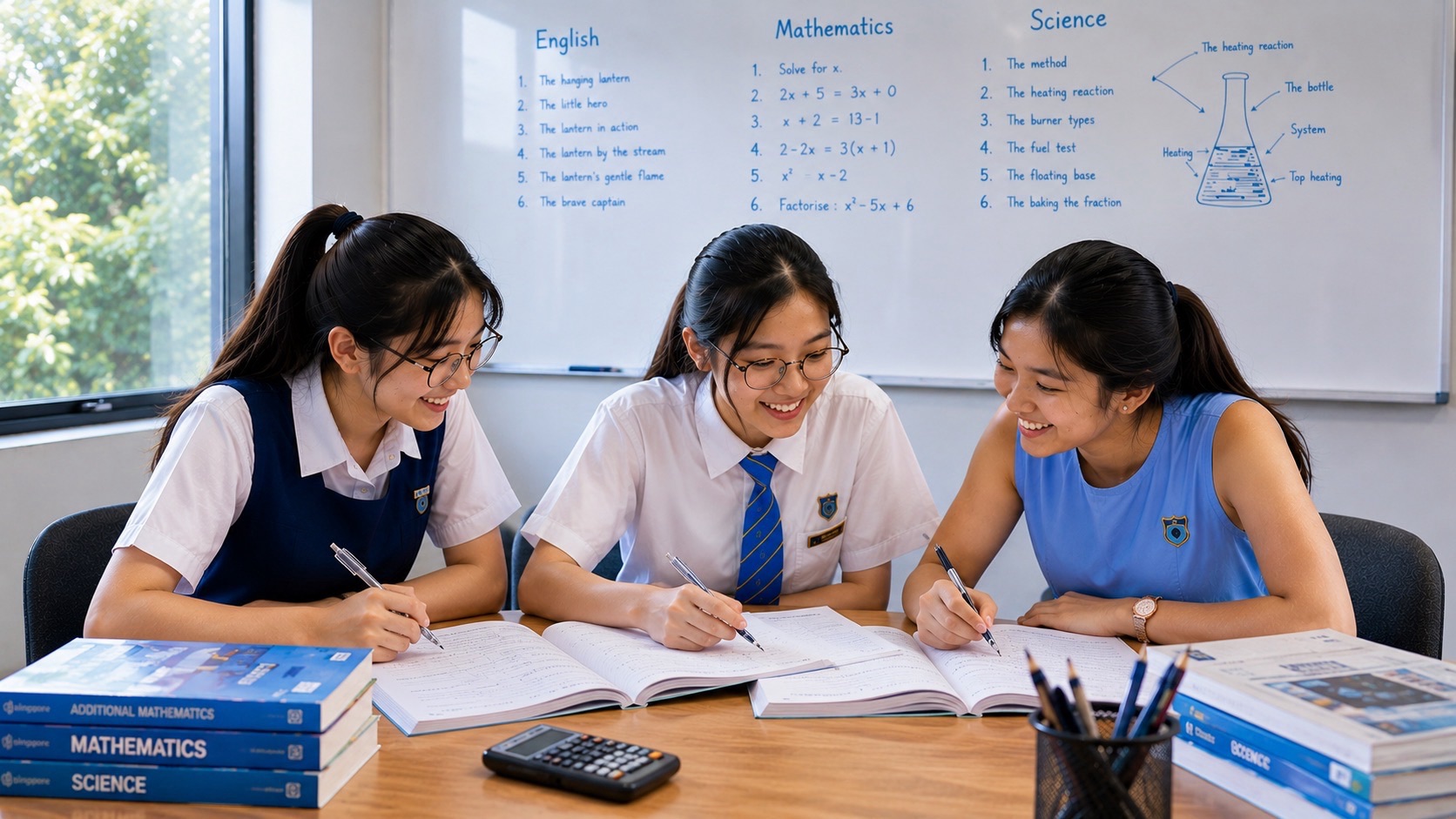
Marine Parade tuition should improve what the student can do independently, not simply increase the amount of academic activity in the week. A useful lesson changes capability: the student understands more clearly, retrieves more reliably, starts difficult work with less hesitation, corrects mistakes sooner and performs with greater control when the question no longer looks familiar.
Marine Parade students often balance school with a full east-coast family routine, and the danger is easy to recognise: when schedules become crowded, learning can become reactive. Tuition should create a stable weekly structure that keeps small weaknesses from accumulating into pre-exam emergencies.
At eduKateSG, we teach in premium 3-pax small-group tutorials near Sixth Avenue MRT. Lessons are typically around 1.5 hours weekly, with materials, guided correction, retrieval practice, mixed application and focused continuation work. The small group matters because it lets the tutor see the student’s thinking closely enough to make the next teaching move precise.
- diagnose the first unstable skill
- repair foundations before adding speed
- build retrieval so learning survives the week
- move from guided to independent application
- test transfer in changed contexts
- improve checking, timing and exam control
How to Improve With Tuition in Marine Parade
For a Marine Parade student, improvement means better academic maintenance. The student should detect small problems early, correct them while they are still small and keep important knowledge active across the term.
Improvement is therefore more than a mark. Marks matter, but they often move after the learning system has already changed. Better starts, fewer repeated mistakes, stronger recall and clearer method selection are leading indicators that the student is becoming more capable.
- fewer surprises before tests
- corrections happen soon after mistakes
- older topics remain available
- revision begins earlier
- the student notices recurring errors sooner
- exam preparation requires less emergency relearning
The aim is to make those improvements durable enough to survive ordinary school conditions: unfamiliar questions, busy weeks, tired evenings and assessment pressure.
The Hidden Problem: Small Academic Drift Is Easy to Ignore
Students rarely collapse in one dramatic moment. More often, one weak concept is left unresolved, then another. A vocabulary gap grows. A Mathematics rule becomes fuzzy. A Science explanation remains incomplete.
Because school continues moving, the student can appear to be coping until a cumulative paper exposes the accumulated drift.
Tuition should therefore function partly as maintenance: check the system, identify drift early and repair before the weakness becomes expensive.
More work can preserve the wrong pattern
Waiting until examination season and then adding large amounts of practice is less efficient than maintaining knowledge steadily across the term.
Practice should therefore match the failure. Concept gaps need explanation. Recall gaps need retrieval. Transfer gaps need variation. Timing problems need controlled speed work. Careless errors need classification and a checking routine.
Why a 3-Pax Tutorial Can Help Marine Parade Students Improve
A 3-pax tutorial makes small drift easier to detect. The tutor can notice a repeated hesitation or minor error pattern before it becomes a major assessment problem.
- the tutor can inspect working rather than only final answers
- students answer often enough to remain cognitively active
- pace can change when a hidden gap appears
- another student’s approach can expose a different way of seeing the problem
- mistakes can be corrected while the reasoning is still fresh
- independent work can be tested within the same lesson
The small group is not valuable because it creates constant attention. It is valuable because it creates high-resolution feedback. Better information leads to better teaching decisions.
The Three Improvement Pathways
1. Repair
Repair removes accumulated weaknesses that are already affecting current work.
- old arithmetic gaps resurfacing in algebra
- forgotten vocabulary affecting comprehension
- grammar errors recurring across compositions
- Science concepts partially remembered
- weak question-reading habits
Repair is successful when the student no longer needs to work around the weakness. The repaired skill becomes part of normal performance.
2. Stabilise
Stabilisation keeps repaired learning available.
- weekly retrieval
- cumulative mixed practice
- error-log review
- short timed sections
- delayed redos
Stabilisation turns occasional success into something the student can reproduce across ordinary school weeks.
3. Extend
Extension becomes possible when maintenance is strong enough that new difficulty does not destabilise earlier work.
- harder transfer questions
- deeper written explanation
- combined topics
- faster decision-making
- greater independence
Extension should increase range and depth without sacrificing clarity, accuracy or independence.
A First-Principles Improvement Loop
Diagnose the first unstable point
We compare current schoolwork with earlier patterns. The question is not only what is wrong now, but whether the error is new, recurring or gradually increasing.
Return to the earliest useful repair point
The visible error may be downstream from the real problem. Algebra can fail because fraction fluency is weak. Composition can fail because vocabulary and sentence control are weak. Science application can fail because the underlying concept relationship was never secure.
Teach the relationship clearly
The tutor repairs the relationship clearly enough that it can be checked and maintained later without full reteaching.
Practise with support
The student attempts carefully chosen questions while the tutor watches the decision points. Prompts are used to reveal thinking or repair a specific break, not to carry the student through the whole answer.
Remove support
The student is expected to recognise familiar error patterns independently and initiate correction.
Retrieve after a delay
The idea returns later without a long recap. If the student cannot bring it back after time has passed, the learning is not yet durable.
Transfer to a changed context
Maintenance is tested through mixed contexts so the knowledge does not remain tied to one chapter.
Add time pressure last
Timed work becomes useful after the method is stable. The goal is to preserve quality while increasing pace, not to turn rushing into an examination strategy.
What a 90-Minute Improvement Lesson Can Look Like
Cold-start retrieval
Each lesson begins with a short maintenance check drawn from older material as well as current topics.
Current schoolwork check
Recent homework, classwork and tests are reviewed for patterns. One or two high-value weaknesses are selected rather than trying to correct everything at once.
Targeted instruction
The tutor selects the small number of repairs that prevent the most future drift.
Guided application
The tutor stays close enough to intervene where reasoning changes direction, but avoids doing the thinking for the student.
Independent application
Prompts are removed. The student must choose and execute the method from a clean start.
Mixed or timed application
Timed work is used to see whether maintained skills remain available under pressure.
Error review
Mistakes are classified as reading, recall, concept, language, arithmetic, notation, organisation, timing or checking problems. The category determines the next repair.
Focused continuation work
The student leaves with a small amount of practice designed to preserve the gain. Homework should have a reason, not merely a page count.
How Tuition Should Improve English
English maintenance means vocabulary, grammar, comprehension and writing skills are revisited often enough to remain usable.
- vocabulary in context and precise word choice
- sentence control
- comprehension evidence and inference
- summary selection and compression
- composition planning and development
- editing and oral response
Students do not wait for a major composition or examination to rediscover the same sentence-level weakness.
How Tuition Should Improve Mathematics
Mathematics maintenance keeps earlier fluency available for later topics.
- number and fraction fluency
- algebraic manipulation
- ratio, percentage and proportional reasoning
- geometry and diagram interpretation
- mixed-topic method selection
- working, checking and time control
When older skills remain stable, new chapters place less strain on working memory.
How Tuition Should Improve Science
Science maintenance keeps concept relationships active across the term.
- concept vocabulary
- cause-and-effect explanation
- experimental variables
- data and graph interpretation
- application to unfamiliar contexts
- answer precision
Students revisit ideas in new contexts so cumulative assessments do not become a complete relearning exercise.
What the Student Should Do Between Lessons
Between lessons, Marine Parade students benefit from brief maintenance work rather than only current-chapter homework.
- attempt before checking the answer
- redo selected errors from a clean page
- retrieve key ideas without notes
- mark the exact point where confusion begins
- bring unresolved school questions back
- stop when fatigue turns practice into careless repetition
A small cumulative retrieval set can prevent much larger revision costs later.
How Parents Can See Improvement Before the Grade Moves
Parents may notice fewer academic emergencies.
- less last-minute relearning
- more stable schoolwork
- earlier correction of weak topics
- fewer repeated mistakes
- better recall before tests
- less dramatic fluctuation across assessments
Parents do not need to interrogate the student after every class. It is often more useful to watch the pattern across several weeks: better starts, fewer repeated errors, more precise questions and stronger independent corrections.
When Tuition Is Not Yet Working
Tuition is not yet working when every examination period requires rebuilding the same old foundations.
- the student cannot explain what is being repaired
- the same error returns without a change in method
- tuition examples do not transfer into schoolwork
- the tutor does most of the thinking
- homework volume rises while independence falls
- the student becomes more dependent on hints
The useful test is simple: what can the student now do more reliably than before?
Travelling from Marine Parade to Sixth Avenue
Marine Parade is served by the Thomson–East Coast Line. Students can travel toward Stevens, transfer to the Downtown Line and continue to Sixth Avenue.
For east-side families, the journey should return value through steady maintenance: fewer repeated weaknesses, stronger cumulative learning and less crisis revision.
Location: eduKateSG, 8 Fourth Avenue, Singapore 268674
Nearest MRT: Sixth Avenue MRT, Downtown Line
Attendance: By appointment
Class Details
Format: Premium 3-pax small-group tutorials
Duration: Approximately 1.5 hours weekly
Teaching approach:
- first-principles explanation
- diagnosis before volume
- guided to independent practice
- retrieval and interleaving
- error analysis
- school-assessment alignment
- carefully paced pre-teaching when appropriate
What Parents Can Bring to a Consultation
- recent school test papers
- marked homework
- teacher comments
- examples of repeated mistakes
- the school’s current topic sequence
- work completed only with heavy help
- questions the student repeatedly avoids
Bring work from different points in the term. Comparing them helps show whether a weakness is improving, drifting or repeatedly returning.
Frequently Asked Questions
How quickly should a Marine Parade student improve with tuition?
Maintenance improvements often become visible over several lesson cycles through stronger recall and fewer repeated errors. Deeper accumulated gaps require longer repair.
Should tuition begin with full examination papers?
Not always. Full papers are useful for integration, timing and diagnosis, but a foundation gap usually needs targeted repair first.
Is more homework always better?
No. Practice volume should match the problem. Fluency may need repetition. Concept repair often needs fewer questions with slower thinking and better correction.
What if my child understands during tuition but cannot work alone?
Then the lesson has not yet reached independent transfer. Prompts should be reduced, cold-start work added and the student required to choose and explain the method.
Can a strong student still benefit from tuition?
Yes. Strong students also need maintenance because advanced performance depends on keeping a wide base of earlier knowledge available.
How do you reduce careless mistakes?
We classify them. Reading, copying, sign, unit, notation, recall and time-pressure errors require different repairs. “Be more careful” is rarely a complete teaching plan.
Do you teach ahead of school?
Yes, when foundations are stable. Calm pre-teaching can reduce later cognitive load, but moving ahead is not useful when earlier knowledge remains unreliable.
Is tuition necessary for every student?
No. Tuition is useful when it solves a real learning problem, provides structure the student cannot yet create alone or offers appropriate extension.
How to Improve With Tuition | Marine Parade
For Marine Parade students, improvement should reduce academic drift.
Catch small problems early, keep strong skills active and prevent revision from becoming emergency repair.
For a wider view of the tuition process, read How Tuition Works | The Tutorial Class Control Tower and How Singapore Works | Tuition.
eduKateSG
8 Fourth Avenue
Singapore 268674
Near Sixth Avenue MRT
Premium 3-pax small-group tuition
By appointment
Properly taught kids shine a bright light into the future.